You may be reading this after work, with a spreadsheet open on one screen and a half-finished prereq plan on the other. Maybe you're a teacher, engineer, paramedic, military veteran, parent returning to school, or someone who built a solid career and still can't shake the pull toward medicine.
That position feels lonely because most advice still assumes you're a college junior with campus advising, open afternoons, and no mortgage. That isn't how many future physicians live. A serious plan for non traditional medical school has to account for work schedules, childcare, old transcripts, debt tolerance, and the fact that you probably can't pause your life for a full-time post-bacc on command.
The good news is that you're not trying to force your way into a system built only for students coming straight from college. The pipeline has shifted. The harder part is that you still need a disciplined, realistic strategy.
What Non-Traditional Really Means in 2026
If you've been out of school for a few years, it's easy to assume you're an exception. You're not.
A modern non traditional medical school applicant often looks like someone who took time after college, worked in another field, raised children, served in the military, or discovered medicine later than expected. That path used to feel unusual. It doesn't anymore.

Delayed entry is now common
The strongest mindset shift comes from the admissions trend itself. The share of matriculants considered “traditional,” defined as taking less than one year between college graduation and medical school, fell from 42.1% in 2014 to 31.4% in 2021, while the group taking one to two years off grew from 36.4% to 44.8%, becoming the majority according to this medical school matriculant trend breakdown.
That matters because many applicants still compare themselves to an outdated image of the premed path. Admissions committees don't. They review applicants in the current pool, and the current pool includes many people who didn't move directly from undergrad to med school.
If your academic record needs repair, a structured bridge may help. Some applicants compare local course-by-course repair with more formal options such as an SMP pathway for medical school preparation, especially when they need recent proof of academic readiness.
Practical rule: Stop calling yourself “late.” The better question is whether your file shows readiness, consistency, and informed commitment to medicine.
What schools usually care about
Being non-traditional doesn't help on its own. What helps is what often comes with it:
- Professional maturity: You've worked under supervision, handled conflict, met deadlines, and shown up when tired.
- Clearer motivation: Career changers usually have to explain why medicine, and that often produces a stronger personal narrative.
- Real-world perspective: Patients don't all come from one age group or one educational background. Neither should future physicians.
The liability isn't your age or prior career. The liability is an application that looks improvised. If your coursework is scattered, your clinical exposure is thin, and your essays sound aspirational instead of informed, admissions readers will notice.
Mapping Your Route Major Non-Traditional Pathways
Non-traditional applicants often make one costly mistake early. They ask, “What's the easiest way in?” The better question is, “Which route fits my academic record, finances, timeline, and residency goals?”
Different pathways solve different problems.
The major options on the table
| Pathway | Primary Focus | Accreditation | Residency Match Advantage |
|---|---|---|---|
| U.S. MD | Broad medical training with strong access to residency opportunities | LCME | Strongest overall positioning for U.S. residency training |
| U.S. DO | Medical training with holistic review that may appeal to many career changers | COCA | Strong U.S. residency access, especially when school fit and board performance are solid |
| Post-bacc | Completing or repairing undergraduate science prerequisites | Varies by institution | Indirect advantage by improving academic readiness before applying |
| SMP | Demonstrating graduate-level academic capability | Varies by institution | Indirect advantage when used to offset weaker earlier academics |
| Caribbean or other international schools | Alternative route when U.S. admission is not secured | Varies by country and school | Lower relative advantage for U.S. residency than U.S. MD or DO routes |
| Accelerated programs | Shortened training model for a narrow subset of applicants | Depends on school | Can help the right applicant move faster, but fit is highly school-specific |
U.S. MD and U.S. DO
For most working adults, U.S. MD and U.S. DO programs should be the primary target. They keep you in the strongest accreditation environment and give you the best platform for residency in the United States.
DO programs deserve a more serious look than they usually get in casual online advice. Many non-traditional applicants fit well in osteopathic admissions because those schools often review applicants by evaluating all aspects of the application. That doesn't mean standards are loose. It means prior work, service, reinvention, and resilience can matter more when the rest of the file is credible.
If your instinct is to treat DO as a backup without learning the training model, don't apply yet. Schools can spot that quickly.
Post-bacc and SMP routes
These are not interchangeable.
A post-bacc makes sense when you're missing prerequisites or need stronger recent undergraduate science work. An SMP is usually a higher-risk, higher-stakes choice for applicants who already have the basics but need to prove they can handle demanding academic work now.
Use them for a clear reason. Don't enroll in a graduate program just to feel productive.
Caribbean and international programs
Emotional discipline is particularly important for non-traditional applicants. People who are tired of waiting can convince themselves that any acceptance is the same as the right acceptance. It isn't.
International options may have a role for some applicants, but they carry more downstream risk around residency access, state licensure questions, and long-term flexibility. If you're exploring that route, compare schools with a skeptical eye and learn the details behind Caribbean medical school pathways and trade-offs.
Accelerated programs
A shortened curriculum sounds attractive when you're starting later. But an accelerated path only helps if the school structure, specialty expectations, and personal logistics fit your life. Most applicants should view these as niche opportunities, not default solutions.
Accreditation and Match Rates The Unfiltered Truth
Applicants spend too much time comparing admissions chances and not enough time asking what happens after medical school. Accreditation sits at the center of that question.
Why accreditation changes your options
For U.S. schools, the key distinction is straightforward. LCME applies to U.S. MD programs, and COCA applies to U.S. DO programs. Those systems exist inside the U.S. medical training environment that feeds into residency.
International schools operate under their own national structures. Some may be legitimate and well-established. That still doesn't make them equivalent to a U.S. MD or U.S. DO path when your goal is U.S. residency.
That gap is one reason the online discussion around “schools that welcome non-trads” often misses the core issue. As noted in this discussion of non-traditional applicants and the lack of hard program-level comparison, content often repeats vague advice without quantifying which programs are genuinely friendlier to these candidates or how outcomes differ.
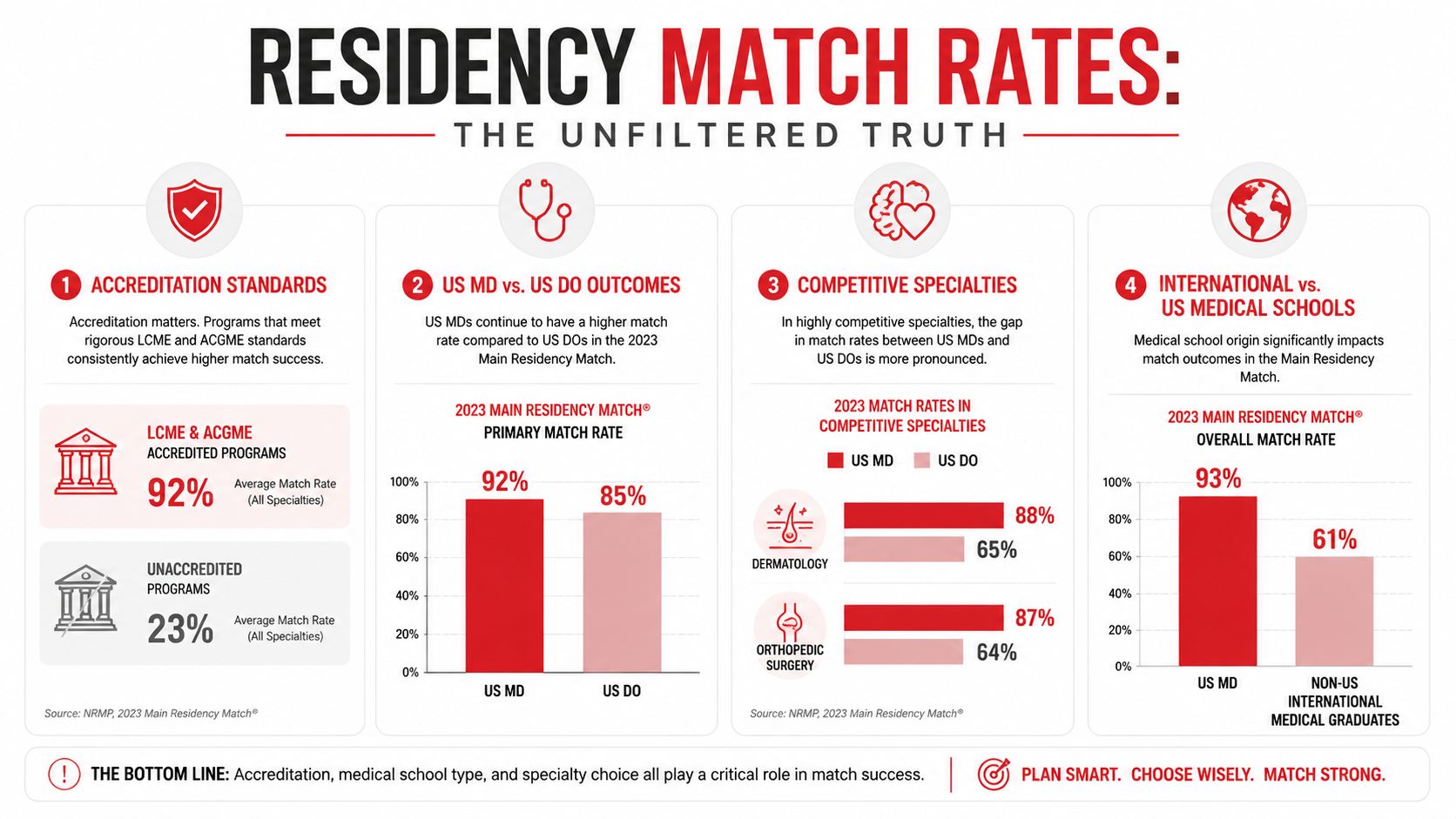
The practical takeaway
You don't need a philosophical view of accreditation. You need a tactical one.
Ask these questions before you apply anywhere:
- Can this school support U.S. residency placement? Look beyond marketing language.
- Will this degree limit where I can train or practice later? Licensing rules can become a problem years after enrollment.
- Am I choosing this route because it fits my strategy, or because I'm frustrated? Those are not the same decision.
For applicants considering schools outside the United States, it's smart to understand ECFMG certification requirements for international graduates before treating that path as a simple fallback.
What works and what doesn't
What works is choosing the strongest accredited pathway you can realistically earn admission to, then building a file that supports residency goals from day one.
What doesn't work is using “I'm older” as a reason to rush into a weaker option. Older applicants often feel pressure to save time. In practice, a rushed entry into a less advantageous path can cost more time, money, and flexibility later.
The right question isn't whether a school will admit you. It's whether that school keeps doors open when it's time to match.
Building Your Application A Realistic Timeline
Most non-traditional applicants don't need more inspiration. They need a calendar that respects reality.
The common failure pattern is trying to compress everything into one frantic year while working full-time. That usually leads to weak grades in prerequisites, shallow clinical experience, a rushed MCAT, and essays written by someone who's exhausted.
A more durable approach uses a longer runway. For many applicants, a three-year preparation window is realistic, and competitive benchmarks often include 150+ hours of clinical volunteering, 150+ hours of non-clinical volunteering, and 40 hours of physician shadowing according to this non-traditional post-bacc planning guide.
Start with the visual overview.
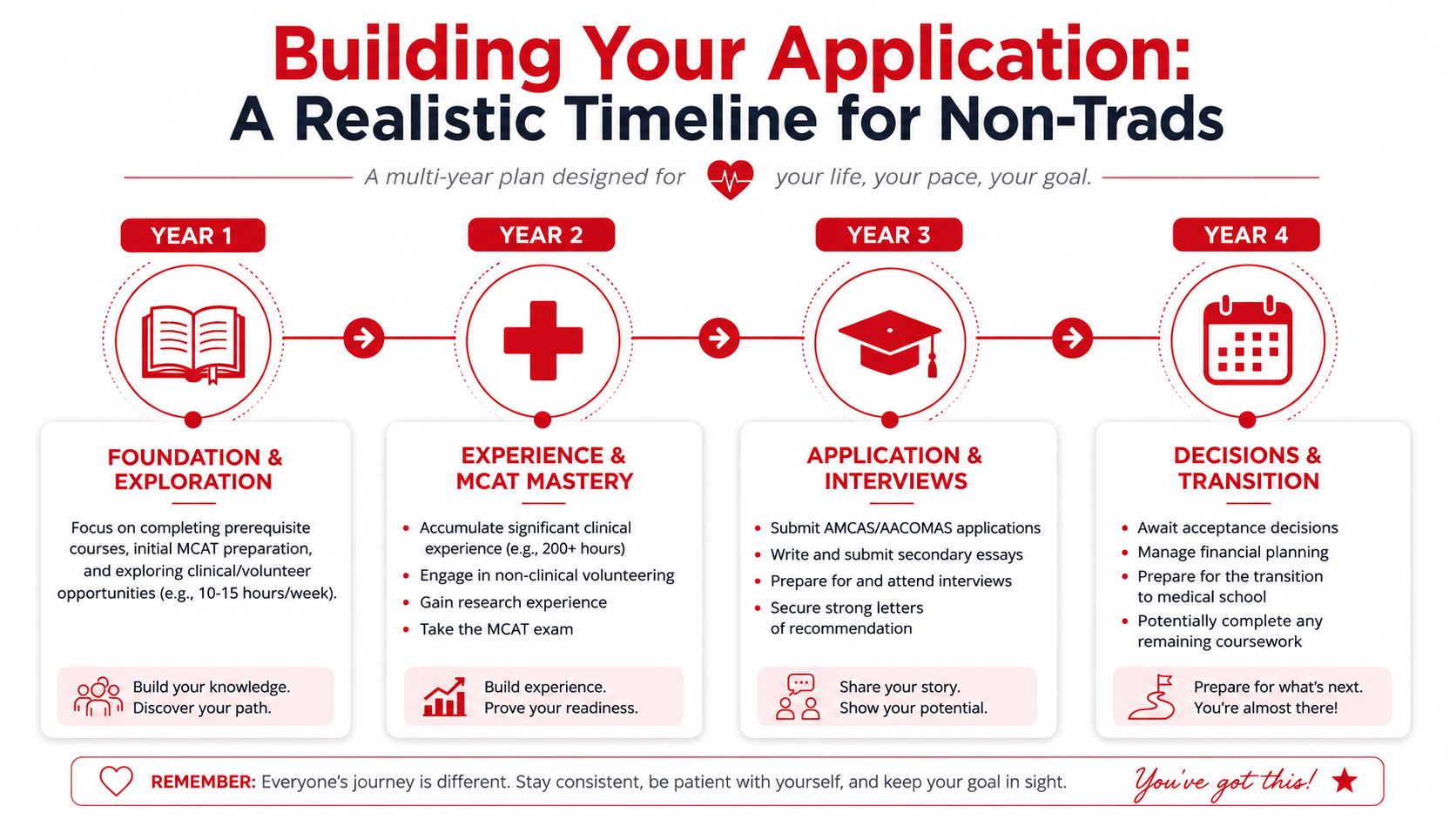
Year 1 foundation and proof of direction
Your first year is about traction, not heroics.
Take the first sequence of science prerequisites in a format you can sustain. If you haven't completed chemistry, understand that sequence planning alone can stretch your timeline. At the same time, begin clinical exposure in a role that puts you close enough to patient care to understand the work, not just admire the idea of it.
Useful roles often include scribing, medical assisting, EMT work, patient transport, hospice volunteering, or clinic volunteering. What matters is consistent contact with patients and healthcare teams.
- Protect grades first: A part-time course load with strong performance beats an overloaded semester with mediocre results.
- Start service early: Non-clinical volunteering is often neglected by career changers who focus only on healthcare experience.
- Track everything: Keep a clean record of dates, hours, supervisors, and responsibilities.
For applicants taking time away from a prior profession, a deliberate gap year before medical school plan can help you decide whether to keep working, reduce hours, or transition gradually.
Year 2 academics and MCAT execution
At this juncture, many applications either become credible or fall apart.
You'll usually be finishing prerequisites, maintaining or expanding clinical work, adding physician shadowing, and preparing seriously for the MCAT. Don't treat the MCAT like a side project. For a non-traditional applicant, it often serves as one of the clearest pieces of current academic evidence.
Here's the embedded overview many applicants find useful before they build a calendar:
A strong Year 2 has rhythm. Coursework is stable. MCAT prep is scheduled, not squeezed in when convenient. Volunteering continues instead of disappearing during exam season.
Year 3 application cycle and interview readiness
By this stage, you should be writing from evidence, not hope.
Your personal statement needs to explain why medicine, why now, and how your prior career sharpened your commitment. Letters of recommendation should come from people who can comment on recent academic ability, professional maturity, and clinical fit.
Admission reality: A compelling reinvention story only works if recent actions back it up. Committees reward consistency, not dramatic intent.
Interview prep matters more for non-traditional applicants than many realize. You'll be asked about age, timing, family logistics, career change, and the practical consequences of entering medicine later. Those questions aren't traps. They're tests of self-awareness.
Navigating the Cost and Financial Aid
In this scenario, generic advice most often fails working adults.
Many articles tell non-traditional applicants to “just complete the prerequisites” without addressing the problem sitting right in front of them. Some people can't leave a salaried job for a full-time post-bacc. Some support children or aging parents. Some already carry undergraduate debt. As noted by Michigan Medicine's discussion of non-traditional applicants, existing content often skips the financial and logistical reality of collecting coursework part-time while working full-time.
The costs that hit before matriculation
Before tuition ever becomes the main issue, applicants usually face:
- Coursework expenses: Prerequisites, labs, books, and fees.
- Application spending: Primary applications, secondary applications, transcript costs, and test-related expenses.
- Time cost: Reduced work hours, less overtime, fewer promotions, or a delayed career move.
- Household strain: Childcare coverage, commute changes, and schedule disruption.
These pressures are why the “best” academic option on paper may be the wrong option in real life. A formal post-bacc may offer structure, but a part-time local route can be the only sustainable choice for someone balancing a job and family.
What tends to work financially
I usually advise applicants to plan financing in layers, not as one big future problem.
- Use a staged budget: Separate pre-application costs from matriculation costs so you can see the runway clearly.
- Choose flexibility when needed: Community-based or extension coursework can make sense when work continuity matters.
- Research aid early: Scholarships, institutional aid, and service-based programs take time to evaluate and pursue.
- Preserve borrowing capacity: Don't burn through savings and credit without understanding the longer training horizon.
If you're building a funding strategy, review realistic options such as medical school scholarship pathways alongside loans and service commitments.
What doesn't work
What fails is pretending the financial problem will sort itself out once you get accepted. It won't. Financial pressure affects grades, MCAT prep, family stability, and whether you can even accept an offer when it arrives.
A sustainable plan isn't less ambitious. It's more professional.
Real Outcomes Are Non-Traditional Students Successful
Yes. The data on completion is stronger than most applicants expect.
Non-traditional medical students in the United States have six-year graduation rates of about 94 to 97 percent, which is comparable to or slightly better than traditional classmates, according to this review of attrition and graduation rates for non-traditional medical students. That same review notes that age is more closely associated with taking an extended path, such as additional time or a leave of absence, than with academic failure.
Why this matters
Many career changers fear the wrong thing. They assume age itself predicts poor performance. It doesn't.
What I see in practice is that non-traditional students often enter with stronger habits around time management, communication, and accountability. They may have tighter schedules and bigger responsibilities, but they also tend to understand why they're there.
The real caution
Success after matriculation doesn't mean the path is easy. It means the admissions bar is doing part of its job. By the time schools admit a well-prepared non-traditional applicant, that person has usually already shown resilience, planning ability, and academic recovery where needed.
Older students don't need pity. They need a plan before admission and support after it.
If you've been telling yourself that you're somehow less likely to make it through once admitted, the available graduation data argues against that fear.
Your Next Steps A Practical Checklist
A non traditional medical school plan gets clearer once you stop trying to solve everything at once. Start with decisions that reduce uncertainty.
Your immediate checklist
- Audit your transcript thoroughly. Identify missing prerequisites, weak science grades, and how much academic repair you truly need.
- Define your constraint first. For some applicants it's GPA. For others it's time, money, childcare, or lack of clinical exposure.
- Choose a primary route. Decide whether you're aiming at direct coursework repair, a post-bacc, an SMP, or a broader MD and DO application strategy.
- Build a weekly schedule. If your plan only works in an ideal week, it won't last. Put classes, volunteering, shadowing, MCAT study, and recovery time on a real calendar.
- Secure clinical exposure early. Don't wait until coursework is done. Start confirming that you genuinely like the day-to-day environment of medicine.
- Line up recommenders before you need them. Recent science faculty and supervisors need time to know your work.
- Discuss the plan at home. If you have a spouse, partner, children, or dependents, this decision affects them directly.
Applicants who succeed usually don't move faster. They move more deliberately.
Frequently Asked Questions
Is there an age that's too old for medical school?
There isn't a universal age cutoff that makes someone automatically too old. The more practical question is whether your application shows academic readiness, informed motivation, and a realistic plan for training.
Are community college prerequisites a bad idea?
Not automatically. For many working adults, community college is the most feasible way to begin or continue science coursework. The concern isn't the label alone. It's whether your overall academic record gives schools confidence that you can handle rigorous science work.
How should I address a low old GPA?
Don't argue with it. Outperform it. Strong recent science coursework, a clear academic trend, and a disciplined MCAT plan carry more weight than excuses.
Do I need to quit my job before applying?
Not usually at the beginning. Many applicants are better served by keeping income and benefits while they complete prerequisites and build experience. The key is whether your current schedule still allows strong grades and consistent clinical involvement.
Is prior healthcare work required?
No. It helps if you have it, but what admissions committees need is evidence that you understand clinical care from direct exposure, not just admiration from a distance.
If you want expert help turning a complicated non-traditional path into a concrete application strategy, Ace Med Boards offers support with MCAT prep, medical school admissions consulting, and long-range planning for applicants balancing work, family, and academic reinvention. A strong application starts with the right route, the right timeline, and honest feedback before you spend another year guessing.