
You're staring at a tuition statement, a lab schedule, and maybe a loan estimate that makes your stomach drop. That's the med-track reality. Scholarship hunting doesn't feel like a side task, it feels like one more exam, except the stakes are your next four years and maybe your residency options too.
The mistake most students make is treating every scholarship opportunity like a lottery ticket. That mindset burns time fast. The winning approach is blunt, boring, and effective, build a pipeline, screen fit hard, and apply to the awards you can win.
Why Medical Scholarships Are a Different Game
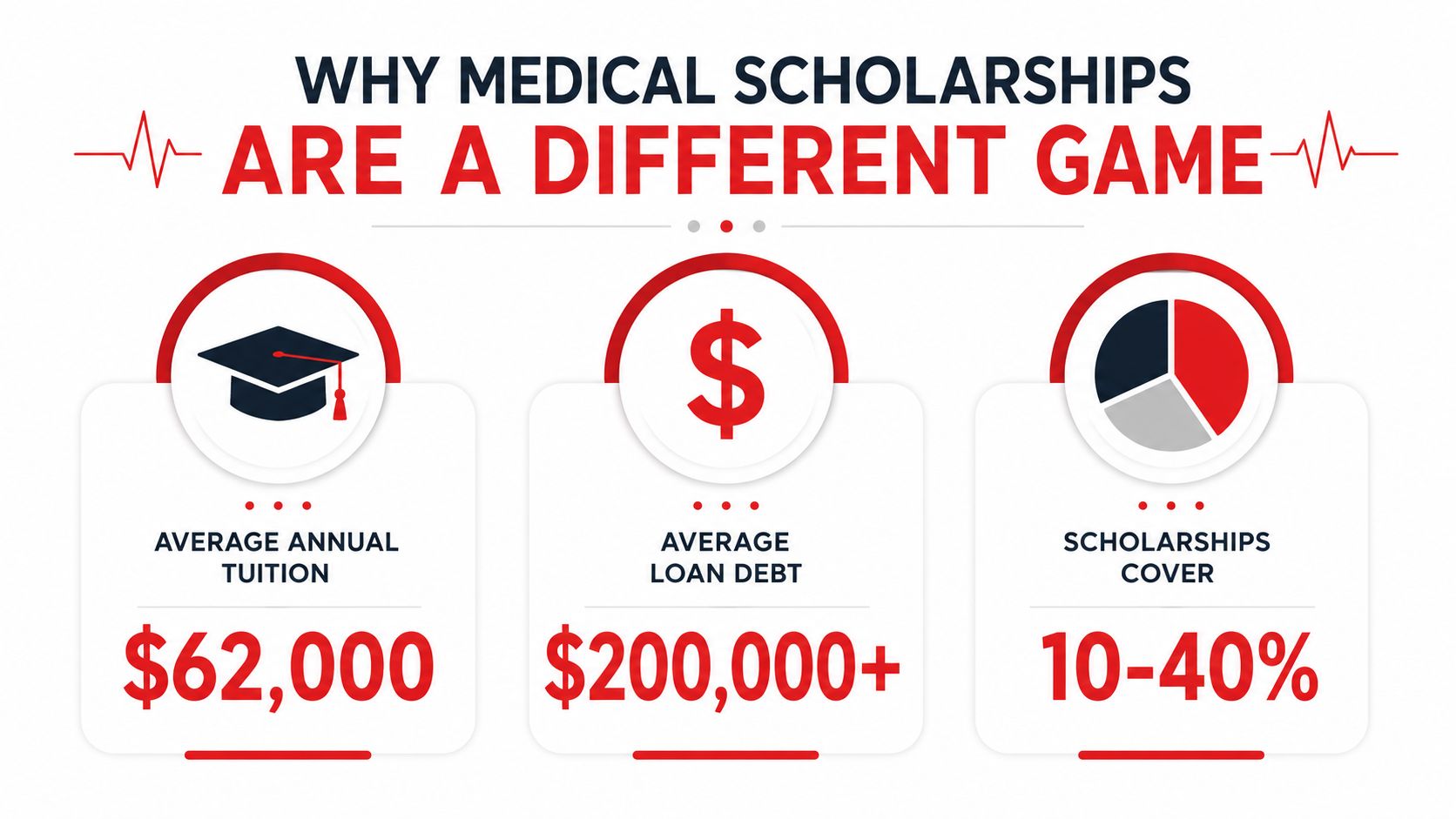
A pre-med senior and a first-year medical student are not playing the same game as a generic undergrad applicant. Med-track timelines are longer, documentation is heavier, and the best awards often sit inside schools, departments, or specialty groups rather than in broad public searches. That matters because scholarship opportunity in medicine usually comes from stacking several realistic awards, not landing one mythical full ride.
Scholarships are available at scale, but the odds are still tight. Recent summaries estimate that only about 7% to 12.5% of college students receive a scholarship in a given year, while more than 1.7 million scholarships are awarded annually in the U.S. alone, and most awards are modest rather than full funding (scholarship statistics roundup). Another roundup places U.S. Department of Education scholarship and grant support at about $46 billion per year and private scholarship funds at $8.2 billion (scholarship funding overview). The point is simple, aid exists, but it's spread across a massive applicant pool.
Why the med-school timeline changes everything
Medical training adds pressure that most scholarship essays never account for. One cycle might overlap with MCAT prep, another with clinical rotations, and another with residency applications. If you chase only headline-name awards, you'll lose to timing long before you lose to merit.
Practical rule: treat scholarships like a portfolio. A few mid-size wins beat months spent on one prestige application that doesn't match your profile.
That's why med students need to think in terms of layered funding, institutional aid, professional society awards, and targeted programs for specific backgrounds or career paths. If you're first-generation, the practical starting point is to understand how those programs are often framed and documented, not just where they're listed. A useful starting reference is this guide for first-generation medical students, because the documentation and positioning angle is usually what trips people up.
If you're trying to get attention for a scholarship itself, not just apply for one, you also need a clear public-facing story. That's where a resource like craft a winning scholarship release can help operators and student groups think about visibility in a disciplined way.
Building a Scholarship Search Pipeline
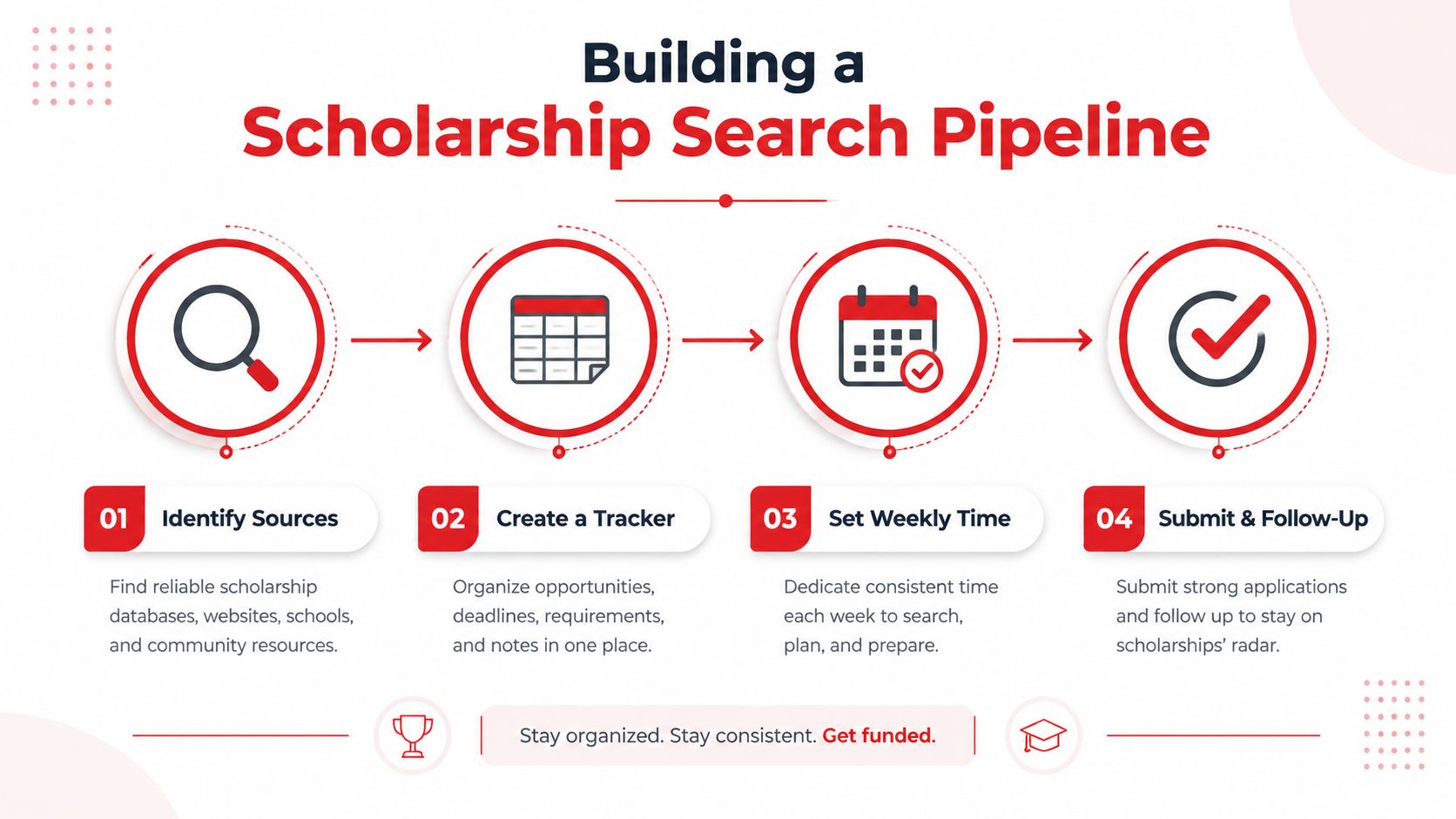
Scholarship hunting gets easier when it stops being emotional. You don't need to “find time” for it every once in a while, you need a system that runs every week whether you feel motivated or not. The strongest applicants I've seen keep one tracker, review it on a schedule, and reject anything that doesn't fit before they start writing.
Start with one sheet, not ten browser tabs
Your tracker should hold only what you'll use, the award name, deadline, eligibility, required documents, renewal terms, and a quick fit score. Add a note for whether the award comes from your school, a professional organization, a local foundation, or a specialty society. That gives you a clean view of where your energy is going.
A med student's best sources are usually institutional financial aid pages, specialty society sites, department pages, and community foundation listings. The point of the tracker is not volume for its own sake. The point is to make smart applications repeatable.
Use weekly maintenance, not annual panic
Set one short weekly block to refresh deadlines and drop stale awards. I'd rather see a student submit fewer applications that are current and targeted than spray old deadlines across a spreadsheet and feel productive. That's how people waste entire weekends and still miss the best opportunities.
One admissions-focused guide recommends 15–20 applications per year instead of relying on a handful of dream awards, and it notes that elite programs can sit around 1–3% acceptance while university-specific merit awards are often in the 15–40% range (scholarship odds and strategy guide). That spread tells you everything you need to know. Fit and volume win.
Keep the list boring. If an award doesn't match your background, your timeline, or your documentation, remove it fast.
The working rhythm is straightforward, identify, track, review, submit, and follow up. Do that consistently, and scholarship opportunity stops being a scramble and starts becoming a funding pipeline.
Here's the simplest way to operationalize it, start with one source list, then add only awards that survive an eligibility screen. If you want a stronger content-style model for how to organize research and source gathering, the same discipline applies to research for medical students.
Screening Eligibility Before You Write a Single Word
The fastest way to waste scholarship time is to write a beautiful essay for an award you never qualified for. That mistake is common because students read for inspiration, not for disqualification. In med-track funding, the disqualifiers matter more than the theme.
Read for proof requirements first
Before you draft anything, check the hard gates. That means citizenship or visa status, level of enrollment, GPA requirements if listed, and any documentation tied to need or identity. If a program asks for Pell-related proof, foster-care verification, homelessness certification, or acceptance at a Pell-eligible institution, flag that immediately and decide whether you can produce it.
Too many applicants go wrong. They spend three hours perfecting a narrative, then learn the award was meant for a narrow pool with specific paperwork attached. That's not a writing failure, it's a screening failure.
Run a five-minute triage
Use a simple filter on every listing, can you prove eligibility, can you meet the deadline, and is the application realistic for your current stage? For pre-med applicants, that may mean checking MCAT or GPA thresholds. For medical students, it may mean confirming MS1 through MS4 status, specialty-track enrollment, or residency timing.
Then cut aggressively. If you can't answer those three questions quickly, move on.
The better your shortlist, the less likely you are to burn out. A clean list of 8 to 10 realistic targets is more useful than a bloated file full of dead ends, and it keeps your effort concentrated where you have a shot. That's especially important for underrepresented and nontraditional applicants, because many programs in that space are highly specific about who they serve and what proof they want (inclusive scholarship outreach guidance).
Don't write first and verify later. If the eligibility box is fuzzy, the award is probably not worth the time.
For a med-school applicant, this discipline pairs well with broader admissions screening habits. If you've ever needed a clean, no-nonsense checklist for school-stage requirements, the same mindset appears in medical school admissions requirements.
Mapping Awards to Your Med School Timeline
Scholarship timing in medicine is not random. It follows the academic calendar, and if you ignore that, you'll end up applying when you should be studying, rotating, or interviewing. The smartest strategy is to match the award cycle to the part of training where you have time to submit a good application.
Match the deadline to the load on your schedule
Early pre-med years are the best time to build materials and relationships. Later, in medical school, the time window narrows fast. MS1 and MS2 students often have more room to apply carefully, while MS3 and MS4 students need a tighter target list because clinical hours and residency prep eat into everything.
School-specific awards often open and close on their own cadence, while specialty society or private foundation awards may land at different points in the year. That means your tracker should never be static. A strong application in the wrong month still loses if it gets buried under anatomy, shelves, or interview travel.
Stack awards around lower-intensity blocks
I'd rather see a student submit during a quieter stretch than force an application into a dedicated study period. That's especially true for med students who are already carrying clinical fatigue. Choose fewer targets when your schedule is brutal, then widen the net when the calendar opens up.
A practical rule is to trim the list as your training gets busier. A pre-med junior can pursue several opportunities across the year, while an MS2 facing Step prep should narrow aggressively and focus on the best-fit awards. The reason is obvious, scholarship opportunity is only useful if you can complete it well.
The cleanest move is to build around the year you're living, not the one you wish you had. If your schedule is getting crowded, your scholarship strategy should get sharper, not broader.
Choosing Targets by Fit, Not by Name Recognition
Prestige is a trap. A famous scholarship feels productive because it sounds impressive, but the math usually says otherwise. One high-profile application can eat the same time as several well-matched awards, and in scholarship work, time is your limiting resource.
Merit, need, and identity are different lanes
Some awards reward academic metrics and research output. Others are built for need, background, service commitment, or specific identity markers like first-generation status, foster-care history, rural ties, or underrepresented in medicine pathways. Those categories are not interchangeable.
If you match a program's documentation, your odds improve because you stop competing in the wrong room. If you don't match, no amount of polished prose fixes it. That's why the old advice to “apply everywhere” is lazy. Apply where your profile fits.
Use a simple decision rule
Before you invest in any award, ask three questions, does this match my documentation, does it match my timeline, and is the probability of a win decent enough to justify the effort? If the answer to any of those is no, move on. You're not being picky, you're being efficient.
The strongest med-track applicants do not chase only the biggest names. They build a mix of institutional, departmental, and targeted awards, then keep pushing volume where the fit is real. The scholarship ecosystem is broad, but the award categories are still segmented, and students who understand that segmentation usually make better use of their time.
A scholarship that fits your file is worth more than a famous award that barely fits your life.
That's the mindset shift. Once you stop treating all opportunities as equal, you stop wasting energy on applications built to flatter your ego instead of fund your education.
Writing the Personal Statement That Actually Wins
Most scholarship essays sound like they were written to impress a committee that's already tired. They're vague, polished, and forgettable. Reviewers read dozens of them, so the application that wins is usually the one that feels specific, grounded, and human.
Open with one concrete moment
A strong statement starts with a real scene, a patient interaction, a lab setback, a shadowing moment, or a course experience that changed how you think. Not a broad claim about wanting to help people. Not a recycled story about “always wanting to be a doctor.” Start with something they can see.
Then move quickly to growth. Show what you learned, what you changed, and how that experience shaped the way you approach medicine. The middle of the essay should prove your trajectory, not just describe your intentions.
Tie the ending to the award mission
The closing has to answer one question, why this scholarship, and why you? If the program supports service, say how your work lines up with service. If it supports research, connect your path to research. If it supports first-generation or community-focused students, make that connection direct and honest.
A representative pre-med applicant might open with a single shadowing moment that changed how they think about access to care, then use the middle to show concrete academic or volunteer growth, and close by tying that trajectory to the award's mission. A stronger MS3 version would be more grounded in clinical work, with a more mature reflection on patient communication or team dynamics. The structure is the same, the evidence changes with the stage.
If you need a clean structure before you write, use the same discipline you'd use for any competitive narrative. A good starting point is this personal statement outline, because structure matters more than dramatic language.
Your essay should sound like a person who has done the work. It should not sound like a brochure.
Recommendations, Submission, and Smart Follow-Up
Letters can save a good application, and weak ones can sink a strong one. Recommenders are busy, so the student who makes their job easier gets a better letter. That's not cynical, it's realistic.
Give recommenders a one-page brief
Send each writer a short sheet with the award name, deadline, your current goals, and two or three specific moments they can mention. Research PIs should get the version that fits your lab work. Clinical attendings should get the version that reflects patient-facing strengths. Pre-health committee writers should get the version that frames your overall readiness.
Then make the deadline impossible to miss. Don't assume people remember your request just because they liked you in clinic or in lab.
Check the small errors before you submit
On submission day, look for the silent killers, missing signatures, incorrect file names, wrong file type, timed-out portal uploads, and missing demographic forms. Those errors don't make you less qualified, they make you look careless. Scholarship committees use those forms, and a missing piece can move your application out of the running.
After submission, confirm that every required item uploaded. If the portal shows a blank field, fix it fast. If you're waiting on a letter, follow up early enough to be useful, not annoying.
For recommendation requests, a disciplined ask is better than a vague favor. Use the same structure every time and make it easy for the writer to say yes. A practical guide to that process is how to ask for a letter of recommendation.
After the decision, send a thank-you note whether you win or not. If you're waitlisted or denied, keep the file, tighten the weak spots, and reapply next cycle if the award allows it. The student who treats each cycle as practice usually becomes the one who starts winning across multiple years.
A CTA for Ace Med Boards.