You're staring at a crowded prep folder, unsure whether to open an AAMC full-length, a Blueprint exam, a Kaplan set, or another question bank. The answer is direct: the best practice MCAT test is the one used for a defined purpose, under realistic conditions, followed by rigorous error review. More exams alone won't fix a plateau.
The AAMC's official practice materials should anchor your plan because they mirror the exam's structure, interface, timing, scaled scoring, and percentile reporting. Third-party resources can add useful volume, but their main value is diagnosis and skill practice. This guide gives you a system for moving from a baseline by section to an error taxonomy, targeted drills, timed sets, and full-length verification.
Why Your Practice Test Strategy Matters More Than Volume
A practice test can either expose the next problem you need to solve or become four hours of passive score collection. Students often choose the second option because taking another exam feels productive. It's easier to click “start” than to examine why a familiar passage type keeps producing the same mistake.
Volume without review creates noise. A student can complete several full-lengths and still miss the same reasoning pattern if every review consists of reading explanations once and moving on. The score changes only when the student identifies the cause, practices the correction, and checks whether the correction transfers to new material.
Give every full-length a job
Use each exam for one of four purposes:
- Baseline: Establish current section-level performance and identify the dominant error types.
- Diagnosis: Test a hypothesis, such as whether timing or content knowledge is causing a weak section.
- Skill development: Use targeted passages and timed sets to correct a recurring weakness.
- Verification: Confirm that the correction holds under full-length, test-day conditions.
The AAMC recommends using its unscored sample test to establish a baseline, then taking Practice Exam One with test-day timing to become familiar with the exam's functionality and time limits. The AAMC official practice materials include two free practice exams and four low-cost full-length practice exams, while the free Practice Exam One is a 230-question test built from previously administered MCAT questions and designed to provide the same look, feel, functionality, scaled score, and percentile rank as the actual exam.
Practical rule: Spend enough time reviewing a full-length to explain every missed and uncertain question. If you can't state the error and the corrective action, the exam hasn't finished teaching you.
Build a system, not a streak
A strong practice schedule moves through baseline by section, error taxonomy, targeted drill, timed set, and full-length verification. That sequence matters because a full-length tells you what happened, but it doesn't automatically tell you what to do next.
Use the MCAT preparation tips to support the broader study routine, but keep your practice exams tied to specific questions. The point isn't to collect an impressive number of completed tests. It's to make each test reduce uncertainty about your content, reasoning, pacing, or endurance.
Choosing the Right Practice MCAT Tests
A student can finish several full-length exams and still lack a clear next step. The problem is usually resource selection, not effort. Each practice MCAT test serves a different purpose, and official and commercial exams vary in passage style, scoring, explanations, and difficulty calibration.
Use AAMC exams as your calibration set. The official exam includes four scored sections: Chemical and Physical Foundations of Biological Systems, Critical Analysis and Reasoning Skills, Biological and Biochemical Foundations of Living Systems, and Psychological, Social, and Biological Foundations of Behavior. Each section is scored from 118 to 132, with 125 as the midpoint, and the total score ranges from 472 to 528. The AAMC score scale also confirms that guessing carries no penalty. Answer every question, even when certainty is low.
Compare resources by role
| Resource | Content Alignment | Difficulty Calibration | Score Predictiveness | Best Use Phase | Cost Range |
|---|---|---|---|---|---|
| AAMC full-length exams | Highest alignment with the official blueprint, terminology, format, and interface | Most representative official calibration | Strongest available practice benchmark | Baseline and final verification | Free and low-cost official options |
| NBME retired forms | Useful AAMC-authored question exposure where available | Not a complete full-length simulation | Limited as a standalone readiness estimate | Supplementary practice | Varies by current availability |
| Blueprint exams | Broad MCAT coverage with commercial interpretation | May differ from official passage style or difficulty | Use for trend and error diagnosis, not as a definitive forecast | Content-building and stamina work | Varies by current product |
| Kaplan exams | Broad coverage and structured commercial explanations | Can feel stylistically different from AAMC material | Useful for practice volume and diagnosis | Earlier and middle preparation | Varies by current product |
| UWorld passages and assessments | Strong practice volume, but not a replacement for official full-lengths | Passage and question style may differ from the MCAT | Best interpreted through error patterns rather than isolated scores | Targeted drilling and content review | Varies by current product |
AAMC full-lengths use previously administered MCAT questions and reproduce the exam's look, feel, functionality, scaled-score output, and percentile reporting. That makes them the strongest tools for final calibration. Check the AAMC preparation hub before scheduling your exams, since available official materials can change.
For a broader comparison of commercial options, review these MCAT practice test recommendations. Choose based on your current task, not on the size of a company's question bank.
Sequence your resources deliberately
Start with the unscored sample if you need a baseline early in preparation. Then take an official scored exam under strict conditions. During content-building, use third-party exams, UWorld passages, flashcards, and targeted question sets to increase volume and expose weak areas. Save enough official material for later verification instead of using every AAMC resource immediately.
After each exam, classify every missed or uncertain question. Label the cause as content knowledge, passage interpretation, reasoning, careless execution, pacing, or endurance. Then connect the label to one corrective action, such as reviewing a concept, drilling a passage type, changing your timing rule, or redoing the item without notes. A score is a checkpoint. The error taxonomy determines your next study block.
Be cautious with CARS comparisons. Commercial CARS sections may use different passage structures, author-stance cues, or answer-choice patterns. Use them to practice reading and reasoning, but give official AAMC CARS performance greater weight when judging readiness.
How to Simulate Real Test-Day Conditions
A practice MCAT should expose the same pacing and endurance problems you will face on test day. The live exam has 230 multiple-choice questions with 6 hours and 15 minutes of testing time, while the full seated experience lasts about 7.5 hours with breaks and administrative procedures, according to the AAMC exam overview.
Reproduce the timing
Follow the official section schedule:
- Chemical and Physical Foundations: 59 questions in 95 minutes.
- Critical Analysis and Reasoning Skills: 53 questions in 90 minutes.
- Biological and Biochemical Foundations: 59 questions in 95 minutes.
- Psychological, Social, and Biological Foundations: 59 questions in 95 minutes.
Include the 4-minute certification period, 30-minute optional mid-exam break, 10-minute optional later break, 3-minute void-question period, and 5-minute optional end-of-day survey in your rehearsal. Use this exam timing guide for students to organize the sequence, while treating the AAMC schedule as the controlling reference for MCAT practice.
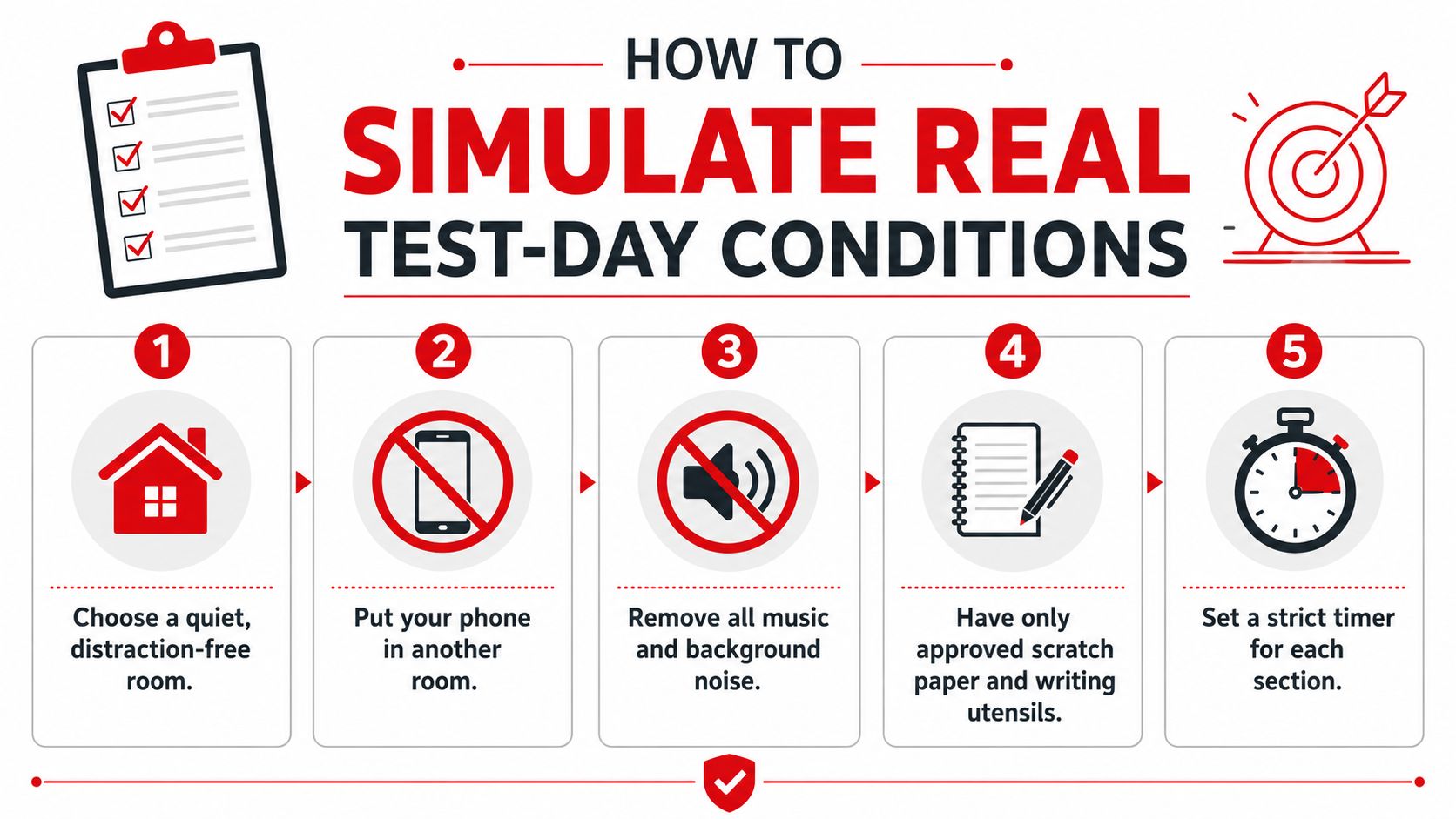
Start when you expect to begin on test day. Complete every section in one sitting, without pausing, extending the clock, splitting the exam across days, or using a phone calculator. Keep your phone outside the room. Remove music and background noise, and use only the scratch paper and writing tools allowed by the testing process.
Rehearse your physical routine
Prepare the breakfast, snacks, water, clothing layers, and break routine you plan to use. Eat and drink only during breaks. Repeating these choices helps separate actual reasoning or pacing errors from distractions caused by hunger, discomfort, or poor preparation.
Complete a brief warm-up with familiar material before starting. Keep it light. The goal is to activate focus, not spend energy before the first section. Use the MCAT test time breakdown to turn the timing rules into a practical rehearsal checklist.
Keep the environment boring: a quiet room, a strict timer, no notifications, and no informal pauses. Record every moment you feel rushed, lose focus, or change your normal process. Those observations belong in your error log because they show whether endurance, pacing, or test-day logistics caused the performance drop.
Building a Section-Level Error Log and Score Audit
Raw accuracy is a starting point, not a diagnosis. Two students can miss the same number of questions for completely different reasons, and they need different interventions. One may lack a content fact, while the other knows the material but misreads the experiment or spends too long on the passage.
Track every missed question and every question you guessed correctly. Near-misses matter because a correct answer reached through weak reasoning may not transfer to a new passage.
Use a consistent taxonomy
Label each error with one primary cause:
- Content gap: You didn't know or couldn't retrieve the relevant concept.
- Misread stem or passage: You overlooked a qualifier, variable, relationship, or question task.
- Flawed elimination: You recognized the topic but accepted an answer that contradicted the passage or data.
- Reasoning or application error: You knew the concept but failed to connect evidence to the requested conclusion.
- Timing pressure: You rushed, guessed, or altered your normal process because time was short.
- Near miss: You chose correctly but couldn't explain why the alternatives failed.
Also tag the relevant AAMC content category and cognitive skill. For CARS, record the passage function and question type in your own terms. For science sections, note whether the problem centered on a figure, experimental design, equation, biochemical relationship, or foundational recall.
Keep the log actionable
| Column Name | Example Entry | Purpose |
|---|---|---|
| Question ID | Exam and question number | Locate the item quickly |
| Section | CARS | Compare recurring patterns by section |
| Passage topic | Experimental intervention | Identify passage families that create difficulty |
| Error taxonomy | Misread variable relationship | Name the root cause |
| AAMC content category | Relevant official category | Connect review to the blueprint |
| Cognitive skill | Scientific reasoning | Separate knowledge from application |
| Confidence | Guessed, uncertain, confident | Capture near-misses and false confidence |
| Corrective action | Predict the finding before viewing options | Specify the next drill |
| Transfer check | New passage completed without prompting | Verify that the correction generalizes |
Run a weekly audit using the progress-tracking dashboard or a spreadsheet you control. Look for repeated causes, not isolated topics. A cluster of Bio/Biochem misses may reflect a content gap, but it may also reveal that you're reading figures after the answer choices instead of identifying variables and controls first.
Track trends without inventing certainty
Create a score-trend chart with one row per assessment and separate columns for Chem/Phys, CARS, Bio/Biochem, Psych/Soc, and total score. Add notes about sleep, timing, breaks, and unusual conditions. The AAMC score report uses scaled section scores and percentile information, so compare like with like rather than treating raw percent correct as a direct prediction of your final result.
Turning Results Into a Targeted Study Plan
An error log becomes useful when it changes your calendar. Don't divide study time evenly across every subject because the MCAT has four sections. Prioritize the errors that are frequent, transferable, and correctable.
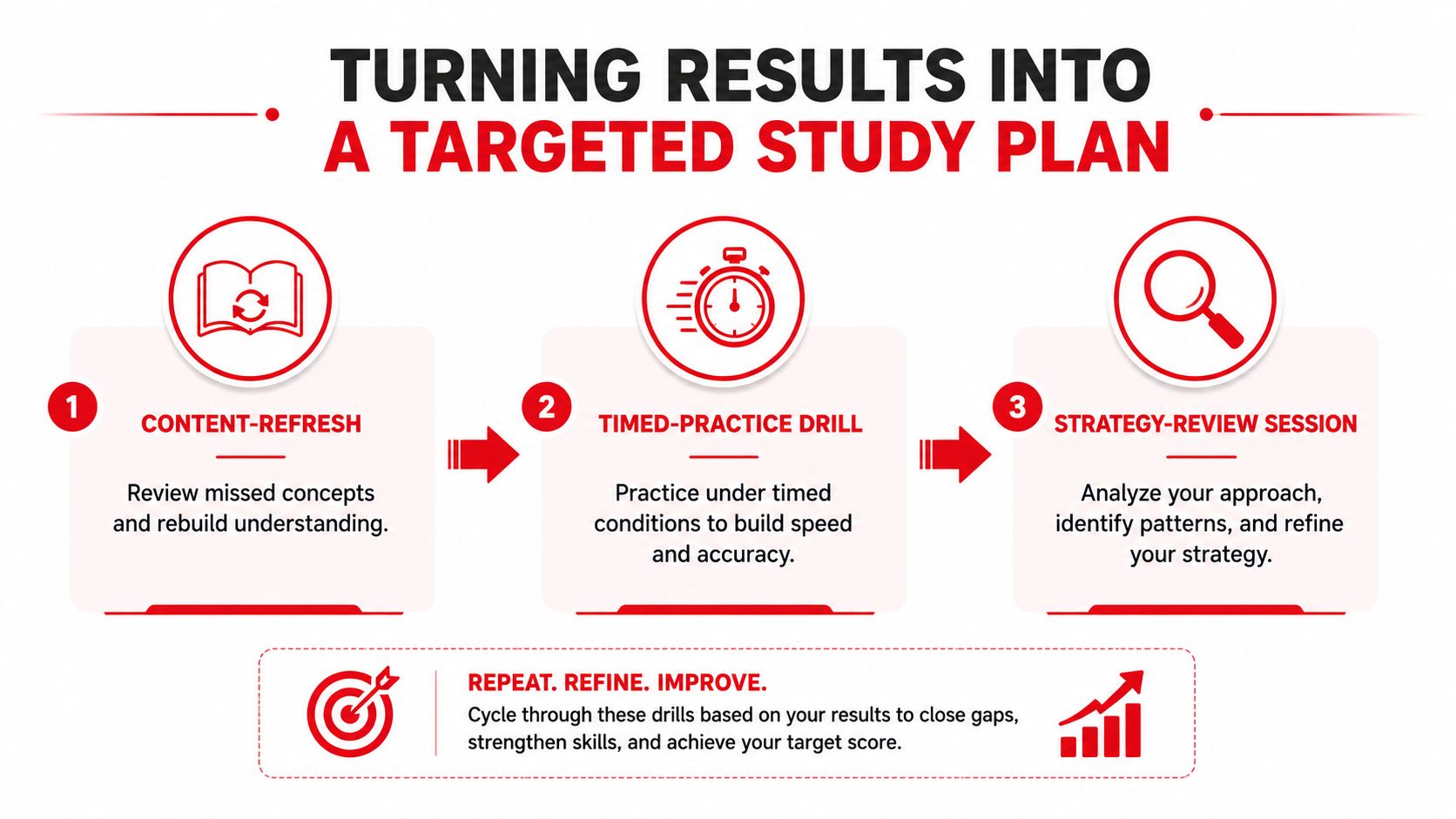
Use a repeating micro-cycle:
- Content refresh: Relearn the missing concept from an authoritative resource, then retrieve it without looking.
- Timed practice: Apply the concept in mixed passages under a defined time limit.
- Strategy review: Explain why the right answer works and why the alternatives fail.
- Verification: Revisit the error type in a later timed set or full-length.
A reusable two-week framework
| Study Day | Primary Task | Error-Log Connection | Evidence of Progress |
|---|---|---|---|
| Day 1 | Audit the latest full-length | Select the top three recurring causes | Prioritized correction list |
| Day 2 | Content refresh and retrieval | Address documented content gaps | Closed-book explanation |
| Day 3 | Timed mixed passages | Practice application, reading, or pacing | Fewer process errors |
| Day 4 | Review and transfer set | Test whether the strategy works on new material | Clear explanation of alternatives |
| Day 5 | Spaced recall and targeted passages | Reinforce weak concepts | More accurate retrieval |
| Day 6 | Timed section or mixed block | Measure section-level execution | Stable pacing and reasoning |
| Day 7 | Recovery and light review | Prevent fatigue from distorting performance | Preparedness for the next cycle |
| Second week | Repeat with the next priority | Compare the same error categories | Trend supported by new evidence |
A strong teaching choice is to make the learner predict the next finding before viewing the answer choices. This helps expose superficial label memorization. The learner must connect the intervention, mechanism, and expected result instead of choosing an answer because a familiar term appears.
Hypothetical example: A student sees a passage involving an experimental change and selects an answer because it repeats a memorized pathway label. During review, the student identifies the decisive variable, predicts the direction of the next finding, and explains why two plausible alternatives fail. A contrast case then changes one decisive variable, requiring the student to solve a nonidentical passage without prompting. That reasoning change matters more than a single score movement.
Use Anki for spaced retrieval, UWorld or another commercial bank for targeted passage volume, and AAMC question packs or official materials for calibration. Keep those roles separate. A full-length verification should answer whether the correction survives fatigue, timing, and section switching.
When to Seek One-on-One Tutoring or Diagnostic Review
A plateau becomes actionable when you can name the error pattern but cannot correct it on your own. Self-study still fits when your log identifies the cause and your next study block follows directly from it. Seek outside review when repeated evidence does not produce a clear intervention.
Watch for these signals:
- Stable plateau: Recent full-length results stay within a narrow band across multiple assessments.
- Recurring section weakness: The same section or question family continues to cost points after content review.
- Execution gap: Your explanations sound accurate afterward, but timing, passage reading, or decision-making breaks down during the test.
- Unclear priorities: Your resource library is large, yet you cannot identify the weakness that deserves the next study block.
Use the AAMC score report guidance to examine section performance and question-level understanding instead of treating one total score as a diagnosis. AAMC full-length results generally provide a tighter prediction range than third-party practice, which can vary more from the official exam. Treat score ranges as interpretation guidance, not promises, and give repeated official results more weight than an isolated commercial score. The AAMC MCAT scores page provides official score-reporting context.
Choose the least expensive effective intervention
Start with a one-time diagnostic review if another person can identify the pattern in your log and redesign your next study cycle. Choose ongoing tutoring when you need recurring accountability, live correction of reasoning, or structured changes after each assessment.
Ask a tutor or service to explain:
- How it separates content gaps from reasoning, timing, and comprehension errors.
- How it uses official AAMC materials without reproducing protected questions.
- How it adjusts strategy by section and by your error pattern.
- What each session produces, such as an error audit, drill plan, or readiness checkpoint.
- Which statements are documented and which are recommendations.
Cost should not force you into an oversized package. Use free AAMC preparation materials, available educational resources, peer review, office hours, and structured self-audits before buying ongoing support. If you seek one-on-one help, select the narrowest service that addresses the documented problem. The benefits of one-on-one tutoring are most relevant when your process needs individualized review. Tutoring should support official practice and independent work, not replace either one.
A short educational video can help you distinguish a knowledge problem from a timing or test-execution problem:
Key Takeaways
- Use official AAMC full-lengths for calibration, and commercial resources for additional practice and diagnosis.
- Review every missed and uncertain question by cause, not just by subject.
- Track section scores, error categories, timing, confidence, and transfer performance in one living log.
- Move from baseline to targeted drills, timed sets, and full-length verification instead of taking exams without a plan.
- Seek diagnostic help when the pattern is persistent but the correction isn't clear, and choose support that matches the specific problem.
Sources
- AAMC Official Prep Practice Exam information
- AAMC MCAT exam structure and schedule
- AAMC MCAT score scale
- AAMC free planning and study resources
- AAMC understanding your MCAT score report
- Approximate practice-test score interpretation guidance
If your practice MCAT data show a plateau or recurring section-level errors, Ace Med Boards offers individualized MCAT preparation and diagnostic review focused on turning those patterns into a practical study plan. Visit the site to learn more and decide whether a free consultation fits your next step.