You're staring at the AAMC portal, trying to choose a test date before someone else takes the seat you need. The safest approach to AAMC MCAT registration is to treat it as a sequence of decisions, not a single payment screen: confirm your account and eligibility, choose a date and center, review the fee deadlines, then verify your identification and accommodations plans.
This guide is date-stamped to August 27, 2026. AAMC policies, availability, fees, score-release dates, and deadlines can change, so verify your final choices on the official AAMC pages before paying. The process applies to premedical applicants preparing for the Medical College Admission Test, or MCAT, including international examinees and students who may need special permission.
What AAMC MCAT Registration Actually Involves
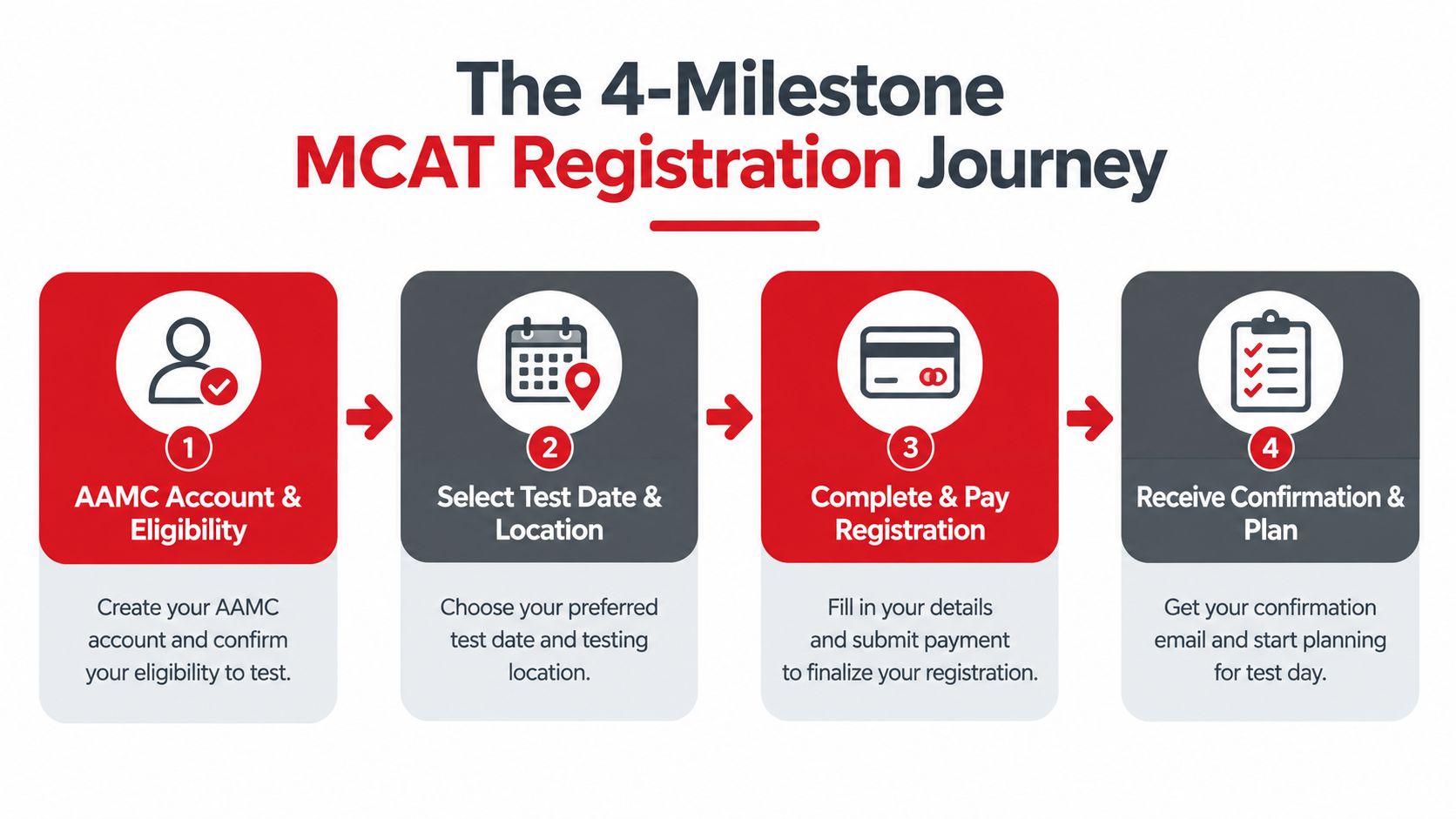
A student may open the AAMC portal expecting one quick choice and a payment screen. Registration works more like a checklist with four checkpoints. Each checkpoint answers a different question: Can you register, where and when will you test, what will you pay, and how will you protect the appointment?
The four registration milestones
Before selecting a seat, confirm your AAMC account and eligibility. Use an email address you can access throughout the application process, enter your legal name accurately, and check whether your educational background requires special permission.
In the scheduling dashboard, choose a test date and center. Available appointments depend on the testing calendar, location, and seats released for that registration group. For the 2026 testing year, registration opened October 21 through October 23, 2025, with a staggered rollout by testing-center location, according to the AAMC MCAT registration page. Treat that opening information as one checkpoint, then verify the current appointment details before submitting payment.
Review the fee category and deadline before paying. Standard registration is $355. Fee Assistance Program registration is $145, and testing outside the United States, Canada, or U.S. territories adds a $130 international fee. The applicable deadline determines which changes remain available after you book, so record it beside your appointment rather than relying on memory.
After payment, protect the appointment. Save the confirmation, inspect the listed test location, and check that your government-issued identification matches your registration profile. If you need accommodations, confirm that the request is progressing through the appropriate AAMC process.
Registration manages the appointment, payment, identity requirements, and score reporting. It does not verify every medical-school prerequisite or manage the American Medical College Application Service, or AMCAS, application. Those remain separate admissions tasks. For context, review what the MCAT exam covers.
International examinees generally do not face extra general eligibility requirements, but some students enrolled in medical programs that are not equivalent to an MBBS program may need special permission by email. Resolve that question before treating an available seat as one you can use.
Creating Your AAMC Account and Confirming Eligibility
A student can lose time before choosing a test date by entering a nickname, using a school email that will expire, or assuming every medical-program student follows the same registration path. Set up the account as if it were a passport record: the details must remain accurate and accessible throughout the application process.
Account setup in a safe order
Create or access your AAMC account. Use the official AAMC website, not a link in an unverified email. Choose a personal address you will monitor through testing and applications, then store the password in a secure password manager. The account may provide access to the MCAT, AMCAS, and the Fee Assistance Program. The MCAT appointment record is created separately when you enter the registration system and begin scheduling.
Enter your legal name exactly as shown on your government-issued identification. Do not shorten a first name, add a nickname, or casually change a middle name. Check hyphens, spaces, accents, and suffixes before saving the profile, because differences can create check-in problems.
Add reliable contact information. Registration notices, appointment confirmations, and policy messages must reach an inbox you check consistently. Review the phone number and email address for typing errors.
Review the profile before opening registration. Correcting a name or email problem after payment may require contacting AAMC, so treat this review like checking a boarding pass before leaving home.
Eligibility depends on the student's educational path. Undergraduates and graduates of accredited institutions generally use the standard route. Students enrolled in foreign medical programs that are not equivalent to an MBBS program, or students attending unaccredited schools, should confirm their status before selecting a seat. The MCAT FAQs describe a special-permission email process for certain enrolled medical students.
International and Canadian applicants should also check whether their intended pathway involves a participating United States medical school. Testing outside the United States, Canada, or U.S. territories does not by itself answer that question. Confirm the route before treating an available appointment as one you can use.
Use this checklist before continuing:
- Legal name: Does every character match your identification?
- Education: Are you an undergraduate, graduate, or enrolled in a nonstandard medical program?
- Testing country: Will you test in the United States, Canada, a U.S. territory, or another country?
- Permission: Do you need written authorization before using a nonstandard route?
Keep registration eligibility separate from coursework planning. The overview of medical-school prerequisites can help you examine those requirements independently, while your AAMC profile handles account and appointment details.
MCAT Fees and Reschedule Deadlines at a Glance
You find an open MCAT seat, pay the registration fee, and then realize your preparation schedule needs another month. The cost of that appointment depends not only on the initial payment, but also on when you change or cancel it. AAMC organizes scheduling changes around deadlines, so the available flexibility decreases as test day approaches.
The confirmed planning thresholds are 60 days, 30 days, and 10 days before the exam. Exact rescheduling charges can depend on the change you request and the appointment shown in your account. Check AAMC's scheduling-fees page for the current amount before you submit a change.
MCAT Fee and Reschedule Tier Reference
| Fee Tier | Approximate Deadline | Cost (USD) | Reschedule or No-Show Consequence |
|---|---|---|---|
| Standard registration | At payment | $355 | Creates the appointment under the standard fee category. |
| Fee Assistance Program registration | At payment, for eligible applicants | $145 | Reduces the registration cost. Confirm eligibility before choosing this category. |
| International fee | At payment, when testing outside the United States, Canada, or U.S. territories | $130 additional | AAMC's FAQ states that this fee is non-refundable upon cancellation. |
| Earlier change window | 60 days before test day | Varies by change type | An earlier change generally leaves more scheduling flexibility. Verify the amount displayed by AAMC. |
| Middle change window | 30 days before test day | Varies by change type | A later change may carry a higher charge. |
| Final change window | At least 10 days before test day | Varies by change type | The final scheduling boundary closes at least 10 days before the exam. |
| No-show or missed final deadline | After the applicable deadline | May forfeit the registration payment | A missed appointment is not automatically refunded or moved. |
Use the table as a planning checklist, not as a replacement for the live fee screen. After registering, save the appointment page, applicable deadlines, and confirmation email together. A screenshot gives you a fixed record if you later need to review what your account displayed.
Practical rule: Register only when your study plan, transportation, identification, and available funds can support that date.
The MCAT test-date planning guide can help you compare possible dates before payment. If you qualify for the Fee Assistance Program, confirm your status through AAMC before selecting the reduced registration fee. If you will test internationally, add the separate international charge to your budget and account for the fact that cancellation does not necessarily return it.
For a reusable 2026 planning routine, write down three checkpoints for your chosen exam: the 60-day review, the 30-day decision, and the final 10-day boundary. At each checkpoint, compare your readiness and travel plans with the cost shown in your AAMC account. That turns a policy page into a calendar reminder and gives you time to act before a deadline closes.
Choosing Your Test Date and Center With the 2026 Calendar
A student can have a strong study plan and still lose a preferred appointment by searching only one center. MCAT registration depends on location, and the opening schedule may be staggered by testing-center group. Access can therefore differ between students, even when they are trying to register at the same time. AAMC reports that roughly 95,000 people take the MCAT each year, so popular dates and centers may fill while applicants coordinate the same application cycle.
Start in the MCAT Registration System scheduling dashboard. Search by date and location, select a primary center, and identify at least one realistic backup before paying. Treat the center like part of your study plan: a distant appointment also requires a transportation route, possible overnight lodging, a weather plan, and enough time to arrive rested.
For the 2026 testing year, the calendar covers a January-to-September season. AAMC's international calendar lists fixed dates including January 9, February 13, March 20, April 10, May 8, June 12, July 24, August 21, and September 3, while available locations vary by country and region. Use the 2026 MCAT test-date resource to compare options, then confirm the appointment against the official AAMC calendar before registration.
A 2026 date-selection table
| Test Date 2026 | Registration Deadline | Gold Zone Deadline | Score Release |
|---|---|---|---|
| January 9 | Check the official AAMC calendar | Check the official AAMC calendar | Check the official AAMC score-release calendar |
| February 13 | Check the official AAMC calendar | Check the official AAMC calendar | Check the official AAMC score-release calendar |
| March 20 | Check the official AAMC calendar | Check the official AAMC calendar | Check the official AAMC score-release calendar |
| May 8 | Check the official AAMC calendar | Check the official AAMC calendar | Check the official AAMC score-release calendar |
| June 12 | Check the official AAMC calendar | Check the official AAMC calendar | Check the official AAMC score-release calendar |
| July 24 | Check the official AAMC calendar | Check the official AAMC calendar | Check the official AAMC score-release calendar |
| August 21 | Check the official AAMC calendar | Check the official AAMC calendar | Check the official AAMC score-release calendar |
| September 3 | Check the official AAMC calendar | Check the official AAMC calendar | Check the official AAMC score-release calendar |
Connect the appointment to your application timeline before treating it as a workable choice. For example, a student registering on October 8, 2025, for a September 12, 2026 appointment should confirm that the date appears for the preferred location, registration is open for that center group, and the score-release timing fits the intended application cycle. If the center is unavailable, compare the remaining published dates. One unavailable appointment is a scheduling problem, not proof that the application plan has failed.
Use this decision aid:
- Choose the earlier date when preparation is stable and the score-release timing fits the application plan.
- Choose the later date when more preparation is needed and an earlier score would force an avoidable readiness compromise.
- Choose a different center when the travel is manageable and the alternate location provides a more reliable appointment.
- Pause and verify permission when the location is international or outside the standard registration pathway.
For 2027 planning, AAMC projects registration for the January-through-September testing season to open October 20 through October 22, 2026, by testing-center location. Because this is a projected future window, verify it on the official AAMC registration page before acting. Use the same checklist each time: confirm the date, center, registration status, score-release timing, travel requirements, and any permission needed for the location.
ID Verification, Accommodations, and Reschedule Policies
Your appointment isn't protected by choosing a date alone. The name on your AAMC profile and the name on your government-issued identification need to align. Before payment, compare them character by character, including spacing, hyphenation, middle names, accents, and suffixes.
Use an acceptable, unexpired government-issued photo identification document and confirm that the document will remain acceptable on test day. Don't wait until the week of the exam to discover that a document has expired or that the name format differs. If the AAMC instructions call for additional identification or documentation, follow the current requirements rather than relying on advice from another applicant.
Accommodations need their own calendar
If you need testing accommodations, begin the request through the AAMC accommodations process before you select a date that depends on those accommodations. Gather the documentation requested by AAMC and allow time for review. A request that is pending isn't the same as an approved accommodation, so don't assume that registration alone confirms extended time, assistive equipment, or another adjustment.
A practical accommodations check includes:
- Documentation: Assemble current supporting records in the format AAMC requests.
- Submission: Use the designated AAMC accommodations portal or process.
- Status: Save the submission confirmation and monitor the decision.
- Appointment: Confirm how approved accommodations connect to the selected date and center.
- Backup: Keep a realistic alternate date if the review remains pending.
AAMC's scheduling system uses deadline thresholds, including 60 days, 30 days, and at least 10 days before test day, and the cost of a change can increase as the exam approaches. The exact charge should be confirmed in the current AAMC fee display. Cancellation and international-fee treatment can also differ from the simple assumption that every payment is fully refundable.
If an emergency affects your ability to test, document the situation and contact AAMC promptly. A no-show can create financial loss, and an unapproved assumption about an emergency exception won't protect the appointment. A void decision is also different from a cancellation or reschedule, so don't use it as an informal substitute for contacting AAMC.
Identity check: Your registration name should be treated as a test-day requirement, not as a profile detail you can clean up later.
Common Registration Mistakes and How to Prevent Them
The most expensive mistakes are often small. Before payment, run a two-minute self-audit that tests the assumptions you're making about your name, location, inbox, deadlines, and accommodations.
| Potential mistake | Two-minute prevention step |
|---|---|
| Name mismatch | Put your government-issued ID beside the registration screen and compare every character. |
| Expired or unsuitable ID | Check the expiration date and document type against the current AAMC requirements. |
| Wrong email address | Send a test message to the registered inbox and confirm that you can access it immediately. |
| Missing international fee | Confirm the testing country before payment and check whether the additional international charge applies. |
| Unclear deadline exposure | Write the 60-day, 30-day, and 10-day milestones on your calendar as soon as the appointment is chosen. |
| Unresolved accommodations | Save the request status and avoid treating “submitted” as “approved.” |
| Unworkable travel plan | Map the route, estimate the arrival plan, and identify a backup center or date. |
| Lost confirmation | Screenshot the confirmation page and store the email with your study documents. |
One common assumption deserves special attention: earlier registration doesn't guarantee a particular seat, but it gives you a better opportunity to compare available centers and dates before the choices narrow. The AAMC's staggered rollout means you should confirm when your testing-center group opens rather than expecting one universal release moment.
Another mistake is choosing the date first and checking readiness later. A registration appointment can create useful structure, but it shouldn't force you to sit for the exam before your preparation is stable. If anxiety, academic gaps, or a demanding course schedule affect your plan, a later date may be the more responsible choice. A changed date is a planning adjustment, not a verdict on your medical career.
Self-audit question: If your ID, inbox, travel route, accommodations status, and fallback date were all checked right now, could you explain your plan without opening another tab?
Your Pre-Test-Day Timeline and Contingency Plan
A useful registration plan connects preparation, appointment details, score release, and application timing. Treat it like a checklist with deadlines. Once you choose a date, replace each planning point with the dates that apply to your appointment.
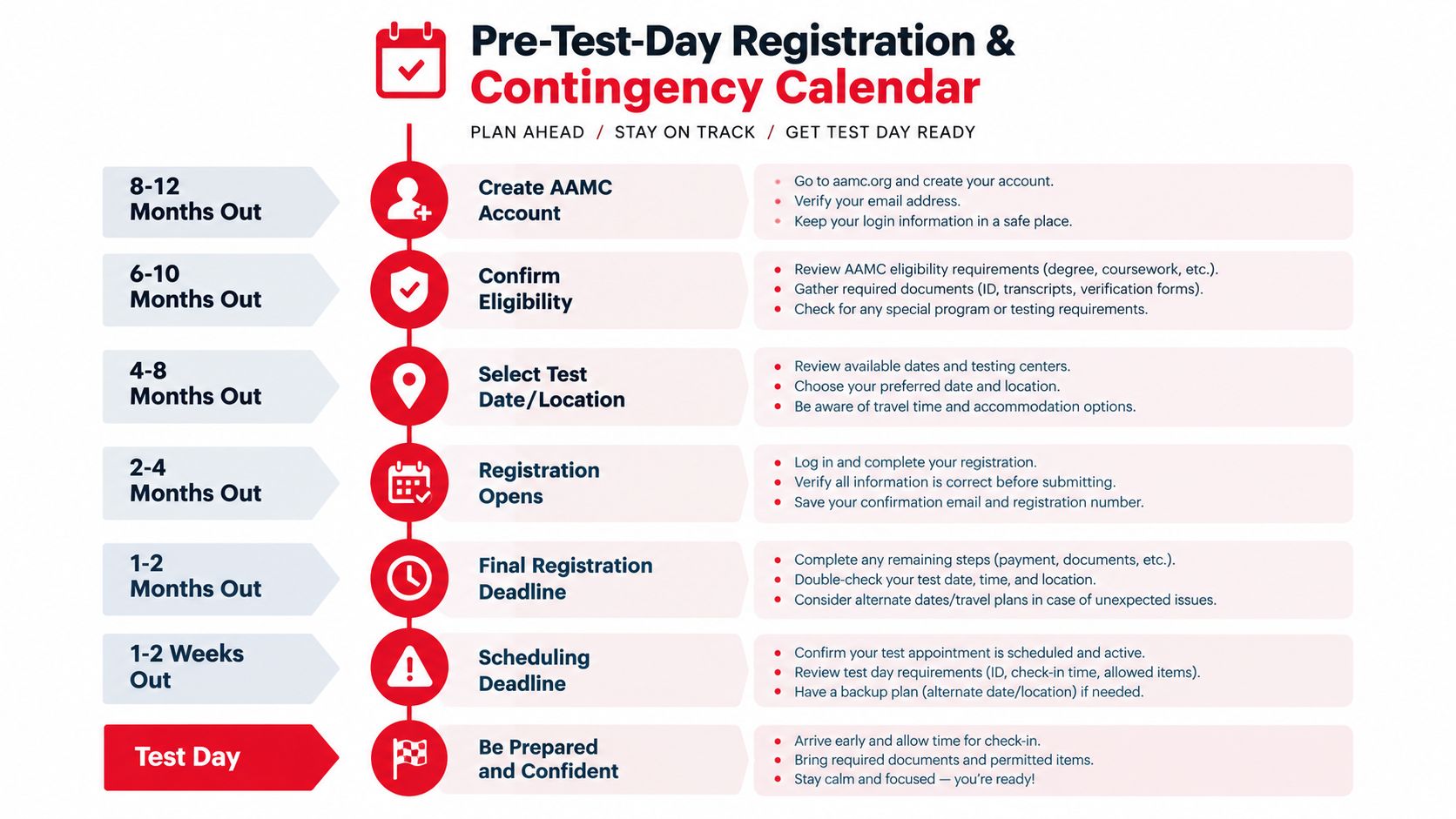
Registration and preparation calendar
Eight to twelve months out: Create your AAMC account, choose a permanent email address, and review eligibility. Note whether you might need special permission or accommodations, since those requests can require separate review.
Several months before testing: Compare the official calendar with your academic schedule, application goals, travel arrangements, and preparation level. Choose a primary date and a workable alternative. For 2026, the published testing season runs from January through September, with specific test dates rather than unlimited availability.
At registration: Check the testing center, country, legal name, fee category, and email address before submitting payment. Save the confirmation page and email immediately.
Before the 60-day threshold: Review your readiness, travel plan, identification, and accommodations status. If the appointment no longer fits, check the current change options before the applicable deadline.
Before the 30-day threshold: Make any needed change after reviewing the greater financial exposure that can apply closer to test day. If preparation has become unrealistic, act before a crisis forces the decision.
At least 10 days before test day: Treat this as the final scheduling boundary identified in AAMC guidance. Confirm that your appointment, identification, route, and test-day requirements are settled.
After the exam: Record the official score-release date rather than expecting results immediately. Use this AAMC MCAT score-release planning resource to place that date on your application calendar.
Three calm contingency branches
If score release compresses your application timing: Record the expected official release date before selecting the exam. Then ask whether that date fits your application plan and preparation level. A later, better-prepared attempt may support a more workable timeline.
If illness or a family emergency occurs: Contact AAMC, document the circumstances, and ask which current exception or change process applies. Do not miss the appointment assuming that your fee or seat will transfer automatically.
If an identification problem appears late: Contact AAMC immediately and follow its instructions. A mismatch can affect check-in, and a last-minute correction may not result in a refund or replacement appointment.
As of August 27, 2026, the remaining published 2026 U.S. MCAT dates are September 3, 4, 11, and 12. AAMC is projected to open 2027 registration October 20 through October 22, 2026, by testing-center location. Confirm those dates and the related deadlines on the official AAMC calendar before publication or payment. Also verify accommodations rules and score-release information, since registration details can change.
Earlier registration does not guarantee a particular seat. It gives you more opportunity to compare available centers and dates before the options narrow. Because AAMC uses a staggered rollout, confirm when your testing-center group opens instead of assuming one universal release time.
Choosing a date before checking readiness can create unnecessary pressure. A scheduled appointment can organize preparation, but it should not force you to test while academic gaps, anxiety, or course demands remain unresolved. Changing the date is a planning adjustment, not a verdict on your medical career.
If you want help matching a chosen date with a preparation schedule, Ace Med Boards provides MCAT preparation support and consultations about readiness, registration timing, and study priorities.
Self-audit question: If your ID, inbox, travel route, accommodations status, and fallback date were checked now, could you explain your plan without opening another tab?