
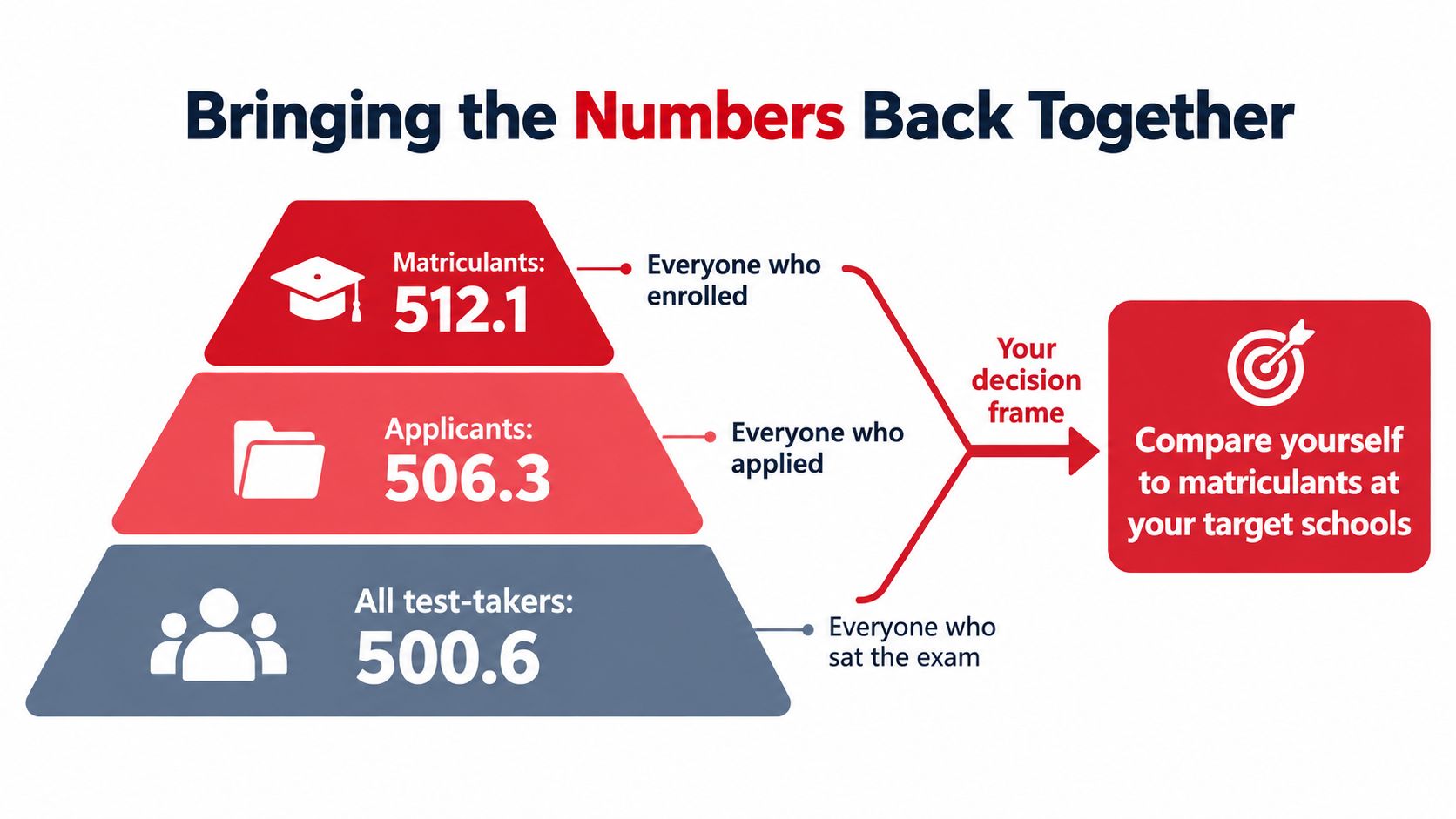
The overall MCAT score average is about 500.6 across all test-takers, while the average MCAT score is about 506.3 for applicants and 512.1 for matriculants. The right comparison depends entirely on which group you want to benchmark against.
That distinction changes how you should read your score report. A score near 500 is close to the average for everyone who sat for the exam, but it sits below the recent averages for people who applied to medical school and those who enrolled. Your total score matters, but your four section scores, percentile rank, target schools, GPA, experiences, and application timing give it meaning.
What the MCAT Score Average Actually Means
Three populations, three different questions
The Association of American Medical Colleges (AAMC) reports MCAT performance for several populations. These figures don't describe the same people, so they shouldn't be treated as interchangeable benchmarks.
The broadest group includes all test-takers. The AAMC reports a mean total score of 500.6 across 305,494 exams administered in 2023, 2024, and 2025. Because this group includes all attempts, not only first attempts, it describes the performance of people who took the exam, not the profile of a typical medical school applicant or enrolled student. The AAMC's score data also show that the overall testing population average sits almost exactly at the midpoint of the 472 to 528 scale.
The applicant group answers a different question: what did people who applied to medical school score? In the AAMC's 2025-2026 applicant data, the mean total MCAT score was 506.3. Matriculants, meaning applicants who enrolled in medical school, had a mean total score of 512.1 in the same data set. The AAMC applicant and matriculant tables show the persistent separation between these populations.
| Population | Average MCAT score | What this group represents |
|---|---|---|
| All test-takers | 500.6 | Everyone represented in the AAMC testing data for 2023, 2024, and 2025, including all attempts |
| Applicants | 506.3 | People who applied to medical school in the 2025-2026 applicant data |
| Matriculants | 512.1 | Applicants who enrolled in medical school in the 2025-2026 data |
Why your comparison group matters
Suppose your score is 501. Compared with all test-takers, it's close to the overall average. Compared with applicants, it's lower than the recent applicant mean. Compared with matriculants, the gap is wider. None of those statements contradicts the others. They answer different questions.
The AAMC reports a standard deviation of around 10 points for applicants in recent cycles, which indicates a broad spread of performance rather than a narrow cluster around the mean. A low-500s score therefore doesn't tell an admissions committee everything about your preparation or potential, but it does need to be interpreted against the population you're entering.
Practical rule: First ask, “Am I comparing myself with everyone who tested, everyone who applied, or people who enrolled?” Only then decide what your score suggests.
How the MCAT Scoring System Works
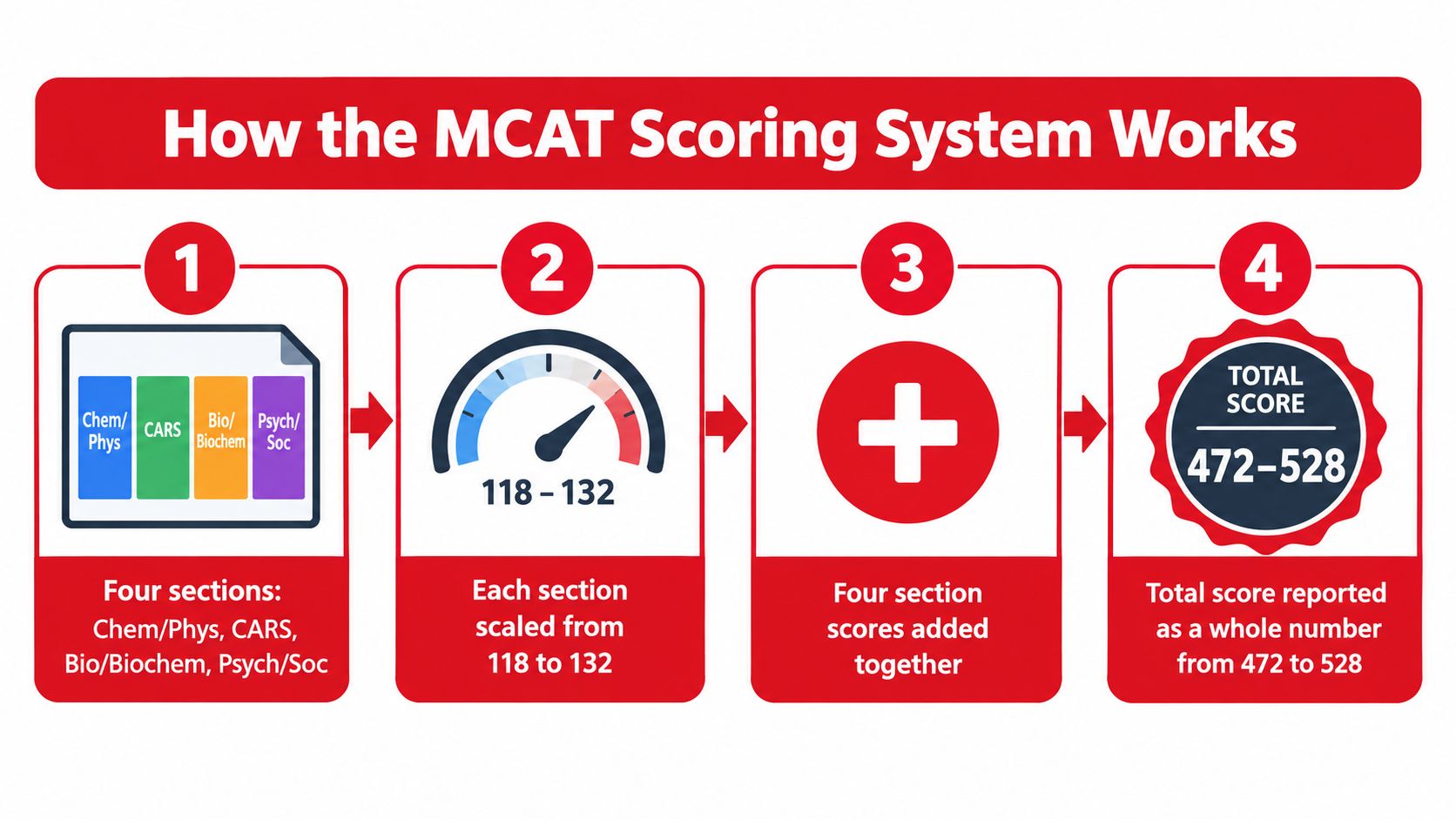
The Medical College Admission Test, or MCAT, reports one total score and four section scores. The total ranges from 472 to 528, with 500 as the midpoint. Each section ranges from 118 to 132, with 125 as the midpoint, and the total is the sum of the four section scores. AAMC's official MCAT score scale provides the governing definitions.
The four sections are:
- Chemical and Physical Foundations of Biological Systems, often called Chem/Phys
- Critical Analysis and Reasoning Skills, or CARS
- Biological and Biochemical Foundations of Living Systems, often called Bio/Biochem
- Psychological, Social, and Biological Foundations of Behavior, often called Psych/Soc
How to read the total
The exam converts the number of correct responses into scaled section scores. That conversion allows different test forms to be compared, even when their question difficulty varies slightly. The score report gives you the scaled results, not just a percentage-correct grade.
The AAMC sample score report gives a useful worked example. A student with section scores of 124, 123, 127, and 127 receives a total of 501, because the four scaled section scores are added together. The same sample report lists section percentile ranks of 43%, 35%, 72%, and 64%, respectively, while the total score appears at the 49th percentile. The AAMC score-report example shows why a balanced total can contain both stronger and weaker sections.
You can practice with your own report by writing the four section scores on a line, adding them, and then checking the total percentile separately. Don't average the section percentile ranks to estimate your total percentile. The total rank is based on the total score distribution.
For a fuller explanation of the scale and score calculation, see how the MCAT is scored.
Reading MCAT Percentile Ranks in Context
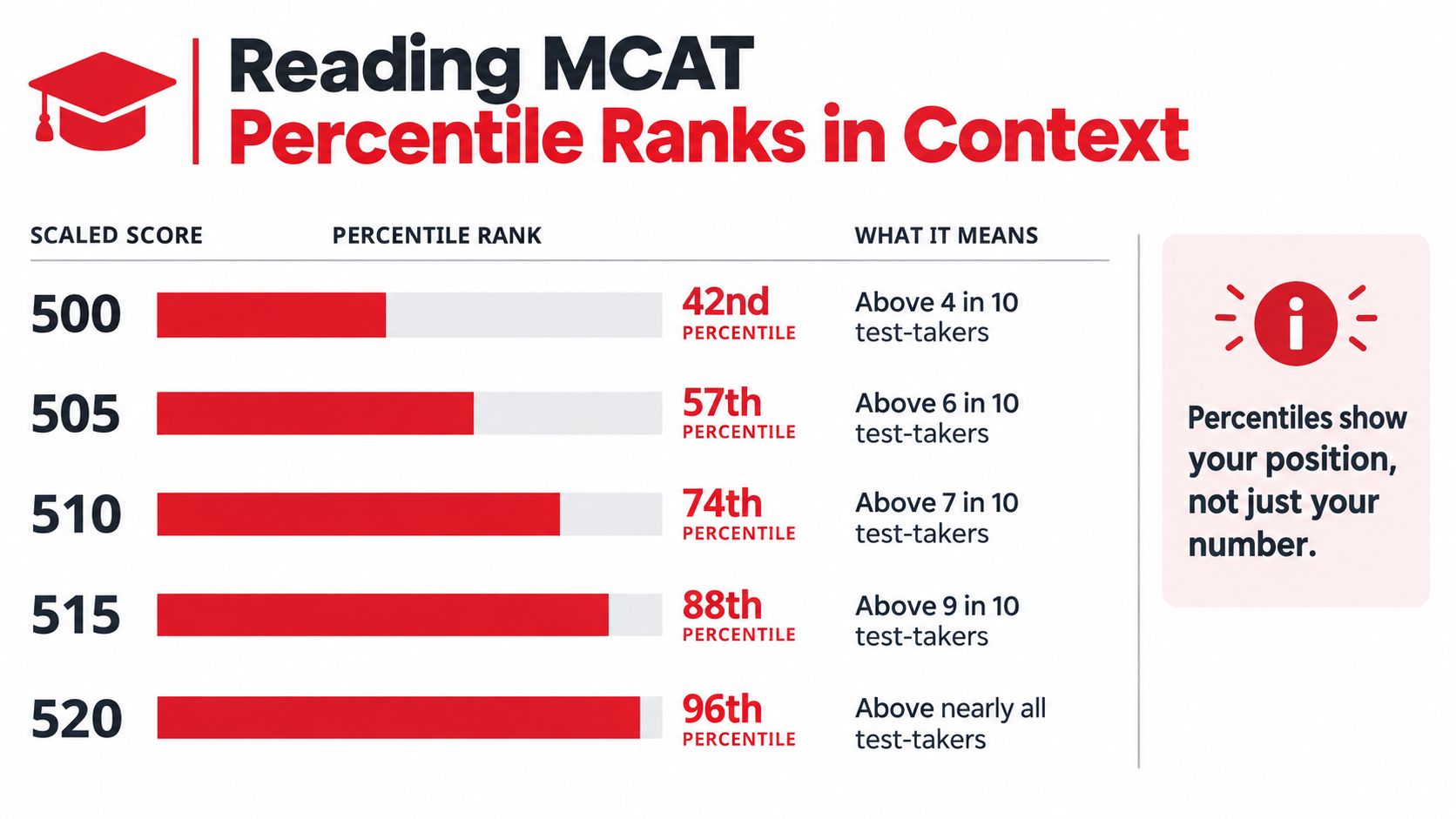
A scaled score tells you the number attached to your performance. A percentile rank tells you how that performance compares with other test-takers. If your score is at a given percentile, it means the relevant testing population scored at or below that level, according to the AAMC's current table.
The AAMC's percentile ranks in effect from May 1, 2025, through April 30, 2026 are based on everyone who tested in 2023, 2024, and 2025. The current AAMC percentile table is therefore the right reference for a score report you're interpreting during that period.
Percentiles don't rise in a straight line
The AAMC's sample score-report materials illustrate the pattern clearly. A total score of 501 corresponds to the 49th percentile in the example report, while the same report shows how section scores can occupy different positions within their individual distributions.
A percentile table may also show a score such as 508 at approximately the upper portion of the testing population and a 515 much higher still. Use the current table rather than relying on remembered conversions, because percentile assignments can be updated as the reference cohort changes.
The practical lesson is that a few scaled points can represent different movements at different parts of the distribution. A change near the center may move your percentile more than the same numerical change near the upper end. That's why you should record the percentile beside the score rather than treating every one-point increase as equivalent.
What a percentile cannot tell you
A percentile rank compares you with the testing population used by the AAMC. It doesn't calculate your probability of admission, and it doesn't replace school-specific data. Applicant and matriculant populations are different from the broad group used for the current percentile table.
Use MCAT percentile ranks as one part of your score audit, then compare your result with the current information for each school you're considering. A percentile is a position marker, not a promise.
MD vs DO Admissions and the MCAT
The MD and DO pathways serve the same broad goal of physician training but draw from different applicant pools and use different institutional missions. You shouldn't treat one national MCAT benchmark as a universal cutoff for both.
For MD programs, the AAMC's recent matriculant mean is 512.1. The available verified data here don't provide a separate national DO matriculant average, so a precise MD-versus-DO numerical comparison would go beyond the evidence. Instead, use current school-level information from the relevant official admissions systems and each program's published materials.
| Metric | MD programs | DO programs |
|---|---|---|
| National benchmark available in this data set | AAMC matriculant mean of 512.1 | No verified national DO mean supplied here |
| Primary comparison | AAMC data and each school's current admissions information | AACOMAS and each school's current admissions information |
| Review context | MCAT considered alongside GPA, experiences, essays, letters, and mission fit | MCAT considered alongside the full application, including academic preparation and osteopathic fit |
| Appropriate interpretation | A national mean is a reference point, not an admission threshold | A school-specific profile is more useful than an unsupported national estimate |
Reading a score without making a promise
A score can be more or less aligned with a program's recent profile, but alignment doesn't equal admission. Schools may weigh academic metrics, clinical exposure, service, research, personal background, state or regional ties, and mission fit differently.
If you're considering both pathways, build separate school lists rather than copying one list into the other. Review each program's current requirements and class profile through official resources such as AMCAS and AAMC admissions information and AACOMAS.
The useful question isn't “Is this score good for MD or DO?” A better question is, “How does this total and section profile compare with the programs I'm prepared to attend, and how does the rest of my application fit their mission?” The answer can support a balanced list, a retest discussion, or a decision to strengthen other parts of the application.
You can also review the broader distinction in MD versus DO admissions, while treating all school-specific figures as time-sensitive.
A Score-Context Worksheet You Can Reuse
A score becomes more useful when you place it beside the information an admissions reader will see. Copy the following worksheet into a notebook or spreadsheet after every official score report and major practice-test milestone.
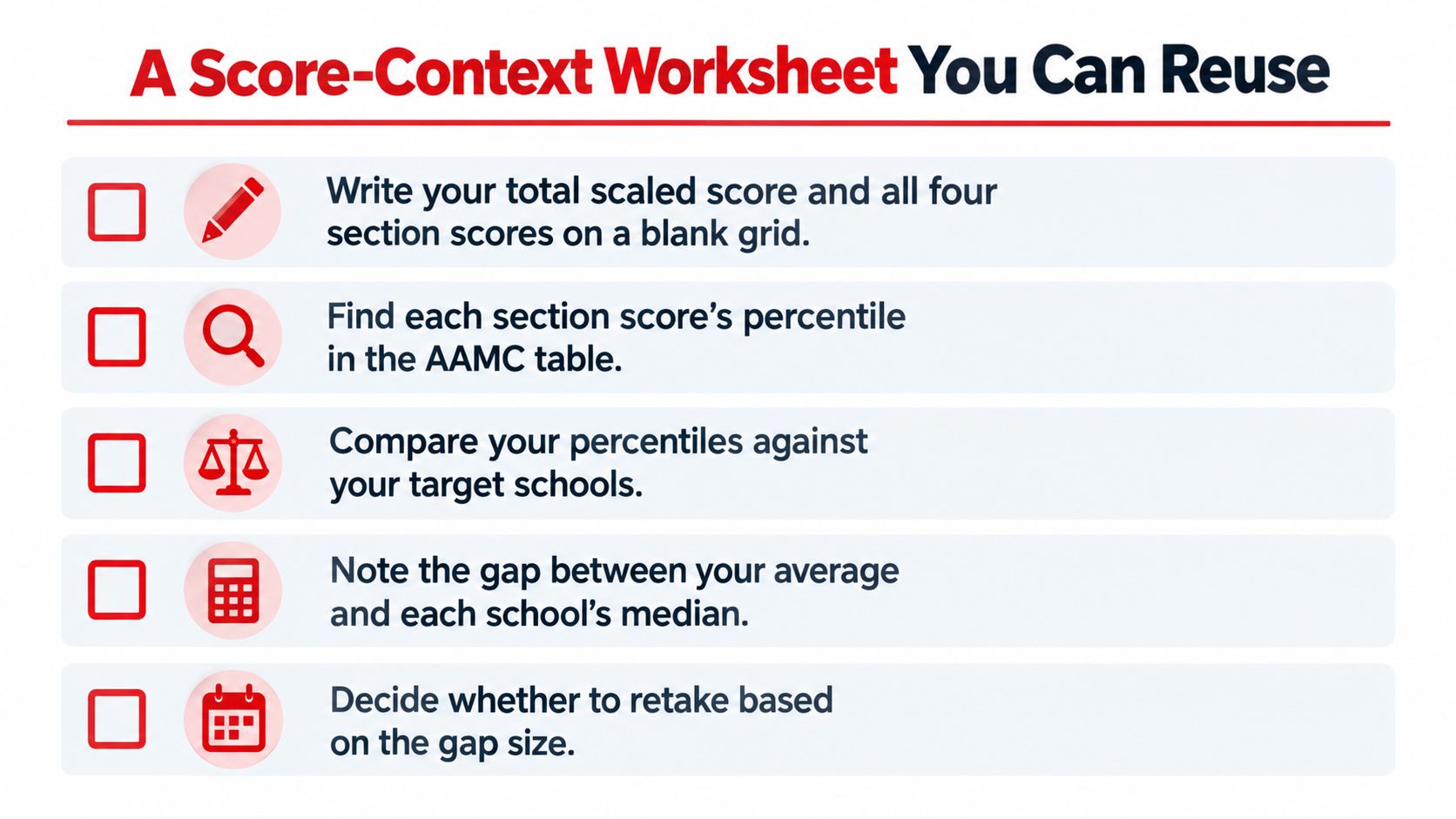
Record the score before interpreting it
| Field | Your information |
|---|---|
| Total scaled score | ______ |
| Chemical and Physical Foundations | ______ |
| CARS | ______ |
| Biological and Biochemical Foundations | ______ |
| Psychological, Social, and Biological Foundations | ______ |
| Current AAMC total percentile | ______ |
| Current AAMC section percentiles | ______ |
| Test date and score-release date | ______ |
| Number of attempts | ______ |
Start with the official report. Don't rely on a practice dashboard, a remembered estimate, or a screenshot without confirming the final total and section scores. The AAMC score-report guidance is the appropriate reference for understanding what each field represents.
Compare schools, not abstractions
Next, list your target programs and record the current MCAT information from the Medical School Admission Requirements database, commonly called MSAR, for participating MD schools. For DO programs, use current AACOMAS and school-specific admissions information. Don't turn a school's group range into an individual admission probability.
Add the rest of your profile:
- Academic record: cumulative GPA, science GPA, post-baccalaureate work, and academic trend
- Preparation evidence: full-length trends, section stability, timing errors, content gaps, and passage-reasoning errors
- Experiences: clinical exposure, service, research, leadership, and employment
- Context: school mission, state or regional connections, and personal circumstances
- Retest factors: likely score gain, remaining preparation time, application timing, cost, stress, and whether the previous attempt reflects your current ability
A simple planning rule can help you sort conversations, but it isn't an admissions rule. Treat a score within roughly two points of a school's reported median as a discussion zone, a result three or more points below as a possible reach, and a result three or more points above as a potentially stronger academic fit. Verify every school's current data before applying.
Planning aid, not a guarantee: Your score should shape your school list, not replace judgment about the complete application.
Keep the worksheet in a shared document if you work with a pre-health advisor. A progress-tracking tool such as the Ace Med Boards progress-tracking dashboard can also support organized review, but no dashboard can decide whether a retest is right for you.
Practical Next Steps After Receiving Your Score
A score report should lead to a decision process, not an automatic reaction. Before scheduling a retake, identify whether the limiting factor was content knowledge, passage interpretation, timing, test-day stamina, anxiety, or an uneven section profile.
Start with the problem your report reveals
For a score below 500, begin with a careful content audit using the AAMC's official content outline and your practice records. A retake should follow structured preparation, not just the passage of time. Review concepts actively, then test whether you can apply them in unfamiliar passages.
For a score from 500 to 505, look for the section or error type that is holding down the total. A focused section bank, timed passage review, and targeted instruction can be more efficient than restarting every subject from the beginning. If you work with a tutor, bring a specific pattern, such as missed graph interpretation or inconsistent timing, rather than only a desired total.
A score from 506 to 509 may fit some applicants' balanced lists, depending on target schools and the rest of the file. At this point, application preparation, school research, essays, and mission fit may deserve as much attention as another round of broad content review.
At 510 or above, don't assume the score settles the admissions question. Review the school list, section balance, GPA, experiences, letters, personal statement, and secondary-essay plan. A higher score may make other parts of the application more visible, not irrelevant.
A sustainable retester rhythm
A demanding plan needs recovery built into it. One possible weekly structure is:
- Content review: roughly ten hours, focused on concepts connected to missed questions
- Practice passages: roughly six hours, with written review of both correct and incorrect answers
- Timed section work: two timed section tests, followed by detailed error analysis
- Full-length practice: one full-length every other week, with the next study block shaped by the results
- Recovery: one dedicated rest day without MCAT tasks
These quantities are a planning example, not a verified performance formula. Adjust them around coursework, employment, caregiving, health, and the time remaining before your application cycle. Persistent sleep disruption, dread, inability to review mistakes, or declining practice performance can signal that the plan needs more recovery or outside support.
Target the skill gap, not just the number. Tutoring is most useful when you can name what isn't working and give the instructor evidence to analyze.
Labeled composite example: A composite applicant has a competitive total but one materially weaker section. Rather than calling the score good or bad, the applicant compares that imbalance with target-school information, practice trends, available preparation time, and the rest of the application. The resulting plan focuses on the weaker section and its recurring error types instead of repeating every topic equally. This example is hypothetical and doesn't represent an Ace Med Boards student or measured result.
Check the current timing information before building a retest plan with MCAT score-release dates. Your test date, score date, application timing, and school deadlines need to work together.
Bringing the Numbers Back Together
The three averages answer three different questions. The all-test-taker figure describes the broad population that sat for the exam. The applicant figure describes people who entered the admissions process. The matriculant figure describes people who ultimately enrolled. Your comparison should become more specific as your decision becomes more specific.
If you're deciding whether your preparation is near the general testing midpoint, the broad mean is relevant. If you're deciding how your score compares with other applicants, use the applicant benchmark. If you're building a medical school list, matriculant data and each target school's current profile are more useful starting points.
The worksheet adds the details a single average can't show. A total can hide a meaningful section imbalance. A percentile can clarify position in the current AAMC reference population. A target-school comparison can reveal whether a retest would materially improve your options, while GPA, clinical experience, service, research, and mission fit may change the way an admissions committee reads the same score.
A practical decision frame
Use this sequence after receiving an official report:
- Verify the total and four section scores.
- Record the current AAMC percentile ranks.
- Compare the score with each target school's current information.
- Identify the weakest section and the dominant error types.
- Review GPA, experiences, context, mission fit, and application timing.
- Choose among applying, retesting, revising the school list, or delaying the application.
Applicants below the applicant-average range may want a careful retest analysis, but a retake isn't automatically the correct choice. Scores in the middle range can support different strategies depending on the balance of MD and DO programs, school mission, and the full application. A score near or above the matriculant benchmark can still require thoughtful school selection, because no MCAT score guarantees admission.
The current percentile table is based on the 2023-2025 testing cohort, so it provides a useful reference for score interpretation during the current reporting period. Expectations can change when the AAMC updates its tables, which is why you should use the latest official version rather than an old chart saved from a prior cycle.
Focus on the next specific gain you can justify. That might mean improving passage reasoning in one section, stabilizing timing, correcting content gaps, or deciding that your application is ready for a carefully balanced list. The most useful mcat score average isn't a single headline number. It's the benchmark that matches your role in the cycle and the schools you intend to approach.
If you want help turning an official score report into a section-level study plan or a more deliberate school-list decision, Ace Med Boards offers MCAT preparation and admissions support through individualized guidance. Visit the site to learn more or schedule a free consultation without treating tutoring as a guarantee of a particular score or admission result.