
A familiar practice problem can stall when the science makes sense but the arithmetic looks awkward. MCAT math isn't a standalone mathematics section; it's arithmetic and quantitative reasoning embedded in science passages and questions. Because calculators aren't permitted, effective preparation emphasizes hand calculation, estimation, and deciding which computation separates the answer choices.
By Ace Med Boards Editorial Team
What MCAT Math Covers and Where It Shows Up
A chemical-kinetics passage ends, and the four answer choices differ only in their exponent: 10⁻³, 10⁻⁴, 10⁻⁵, 10⁻⁶. The chemistry was the easy part. The score now depends on whether the powers of ten land correctly. The Medical College Admission Test (MCAT) embeds that kind of arithmetic inside science questions, and the Association of American Medical Colleges (AAMC) describes this applied-knowledge design as part of the redesigned exam that launched in April 2015, according to its AAMC history.
The exam's four sections are Chemical and Physical Foundations of Biological Systems (CP), Biological and Biochemical Foundations of Living Systems (BB), Psychological, Social, and Biological Foundations of Behavior (PS), and Critical Analysis and Reasoning Skills (CARS). Quantitative skill pays off mainly in the three science sections; CARS rewards reading and reasoning rather than calculation.
The connecting skill across all of it is numerical triage: deciding which single computation separates the answer choices before doing any arithmetic, then checking units, exponents and axes before committing to a selection.
MCAT math skills and where they appear
The following map connects quantitative skills with useful practice contexts. Section labels indicate where preparation is especially relevant, not a measured frequency of question types.
| Skill | Typical exam situation | Sections where it most often appears |
|---|---|---|
| Scientific notation and powers of ten | Comparing concentrations or masses that differ by many orders of magnitude | CP, BB |
| Unit conversion and dimensional analysis | Converting mL to L, or between similar metric prefixes, before substituting into a formula | CP, BB |
| Ratios, proportions and percentages | Fold change, percent change and comparing rates | BB, PS |
| Square-root estimation | Approximating a root to separate close answer choices | CP |
| Slopes and linear graphs | Finding slope from points on a plotted line | CP, PS |
| Semilog and log-log graphs | Reading data plotted on logarithmic axes | CP, BB |
| Probability | Estimating how often an outcome occurs across repeated trials | PS, BB |
| Statistics | Mean, median, range, standard deviation and confidence intervals | CP, BB, PS |
Two rows deserve attention early. Logarithmic axes compress large ranges so that equal distances represent equal ratios rather than equal differences, and misreading one axis can shift an answer by several powers of ten. Unit conversion errors work the same way: a single missed prefix quietly moves the exponent.
The MCAT calculator-policy guide covers the no-calculator setting and the noteboard-and-marker workflow it requires. For extra arithmetic practice outside MCAT passages, CramShare's shared study materials for maths students offer general exercises; use them to build hand-calculation speed rather than as a guide to what the exam covers.
Key Takeaways
- Start with units and powers of ten. These foundational skills make later calculations easier to organize.
- Inspect the choices before calculating. Their spacing determines the precision required, then units, exponents and axes confirm the selection.
- Separate arithmetic from interpretation. A correct calculation can still answer the wrong scientific question.
- Practice visible scratch work. Short, labeled steps are easier to check than an entirely mental solution.
Estimate First and Calculate Only What Decides the Answer
The answer-choice spread test comes before long division. When options differ by orders of magnitude, a rough calculation may distinguish them; closely spaced options demand more precision.
Estimation isn't permission to choose whichever answer looks nearest. The estimate must be accurate enough that reasonable rounding wouldn't change the selection.
Educational example with widely separated choices
All worked examples in this article are original educational exercises, not official or recalled examination items.
Suppose a sample contains 3.0 × 10⁻⁴ mol dissolved to a final volume of 0.25 L. The question asks for molarity, meaning moles per liter.
| Choice | Concentration |
|---|---|
| A | 1.2 × 10⁻³ M |
| B | 1.2 × 10⁻² M |
| C | 1.2 M |
| D | 0.12 M |
The setup is concentration = amount ÷ volume:
(3.0 × 10⁻⁴ mol) ÷ 0.25 L
Dividing by a quarter is equivalent to multiplying by four:
3.0 × 4 × 10⁻⁴ = 12 × 10⁻⁴ = 1.2 × 10⁻³ M
Only A fits. This calculation simplifies exactly, so there's no reason to perform written long division.
A repeatable numerical-triage sequence
- Name the target. Write the requested quantity and its unit.
- Estimate and compare. Simplify convenient fractions or round cautiously, then inspect the choices.
- Calculate the discriminating step. Retain precision only where it could change the answer.
- Check direction and scale. Decide whether the result should be larger, smaller, positive, or negative.
The visual summarizes how answer spacing can guide computation.
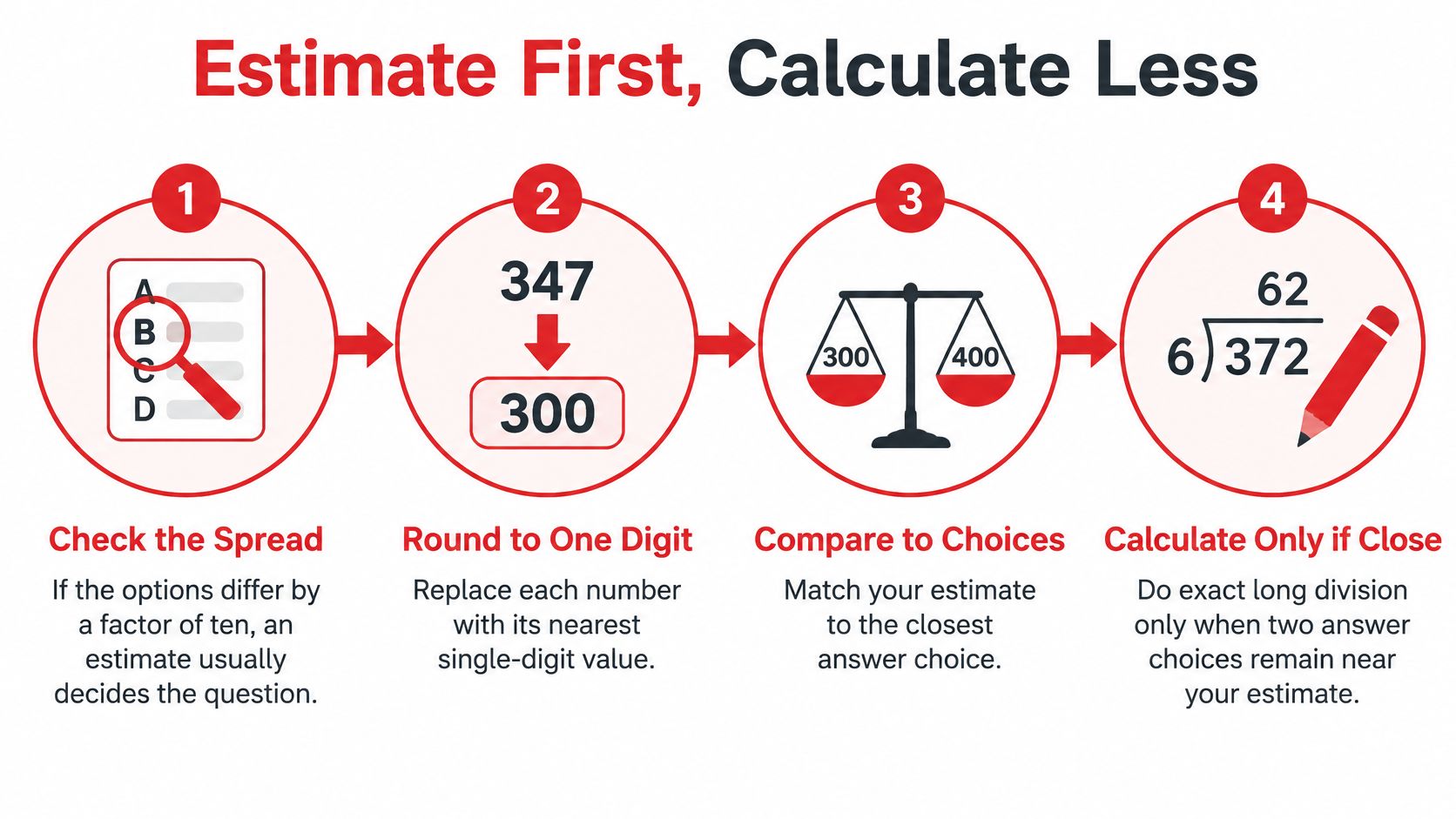
Rounding to a leading digit is useful only when enough separation remains between options. Simplifying exact factors first often preserves accuracy without adding work.
For contrast, consider an educational calculation of 1.01 ÷ 0.50, with remaining choices of 2.00 and 2.04. Those choices differ by about 2%, and an estimate of “about two” cannot distinguish them. Exact simplification gives 2.02, so neither option can be selected confidently without checking the question's rounding instructions or earlier setup.
Practical rule: If the uncertainty introduced by rounding could cross the boundary between choices, more precision is necessary.
According to the AAMC scoring FAQs, scoring depends on correct answers, and wrong answers receive the same treatment as unanswered questions. A blank therefore doesn't offer a scoring advantage over the best-supported selection.
An educational 60-second triage drill can isolate this skill: examine a practice item and record only the target unit, likely magnitude, and proposed method. Completing the arithmetic afterward reveals whether the chosen method was appropriate.
Scientific Notation and Powers of Ten by Hand
Scientific notation separates a number into a coefficient and a power of ten. Handling those pieces separately reduces the amount of information held in working memory.
Multiplication and division
Multiplication adds exponents because powers represent repeated factors of ten.
Educational example
(4.5 × 10⁶) × (2.0 × 10⁻³)
= (4.5 × 2.0) × 10⁶⁺⁽⁻³⁾
= 9.0 × 10³
Division subtracts the denominator's exponent. Parentheses matter when that exponent is negative.
Educational example
(6.0 × 10⁸) ÷ (1.5 × 10⁻²)
= (6.0 ÷ 1.5) × 10⁸⁻⁽⁻²⁾
= 4.0 × 10¹⁰
The exponent increases here because division by a small number makes the quotient larger. That direction check catches the tempting but incorrect result of 10⁶.
Powers and addition require different moves
Squaring applies to both the coefficient and the power of ten.
Educational example
(2.4 × 10⁻⁵)²
= 2.4² × 10⁻¹⁰
= 5.76 × 10⁻¹⁰
≈ 5.8 × 10⁻¹⁰
The final rounding preserves the input's two significant figures. Squaring the exponent itself would be a different operation and wouldn't represent the original expression.
Addition requires matching powers before combining coefficients:
Educational example
3.0 × 10⁴ + 5 × 10²
= 3.0 × 10⁴ + 0.05 × 10⁴
= 3.05 × 10⁴, before any context-dependent rounding.
The smaller term is only about 1.7% of the larger term. Adding the original coefficients directly would incorrectly treat the quantities as equal in scale.
Work the coefficients first, track the exponents separately, and normalize only after combining them.
For a nonzero number in standard scientific notation, the coefficient's absolute value belongs between 1 and 10, excluding 10. A result of 24 × 10⁻⁶, for example, becomes 2.4 × 10⁻⁵.
Common slips deserve explicit checks:
- Negative-exponent reversal. A more negative exponent means a smaller magnitude when coefficients match.
- Unfinished normalization. A coefficient above the standard range requires a compensating exponent adjustment.
- Incomplete squaring. Both the coefficient and power of ten must change.
The MCAT formula-sheet resource can support equation review alongside these arithmetic exercises. Answer-choice digits help indicate useful calculation precision, but explicit rounding directions and significant-figure rules still take priority.
Unit Analysis and Dimensional Checks Step by Step
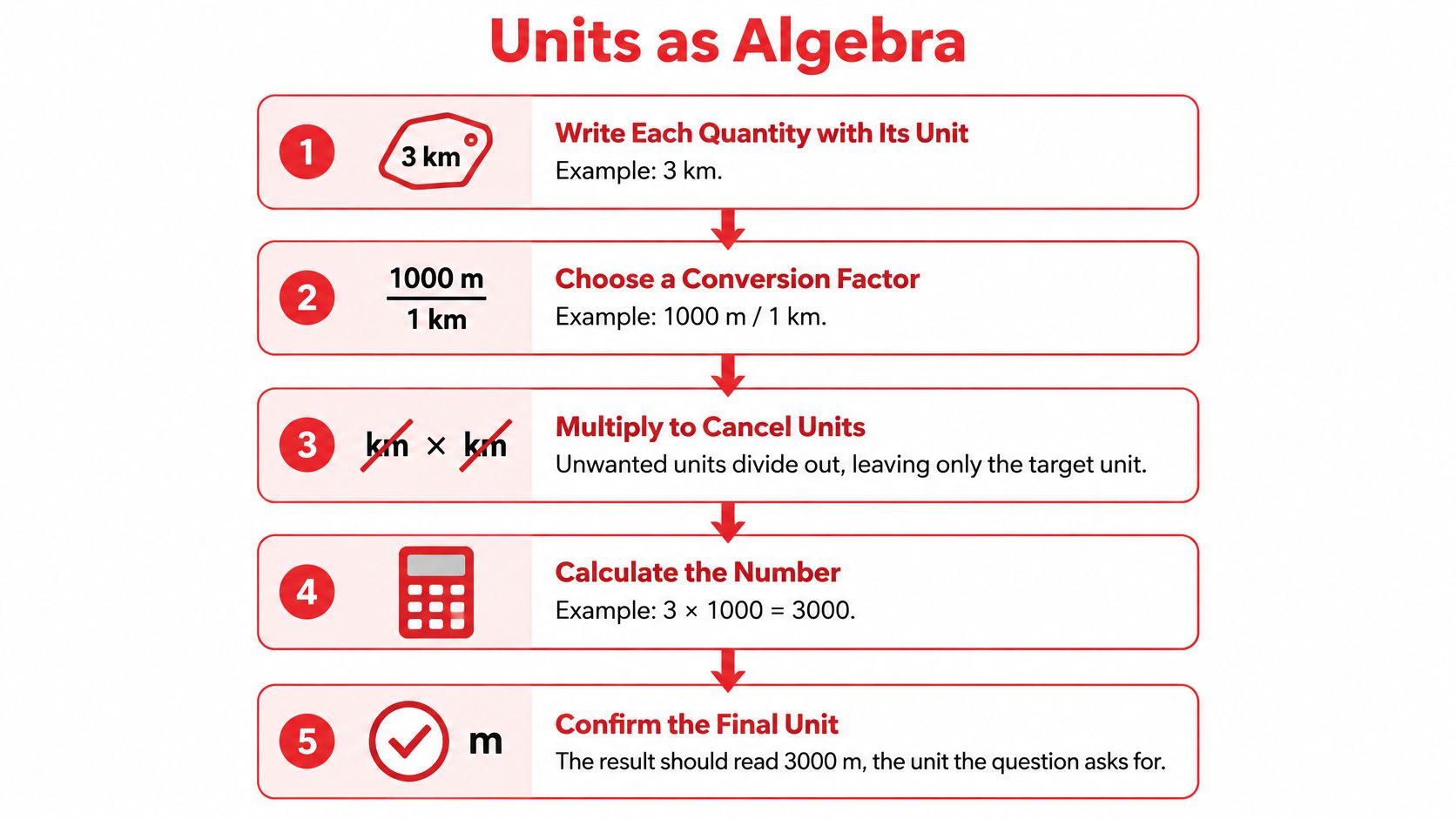
Dimensional analysis treats units as algebra. Multiplying by an equivalent-unit ratio changes how a quantity is expressed without changing the physical quantity itself.
The AAMC mathematical-skills document includes dimensional analysis, metric and English-unit conversions, reasonable estimation, and significant digits among the expected skills. Common reference pairs worth practicing include 1 L = 1,000 mL, 1 kg = 1,000 g, and 1 in = 2.54 cm.
A units-first workflow
- Write the target unit. This identifies what must remain at the end.
- Write the given quantity with its unit attached.
- Chain equivalent-unit ratios. Place each unwanted unit opposite its existing position so it cancels.
- Estimate the numerical scale before multiplying.
- Inspect the remaining units. They must match the requested quantity.
The flowchart illustrates cancellation with a simple length conversion.
Educational example with solution amount
Suppose a problem gives 250 mL of a 0.40 mol/L solution and asks for the amount in moles.
| Workflow step | Application |
|---|---|
| Target | mol |
| Given | 250 mL and 0.40 mol/L |
| Conversion chain | 250 mL × (1 L / 1,000 mL) × 0.40 mol/L |
| Scale estimate | A quarter liter contains a quarter of the amount in a liter |
| Remaining unit | mol |
The milliliters cancel first, followed by liters:
0.25 L × 0.40 mol/L = 0.100 mol
The arithmetic gives 0.100 mol; with the concentration's two significant figures, 0.10 mol is an appropriate reported result. Reporting mol/L would leave the answer as concentration rather than the requested amount.
Educational example with cubed units
Convert 1.0 g/cm³ into kg/m³.
| Workflow step | Application |
|---|---|
| Target | kg/m³ |
| Given | 1.0 g/cm³ |
| Conversion chain | 1.0 g/cm³ × (1 kg / 1,000 g) × (100 cm / 1 m)³ |
| Scale estimate | The volume conversion contributes more than the mass conversion removes |
| Remaining unit | kg/m³ |
The calculation becomes:
1.0 × 10⁻³ × 10⁶ = 1.0 × 10³ kg/m³
The length conversion must be cubed because the denominator contains volume. Using an uncubed factor would leave unmatched length dimensions instead of producing kg/m³.
This distinction matters whenever a problem uses area, volume, or density. The same cancellation discipline also helps organize stoichiometry, as illustrated in the limiting-reactant calculation guide.
Proportional Reasoning and Logarithms as Quick Ratios
Percentage changes don't add up directly because each change can use a different starting amount. In an educational scenario, a 40% increase followed by a 25% decrease gives:
1.40 × 0.75 = 1.05
The net change is +5%, not +15%. The decrease applies to the already increased quantity.
A percentage-point change uses subtraction instead. An educational rate rising from 20% to 30% increases by 10 percentage points, while its relative increase is 50%.
Logarithms translate multiplication into addition
For base-ten logarithms, log₁₀ answers the question of what exponent produces a number from ten. Throughout these examples, “log” means log₁₀.
- Powers of ten: log(10ⁿ) = n.
- Products: log(ab) = log a + log b.
- Ratios: log(a/b) = log a − log b.
Logarithm reference values for quick estimates
These rounded mathematical values support mental estimates.
| Value | Approximate log₁₀ and how to use it |
|---|---|
| 2 | 0.30; repeated doubling adds about 0.30 per doubling |
| 3 | 0.48; useful for factors near three |
| 5 | 0.70; also follows from log 10 − log 2 |
| 7 | 0.85; useful for factors between five and ten |
| 10 | Exactly 1, since each power of ten adds 1 |
Educational example: A concentration rises from 2 × 10⁻⁴ M to 1.6 × 10⁻² M. The ratio is 80, so:
log 80 = log 8 + log 10
= 3 log 2 + 1
≈ 0.90 + 1
= 1.90 log units
This computes the logarithm of the ratio, not the difference between the original concentrations.
Written practice helps keep ratios and logarithmic transformations distinct.

Axes determine the interpretation
In an educational semilog graph whose adjacent gridlines represent tenfold changes, rising two gridlines means a 100-fold increase. Equal vertical distances on that axis don't represent equal arithmetic differences.
The AAMC exam-content overview emphasizes interpreting tables, figures, graphs, and statistical uncertainty. Reading labels, controls, and error bars therefore belongs before arithmetic, not after it.
Square-root estimation uses a different reference strategy: nearby perfect squares. For example, √50 lies above 7 because 7² = 49, and below 7.1 because 7.1² = 50.41.
Statistics and Probability Checks Without a Calculator
An original educational data set contains trial values of 4.2, 4.6, 4.4, 9.8, and 4.5 mg. Sorting them produces 4.2, 4.4, 4.5, 4.6, 9.8 mg.
| Statistic | Calculation | Result |
|---|---|---|
| Median | Middle sorted observation | 4.5 mg |
| Range | 9.8 − 4.2 | 5.6 mg |
| Mean | 27.5 ÷ 5 | 5.5 mg |
The high observation pulls the mean above the main cluster. If a question asks about a typical observation, the median deserves consideration, although a question explicitly asking for the mean still requires the mean.
Spread isn't the same as center
Standard deviation describes spread around the mean. For an educational comparison, 4, 5, 6 and 0, 5, 10 have the same mean, but the latter set has greater spread.
A comparison question may therefore be answerable without calculating either standard deviation. An unusual value shouldn't automatically be discarded; exclusion requires a justified reason.
Independent probability and uncertainty
Suppose each independent trial has a 0.2 probability of success. The probability of at least one success across three trials is easier to calculate through the complement:
1 − P(no successes) = 1 − 0.8³ = 1 − 0.512 = 0.488
That's about 0.49, rather than 0.60. Adding success probabilities alone double-counts outcomes containing multiple successes.
- Independence check: Multiplication of unchanged trial probabilities requires the independence assumption.
- Difference-interval check: A confidence interval for a difference that includes zero doesn't establish a nonzero difference at its corresponding confidence level.
- Overlap check: Overlap between separate groups' confidence intervals isn't, by itself, a definitive significance test.
Statistical language should stay within what the design and uncertainty support. Numerical association alone doesn't establish causation.
An Error Checklist for Calculation Mistakes
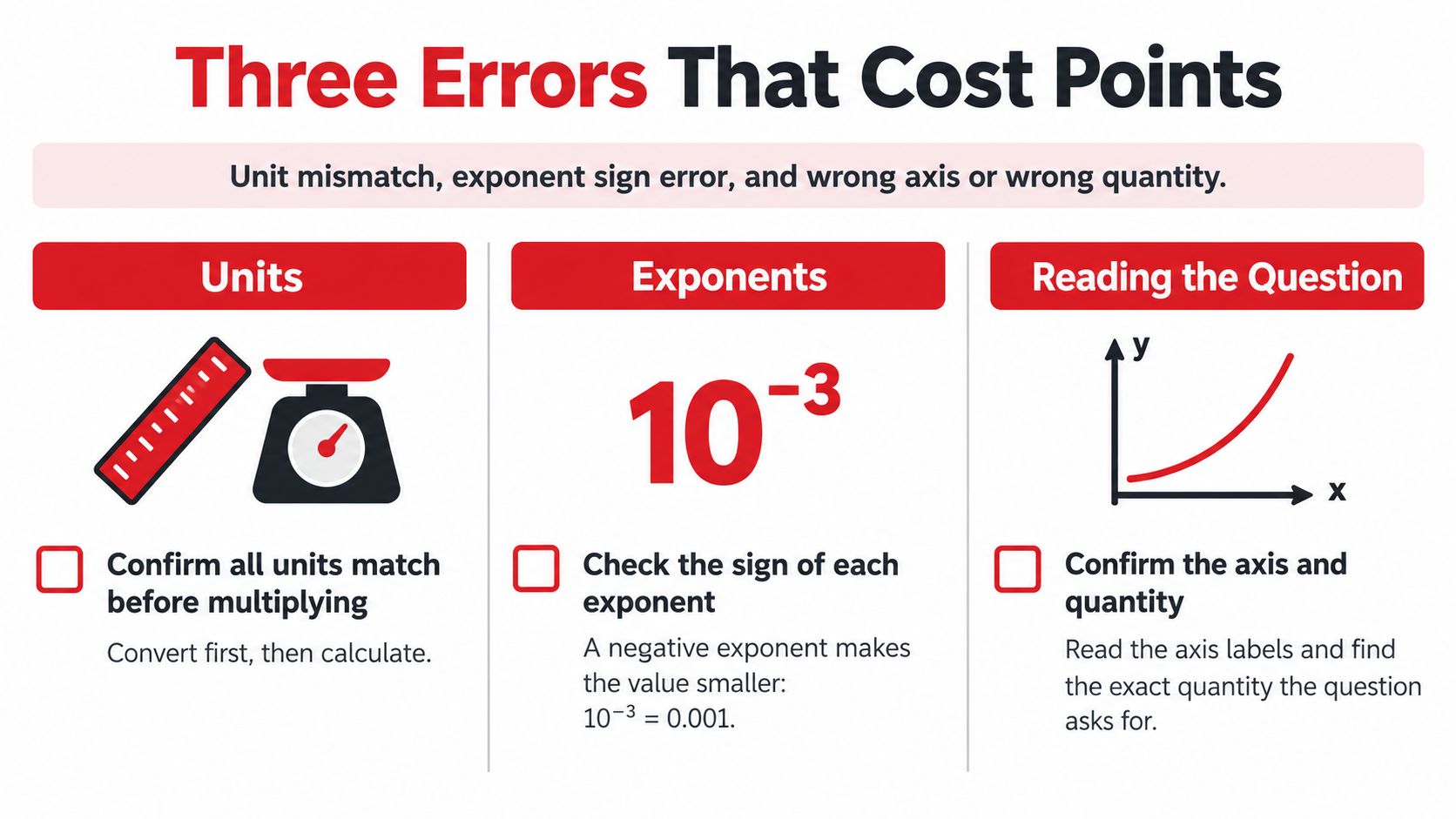
A unit mismatch, an exponent-sign error, and reading the wrong axis or quantity can derail an otherwise sound solution. These errors don't necessarily indicate weak arithmetic; they can arise before calculation begins.
Faster computation won't fix an incorrect setup. Review is more useful when it identifies the earliest point where the reasoning diverged.
A final-answer audit
| Category | Check before selecting an answer |
|---|---|
| Units | Confirm numerator and denominator units; inspect squared and cubed conversions |
| Exponents | Check signs and normalize the coefficient |
| Graphs | Identify linear or logarithmic scales and read the correct axis |
| Target | Confirm that the result answers the question rather than an intermediate step |
| Precision | Preserve enough digits to distinguish the choices |
| Magnitude | Compare the result with a brief independent estimate |
Particular attention belongs to m versus mm, mL versus L, and percentage change versus percentage-point change. Similar-looking notation can hide a different quantity.
The visual highlights setup and reading checks that deserve attention alongside arithmetic.
Record a corrective rule, not just a missed answer
The AAMC scoring explanation states that section scores are reported separately and the total is their sum. Quantitative errors therefore belong in the relevant science-section review rather than a detached “math score” category.
An error log can use the following template. The entries are illustrative, not student records.
| Date | Science section | Error type | Corrective rule |
|---|---|---|---|
| Practice date | CP | Conversion | Convert volume before substituting |
| Practice date | BB | Setup | Identify the requested ratio before dividing |
| Practice date | PS | Reading | Distinguish relative change from percentage points |
| Practice date | CP | Arithmetic | Separate coefficients from exponent operations |
A useful review sequence is:
- Reattempt without the explanation. This distinguishes a recoverable execution error from a missing concept.
- Locate the first incorrect move. Later mistakes may be consequences rather than separate weaknesses.
- Write an actionable correction. “Be careful” is less useful than “cube every factor in a volume conversion.”
- Test the correction in context. An MCAT practice-question workflow can help connect isolated drills with passage-based reasoning.
Correct answers also deserve review when the method involved guessing or excessive computation. Accuracy achieved through an unstable method may not transfer reliably to the next problem.
Build a Six-Week Math Drill and Decide Your Next Step
The following is an illustrative study plan, not a validated readiness benchmark. Its daily drill periods should fit within a broader MCAT study schedule that includes content review, passage practice, and rest.
Six-week MCAT math practice sequence
| Week | Daily drill (15 to 20 minutes) | Timed practice | Review focus |
|---|---|---|---|
| Week 1 | Scientific notation and unit conversions | Estimate-only set of 10 items | Log each error by type |
| Week 2 | Ratios, percent change and proportional reasoning | Timed set of 10 percent-change and ratio items | Recheck percent-change traps |
| Week 3 | Logarithms, log axes and square-root estimates | Graph-reading set with log-axis items | Review axis labels before calculating |
| Week 4 | Statistics, mean, spread and confidence intervals | Passage set from BB or PS | Separate reading errors from math errors |
| Week 5 | Mixed quantitative reasoning in CP and BB | One full science section on a timer | Compare pacing with the plan |
| Week 6 | Error-log review and targeted repeats | Scored official AAMC full-length practice test | Plan the next block by error type |
For short educational drill sets, an initial planning allowance of about 16 minutes for 10 items can expose pacing problems. That allowance isn't a per-question deadline or a readiness standard; passage reading and question difficulty require flexibility.
Decide what support would address
If the same error category persists after two weeks of targeted practice in this illustrative plan, one-on-one support may be worth considering. The useful question is whether the difficulty involves content knowledge, representation, setup, or execution.
For MCAT preparation discussions, the student shares a test date, current practice results, available study time, and the hardest parts of preparation with Ace Med Boards. One hour of MCAT tutoring can be purchased for $150; the MCAT pricing and program-information page should be checked for current rates and options.
Tutoring complements official AAMC practice materials and independent review rather than replacing them. Scored official practice tests provide a more appropriate basis for score interpretation than a homemade math drill.
Sources
- AAMC history for the redesigned exam's emphasis.
- AAMC scoring FAQs for treatment of unanswered and incorrect responses.
- AAMC mathematical-skills document for quantitative expectations.
- AAMC exam-content overview for data interpretation.
- AAMC scoring explanation for section-based reporting.
Ace Med Boards publishes MCAT preparation resources covering calculation methods, formulas, and study planning. Premedical applicants seeking help organizing their next preparation block can visit Ace Med Boards to schedule a free consultation and discuss their practice results, timeline, and quantitative challenges.