You're in the middle of a timed chemistry question, the numbers look messy, and the test-writer has tucked two reactants, mixed units, and a product ask into the same prompt. That's exactly when students freeze, because the task isn't just doing stoichiometry, it's figuring out which substance runs out first. Once you can calculate the limiting reactant cleanly, the rest of the problem starts behaving.
What a Limiting Reactant Is and Why It Matters
A limiting reactant is the reactant that gets used up first, which means it sets the ceiling for how much product can form. If you've ever watched a sandwich shop run out of bread while still having plenty of cheese, you already understand the idea. Cheese can sit there all day, but no more sandwiches come out without bread.
That's why this skill matters so much on exam day. The limiting reactant determines the theoretical yield, the amount of product you can make on paper, and it also tells you how much excess reactant will be left behind once the reaction stops. If you name the wrong limiter, every answer that follows gets dragged off course.
For MCAT-style chemistry, the concept shows up inside longer stoichiometry questions, not just as a vocabulary check. It also appears in first-year general chemistry, pharmacy prerequisites, and dental admissions prep, where students are expected to move from balanced equations to product amounts without getting lost. If this topic feels annoyingly procedural, that's because it is procedural, and that's good news. Procedures are learnable.
Practical rule: the reaction stops when one reactant can't keep up with the balanced equation anymore. The one that runs out first controls the final product amount.
If you want a quick review of the broader topics that usually sit next to this one, the MCAT high-yield outline on Ace Med Boards is a useful place to keep bookmarked.
The Standard Method for Calculating Limiting Reactants
The challenge is figuring out which substance runs out first. The standard workflow chemistry references teach again and again is straightforward, balance the equation, convert everything to moles, calculate how much product each reactant could make, then choose the reactant that makes the smaller amount of product. That “smallest product wins” rule is the backbone of the method, and it directly determines both the theoretical yield and the amount of excess reagent left after the reaction ends, as explained in Chad's Prep.
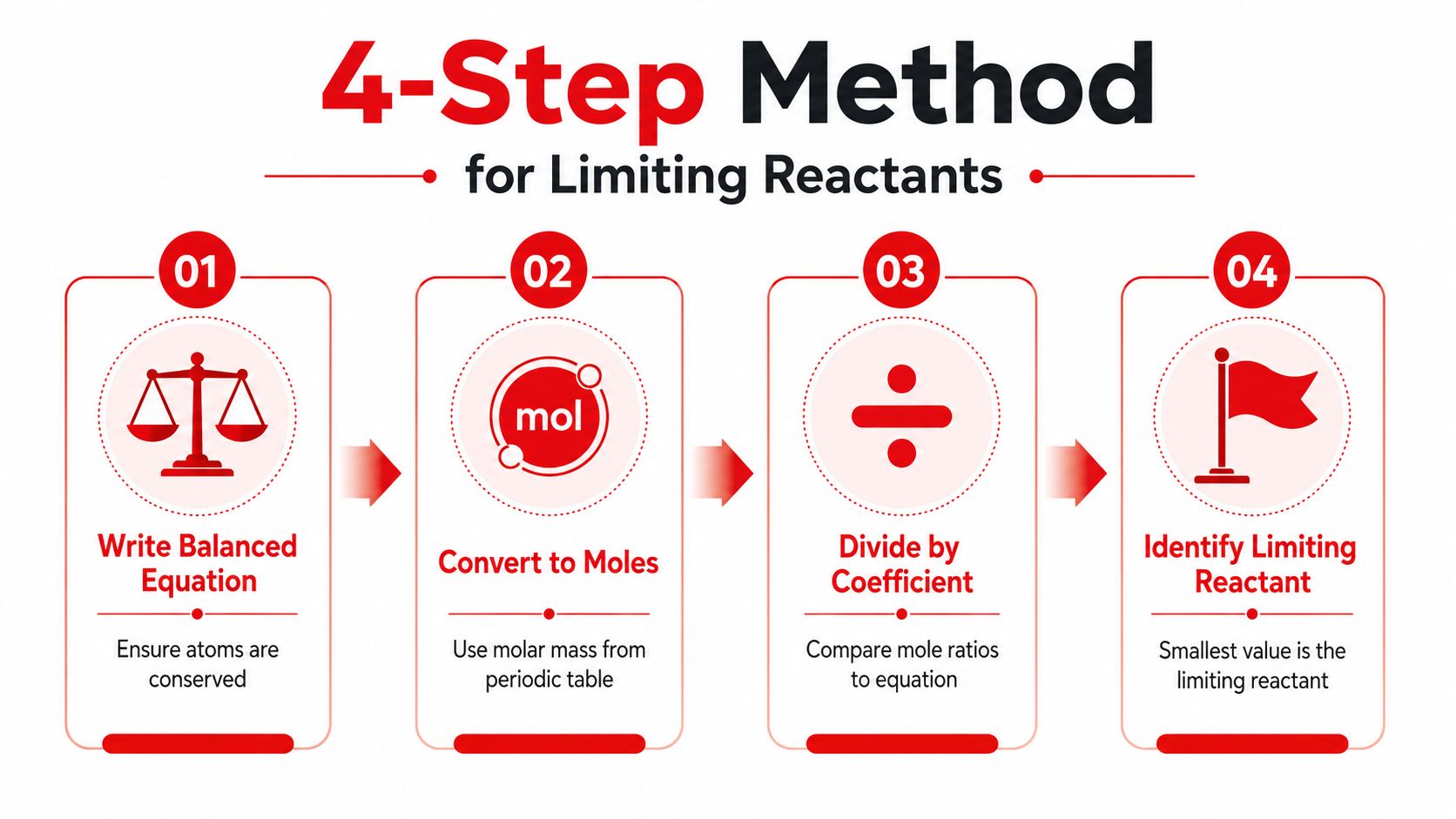
Step 1, balance the equation
Start with a balanced equation. The coefficients are the mole relationship between reactants and products, and without that map, every later step becomes guesswork. If the equation is not balanced, the comparison is meaningless.
Step 2, convert every given amount to moles
Students usually stumble here. A problem may give grams, solution concentration and volume, or even density-based liquid data, but the comparison only makes sense in moles. You cannot compare raw grams to grams and expect the coefficients to fix the setup later.
Step 3, calculate product from each reactant
Treat each reactant separately and ask, “How much product could this one make if it were the only reactant controlling the reaction?” That is the cleanest way to see the cap each reactant places on the process. If one reactant can make more product than the other, it is not the bottleneck.
Step 4, pick the smaller product amount
The reactant that produces less product is the limiting reactant. In a simple worked comparison, if reactant A can form 3.2 mol of product and reactant B can form 2.7 mol, B is limiting because it stops the reaction at 2.7 mol. That single comparison tells you the theoretical yield and how much excess is left.
Use this MCAT formula sheet as a companion while you practice, especially if you are still building speed with stoichiometric setup.
Worked Examples to Practice the Method
The fastest way to get comfortable is to watch the same logic survive different numbers. One example can feel neat and obvious, but two examples with different coefficients and inputs show you what the method looks like when the question stops being friendly.

Example 1, straightforward mass to mass
Take the reaction 2H₂ + O₂ → 2H₂O. Suppose you're given 4.0 g of H₂ and 32.0 g of O₂. First, balance the equation, which is already balanced here. Then convert both reactants to moles.
Hydrogen, 4.0 g ÷ 2.016 g/mol = 1.98 mol H₂. Oxygen, 32.0 g ÷ 32.00 g/mol = 1.00 mol O₂. Now compare how much water each could make. Hydrogen uses the 2:2 relationship with water, so 1.98 mol H₂ → 1.98 mol H₂O. Oxygen uses the 1:2 relationship, so 1.00 mol O₂ → 2.00 mol H₂O.
Hydrogen makes less product, so H₂ is the limiting reactant. Oxygen is excess. The key move wasn't the arithmetic, it was making both product predictions before deciding.
Example 2, a messier coefficient comparison
Now use N₂ + 3H₂ → 2NH₃ with 2.0 mol N₂ and 4.0 mol H₂. From nitrogen, 2.0 mol N₂ × 2 mol NH₃ / 1 mol N₂ = 4.0 mol NH₃. From hydrogen, 4.0 mol H₂ × 2 mol NH₃ / 3 mol H₂ = 2.67 mol NH₃.
Hydrogen produces less ammonia, so H₂ is limiting. Nitrogen is excess. If you want more practice with problems like this, the online MCAT practice questions are a good place to repeat the same setup until it feels automatic.
The reason this works is simple. You're not comparing what the reactants look like at the start, you're comparing the product each one can support. That's the whole game.
If you only remember one habit from these examples, make it this, compute the product from each reactant separately before you choose the limiter.
The Fast MCAT Shortcut for Identifying Limiting Reactants
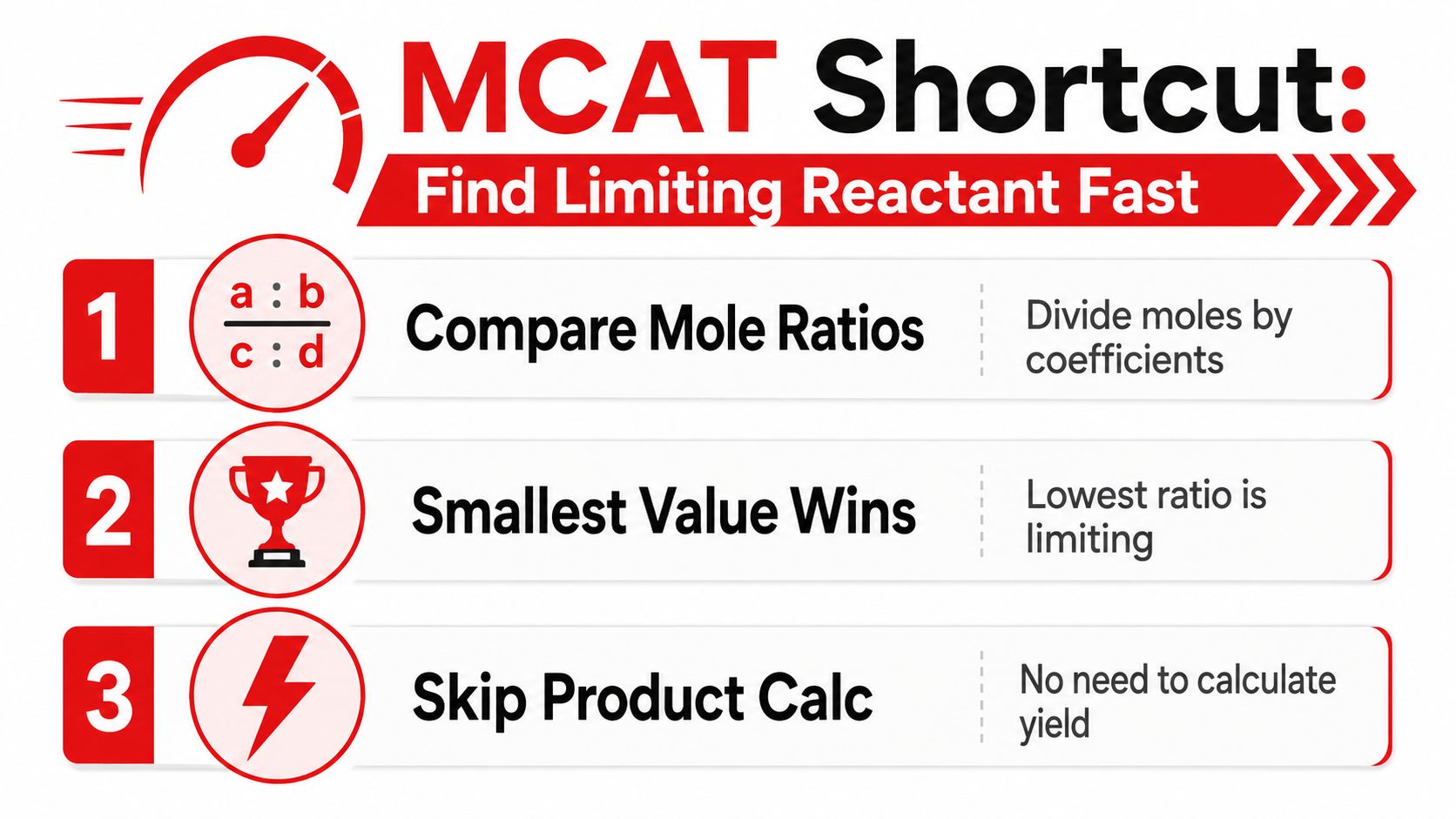
On a timed exam, you don't always want to run the full product calculation twice. A faster shortcut is to divide each reactant's moles by its coefficient in the balanced equation, then compare the resulting ratios. The smallest mole-to-coefficient ratio marks the limiting reactant. That exact rule is commonly taught in chemistry instruction, and it works because it measures how much of each reactant is available relative to what the equation demands YouTube chemistry lecture.
Why the shortcut works
A balanced equation tells you the proportion of moles each reactant needs. Dividing by the coefficient turns each reactant into a “how much do I have per required amount?” comparison. The lower ratio means that reactant is closer to being consumed, so it limits the reaction first.
That's why the shortcut and the full product method always agree. They're just two ways of asking the same question. One asks, “Which reactant makes less product?” The other asks, “Which reactant has less available per stoichiometric requirement?”
A quick side-by-side check
Using N₂ + 3H₂ → 2NH₃, with 2.0 mol N₂ and 4.0 mol H₂:
- Nitrogen ratio: 2.0 ÷ 1 = 2.0
- Hydrogen ratio: 4.0 ÷ 3 = 1.33
Hydrogen has the smaller ratio, so it's limiting. That matches the full product-calculation method exactly. This is the version to lean on when time gets tight, especially if the problem looks clean and the coefficients are easy to work with.
If you ever wonder whether calculators are allowed on the exam, check the specific policy notes in this MCAT calculator guide. It's better to know your test-day constraints before you start drilling speed.
Common Mistakes Pre-Med Students Make
The biggest mistake is comparing raw amounts without respecting the coefficients. A student sees more grams or more moles of one reactant and assumes it must be the excess one, but stoichiometry doesn't care about raw quantity. It cares about proportion.
A second mistake is stopping after naming the limiter. That's only half the job. The problem often asks for leftover excess reagent, theoretical yield, or percent yield, and those answers come from the limiting reactant, not from a guess based on the starting amounts.
Mixed-unit problems cause a third kind of panic. One reactant may be given as grams, another as molarity times volume, and a third as a liquid with density information. The fix is always the same, convert every input to moles before you compare anything. A problem only becomes confusing when students try to compare incompatible units.
Watch the units first. If the givens aren't all in moles yet, the limiter isn't ready to be identified.
| Common Limiting Reactant Mistakes and Fixes | How to Fix It |
|---|---|
| Comparing grams directly | Convert all reactants to moles first |
| Ignoring balanced coefficients | Divide moles by the coefficient or calculate product from each reactant |
| Naming the limiter too early | Finish the product comparison before choosing |
| Getting stuck on mixed inputs | Translate grams, molarity, volume, or density into moles before comparing |
| Forgetting excess reagent | Use the limiting reactant to find what remains unreacted |
A lot of simplified tutorials stop at the first answer, but the exam rarely does. If your question includes a solution concentration or a liquid volume, slow down and translate the input before you do anything else. That's the difference between a clean stoichiometry chain and a rushed guess.
The same pattern shows up repeatedly in the MCAT mistake guide, because the error usually isn't the chemistry. It's the setup.
Calculating Excess Reagent and Percent Yield
Once you know the limiting reactant, the rest of the calculation gets more concrete. The limiter tells you how far the reaction can go, and that same amount of reacted material tells you how much of the other reactant is left over. In other words, limiting reactant, excess reagent, and product formed are all part of one chain.
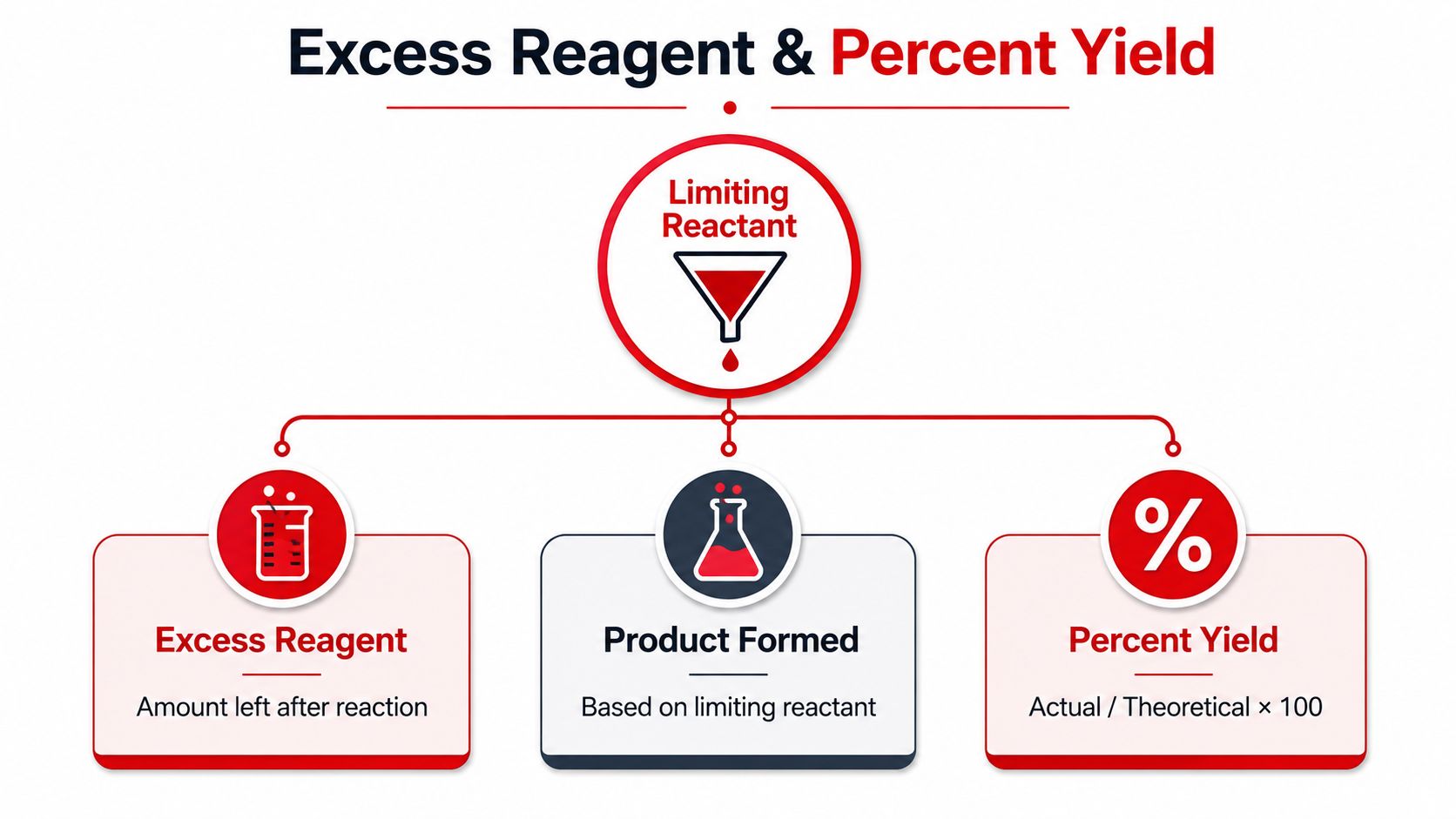
Finding the excess reagent left behind
Start with the limiting reactant and use the balanced equation to figure out how much of the excess reactant was consumed. Then subtract that from the original amount. That leaves the amount still sitting in the flask, beaker, or reaction vessel.
Using N₂ + 3H₂ → 2NH₃ again, if H₂ is limiting, the amount of N₂ consumed depends on the mole ratio. If 4.0 mol of H₂ reacts, that amount corresponds to 4.0 × 1 mol N₂ / 3 mol H₂ = 1.33 mol N₂ used up. If you started with 2.0 mol N₂, the leftover excess is 0.67 mol N₂.
Moving into percent yield
Percent yield compares the actual yield to the theoretical yield using the standard ratio of actual divided by theoretical, then multiplied by 100. Theoretical yield comes from the limiting reactant, so this step only works cleanly if you already identified the limiter correctly. If the problem gives you actual mass, divide that by the theoretical mass and convert it into a percentage.
If you want a clean calculator for that final step, thecalcs percent yield calculator can help you check your setup after you've done the stoichiometry by hand.
The yield step is never separate from the limiting reactant step. It's the same reaction story, just ending with real lab data instead of theoretical paper chemistry.
That's why strong test-takers treat excess reagent and percent yield as follow-through, not as new topics. If the limiter is wrong, the leftovers are wrong too, and the percent yield becomes meaningless.
Final Tips for Exam Day Success
When you face a limiting-reactant question, start with the balanced equation, then convert every input to moles before you compare anything. If the numbers are messy, don't panic, the mixed-unit translation is usually the hardest part, not the ratio test. Once everything is in moles, either compute product from each reactant or use the mole-to-coefficient shortcut and choose the smallest value.
Use the full product method when the problem feels unfamiliar, especially if the givens include grams, solution data, or density. Use the shortcut when the setup is already clean and time is tight. Either way, don't stop at naming the limiter if the question also asks for excess reagent, theoretical yield, or percent yield.
Double-check the coefficient attached to each substance. That one detail keeps students from comparing the wrong ratio and walking away with a confident wrong answer. If you slow down for ten seconds at that point, you usually save the whole problem.
The best MCAT habit here is consistency. Same setup, same unit conversion, same comparison, every time.
Ace Med Boards helps pre-meds build that kind of consistency with targeted tutoring and exam strategy that fits the way high-stakes chemistry questions are written. If you want more practice turning mixed-unit stoichiometry into clean limiting-reactant answers, visit Ace Med Boards and start building the speed and confidence you'll want on test day.