Doing more MCAT practice questions isn't automatically the fastest path to improvement. The higher-value habit is to review each passage closely, identify why you missed an item, and apply that lesson to an unseen problem. The MCAT rewards reasoning with unfamiliar information, not recognition of questions you've already memorized.
The plan below treats practice as a learning system. It covers the four official sections, the AAMC resource ecosystem, original passage-review methods, error logging, timing, and the point at which targeted MCAT tutoring may complement independent study. No practice plan can guarantee a score, admission, or test outcome, but a disciplined review process can make your preparation more focused and measurable.
Why More Questions Do Not Guarantee a Higher Score
A growing question total can hide stagnant performance. If you repeatedly misread experimental variables, confuse correlation with causation, overlook a unit, or select an answer that sounds familiar without passage support, more unreviewed questions rehearse the same mistake.
The MCAT contains 230 questions across four sections: Chemical and Physical Foundations of Biological Systems, Critical Analysis and Reasoning Skills, Biological and Biochemical Foundations of Living Systems, and Psychological, Social, and Biological Foundations of Behavior, according to the AAMC overview of the MCAT exam. Because the exam asks you to interpret evidence and apply knowledge to unfamiliar situations, memorizing content alone is not enough. Passage interpretation, timing, and answer selection must be practiced together.
The useful unit is the reviewed mistake
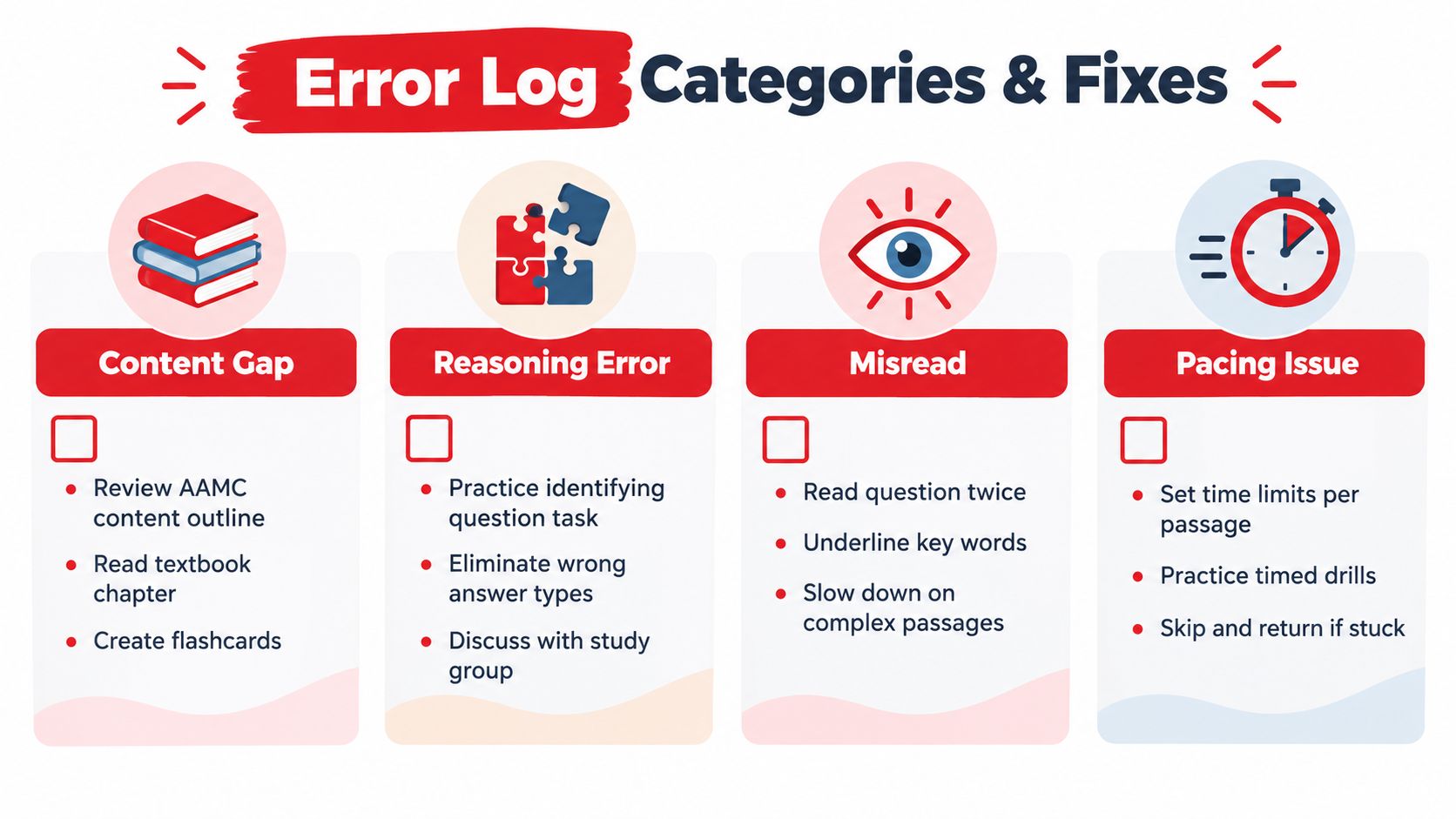
Treat each missed or flagged item as a diagnostic record. Before reading the explanation, identify the failure mode:
- Content gap: You did not know or could not retrieve the relevant concept.
- Reasoning error: You knew the concept but applied it incorrectly to the passage or question.
- Misread: You missed a qualifier, comparison, negative phrase, axis label, or unit.
- Pacing issue: You understood the task but spent too long or rushed.
Each category points to a different correction. A content gap calls for targeted review and retrieval practice. A reasoning error calls for passage deconstruction and answer-choice analysis. A misread may require slower attention to qualifiers. A pacing issue calls for timed sets and a clear decision about when to move on.
A useful review resembles debugging a failed experiment. Find the first step where your interpretation diverged from the evidence, then record the correction in an error log. For every missed passage, write a brief summary of the experiment, the question's task, the evidence supporting the credited answer, and the flaw in each tempting distractor. Students examining the reasoning demands of comprehension can also review how reading assessments work.
The AAMC's official materials offer a calibration point. Its full-length practice exams contain 230 questions each, matching the MCAT's length and structure, while its practice and planning resources include question banks and sample materials. Use that similarity to judge passage interpretation, timing, and endurance, rather than treating completion volume as the goal.
Practical rule: Don't count a question as fully completed until you can explain why the credited answer wins and why the other options fail.
A detailed distractor analysis approach can help convert wrong options into evidence about your habits. Ten carefully reviewed questions can reveal more than a larger set completed without analysis. The aim is to reduce the number of times the same mistake returns.
Choosing the Right MCAT Practice Question Sources
A larger question bank does not automatically produce better preparation. Each source should have a defined job: official AAMC material calibrates you to the exam, while third-party questions provide extra repetition and explanations. Choose resources by format fidelity, explanation quality, passage design, and performance tracking, then review a smaller set carefully enough to identify why your reasoning failed.
The AAMC's core materials cover different stages of preparation. Its Online Section Bank includes 300 questions, the CARS Question Pack Volume 1 contains 120 passage-based questions, the Sample Question Guide includes 12 questions, and official practice exams contain 230 questions each. The AAMC also reports that online questions associated with the retired Official Guide were expanded to 120 free practice questions through its preparation resources.
A practical comparison
| Resource | Question Count | Format | Best Use Case |
|---|---|---|---|
| AAMC Section Bank, Volume 1 | 300 | Online passage-based and independent questions | Higher-level science reasoning and targeted practice |
| AAMC CARS Question Pack Volume 1 | 120 | Passage-based CARS questions | CARS passage interpretation and answer justification |
| AAMC Sample Question Guide | 12 | Three questions per section | Initial orientation to section styles |
| AAMC official practice exams | 230 per exam | Full-length, exam-like practice | Timing, endurance, passage sequencing, and readiness review |
| Khan Academy MCAT course linked by AAMC | 3,000 review questions | Review questions paired with instructional content | Supplemental content review and retrieval practice |
The AAMC describes the Khan Academy course linked through its preparation materials as containing 1,100 videos and 3,000 review questions. Its question materials can also support tracking by Foundational Concept, Content Category, and Skill category in the AAMC Sample Question Guide. Use those categories as labels in your error log. A cluster under one skill may require a reasoning adjustment, while scattered misses across one content category may point to a knowledge gap.
How to use third-party banks
Third-party questions are useful for practice volume, but their style may differ from AAMC questions. Before committing to a bank, inspect whether its passages require experimental interpretation, evidence-based conclusions, and separation of relevant from irrelevant details. An attractive explanation should address every option, because a distractor often reveals whether you misread the task, overextended the evidence, or relied on a familiar fact that the passage did not support.
Use third-party material to build repetition and test specific weaknesses. Save official AAMC questions for calibration, especially after you have established a review process. This approach prevents you from spending scarce official material before you can learn from each attempt. For a broader comparison of selection and sequencing, consult this guide to MCAT practice tests.
The AAMC has announced a CARS product transition. Its official MCAT preparation update states that CARS Question Pack Volume 1 is scheduled to stop being sold after September 14, 2026, and a new 575-question CARS Question Bank is scheduled to launch on September 30, 2026, with 166 new questions and 409 previously sold questions. Verify availability directly with AAMC, since product details may change before you organize your study plan around the transition.
A Repeatable Workflow for Reviewing Every Practice Passage
A practice question earns its value during review, not when you record a letter. Deep analysis of a smaller set can expose more recurring errors than rapid drilling through a large bank. Use one review sheet for science and CARS so each missed or uncertain item becomes evidence about your reasoning.
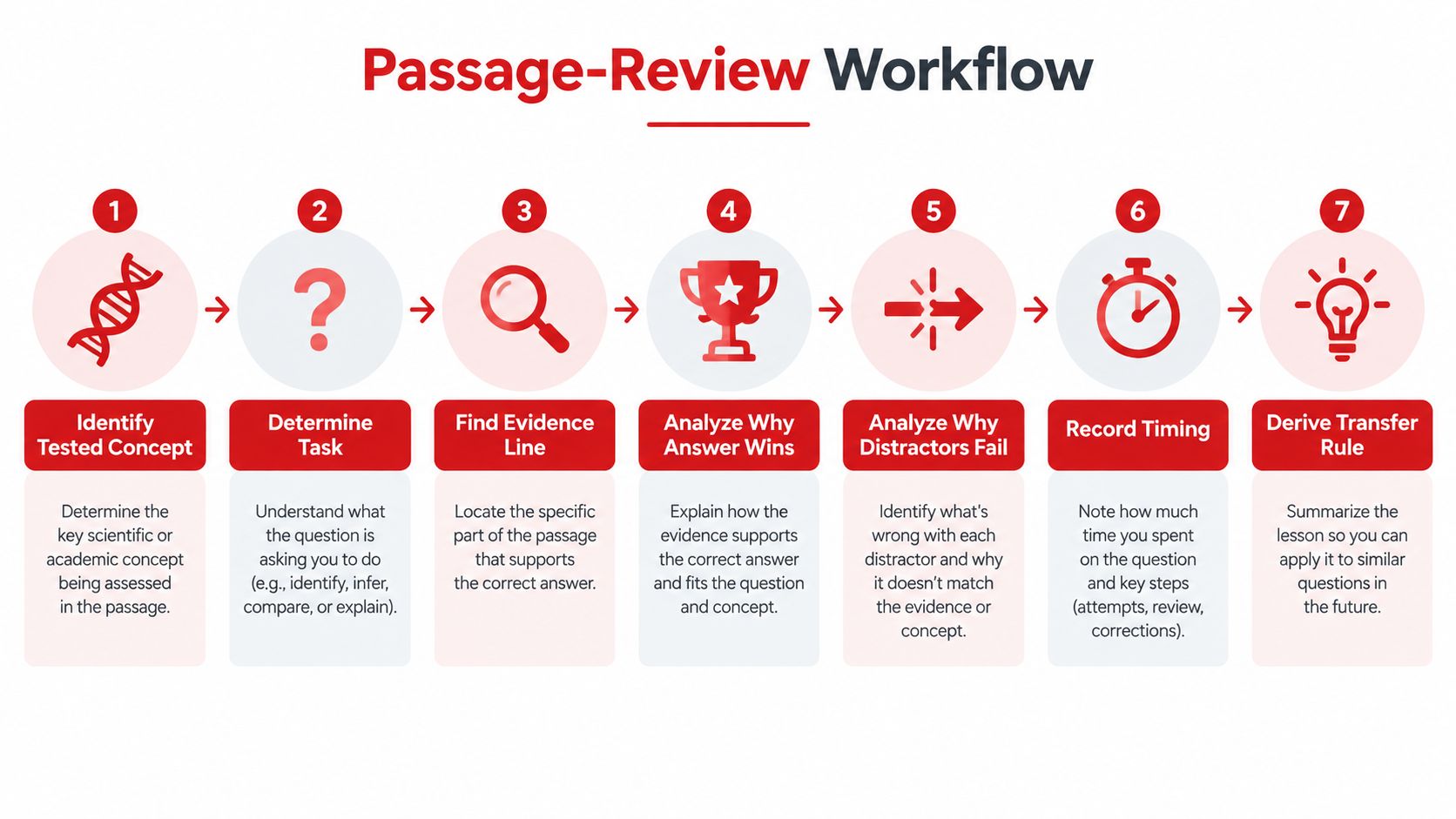
The seven fields to record
- Tested concept: Name the specific idea, such as enzyme inhibition, acid-base chemistry, experimental design, social stratification, or argument structure.
- Task: State what the question required. Did you need to interpret data, apply a definition, infer a result, identify an assumption, or select supporting evidence?
- Evidence line: Record the sentence, table feature, graph trend, or wording in the options that supports the credited answer.
- Why the credited answer wins: Explain the connection in your own words. If you cannot do so without copying the explanation, the reasoning is not yet secure.
- Why each distractor fails: Label the problem. An option may contradict the passage, answer a different question, overstate the evidence, or depend on outside knowledge.
- Timing: Note whether your pace supported accuracy or caused rushed reading and guessing.
- Transfer rule: Write one rule that applies to a new passage.
A useful transfer rule might be: “For the best explanation, identify the observed result first, then choose the mechanism that accounts for the evidence without adding unsupported assumptions.” That rule guides future reasoning. A copied fact does not.
An original example
A researcher compares two cell cultures, exposes them to different concentrations of a signaling molecule, and measures the proportion of cells expressing a target gene. The higher concentration produces more expression, but the passage also reports substantial variation between trials.
If the question asks which conclusion is most justified, record experimental interpretation as the concept, evaluating evidence as the task, and the concentration-response pattern plus trial variability as the evidence. The credited answer should describe the observed association. It should not claim that the molecule alone caused every change unless the design supports causation.
A distractor might assert a definite causal relationship while ignoring the variability. Another might conclude that the molecule has no effect because the results are not identical across trials. A third might extend the pattern to concentrations that were never tested. These options fail for different reasons, so labeling each error sharpens your future review.
Scientific reasoning often requires careful reading of tables, graphs, and charts. Guidance on MCAT research methods and statistics also emphasizes checking labels, units, controls, error bars, causation, and the limits of reported data. Make those checks visible on your review sheet instead of trusting a vague impression that the graph “looked right.”
Use an MCAT practice test to apply the workflow under realistic conditions. Review incorrect and flagged items before starting another full-length, and add repeated root causes to your error log.
The following embedded video offers another visual prompt for organizing passage analysis:
Consider a hypothetical learner who rereads CARS passages repeatedly, highlights too much, and misses inference questions. A focused correction would limit highlighting, require a one-sentence description of each paragraph's function, demand textual evidence for every answer, and test the rule on new AAMC-style passages rather than remembered items. The example is hypothetical, not a reported student result.
Building a Realistic Weekly Practice Schedule
More practice questions do not automatically produce better preparation. A useful week assigns time to solving, reviewing, and correcting the reasoning that caused each miss. Early work can prioritize accurate passage interpretation. Later weeks should add timed decisions, mixed passages, full-length endurance, and detailed review. The MCAT includes 6 hours and 15 minutes of content time and approximately 7 hours and 30 minutes of total seated time, according to the AAMC exam description.
A flexible weekly framework
| Day | Main Practice | Review and Recovery |
|---|---|---|
| Monday | Timed science passages from a selected section | Review every miss and update the error log |
| Tuesday | Untimed CARS passage analysis and targeted content retrieval | Light evening or rest period |
| Wednesday | Full-length or substantial mixed-section practice | Review answers and classify root causes |
| Thursday | Targeted content review based on logged errors | Complete a smaller timed passage set |
| Friday | Mixed timed passages across science sections | Analyze distractors and record transfer rules |
| Saturday | Full-length simulation when appropriate | Review in manageable blocks, then rest |
| Sunday | Psychology, Social, and Biological Foundations retrieval practice | Plan the next week from error patterns |
Treat this framework as a starting structure, not a fixed calendar. During early preparation, complete some passages untimed and explain the author's purpose, evidence, and answer choices before adding pressure. Timing works like a second layer of difficulty. Add it after your reasoning is accurate enough to examine clearly. If timed work produces repeated misreads, reduce the question volume and repair the reading process first.
A structured MCAT study schedule can help you match practice intensity to the time available. Reserve enough time to review each passage thoroughly. Five carefully examined questions can teach more than a large set rushed through without identifying why the distractors failed.
When to use full-length exams
Use a full-length exam to answer diagnostic questions, not merely to generate a score. Check where fatigue affected comprehension, whether timing deteriorated in one section, and which root causes appeared across multiple passages. Review the exam before scheduling another one, then let those findings determine the next week's practice.
Recovery matters: A schedule with no time for review, sleep, or learning consolidation can create more activity without improving reasoning.
Choose official full-length materials when you need the closest available match to the test format. Supplementary exams can build endurance, but differences in wording and difficulty require cautious interpretation. A full-length is most useful when its passages become a map of what to repair, rather than a verdict on your ability.
Tracking Errors to Close Content and Reasoning Gaps
More practice questions will not repair an error you have not explained. An error log becomes useful only when it changes your next study action. “Missed metabolism” is too broad. Record whether you lacked biochemical knowledge, misread an experiment, overlooked a comparison, misunderstood the question, or lost accuracy under time pressure. Treat each mistake like a symptom: the correction depends on the underlying cause.
Match the error to the fix
| Root Cause | Diagnostic Question | Appropriate Response |
|---|---|---|
| Content gap | Could you explain the concept without the passage? | Review the relevant AAMC content outline topic, retrieve it from memory, and practice a focused set |
| Reasoning error | Did you know the facts but choose an unsupported interpretation? | Reconstruct the task, cite evidence, and compare answer-choice logic |
| Misread | Did you miss a qualifier, unit, axis, or negative phrase? | Reread deliberately and mark the exact wording that changed the answer |
| Pacing issue | Did time pressure cause an otherwise avoidable miss? | Use timed drills, set passage checkpoints, and practice moving on when stuck |
The AAMC Section Bank's performance tracking by Foundational Concept, Content Category, and Skill category provides useful labels for finding patterns. Combine those categories with your own root-cause notes. A cluster of misses in one topic may indicate missing content. The same error across biology, chemistry, and psychology may instead reveal a broader reading or reasoning problem.
Turn the log into a weekly plan
At the end of each study cycle, sort your entries into three groups:
- Repeated errors: Address these first because they recur across questions or sections.
- Single misses with clear explanations: Record the lesson, then check whether it transfers to a new item.
- Uncertain classifications: Revisit the passage and explanation rather than forcing a premature conclusion.
Your log should lead to a specific follow-up task. After reviewing a targeted concept or reasoning process, complete an unseen passage that tests the same skill in a different context. A correct answer counts as progress only when you can explain why the evidence supports it and why the alternatives fail. If you recognize the content but repeat the reasoning error, keep the issue active and adjust the practice task rather than adding more questions.
Record confidence alongside accuracy. A correct answer chosen by guessing deserves review because the result may not reflect a reliable process. An incorrect answer reached through sound reasoning may point to a narrow knowledge gap rather than a general strategy problem. This distinction keeps your study time focused: repair the cause, test the repair, and let the next set of MCAT practice questions confirm whether the change holds.
When to Seek Targeted MCAT Tutoring
More questions will not solve an error you cannot explain. Self-study works when your review identifies the cause of each miss and your schedule responds to that evidence. Targeted tutoring becomes useful when the same problem persists after consistent, specific review, or when you cannot tell whether the bottleneck is content knowledge, reasoning, reading, or pacing.
Consider individual support when:
- Your error log lacks a pattern: A tutor can help classify misses and separate a knowledge gap from an execution problem.
- CARS reasoning remains unclear: If you know the passage topic but cannot support an answer with textual evidence, guided passage deconstruction can show where your interpretation changes direction.
- Timing changes your accuracy: A tutor can observe your process and help set rules for skipping, returning, and estimating rather than letting the clock dictate each decision.
- Your study plan is too broad: Logged errors can determine which concepts and question types deserve review, replacing unfocused rereading with deliberate practice.
- Test anxiety disrupts practice: Structured sessions offer a controlled setting to rehearse timing and review habits without judgment.
Tutoring should complement official AAMC materials, retrieval practice, and full-length review. Ask providers how sessions are organized, whether they examine passages line by line, how progress is recorded, and how recommendations change as your error pattern changes. A useful tutor should make your independent work more precise, not make you dependent on explanations.
Ace Med Boards provides MCAT preparation support that includes individualized guidance tied to practice-question analysis and study planning. You can compare different MCAT tutoring services and decide whether the format fits your needs, budget, schedule, and preferred learning style.
Ask yourself, “What specific mistake can I now prevent on an unfamiliar passage?” The answer should guide your review sheet, error log, and next practice decision. If your MCAT practice questions produce repeated misses without a clear explanation, Ace Med Boards can help you assess whether targeted question-review support fits your current AAMC materials and study plan.