What's the point of adding a Master of Public Health if it doesn't change the work you're trying to do? For medical students and residents, that's the right question. An MPH is worth it only if you want stronger population-health, policy, biostatistics, or systems training that supports a specific career move, not just another line on your CV.
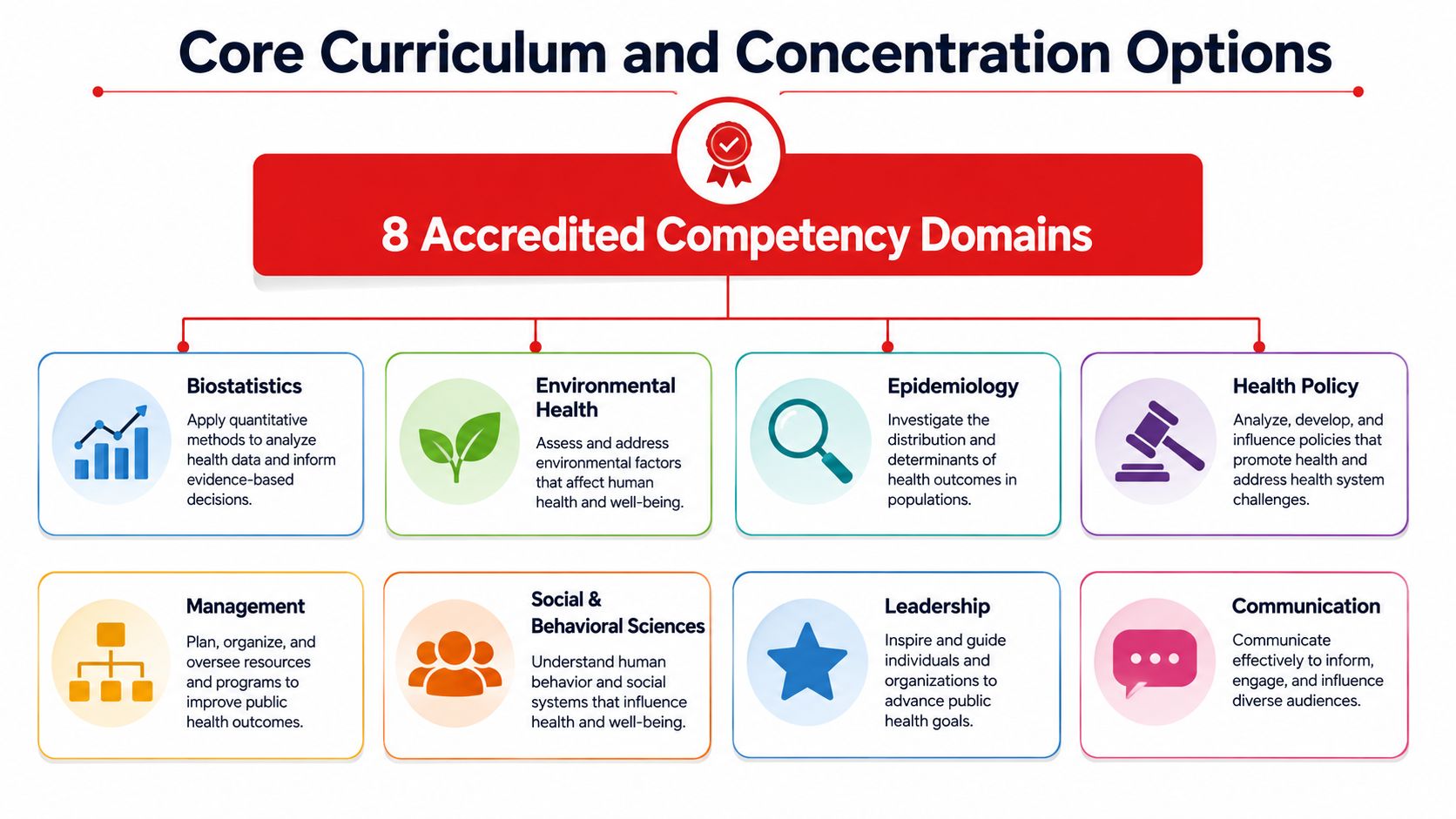
The degree has real substance. Johns Hopkins traces the MPH to an early Certificate in Public Health that was later renamed to emphasize academic quality and standardize the credential, and World War II helped accelerate program growth before the degree became a training pipeline for institutions such as the CDC and WHO (Johns Hopkins MPH history). Modern accredited MPH programs are built around 22 foundational competencies across 8 domains, so this is not a vague generalist degree. It's a structured credential for people who need measurable public-health skills.
What a Master of Public Health Actually Is
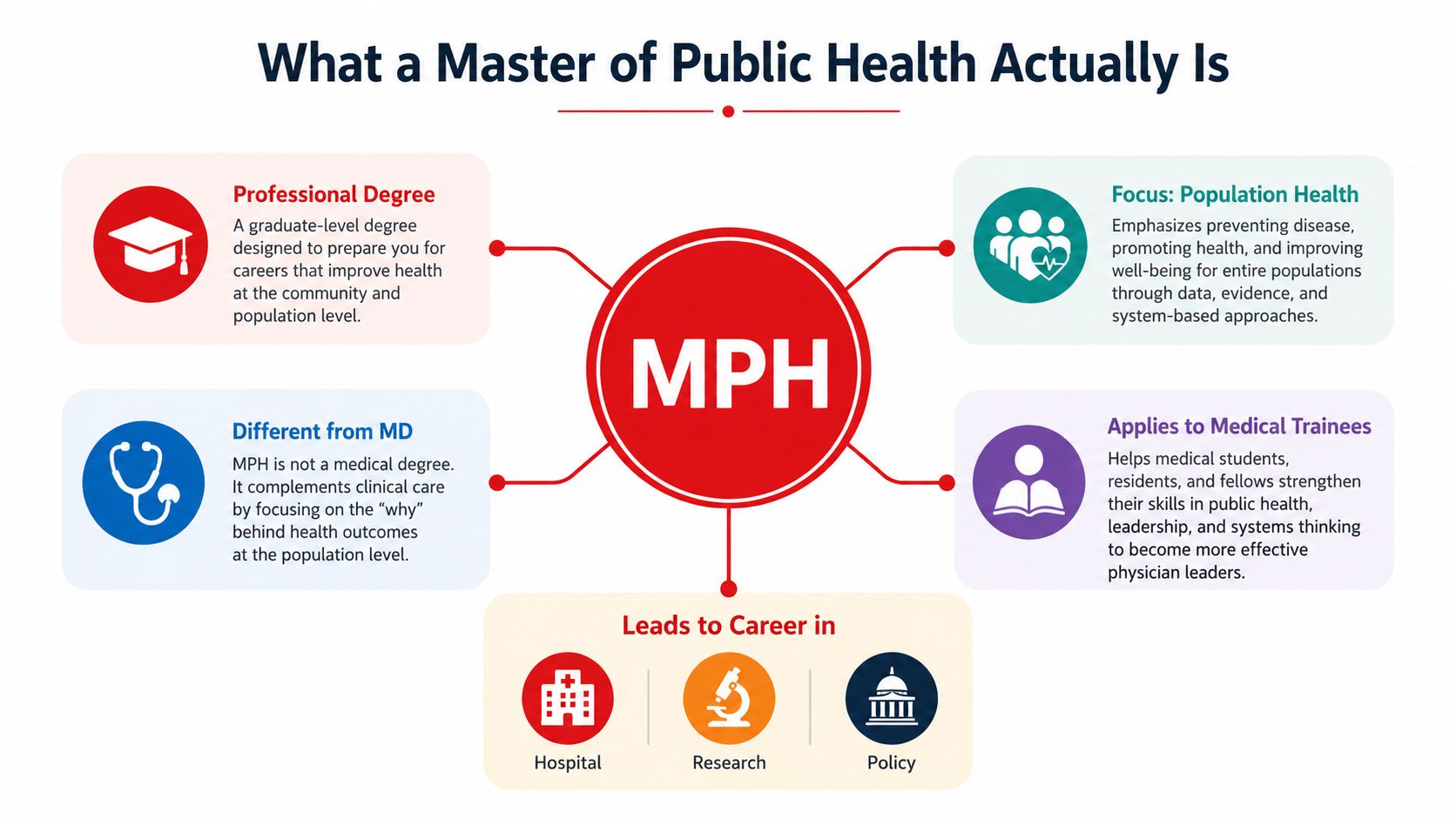
A Master of Public Health is best understood as a professional degree for people who want to shape health at the population level. For medical trainees, that matters because the MPH is not just about “interest in public health.” It trains you to think in terms of surveillance, prevention, program design, and systems rather than only individual diagnosis and treatment.
Why the degree looks different now
The modern MPH is competency-based. Accredited programs are organized around 22 foundational competencies across 8 domains, including evidence-based approaches, health systems, planning and management, policy, leadership, communication, interprofessional practice, and systems thinking (CEPH-aligned competency framework). That framework gives employers something concrete to evaluate. They can look at what you can do, not just the title of a course on your transcript.
That shift matters for medical students and residents because it makes the MPH easier to use strategically. If you want epidemiology, biostatistics, or health-policy work, you should ask whether a program trains analytic decision-making well, not whether it offers a broad menu of electives. An MPH with weak skill development is a weak investment.
Practical rule: Choose an MPH for skill acquisition, not for prestige. If the program doesn't strengthen your ability to analyze data, interpret evidence, or design systems-level interventions, it's probably not the right use of your time.
A useful way to think about it is this. An MPH is closer to professional training than to pure academic research, even though many programs include research methods. That's why it sits differently from a research-heavy MS or PhD. Medical trainees who want a public-health role should care less about the label and more about the competencies the curriculum builds.
For a medical student deciding whether public-health training belongs in a career plan, it helps to start with quantitative thinking. If biostatistics feels like a weak area, a practical starting point is the biostatistics for USMLE Step 3 resource, because many MPH pathways rely on the same statistical reasoning mindset even if the context changes.
Core Curriculum and Concentration Options
The core MPH curriculum is more disciplined than a lot of applicants expect. Accredited programs are supposed to teach the same competency backbone, but the concentration you choose determines where that backbone gets applied. A student focused on epidemiology will build a very different professional profile from someone who leans toward health policy and management.
What the core curriculum actually demands
CEPH-aligned competency lists include applying epidemiological methods, selecting quantitative and qualitative data collection methods, analyzing data using biostatistics and informatics, and interpreting results for research, policy, or practice (2024 competency list). That is the center of the degree. If a program doesn't push you toward those skills, it's not doing the job well.
The core domains also push students into public-health work that feels immediately practical. Planning and management shows up in how programs are designed. Policy shows up in how interventions get funded and implemented. Systems thinking matters because public health fails when people treat one clinic, one outbreak, or one community problem as isolated.
How concentrations change your trajectory
A concentration should match the kind of problems you want to solve.
- Epidemiology works if you want to study disease patterns, outbreaks, and prevention strategies.
- Biostatistics fits people who like quantitative methods and evidence interpretation.
- Health policy and management suits trainees drawn to administration, regulation, and health-system design.
- Environmental health is a fit for people who want to connect exposures, risk, and prevention.
- Community health sciences makes sense for work tied to education, behavior change, and outreach.
The mistake is choosing a concentration because it sounds broad or prestigious. Pick the one that sharpens your day-to-day decision-making. If you're trying to become a better clinician who can interpret population data, a concentration aligned with analytics and systems will serve you better than one chosen for vague versatility.
For a closer look at the analytical side of the degree, the epidemiology resource is a useful companion if you're comparing MPH training with other quantitative paths.
Program Formats and Dual Degree Paths
Format matters because the wrong schedule can wreck the value of the degree. A full-time MPH works for people who can pause other obligations. A part-time or online MPH works better for residents or practicing physicians who can't afford to step away from clinical training. The format should fit your stage of training, not just your ambition.
Which format fits which trainee
| MPH Program Format Comparison | Typical Duration | Flexibility | Best For |
|---|---|---|---|
| Full-time MPH | Usually the fastest path | Lower flexibility | Students who can dedicate themselves to coursework and practicum work |
| Part-time MPH | Slower completion | Higher flexibility | Residents and working physicians who need to keep clinical duties |
| Online MPH | Depends on school structure | High flexibility | Learners balancing training, family, or relocation limits |
| MD/MPH or DO/MPH dual degree | Integrated into medical school planning | Moderate flexibility | Medical students who want public-health training without fully stepping away from medicine |
Dual-degree paths are especially relevant for medical students because they let you layer public-health thinking onto clinical training rather than treating it as a separate career. The strongest use case is a student who already knows they want to work in policy, population health, health systems, or academic medicine. If you're still undecided, a dual degree can become expensive detour territory.
How to choose without wasting time
Dual-degree programs usually work best when you can fold MPH coursework into medical school scheduling, often during a research block or around the later clinical years. That structure helps if you already know the public-health work you want to do. It's a weak choice if you're using the MPH to escape uncertainty, because the degree won't solve lack of direction.
Best-fit test: If you can name the exact role the MPH helps you reach, the format choice is probably straightforward. If you can't name the role, pause before enrolling.
Residents should think differently. For them, online or part-time training usually makes more sense because the degree has to coexist with call schedules, rotations, and licensing pressures. The point is efficiency, not romance.
If you want to present your MPH work clearly in later residency or fellowship interviews, it helps to connect the degree to concrete outputs. A practical reference is how to present research findings, because public-health training only matters if you can explain what you did and why it mattered.
Career Outcomes and Salary Realities
An MPH can strengthen a medical career, but it does not flatten the job market. Sector, geography, and work authorization still shape what you earn. If you are an international graduate, weigh the credential against the fact that ROI differs sharply by country and by employer type.
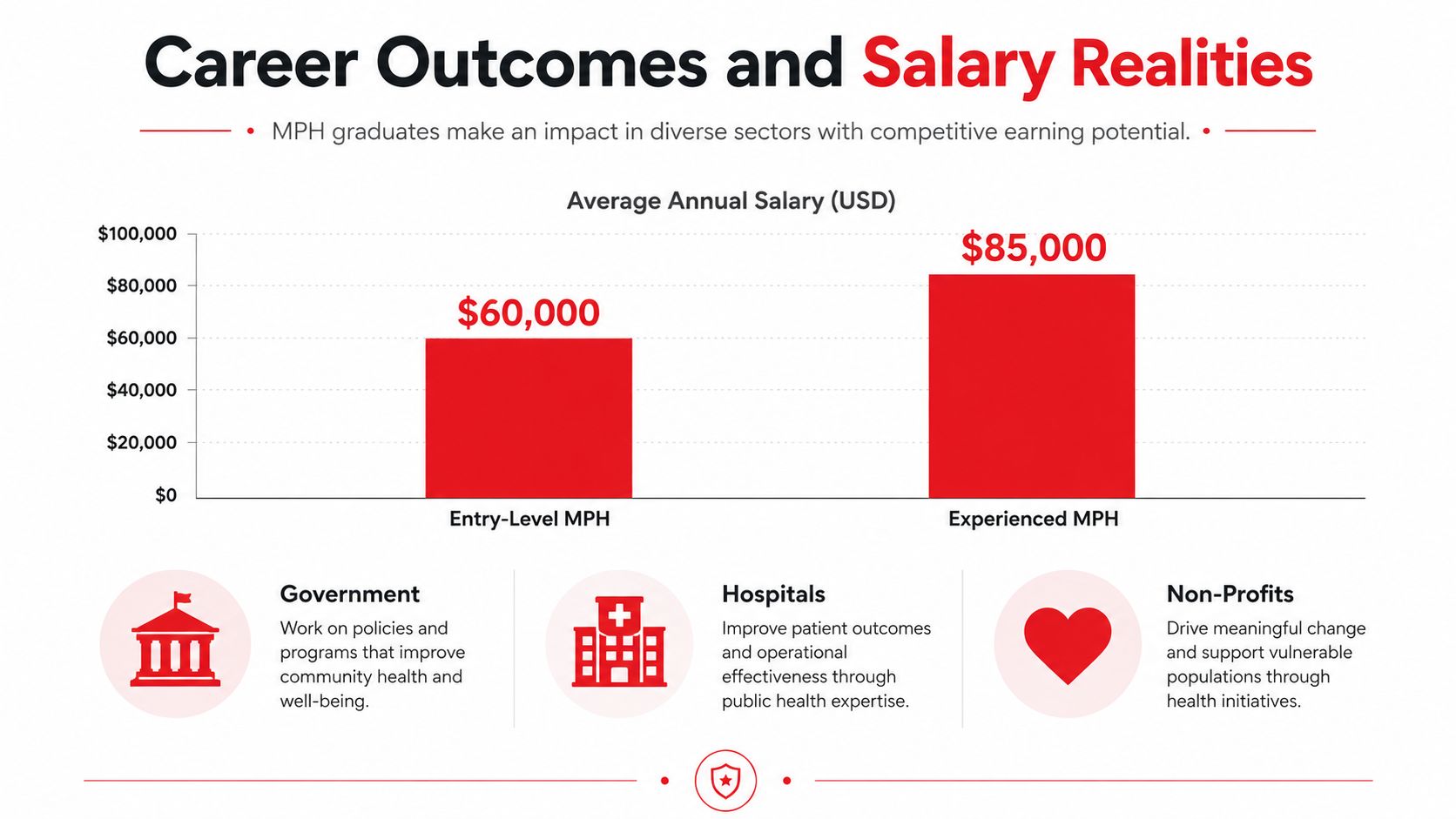
What the labor market looks like
One public-health-school outcomes report found an average MPH salary around $55,600 overall, with higher averages in private-sector roles than in nonprofit or government work (MPH salary outcomes study). That is the main takeaway. The degree itself does not set your compensation. The sector you choose does.
A separate university salary outlook page gives a useful, narrower snapshot of reported outcomes in specific settings, including estimates around $78,000 for U.S.-oriented MPH roles and lower figures in the UK, with entry outcomes closer to £23,495 to £43,709 (salary outlook coverage). Treat that as a program-level outlook, not a universal market rate. ROI depends on market, role, and whether you can legally work in the country where you plan to practice.
There is also a demand signal to watch. A recent Think Global Health report said MPH programs saw a 15% enrollment decline amid public-health backlash (enrollment coverage). That does not erase the degree's value. It does mean applicants should stop assuming public health offers automatic growth or prestige.
What this means for residency and clinical careers
For medical students and residents, an MPH helps when it supports a coherent academic or service story. That matters most in specialties that value research, prevention, quality improvement, and population health work. It is not a shortcut into residency.
An MPH helps when it makes your application sharper. It hurts when it reads like a generic add-on.
Use it to produce something concrete. Will it help you publish, lead quality projects, or build a policy profile that target programs respect? If the answer is no, the investment is hard to defend.
For readers comparing how credentials and presentation shape professional signaling, the meaning of master's hood colors is a useful reminder that the symbol matters less than the work behind it. The same logic applies to an MPH.
Admissions Requirements and Application Timeline
Admissions are where an MPH stops being a vague idea and becomes a screening process. If you are a medical student or resident, that usually helps, but program requirements still vary enough to catch careless applicants off guard.
What schools ask for
Some programs want more than a transcript. Johns Hopkins says applicants need either 2 years of full-time, post-baccalaureate, health-related work experience or a doctoral degree in a field underlying public health (Johns Hopkins MPH admissions). That is a clear signal that select programs want maturity, not just interest.
Other schools publish straightforward academic thresholds. The University of Florida requires a U.S. bachelor's degree or equivalent, a 3.0 GPA after the first 60 undergraduate credit hours, and satisfactory English proficiency for international applicants. CEPH self-study material also notes that an MPH program or equivalent professional master's degree should be at least 42 semester-credit units long, and the University of Wisconsin–Madison expects at least one semester each of college-level mathematics and biology, chemistry, or physics before admission (CEPH self-study and UW–Madison prerequisites). The University of Pittsburgh expects MPH and certificate applicants to show six college credits in behavioral and social sciences with a C or better (Pitt admissions requirements). The point is simple. Many programs want evidence that you can handle graduate-level public health work before they admit you.
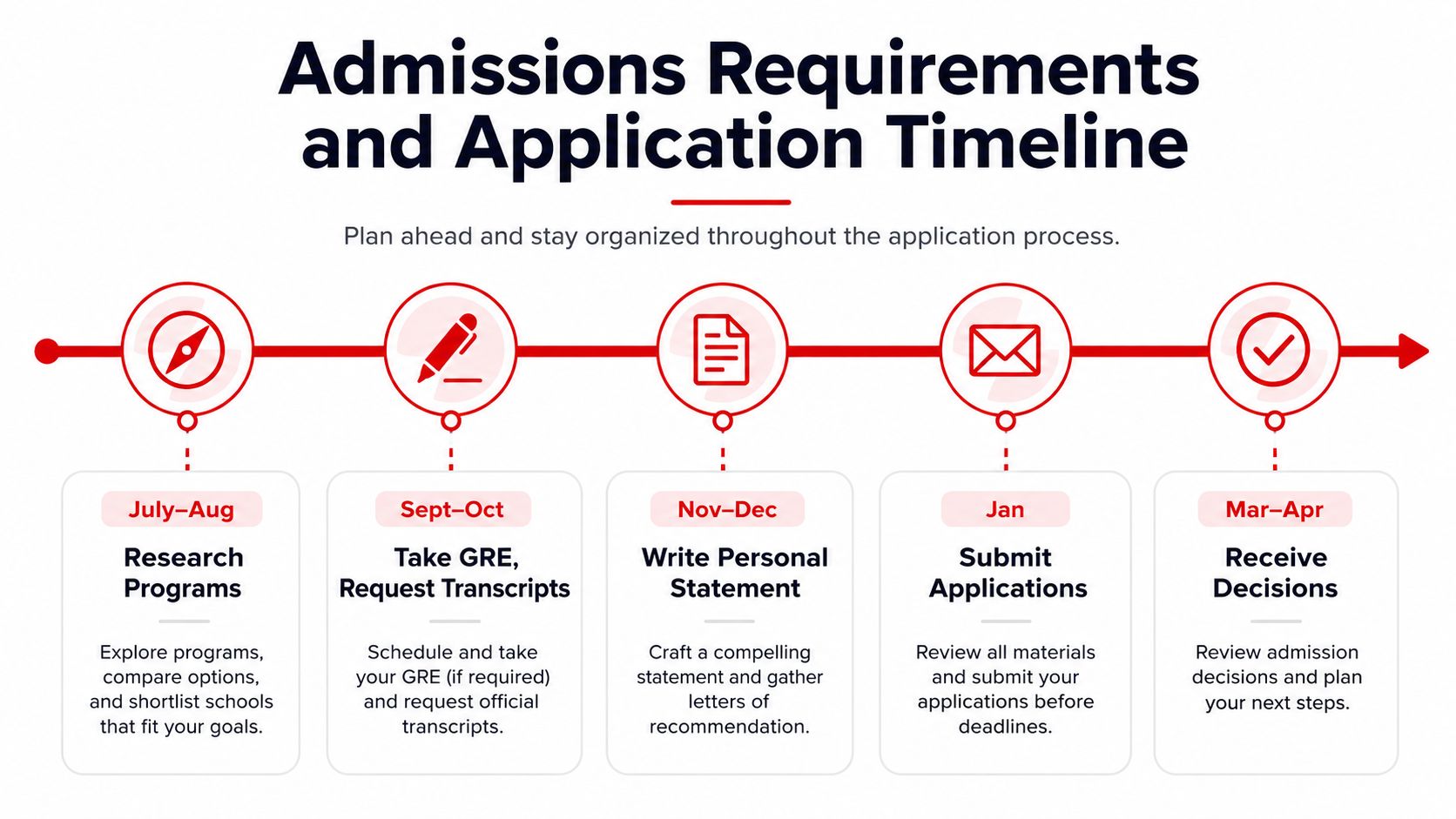
A realistic application rhythm
Start early and work backward from deadlines.
- July to August: Research programs and match prerequisites to your background.
- September to October: Request transcripts, confirm recommender availability, and finish missing coursework.
- November to December: Write a personal statement that ties the MPH to a real career goal.
- January: Submit applications.
- March to April: Review decisions and compare offers.
International applicants need extra time for credential review and English testing, so waiting until the final stretch is a bad move. If your file includes research or project work, use a research appraisal resource to show that you can judge evidence, not just repeat public health jargon. Committees notice substance fast.
Tuition Costs and Funding Strategies
Tuition is where enthusiasm meets arithmetic. MPH programs can be affordable at some public institutions and very expensive at others, especially once residency status enters the picture. If you don't run the numbers, you're guessing.
What the tuition data actually show
For 2025 to 2026, the University of Michigan School of Public Health lists full-time tuition of $18,550 per term for Michigan residents and $30,632 per term for non-residents (Michigan tuition and fees). That gap is large enough to change the entire financial picture of the degree.
That's why broad talk about “career flexibility” misses the point. The question is whether the salary path you expect can support the total cost of attendance in your target sector. A private-sector role may justify the expense more easily than a government or nonprofit position, but that depends on your actual job market and location.
How to think about funding
Look beyond tuition alone. Scholarships, fellowships, employer reimbursement, and federal student aid all matter. For dual-degree students, some institutions fold MPH costs into broader medical school financing, which can soften the blow. If you're already carrying major medical education debt, that detail matters more than glossy program language.
Funding rule: Don't compare only sticker price. Compare sticker price, likely debt, and the sector you expect to enter after graduation.
A practical funding search should start with institutional aid pages and end with a realistic budget. If the program's website doesn't clearly show aid pathways, ask directly before you apply.
For readers already in the scholarship-search phase, the scholarship opportunity page is a natural place to organize your next steps while you compare MPH costs against your other training obligations.
Is an MPH the Right Move for Your Career
Should you get an MPH? Only if it changes your training path in a real way. For medical students and residents, the degree makes sense when it supports policy work, hospital administration, academic research, quality improvement, or a population-focused clinical career. If you want a credential mainly for optics, skip it. The tuition and time are hard to justify.
Use this decision framework
Ask these questions in order.
- Do I have a clear public-health use case? If you cannot name the role, the MPH is probably too early or too vague.
- Will this degree strengthen my current training path? For residents and students, the strongest MPH fits research, quality improvement, policy, or systems work.
- Can I absorb the cost without regret? If tuition creates serious financial strain, the return has to be very strong.
- Am I choosing the right format? Full-time, part-time, online, and dual-degree paths solve different problems.
- Does the program train real competencies? Look for analytics, policy, and systems training, not just broad public-health branding.
For trainees, the core question is ROI. An MPH can help if it makes you a better candidate for the work you want. It can also be a poor trade if it adds debt without opening a clearer path.
What not to expect
Do not expect an MPH to guarantee a better residency match or a higher salary by itself. It will not. The degree helps only when it makes your career story more coherent and your skills more useful. That is the standard you should use.
Salary reality depends on sector. Private-sector roles can justify the cost more easily than government or nonprofit positions, while hospital administration and academic work may reward the degree in different ways. If you are already carrying major medical education debt, be honest about whether the added credential changes your options enough to matter.
If you are still unsure, talk to current MPH students, alumni, or faculty at programs you are considering. Compare their feedback with your training stage and your actual career target. If you cannot connect the degree to a defined outcome, wait.