What if the most useful response to a failed exam isn't choosing another test date, but understanding what must change before that date? After a confirmed failure on COMLEX-USA Level 2-CE, the recovery plan should begin with the official score report, an attempt-history check, and school advising, followed by targeted remediation and measurable readiness checks.
Students searching for “failed COMLEX Step 2” are generally referring to COMLEX-USA Level 2-CE, the Osteopathic Medical Licensing Examination of the United States Level 2 Cognitive Evaluation. A failed attempt is recoverable, but another attempt deserves a different preparation strategy, not just more hours with the same materials.
Ace Med Boards Editorial Team
Immediate Steps After a Failed Result
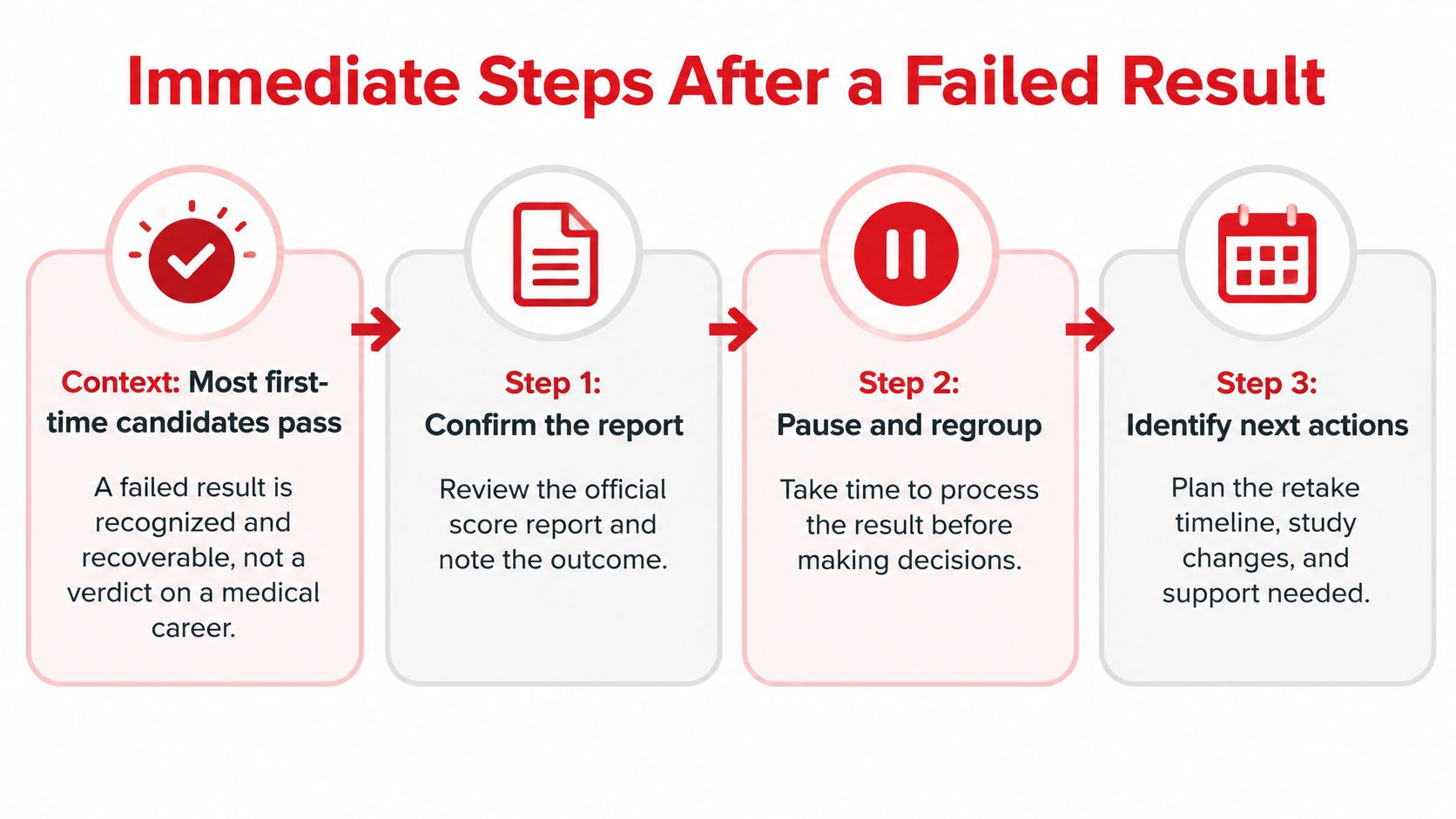
Most first-time candidates pass, and repeat candidates can also succeed. The Journal of Osteopathic Medicine article reports first-time and repeat-candidate Level 2-CE pass rates of 92.5% and 83.2%, respectively, for 2023–2024. Those group outcomes aren't individual predictions, but they support taking remediation seriously without treating failure as a verdict on a medical career.
The National Board of Osteopathic Medical Examiners (NBOME) administers COMLEX-USA. Academic advisors can help students distinguish clinical knowledge gaps, osteopathic manipulative medicine (OMM) concerns, question-analysis problems, and administrative requirements before another attempt.
The first administrative actions
Save the official report. Record the pass/fail designation and total standard score, using the report's passing standard for comparison rather than a remembered practice score.
Create an attempt chronology. Include the examination date, testing-window closing date, and result-release date, because these dates answer different eligibility and planning questions.
Contact student affairs or the dean's office. Request written clarification of academic standing, required remediation, rotation restrictions, and any leave or progression policies that apply.
Read school policies before contacting residency programs. The student handbook and advising office should establish what the school requires and records before the student makes application-timing decisions.
Check current score-review procedures. Consult NBOME's published information rather than assuming that an appeal exists, and obtain any applicable deadline and submission requirements in writing.
Pause major application decisions. Decisions about graduation, applications, and retesting should follow confirmed rules and school guidance, not results-day urgency.
A useful advising email attaches the official report and asks specific questions: What remediation is required? Who authorizes another attempt? Which academic deadlines are affected? Who will review readiness before registration?
Key takeaways
- Documents come before booking. The report and attempt history establish the starting point.
- School requirements need written confirmation. Informal advice from classmates isn't a substitute.
- Preparation must change deliberately. The recovery plan should name the problem and the method for correcting it.
- Readiness needs evidence. Confidence matters, but it shouldn't be the only reason to schedule.
Retake Rules and the Timeline That Follows
A failed attempt uses a limited testing opportunity. The NBOME eligibility bulletin establishes four scored attempts per examination level and a maximum of four attempts at the same level within a twelve-month period, with incomplete or voided attempts counting toward the latter limit.
These are separate counts. A student shouldn't assume that an unscored examination disappears from the scheduling calculation.
COMLEX-USA Level 2-CE attempt rules and timing
The standards below reflect the cited policy information, not a guarantee of eligibility for a particular booking. The student should record the date checked when reviewing the live bulletin before registration.
| Rule | Current NBOME standard (verify and date before booking) | What it means for your plan |
|---|---|---|
| Scored attempts per examination level | Four | Each failed attempt uses one of the four; count remaining attempts before choosing a date |
| Same level within any twelve-month period | Maximum four attempts | Incomplete or voided attempts count toward this limit |
| Passing standard | Three-digit standard score of 400 or higher | Pass/fail status is reported alongside the score |
| Result release | Generally two to six weeks after the relevant testing window ends | Build this gap into registration and application timing |
| Retake after passing | Not permitted merely to raise a passed score | A retake is for passing a previously failed examination, not score improvement |
| Waiting period between attempts | Obtain the applicable interval from the current NBOME bulletin or written NBOME confirmation | Confirm before booking; don't infer an interval from this table |
The bulletin also identifies prior Level 1 passage, completion of the required medical-school training, and dean certification of academic and professional standing as eligibility conditions. A student's ability to study independently doesn't establish administrative permission to test.
Build the calendar backward
Start with the date by which the school needs a passing result. Allow for the published result-release schedule, then identify a feasible examination window, registration requirements, and any applicable waiting period.
A hypothetical candidate with an earlier voided attempt should include that event when checking the rolling attempt window. Counting only score reports could produce the wrong conclusion about eligibility.
Booking rule: A calendar date isn't usable until both NBOME eligibility and school authorization are clear.
Students considering a date change can consult the COMLEX rescheduling guide for planning context, while confirming operative deadlines through the official registration process. Save the bulletin version or access date, the school's written response, and the registration confirmation together.
If school deadlines and realistic preparation time conflict, the student should request an advising decision rather than compress remediation without discussion. Policies and scheduling information can change, so another check immediately before booking is worthwhile.
Reading the Score Report Without Overreacting
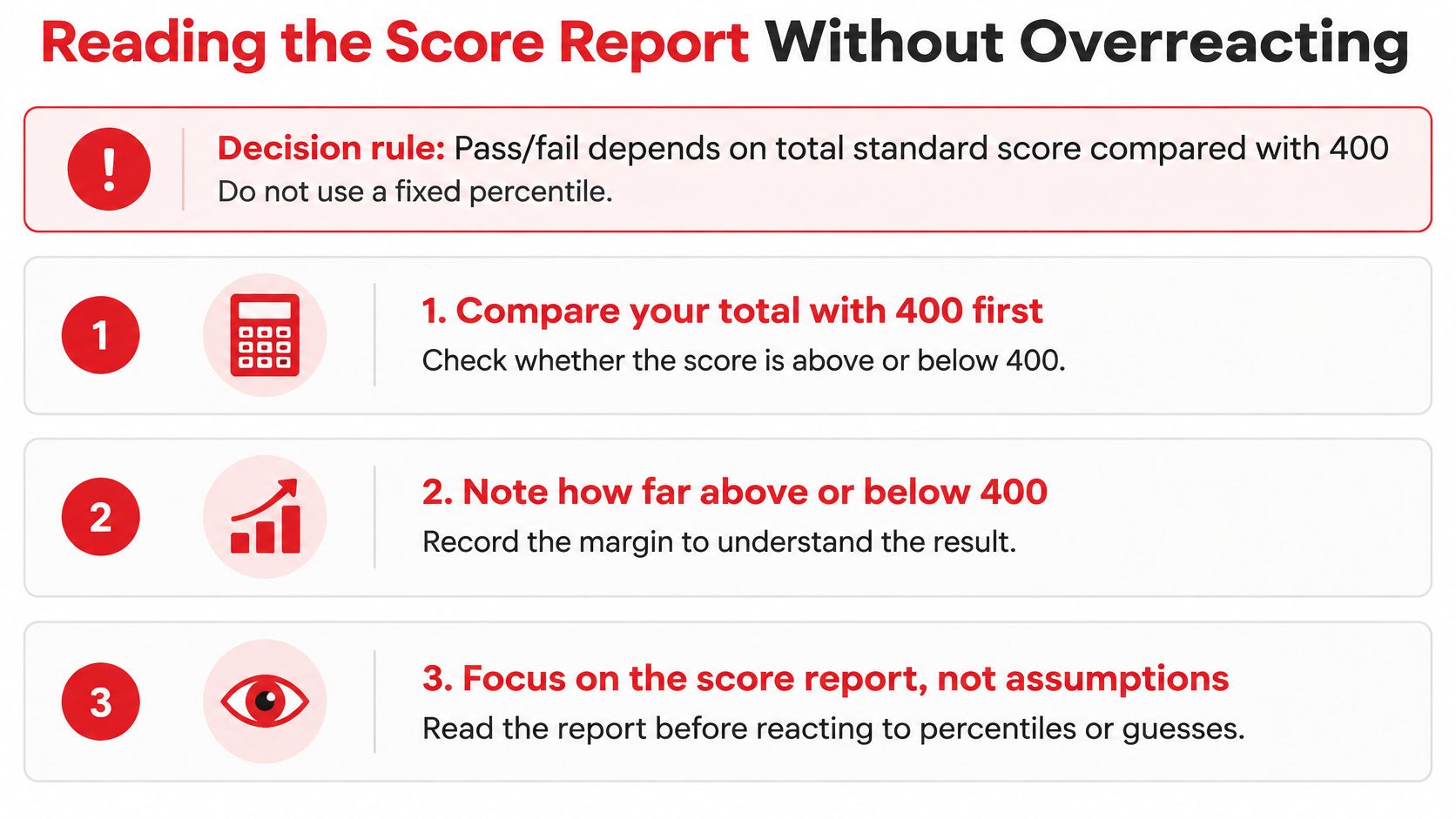
The passing decision concerns total examination performance, not a predetermined percentage of candidates who must fail. The NBOME Level 2-CE score-report guide identifies 400 or higher as passing and organizes the Performance Profile across seven competency domains and ten clinical presentations.
Start with the overall outcome and calculate the margin from the passing standard. A narrowly missed result and a substantially lower result deserve different discussions about preparation depth, but neither establishes the cause by itself.
Interpret patterns rather than isolated bars
The NBOME scoring and reporting explanation describes the graphical profile as a comparison with first-time test-takers who passed. It helps organize questions about weaknesses; it doesn't establish that a student lacks ability throughout a discipline.
Competency domains describe capabilities involved in clinical practice, while clinical presentations organize the circumstances in which knowledge and reasoning are applied. Students should use the exact labels printed on their own report rather than replacing them with question-bank subject categories.
For planning, a student and advisor can annotate apparent deficits as narrow, moderate, or large. These are working descriptions, not official NBOME classifications or numerical cutoffs.
Subscores warrant caution because they rest on fewer items and are less reliable than the total score. A single low-looking area should prompt investigation, not an immediate decision to devote the entire study period to that subject.
Score audit worksheet for a failed Level 2-CE attempt
| Check | Where to find it | Question to answer |
|---|---|---|
| Total standard score | Score report summary | How far is it from the passing standard of 400? |
| Pass/fail status | Score report | Is the official outcome confirmed before planning begins? |
| Competency domains | Graphical Performance Profile, seven domains | Which domains sit well below the first-time passer comparison? |
| Clinical presentations | Profile breakdown, ten presentations | Are misses clustered in a particular presentation type? |
| Error pattern | Personal practice log | Are errors caused by knowledge gaps, misreading, reasoning, or timing? |
| OMM content scope | Current NBOME content outline | Does the outline list OMM content for Level 2-CE, and how much? |
Before treating an OMM weakness as the main score driver, the student should check the current content outline and connect that concern to actual practice errors. Familiarity with a subject's reputation isn't evidence of its contribution to an individual result.
The COMLEX score and percentile explanation can help separate comparative standing from the passing decision. For students whose self-criticism interferes with reviewing evidence, inner-coach guidance from Vancouver Counselling Clinic offers a supplementary reflection resource, not examination-policy or treatment guidance.
The worksheet should be completed within a week if feasible, while pacing difficulties and preparation habits remain fresh. It should never include reconstructed live examination questions.
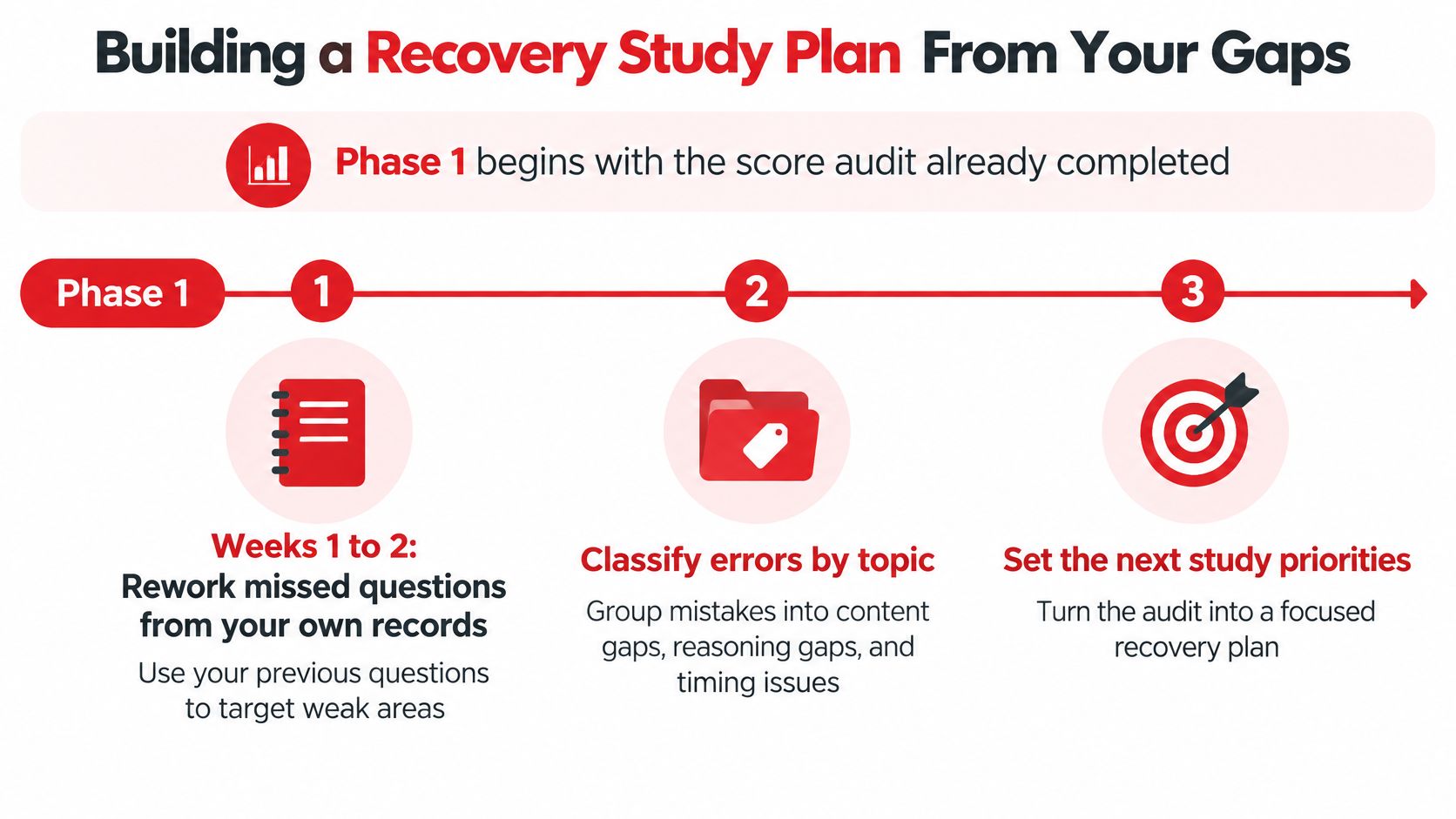
Building a Recovery Study Plan From Your Gaps
Phase 1 during weeks 1 to 2
With the score audit completed, the student begins by reworking missed practice questions from personal study records. Every error receives a practical classification: knowledge gap, reasoning error, misreading, or timing problem.
The proposed phase durations and block sizes below are planning choices, not NBOME requirements or validated readiness thresholds. They should be adapted to school deadlines, rotation responsibilities, and the extent of remediation needed.
A spreadsheet or notebook should contain these five columns:
- Date: When the practice error occurred.
- Topic: The concept or task tested.
- Reason for the miss: The specific error category and explanation.
- Specific fix: An action that can be tested during later practice.
- Recurrence: Whether the same error appeared again.
An original workflow example illustrates why classification matters. Suppose a student knows the relevant concept but misses the word except in an educational practice item. Logging the miss as a knowledge gap would lead to unnecessary content review; logging it as misreading leads to a deliberate first read and identification of the actual task.
The same distinction applies to reasoning. A student who recognizes the diagnosis but cannot distinguish competing management choices needs to explain why each plausible option fits or doesn't fit the scenario, not merely memorize the correct answer.
Phase 2 during weeks 3 to 6
The student directs most focused review toward the two or three weakest areas supported by both the profile and practice records. Timed blocks of 20 to 40 items provide a manageable starting format, followed by review of every answer, including correct guesses.
Review should answer three practical questions: What information mattered? Why was the selected answer attractive? What would make the correct choice recognizable in a different presentation?
Content repair should be proportionate. A missing fact may call for a short retrieval prompt, while a misunderstanding may require a concise explanation, diagram, or faculty discussion before further questions.
More completed questions aren't automatically more useful practice. The student needs a specific correction that transfers to an unfamiliar item.
NBOME's official practice materials should serve as the primary reference for examination familiarization. Independent question banks, review books, and spaced-repetition tools can support practice and retention without being treated as interchangeable with official materials.
The COMLEX practice-question and study-resource guide can help organize resource selection. Adding another resource should solve a defined problem rather than create another unfinished task.
Phase 3 during weeks 7 to 8
Timed mixed blocks across clinical presentations test whether improvements persist when subject labels disappear. Students should practice pacing, returning to flagged items, and maintaining attention without neglecting previously stronger areas.
At the end of the phase, the advisor reviews what changed in the error log, not merely whether the schedule was completed. Repeating the first-attempt approach unchanged is unlikely to address a problem that the student hasn't identified.
Clinical content used in this process is for examination education, not patient-care advice.
Documenting Remediation for Residency Applications
A remediation record should show what happened and what the student did afterward. It needn't become an elaborate narrative, and personal study records shouldn't automatically be submitted as application attachments.
Keep a contemporaneous record
- Official score report: Retain the original document rather than relying on a screenshot or remembered score.
- Attempt chronology: Record examination events and the administrative status attached to each.
- Registration confirmations: Save evidence of the planned retake and subsequent changes.
- Dated remediation log: Record study hours, resources, practice-question totals, accuracy by domain, and error categories.
- Advising correspondence: Keep written instructions, authorization requirements, and progress-review decisions.
- Readiness summary: State which preparation changes were completed and what remains unresolved.
A log kept during preparation is more useful than one reconstructed after an interview invitation. It allows an advisor to distinguish genuine changes in approach from a vague statement that the student studied harder.
The student should also separate learning records from sensitive personal information. A preparation log can describe missed study time or a requested support referral without recording private counseling details.
Coordinate the explanation with the official record
The NBOME frequently asked questions state that score reports are available to the student's college of osteopathic medicine. The student should still confirm with NBOME and the school which information the school accesses and how it records that information locally.
An advising meeting should establish required progress reporting, whether remediation or an academic action must be documented, and how retake timing affects the application cycle. The student shouldn't assume that an examination failure, an academic action, and a leave of absence are interchangeable reporting categories.
Current Electronic Residency Application Service (ERAS) instructions and individual program guidance should determine application responses. The school's advising office should confirm how those requirements apply before the student submits an explanation.
For broader planning considerations, the COMLEX scores and residency application guide provides related context without replacing school-specific advice.
A useful explanation is factual, accountable, and proportionate. It doesn't minimize the result or turn the application into a defense of every study decision.
A concise response can follow fact, action, result: identify the unsuccessful attempt, describe the actual remediation completed, and report the retake outcome accurately. If the retake is pending, the student should state that status rather than imply a successful outcome.
Support Systems and Readiness Checkpoints
The school's academic support office, a faculty mentor, a structured peer study group, and campus counseling serve different purposes. Academic support can organize remediation, a mentor can challenge the score interpretation, peers can support consistency, and counseling can help students manage the emotional burden.
Using counseling after a failed examination is ordinary and useful. Test anxiety can add substantial load, but a disappointing result alone doesn't establish an anxiety disorder or prove that anxiety caused the failure.
Make support practical
- Protect a consistent sleep schedule: Avoid alternating late-night catch-up sessions with exhausted study days.
- Schedule breaks: Put recovery time on the calendar rather than treating it as a reward for finishing everything.
- Limit results-day checking: Repeatedly opening the score report or comparing social-media accounts doesn't generate new planning information.
- Choose a trusted contact: Arrange a weekly check-in focused on functioning, workload, and next actions.
- Seek professional help when needed: Persistent low mood, major sleep or appetite changes, or difficulty functioning warrant contact with campus counseling or a qualified clinician.
Immediate safety concerns call for local crisis resources or emergency services. Study planning isn't a substitute for mental-health care.
The NBOME 2024 annual report reports a 92.5% first-time Level 2-CE pass rate in 2023–24. That national benchmark provides context, not permission to book a retake or a prediction about an individual student.
Use a go-or-hold decision
The following checkpoints are editorial planning tools based on the student's records, not validated pass predictors:
- Targeted accuracy improves across three consecutive timed blocks. The blocks should be reasonably comparable in difficulty and completed without assistance.
- Repeated errors decline within each category. The log should demonstrate correction rather than merely a changing list of topics.
- Planned study phases are complete. A written note should identify what changed in content knowledge, reasoning, question approach, and pacing.
Meeting all checkpoints supports a go discussion with the advisor. Missing any checkpoint supports a hold and revision, not a conclusion that the student cannot succeed.
The guide to specialized COMLEX preparation offers additional context for students considering structured academic help. Support should make the student's work more focused, not replace independent evidence of improvement.
Choose Your Retake Date and First Action
A retake date should follow an eligibility decision, a school decision, and a preparation decision. An available testing appointment answers none of those questions by itself.
A near-threshold result may justify a focused plan if practice records support that approach. A broader deficit may require a longer rebuilding period, especially when the student cannot yet explain why familiar concepts become incorrect answers under time pressure.
Resolve uncertainty before registration
If a school deadline arrives before readiness, the student should bring the conflict to the advising office explicitly. Useful questions concern available academic options, authorization requirements, and the consequences of postponement.
A hold should also have a purpose. The revised plan should name the unresolved problem, the corrective action, and the evidence that will permit another review.
Ace Med Boards offers COMLEX tutoring for students preparing for Level 1, Level 2-CE, and Level 3, including students returning after an unsuccessful attempt. Level 2-CE tutoring uses clinical vignettes to practice diagnosis, next steps in management, and competing answer choices, while broader COMLEX support addresses content review, clinical reasoning, question approach, and pacing.
Tutoring complements official NBOME practice materials and independent study. It doesn't replace school authorization, and no pass, score, or residency outcome is guaranteed.
Sources and policy checks
The principal references are the NBOME eligibility bulletin, Level 2-CE score-report guide, scoring and reporting explanation, frequently asked questions, and annual report, with peer-reviewed context from the Journal of Osteopathic Medicine. Examination policies are time-sensitive; the student should date the current-policy check before booking rather than treating an undated summary as authorization.
Final booking checklist
- NBOME rules confirmed: Attempt count, registration window, and any waiting period are resolved.
- School requirements confirmed: Academic standing and required remediation are documented.
- Score audit completed: The study priorities have a defensible basis.
- Improvement demonstrated: Practice records show a sustained trend rather than an isolated strong block.
- Readiness reviewed: All checkpoints are met, or a clear reason to hold is recorded.
If any item remains open, booking should wait until it is resolved. The first action this week is a completed score-audit worksheet emailed to the school's advising office with specific questions about authorization, remediation, and deadlines.
Ace Med Boards offers a free COMLEX consultation to discuss the student's examination level and timeline, including planning after an unsuccessful attempt. Students considering outside support can review the COMLEX tutoring information and visit Ace Med Boards to request a consultation if it fits their recovery plan.