Where do you feel least prepared right now, the interview, the diagnosis, the treatment logic, or the exam?
No single set of psychiatry clerkship resources covers those four jobs. The useful mix depends on the gap you are closing, and on whether you are on rotation or preparing for a Shelf exam.
The National Board of Medical Examiners (NBME) writes the Psychiatry subject examination that many U.S. schools call the Shelf exam. Match a tool to one function instead of hunting for one winner.
Students, staff psychiatrists, and residents in one priority survey agreed on five goals: a mental status examination, comfort with psychiatric patients, suicidality, interviewing, and drug and alcohol problems (Academic Psychiatry).
Needs-based selection matrix
- Interview and mental status exam: Interactive cases plus a bedside guide. Short stack: ADMSEP CSI eModules and The Hub.
- Diagnosis: Worked cases plus official diagnostic education. Short stack: Case Files Psychiatry and APA DSM-5-TR resources.
- Treatment reasoning: A compact review plus medically ill presentations. Short stack: First Aid for the Psychiatry Clerkship and ACLP student materials.
- Subject exam practice: Timed questions plus one official form. Short stack: UWorld or AMBOSS, then an NBME Clinical Science Mastery Series assessment.
This article is examination education, not guidance on patient care. Details reflect publicly listed information as of 2026-11-08 and can change. A low earlier Shelf score describes one exam, not your ceiling. Start with the function that feels weakest this week.
1. ADMSEP Clinical Simulation Initiative (CSI) eModules
Free, self-paced cases help when the ward hasn't shown you a skill yet.
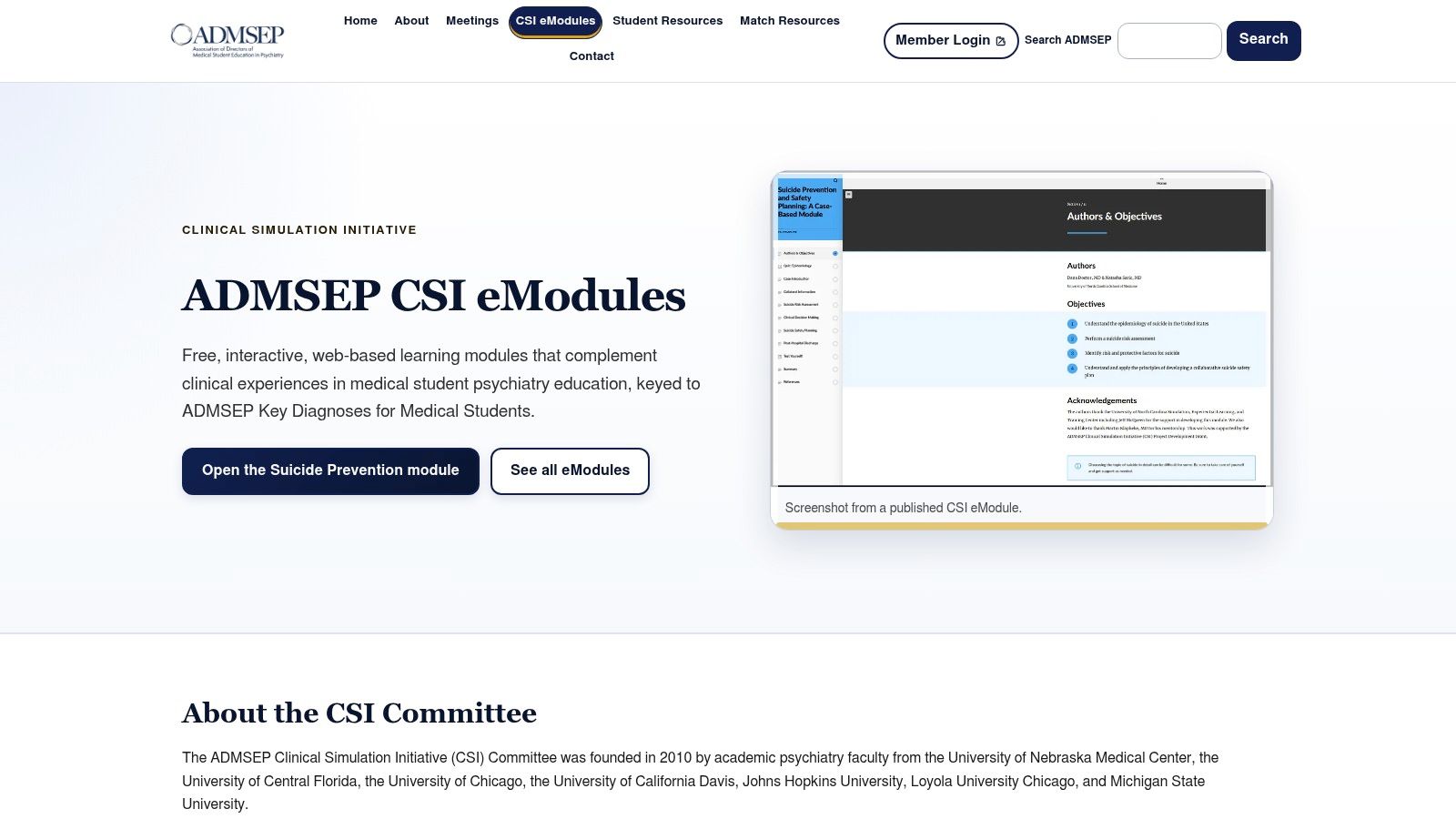
The Association of Directors of Medical Student Education in Psychiatry built Clinical Simulation Initiative (CSI) eModules to complement student clinical work. They are web-based. You move at your own pace between patients or after sign-out.
Topics include psychiatric interviewing, mental status exams, suicide safety planning, agitation, psychosis, and mood disorders. Other modules cover substance use, delirium, catatonia, and capacity assessments.
One clerkship evaluation found students could access asynchronous supplements, including ADMSEP e-modules, and still report equal ability to use the digital materials (Academic Psychiatry). A short module is a fair way to rehearse a task your site rarely assigns.
Use it when: you need interview, safety, or assessment practice before or after a real encounter.
Limit: modules differ in topic and maturity, and some are still being updated for accessibility. They aren't a Shelf question bank or a full study plan.
Open the ADMSEP CSI eModules for the case you haven't seen yet.
2. First Aid for the Psychiatry Clerkship, Sixth Edition
How can a concise review text support both patient care and exam preparation?
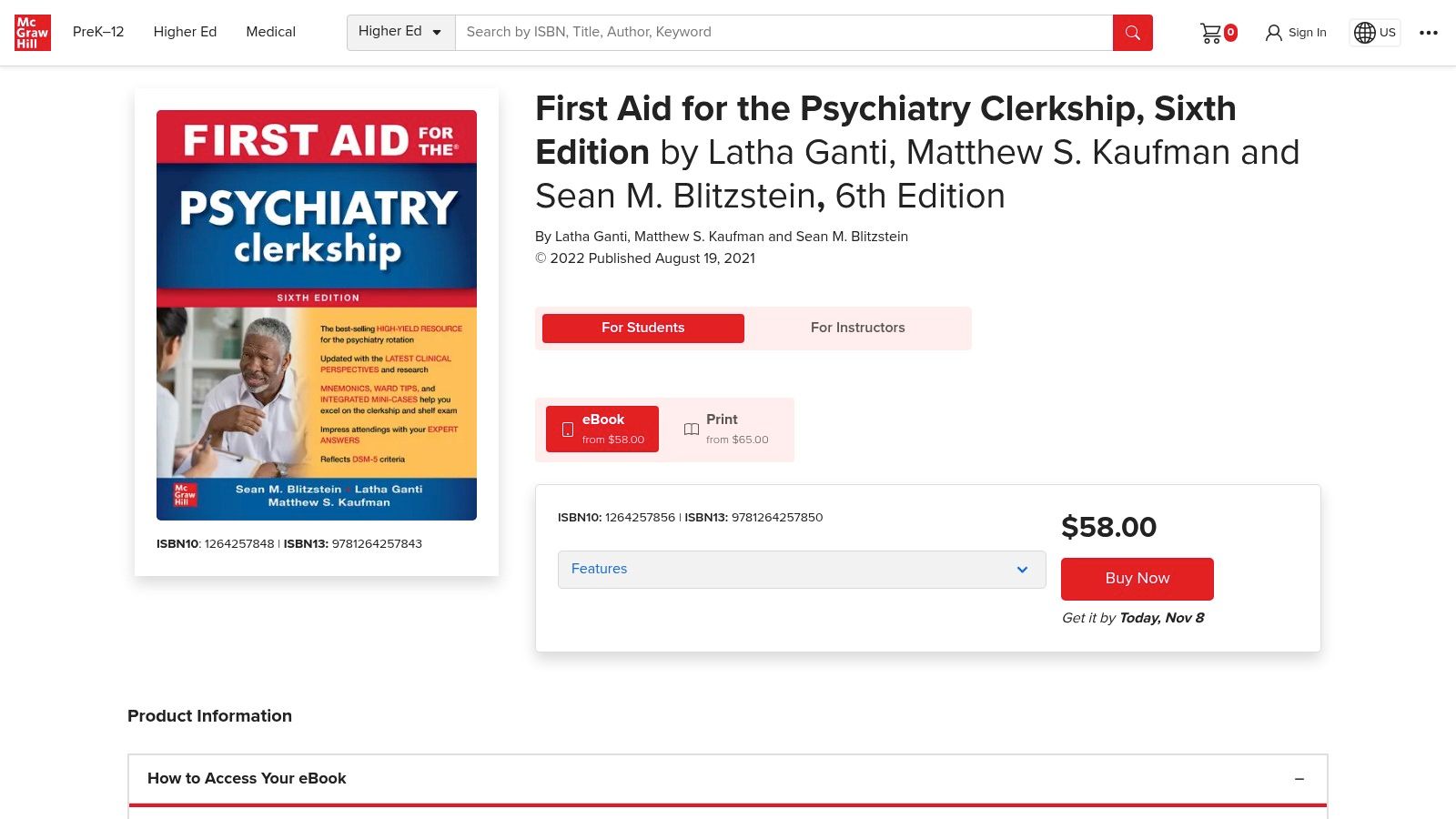
The sixth edition pairs high-yield summaries and mnemonics with mini-cases, diagrams, flowcharts, and summary boxes. Ward tips sit alongside exam tips. Read a few pages after rounds, or use the ebook to look up a topic between encounters.
The publisher describes the book as aligned with national clerkship curricula and the Shelf blueprint. That blueprint places 65%–70% of content in behavioral health and 65%–70% of physician tasks in diagnosis, with pharmacotherapy, intervention, and management at 30%–35% (BoardVitals). Spend the early weeks on history, mental status, and differentials. Use the treatment pages to review management after you can recognize the clinical patterns.
Practical rule: Read the page that matches today's patient, then close the book. Don't reread the whole chapter.
The sixth edition was published in 2021, so check current references before relying on a clinical detail. A review text also provides limited question practice. See the McGraw Hill product page for the current edition listing. For help choosing among available tutoring services, visit Ace Med Boards tutoring services.
3. UWorld Step 2 CK QBank, Shelf Review
Questions earn their place once you can name the task in a vignette.
UWorld's Step 2 Clinical Knowledge (CK) QBank includes a Shelf Review mode with psychiatry selectable by subject. Explanations and performance tracking show which items you miss. You can run timed blocks or tutor-style review. Some longer subscriptions add self-assessments and extra study tools.
What it does well
- Clerkship sorting: Subject mode keeps psychiatry separate from the rest of Step 2 CK.
- Missed-item review: Explanations support a second pass on uncertain choices.
- Later reuse: The same bank can feed broader Step 2 CK study after this rotation.
Paid access can be a large expense, so confirm the current term before you buy. This is a broad clinical QBank, not a psychiatry-only curriculum. It also doesn't replace interview practice or your school's encounter log.
Do a short timed set after you can state a diagnosis in one sentence. Untimed reading won't train the pace.
Start from the UWorld Step 2 CK page and select psychiatry inside Shelf Review rather than wandering the full bank.
4. AMBOSS Psychiatry Clerkship and Shelf Materials
Need a quick answer to a clinical question, then a chance to apply it? AMBOSS combines a searchable medical library with psychiatry Shelf questions and study plans.
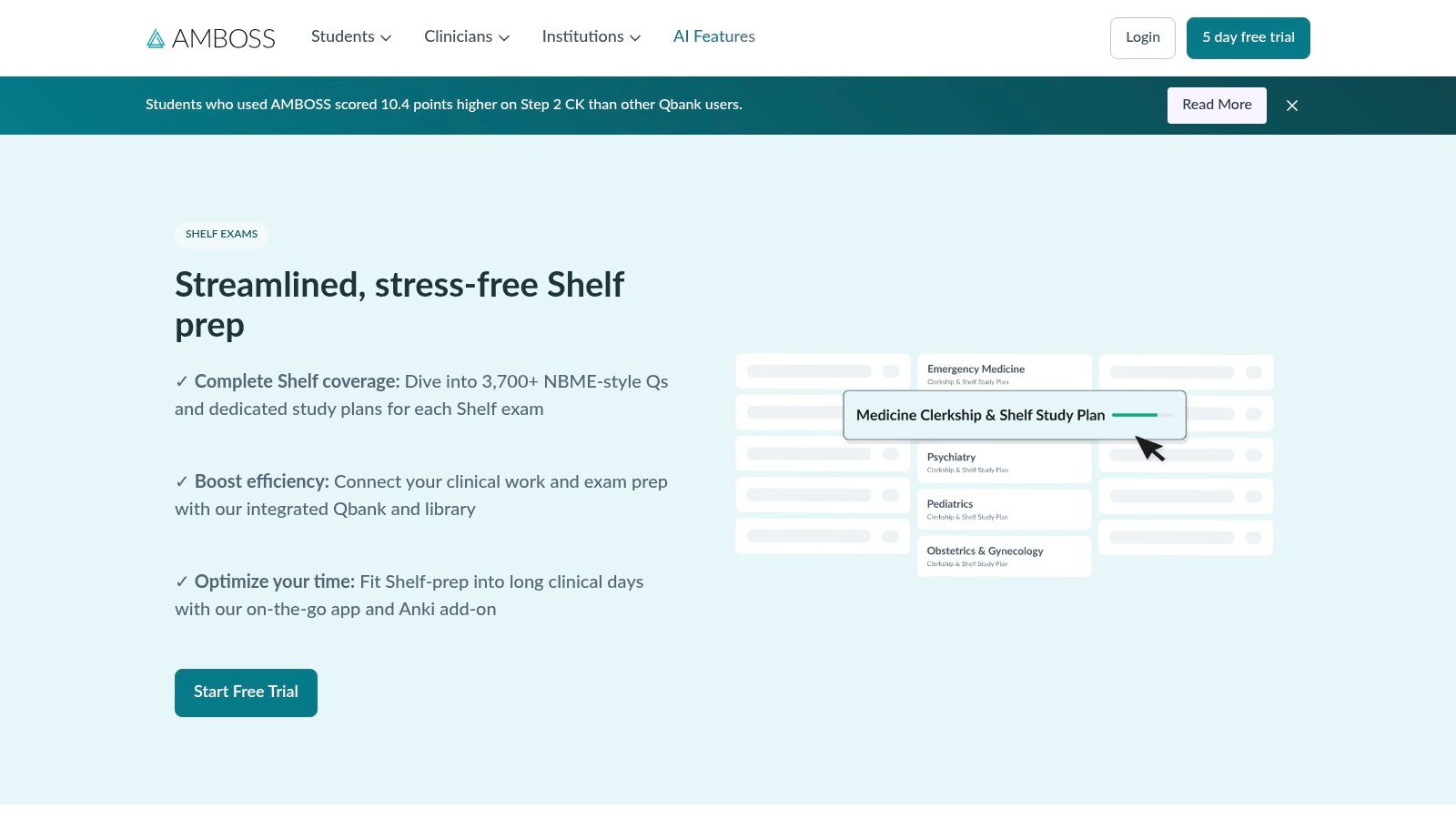
Use the library to clarify a definition or review a topic, then try related questions to check your reasoning. Study plans, clerkship survival guides, clinical-skills material, Anki integration, and mobile or offline access support different parts of the rotation. AMBOSS also offers plans for other clerkships and Comprehensive Osteopathic Medical Achievement Test (COMAT) subjects.
The Psychiatry Subject Exam has 110 questions and a 165-minute time limit, about 90 seconds per question, according to AMBOSS's psychiatry Shelf page. Timed practice can help you apply knowledge at that pace. Flashcards alone do not provide the same question practice.
The main limitation is breadth: the platform may offer more material than you need for a four-week rotation, and it is not psychiatry-only. Choose a small set of topics, review them in the library, and complete related questions rather than collecting articles you will not revisit.
5. Case Files: Psychiatry, Seventh Edition
Sixty cases push you to explain a differential out loud, not just recognize a heading.
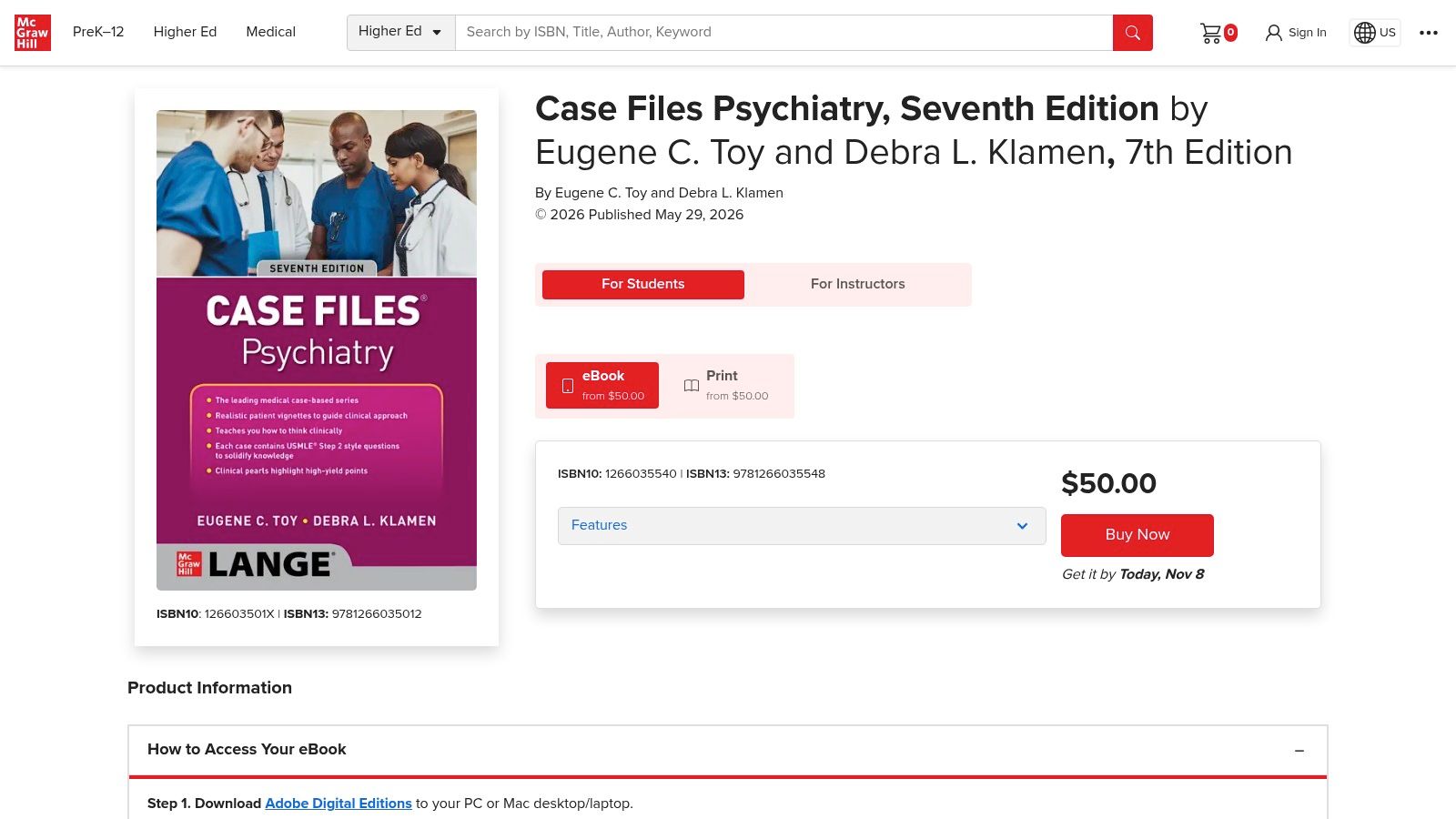
The seventh edition, published in 2026, organizes 60 cases around psychiatric presentations and disorders. Each case uses questions that ask for diagnostic and management reasoning, plus USMLE-style review questions, clinical pearls, concise summaries, and updated references. USMLE here means the United States Medical Licensing Examination.
A workable case routine
- Read the vignette cold: Write a one-line differential before you peek.
- Answer the prompts: Commit to a next step, then read the explanation.
- Say the plan: In two minutes, state the leading diagnosis and why the runner-up is less likely.
That routine is slower than skimming a review book. It is also closer to how you present on rounds. The book isn't a full clinical reference or a large question bank. If you only have a few nights before the exam, it may be too time-heavy for a first pass.
Check the McGraw Hill listing for Case Files Psychiatry so you have the 2026 edition, not an older printing.
6. NBME Clinical Science Mastery Series: Psychiatry
How well can you apply your preparation under subject-exam conditions? An NBME self-assessment gives you a timed question set and feedback to help you judge readiness.
Psychiatry forms in the NBME Clinical Science Mastery Series are fixed-length question sets that can be taken at standard or self-paced timing, with feedback by content area, explanations for items, and an approximate subject-exam score conversion that is a guide rather than a prediction.
One school syllabus requires at least 25 logged patient encounters and lists the self-assessment at $20 with answer explanations (Florida State University College of Medicine). Requirements and fees may differ by school, so check your own clerkship instructions.
Use the psychiatry Shelf exam practice questions to review missed concepts after completing the form. This self-assessment is a readiness check, not a course or ongoing question bank. Take it after a question block, when you can use the content feedback to choose what to review next.
7. NextGenU Psychiatric Clerkship for Medical Students
Some students want a syllabus when the local one feels thin. NextGenU offers that sequence for free.
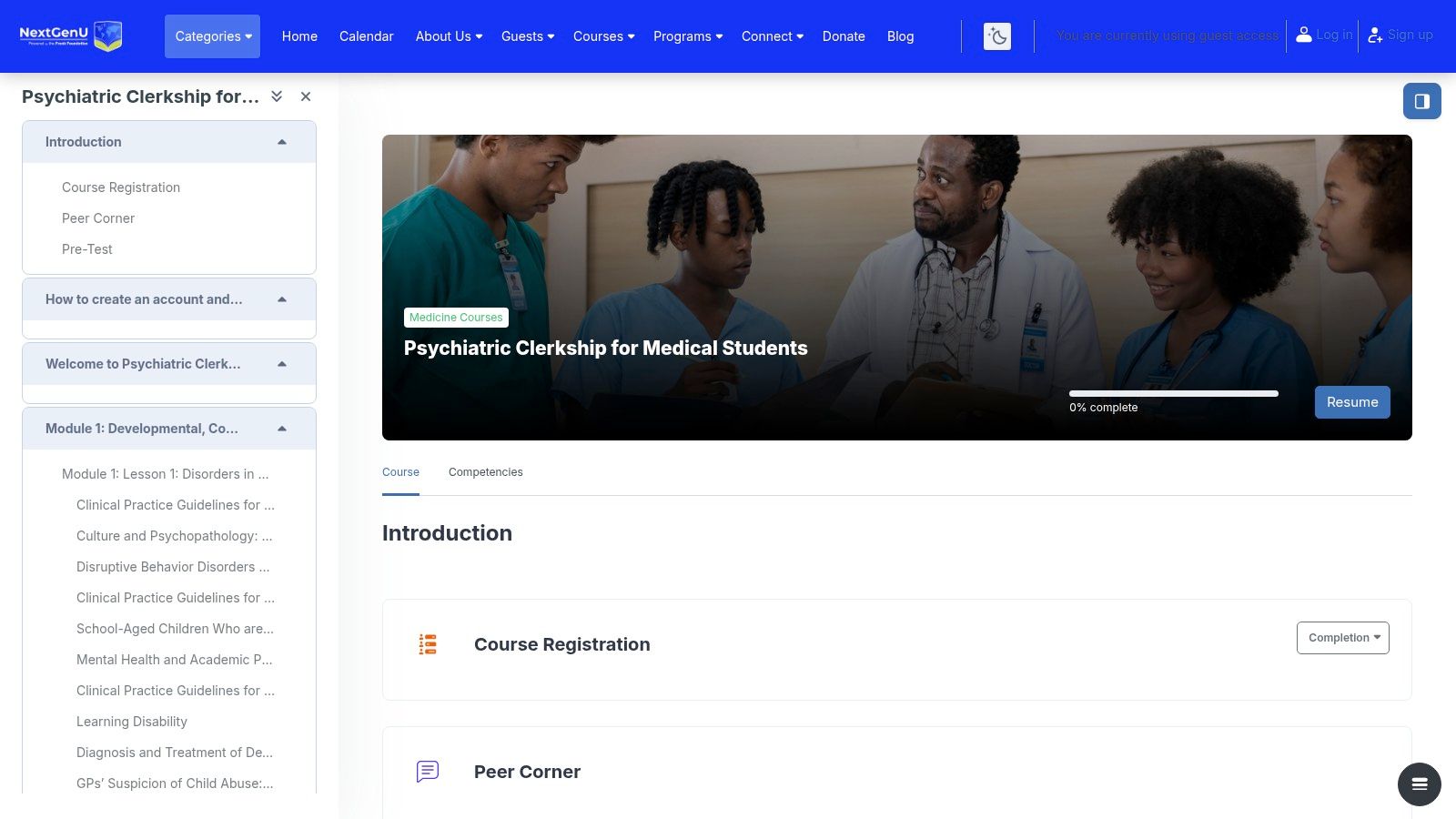
The course is open to medical students and teaching staff. Six modules cover psychiatric conditions, prevention and treatment, professionalism and law, and clinical skills. Case studies and quizzes sit inside the path. A 40-question final exam comes at the end, and a certificate is available after you meet the course requirements.
The listed workload is about 260 hours. That is not realistic across a short rotation if you also have call, notes, and a subject exam. Treat the course as a menu. Pull the module that matches a gap, such as clinical skills or a condition you haven't seen.
It can supplement local teaching or serve as a broad review when you have a lighter elective. It is a poor sole plan if your only goal is Shelf practice this month.
The course page is NextGenU Psychiatric Clerkship for Medical Students. Confirm that the modules you want are open before you build a calendar around them.
8. American Psychiatric Association (APA) DSM-5-TR Educational Resources
Diagnostic criteria are easier to learn when you can see how a screen is scored, not only how a vignette ends.
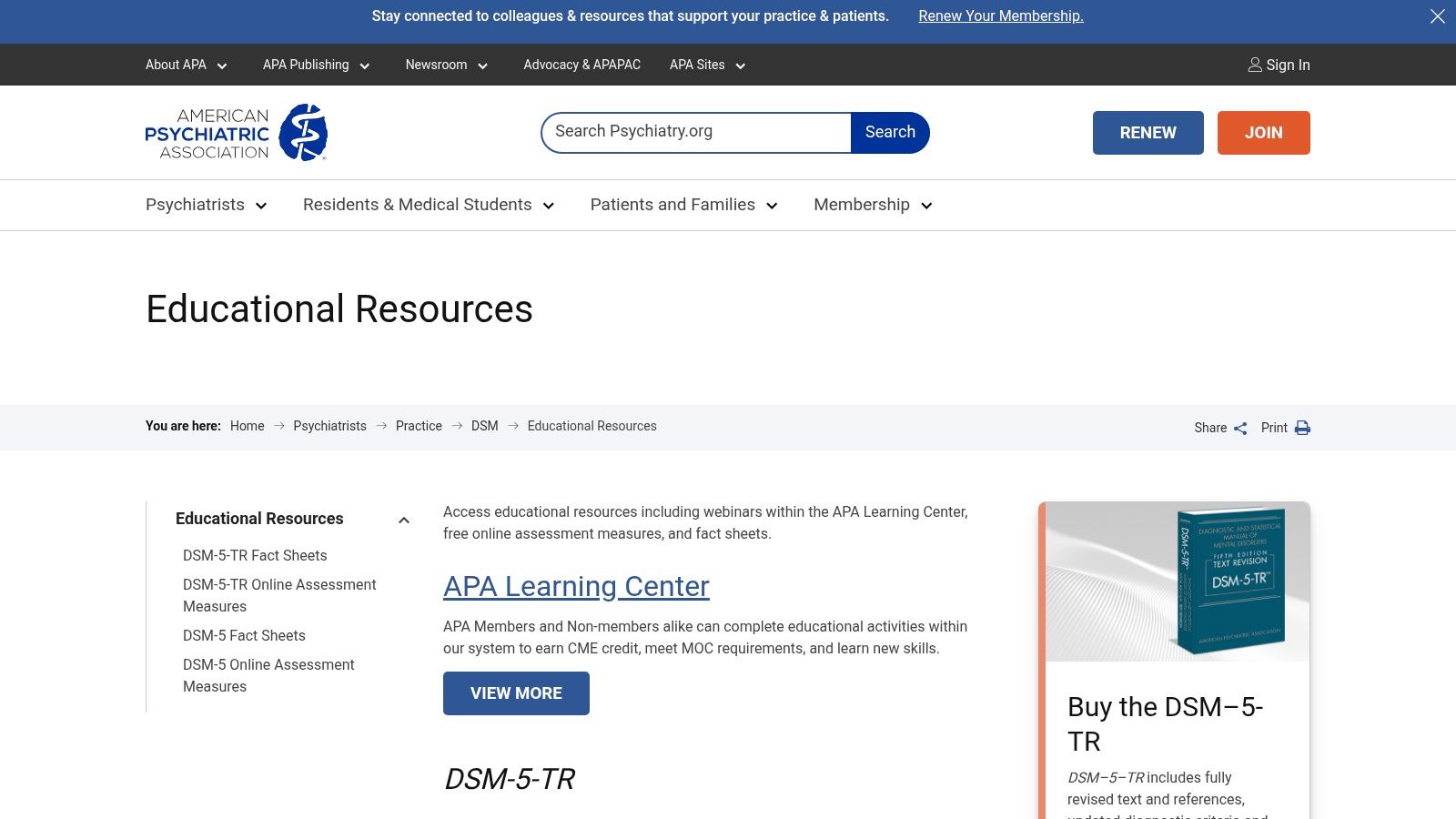
The American Psychiatric Association (APA) publishes DSM-5-TR educational resources, including fact sheets and online assessment measures with instructions, scoring information, and interpretation guidance. DSM-5-TR is the Diagnostic and Statistical Manual of Mental Disorders, Fifth Edition, Text Revision. The Learning Center lists activities for members and non-members. Some materials are free.
These pages help you understand what a screening tool asks and what a score does not prove. They don't replace a clinical interview or your own diagnostic judgment. They also aren't a Shelf course.
Pair a fact sheet with a case you already worked. For how disorders are grouped on exams, the anxiety disorders classification explainer is a focused next read, not a substitute for the criteria.
A screen can support a formulation. It can't finish one.
Start at the APA DSM educational resources page and download only the measure that matches this week's patients.
9. The Hub – Psychiatry
The Hub is a free, presentation-based guide for revisiting common encounters after clinic.
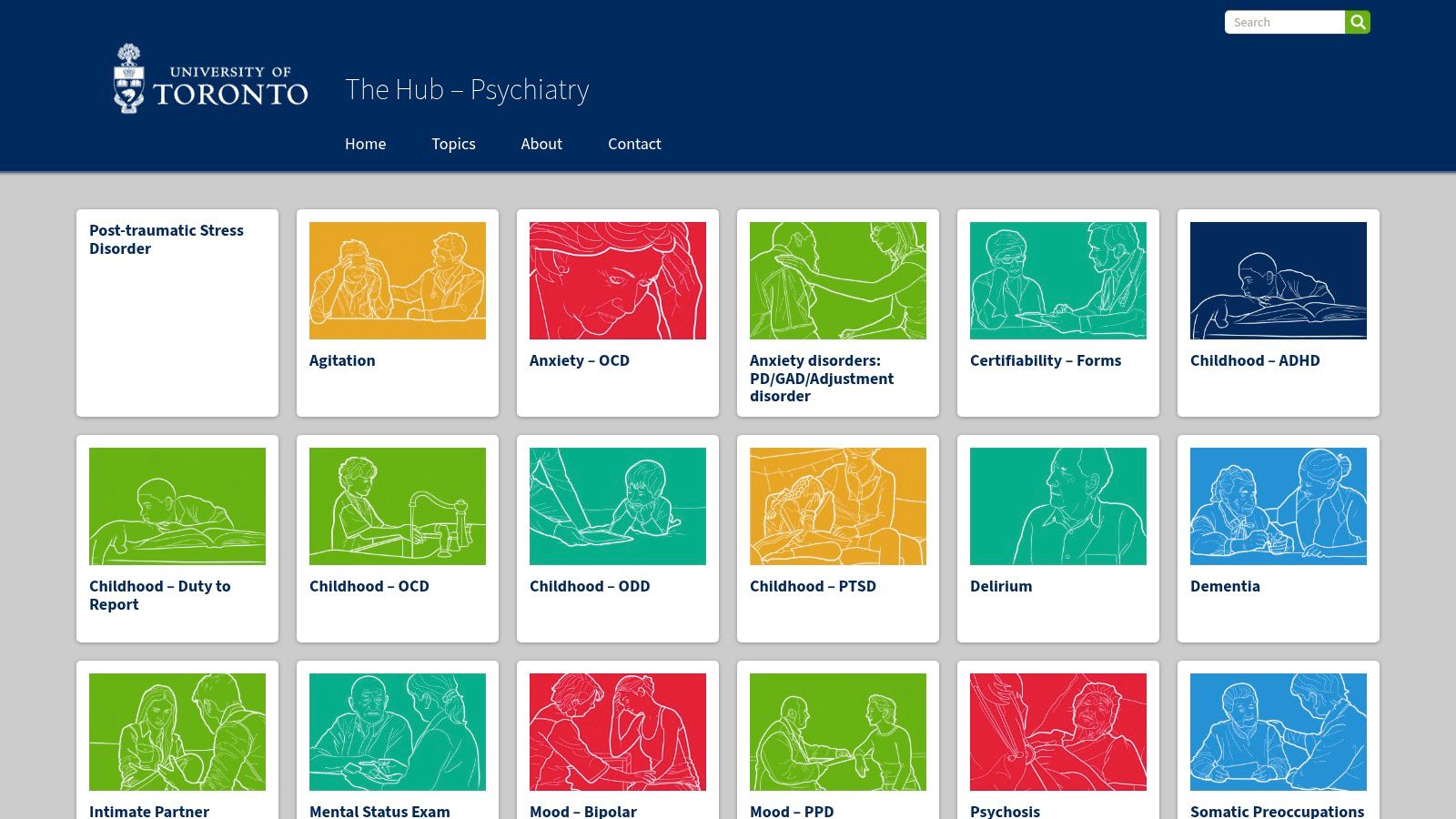
Developed for second- and third-year students, it offers 18 topics, including psychosis, mood disorders, substance use, suicide, and delirium, plus mental status exam content. A page may mix cases, videos, slides, guidelines, quizzes, and references. A faculty and student committee reviews the content on a periodic schedule.
Where it helps
- Interview refresh: Use the mental status and suicide pages before a new patient.
- Mixed formats: A video plus a short quiz beats rereading the same notes.
- No paywall: You can open it from a phone between patients.
The site was built at the University of Toronto, so teaching emphasis and exam expectations can differ from a U.S. Shelf exam. The site also says it isn't a complete syllabus or enough by itself for an exam.
If you are weighing psychiatry as a career after the clerkship, the steps to becoming a psychiatrist article covers the longer path. For this month, stay on The Hub – Psychiatry topics you will present.
10. Academy of Consultation-Liaison Psychiatry (ACLP) Medical Student Resources
General review books underplay psychiatry on medical and surgical wards. ACLP materials fill that hole.
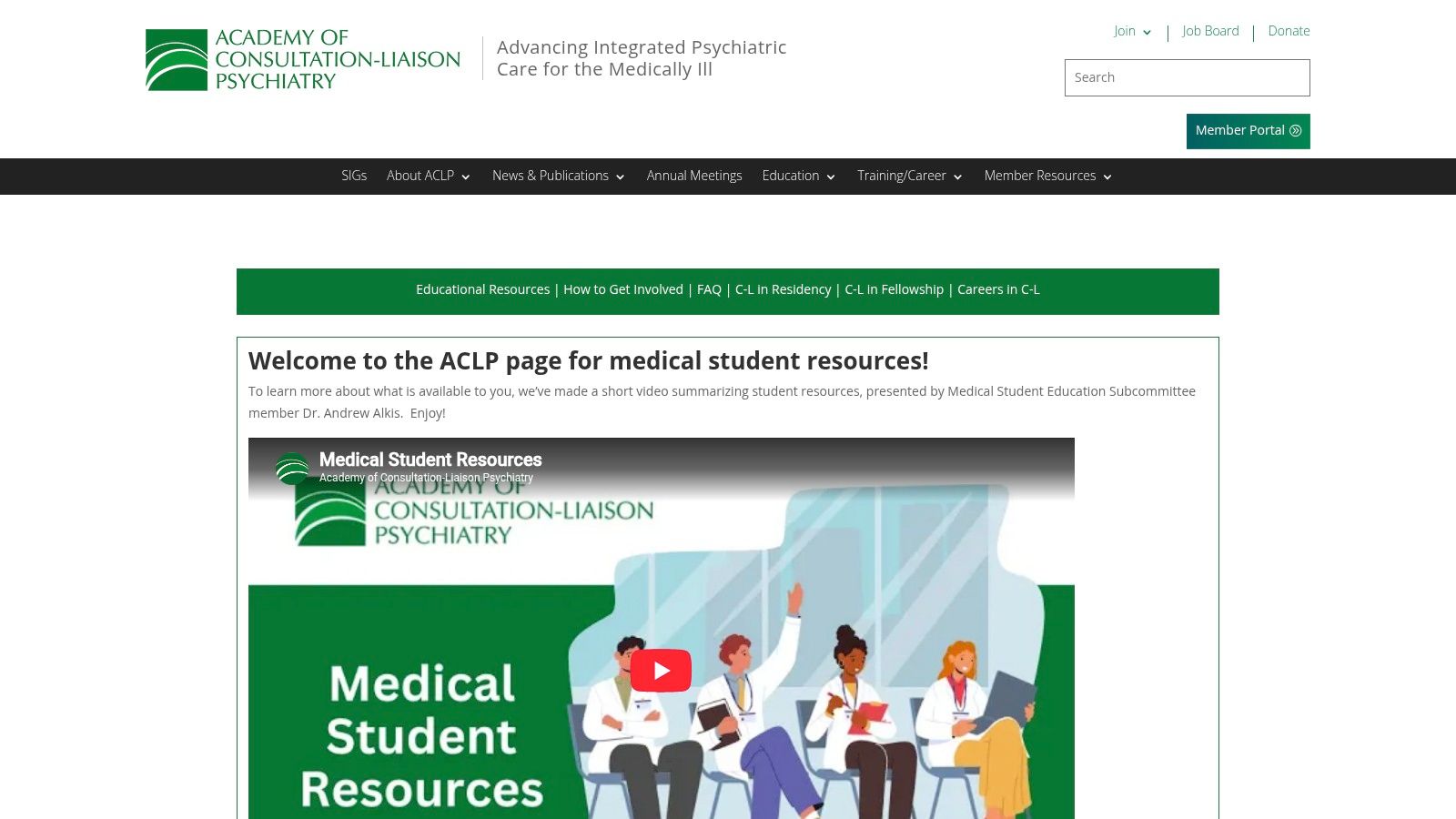
Consultation-liaison psychiatry is psychiatric care for patients with medical or surgical illness. Student materials include a rotation guide, adult and pediatric presentation summaries, and topic slides. Delirium, capacity, depression in medically ill patients, and catatonia are called out. A linked open-access question bank is part of the set. Free student membership provides access to member resources, though some files depend on membership or the linked site.
A shortened three-week structure may force a choice between inpatient and consultation-liaison settings, with missed conditions covered by didactics or online modules (Case Western Reserve University clerkship report). If your site is only one of those, use the other as reading.
These pages aren't a broad core curriculum and they don't replace a general Psychiatry question bank. For how psychiatric care sits inside other services, see behavioral health integration. The student hub is the ACLP medical student page.
How Each Psychiatry Clerkship Resource Supports Interviewing, Diagnosis, Treatment Review, and Shelf Prep
Choose a resource by the task in front of you. A clinical simulation can help you practice an interview; a reference can clarify diagnostic criteria; a question bank can test whether you can apply both under exam conditions.
| Resource | Main function | Access model | Best use stage |
|---|---|---|---|
| ADMSEP Clinical Simulation Initiative (CSI) eModules | Interactive practice of core psychiatry skills and topics | Free, web-based, self-paced | During the rotation to build clinical skills |
| First Aid for the Psychiatry Clerkship, Sixth Edition | Concise, exam-focused review with rotation guidance | Print and ebook formats; current purchase and access terms are set by the seller | Throughout the clerkship for focused review |
| UWorld Step 2 CK QBank, Shelf Review | Psychiatry Shelf questions with explanations and performance tracking | Paid subscription; current terms are set by UWorld | During clerkship study and Shelf preparation |
| AMBOSS Psychiatry Clerkship and Shelf Materials | Clinical reference, study plans, and question bank | Platform access; current pricing and subscription terms are set by AMBOSS | Across the rotation, including Shelf preparation |
| Case Files: Psychiatry, Seventh Edition | Case-based practice in diagnostic and treatment reasoning | Print and ebook availability; current purchase and access terms are set by the seller | During the clerkship for applied case review |
| NBME Clinical Science Mastery Series: Psychiatry | Self-assessment with content-area feedback | Paid self-assessment; the current fee and access terms are set by NBME | Near the end of preparation to assess readiness |
| NextGenU Psychiatric Clerkship for Medical Students | Structured online course with cases, quizzes, and a final exam | Free online course; certificate available after requirements are met | Early in the clerkship or for structured broad review |
| American Psychiatric Association (APA) DSM-5-TR Educational Resources | Diagnostic reference and assessment-measure guidance | Some materials are free; Learning Center activities are available to members and non-members | As a supplement when studying diagnosis and assessment |
| The Hub – Psychiatry | Interactive guide to common presentations and clinical encounters | Free and publicly accessible | During the rotation to review clinical topics and skills |
| Academy of Consultation-Liaison Psychiatry (ACLP) Medical Student Resources | Consultation-liaison psychiatry guides and topic resources | Free student membership; some files depend on membership or linked sites | During relevant medical or surgical rotations, or for subspecialty review |
For interviewing practice, start with CSI or The Hub. Their interactive or encounter-focused formats help connect questions and examination skills to clinical situations. They do not replace supervised patient interviews.
For diagnosis and treatment reasoning, use case-based practice alongside a reference. Case Files presents clinical scenarios; First Aid offers concise review; APA resources can help with diagnostic criteria and assessment measures. Check that a reference answers the question you have, rather than treating any one resource as a complete clinical guide.
For Shelf preparation, question banks and the NBME self-assessment serve different purposes. UWorld and AMBOSS provide practice questions with explanations, while the NBME assessment offers a separate check of performance by content area. Current fees, formats, and access terms can change, so check each product owner's site before purchasing.
Build a Short Resource Stack and Check It Against Official Blueprints
Pick one resource for each row of the matrix, then stop adding titles. Four tools you will open beat ten you only bookmark.
A practical stack for a standard month looks like this. Use CSI modules or The Hub for interviews and the mental status exam. Use Case Files or APA fact sheets when the job is formulation. Use First Aid, with ACLP pages if your patients are medically ill, for treatment logic. Use one question bank, UWorld or AMBOSS, for timed vignettes. Sit one NBME Clinical Science Mastery Series psychiatry form late enough that the feedback can change what you study, and early enough that you can still review it.
Before you pay for a bank or a book, reread the current subject-exam description on the NBME site. Question counts, timing, and content areas can shift. School rules on logs, required forms, and passing cutoffs are local. A price or edition listed here is as of 2026-11-08 and may already differ on the seller's page.
Question review is its own skill. After each block, sort misses into interview gaps, diagnostic misses, and treatment-step errors. The psychiatry Shelf question article linked above walks through that review pattern so you don't have to rebuild it here.
If the calendar is the hard part, Ace Med Boards offers one-on-one online Shelf exam tutoring that covers clinical reasoning, question analysis, pacing, and the topics that need more time. The plan can account for your rotation schedule, exam date, study time, and practice performance. The tutoring services page lists current subjects, including internal medicine, surgery, pediatrics, obstetrics and gynecology, family medicine, emergency medicine, and neurology, plus Shelf exam support. Check that page for what is offered now. This article doesn't assume a psychiatry-specific tutoring package.
Nothing here tells you how to start, stop, or change a patient's treatment. It is exam study guidance only. Confirm editions, access terms, and fees on the owner's site before you buy.
Ace Med Boards offers one-on-one online tutoring for USMLE, COMLEX, and selected Shelf and COMAT exams, with sessions that can focus on clinical reasoning, question analysis, and pacing around a clerkship schedule. That support sits beside the books, banks, and official forms in this guide. It doesn't replace them. If you want help choosing a study plan for your exam date, visit Ace Med Boards.