Rescheduling more than 30 days before a COMLEX appointment costs nothing, while waiting until the final week can trigger a $250-$500 forfeiture. A candidate whose study plan no longer fits the appointment should check the deadline, replacement-date availability, and eligibility window before making the change.
The question often starts with an unfinished review plan, an uncertain practice assessment, or a travel arrangement that has fallen through. The right response isn't automatically to postpone or push through. It's to separate readiness, scheduling, and financial consequences, then act while the available options remain open.
Byline: Ace Med Boards Editorial Team
Policy basis: the NBOME's published registration guidance and 2025–2026 bulletin. Fees and procedures are time-sensitive, so candidates should confirm the applicable policy and account eligibility before submitting a change.
What Rescheduling Actually Costs and When
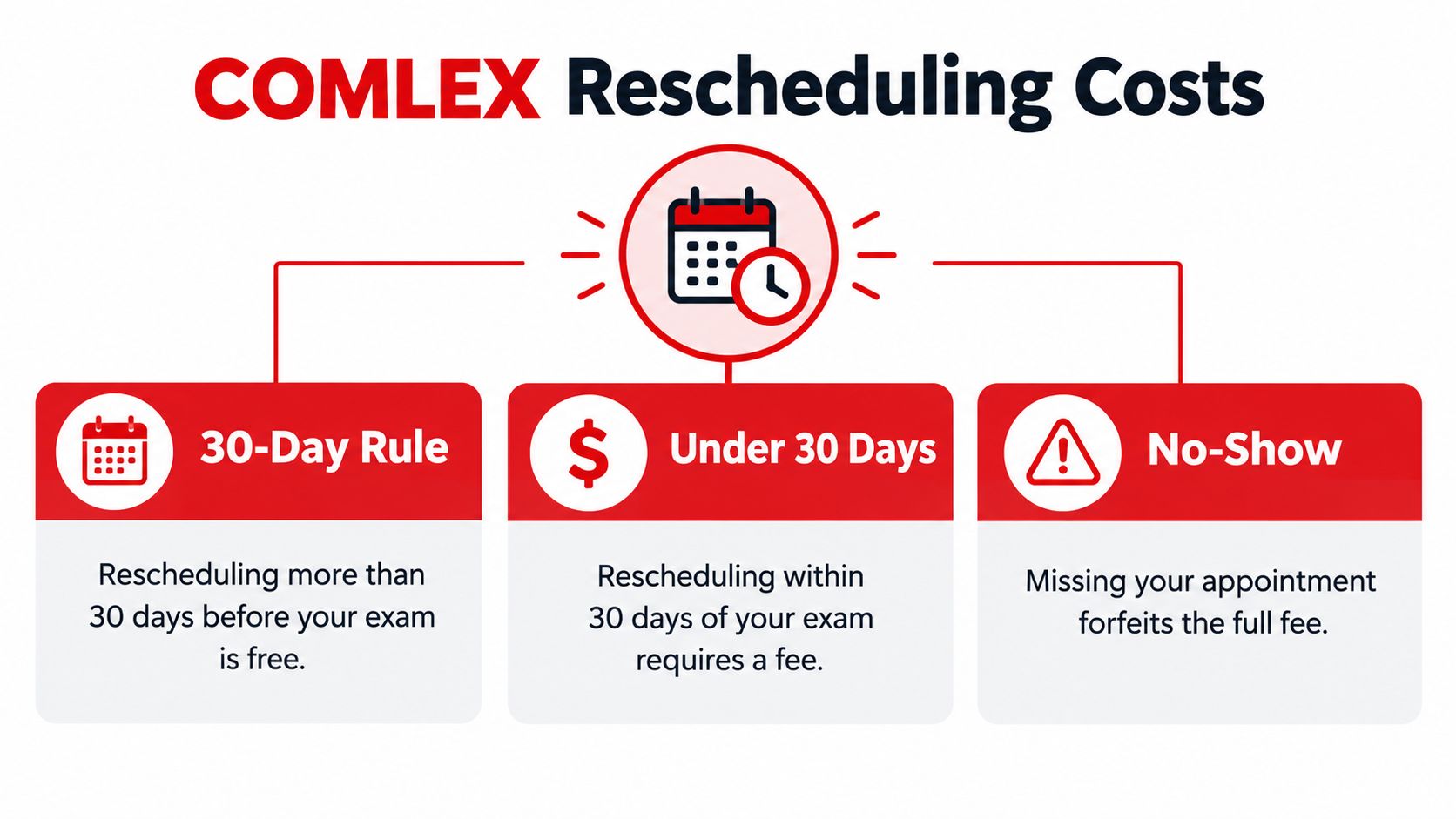
An upcoming appointment that no longer fits the study plan creates two decisions: whether additional preparation would help, and what moving the appointment would cost. The National Board of Osteopathic Medical Examiners (NBOME) sets the financial rules for the Osteopathic Medical Licensing Examination of the United States (COMLEX-USA). Under its registration and scheduling policy, changes made more than 30 days before the appointment carry no fee.
That wording matters. An appointment exactly at the threshold belongs to the charged window, not the free window. Candidates should calculate the interval from the actual appointment rather than treating “about a month away” as sufficient.
The calendar determines the charge
The fee schedule progresses from a free early change to an intermediate forfeiture, a higher final-week forfeiture, and finally a no-show forfeiture. Level 1 and Level 2-Cognitive Evaluation (Level 2-CE) share the same amounts, while Level 3 has higher charges in every paid tier.
The comparison table below gives the exact amounts. Before opening the scheduling system, a candidate should identify the applicable row and decide whether the proposed delay has a concrete purpose.
Key Takeaways
- Early action preserves options. A candidate who has already decided to move the appointment shouldn't wait merely to avoid an uncomfortable administrative task.
- A no-show is a separate category. Missing the appointment isn't equivalent to completing an ordinary reschedule.
- Charges apply per examination day. Candidates with a multi-day appointment should review every affected administration.
- A postponement needs a study objective. More calendar time is useful only when the candidate can identify what preparation will change.
Practical rule: Once postponement is the clear decision, delaying the administrative action offers no preparation benefit.
Candidates coordinating other examinations should keep their calendars separate. A guide to MCAT test dates concerns the Medical College Admission Test, not COMLEX scheduling or eligibility. Rules from another examination shouldn't be used to estimate a COMLEX charge.
How to Reschedule a COMLEX Appointment Online or by Phone
The online route should start inside the candidate's NBOME Portal, not with an old bookmark or a general search for a testing center. The NBOME scheduling FAQs describe the route as My Exams → Reschedule or Cancel, which sends the candidate to the Pearson scheduling site. This is a Pearson workflow, not a Prometric workflow.
Before logging in, the candidate should collect the existing appointment confirmation, candidate identification information, preferred locations, and acceptable alternative dates. Preparation makes it easier to distinguish a workable replacement from a date that merely looks available.
Completing the online change
Inside My Exams, the candidate should open the relevant appointment and follow the reschedule option on the Pearson site. The replacement date, location, and displayed charge should be checked before the final submission.
A selected date isn't enough. The candidate should continue until the system confirms the transaction, save that confirmation, and check the updated appointment information against the original booking.
- Check the examination. The confirmation should show the intended COMLEX level.
- Check the logistics. The date, start time, and center should match the candidate's actual plan.
- Check completion. A pending screen, interrupted session, or error message shouldn't be treated as a successful change.
- Update the calendar. The old appointment should be replaced only after the new booking is confirmed.
NBOME states that examinations cannot be rescheduled less than 24 hours before the scheduled date, and a change within that interval receives no-show treatment, as detailed in its scheduling FAQs. A candidate approaching that cutoff shouldn't assume that a phone call can override it.
When phone assistance is appropriate
If the system blocks a change, the candidate should use the current testing-provider contact details available through the official scheduling route. Account eligibility questions and emergency-assistance cases belong with NBOME Client Services.
The candidate should explain the existing appointment, the requested change, and the exact system message. Asking whether the transaction was completed is more useful than assuming that speaking with a representative automatically moved the appointment.
NBOME's FAQs specify that cancellations must be completed online through the candidate's account. Phone assistance therefore shouldn't be treated as a substitute for the required cancellation transaction.
For candidates also taking the United States Medical Licensing Examination (USMLE), the Step 1 scheduling guide addresses a separate examination process. Neither appointment changes automatically when the other moves.
NBOME Fee Tiers Compared Across COMLEX Levels
The most useful COMLEX reschedule comparison is the candidate's own time window against the applicable level. The following amounts come from the 2025–2026 COMLEX-USA Bulletin of Information and represent the published forfeitures for rescheduling, cancellation, or no-show treatment.
COMLEX Reschedule and Cancellation Fees by Time Window
| Time Before Appointment | Level 1 / Level 2-CE | Level 3 |
|---|---|---|
| More than 30 days | $0 | $0 |
| 6–30 days | $85 | $170 |
| 1–5 days | $250 | $350 |
| Within 24 hours or failure to appear | $400 | $500 |
These amounts are assessed per examination day, not necessarily once for an entire registration. A candidate changing a multi-day examination should review the consequences for each affected day rather than budgeting for a single charge.
What the comparison means
The sharpest distinction is between making a deliberate change and letting the appointment become a no-show. The latter carries the highest published forfeiture, even though the candidate hasn't gained any additional preparation time by failing to complete the scheduling transaction.
Level 3 also requires a larger financial allowance in each paid window. That doesn't mean a resident should keep an unsuitable appointment solely because changing it costs more. It means the resident should evaluate the fee alongside the proposed preparation plan and program obligations.
The relevant comparison isn't “fee versus no fee.” It's the cost of a workable revised plan versus keeping an appointment that no longer fits.
- Use the appointment date. The fee window relates to the scheduled administration, not the date the candidate first purchased the examination.
- Budget for the actual change. Moving multiple affected days can create greater exposure than moving a single appointment.
- Avoid refund assumptions. A published forfeiture isn't necessarily the entire registration payment.
The COMLEX-USA overview provides broader examination context. For a scheduling decision, the specific level and appointment details remain the controlling information.
Reschedule vs Cancel vs Eligibility Extension
Rescheduling moves an appointment. Cancellation releases it. An eligibility extension concerns permission to test during a different period. These are distinct administrative actions, and none should be assumed to complete the others.
A candidate who wants a later date needs both an available appointment and valid eligibility for that date. An appealing replacement slot isn't useful if the candidate's authorized testing period doesn't cover it.
Choose the action that solves the actual problem
| Candidate's situation | Appropriate issue to resolve |
|---|---|
| The current date is unsuitable, but a replacement fits existing eligibility | Appointment rescheduling |
| The candidate won't attend and has no workable replacement yet | Appointment cancellation |
| The desired replacement falls outside the authorized testing period | Eligibility review with NBOME |
| The candidate remains uncertain about preparation | Readiness planning before selecting a date |
Cancellation shouldn't be described as a refund available only outside the early-change window. NBOME's policy permits a full refund for an eligible early cancellation, while later cancellation or no-show treatment can leave a remaining eligible registration amount refundable after the applicable forfeiture. The candidate should check the account-specific outcome rather than assume either a full refund or total loss.
For an eligibility concern, the candidate should review the period shown in the NBOME account and contact NBOME about the available options. An extension shouldn't be assumed to be approved, free, or completed merely because the candidate requested it.
Readiness is a separate planning problem
A later appointment doesn't correct a study plan by itself. The candidate should identify the reason for moving: unfinished content review, recurring reasoning errors, pacing difficulties, or a disruption that prevented meaningful preparation.
A revised plan should specify what will happen before the replacement date and what evidence will support keeping that date. The COMLEX Level 1 preparation timeline can help organize that work without substituting for NBOME eligibility rules.
- Resolve permission first. The desired date must fit the candidate's confirmed authorization to test.
- Resolve the appointment separately. An eligibility inquiry doesn't cancel or move an existing booking.
- Define the benefit of postponement. A revised date should support an identifiable preparation task, not an indefinite delay.
Emergencies, Waivers, and the Candidate Assistance Program
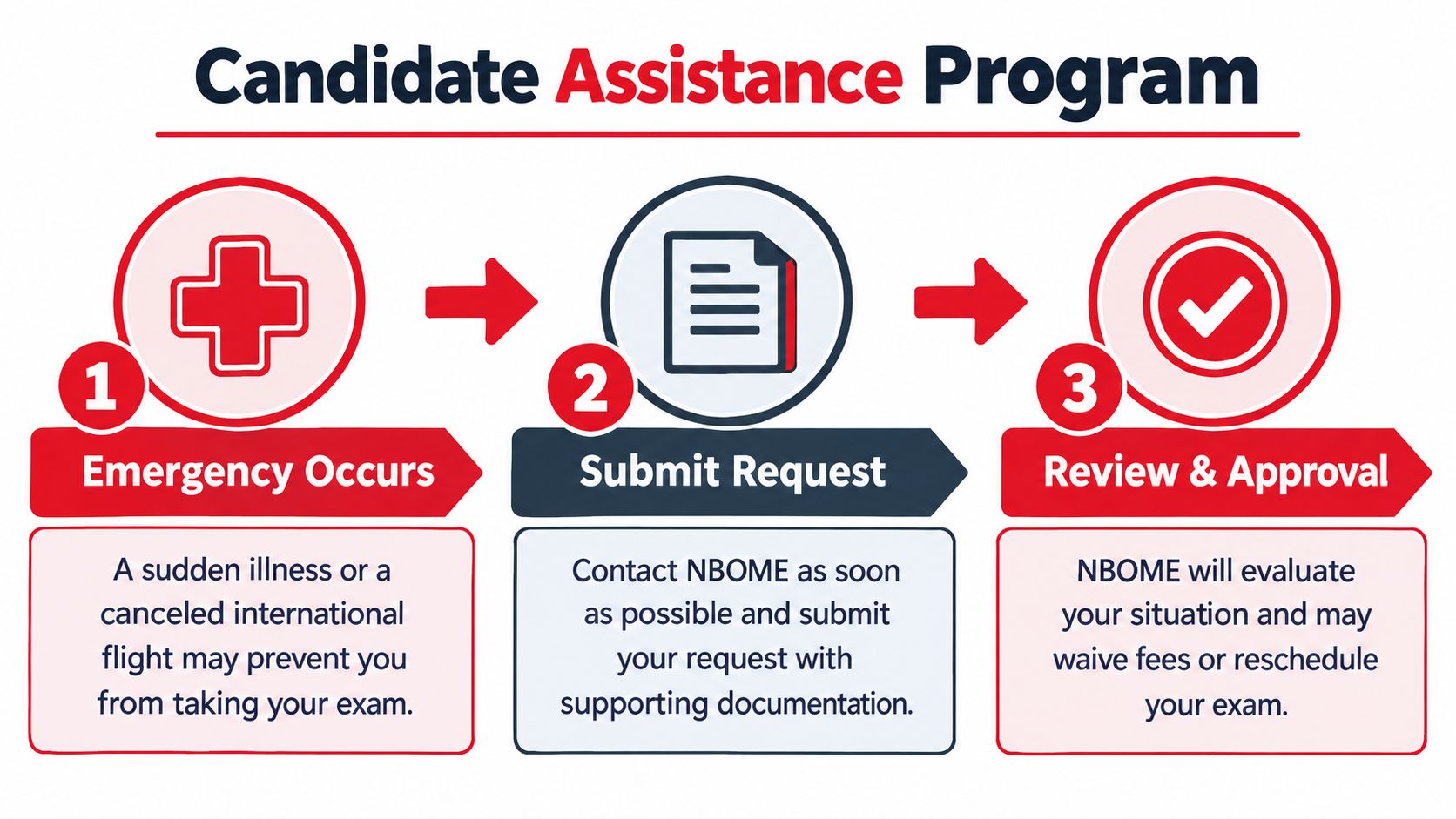
An uncontrollable event can justify asking for relief, but it doesn't automatically remove a scheduling charge. Through the NBOME Candidate Assistance Program, candidates affected by circumstances beyond their control may request a full or partial waiver of rescheduling or cancellation fees.
NBOME recommends prompt notification and submission of the relevant fee-waiver or expense-reimbursement form within 30 days of the missed examination. The written request should include supporting evidence, such as a flight-cancellation email. NBOME retains discretion over the decision, so neither approval nor a complete refund is guaranteed.
Build a clear, documented request
The strongest controllable part of the process is the record. The candidate should explain what happened, when it happened, how it affected attendance, and what actions followed.
- Notify NBOME promptly. The explanation should identify the scheduled examination and the event preventing attendance.
- Preserve original evidence. A flight-cancellation notice should retain the itinerary and cancellation details, not just a cropped headline.
- Submit the required form. A phone conversation alone shouldn't be treated as the written waiver request.
- Keep communications together. Confirmation messages, case references, and responses help establish the sequence of events.
For other circumstances, the candidate should ask NBOME what documentation is appropriate. A clinician's note, police report, or other record may help explain an event, but those documents shouldn't be presented as a universally required checklist or a promise of approval.
Documentation principle: A concise timeline supported by original records is more useful than a long explanation without evidence.
An ordinary scheduling conflict, anxiety about readiness, or a transportation problem shouldn't be labeled an approved emergency category without NBOME's determination. The candidate should describe the circumstances accurately rather than try to fit them into an assumed exception.
Testing-center disruptions follow a different review
NBOME also addresses adverse testing conditions and center emergencies. When NBOME determines that a qualifying center-level problem affected all or most candidates, a future appointment without an additional fee may be available.
If an evacuation or emergency prevents completion or makes examination data irretrievable, the bulletin provides for an unscored examination and a replacement appointment without an additional fee. The candidate remains responsible for scheduling that replacement; later changes can attract ordinary fees.
A center disruption therefore shouldn't be interpreted as automatic rebooking. The candidate needs confirmation of NBOME's determination and the next scheduling action.
International Candidates, Travel Visas, and Limited Test Center Access
Travel planning applies to COMLEX-eligible candidates traveling from abroad, not automatically to every international or foreign medical graduate. International residence or foreign medical training alone shouldn't be treated as proof of COMLEX eligibility.
For an eligible candidate traveling to an appointment, the rescheduling decision should include the entire journey. A replacement date must work with travel permission, transportation, accommodation, and the candidate's ability to reach the confirmed testing location.
Assess the journey before committing to a date
Flight cancellations, transit interruptions, visa delays, and unresolved travel documents can make an appointment impractical. These are planning considerations, not automatically approved waiver categories.
A candidate facing uncertain travel should compare realistic options rather than preserve the original date because a ticket has already been purchased. The relevant question is whether the candidate can attend the examination under the confirmed arrangements.
- Verify the location. A city or region preference isn't a confirmed testing-center appointment.
- Check travel permission. The proposed itinerary should fit the candidate's actual documents and authorization.
- Consider alternatives. Another available center may require different transportation or overnight arrangements.
- Keep a communication backup. Appointment details and contact information should remain accessible if mobile service fails.
For connectivity planning, Simsima's guide to an eSIM for international travel is an optional travel resource. It isn't an authority on COMLEX rules, visa requirements, or emergency fee waivers.
Preserve evidence without assuming requirements
The candidate should retain relevant airline notices and correspondence about a travel disruption. Depending on the circumstances, boarding-pass records, passport entry records, or embassy correspondence may help explain the timeline, but the supplied NBOME guidance doesn't establish those as mandatory documents for every international case.
The earlier waiver procedure still controls whether NBOME grants relief. A disrupted itinerary doesn't cancel the examination, complete a written request, or erase a no-show forfeiture on its own.
For candidates with limited practical access to centers, the available replacement appointment deserves careful review before the change is finalized. A distant slot that conflicts with travel or training commitments isn't a useful solution merely because it appears in the scheduling system.
Early resolution is preferable to a last-minute scramble. Travel arrangements should support the examination date, not require the candidate to rely on an unconfirmed exception.
Same-Week Decision Checklist and Practical Tips
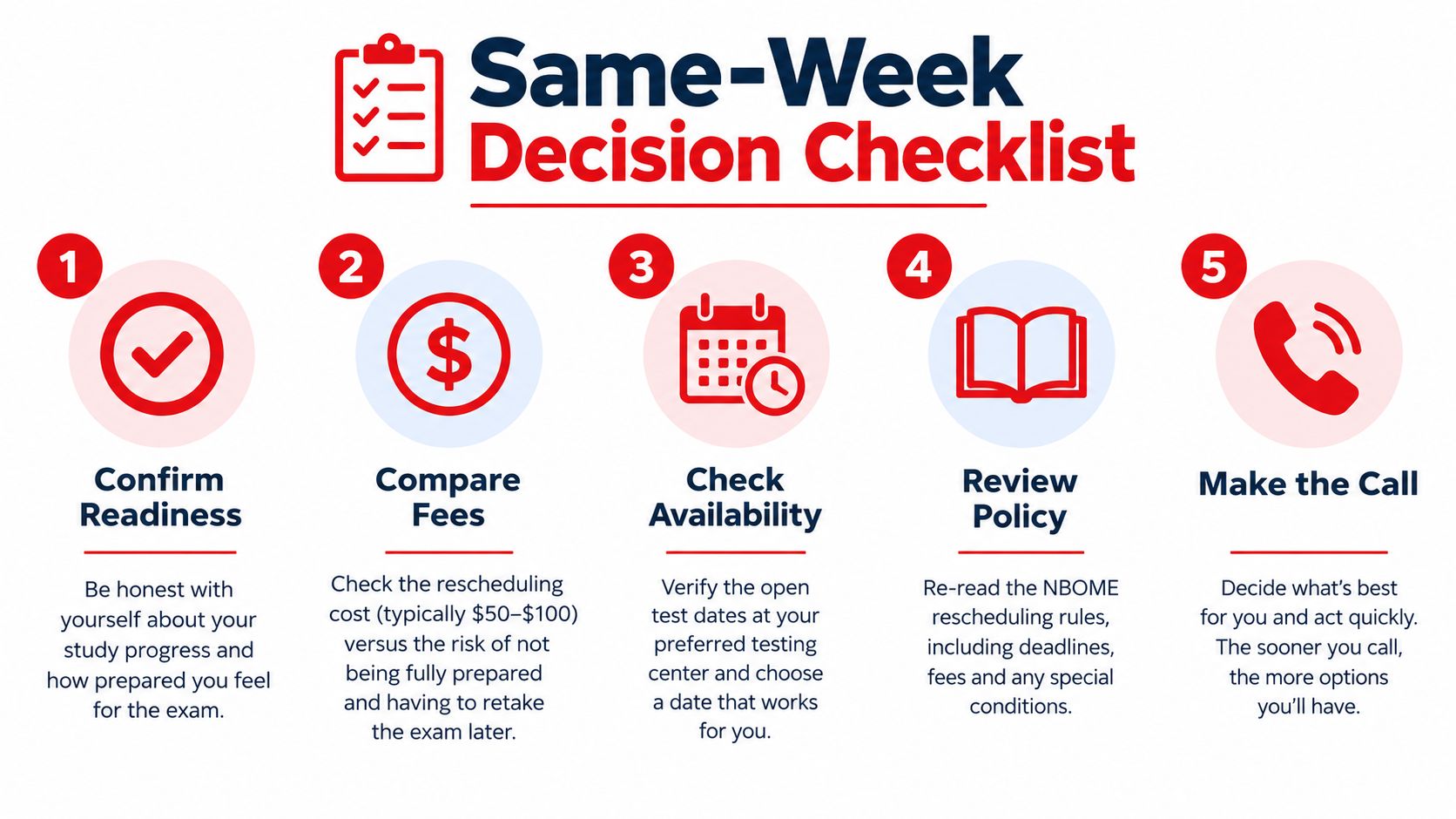
A same-week decision should produce a clear outcome: keep the appointment with a focused preparation plan, or move it to a feasible replacement date. Repeatedly reconsidering the decision without checking availability or completing the transaction leaves the candidate with uncertainty rather than additional options.
The financial difference is substantial. Rescheduling or cancelling more than 30 days ahead carries no fee, while the maximum Level 1 or Level 2-CE forfeiture is approximately 4.7 times the intermediate-window amount, $400 versus $85, under the 2024–2025 COMLEX-USA Bulletin. That comparison is a reason to act deliberately, not a reason to take an examination before preparation is adequate.
A practical decision checklist
- Assess readiness using evidence. Review recent practice work, recurring errors, pacing, and advisor feedback rather than relying only on confidence or anxiety.
- Name the benefit of moving. Specify what additional preparation will accomplish. The COMLEX Level 1 study schedule can support a revised plan.
- Check the replacement. Confirm availability and account eligibility before committing to a new date. NBOME also requires Level 1 and Level 2-CE appointments to be scheduled at least 5 calendar days in advance, under its registration policy.
- Compare the broader consequences. Consider the displayed charge alongside clerkship, school, or residency obligations. Institutional deadlines should be confirmed directly.
- Close the administrative loop. Save the final confirmation, update travel arrangements, and use an exam-day preparation checklist to review remaining logistics.
A workable postponement plan identifies a specific preparation gap and a feasible way to address it. A plan consisting only of “study more” needs refinement before the replacement date is selected.
Sources
The official authorities supporting the policies above are NBOME's Registration and Scheduling guidance, Frequently Asked Questions, 2025–2026 Bulletin of Information, Candidate Assistance Program, and 2024–2025 Bulletin of Information, linked at the relevant policy statements. Account-specific eligibility and unresolved scheduling issues should be confirmed directly with NBOME.
Personalized COMLEX tutoring can complement independent study when a candidate needs a clearer preparation plan before choosing a replacement appointment. Candidates weighing postponement can visit Ace Med Boards to schedule a free consultation focused on preparation gaps, available study time, and a realistic revised schedule.