COMSAE Level 2 means COMSAE Phase 2, the National Board of Osteopathic Medical Examiners' readiness assessment aligned to COMLEX-USA Level 2-CE, and it has no official numerical passing score. What can a readiness score tell a student if it isn't a pass-or-fail decision?
The useful answer lies in the pattern behind the total: clinical reasoning, osteopathic integration, foundational knowledge, and performance under time pressure. A score can help identify what deserves attention without becoming a verdict on a student's future in medicine.
By Ace Med Boards Editorial Team
What COMSAE Level 2 Measures
COMSAE stands for Osteopathic Medical Self-Assessment. Phase 2 is intended for the clinical-education stage and follows the framework of the Osteopathic Medical Licensing Examination of the United States, Level 2-Cognitive Evaluation, commonly called COMLEX-USA Level 2-CE.
The distinction is practical. COMSAE provides an assessment snapshot; COMLEX-USA is the licensing examination. Completing a practice form isn't equivalent to completing a licensing requirement, and a practice score shouldn't be treated as an official licensing decision.
COMSAE Phase 2 compared with COMLEX Level 2-CE
| Feature | COMSAE Phase 2 | COMLEX-USA Level 2-CE |
|---|---|---|
| Purpose | Readiness assessment aligned to Level 2-CE | Licensing examination of clinical and foundational competence for supervised graduate medical education |
| Stakes | No numerical minimum passing score | Pass or fail from total performance; minimum standard score 400 |
| Length | Confirm the current form with NBOME | 320 single-best-answer items in two 4-hour sessions |
| Score use | Descriptive performance bands and a performance profile | Criterion-referenced total score, not a preset pass quota |
| Administration | School COM forms or individual student forms | Eligible candidate after Level 1, second-year completion, and dean attestation |
The NBOME examination-format guide specifies 320 single-best-answer questions in two four-hour sessions, totaling eight testing hours, for Level 2-CE. That format makes sustained concentration and pacing relevant preparation targets, not merely finishing more questions.
The current COMSAE form's item count and fee aren't established by the references used here. For 2026 planning, those details should be confirmed directly with NBOME before purchase rather than inferred from the licensing examination's format.
Key Takeaways
- Framework matters. Phase 2 follows the Level 2-CE framework rather than functioning as an unrestricted question bank.
- Labels need context. COMSAE bands describe performance; they don't issue a licensing decision.
- Small subscores need caution. A narrow performance area may provide less dependable evidence than a repeated pattern across materials.
- Readiness has several inputs. Assessment timing, clinical-subject performance, and missed-question patterns belong beside the total score.
A student can use clinical-knowledge preparation for COMLEX Level 2 to connect rotation learning with exam preparation. Before replacing resources or rebuilding an entire schedule, the more useful first step is checking which blueprint domains the current plan addresses.
Reading COMSAE Score Bands
The common question, “What's the COMSAE passing score?” contains a misleading assumption. NBOME doesn't establish a numerical minimum passing score for COMSAE. An institution may use an assessment result in its own readiness process, but that doesn't create a universal NBOME pass line.
According to NBOME's scoring and reporting guidance, Phase 2 scores below 400 indicate lower performance, 400–649 indicate average performance, and above 649 indicate higher performance. These are descriptive categories, not converted COMLEX outcomes.
COMSAE Phase 2 bands versus the COMLEX pass standard
| Result | Official meaning | What it does not mean |
|---|---|---|
| COMSAE below 400 | Lower performance | An official COMSAE failure or the COMLEX pass decision |
| COMSAE 400–649 | Average performance | A converted or predicted Level 2-CE score |
| COMSAE above 649 | Higher performance | A guarantee of passing or of a particular Level 2-CE score |
| COMLEX Level 2-CE score of 400 | Minimum passing standard score | A COMSAE cutoff or a pass based on one subject area |
The NBOME frequently asked questions identify 400 as the minimum passing three-digit standard score for COMLEX-USA Level 2-CE and describe the decision as criterion-based, using total examination performance rather than a predetermined pass quota. A student's result isn't decided by how many classmates pass or by a single subject-area label.
What deserves caution
A COMSAE result in the lower band deserves attention, but calling it an official COMSAE failure adds a conclusion the assessment doesn't provide. Likewise, reaching the average band doesn't establish that the licensing examination has already been passed.
NBOME also cautions that performance areas containing relatively few questions are less reliable and more susceptible to measurement error. A thin subscore can suggest a question to investigate, but it shouldn't independently trigger an extensive content restart.
Interpretation rule: A subscore is more useful when independent practice results support the same weakness.
If a college requires a particular assessment result before approving an examination date, the student should confirm that requirement with the college. Institutional requirements and NBOME performance labels answer different questions.
Students comparing score labels with relative standing may find COMLEX scores and percentiles helpful. A percentile, a descriptive band, and a licensing pass standard shouldn't be used interchangeably.
How the Phase 2 Blueprint Is Weighted
A student may recognize a diagnosis yet struggle to select the next management step. Another may understand the biomedical mechanism but miss the osteopathic component. Those are different preparation problems, even when they occur within the same organ system.
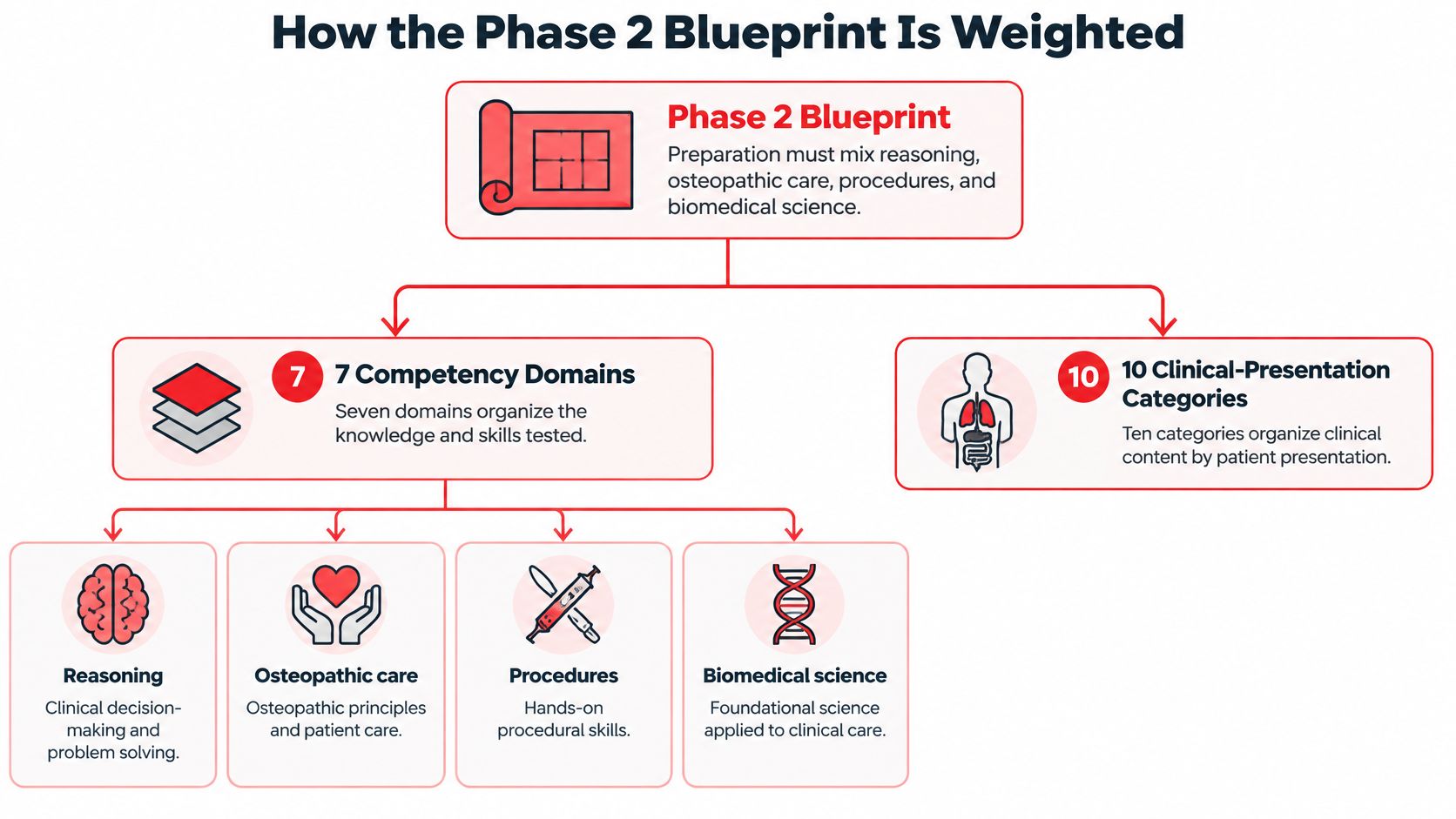
The NBOME Phase 2 blueprint organizes assessment content across seven competency domains and ten clinical-presentation categories, with minimum emphasis of 30% for Osteopathic Patient Care and Procedural Skills, 26% for Application of Knowledge for Osteopathic Medical Practice, 25% for the Foundational Biomedical Sciences Knowledge Base, and 10% for Osteopathic Principles, Practice, and Manipulative Treatment.
Translate domain weights into study choices
The largest stated competency emphasis concerns patient care and procedural skills. Preparation therefore needs more than recognition of disease names. Students should practice identifying what the question asks, determining the relevant clinical stage, and distinguishing an appropriate action from an action that would occur later.
Application of knowledge calls for using information rather than merely recalling it. Biomedical review remains relevant, but the useful endpoint is explaining how a mechanism changes interpretation of a clinical presentation.
Osteopathic manipulative medicine, or OMM, shouldn't be isolated from the rest of clinical preparation. Review can connect osteopathic findings and principles with the same case types used for diagnosis and management practice.
Communication, professionalism, systems-based practice, and practice-based learning are additional blueprint requirements. They aren't optional material to leave until every organ-system chapter feels complete.
Review presentations separately from competencies
The clinical-presentation minimums include:
- Community health and wellness: At least 12%.
- Musculoskeletal system: At least 13%.
- Major clinical systems: At least 10% each for nervous system and mental health, gastrointestinal and nutritional health, circulatory and hematologic systems, and respiratory system.
Additional categories include human development, reproduction and sexuality; endocrine and metabolism; and genitourinary, renal, and breast conditions.
A clinic-day analogy helps explain the distinction. A patient encounter may require diagnostic reasoning, selection of the next step, interpretation of an osteopathic finding, and recognition of a systems issue. The presentation describes the clinical setting; the competency describes the task.
The COMLEX Level 2 blueprint guide can support that mapping. Before adding another resource, a student should name two competency gaps and two presentation gaps supported by actual review patterns.
What a Phase 2 Score Can Predict
A peer-reviewed predictive study in the Journal of Osteopathic Medicine found that a combined model explained 73.9% of observed variation in COMLEX-USA Level 2-CE performance; within that sample, a first-time COMSAE Phase 2 score of 447 and average clinical COMAT score of 94.4 were associated with passing. Those findings describe the study sample, not universal readiness cutoffs.
The model combined average clinical Osteopathic Medical Achievement Test (COMAT) performance, first-time Phase 2 score, preclerkship examination average, and Level 1 pass/fail status. Its explanatory value belonged to that combination, not to COMSAE alone.
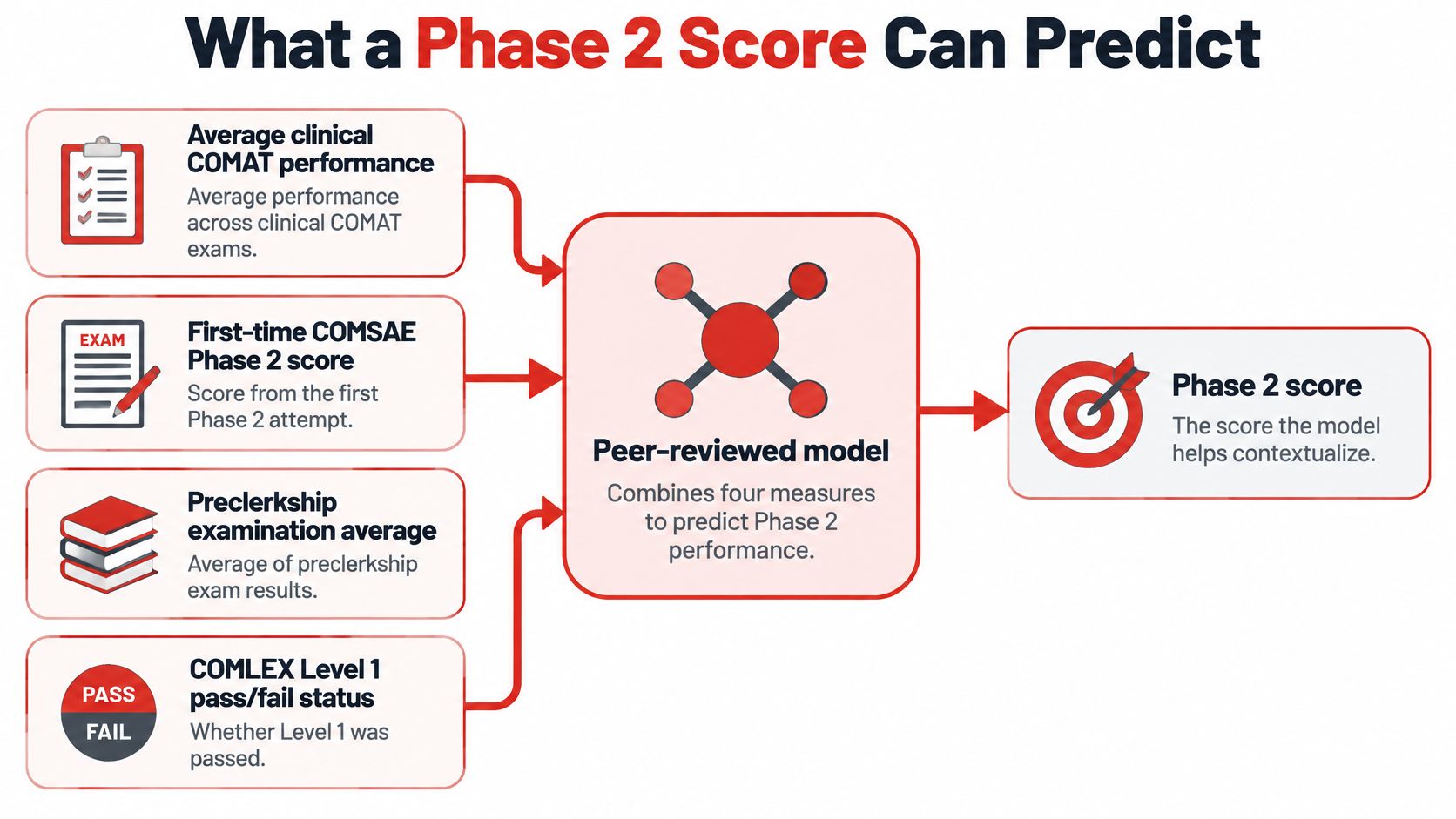
The study's predicted outcome was Level 2-CE performance, not another Phase 2 score. More than a quarter of the observed variation remained unexplained, and the model doesn't supply a dependable personal conversion formula.
Educational contrasts, not student outcomes
Consider these hypothetical situations:
- A score near the study benchmark with weak COMAT performance. The student may still have unresolved clerkship-level knowledge or management gaps. The assessment number alone wouldn't justify dismissing those concerns.
- A borderline Phase 2 result with consistently strong COMAT performance. The student may benefit from investigating long-stem reading, integration, pacing, or answer-choice comparison before assuming that all clinical knowledge needs rebuilding.
Neither scenario identifies a cause automatically. Each suggests what an advisor should examine next using independent evidence.
The study also reported that the relationship was strongest for the first COMSAE taken close to Level 2-CE and weakened across subsequent attempts. A sensible interpretation is to retain the earliest well-timed assessment as a baseline and use later forms to examine direction of change.
A predictive association can support advising without becoming permission to ignore conflicting evidence.
Population results aren't personal probabilities
A secondary account reporting NBOME testing-cycle results states that 92.5% of 9,096 first-time COMLEX-USA Level 2-CE takers passed during the 2025–2026 cycle. That figure describes licensing-examination results, not COMSAE bands or an individual student's probability of passing.
Form differences, test-day conditions, and uncertainty in narrow subscores also limit what a single assessment can establish. A student who slept poorly or lost pacing should document those conditions, without assuming they explain every missed question.
The useful question isn't “What COMLEX score does this equal?” It's “Which interpretation best fits the assessment, clerkship performance, and current practice work?” Guidance on COMSAE-to-COMLEX conversion limits can help distinguish contextual interpretation from an unsupported conversion chart.
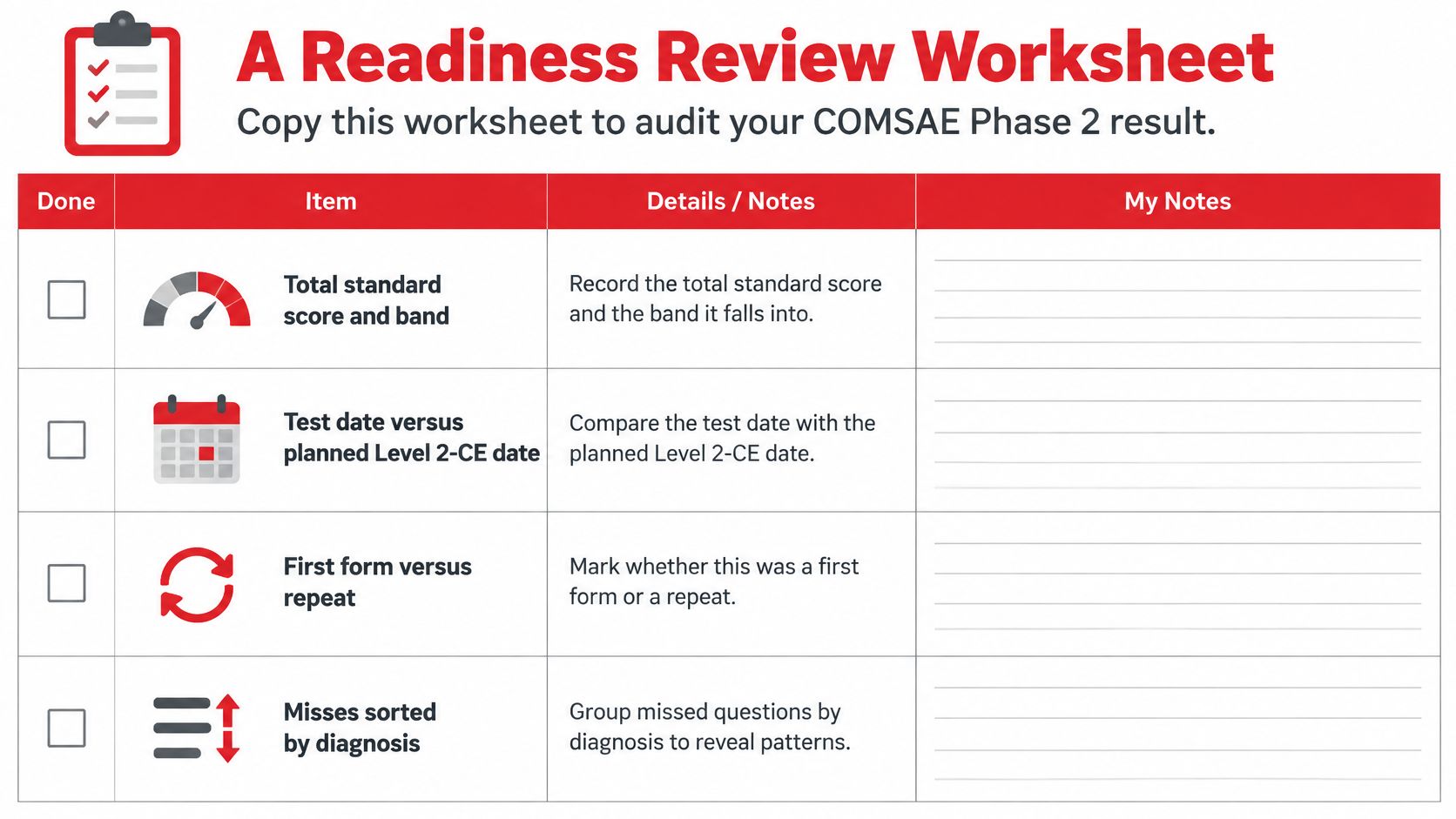
A Readiness Review Worksheet
A readiness review works best when it produces a short list of decisions rather than a longer list of resources. The worksheet below separates observations from interpretations so that a disappointing total doesn't automatically lead to an unfocused restart.
Copyable score-audit worksheet
| Review field | Information to record | Decision the information supports |
|---|---|---|
| Total standard score and band | Exact report result and official label | Establish the starting point without inventing a pass decision |
| Assessment date and planned Level 2-CE date | Both dates and any school deadline | Identify the available preparation interval |
| First form or repeat | Assessment history and testing conditions | Distinguish baseline information from trend information |
| Competency-related misses | Diagnosis, management sequence, OMM integration, communication, systems-based care | Select the reasoning skill requiring practice |
| Clinical-presentation clusters | Repeated weaknesses by presentation or system | Choose focused clinical review |
| Timing and long stems | Rushed endings, repeated rereading, unresolved answer choices | Identify pacing or reading-process targets |
| Resources already used | Question banks, official assessments, notes, review materials | Reduce duplication and assign each tool a purpose |
| COMAT or clerkship pattern | Consistent strengths and unresolved subject weaknesses | Check whether independent evidence agrees |
| Anxiety and pacing notes | Observable interruptions, avoidance, concentration changes | Plan support and more representative practice |
The worksheet should summarize available score reports and authorized practice work. It shouldn't reconstruct protected assessment questions or depend on recalled examination content.
A hypothetical completed review
Consider a fictional educational example, not an Ace Med Boards client or reported outcome. A student earns 430, within the average band, on a first form taken six weeks before a planned examination date. Biomedical recall appears relatively stronger, while authorized practice review shows repeated difficulty with osteopathic integration and selecting the next management step.
The student's surgery and pediatrics COMAT performance is uneven. That pattern supports checking clinical application in those subjects, but it doesn't establish that every question in either field requires remediation.
The completed audit produces three priorities only:
- Mixed timed blocks focused on next-step reasoning. Review should distinguish the action appropriate now from reasonable actions that belong later.
- A short OMM set connected to the same case types. The student links osteopathic concepts with clinical reasoning instead of maintaining a disconnected memorization list.
- A full practice day organized as two four-hour sessions. The purpose is to observe concentration, pacing, and recovery across a licensing-style testing day, not to calculate a predicted score.
These are illustrative planning choices, not an outcome forecast. The example's schedule doesn't establish how long another student needs.
Audit checkpoint: A useful priority names both the weakness and the practice behavior intended to address it.
A thin subscore shouldn't be treated as an exact measurement of subject mastery. Repeated patterns across independent materials deserve more weight than an isolated label.
The finished worksheet becomes the input for an advisor discussion about priorities, available time, and examination-date decisions. It remains a planning document, not a homemade COMLEX score calculator.
Adjust the Plan After Your Result
Eligibility comes before score interpretation. The NBOME eligibility requirements require a candidate to have passed Level 1, completed the second year at an accredited college of osteopathic medicine, and received dean attestation of good academic and professional standing before Level 2-CE.
A practice result can't override those conditions. Coursework completion alone doesn't establish eligibility, and an assessment label doesn't substitute for institutional approval.
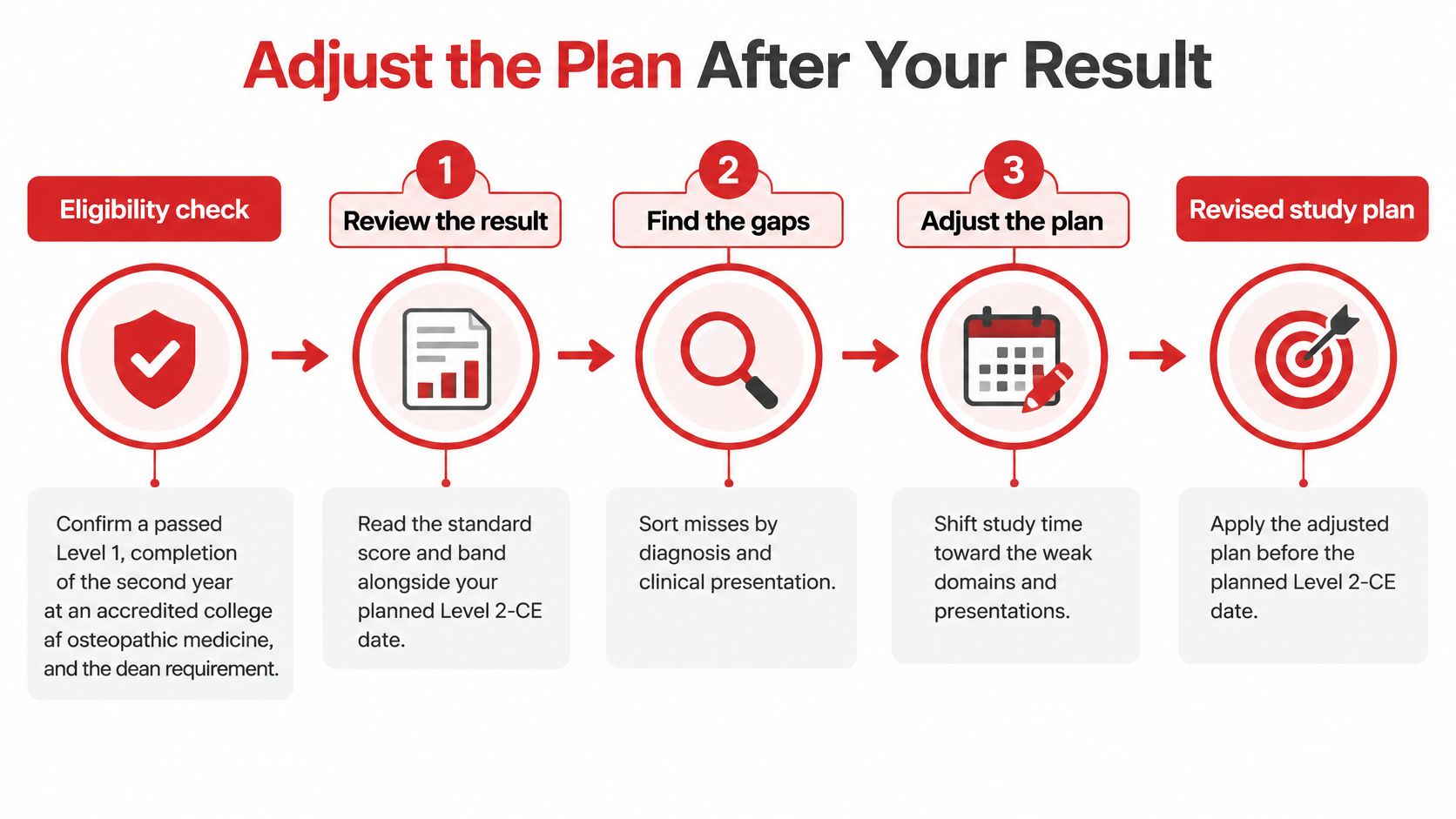
A practical decision path
Confirm the college's requirements. The student should verify the planned date, local assessment policy, and approval process with the appropriate academic office. A remembered policy or classmate's experience isn't sufficient.
For lower performance, simplify preparation. Pause broad resource collecting. Rebuild patient-care reasoning and OMM integration within mixed cases, then review timed performance with an advisor before reconsidering the examination date.
For average performance, target the weakest supported domains. The worksheet should determine the focus. When the calendar permits, preparation can emphasize those gaps while testing whether pacing remains stable through a full practice day.
For higher performance, maintain rather than chase. Spaced mixed practice and deliberate review may be more useful than repeatedly testing for a more reassuring number. A later form should answer a specific unresolved readiness question.
Keep the baseline identifiable. Later assessments should be recorded with their dates and conditions. Averaging attempts into a personal prediction obscures the preparation changes between them.
Study focus and timing by COMSAE result
These are illustrative planning windows, not NBOME requirements or validated minimum preparation periods. They assume the college permits changes to the planned date.
| Result | Main focus | Planning window |
|---|---|---|
| Lower performance | Patient-care reasoning, OMM integration, and timed mixed blocks | Often several weeks; confirm any date change with the college |
| Average performance | The two weakest domains plus full-day pacing | About 4–8 weeks when the examination date allows |
| Higher performance | Spaced mixed review, stamina, and one later trend check | Shorter runway; avoid chasing another number |
| Repeat taken soon after the first | Trend only, with the first well-timed score kept as baseline | Don't average attempts into a prediction |
A date decision should reflect the available evidence and the college's requirements, not a table alone. If the remaining interval can't accommodate the identified work, an advisor discussion is more useful than compressing every resource into an unrealistic schedule.
A lower score or an earlier unsuccessful licensing attempt is a preparation problem to investigate, not a judgment about a student's suitability for medicine. Respectful review asks what happened, which patterns persist, and what support would make the next plan more workable.
Decide Whether to Get Targeted Help
The completed worksheet can distinguish a content gap from a process problem. Targeted support may be useful when mixed-block performance plateaus, next-step questions remain difficult, OMM is missed within otherwise well-understood vignettes, or pacing deteriorates during sustained practice.
A return after an unsuccessful Level 2-CE attempt may also warrant structured review. The purpose isn't to repeat the same preparation more intensely, but to identify which decisions and study behaviors need to change.
Ace Med Boards COMLEX tutoring uses clinical vignettes to practice diagnosis, management decisions, and reasoning through competing choices. It complements official NBOME materials, a question bank, and independent study; it doesn't replace those tools or provide protected examination content. The separate COMLEX tutoring information page provides another relevant starting point for readers evaluating that option.
How does a COMAT differ from Phase 2?
A COMAT is a clerkship-subject assessment, while Phase 2 samples the broader Level 2-CE framework. Strong subject performance can add context, but the assessments should remain separate signals.
Can Phase 1 or Phase 3 substitute for Phase 2?
No. Each COMSAE phase aligns with its corresponding COMLEX level. Results from another phase shouldn't replace the assessment intended for the student's current licensing stage.
Where should current item counts and fees be checked?
For 2026 planning, the current NBOME Phase 2 page should be checked before purchasing a form. This article doesn't establish a current COMSAE item count or fee.
Sources
The examination references are NBOME's Phase 2 blueprint, scoring and reporting guidance, examination-format guide, frequently asked questions, and eligibility bulletin. Predictive findings come from the Journal of Osteopathic Medicine study; the testing-cycle pass rate is identified separately as a secondary report.
Ace Med Boards isn't affiliated with or endorsed by NBOME. Any package or progress-guarantee terms require review of the current policy and shouldn't be interpreted as a promised licensing result.
Ace Med Boards offers a free COMLEX consultation about exam level and timeline, along with a free Board Score Audit reviewing the latest assessment data, current resources, study schedule, examination date, and target outcome. Students seeking help interpreting a Phase 2 result can visit Ace Med Boards to arrange a low-pressure review of the completed worksheet and possible next steps.