
You're probably in the most uncomfortable phase of board prep. You know enough to pass. You also know enough to scare yourself.
One minute you're reviewing renal physiology and telling yourself you've got this. The next, you're checking your permit, wondering if your ID still matches the registration exactly, and debating whether one more late-night question block will save you or wreck you. That swing between confidence and panic is normal. It's also where bad decisions happen.
Good exam day preparation isn't motivational fluff. It's operational. It's what keeps a decent knowledge base from getting sabotaged by poor sleep, bad pacing, shaky logistics, or a fried brain. A lot of students lose points before the first question even loads because they treat exam day like an afterthought instead of the final phase of training.
If you need a practical framework to organize the last stretch, use an exam preparation planner built for medical students. Then stop improvising.
Introduction to Exam Day Preparation
A tense med student the week before an exam looks almost identical every time. Laptop open. Question bank half-done for the day. Coffee getting cold. Backpack on the floor with snacks, charger, earplugs, and a growing pile of “I should probably bring this” items. Meanwhile, your brain is running two separate conversations. One is clinical. The other is pure anxiety.
That anxiety gets louder when the studying phase starts giving way to the performance phase. At that point, knowing content isn't enough. You need a plan for the final week, the last evening, the morning ramp-up, your pacing inside each block, and what to do if something goes sideways.
Practical rule: Treat exam day preparation like part of the exam itself. If you leave timing, sleep, food, and logistics to chance, you're not “being flexible.” You're bleeding points.
Students often assume the only dangerous mistake is under-studying. Wrong. Overstudying at the wrong time is just as destructive. So is walking in mentally cold, starting too slowly, or burning energy on panic instead of questions. The fix is simple. Build the week and the day on purpose.
Pre Exam Week Planning
The final runway matters. For major cumulative exams, research and academic guidance recommend starting 3 to 4 weeks before test day with spaced repetition and timed practice tests, not random last-minute cramming, according to Learn Do Grow's test preparation guidance.
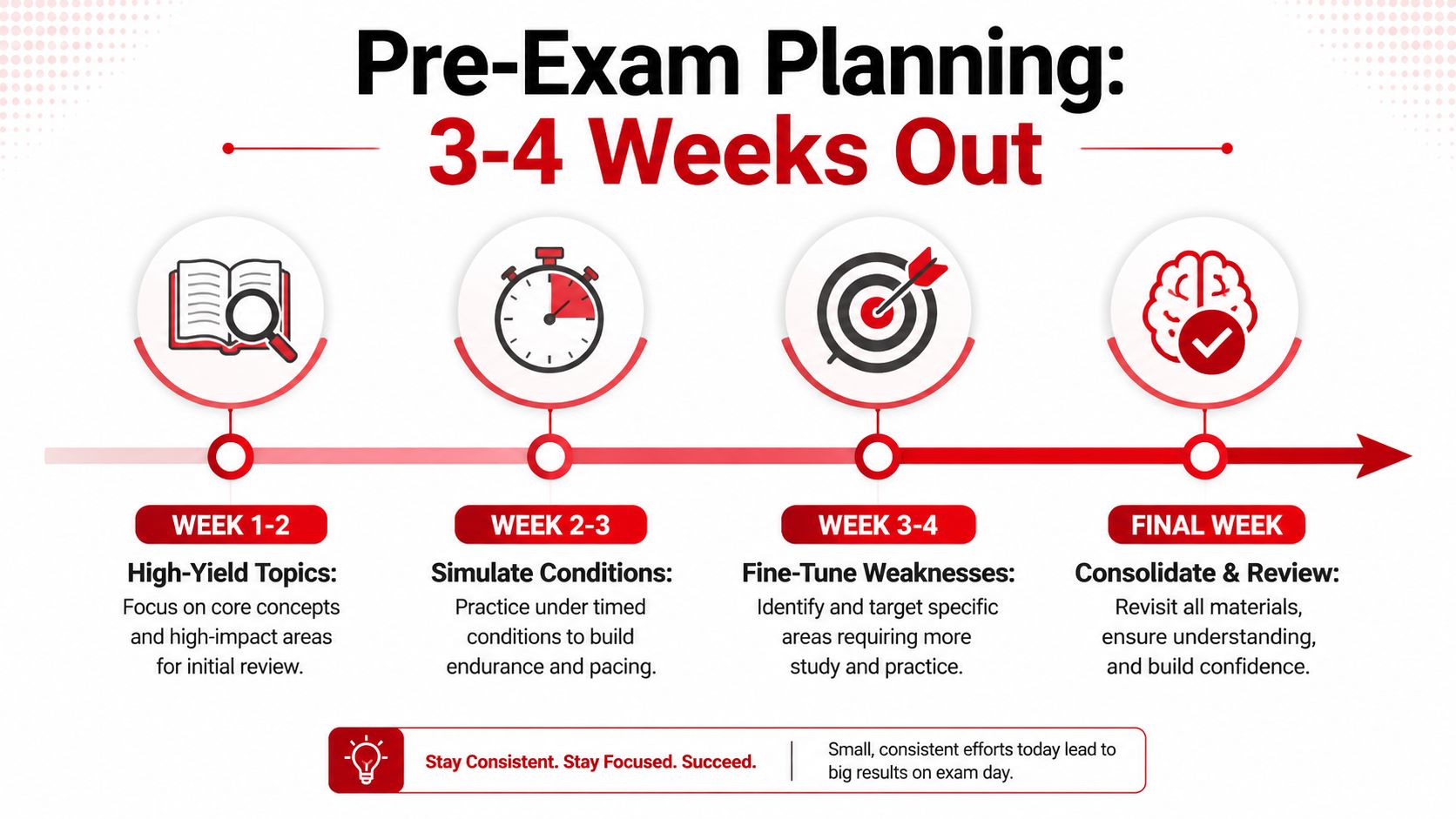
If you're inside that window, good. Use it correctly. If you're later than that, stop complaining about lost time and get disciplined with what's left.
Your daily structure
For major unit exams, advance study should include daily sessions of 45 to 60 minutes. For cumulative medical exams, I prefer stacking those sessions into a repeatable day rather than “studying until tired.” The reason is simple. Predictable study blocks reduce decision fatigue.
A clean day looks like this:
- First block: High-yield review from a weak system or discipline.
- Second block: Timed questions on mixed topics.
- Third block: Review of errors, not just answer explanations.
- Fourth block: Spaced repetition with flashcards or handwritten recall.
Alternate subjects instead of forcing one giant marathon on a single topic. Path, pharm, biostats, and ethics don't fatigue your brain in exactly the same way. Mixed cognitive load keeps you sharper.
What to do each week
Use the final weeks differently.
| Week range | Main job |
|---|---|
| Early phase | Rebuild core concepts and identify weak areas |
| Middle phase | Increase timed mixed blocks and tighten recall |
| Final week | Simulate test conditions and sharpen pacing |
That's the broad structure. Here's the blunt version of how to execute it.
- Start with the syllabus or blueprint. Identify the top weighted topics first. When time is limited, depth beats fake coverage.
- Use practice problems strategically. Within that earlier prep window, complete 2 to 3 practice problems for each of the top 3 highest-weighted topics identified in the syllabus. That forces depth where it matters most.
- Review mistakes the same day. Don't bank a pile of missed questions and tell yourself you'll “circle back.”
- Protect one serious simulation each week. Use mixed, timed, randomized blocks. Sit still. Follow the clock. No pausing.
If your “practice” happens with music on, phone nearby, and no timer, you're not rehearsing exam performance. You're rehearsing comfort.
For a structured weekly template, use a study schedule for medical students facing high-stakes exams.
Final week priorities
The last week isn't for heroic content expansion. It's for execution. Students who use timed, randomized question blocks under simulated exam conditions in the final week show 10 to 15% higher score retention than students who focus on weak-area review alone, based on the AMA's shelf exam study habits article.
That means your final week should look more like this:
- Mixed blocks over isolated topics
- Timed work over open-ended review
- Error-pattern analysis over endless annotation
- Fatigue rehearsal over perfectionism
Do not spend the whole week trying to “finally master everything.” You won't. What you can do is train your brain to retrieve, eliminate, and move.
Night Before Checklist
The night before is not a bonus study day. It's a recovery protocol.
Expert consensus says you should stop active studying 12 to 18 hours before the exam, get at least 5 to 6 hours of sleep while aiming for 7 to 8, and eat a balanced breakfast with complex carbohydrates, protein, and fat the next morning, according to Med School Insiders' exam-day guidance.
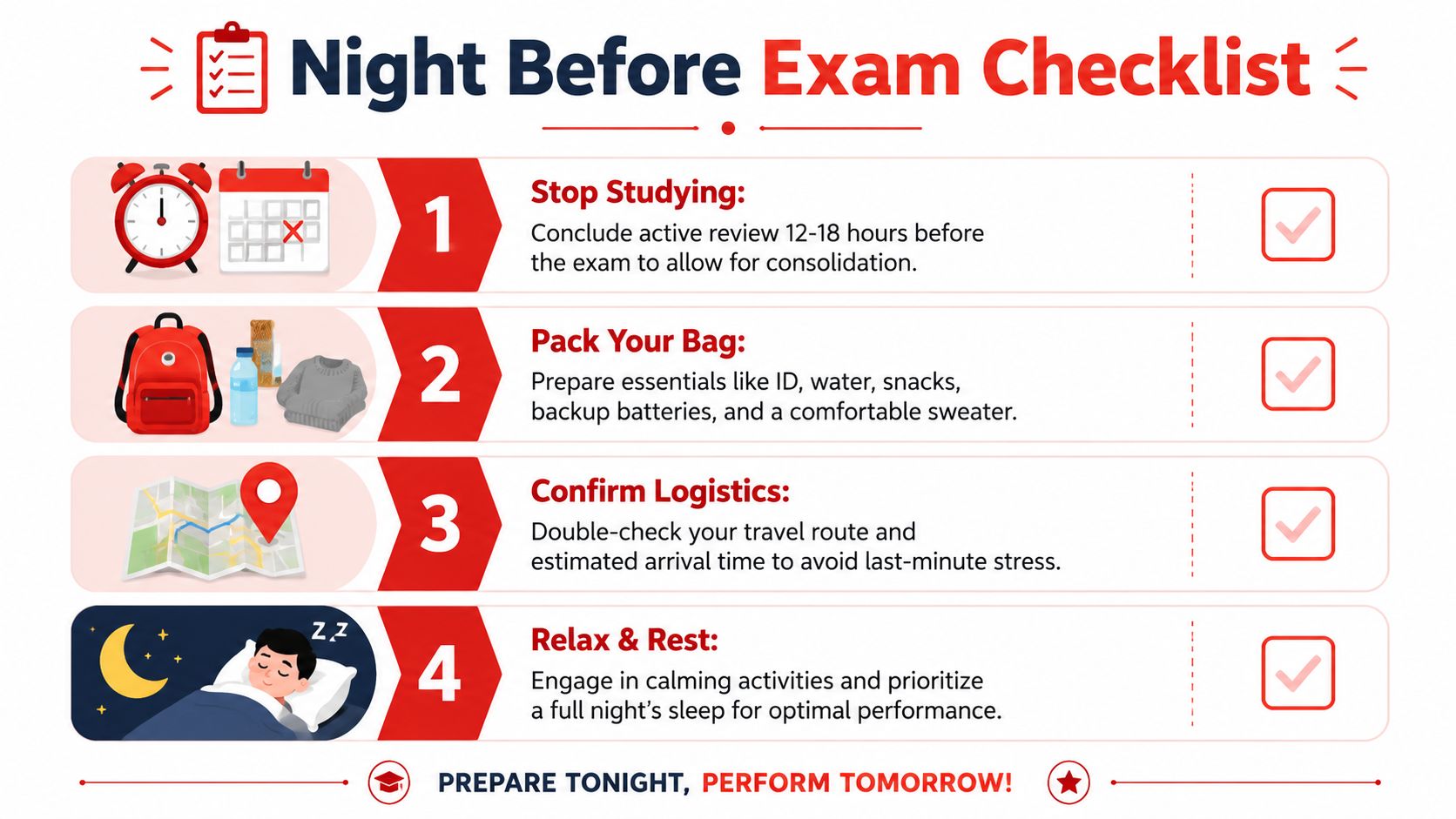
Students hate this advice because it feels passive. It isn't. It's disciplined.
Your evening timeline
Use the evening like a shutdown sequence, not a cram session.
- Late afternoon: Finish active studying. Close the question bank. Stop trying to rescue your score with panic.
- Early evening: Do one short skim of your own flashcards, formula sheet, or handwritten misses. Personal material only. No new resources.
- After that: Pack everything and verify logistics.
- Final stretch before bed: Wind down hard. Lower stimulation. Protect sleep.
Here's what belongs in your bag:
- Required identification: Bring what the testing center requires.
- Comfort layer: Sweater or light jacket because room temperature is unpredictable.
- Food and drink: Simple snacks and water for breaks, if allowed.
- Essentials: Charger, wallet, keys, and anything specifically permitted at your site.
A lot of students also benefit from a deliberate wind-down routine. If your brain stays revved up at night, borrowing ideas from more from SleepHabits can help you build a calmer pre-sleep routine without turning bedtime into another performance test.
For food planning the next morning, save a shortlist from this guide on foods to eat before test.
Here's a useful reminder before you sleep:
What not to do
Don't “just review a little more” once you've already crossed into fatigue.
Don't pick a fight with yourself over topics you still dislike.
Don't stay up to win an argument with your anxiety.
Your score won't be saved by one more exhausted hour. It can absolutely be damaged by one less hour of sleep.
Morning Activation Routine
Walking into a major exam mentally cold is a stupid unforced error. Too many students protect their energy so aggressively that they arrive half-awake and need the first block to become functional. That first block counts.
Current guidance doesn't give a strong data-backed protocol for low-stakes warm-up, but addressing that gap with a 10-minute diagnostic question set can reduce misreading errors tied to sluggish mental activation, as discussed in the University of Melbourne's exam day tips.
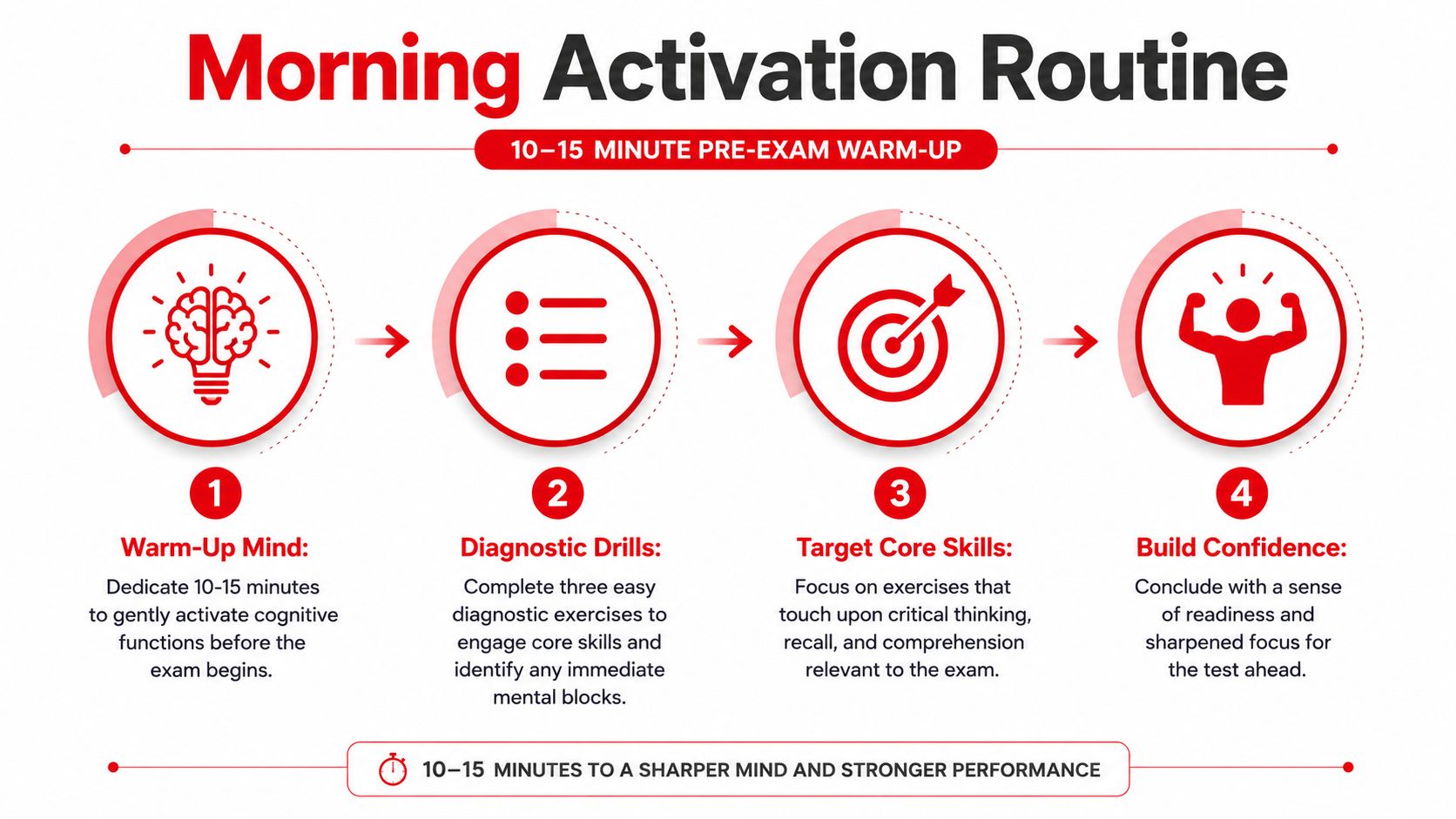
A better pre-exam warm-up
You do not need a full study session. You need a controlled ignition.
Use this sequence:
- Three easy diagnostic questions. Not your hardest ones. You're waking up pattern recognition, not testing self-worth.
- Rapid recall from a narrow topic. Drug mechanisms, murmurs, rashes, cranial nerves, acid-base patterns. Keep it brief.
- One minute of instruction awareness. Remind yourself to read every stem, note qualifiers, and respect task wording.
- Quiet reset. Sit still for a moment before going in. No frantic scrolling.
That's enough to shift you from sleepy to clinically engaged without draining focus.
Breakfast that works
Eat a real breakfast. Not candy and caffeine. Not nothing.
You want food that's steady, boring, and easy to tolerate. Complex carbs, protein, and fat support concentration better than a sugar spike. If you need easy ideas that won't become a production, this roundup of Simple breakfast pairings for Cartograph Coffee is useful because the combinations are simple enough to execute under stress.
A solid exam morning is quiet. Wake up, move, eat, activate, leave.
In Test Strategies and Breaks
Once the exam starts, pacing becomes a clinical skill. Students who know the material still get trapped when they linger too long, reread stems compulsively, or try to force certainty on low-confidence questions.
For high-stakes exams, a practical pacing method is to complete at least 40% of questions by the 25% time mark, 70% by the 50% mark, and 90% by the 75% mark, according to this high-stakes exam pacing walkthrough. If you miss those marks, speed up immediately. Don't wait for a miracle in the last minutes.
Time-pacing benchmarks
| Elapsed Time | Questions Completed |
|---|---|
| 25% time | 40% completed |
| 50% time | 70% completed |
| 75% time | 90% completed |
Print that into your brain before test day.
How to answer faster without getting sloppy
The biggest mistake is passive reading. Read the stem with a purpose. Before looking at the options, generate your own answer if you can. That reduces the temptation to get seduced by attractive distractors and keeps your reasoning cleaner. If you're still trying to sharpen that skill, this guide on how to improve test-taking skills is worth reviewing before your next block.
When you hit a hard question, use a simple triage model:
- Know it: Answer and move.
- Can narrow it: Eliminate aggressively, choose the best remaining answer, flag only if your interface allows and your timing is healthy.
- No clear angle: Make the best quick elimination you can, pick, and move.
Most pacing disasters don't happen because the whole exam is hard. They happen because one stubborn question steals time from ten gettable ones.
Breaks that actually help
Breaks are not rewards. They are maintenance.
Use them to reset your eyes, shoulders, hands, and breathing. Stand up. Walk. Drink some water. Eat a small portion of the snack you already tested before exam day. Don't use breaks to autopsy the last block. That's how one bad question infects the next section.
If you're prone to jitters or stress-related fog, some students like reading about herbs and nutrients for mental clarity well before exam week so they can decide what fits their routine. Just don't experiment with anything new on the actual day.
Anxiety control under the clock
Anxiety burns time in sneaky ways. It makes you reread. It makes easy stems feel hostile. It makes you check and recheck obvious answers.
One practical strategy is brief visual reset. Look away from the screen, relax your jaw, drop your shoulders, and take one slower breath before the next question if you feel yourself spiraling. Some guidance also notes the palming method and visualization can reduce test anxiety by 40%, and that 65% of students who fail initial attempts report anxiety as the primary cause of time mismanagement, according to Windsor University's medical test-taking strategies.
The point isn't to become serene. The point is to stay functional.
Post Exam Debrief and Recovery
The second you leave the exam, your brain will want to do something unhelpful. It will either replay every ugly question or collapse entirely. Don't let it choose for you.

Debrief without spiraling
Give yourself a short, controlled debrief. Write it down if needed.
- Three things that went well: Timing, calm under pressure, block endurance, recognition of familiar patterns.
- Two points of hesitation: Question types, pacing dips, content clusters that shook you.
- One surprise topic: Anything that felt underrepresented in your prep.
That kind of reflection is useful. Group texting your friends about obscure stems isn't.
After an exam, memory is noisy. Capture patterns, not trivia.
Recovery that helps the next performance
You're not lazy if you need recovery. You're coming off cognitive strain.
Hydrate. Eat normal food. Walk a bit. If you're depleted, take a short nap and then get outside or do something with a hard stop. The point is to tell your nervous system the event is over. If another exam is coming, save detailed content review for later, when your brain isn't distorted by adrenaline.
One lesson from the final week still matters here. Students who used timed, randomized question blocks under simulated conditions in the final week had 10 to 15% higher score retention than peers who focused only on weak-area review, based on the AMA article on shelf exam study habits. If your exam felt manageable under pressure, that rehearsal likely helped. Keep that note for the next one.
Contingency Planning and Quick Decision Aids
Bad mornings happen. Traffic stalls. You forget where you parked. Your document isn't where you thought it was. The answer isn't to panic faster.
Build two backups for everything that can realistically fail. Keep a second transport option. Store critical documents in more than one place if permitted. Know who to call and where to go before you're stressed enough to think badly.
Use quick decision rules:
- Running late: Stop reviewing. Start moving. Logistics beats flashcards.
- Tech problem before entry: Get staff help immediately. Don't troubleshoot in isolation while time disappears.
- Anxiety spike in line: Step aside, breathe once, and reduce the problem to the next action only.
- Terrible block: Treat it as one block. Reset before the next one.
If this exam doesn't go your way, don't turn one bad day into a permanent identity. A structured USMLE retake strategy complete guide for second attempts can help you rebuild the right way.
If you want direct, personalized help tightening your exam day preparation, pacing, question analysis, and final-week strategy, Ace Med Boards offers one-on-one support for USMLE, COMLEX, Shelf exams, and related high-stakes testing. It's a good fit if you're tired of generic advice and want a plan built around how you perform under pressure.