
You can recognize the vignette: an infant becomes lethargic after missing feeds during an illness, a patient develops unexplained metabolic acidosis, or a laboratory graph asks you to interpret an inhibitor. The correct answer usually doesn't require reproducing every arrow in a pathway. It requires a clinical reasoning map that connects purpose, location, regulation, cofactors, physiologic state, and the abnormality that exposes the mechanism.
Biochemistry is the study of chemical reactions in living systems. For medical exams, its value lies in explaining why a metabolite accumulates, why a product disappears, how a drug changes a pathway, or why a patient deteriorates when nutrition changes. The approach below is designed for medical students, osteopathic medical students, international medical graduates, premedical students, and applicants preparing for the United States Medical Licensing Examination (USMLE), COMLEX-USA, or the Medical College Admission Test (MCAT), with exam-specific details kept distinct.
Why Biochemistry Feels Hard and What to Do About It
A Step 1-style vignette might describe a previously well infant who develops vomiting, lethargy, and hypoglycemia after a viral illness and reduced intake. Several disorders could produce that pattern, so memorizing isolated disease names won't carry you far. You need to ask what fuel the body should be using during fasting, where that fuel is processed, which regulated step controls the response, and what accumulates when the pathway fails.
That shift matters because medical biochemistry is often experienced as rote memorization rather than clinical reasoning. Educational reviews describe learners as finding the subject abstract, repetitive, and weakly connected to practical application, while newer teaching work has continued to emphasize case-based and laboratory-linked learning as a way to close that theory-practice gap (medical education review). More content isn't automatically the solution. Better context often makes existing content usable.
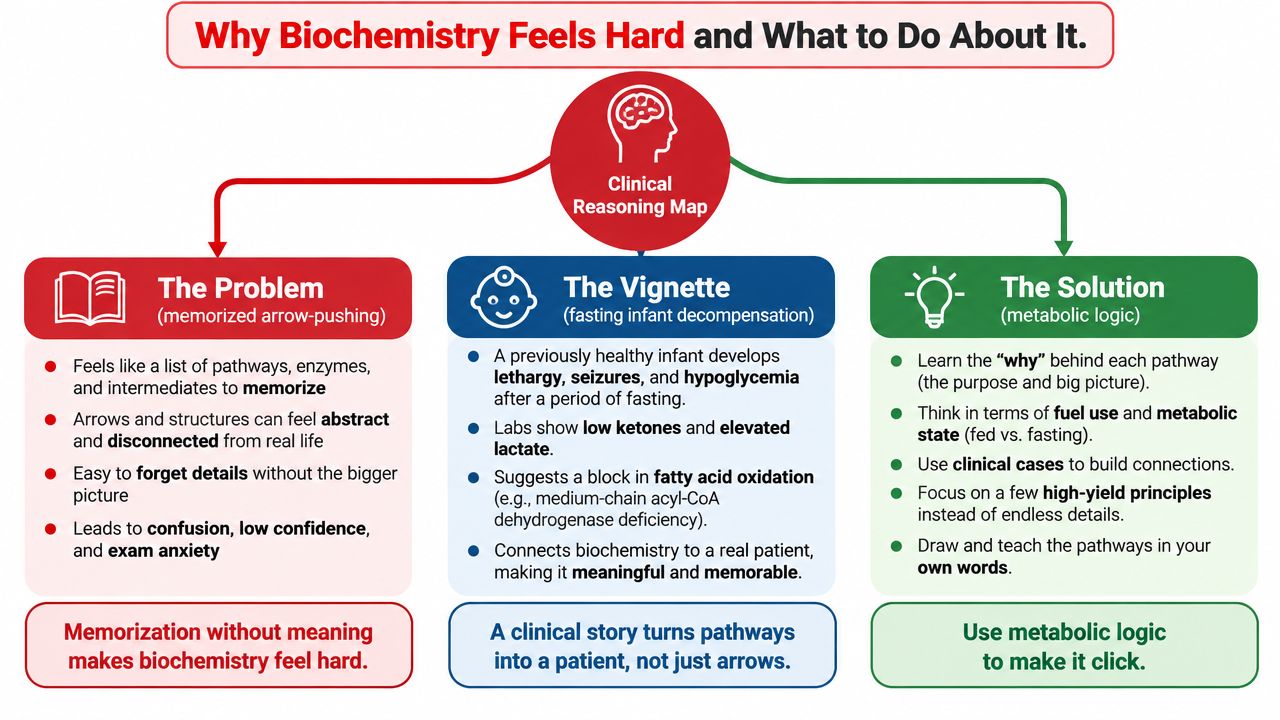
The four recurring sources of confusion
- Pathway overload: You memorize arrows without knowing the pathway's job.
- Weak kinetics intuition: You know inhibitor definitions but can't predict what happens to substrate, product, or graph lines.
- Compartment confusion: You remember a reaction but not whether it occurs in the cytosol, mitochondrion, lysosome, or endoplasmic reticulum.
- Disconnected inherited disorders: You recognize a buzzword but can't map it to the missing enzyme and accumulated metabolite.
Use one repeatable framework. For every pathway, identify its purpose, cellular location, rate-limiting or regulated step, activators and inhibitors, fed or fasted state, cofactors, linked pathways, and disease or drug hook. This is also where spaced repetition for medical study helps, but only after you create meaningful cards. A card that asks “What does this enzyme do?” is weaker than one that asks “What accumulates when this enzyme is absent, and what physiologic state makes the defect visible?”
Biochemistry becomes more manageable when you stop treating it as a list of reactions. Treat each pathway as a small system with inputs, outputs, control points, and consequences. The next building blocks give you the vocabulary for that system.
The Five Building Blocks You Must Master First
Every major biochemistry question rests on a small set of foundations. Study them in an order that lets each topic support the next: begin with carbohydrates and enzyme kinetics, then add lipids, amino acids, and nucleotides. That sequence gives you early practice with energy flow, regulation, and graph interpretation before you layer on nitrogen handling and genetic medicine.
| Building Block | Core Purpose | Representative Exam Archetype | High-Yield Question Type |
|---|---|---|---|
| Carbohydrate metabolism | Match glucose availability with energy production or storage | A fasting or fed-state vignette | Glycemic dysregulation, glycogen storage, gluconeogenesis |
| Enzyme kinetics | Predict how enzymes respond to substrate, inhibitors, and regulation | An altered reaction-rate graph | Michaelis-Menten or Lineweaver-Burk interpretation |
| Lipid metabolism | Store, mobilize, transport, and oxidize energy-dense fuel | A patient unable to tolerate fasting | Dyslipidemia, fatty acid oxidation, ketone production |
| Amino acid metabolism | Process nitrogen and carbon skeletons | A newborn with neurologic or metabolic symptoms | Nitrogen balance, amino acid disorders, urea-cycle defects |
| Nucleotide metabolism | Build and recycle nucleic-acid components | A drug blocks nucleotide synthesis | Antimetabolite action and purine or pyrimidine disorders |
Build from purpose rather than reaction order
Carbohydrates answer a basic question: can the cell use glucose now, store it, or make more when intake falls? Enzymes explain why the reaction proceeds at a particular rate and how drugs or mutations change that rate. The clinical clue may be a graph rather than a symptom.
Lipids become easier after you understand fasting physiology. Ask whether the tissue needs fatty acids, ketone bodies, or glucose, then identify the transport and oxidation steps that make that fuel available. Amino acids require a separate nitrogen map, because the carbon skeleton can enter energy pathways while nitrogen must be safely handled.
Nucleotides connect metabolism to pharmacology. Drugs that inhibit nucleotide synthesis can affect rapidly dividing cells, and inherited disorders can reveal whether the problem lies in synthesis, salvage, or degradation.
For protein structure, use a compact reference such as this guide to primary, secondary, tertiary, and quaternary protein structure. Then perform a self-audit: can you explain the purpose of each block, name one regulated step, identify its dominant fed or fasted context, and predict what happens when one enzyme fails? Your weakest answer identifies the first review target.
High-Yield Pathway Maps for Board-Style Questions
A useful pathway card should fit on one page and force you to connect mechanism with presentation. Use these fields:
- Purpose
- Cellular location
- Key intermediates
- Rate-limiting enzyme
- Regulators
- Fed state
- Fasted state
- Clinical or pharmacological hook
The seven-field core can be expanded with cofactors, products, linked pathways, and disease mechanisms when a pathway is particularly dense.
Three cards worth building first
| Pathway | Purpose and location | Rate-limiting or regulated step | Fed and fasted logic | Clinical hook |
|---|---|---|---|---|
| Glycolysis | Converts glucose to pyruvate in the cytosol | Phosphofructokinase-1, or PFK-1 | Fed conditions favor glucose use; fasting reduces glycolytic drive in the liver | Defects alter red-cell energy handling and lactate-related reasoning |
| TCA cycle | Oxidizes acetyl-CoA in the mitochondrial matrix while capturing reducing equivalents | Isocitrate dehydrogenase is a major regulated step | Fed metabolism supplies acetyl-CoA; fasting shifts hepatic carbon toward gluconeogenesis and ketone production | Requires oxygen indirectly through the electron transport chain |
| Gluconeogenesis | Produces glucose during fasting, primarily in the liver | Fructose-1,6-bisphosphatase is a key control point | Fasting hormones favor glucose production; fed signals suppress it | Explains why some carbon sources raise glucose while even-chain fatty acids cannot provide net glucose |
Glycolysis and gluconeogenesis are not the same pathway running backward. Their opposing control points are the board-relevant pivot. PFK-1 promotes glycolysis, while fructose-1,6-bisphosphatase promotes gluconeogenesis. Their reciprocal regulation prevents the liver from wasting energy by driving both directions at once.
When calculating net energy, separate substrate-level phosphorylation from reducing-equivalent production. Don't assume that every pathway's product enters the same compartment or has the same fate. A pathway card should show where carbon goes next, not merely where it started.
The same structure works for fatty acid oxidation, ketogenesis, the urea cycle, and the hexose monophosphate shunt. DNA replication offers a parallel molecular-genetics map: replication is semiconservative, with each daughter molecule containing one parental and one newly synthesized strand, and human cells have roughly 100,000 replication origins according to a biochemistry and molecular-genetics reference (DNA replication overview). For molecular genetics, add template, enzyme, direction, and product.
Practical rule: If a pathway card doesn't predict a laboratory finding, symptom, drug effect, or inheritance pattern, it isn't finished.
For a focused carbohydrate review, compare your card against this explanation of the net products of glycolysis.
Enzyme Kinetics and Regulation Without the Confusion
Enzyme kinetics becomes useful when you treat every graph as a question about capacity and substrate handling. The maximum reaction rate, or Vmax, reflects the system's capacity under the stated conditions. The Michaelis constant, Km, is the substrate concentration associated with half of Vmax in the classic Michaelis-Menten model. Km can help characterize an enzyme, but it isn't automatically a direct measurement of binding affinity.
| Inhibitor Type | Effect on Vmax | Effect on Km | Lineweaver-Burk Signature | Board-Example Drug |
|---|---|---|---|---|
| Competitive | Unchanged | Increased | Lines intersect on the y-axis | Methotrexate is commonly taught as a competitive inhibitor of dihydrofolate reductase |
| Noncompetitive | Decreased | Unchanged in the idealized pure model | Lines intersect on the x-axis | Use the mechanism given in the stem rather than forcing a drug analogy |
| Uncompetitive | Decreased | Decreased | Parallel lines | Often tested as a graph pattern more than a named clinical drug |
A competitive inhibitor competes for the active site. Increasing substrate can overcome the inhibition in the idealized model, so Vmax remains unchanged while the apparent Km rises. A pure noncompetitive inhibitor lowers Vmax without changing Km, because adding substrate doesn't restore the lost catalytic capacity. An uncompetitive inhibitor binds the enzyme-substrate complex, lowering both values.
The Lineweaver-Burk plot uses reciprocal values. The y-intercept represents 1/Vmax, and the x-intercept represents -1/Km. Focus on the intercept or line pattern first, then translate it into physiology.
The 60-second kinetics card
- Ask what changed: Did the maximum capacity fall, or does the enzyme need more substrate?
- Check the graph: Look at y-intercepts, x-intercepts, and whether lines are parallel.
- Separate models: Drug examples can be simplified; the stem's graph and wording control the answer.
- Add regulation: Allosteric control changes activity through a regulatory site, covalent modification changes the enzyme's state, and proteolytic activation converts an inactive precursor into an active enzyme.
- Apply the clinical hook: Statins inhibit HMG-CoA reductase, while angiotensin-converting enzyme inhibitors block conversion within the renin-angiotensin system. The exam may test drug action, not a pure kinetic category.
Enzymes lower activation energy, and activity varies with substrate concentration, enzyme concentration, pH, and temperature (clinical biochemistry curriculum.pdf)). Build intuition by predicting the accumulated substrate and deficient product before looking at answer choices. Use this Lineweaver-Burk plot and inhibition guide to practice the graph patterns separately from memorizing drug lists.
Clinical Vignettes and Inherited Metabolism Errors
Labeled composite learner scenario: A 4-week-old infant has poor feeding, vomiting, and a sweet-smelling diaper. The vignette may be pointing toward maple syrup urine disease, or MSUD, a disorder involving branched-chain amino acid metabolism. The point isn't to memorize the smell alone. The point is to connect the clue to the pathway, the missing enzyme complex, the accumulated substrates, and the expected neurologic or metabolic consequences.
A practical vignette sequence
- Name the physiologic disturbance. Look for hypoglycemia, ketosis, anion-gap metabolic acidosis, hyperammonemia, or neurologic deterioration.
- Identify the fuel state. Did symptoms begin after fasting, feeding, infection, or exposure to a particular nutrient?
- Map the compartment. Glycogen storage, lysosomal, mitochondrial, and cytosolic disorders produce different patterns.
- Predict accumulation. The substrate before the blocked step rises, while the product after it falls.
- Use the clue as confirmation. A sweet odor, cherry-red appearance, or musty odor can narrow a differential, but shouldn't replace mechanism.
A child with fasting hypoglycemia and little or no ketosis suggests impaired fatty acid use or a related energy problem. Hypoglycemia with hepatomegaly points you toward glycogen handling or gluconeogenesis. Hyperammonemia without the same degree of metabolic acidosis raises concern for a urea-cycle problem, while prominent acidosis with unusual organic acids supports an organic acidemia pattern.
Acid-base interpretation is often the hinge. Review hydrogen-ion physiology with this acidosis guide from ProMed Certifications, then return to the metabolic pathway rather than treating the pH as an isolated number.
Triage by disorder family
- Glycogen-storage disorders: Think storage, fasting intolerance, hepatomegaly, muscle symptoms, or altered glucose availability.
- Lysosomal disorders: Think intracellular accumulation, organ enlargement, neurodegeneration, or distinctive structural findings.
- Mitochondrial disorders: Think impaired oxidative energy production, multisystem disease, and exercise or fasting intolerance.
- Amino-acid disorders: Think feeding-related deterioration, neurologic findings, unusual odors, and abnormal nitrogen or organic-acid handling.
Board questions may ask for the deficient enzyme, accumulated metabolite, inheritance pattern, or management principle such as avoiding a triggering sugar or limiting a dietary substrate. Treat those as connected parts of one pathway card, not four unrelated facts.
A Four-Week Biochemistry Study Plan That Actually Works
A short biochemistry sprint should be structured around 60 to 90 minute daily blocks, active recall, and deliberate review of errors. The schedule below is a planning framework, not a guarantee of readiness. Adjust the volume to your exam date, baseline knowledge, and other subjects.
Before you begin
Prepare a reliable biochemistry reference, an approved question resource, blank pathway-card templates, a spaced-repetition system or paper cards, and an error log. Separate USMLE, COMLEX-USA, and MCAT objectives rather than blending them. Use the relevant official content outline to confirm scope, because exam emphasis and policies can change.
| Week | Main focus | Daily work | Milestone |
|---|---|---|---|
| Week 1 | Building blocks, protein structure, enzyme kinetics | Review one concept, create cards, complete a small set of untimed questions, then explain errors aloud | Explain protein structure, kinetics graphs, and core cofactor roles without notes |
| Week 2 | Carbohydrate metabolism and fed-fast regulation | Build glycolysis, gluconeogenesis, glycogen, TCA, and pentose-phosphate cards; add timed questions | Predict pathway direction from hormones, energy state, and substrate availability |
| Week 3 | Lipid, amino acid, and nucleotide metabolism | Map fatty acid oxidation, ketogenesis, urea handling, amino-acid disorders, and nucleotide drugs | Link each pathway to a disease, drug, or inherited pattern |
| Week 4 | Clinical integration and weak-area repair | Use NBME-style self-assessment material where appropriate, review misses, and retest weak subtopics | Explain why each missed answer was wrong and transfer the mechanism to a new vignette |
A simple question-review workflow keeps practice from becoming passive:
- Tag the miss: Label it by pathway and by mechanism, recall, timing, or misreading.
- Rebuild the map: Write the purpose, location, regulated step, and accumulated substrate.
- Explain one line: State why the correct answer fits and why the tempting answer fails.
- Reattempt later: Solve the item without looking at the prior explanation.
- Test transfer: Use a different question involving the same enzyme or pathway.
Digital flashcard systems can automate review intervals, while handwritten cards may suit learners who remember spatial layouts and drawings. A neutral comparison of exam-prep apps and spaced-repetition tools can help you choose a system without confusing the tool with the learning method.
Use the video below as a supplementary visual explanation, not as a replacement for questions and error analysis.
At the end of the plan, audit yourself. Can you interpret kinetics, locate pathways, identify regulated steps, predict fed-fast changes, connect inherited disorders to metabolites, and explain a new vignette without relying on a memorized buzzword? If one answer is no, keep that domain active while you study other subjects.
When One-on-One Tutoring Changes the Trajectory
Independent study is often enough to build breadth. Official practice materials, a question bank, and a concise review resource help you see the range of tested concepts. One-on-one tutoring adds a different function: it can identify whether a missed question reflects a missing fact, a faulty mechanism, poor timing, or failure to transfer knowledge to an unfamiliar presentation.
Look for tutoring when the same issue persists across several review cycles. Examples include confusing rate-limiting steps, choosing an enzyme based on a buzzword without checking the physiologic state, or repeatedly missing metabolism, kinetics, and inherited-disorder questions for different reasons. A plateau should prompt diagnosis, not self-criticism.
A useful tutor doesn't simply redraw the pathway. They identify which question your reasoning failed to answer.
A focused session might begin with a short diagnostic block, then produce a custom pathway card for the weakest system. The tutor can ask you to predict the substrate and product changes, explain the compartment, compare fed and fasted regulation, and complete a timed mini-drill. That complements, rather than replaces, independent practice with official materials and question banks.
Choose support based on fit:
- Metabolic biochemistry expertise: The tutor should explain control points, cofactors, compartmentalization, and inherited disease mechanisms.
- Exam-style reasoning: USMLE, COMLEX-USA, and MCAT questions require different forms of integration, so don't assume one exam's approach transfers perfectly to another.
- Error-based planning: Your tutor should use your subtopic accuracy, mechanism-versus-recall errors, timing, and transfer performance to guide the next session.
- Practical reinforcement: Ask whether the plan includes pathway cards, spaced-repetition prompts, and short mock blocks around your weak domains.
Ace Med Boards offers one-on-one tutoring benefits as part of its educational support options. Evaluate any tutoring service by its documented scope and by whether the proposed plan addresses your actual reasoning gaps.
Frequently Asked Questions About Biochemistry Prep
When should I introduce biochemistry in medical school?
Start with small, consistent reviews during foundational coursework so pathways remain connected to physiology and genetics. During dedicated Step 1 preparation, shift toward integrated vignettes and error-based review rather than restarting every textbook chapter. Schedule a diagnostic block before deciding how much time the subject needs.
How many biochemistry questions should I do each day during a four-week sprint?
Choose a volume you can review carefully within your available study block. A smaller set with a written mechanism and a later reattempt is more useful than a large set completed without analysis. Track accuracy by pathway and question type, then adjust the next day's focus.
Should I use Anki or handwritten pathway cards?
Use Anki when you need automated spacing and rapid retrieval of discrete facts. Use handwritten cards when drawing compartments, reciprocal regulation, or carbon flow helps you reason visually. Test both briefly, then keep the format that makes you explain mechanisms rather than recognize familiar wording.
How do I balance biochemistry with genetics, pharmacology, and physiology?
Use shared mechanisms as connection points. Pair a pathway with its regulatory hormone, related drug, genetic defect, and physiologic consequence, but keep separate error tags so one subject doesn't hide another. Book a diagnostic tutoring session if integrated questions remain difficult after targeted review.
Educational explanations in this article are for examination preparation and aren't medical advice or a substitute for clinical training or patient-specific evaluation.
Ace Med Boards offers diagnostic tutoring and personalized study-plan support for learners who need targeted help connecting biochemistry mechanisms to board-style questions. Visit Ace Med Boards to discuss a focused diagnostic block and determine whether individualized support fits your preparation plan.