The AAMC releases MCAT scores 30 to 35 days after the exam date, and they're posted by 5:00 p.m. ET on the scheduled release day. The exact release date is fixed in advance on the official AAMC calendar, so this is a predictable wait, not a rolling or individualized process.
If you're staring at your calendar and wondering whether to keep studying, plan an application, or prepare for a retake, the release date is the anchor. Knowing that timeline helps you make calmer, better decisions while the score is still pending.
How the MCAT Score Release Schedule Actually Works
The most common mistake students make is assuming the MCAT score release date is fuzzy or personal. It isn't. The AAMC states that official MCAT scores are released 30 to 35 days after the exam date and posted no later than 5:00 p.m. ET on the scheduled release day, which is why the wait feels long but still structured (AAMC scores page).
That fixed window matters because it gives you something concrete to plan around. If you test in one month, your score is usually in the following month, and the release day is already set on the AAMC calendar before you ever sit for the exam (AAMC score release page). For pre-med applicants, that predictability affects when you can submit a complete application, whether you can wait for the score before applying, and how much time you have for a retake decision.
Why the timeline is standardized
The score-release system is calendar-based nationwide. AAMC ties score availability to specific test administrations, not to individual scoring requests, and scores are posted through the AAMC Score Reporting System on the website once they're ready (AAMC scheduling and score release calendar). That means nobody can call in for an early score, and nobody gets a separate turnaround time.
Practical rule: Use the official release date, not a rough estimate, when you build your MCAT and application calendar.
This matters most during application season, when a score can determine whether your file is complete on time. The release date is one of the few parts of the admissions process you can know ahead of time, so treat it like a planning deadline rather than a surprise. If you want a broader view of exam timing and study coordination, the MCAT exam test dates page is a useful place to compare release timing against the test calendar.
2026 MCAT Test Dates and Score Release Calendar
The 2026 MCAT calendar is best read as a paired system. Each test date already has a scheduled score-release date, so the test day and release day are really one timeline, not two unrelated events. That's why students who pick a date without checking the release schedule can end up with a score that arrives later than they expected.
Use the table below as your bookmarkable reference. The dates come from the official AAMC schedule, and the calendar is set in advance, though AAMC can update it if needed (AAMC calendar and score release dates).
| 2026 MCAT Test Dates and Scheduled Score Release Dates | |
|---|---|
| Test Date | Scheduled Score Release Date |
| January 9, 2026 | February 10, 2026 |
| January 10, 2026 | December 31, 2025 |
| February 10, 2026 | January 5, 2026 |
| February 17, 2026 | January 13, 2026 |
| February 24, 2026 | February 3, 2026 |
| March 17, 2026 | February 25, 2026 |
| April 7, 2026 | March 10, 2026 |
| April 21, 2026 | March 31, 2026 |
| May 12, 2026 | April 1, 2026 |
| May 12, 2026 | April 14, 2026 |
| May 27, 2026 | April 15, 2026 |
| May 27, 2026 | April 22, 2026 |
| June 2, 2026 | April 28, 2026 |
| June 9, 2026 | April 29, 2026 |
| June 9, 2026 | May 4, 2026 |
| June 16, 2026 | May 12, 2026 |
| June 23, 2026 | May 20, 2026 |
| June 30, 2026 | June 2, 2026 |
| July 14, 2026 | June 3, 2026 |
| July 14, 2026 | June 16, 2026 |
| July 28, 2026 | June 17, 2026 |
| July 28, 2026 | July 1, 2026 |
| August 11, 2026 | July 14, 2026 |
| August 25, 2026 | July 21, 2026 |
| September 2, 2026 | August 5, 2026 |
| September 15, 2026 | August 11, 2026 |
| September 22, 2026 | August 12, 2026 |
| September 22, 2026 | August 24, 2026 |
| October 6, 2026 | August 25, 2026 |
| October 6, 2026 | September 1, 2026 |
| October 13, 2026 | September 2, 2026 |
A few things stand out immediately. First, the release dates are already mapped to the administration dates, which shows how tightly the exam timeline is linked to admissions planning. Second, some testing dates have more than one possible release date because they correspond to separate administrations in the AAMC calendar. Third, dates are subject to official updates, so your final check should always be the AAMC page, not a screenshot saved from months earlier.
If you're deciding when to test, this calendar should sit next to your application timeline. A date that looks convenient on paper can become inconvenient if the score lands too late for your target cycle. For students building a plan around those deadlines, the MCAT exam test dates page is a practical companion reference.
What Happens Between Test Day and Score Release
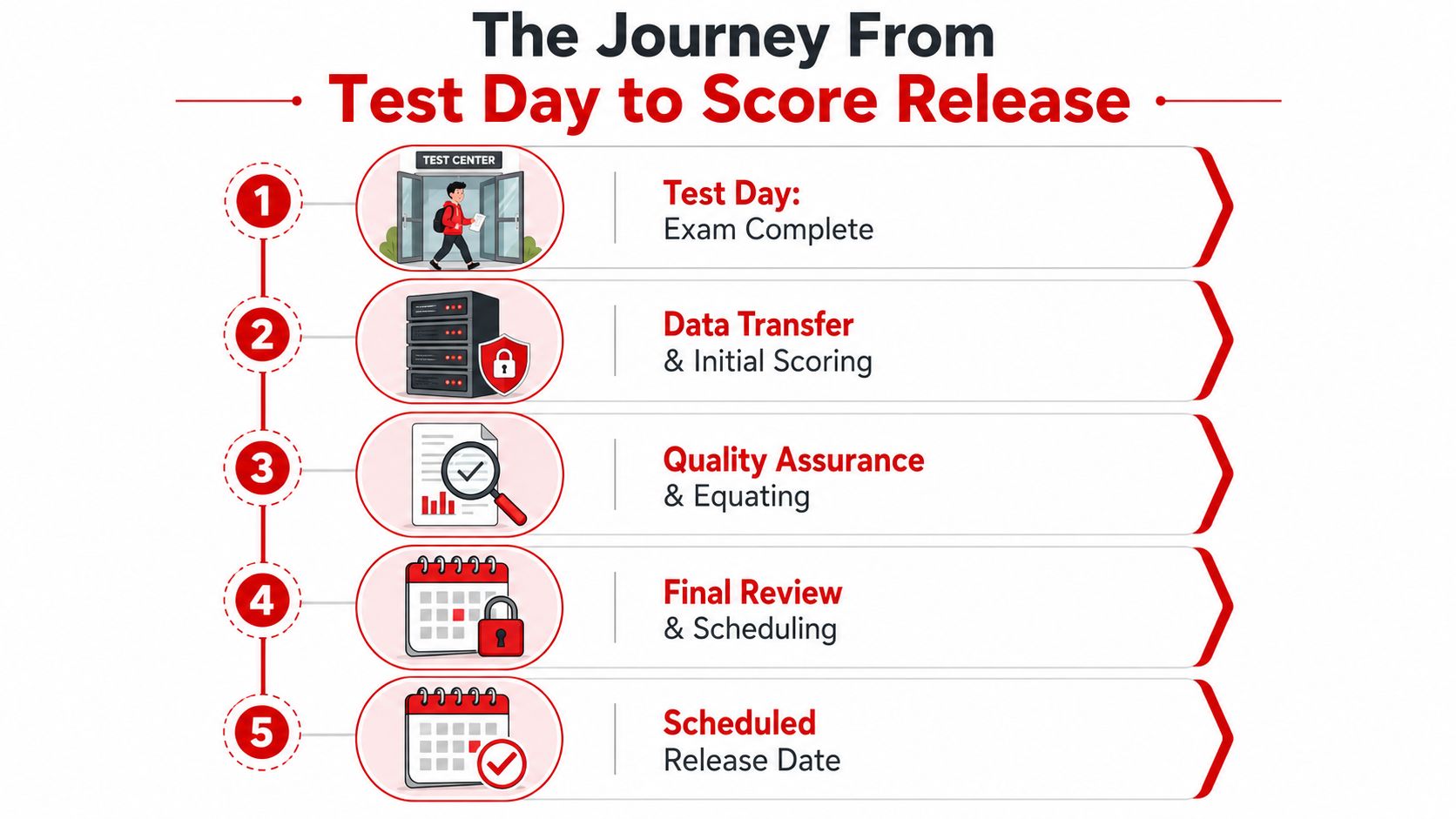
On test day, the exam is complete, but your score isn't ready yet. The AAMC needs time to process the administration, run scoring steps, and complete the review that leads to the scheduled release window. That is why you won't see a score at the test center and why the timeline stays fixed across the country (AAMC scores page).
The waiting period is part of the system
A useful way to think about the gap is this. Test day ends one phase, but it doesn't start score access. The score must move through scoring, quality review, and final posting before it appears in your AAMC account. That's why the release is tied to a calendar date rather than to when you finished the exam.
During that wait, silence is normal. No early email means nothing is wrong, and no extra portal refresh will speed things up. The AAMC says the score is posted by 5:00 p.m. ET on the release day, so until that point, the absence of a result is expected (AAMC scores page).
You can't hurry the release, but you can use the waiting period well.
For many students, the most productive use of that time is simple. Organize your application materials, review school requirements, and decide what you'll do if the score is higher, lower, or close to your target. If the wait is triggering a lot of anxiety, a structured reset can help, and that's where test anxiety support can fit into a longer prep plan.
A realistic example of the in-between period
Take a composite applicant who tested in late May and expects a score in June. While the score is pending, they can finish the personal statement, request transcripts, and build a school list. They don't need to freeze all progress just because one number is missing.
The key is to keep momentum without pretending the score won't matter. That balance makes the waiting period feel more manageable and keeps your application moving.
Score Day Checklist and How to Access Your Results
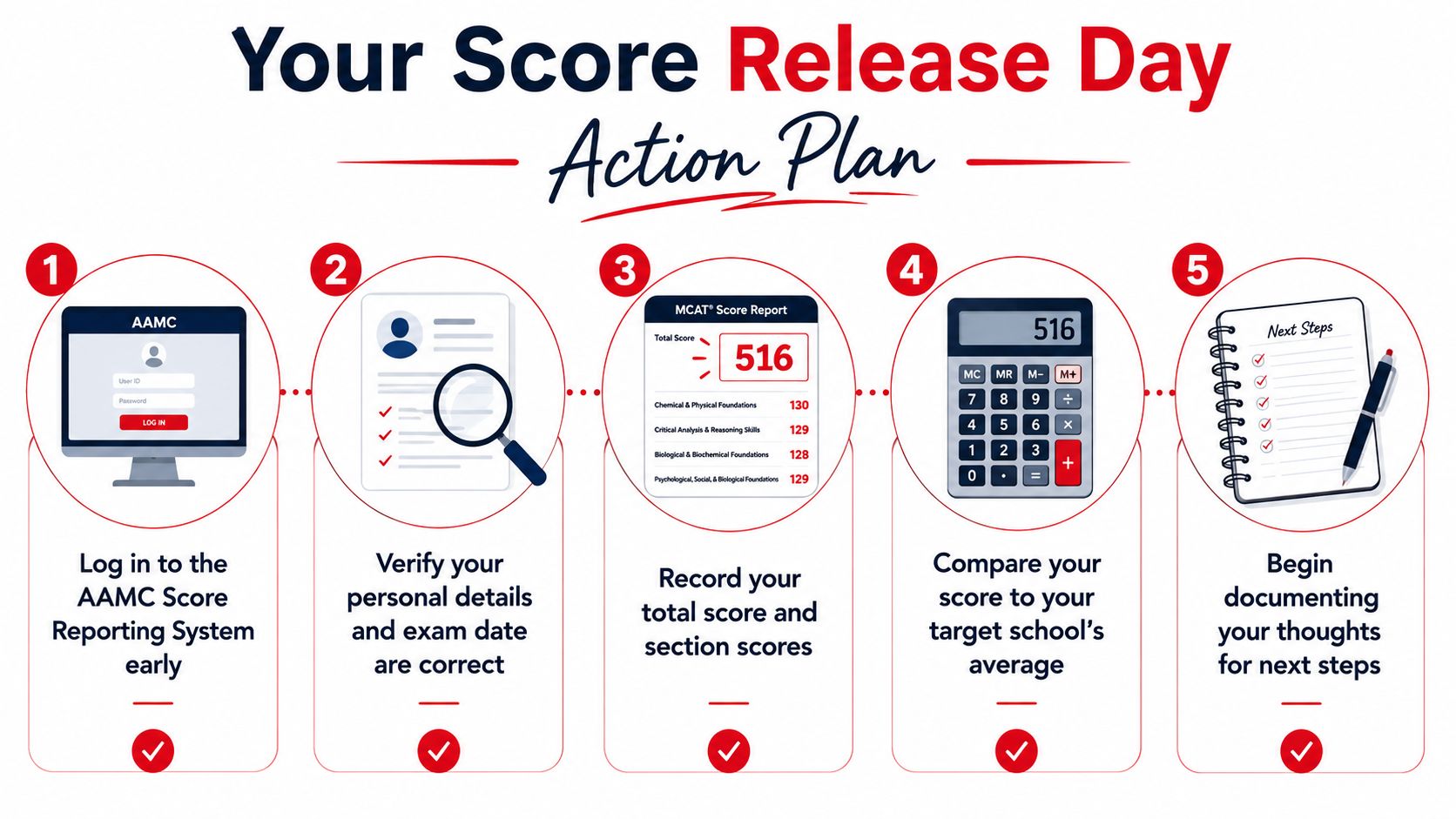
On release day, go straight to the AAMC Score Reporting System, which is where official MCAT scores are posted once they're available (AAMC calendar and score release dates). Don't rely on texts, screenshots from friends, or third-party calendars for the actual result.
Your score-day checklist
- Log in early, but don't panic-refresh. The AAMC posts scores by 5:00 p.m. ET, so checking before then is fine, but it doesn't change the timing.
- Confirm your exam details. Make sure the name, test date, and report you're opening match your actual administration.
- Record the full score report. Save the total score and each section score for your records.
- Review the report as a whole. Look at the total first, then break down the section performance so you understand where your strengths and gaps are.
- Write down immediate next steps. Decide whether the score supports your current plan or whether you need to revisit your timeline.
The score report is meant to be read carefully, not emotionally. A strong section can point to an area you should continue using in your application narrative, while a weaker section may signal a retake conversation rather than a full reset. If you want to log into an organized prep dashboard after release, the MCAT prep hub login is the right internal starting point.
What to check before you make any decision
Your first instinct may be to compare the number to a dream school immediately. Take a breath first. The better move is to compare it against the actual schools on your list, the rest of your application, and your timeline for the current cycle.
If the score is lower than hoped, that does not end your path. It just changes the plan.
Deciding Whether to Keep Your Score or Retake the MCAT
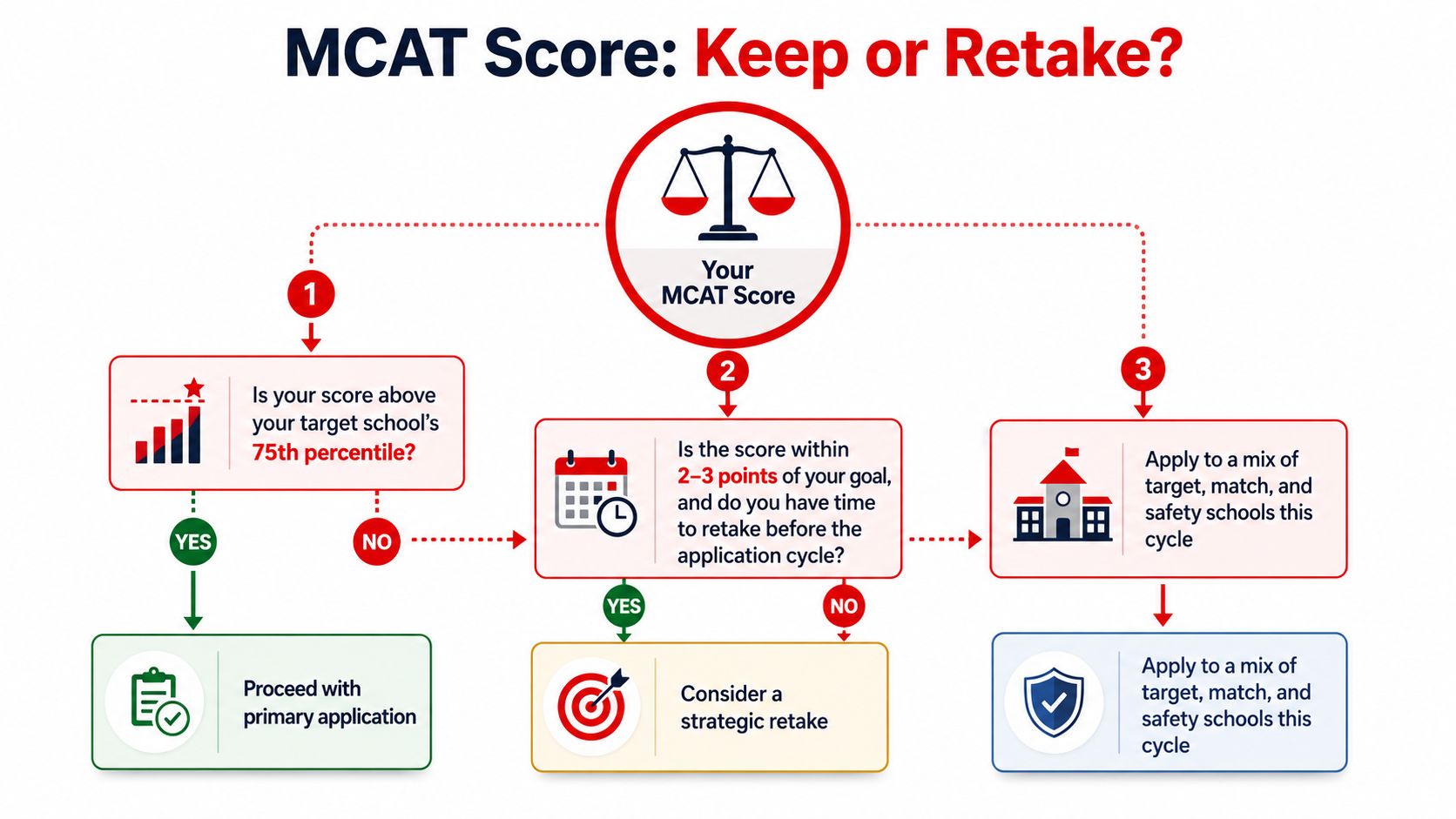
Score decisions are not just about pride, and they're not just about a single school's number. They're about whether the score supports the application strategy you're using this cycle. That means looking at timing, competitiveness, and whether a retake can happen without pushing you into a weaker application window.
A simple decision framework
Start with three questions.
- Does the score fit your target list? If the result is comfortably aligned with the schools you want to apply to, keeping it may make sense.
- Is the score close enough to justify a retake? If you're only a little short of your goal and still have time, a retake can be worth considering.
- Can you retake without damaging your timeline? If a retake would push you too far behind, a carefully chosen school list may be the better move.
That framework is more useful than chasing a perfect number in isolation. For a broader sense of how to interpret a score in context, the good MCAT score guide can help you think about score strength without turning the decision into guesswork.
A composite applicant example
Consider a composite applicant who gets their score back after their internal application goal date. They want to keep the cycle moving, but they also know one school on their list expects a stronger result. Their response is not to freeze.
They verify each school's requirements, finish the rest of the application in parallel, and decide whether to submit before the score is fully aligned with their goal. They also keep a retake contingency ready in case the timing or competitiveness doesn't line up. That approach doesn't promise an admission outcome, but it does keep them organized and honest about the tradeoffs.
Where support fits
Some students want structured feedback after release, especially if they're unsure whether the number supports a keep-or-retake decision. In that situation, one option is Ace Med Boards, which offers MCAT preparation and medical school admissions support alongside its other tutoring services. Used well, that kind of support can help you interpret the score in context and plan your next move.
Common Misconceptions About MCAT Score Timing
One common misconception is that MCAT scores arrive on the same day count for everyone, every time. The official schedule doesn't work that way. Release timing is date-specific, which is why the AAMC calendar matters more than a rough phrase like “about a month” (AAMC score release calendar).
Another misunderstanding is that scores are released gradually throughout the day or can be expedited by contacting the AAMC. The official policy points the other direction. Scores are posted through the AAMC system by the scheduled release deadline, not individually on request (AAMC scores page).
What to ignore
- Do not trust unofficial “early score” rumors. There isn't a separate back channel for regular access.
- Do not assume every test date has the same wait. The calendar varies by administration.
- Do not plan around a friend's release day. Their test date may map to a different posting date.
A lot of stress comes from trying to control a process that isn't customizable. The better move is to use the official schedule, then build your application and retake decisions around it.
The same logic applies if you're wondering how long an MCAT stays useful later on. The timeline for score access is one thing, and the timeline for school policy is another, so it helps to keep those questions separate. For that broader planning issue, the how long is the MCAT good for guide is a helpful follow-up.
Planning Your Application Timeline Around Score Release
Work backward from the release date, not forward from the hope that the score will arrive “in time.” That single habit keeps students from building an application plan on assumptions. Pair the AAMC release calendar with each school's latest acceptable test date, then leave room for score review before you commit to a retake or a primary submission.
If your score lands after your internal goal, use the time to finish the rest of the application anyway. Personal statements, school lists, transcripts, and activity descriptions can all move forward while you wait. That way, you're not starting from zero on score day.
A practical next step is to compare your score against your school list, then decide whether you need structured MCAT prep, admissions planning, or both. If you want help thinking through that choice, you can explore the MCAT exam dates page, review the good MCAT score guide, and consider a Board Score Audit style conversation before making a retake decision.
Ace Med Boards helps students use the MCAT score release date as a planning tool, not a source of guesswork. If you want to compare your score against your application timeline and talk through next steps, visit Ace Med Boards for MCAT preparation and admissions support that stays focused on your actual deadline.