

You're staring at a calendar, a practice score, and an application deadline, and the question isn't just when the MCAT is offered. It's which MCAT exam test dates give you the best shot at a clean application timeline, a realistic study runway, and a score that arrives before schools start serious review.
For 2026, the right move is to treat your test date as part of your application strategy, not a separate administrative task. The best date is the one that matches your readiness and still leaves room for score release, verification, and submission before the cycle gets crowded.
Choosing Your MCAT Date in 2026
The smartest way to approach mcat exam test dates is to work backward from your application goal, not forward from whatever date looks convenient. In 2026, the testing window runs from January 9 through September 12, so you're choosing inside a fixed season, not a year-round menu. That matters because medical school timing rewards applicants who finish the MCAT early enough for score release, transcript matching, and primary submission.
If you want to apply in the strongest possible position, start by asking one question, “When do I want my score in hand?” Then count back from that point to your study plan and your registration deadline. A date that looks comfortable on paper can become the wrong choice if it pushes your score into a later review window.
Practical rule: pick the latest date that still lets you submit with confidence, not the earliest date you can barely survive.
A lot of applicants make the same mistake. They choose a date because it fits a school break, a vacation, or a free weekend, then realize too late that the score lands after they wanted to submit. That's backwards. Your MCAT date should support the application cycle, not fight it.
For a practical starting point, use your study plan first, then confirm the registration window. If you're still figuring out when to begin studying, this MCAT study start guide is a useful planning anchor before you lock anything in.
How the 2026 MCAT Calendar Is Structured
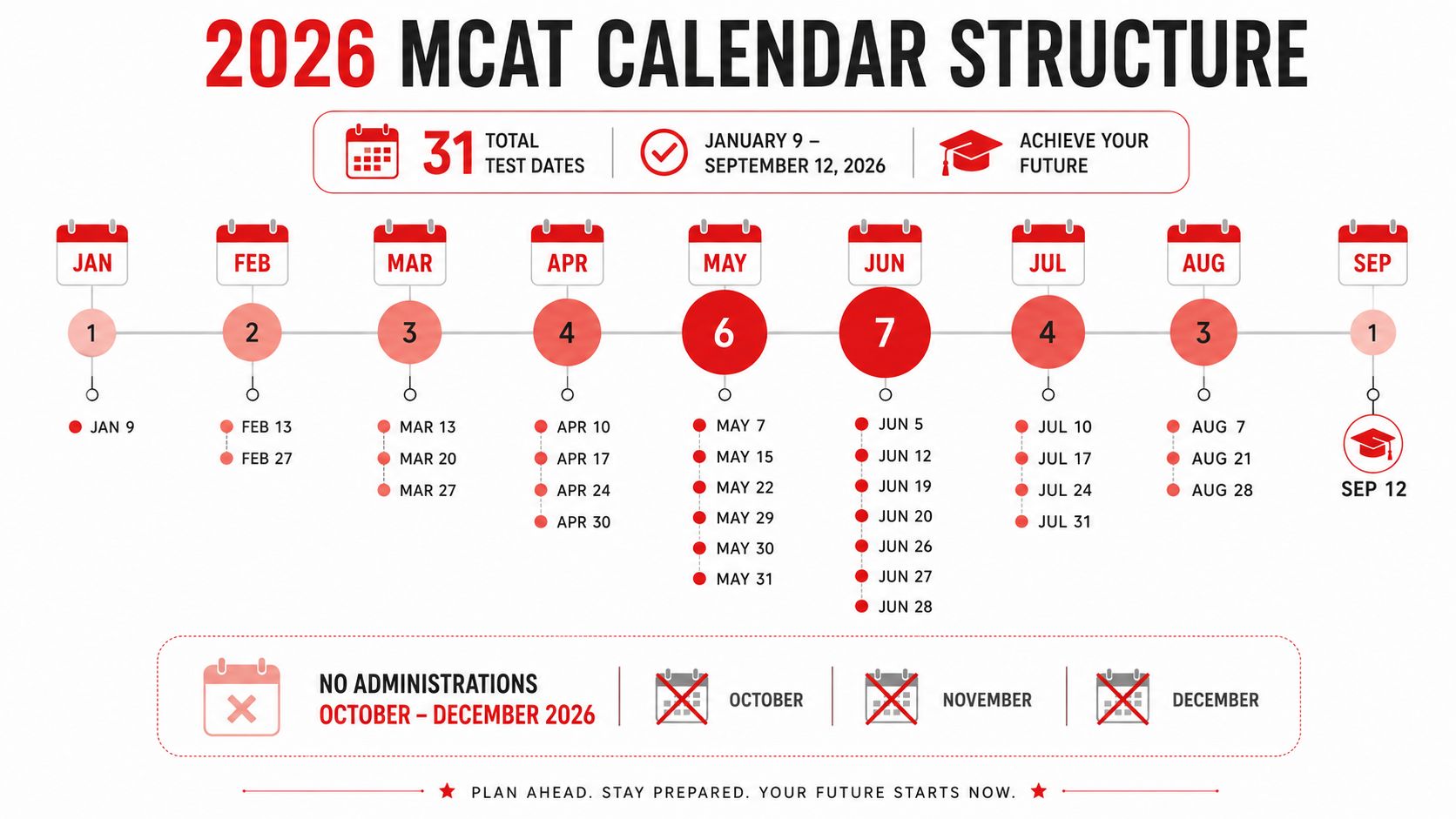
The 2026 AAMC calendar is built around a fixed testing window, not a loose monthly pattern. The 2026 MCAT exam schedule shows 31 total test dates across the testing window, which runs from January 9 through September 12, 2026, with no official administrations in October, November, or December. That structure tells you two things right away. The MCAT is offered inside a defined annual span, and the back half of the year is not a fallback if your original plan runs late.
The schedule is uneven, and that unevenness affects how you should choose a date. Independent date summaries show that the exam appears on one to six dates per month, with May having the most dates and February and July having the fewest. Some months give you room to wait for the date that fits your prep, while others force faster decisions because the seat count is tighter. Early-year options are especially limited, so applicants who want a spring administration need to plan early instead of hoping a better date will appear later.
What the uneven calendar means in practice
A month with more test dates gives you more flexibility to match your readiness. A month with only a few dates leaves less room for error, less room for rescheduling, and less room for recovery if you are trying to balance classes, work, or application tasks at the same time.
The difference matters most when your MCAT date has to fit a real application timeline. A single date in a month can turn a casual choice into a hard commitment, because once you miss that window, your next option may no longer support the submission timing you want. That is why the calendar structure should shape your decision before convenience does.
If you want to match your test day to how your brain functions under pressure, the sleep cycle guide for executives is a useful reference point. The day before the exam affects focus, recovery, and test-day stamina, so your date choice should leave room for rest, not just study.
Registration Deadlines and How the Tiered System Works
AAMC uses a three-step deadline structure tied to each exam date, with registration checkpoints at 60 days, 30 days, and 10 days before the test. That's the backbone of the scheduling system, and it's why “I'll register once I'm sure” can become expensive or impossible if you wait too long. The earlier you act, the more options you keep.
For the January 9, 2026 test date, the deadlines fall on November 10, 2025, December 10, 2025, and December 30, 2025. For the March 7, 2026 test date, the deadlines are January 6, 2026, February 5, 2026, and February 25, 2026. Those dates are not suggestions. They define the scheduling window for that administration.
Bottom line: if a date matters to you, don't wait for the last deadline tier unless you're comfortable with less flexibility.
The point of the tiered system is simple. Earlier registration usually gives you more control over seat selection and scheduling, while later registration narrows what's available. If you're aiming for a popular spring or summer sitting, the registration clock is part of the decision, not an afterthought.
If you want a plain-language walkthrough of the mechanics before you commit, review the MCAT registration guide and compare it against your own timeline. That's the right way to avoid scrambling at the wrong time.
Matching Your Test Date to Score Release and Application Timing
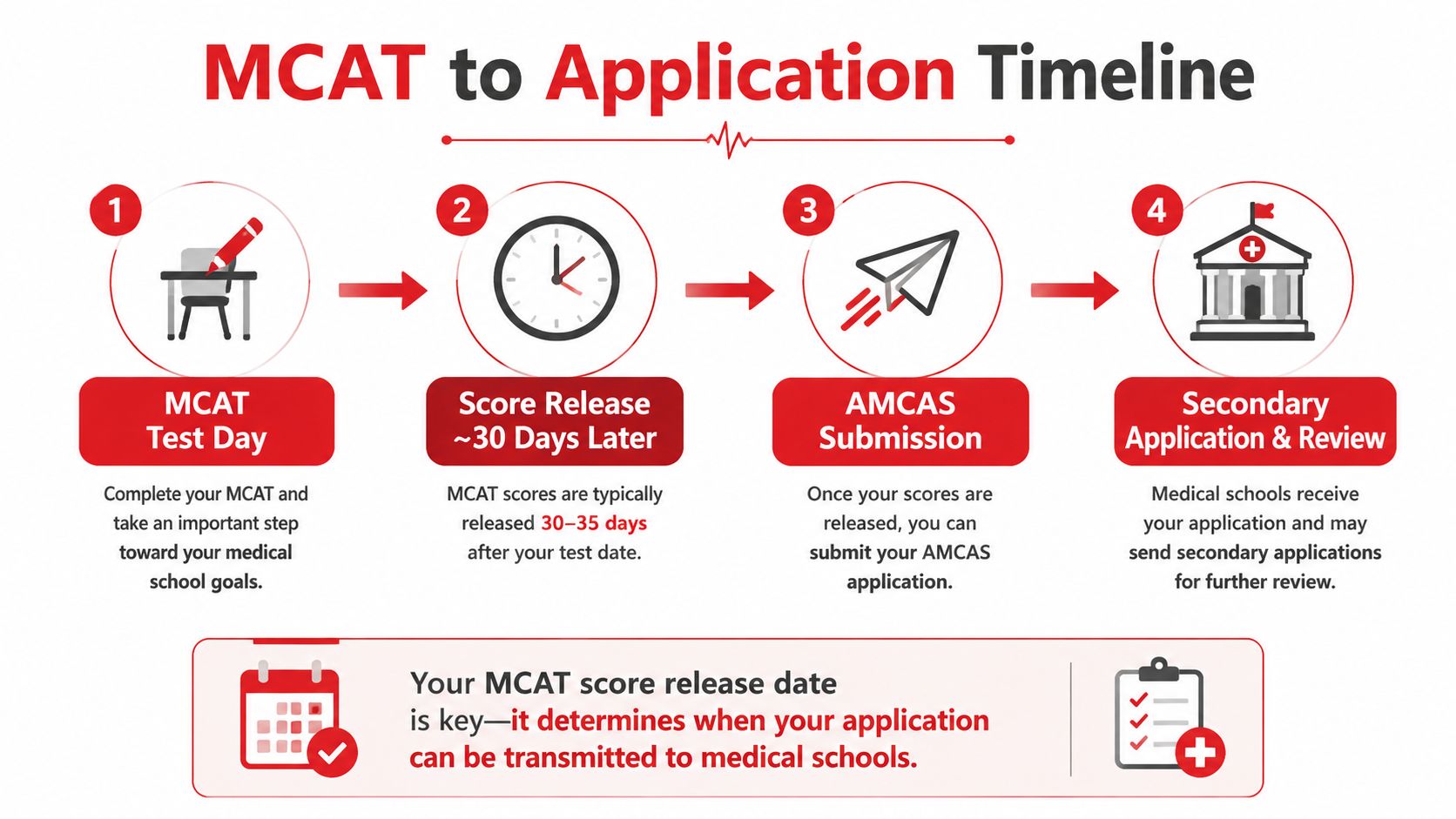
Score release is the part many applicants underestimate. A good test date is only useful if the score arrives when you can use it. For 2026, score release is typically about 4 to 6 weeks after the test date, with the February 13 exam releasing on March 17 and the March 7 exam releasing on April 7. Those dates are the difference between a submission that moves smoothly and one that gets held back.
Early, mid, and later testing windows
An early test date gives you the cleanest path to a complete application. Your score lands sooner, your materials can be assembled sooner, and you're less likely to be waiting on one missing piece while schools begin review. That's why spring dates carry so much strategic value.
A mid-season date can still work well if your preparation needs more time, but the trade-off is obvious. You gain study runway and lose application speed. Late-summer dates should be chosen only when readiness demands them, because the score release window can push you deeper into the cycle.
Schools can't review a score they don't have. If timing is the issue, the MCAT date matters just as much as the score itself.
If you want help thinking through whether your target date supports your application strategy, the MCAT score release dates guide is a helpful reference point. For applicants who like a structured planning lens, Ace Med Boards also offers MCAT planning support, but the decision still starts with your own timeline.
Rescheduling, Cancellation, and What Happens When Plans Change
People do get sick. Family emergencies happen. Sometimes a test date turns out to be wrong for your prep. AAMC's registration system is built with that reality in mind, but the flexibility is not unlimited. Registration, rescheduling, and cancellation all sit inside deadline tiers that affect what you can change and when, and the closer you get to test day, the less room you have.
The practical lesson is straightforward. If your life situation changes early, act early. Waiting until the last minute shrinks your options and can push you into a less desirable date or a tougher fee tier. That's especially important if your original plan depended on a very specific testing window.
For readers who want to understand the cost side before they make a move, the MCAT exam fee overview is a good place to compare the registration decision with the financial impact. That's not about creating panic. It's about avoiding a rushed choice when a calmer one was still available.
The most useful habit here is simple, keep a backup date in mind before you register. If your preferred administration fills up or your schedule shifts, you'll already know your next-best option instead of starting from zero.
Why More Study Time Is Not Always the Better Strategy
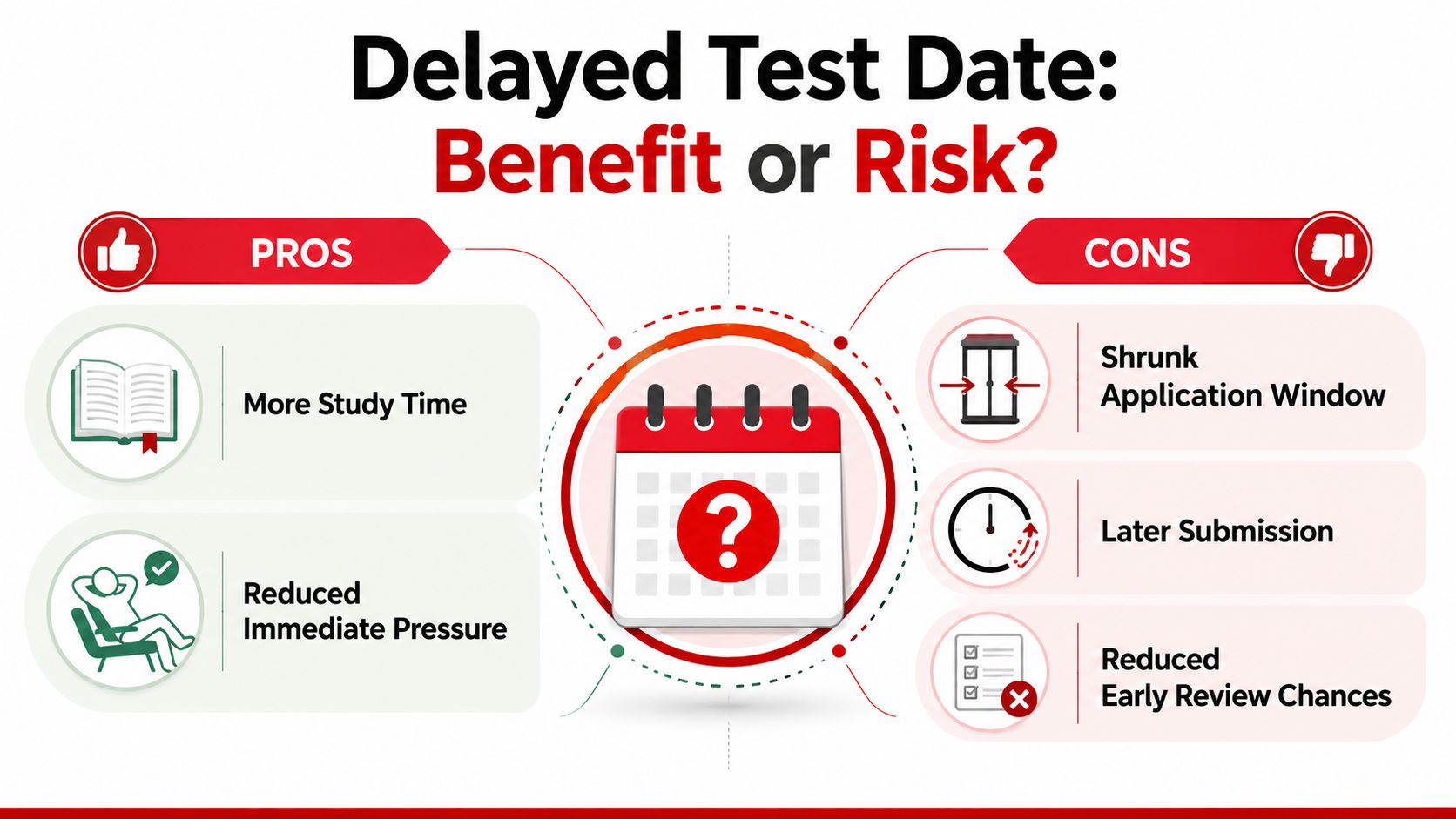
More time sounds safer, but it isn't automatically better. Applicants often delay the MCAT because they think the extra months will solve everything, when the issue is usually structure, consistency, or test-day readiness. If the later date pushes your score release further into the cycle, the “safer” choice can become the weaker application choice.
AAMC notes that score release is part of the registration flow, and the 2026 testing year runs from January through September, which makes timing unusually consequential for applicants balancing readiness against deadlines. That's why a later date should be a deliberate choice, not a default one. If you're already close to ready, waiting just to wait usually costs more than it helps.
A better decision filter
Use this quick check before you delay:
- Are your content gaps specific? If yes, extra time may help. If your studying is just scattered, more time won't fix that.
- Is your practice score trending upward? If it is, a target date can sharpen focus. If it isn't, you need a better plan, not just a later date.
- Will a later score still support your application timing? If not, the delay has a real cost.
- Can you study consistently for the next several weeks? A strong, steady plan beats a longer, unfocused one.
If you're stuck between “not enough time” and “too much time,” use the MCAT prep time guide to pressure-test your timeline. The right date is the one that matches your actual readiness, not your wishful thinking.
Popular Dates Fill Quickly and How to Build a Backup Plan
Some MCAT dates disappear fast, especially in the spring and early summer when applicants are trying to stay on schedule for the cycle. That is not just a registration problem. It is a timing problem, because your test date determines when your score comes back and whether that score still fits your application plan. In crowded markets, the earliest desirable seats go first.
Use the table below as a planning tool, not just a list of dates. The later entries shown here are projected 2026 administrations with their associated deadlines and expected score release timing, so you can see how quickly a seat choice affects the rest of your calendar.
| Representative 2026 MCAT Dates | 60-Day Deadline | 30-Day Deadline | 10-Day Deadline | Score Release |
|---|---|---|---|---|
| February 13, 2026 | December 15, 2025 | January 14, 2026 | February 3, 2026 | March 17, 2026 |
| March 7, 2026 | January 6, 2026 | February 5, 2026 | February 25, 2026 | April 7, 2026 |
| June 12, 2026 | April 13, 2026 | May 13, 2026 | June 2, 2026 | July 14, 2026 |
| August 11, 2026, projected 10-day deadline | projected 60-day deadline | projected 30-day deadline | projected 10-day deadline | projected score release |
| September 22, 2026, projected score release window | projected 60-day deadline | projected 30-day deadline | projected 10-day deadline | projected score release |
How to avoid getting boxed in
Pick a primary date and a backup date at the same time. If your first choice fills, you already know whether the next realistic option still works for your application timeline, your study plan, and your target score release. That decision should happen before registration gets tight.
A few practical moves help:
- Choose nearby dates first. Dates in the same season usually preserve your broader application timing.
- Register early. Early registration is the cleanest way to protect your seat.
- Stay flexible on location. A different test center in the same region may have openings when your first choice does not.
- Check score release timing before you commit. A date that pushes your score too late can do more harm than a slightly earlier date that is already secured.
- Build in one realistic backup. If your preferred date is unavailable, you should already know your next move.
If you want a service-based planning check, Ace Med Boards can help applicants compare timing options against study readiness and the broader application schedule. That is useful when your first-choice date is gone and you need a fast, practical decision.
Pre-Registration Checklist and Common Questions
Before you click register, make sure your coursework is on track, your AAMC account is ready, your ID details match exactly, and your payment method works. Don't choose a date while you're still fixing account basics. If your prep is uneven, it's better to know that before the seat is gone.
Quick FAQ
- Can I take the MCAT more than once? Yes, but repeated attempts should be strategic, not automatic.
- Will every school see every score? Schools receive MCAT scores through the application process, so plan as if each official score matters.
- What if a technical issue interrupts test day? Contact the test administrator immediately and document everything.
One final rule, register for the date that fits your real readiness and your real application timeline, not the date that looks good in a planner.
If you want help choosing between MCAT dates, building a realistic study runway, or lining up your score release with your application strategy, Ace Med Boards offers MCAT prep and admissions support built around that exact decision point. Visit Ace Med Boards to review the current options and decide whether a free consultation makes sense for your timeline.