As of November 10, 2026, the current COMLEX Level 3 format is a two-day, computer-based exam with four separately timed 3.5-hour sessions, 420 single-best-answer multiple-choice questions and about 26 clinical decision-making cases. What changes when a candidate stops treating those numbers as trivia and starts treating each block as a fixed series of decisions that can't be recovered in a later session?
COMLEX Level 3 Format at a Glance
How many kinds of answers does one testing day require?
The Osteopathic Medical Licensing Examination of the United States (COMLEX-USA) Level 3 is a two-day, computer-based, non-adaptive examination. The National Board of Osteopathic Medical Examiners (NBOME) describes it as an assessment of an osteopathic resident's readiness to provide safe, effective care in unsupervised generalist practice. The NBOME description of examinations sets out four separately timed testing sessions, 420 predominantly single-best-answer multiple-choice questions (MCQs) and approximately 26 clinical decision-making (CDM) cases.
An MCQ is the conventional single-best-answer item: one choice, then the next stem. CDM is a case with several linked decisions, answered through extended multiple choice or a short written entry. The switch works like moving from a quick triage note to a short order set. Recognition alone does not train the second habit. Candidates who only drill single-best-answer items often stall when a case asks for several appropriate actions, or for a concise written response.
Format Snapshot
| Component | Current format |
|---|---|
| Delivery | Computer-based, non-adaptive |
| Testing days | Two |
| Testing sessions | Four, each 3.5 hours, two per day |
| Scheduled testing time | 14 hours overall |
| Administration window | 14-day eligibility window |
| Single-best-answer MCQs | 420 |
| CDM cases | About 26, generally two to four questions each |
| CDM questions overall | Roughly 70 to 80 |
| Break time | 60 minutes pooled per day |
Confirm these details in the current NBOME bulletin before booking, since format details can change.
Non-adaptive delivery means item difficulty does not rise or fall because earlier answers were right or wrong. Treat a hard stem as that stem, not as a score signal. The 14-day eligibility window is the span in which the two testing days are scheduled. It is not extra exam time added to the 14 hours of scheduled testing.
Practical rule: Plan around separately timed sessions, not around one long pool of exam time.
How Timing Works Across the Two Testing Days
Each session lasts 3.5 hours, or 210 minutes, and two sessions fall on each testing day. The clock doesn't carry across sessions. Unused minutes from a strong morning session can't help an afternoon session, and a slow start can't be repaid later.
Sections can't be reopened after a candidate advances. Review, second looks at flagged items, and correction of careless reading must happen inside the current section. That rule shapes practice more than many candidates expect. A practice block that allows unlimited return visits teaches a habit the interface won't support.
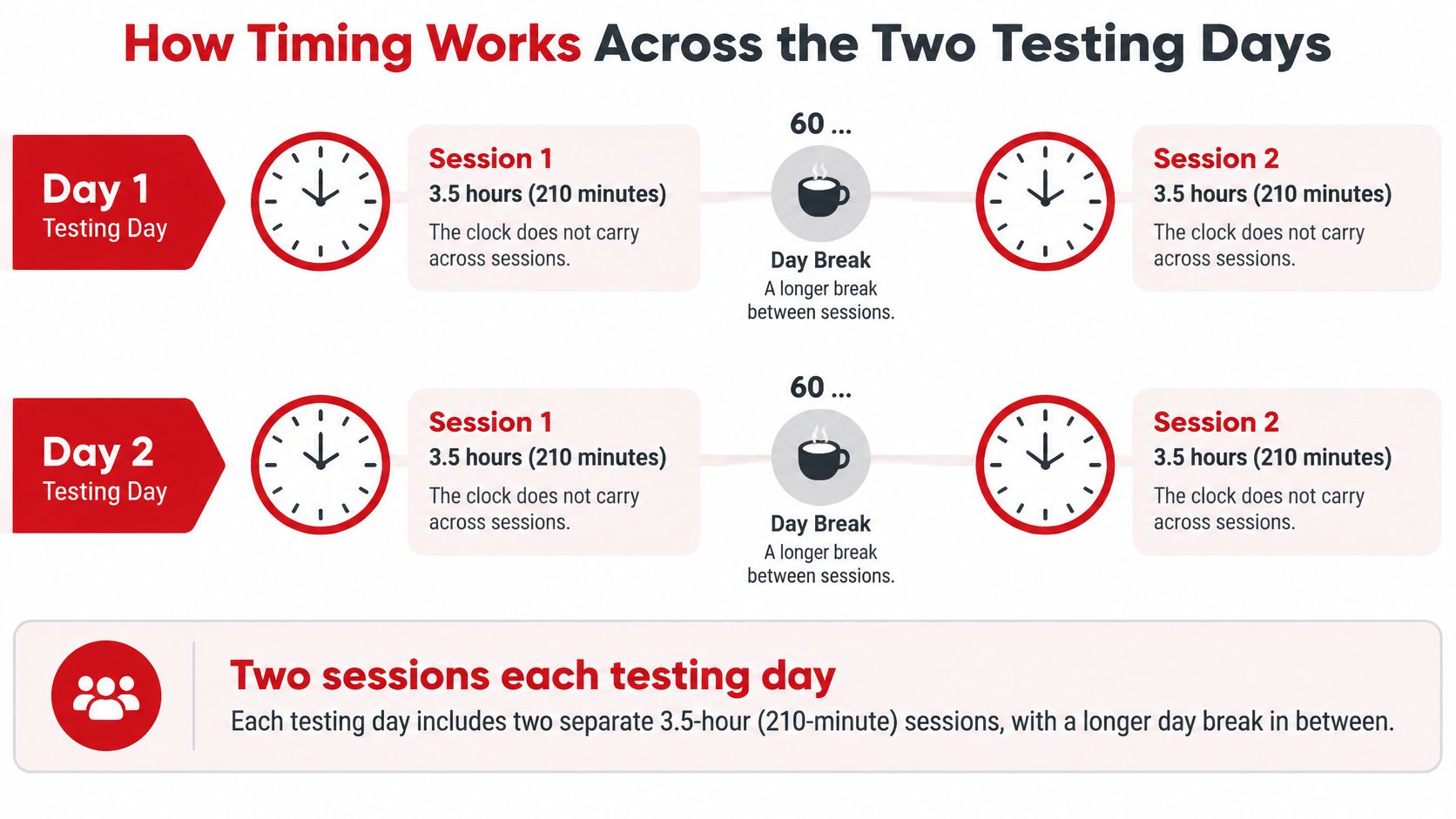
The materials reviewed for this guide don't state the number of items or sections per session in the current format. Readers shouldn't estimate that count from older summaries. The count should be confirmed in current NBOME materials before a per-item budget is set.
A Pacing Method Candidates Can Rehearse
- Write 210 minutes: Put that total at the top of a planner for each session, because every calculation starts from the session clock.
- Subtract planned breaks: Deduct break time planned from the daily pool, so rest does not consume review time.
- Divide by confirmed items: Once NBOME materials confirm the session item count, divide usable minutes by that count for a per-item budget.
- Set three checkpoints: Note how many items should be finished at one quarter, one half, and three quarters of the session.
- Protect the ending: Reserve the final minutes of each section for a review pass before advancing.
- Log actual pace: Record actual time per item in every timed practice block, then compare it with the budget.
A COMLEX Level 3 practice test plan works best when it tests this method under realistic blocks.
Carrying Day 1 pacing into Day 2 without adjustment is a common pitfall, especially after a tiring first day.
A short day plan helps. It should list each session's start time, checkpoints, and planned break before test day arrives. Decisions made calmly in advance don't have to be improvised between sessions.
Question Types on Level 3 and How Each Is Answered
Two response habits sit at the center of the current COMLEX Level 3 format. Conventional items reward fast recognition. CDM items reward deliberate prioritization. The NBOME examination format overview describes 420 single-best-answer multiple-choice questions plus approximately 26 CDM cases, each with two to four decision points answered through extended multiple choice or short-answer fields.
That distinction matters during review. Recognizing a correct option after seeing an explanation isn't the same skill as selecting every appropriate action from a list. It also isn't the same as typing a precise management step without prompts.
| Item type | Where it appears | How you respond | Core preparation skill |
|---|---|---|---|
| Single-best-answer multiple choice | Standalone items; 420 in the current format | Select one option | Fast recognition under fixed time |
| Extended multiple choice | CDM cases with two to four decision points | Select each option that applies; more than one may be correct | Judging each option on its own merits |
| Short-answer entry | CDM cases, alongside extended multiple choice | Enter a concise written response | Writing precise management actions |
| Audio-visual material | May appear within items | Interpret the material, then answer as the item asks | Reviewing images and audio under time limits |
How Candidates Should Record Practice
For each practice item, the log should record three things. The format comes first. The expected response length comes next. Time spent comes third. That simple record shows whether errors come from knowledge, misreading, slow media interpretation, or vague written answers.
Audio-visual material deserves separate practice time. A candidate who pauses practice media freely may struggle when the same material appears inside a fixed clock. Short, timed exposure builds a steadier habit.
Short answers need restraint. A paragraph buries the intended action and wastes time. A precise phrase naming the action is easier to produce and easier to review afterward. Candidates building basic question stamina can also review structured COMLEX question practice, then return to Level 3 style prompts.
The table can guide weekly practice blocks. One block can train recognition speed, while another trains option-by-option judgment and written entry. CDM structure and case timing need closer attention on their own.
Working Through Clinical Decision-Making Cases
A CDM case works like a clinic visit broken into checkpoints. You are asked to act as an independently practicing physician: choose the next useful step, not recite a diagnosis and stop. The scenario stays the same patient. Each prompt narrows the job. A first test is not a full workup. Immediate management is not long-term follow-up. Follow-up is not a second pass through the opening evaluation.
The NBOME CDM cases tutorial describes 26 clinical cases, generally with two to four questions per case, for approximately 70 to 80 questions overall. Those cases are spread across the exam's separately timed sessions. One session's clock does not carry into the next, so there is no single combined timer for all 26 cases. Set the case budget from the session you are in. Divide the minutes still on that clock by the cases still ahead in that session. A short, familiar case should finish under that line. A denser case may use more. When a case nears the line without a clear path, lingering rarely improves the answer enough to justify the time it takes from later cases in the same session.

Reading a CDM Stem Without Drifting
Many CDM errors start before an option is selected. A candidate reads the whole narrative, forms a broad impression, and then chooses actions that sound generally reasonable. The prompt is usually narrower. Strong performance depends on separating the story from the decision in front of you.
A steadier sequence looks like this:
- Identify the question first: Read the specific prompt before studying the options, so the stem is searched for evidence that answers that prompt.
- Mark each decision point: Label whether the prompt asks for a test, an immediate action, or follow-up, because each category has a different standard for a good answer.
- Decide what the stem supports: Use the findings given in the case instead of adding assumptions the case does not state.
- Enter the required format: Select every supported option in extended multiple choice, or type a concise action in a short-answer field.
Under time pressure, that order blocks a common shortcut. Candidates often answer the diagnosis they expect rather than the management step the prompt requested. Marking the decision point interrupts that habit before the clock slips.
An Original Educational Example
Consider a hypothetical adult who presents with fatigue and a new cough. The educational vignette gives a short history, examination findings, and a small set of initial results. It does not ask for one global answer. It presents three decision points in sequence.
The first decision point asks for the most useful first test. Ask which result would most change the next step for this presentation. Ordering every plausible test ignores priority and the difference between information that guides action and information that only adds detail.
The second decision point asks for the most appropriate immediate management step. The word immediate matters. A reasonable long-term intervention can still be the wrong answer if the prompt asks what should happen now. Look back at severity clues in the stem and choose the action that matches the urgency described.
The third decision point asks for the follow-up plan. That prompt shifts the frame again. Follow-up should connect to the earlier findings, the response expected, and the interval implied by the case. A generic instruction to return if worse may be too vague when the case expects a defined reassessment or monitoring step.
The reasoning matters more than one polished label. At the first point, the candidate prioritizes information. At the second, the candidate prioritizes timing and safety. At the third, the candidate prioritizes continuity. Those are three different judgments inside one patient story, and each one needs its own response before you move on.
Where Candidates Lose Time in CDM Sections
Time loss usually accumulates inside one session. A candidate rereads the full stem at every decision point, debates two similar extended-choice options for several minutes, or writes a long short answer, deletes it, and rewrites it. None of those moments feels dramatic. Repeated across the cases still sitting in that session, they consume the review buffer.
- Rereading everything: Returning to the whole stem for each prompt wastes minutes. Marking key findings during the first read reduces repeat searching.
- Treating extended choice like single choice: Stopping after one correct option misses the format. Each option needs its own yes or no judgment.
- Overwriting short answers: Long entries slow typing and blur the action. The entry should name the step directly.
- Refusing to move on: One difficult case can absorb time meant for several manageable cases still on the same clock.
Pacing check: If a case runs past the budget you set from the remaining session time, enter the best supported answer the item permits and move on.
Recovery is a skill you can rehearse. During practice, set a timer for the case budget you calculated for that block. When it ends, record an answer, mark the case for later study, and continue. The habit feels uncomfortable at first. It protects the rest of the session.
Review should separate case reading from medical knowledge. A missed key feature may mean the candidate did not know the management step. It may also mean the candidate answered a later decision too early, selected unsupported actions, or wrote an answer that was too broad. Those causes need different fixes. A guide to what clinical reasoning involves can help candidates name the reasoning step that broke down.
A useful practice log for CDM has four columns: decision type, action chosen, stem evidence used, and time spent. After several cases, patterns become visible. Repeated trouble with follow-up prompts calls for different practice than repeated trouble with first tests.
Authorized breaks between sessions need a plan too. Once a session ends, its answers cannot be reopened, so replaying uncertain items does not change them. Use the break to reset posture, breathing, and the case budget for whatever cases the next session still holds.
By test day, the goal is not to make every case feel easy. The goal is a repeatable method that holds up when a case is unfamiliar. Read for the decision, use only supported evidence, answer in the required format, watch the budget for the session you are in, and move forward.
How the Pass Standard and Scoring Work
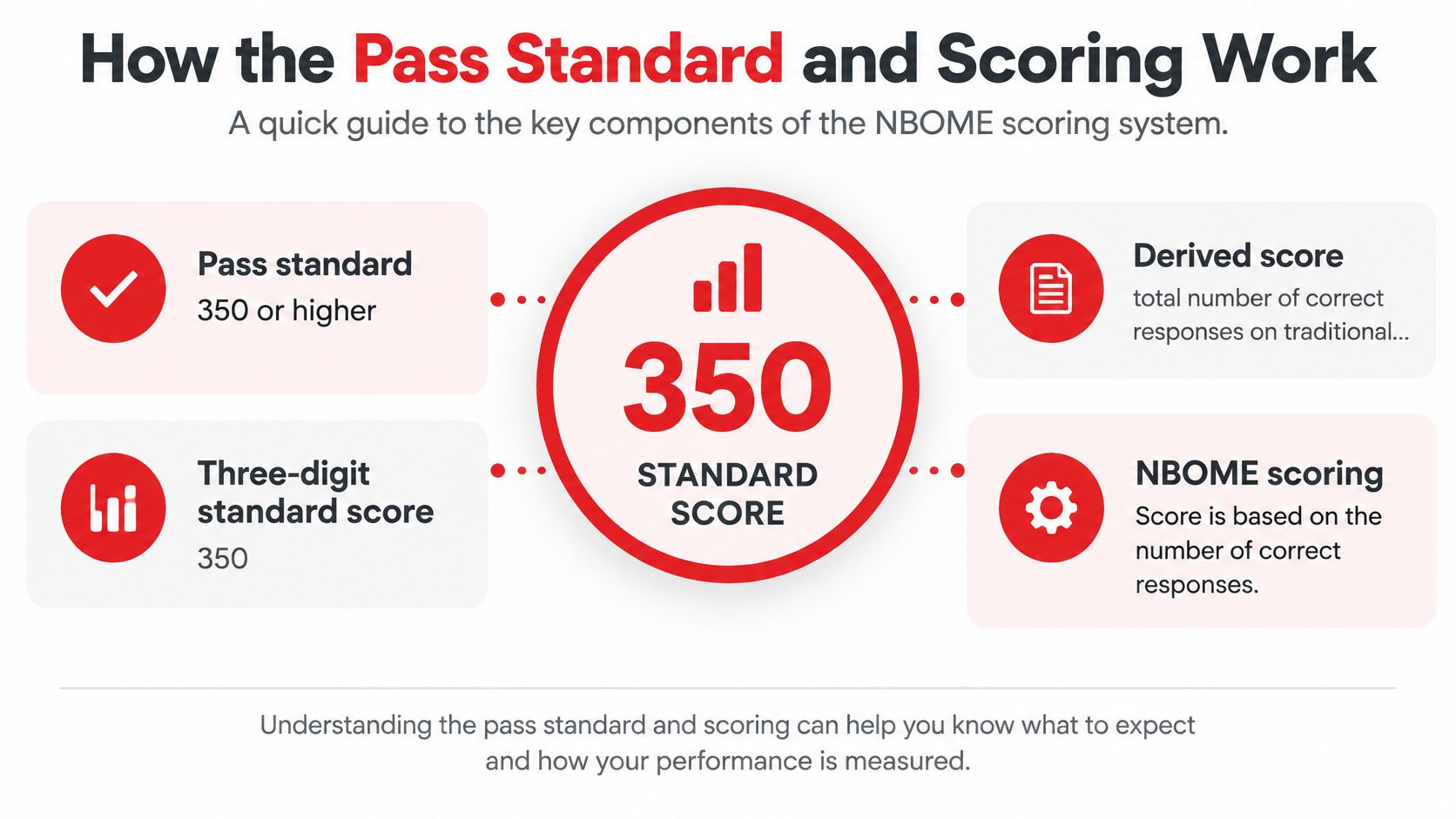
A passing result requires a three-digit standard score of 350 or higher, and the NBOME Level 3 score report states that the score is derived from the total number of correct responses on traditional multiple-choice questions plus the number of correct key features in CDM cases across the examination. CDM performance therefore counts toward the overall result. It isn't a separate pass or fail hurdle.
That structure changes how readiness should be judged. A candidate who reviews only conventional questions has an incomplete picture. A candidate who practices cases without timed MCQ blocks has the opposite gap. Both formats feed the same reported outcome.
NBOME's published description doesn't give a per-item point value. This guide doesn't estimate one. A single practice score also isn't the same as an official score, and candidates interpreting practice results can review COMLEX score percentile context without treating it as a prediction formula.
A Simple Score-Audit Method
- Sort every miss: Place each missed practice item into MCQ or CDM, because the fix depends on the response format.
- Tag the cause: Label each miss as a knowledge gap, a misread option, or a missed key feature.
- Count the pattern: Identify which tag dominates in each section instead of relying on a general impression.
- Retest the largest category: Revisit that category first, then test it again in a timed block.
For official reporting details, candidates should use NBOME score reporting materials. The audit is a study habit built on personal practice data. It shows where preparation time belongs, but it doesn't convert practice percentages into an official outcome.
A low practice result or an unsuccessful attempt doesn't define a candidate's future in medicine. It provides information about what to repair next. Calm, specific review serves that process better than broad repetition of everything at once.
What the 2027 One-Day Format Changes
How should you pace your preparation if your exam date falls under the planned one-day format? The NBOME Level 3 page describes a transition to one-day testing beginning January 13, 2027. The planned design has four two-hour testing sessions, with two sections in each session, 240 single-best-answer multiple-choice questions, and 16 CDM cases.
Compared with the current design, the planned format has 180 fewer multiple-choice questions, a reduction of about 42.9%, and 10 fewer CDM cases, a reduction of roughly 38.5%. These figures describe the planned exam, not the current schedule. The distinction matters because pacing practice should match the version you will take.
What Stays Recognizable
The redesigned exam retains its broad assessment purpose and blueprint. Candidates still answer multiple-choice knowledge questions and work through case-based clinical reasoning. CDM responses continue to use extended multiple-choice and short-answer formats.
That means your response habits still matter, even with fewer items. For each question, identify what it asks before choosing an answer. In a CDM case, prioritize the next clinical action and keep short-answer responses focused.
The NBOME Level 3 blueprint lists these minimum allocations:
- Osteopathic patient care and procedural skills: 40%
- Application of knowledge for osteopathic medical practice: 15%
- Osteopathic principles, practice, and manipulative treatment: 10%
- Practice-based learning and improvement: 8%
These are minimum allocations, not guaranteed shares for every exam form. They indicate that osteopathic content and patient care remain central in the planned format.
The 2027 redesign changes testing volume and scheduling. Clinical reasoning and osteopathic content remain part of Level 3.
What Changes in Preparation
The main preparation adjustment is how you distribute stamina. The current design spreads testing across two days; the planned design consolidates it into one day with shorter sessions. A single day removes the overnight reset, while shorter sessions call for a different rhythm of attention and breaks.
Match timed practice to your scheduled format. Before the transition, rehearse the current session lengths and two-day rhythm. Under the planned design, organize practice around the shorter sessions described by NBOME. Using the wrong structure can make your pacing seem more reliable than it is.
The scheduled date determines which format to rehearse. Confirm dates and eligibility rules through official NBOME guidance rather than inferring them from a format summary. Check current NBOME materials for scoring and reporting details, too; structural announcements do not necessarily settle every operational question.
Older advice may still help with content review but may not fit the planned session schedule. The exam's core study demands remain: review content, practice timed questions, prioritize CDM actions, and study osteopathic principles. Adjust the timing template to the format you will take.
Confirm the Format Before You Plan Your Prep
Are you rehearsing the exam you will sit? A short confirmation routine, repeated before booking and again before intensive timed practice, keeps each timed-block decision tied to the format on your date.
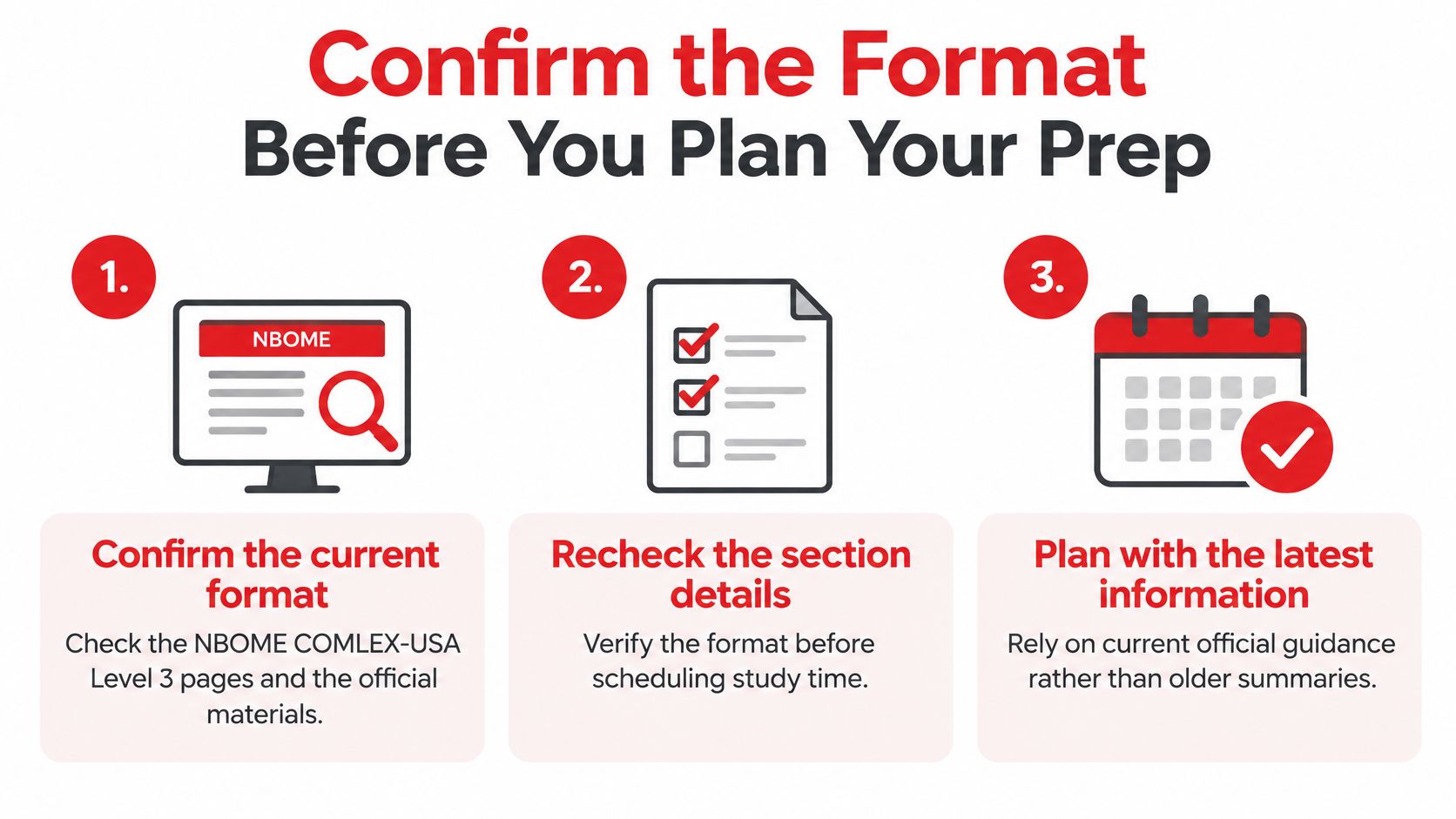
Treat the routine like a pre-flight check. You identify the aircraft, then you practice the sequence of choices that aircraft requires. Guessing the container first wastes later pacing work.
- Confirm the current format: Check the NBOME COMLEX-USA Level 3 pages and the current bulletin of information, and record the date checked.
- Compare the scheduled date: Place the planned testing date against January 13, 2027 to identify which format applies.
- Build a pacing sheet: Use the session timing method and the CDM case budget rather than relying on a generic study calendar.
- Test each item type: Run one timed practice block for each response format, then audit misses by cause.
- Set a recheck date: Recheck NBOME materials before booking, because a plan built months earlier may rest on outdated details.
Step 2 is the fork. The date decides whether your sheet budgets two testing days or the later one-day structure. Step 3 then turns that structure into minutes: how long a multiple-choice block gets, and how you spend the case budget when several actions look reasonable. Step 4 is the habit check. A miss from misreading the stem is not the same miss as running out of time or ranking the second-best next step first. Write the cause down so the next block trains the weak response, not a vague review of “questions.”
Technology used during study breaks deserves the same current-information habit. Just as a candidate checks official exam pages instead of relying on an old summary, a reader setting up a study space can follow current device guidance to update your LG Smart TV rather than guessing through menus. Current instructions prevent avoidable friction.
Candidates who want a broader study sequence after confirming structure can read the COMLEX Level 3 preparation guide. Ace Med Boards lists COMLEX-USA tutoring as a service area, and readers can review the COMLEX tutoring service page. COMLEX tutoring covers content review, clinical reasoning, question approach, and pacing, including Level 3, and a free COMLEX consultation is offered to discuss the student's exam level and timeline. Tutoring complements official NBOME materials and independent study rather than replacing them.
Private tutoring is offered for COMLEX-USA Level 1, Level 2-CE, and Level 3, among other listed examinations. Confirm that scope on the current site before you decide to enroll.
Sources
- NBOME COMLEX-USA Level 3 examination pages, checked as of November 10, 2026
- Current NBOME Bulletin of Information, checked as of November 10, 2026
- NBOME score reporting materials, checked as of November 10, 2026
- NBOME guidance on the planned 2027 format, checked as of November 10, 2026
Ace Med Boards offers COMLEX-USA tutoring that covers content review, clinical reasoning, question approach, and pacing for Level 3 candidates working through timed MCQs and CDM cases. A free consultation can help a reader discuss exam level, timeline, and whether outside support fits alongside official NBOME materials and independent study. Readers who want that conversation can visit Ace Med Boards to review the available services and next steps.