Can a familiar review lecture still leave a student studying outdated answers? The Emma Holliday Internal Medicine review is useful as a compressed shelf-exam map, not as a current treatment reference. Its strongest role is to organize familiar material before active recall and practice questions, while management, screening, and oncology claims receive separate verification.
By Ace Med Boards Editorial Team
Who Emma Holliday Is and What Her Review Covers
Emma B. Holliday is a gastrointestinal radiation oncologist at MD Anderson Cancer Center, rather than a practicing general internist. Her widely circulated Internal Medicine review represents student-created shelf preparation, not a contemporary clinical guideline.
A student approaching the end of a medicine clerkship may recognize individual diseases but struggle to organize them into useful differentials. That's the problem a concise review can help address: connecting a presenting complaint to a mechanism, a discriminating finding, and a diagnostic pathway. Recognizing a slide, however, isn't the same as independently solving a new vignette.
Career Milestones and Their Meaning
Holliday's public professional profile reports an internal-medicine internship in 2011–2012, radiation-oncology residency in 2012–2016, and more than 50 scientific articles and textbook chapters. These milestones describe her training and scholarship; they don't establish that every recommendation in an older lecture remains current.
Emma Holliday career milestones as reported in public sources
| Milestone | Period | Detail as reported | Confirm before citing |
|---|---|---|---|
| Lecture recorded as a medical student | Early student-training period | Fourth-year elective at the University of Texas Health Science Center at San Antonio (UTHSCSA), made for peers | Exact recording date |
| Clinical internship | Before radiation-oncology residency | One-year internal medicine internship at UTHSCSA | Not an internal medicine residency |
| Radiation oncology residency | After internship | Residency at MD Anderson Cancer Center | Training dates against an institutional biography |
| Faculty appointment | Earlier interview and later profile | Assistant professor in the earlier account; associate professor on a later profile | Current title on the MD Anderson faculty profile |
| Publications | Ongoing | Scientific articles and textbook chapters | Current count against a primary bibliographic database |
The origin story is peer-oriented: the recordings began as a favor to a classmate rather than as a conventional commercial course. The New York Medical College peer-to-peer resource guide places the medicine video near the end of a rotation, consistent with its role as consolidation rather than first exposure.
Faculty titles require particular care. An earlier interview described Holliday as an assistant professor, while a later professional profile identifies an associate professorship; anyone citing her current appointment should confirm the institutional listing.
Scope check: An internal-medicine internship is not an internal-medicine residency, and a shelf-review lecture isn't evidence of current general-internal-medicine practice.
For students organizing responsibilities across rotations, the medical student clerkships guide provides a broader planning context. The useful distinction is between learning medicine through a clerkship and using a summary to retrieve what that clerkship has already introduced.
What the Internal Medicine Lecture Covers, Topic by Topic
Which part of a compressed review deserves another look? The lecture's topic markers offer a starting map, helping students return to a domain without replaying the full recording.
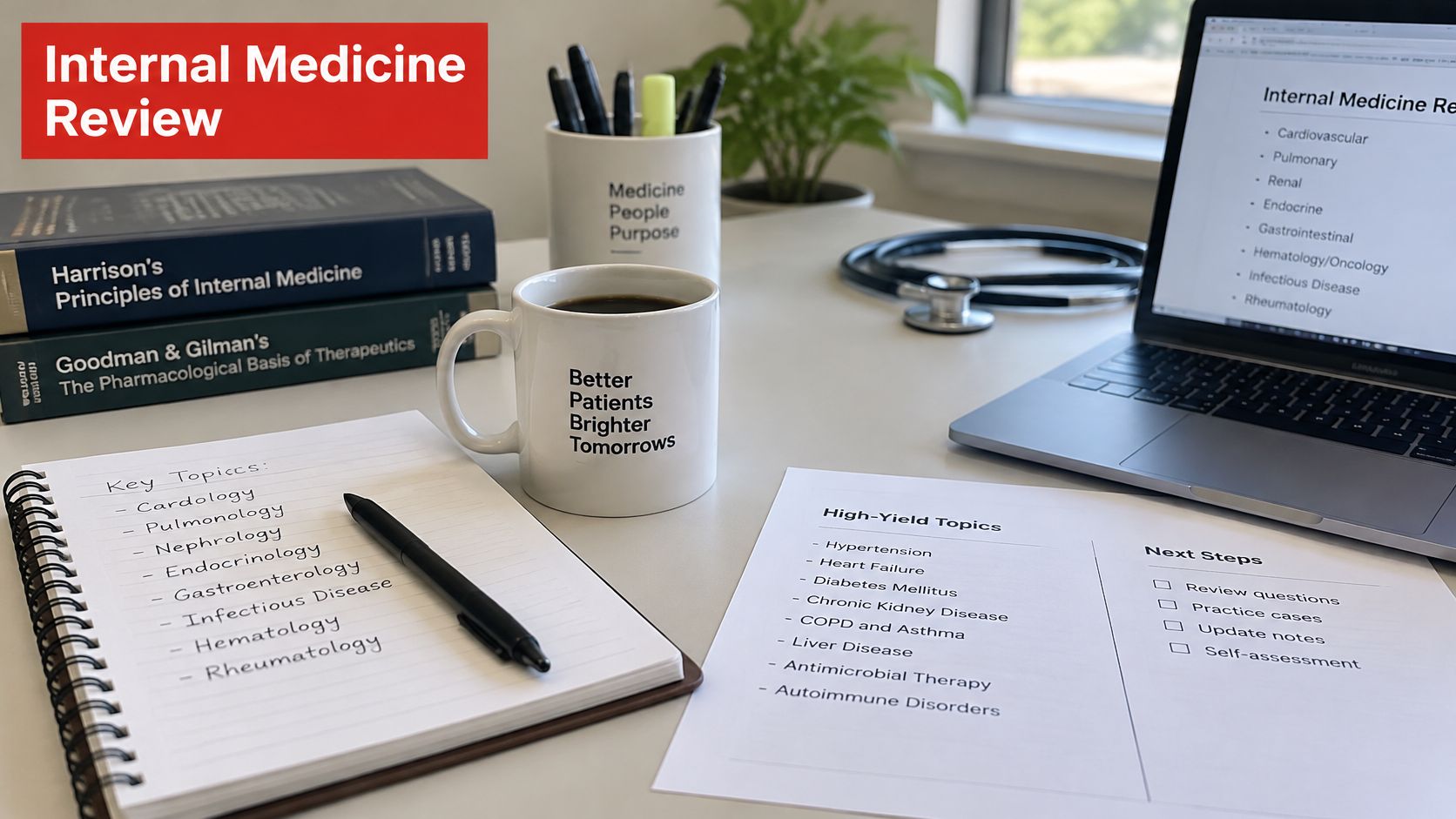
The Emma Holliday lecture overview describes an approximately two-hour Internal Medicine session from the early 2010s and lists the navigation markers below. The wider series covers four clerkship subjects: Internal Medicine, Surgery, Pediatrics, and Psychiatry, with slightly more than eight hours of video in total.
Internal Medicine lecture topics and timestamps as listed
| Domain | Start time as listed | Use it for |
|---|---|---|
| Cardiology | About 1:25 | Review cardiac presentations and compare shelf-level patterns. |
| Pulmonology | About 37:23 | Revisit respiratory presentations and distinguish common patterns. |
| Gastroenterology | About 1:01:55 | Organize gastrointestinal presentations and related distinctions. |
| Infectious disease | About 1:07:56 | Review infection patterns; verify management concepts against current sources. |
| Renal medicine, or nephrology | About 1:28:50 | Revisit renal physiology and connect it to syndromes. |
| Hematology/oncology | About 1:48:50 | Review hematologic and malignancy patterns; check current oncology guidance. |
The markers are navigation aids, not guaranteed chapter boundaries. A re-upload or edited version may start at a different point, so use the displayed topic as a guide and check the surrounding explanation.
Turn Topics Into a Checklist
For each domain, write down the presenting problems discussed, distinctions that remain difficult, and topics missing from your notes. Make each checklist item a task: explain a mechanism, distinguish competing diagnoses, or identify which claims need checking against current guidance.
A useful review map has two layers: the timestamp gets you to the right neighborhood, while the surrounding explanation shows how the lecture connects the ideas. PatientNotes' page on clinical documentation for internists provides a separate context for documentation. It does not establish whether a lecture recommendation is current or determine an exam answer.
Treat the recording as a dated, compressed map. Verify every management, screening, and oncology claim against current sources before relying on it.
How to Use the Review in a Two-Day Shelf Pass
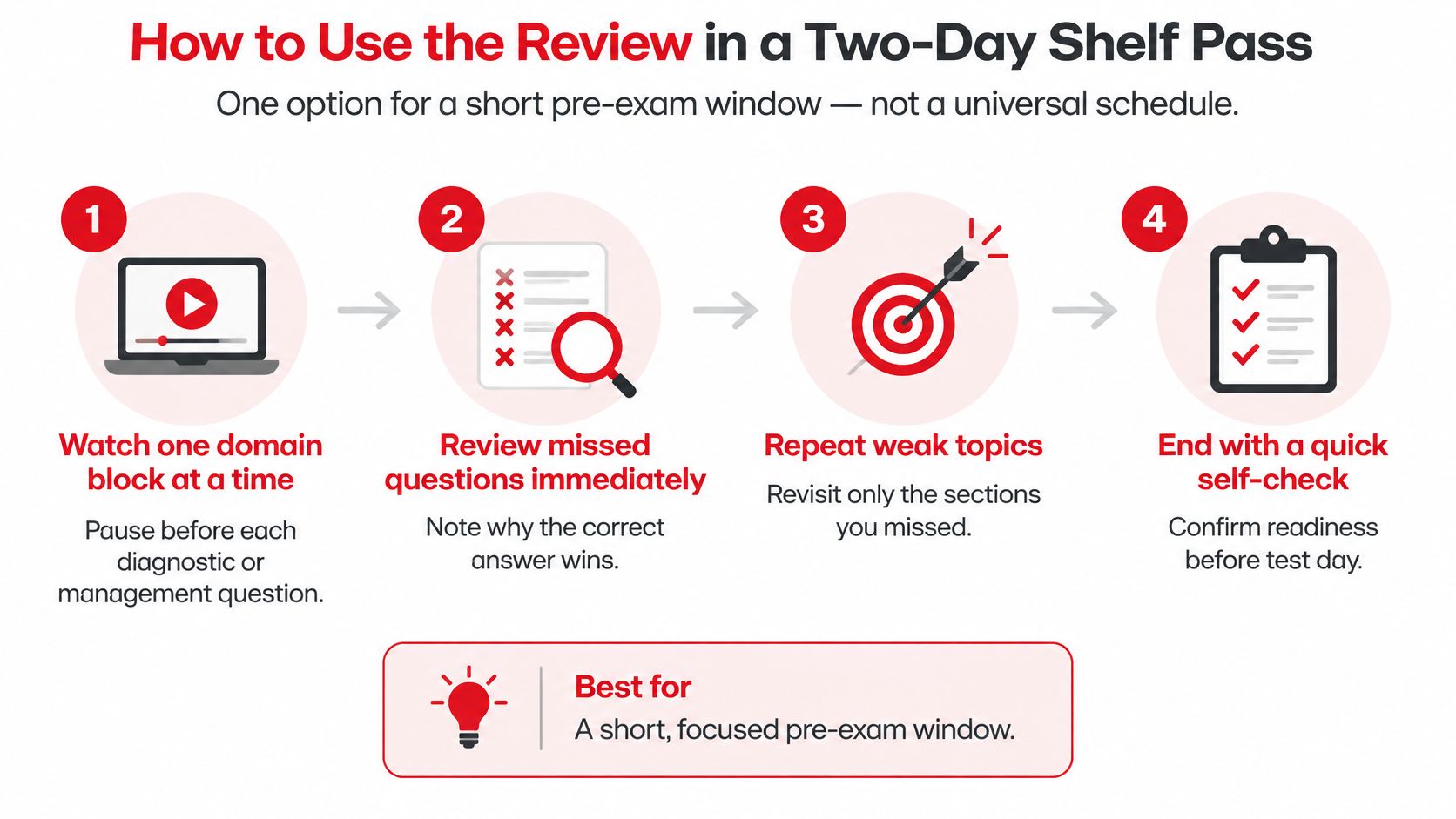
A two-day shelf pass is a planning option for a short pre-exam window, not a universal schedule or a prediction of readiness. Students who still need foundational instruction may benefit more from targeted reading and question analysis than from finishing the recording.
The Internal Medicine review recording presents a deliberately compressed shelf-review format. Its brevity makes selective pauses and retrieval more useful than treating playback completion as the main objective.
A Practical Watch, Retrieve, and Test Sequence
Watch a domain block and predict the conclusion. Before Holliday names a diagnosis or management step, students should pause and state what they expect. An uncertain prediction is useful information, not a reason to avoid pausing.
Build a one-line illness script for each condition: risk factors, mechanism, discriminating finding, first test, and initial treatment concept at exam level. Any management component remains provisional until checked against a current source.
Record the domain and timestamp. A tracking sheet can include the condition, the confusing distinction, the question that exposed the gap, and the verification status. This keeps later review focused.
Answer authorized question-bank items on the same domain before moving on. Tag misses as physiology, pattern recognition, management, or guideline detail, and explain why the correct answer fits better than the most tempting alternative.
Send management and guideline misses to a separate verification queue. Copying the lecture answer into a flashcard before resolving a conflict can make an outdated claim harder to correct later.
On the following study day, reconstruct the scripts from memory. Rewatch only the blocks connected to remaining gaps, then test those distinctions with different questions.
The guide to using UWorld for shelf exams offers a related question-review framework. A question bank should expose whether students can transfer an explanation to an unfamiliar presentation, not merely recognize wording from their notes.
An Original Educational Exercise
Consider a hypothetical 58-year-old with exertional dyspnea and leg swelling. Before the lecture explanation, the student writes which additional finding or test would best distinguish the leading possibilities, then explains what result would change the working diagnosis.
The exercise intentionally stops short of supplying a diagnosis or treatment. Those symptoms alone don't justify a single answer, and no individualized clinical recommendation follows from this abbreviated scenario.
A useful tracking entry might read: “Cardiology, dyspnea with edema, selected a test without explaining what uncertainty it resolves.” That identifies a reasoning task more precisely than “weak in cardiology.”
A missed question should produce a repair task, not just a longer list of facts.
Question performance should also direct attention to material that a compressed overview cannot develop equally, including acid–base interpretation, electrocardiogram (ECG) localization, renal physiology, antibiotic selection, and guideline-dependent preventive care. Students should investigate these omissions rather than assume that unmentioned material is unimportant.
All examples are for examination education, not patient care. Qualified medical editorial review should approve clinical teaching examples before their incorporation into formal study materials.
Where the Review Fits and How to Verify It
Study tasks the review supports and the sources to pair with it
| Study task | Fit for this review | Reason | Pair it with |
|---|---|---|---|
| Shelf domain overview | Strong fit | Organizes broad internal medicine into domains | Practice questions and the official content outline |
| Illness-script building | Strong fit | Supports presentation-to-diagnosis pathways | Question-level analysis |
| Management thresholds and drug choice | Verify first | Recommendations change | Current specialty guidelines |
| Preventive care and screening intervals | Verify first | Guideline-dependent and time-sensitive | Current guidelines with publication dates |
| Oncology staging and therapy | Not a fit alone | Requires disease-specific updates | Current disease-specific sources |
| Procedural and bedside skills | Not a fit | Video cannot establish hands-on competence | Supervised clinical training |
| Inpatient and ambulatory decisions | Not a fit | Requires individualized current guidance | Local protocols and treating clinicians |
The MD Anderson faculty profile identifies Holliday's gastrointestinal radiation-oncology specialization. That scope matters because professional expertise and the currency of a particular educational recording are separate questions.
Holliday's public reflection on the student-created material also distinguishes that broad review from her later subspecialized practice. Neither popularity nor an accomplished subsequent career substitutes for checking the age and applicability of an individual recommendation.
A Claim-by-Claim Verification Workflow
Record provenance. Save the upload date, channel, title, and version watched. An upload date doesn't necessarily establish the original recording date or permission to redistribute it.
Tag each study claim as physiology, classic presentation, diagnostic threshold, drug choice, screening, or staging. These categories need different checks.
Compare physiology and classic presentations with standard medicine texts. Use the official examination content outline to check scope, recognizing that an outline identifies examinable areas rather than validating a treatment recommendation.
Verify thresholds, drugs, and screening against current specialty guidance. Record the issuing organization, publication or update date, and the population to which the recommendation applies.
Use authorized recordings and officially released materials. If authorization isn't clear, students should seek confirmation rather than download or share redistributed copies.
Label each entry confirmed, updated, or uncertain, with an actual verification date. A recently accessed webpage isn't necessarily a recently updated guideline.
Rewrite or remove uncertain statements before using them to answer practice questions. When sources appear inconsistent, compare their populations, settings, and publication dates before choosing between them.
Check artificial intelligence (AI) summaries against primary documents. An AI-generated citation or confident explanation isn't sufficient evidence that a recommendation exists.
The purpose isn't to declare the entire lecture obsolete. It's to preserve useful organization without carrying an unchecked answer into a modern study set.
For example, an oncology note may preserve a recognizable presentation while requiring replacement of its staging or therapy section. A screening note may require checking eligibility, interval, exceptions, and recommendation date rather than changing a single number.
Verification rule: A recommendation remains unresolved until a student can identify both its source and the circumstances in which it applies.
The Internal Medicine MKSAP discussion can help students consider a more detailed companion resource. Adding another resource should solve an identified depth problem, not create a second unfinished reading list.
Key Takeaways for Using the Review Safely
Treat the recording as legacy exam preparation. Students should use Holliday's student-era shelf synthesis to organize concepts, not label its recommendations as current merely because the video remains accessible.
Keep training and scope distinct. Her internal-medicine experience included an internship rather than an internal-medicine residency, so students shouldn't infer that the recording represents present-day general-internal-medicine practice.
Measure retrieval rather than familiarity. A domain is more useful after a student can reconstruct its diagnostic distinctions and apply them to authorized practice questions; these active-recall study methods provide ways to make that work observable.
Date every management verification. Drug choices, thresholds, screening intervals, and oncology material should enter a trusted study set only after comparison with applicable current guidance and a recorded verification date.
Keep clinical competence outside the video checklist. Procedures, bedside examination, and individualized inpatient or ambulatory decisions require supervised training and appropriate clinical oversight, not successful recall of a lecture.
The central distinction is between a useful explanation and a sufficiently verified answer. Students can value the former while still checking the latter, and difficulty retrieving a concept provides a specific next task rather than a judgment about their potential.
These principles apply to examination education only, not the care of any patient. A study plan should retain that boundary even when its examples resemble problems encountered during a clerkship.
Decide Your Next Step for Internal Medicine Prep
Self-study is a reasonable starting route when question review produces clear, manageable repair tasks. A lecture, an authorized question bank, and the official content outline can support that route. Repeated confusion despite careful review may justify targeted help with reasoning or study structure.
The NBME shelf practice exams guide can help students place practice assessment within that decision. The National Board of Medical Examiners (NBME) remains the authority for its own examination information.
Choose Support for the Actual Gap
Ace Med Boards offers individual online tutoring, including internal medicine shelf preparation; its other supported rotations include surgery, pediatrics, obstetrics and gynecology, family medicine, emergency medicine, and neurology. Students considering tutoring services should confirm current program details and bring specific question-review difficulties rather than only a broad request to improve.
Tutoring complements independent study, question banks, and official practice materials. It doesn't guarantee a score or examination outcome.
For students comparing how centers organize support, Tutorbase for test prep centers provides an operational reference, not evidence of teaching quality or examination results. Administrative organization and educational effectiveness shouldn't be treated as interchangeable.
Ace Med Boards is not affiliated with or endorsed by NBME or the National Board of Osteopathic Medical Examiners (NBOME), and no affiliation with the United States Medical Licensing Examination (USMLE) or Federation of State Medical Boards (FSMB) is claimed. Its tutoring is exam education, not patient treatment.
Before relying on fees, formats, or policies, students should confirm current details directly with NBME, USMLE, or NBOME, according to the examination involved.
Sources
Use the sources below for distinct purposes: institutional and professional profiles provide biographical context, while the recording and library resource describe the lecture's educational role.
- MD Anderson Cancer Center, Emma Holliday faculty profile. Institutional information about her specialty and faculty identity.
- Doximity, Emma Holliday professional profile. Professional background and publication information.
- New York Medical College Library, Internal Medicine peer-to-peer resources. Context for using the lecture near the end of an internal medicine clerkship.
- Emma Holliday Internal Medicine review recording. A legacy educational resource. Check its content against current guidance before applying clinical recommendations.
- Emma Holliday's public statement about the review. Context about the review's creation and its relationship to her later subspecialty practice.
Ace Med Boards offers individualized online internal medicine shelf tutoring for students working on reasoning gaps identified through practice questions. Visit Ace Med Boards to consider whether tutoring fits your study plan, or schedule a free consultation to discuss your domain checklist and unresolved questions.