Active recall is retrieval practice, where you test yourself to pull information from memory, and it improves durable retention more than rereading when paired with spacing and feedback. In one Swahili-English word-pair study, learners who continued retrieval practice retained about 80% of items after one week, compared with 36% among learners who stopped practicing items after initial learning, as reported in the overview of the testing-effect research.
You may recognize the problem. You reread a renal physiology summary, highlight a few mechanisms, and feel familiar with the page. The next day, however, a question asks you to predict the acid-base pattern after a specific tubular defect, and the explanation feels just out of reach. That gap between recognition and retrieval is where many medical learners lose study time.
Active recall study methods close that gap by making retrieval the central task. For USMLE, COMLEX-USA, and Shelf preparation, the method works best as a system that combines recall, spacing, mixed practice, feedback, and transfer to original unseen questions. A low score or an uncomfortable review session isn't a judgment about your ability. It's information about what your current study process is and isn't making retrievable.
What Active Recall Is and Why It Works for Exams
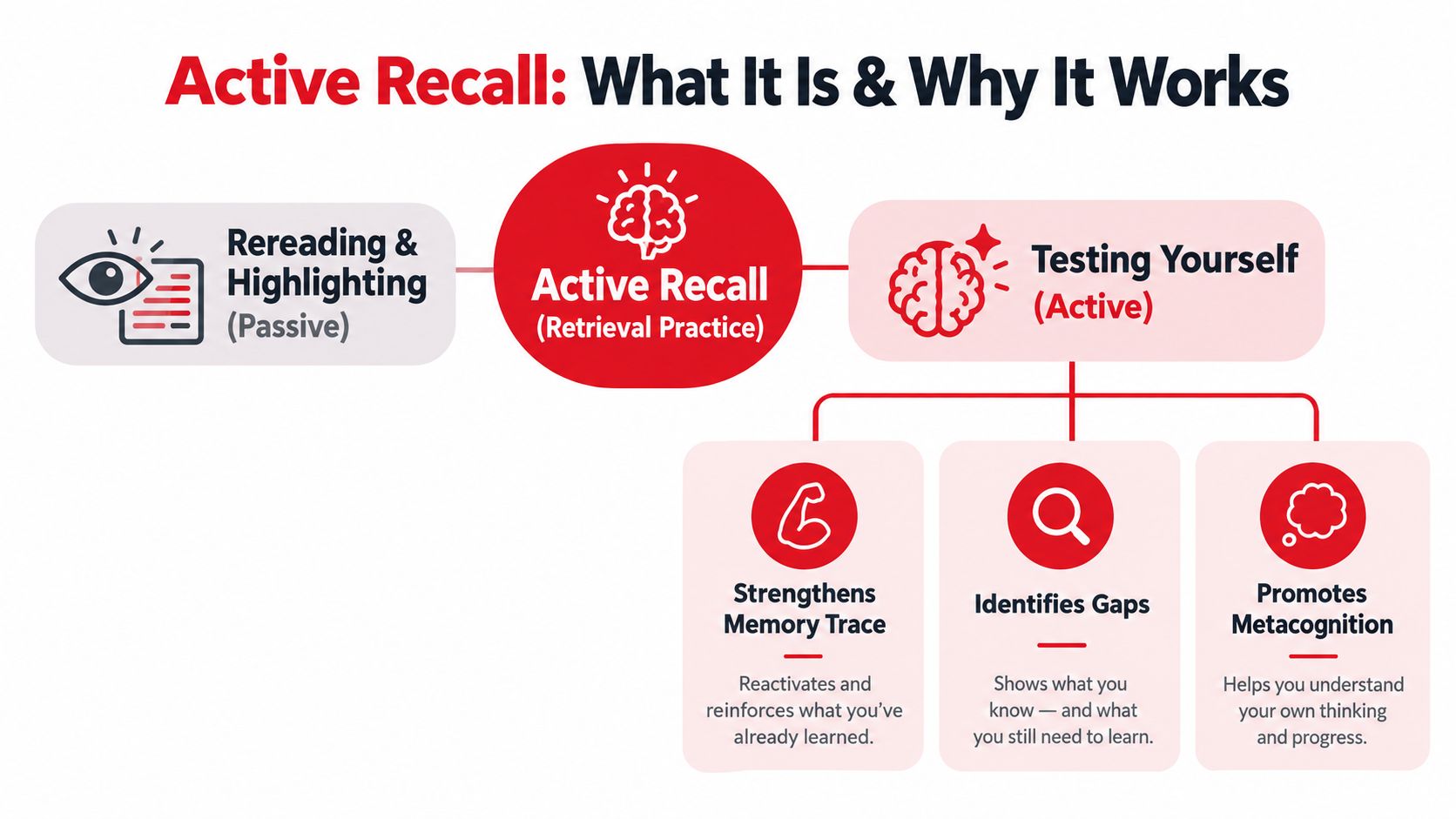
Active recall is retrieval practice. You close your notes, look at a prompt, and produce the answer from memory before checking an explanation. That might mean explaining the mechanism of nephrotic edema, drawing a pathway from memory, answering a short-answer prompt, or deciding why one diagnosis fits an original clinical vignette better than another.
Rereading and highlighting are different. They expose you to information, but they don't require you to reconstruct it. Familiarity can make a page feel easy even when you couldn't generate the answer independently. Active recall creates a more demanding test of whether the information is available when you need it.
Why retrieval matters under exam conditions
Medical examinations don't usually ask whether a paragraph looks familiar. They ask you to retrieve a mechanism, interpret a finding, distinguish similar conditions, and apply information to a new presentation.
Retrieval practice helps in three connected ways:
- It strengthens access: You repeatedly practice finding an idea without relying on the page layout or highlighted wording.
- It reveals gaps: A wrong or incomplete answer shows what needs attention more clearly than passive review.
- It improves metacognition: You compare your confidence with your actual performance and make better decisions about what to study next.
A 2021 systematic review identified 49 effect sizes across 5,374 students, with 57% showing medium or large benefits for retrieval practice over comparison methods in school and classroom settings. The review appears in Educational Psychology Review. Those findings don't mean every flashcard or question automatically produces learning. They support a more precise conclusion: testing yourself is a measurable learning advantage across real educational environments, not merely a preferred study style.
For exam preparation, keep the target clear. USMLE means the United States Medical Licensing Examination, COMLEX-USA means the Osteopathic Medical Licensing Examination of the United States, and Shelf examinations assess knowledge within clinical rotations. Each requires alignment with its official content outline and practice materials. MCAT preparation is a separate pathway for premedical applicants and shouldn't be blended into a board-exam schedule.
For a broader study-planning framework, review study strategies for medical exams. Use active recall as the engine, then build a routine that tells you what to retrieve, when to retrieve it, and how to respond when retrieval fails.
How Retrieval Practice Spacing and Interleaving Build Durable Memory
Retrieval is more powerful when you control timing, topic order, and feedback. A learner who answers a question immediately after reading may be checking short-term familiarity. A learner who returns later, retrieves with less support, and then applies the idea to an unfamiliar prompt is testing durable access.
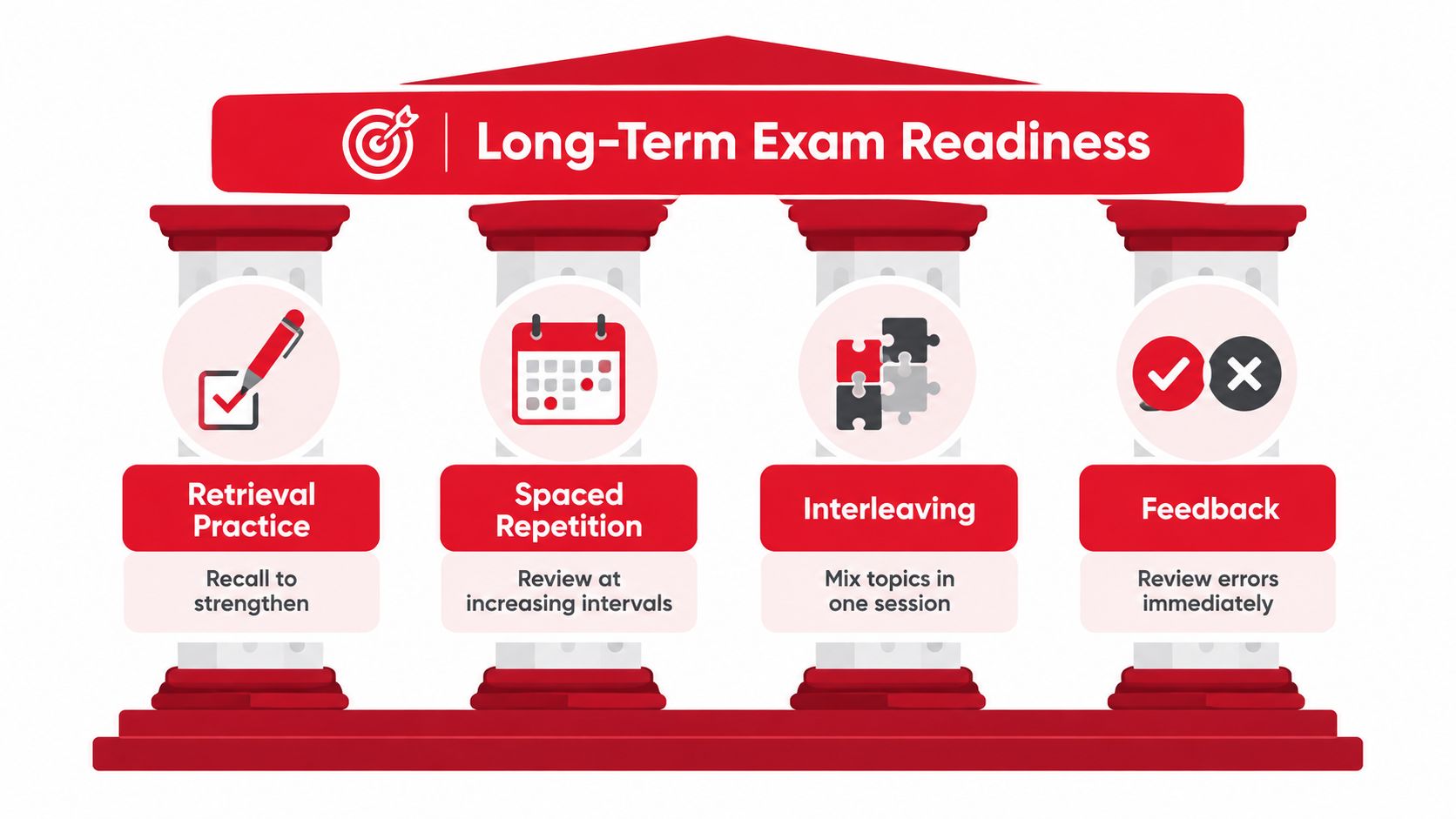
Four principles that work together
Retrieval practice asks you to generate an answer before seeing the explanation. Use it for mechanisms, associations, diagnostic distinctions, and next-step reasoning. A useful prompt isn't “review renal physiology.” It's “What transport defect explains this acid-base pattern, and why?”
Spaced repetition separates reviews instead of compressing them into one sitting. A practical sequence might begin with a later same-day check, followed by reviews on subsequent days and later in the week. The exact timing should respond to performance. Easy retrieval can move farther away, while an unstable concept returns sooner. The spacing guidance for medical exam study can help you turn that principle into a calendar.
Interleaving mixes related topics rather than placing every similar question in one uninterrupted block. A mixed set involving acid-base disorders, diuretics, and renal pathology forces you to identify which framework applies. That discrimination resembles the decision work required by unseen exam questions more closely than a long run of nearly identical prompts.
Feedback tells you whether your answer was correct, incomplete, or based on the wrong reasoning path. Check feedback after attempting the question, then write the correction in your own words. Feedback without retrieval becomes rereading. Retrieval without feedback can reinforce a misconception.
Don't organize study around learning-style labels
“Visual learner” and “auditory learner” labels don't justify matching instruction to a preferred sensory mode. Choose the representation that fits the material instead.
A pathway may benefit from a simple diagram plus a verbal explanation. A differential diagnosis may be clearer in a comparison table. A pharmacology association may require a concise prompt and an application question. The point isn't to force every topic into one format. The point is to combine words with useful diagrams when that combination makes the relationship easier to retrieve and apply.
Practical rule: If you can recognize the explanation but can't produce or use it without notes, the next session should contain less rereading and more retrieval with feedback.
The 2021 review cited above supports retrieval practice in classroom settings, while the long experimental history of the testing effect helps explain why the method remains central to durable learning. For a medical learner, the practical test is transfer. Can you use the concept when the wording, patient details, or neighboring topic changes?
How to Implement Active Recall for USMLE COMLEX and Shelf Prep
A workable system starts with an exam goal and ends with a weekly adjustment. It shouldn't measure success by hours alone.
Set a measurable exam goal
Define the examination, target content areas, available study window, and the behavior you need to improve. For a USMLE learner, the goal might center on retrieving mechanisms and applying them to mixed original questions. For a COMLEX-USA learner, include the relevant osteopathic content and official blueprint alignment. For a Shelf learner, organize around the current rotation and its approved content expectations.
Your completion check is simple: you can state what exam you're preparing for, what material it covers, and which performance problem you're addressing.
Run a diagnostic
Use an appropriate diagnostic or baseline set of original practice questions. Work under realistic conditions, commit to answers before reviewing explanations, and record uncertainty as well as correctness.
The diagnostic isn't a verdict. It gives you a starting map. Look for patterns such as missing knowledge, difficulty applying a known fact, careless reading, weak pacing, or failure to identify the tested task.
Tag errors by cause
An error log should distinguish causes rather than list only missed topics.
- Knowledge error: You didn't know or couldn't retrieve the relevant fact.
- Application error: You knew the fact but couldn't use it in the presented context.
- Reasoning error: You selected a conclusion without comparing the strongest alternatives.
- Careless error: You misread, rushed, or changed a defensible answer without a sound reason.
The tag determines the intervention. A knowledge error may need a short-answer prompt. An application error needs a new context. A pacing problem requires timed mixed practice, not another pass through the same notes.
Schedule spaced retrieval
Convert each important weakness into future retrieval events. Place the concept on a calendar, then vary the prompt so you're not memorizing one wording.
A learner who misses a mechanism might first answer a direct question, later draw the pathway, and then explain how the mechanism changes a new clinical presentation. Anki and spaced-repetition guidance can support scheduling, but the schedule still needs human review.
Practice mixed unseen questions
Use original or properly licensed practice material. Don't use recalled examination content, and don't treat recognition of a familiar answer choice as proof of mastery.
Mix topics after foundational learning has begun. A USMLE block might combine physiology, pathology, and pharmacology. A COMLEX-USA block should remain aligned with its examination blueprint. A Shelf block should reflect the relevant rotation rather than board topics from unrelated systems.
Review with an error log
Review the reasoning, not just the correct letter. Write the corrected principle, the clue you missed, and a transfer task that changes the surface details.
For example, instead of recording “missed acid-base question,” write: “I treated the urine finding as diagnostic without identifying the underlying transport defect. Next, explain the mechanism from a different electrolyte pattern and predict the expected compensation.”
Adjust weekly using four signals
At the end of the week, examine accuracy on unseen material, retention after spacing, pacing, and sustainable workload. If accuracy rises only on familiar prompts, increase transfer testing. If retention falls at longer intervals, shorten the next review gap. If pacing is poor, add timed mixed practice. If the workload repeatedly collapses, reduce task volume while protecting retrieval quality.
This approach keeps the plan responsive without turning a difficult week into a personal judgment.
Choosing the Right Retrieval Format for Medical Learning
Active recall isn't one tool. The format changes what you practice, so choose it based on the skill you need.
A 2026 randomized trial in fifth-year medical students found that short-answer retrieval produced the largest long-term gain, while re-solving virtual patient cases and multiple-choice questions mainly maintained knowledge. The study is available through the medical education trial record. The implication isn't that multiple-choice questions are unhelpful. They remain useful for decision-making, pacing, and exam-like transfer. They shouldn't be your only retrieval format if durable free recall is the weakness.
| Format | Best Use Case | Retention Impact | Transfer Tip |
|---|---|---|---|
| Flashcards and Anki | Rapid recall of concise facts, associations, and mechanisms | Efficient for repeated retrieval, but quality depends on precise prompts | Add a short explanation or diagram, then test the idea in an unseen question |
| Short-answer prompts | Mechanisms, differentials, pathways, and explanations | Strong choice when you need to produce information without cues | Change the clinical context and require a teach-back explanation |
| Multiple-choice blocks | Application, discrimination, pacing, and exam-like decisions | Useful for maintaining and applying knowledge | Hide familiar cues by mixing topics and reviewing every option |
| Virtual patient cases | Sequential reasoning and integration | Helps practice clinical application and maintenance | Follow the case with a short-answer prompt about the governing mechanism |
| Retrieval-based notes | Turning lectures or reading into questions | Useful for converting passive material into active prompts | Close the source and answer from memory before checking |
Flashcards work best when each card tests one meaningful idea. “What causes this?” is often too broad. A stronger prompt asks for a mechanism, a key distinction, or a predicted finding. Ace Med Boards offers flashcard guidance for medical exams that uses answer-before-reveal practice as the basic retrieval behavior.
Short-answer practice deserves a prominent place. Ask yourself to name the mechanism, explain why an option is wrong, or predict what changes when one variable is altered. These prompts expose partial knowledge that a multiple-choice cue might conceal.
Use question blocks for transfer, not just for score collection. After answering, close the explanation and state the governing rule in a new form. If you can select the answer but can't explain the mechanism, mark the item for short-answer retrieval rather than moving on.
Format check: Choose the format that matches the failure. Facts that won't come to mind need free recall. Concepts that won't transfer need mixed, unseen application.
Weekly Retrieval Calendar and Error Log You Can Reuse
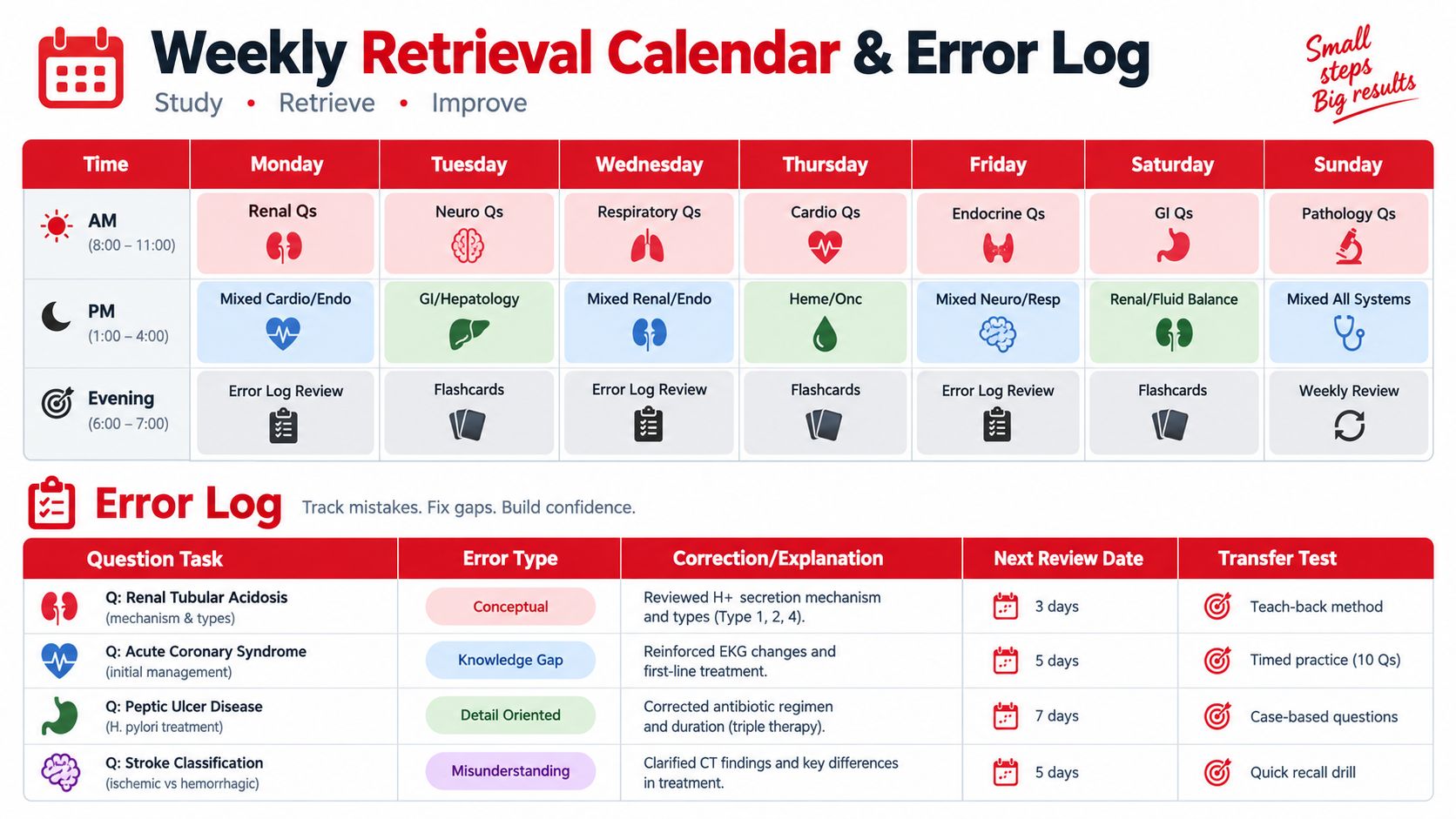
A weekly calendar prevents active recall from becoming an intention without a retrieval appointment. It also keeps the workload visible without treating study hours as the main outcome.
Reusable weekly calendar
| Day | Retrieval task | Spacing or transfer emphasis |
|---|---|---|
| Monday | Retrieve the current system with short-answer prompts, then complete a mixed set | Record knowledge, application, reasoning, and careless errors |
| Tuesday | Revisit Monday's weak prompts and add a different representation | Explain one mechanism with words and a useful diagram |
| Wednesday | Complete an unseen mixed block across related systems | Review feedback immediately and create correction prompts |
| Thursday | Retrieve earlier material without notes | Use a changed clinical context for transfer |
| Friday | Complete another mixed block aligned with the appropriate exam | Track accuracy, retention, and pacing |
| Saturday | Review the error log and perform targeted short-answer retrieval | Test the highest-impact weaknesses in a new form |
| Sunday | Conduct a light cumulative retrieval check and plan the next week | Keep sustainable tasks, move stable material farther out |
This calendar can be adapted for USMLE, COMLEX-USA, or Shelf preparation, but the content should stay exam-specific. Follow the relevant USMLE content outlines or NBOME COMLEX-USA examination information when deciding which topics and competencies belong in the plan.
Error log template
| Question Task | Error Type | Correction | Next Review Dates | Transfer Test |
|---|---|---|---|---|
| Explain an original renal mechanism prompt | Knowledge | Write the mechanism in one sentence and draw the relevant transport relationship | Later this week, then the following week | Explain the mechanism using a changed electrolyte pattern |
| Compare two causes of anemia | Application | Identify the discriminating laboratory and physiologic clue | Tomorrow, then several days later | Select the best distinction in an unseen vignette |
| Complete a mixed cardiovascular block | Pacing | Mark the point where time was lost and practice shorter decisions | Next mixed block | Reattempt a new timed block with topic order changed |
| Teach back a pharmacology association | Reasoning | Link drug action to downstream physiology instead of memorizing the label | Later this week | Predict an adverse effect from the mechanism |
A clearly labeled composite example
Hypothetical composite learner: A student spends four hours rereading notes but can't retrieve the facts the next day. The revised plan converts notes into questions, schedules reviews at expanding intervals, mixes related topics, and checks retention one week later on unseen items.
The student might turn “review renal tubular physiology” into prompts such as: “What transport process explains this finding?” and “How would the expected result change if the affected segment were different?” The student then records whether the problem was missing knowledge, weak application, faulty reasoning, or careless reading.
This example doesn't represent a verified Ace Med Boards student, measured outcome, or guaranteed result. Its purpose is to show how a passive task becomes a sequence of retrieval, correction, spacing, and transfer.
Troubleshooting Common Pitfalls and Tracking Real Progress
The biggest hurdle at the beginning is discomfort. Rereading feels smoother, while retrieval exposes uncertainty. If you avoid that uncertainty, you may spend more time studying without practicing the skill the examination demands.
Use this troubleshooting checklist:
- Close the notes: Answer before looking, even when the response is incomplete.
- Name the error: Tag the cause instead of writing only “wrong.”
- Check feedback promptly: Correct the reasoning while the attempt is still fresh.
- Change the prompt: Test the same principle in a new form.
- Protect transfer: Include unseen mixed questions rather than repeating familiar items.
- Reject learning-style shortcuts: Match the representation to the material and use diagrams when they clarify relationships.
Track progress with measures that reflect exam performance: accuracy on unseen mixed blocks, retention after spaced reviews, pacing per question, and workload you can sustain. Hours can help organize a plan, but hours alone don't show whether information remains retrievable.
A 2024 systematic review found that flashcards were the most popular active-recall tool and were associated with higher GPA and test scores, while self-testing, retrieval practice, and concept mapping were effective but underused. The findings are summarized in the PubMed record for the systematic review. Popularity and evidence-based use aren't the same thing, so build the less comfortable methods into the calendar deliberately.
For a focused framework on evaluating your own knowledge and confidence, see metacognitive awareness for medical learners.
Key Takeaways and Next Steps for Consistent Retrieval Practice
Active recall study methods work best as a coordinated routine:
- Retrieve before reviewing: Make yourself produce the answer before checking notes or explanations.
- Space the work: Return to material after increasing intervals and shorten the gap when retention is unstable.
- Interleave related topics: Mixed practice helps you decide which framework applies.
- Use feedback and transfer: Correct the cause of an error, then test the principle on an unseen prompt.
- Track useful signals: Review accuracy, retention, pacing, and sustainable workload each week.
A weak result, a failed attempt, or a long academic gap can make studying feel personal. It isn't evidence that your medical career is over. Use the result to identify the next retrieval target, adjust the schedule, and seek support when an outside perspective would make the plan more manageable.
Clinical examples in this article are for examination education, not patient treatment or individualized medical advice. Align content selection with the current USMLE examination materials or the applicable NBOME guidance, and use official resources for current exam policies and outlines.
If you want help applying this system to a specific USMLE, COMLEX-USA, or Shelf preparation plan, you can review USMLE and COMLEX tutoring options, compare program and pricing information, or request a free consultation. A structured review can help you turn missed questions into a calendar of targeted retrieval and transfer practice.
Ace Med Boards provides personalized online tutoring and test-preparation support for USMLE, COMLEX-USA, and selected Shelf examinations, with study planning that can incorporate retrieval practice and error review. Visit Ace Med Boards to learn about the available options and decide whether a free consultation or Board Score Audit fits your current preparation needs.