

For 2026-2027, COMLEX Level 2 CE test dates are ten testing windows from June 4, 2026, through February 12, 2027, not one national exam day. Each window has its own projected score-release date.
A student finishing a rotation often starts with a simpler question, which day looks open. That's the wrong first question. A seat inside the wrong window can produce a score after a school or application deadline, even when the appointment itself fits the rotation calendar perfectly.
COMLEX Level 2 CE Test Dates and Score Releases
A student finishing a hospital block may find an appointment that fits the gap before the next rotation. The score, however, follows the testing window, not the individual appointment day. That difference matters when a school or application deadline depends on having a result.
The NBOME testing windows and score release dates calendar pairs each completion window with a projected release date. For example, the June 4-27, 2026 window has a projected release date of August 4, 2026. Testing at either end of that window points to the same listed release.
Verified 2026-2027 Level 2-CE Windows and Score Releases
| Testing window | Projected score release | Planning note |
|---|---|---|
| June 4-27, 2026 | August 4, 2026 | First listed window of the cycle |
| June 28-July 16, 2026 | August 13, 2026 | Early summer completion |
| July 17-August 4, 2026 | August 25, 2026 | Mid-summer completion |
| August 5-23, 2026 | September 15, 2026 | Late-summer completion |
| August 24-September 9, 2026 | September 22, 2026 | Early-fall completion |
| September 10-26, 2026 | October 13, 2026 | Fall completion |
| September 27-October 17, 2026 | November 3, 2026 | Fall completion |
| October 18-November 7, 2026 | November 24, 2026 | Late-fall completion |
| November 8, 2026-January 8, 2027 | January 26, 2027 | Winter completion |
| January 9-February 12, 2027 | February 25, 2027 | Last listed window of the cycle |
Use the release date as a planning target, not as a guarantee that a score will be available earlier that day. The calendar's projected dates can change if scheduling or testing-site disruptions affect operations.
Key Takeaways for Reading the Calendar
- A window is a range, not an appointment: Your seat falls on a specific day within the window, while the listed release applies to the window.
- Registration opens well ahead: Registration typically opens about six months before a window begins.
- Leave time to book: NBOME advises attempting to schedule at least 120 days ahead, since preferred dates and test centers can fill.
- Allow for release timing: Absent unforeseen circumstances, scores are released by 5:00 p.m. Central Time on the projected date.
A score released on a deadline date may arrive too late for a morning cutoff. Leave a buffer for the score report to become available, be submitted where required, and be reviewed.
Four Clocks Behind Every Level 2-CE Date
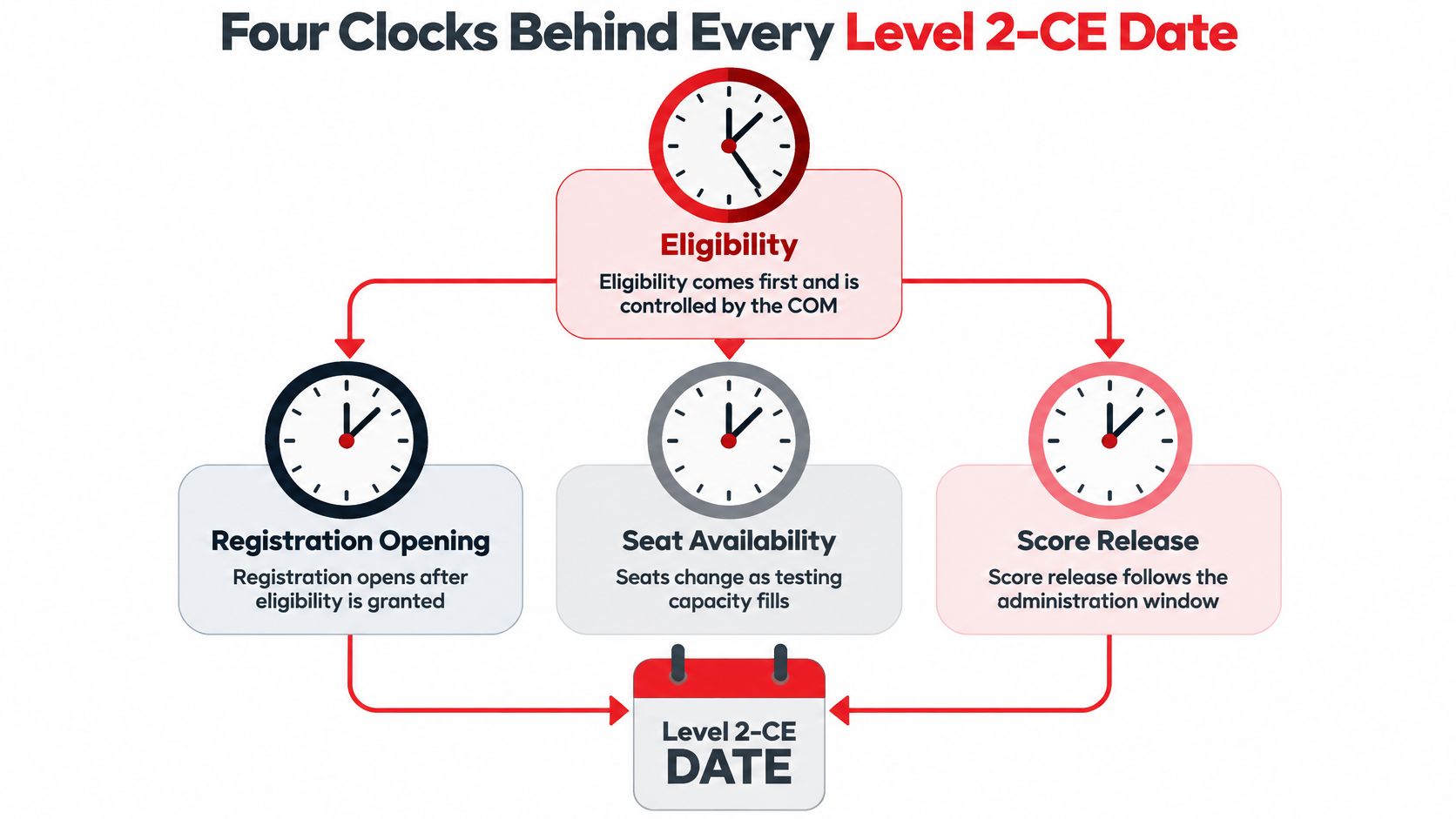
A Level 2-CE plan can stall even when the calendar looks open. Four clocks determine whether a date works: eligibility, registration opening, seat availability, and score release. Each answers a different question, and progress on one does not advance the others.
Eligibility Comes First
The student's college of osteopathic medicine (COM), not the scheduling screen, determines eligibility. The NBOME Bulletin of Information eligibility section lists passing COMLEX-USA Level 1, completing the second year at an accredited college of osteopathic medicine, and obtaining an attestation of good academic and professional standing from the COM dean. An open seat cannot replace a missing requirement or attestation.
If a Level 1 result, academic standing, or COM processing is pending, the calendar may show a suitable window before the account is ready to register. Check eligibility early so you can distinguish an administrative delay from a lack of available seats.
Registration Opening and Seat Availability
Registration typically opens about six months before a window begins. Have your NBOME account and COM eligibility in order before registration opens. The opening date tells you when registration becomes possible; it does not tell you which seats will remain available.
Seat availability is a separate clock. Nearby centers may fill while more distant locations still have openings, so a preferred window does not guarantee a convenient date or location.
Practical rule: Without eligibility, you cannot register. Without a confirmed seat, you do not have an exam date.
The Score Clock
The fourth clock is score release. It is tied to the examination window, not to the day you select a seat. A confirmed appointment establishes when and where you will test; it does not establish when the score will be available.
That distinction matters if a school or application deadline depends on the result. Choose a window based on when the score must exist, then look for a seat within that window.
Work Backward From the Score You Need
A school or application deadline falls in early September. The question is not just when you can sit for Level 2-CE, but when the score must be available. Start with that deadline, then work backward through the expected score-release window to choose an exam administration.
The NBOME frequently asked questions page says Level 1 and Level 2-CE scores are generally released approximately four to six weeks after the examination administration date. That range helps set expectations; use the listed release date for the specific administration when comparing windows.
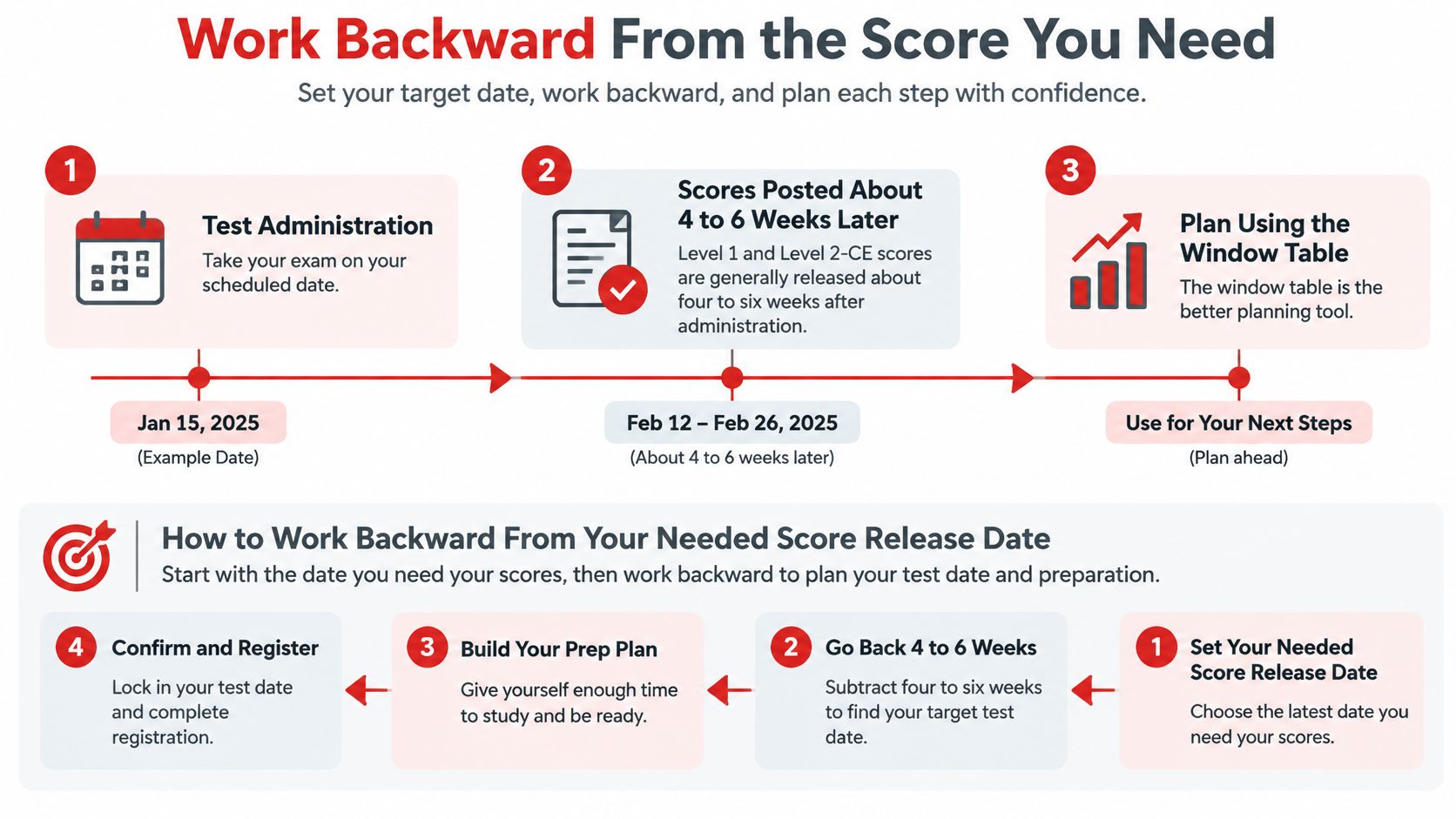
Scores are typically released on the listed date, although NBOME notes that release dates can change, so a deadline on that same day leaves no margin. Students can review the COMLEX score percentile explanation to understand score context, while keeping that question separate from selecting an exam window.
One Worked Deadline Example
Suppose a school or application task needs the score by early September. The August 5-23 window has a listed release date of September 15, which would be too late. An earlier option, July 17-August 4, lists a release date of August 25, leaving more time for score transmission or a changed release date.
Later exam windows may offer more study time, but they can also push score availability past a deadline. Compare the exam window and release date together before choosing.
The Passing Standard in Context
The Level 2-CE passing standard is 400, as stated on the NBOME frequently asked questions page. A passing score is a standard, not a personal target or a percentile. Students whose practice results are near that mark can use them to consider readiness and timing.
Choose the latest window whose listed release date leaves time before the score is needed. Then confirm that a seat is available in that window.
Rotation-Aware Booking Timeline
A rotation calendar makes abstract lead times concrete. Duty days, night shifts, shelf exams, and travel between sites all compete with the booking sequence, so each milestone belongs on the same calendar the student already uses for clinical commitments. Students mapping blocks across the year can align this sequence with the medical school rotations planning overview before picking a window.
Rotation-Aware Booking Sequence
The table is a planning illustration built from the eligibility, registration, seat, and release rules already described. It isn't a recommendation for any individual student, since COM deadlines and rotation policies differ by school.
| Timing | Milestone | Action |
|---|---|---|
| About six months before the window opens | Registration typically opens | Confirm NBOME account and COM eligibility |
| About four months before the target date | NBOME 120-day scheduling advice | Compare centers and block travel on the rotation calendar |
| Before the rotation block starts | Hold exam day and surrounding evenings | Confirm no overlapping rotation duties |
| At least five calendar days before the exam | Level 2-CE late-booking limit | Treat as the final booking step, not a plan |
| Projected score-release date | Target for score availability | Keep a buffer before any school or application deadline |
The sequence works because each row protects a different failure point. Eligibility confirmation prevents a registration block. The four-month seat search preserves center choice. Holding the surrounding evenings prevents a post-call exam morning that looked acceptable when only the date itself was circled.
Notice what the timeline doesn't do. It doesn't tell a student to wait for a vacation week and hope seats remain. It also doesn't treat the five-day limit as a safety net, because by that point center choice, travel, and readiness decisions have almost no room left to adjust.
How to Book a Level 2-CE Seat
A seat can be confirmed for the wrong window if you book before checking when the score must be available. Compare the intended window with your COM's eligibility and the clinical schedule first, then complete registration and scheduling in order.
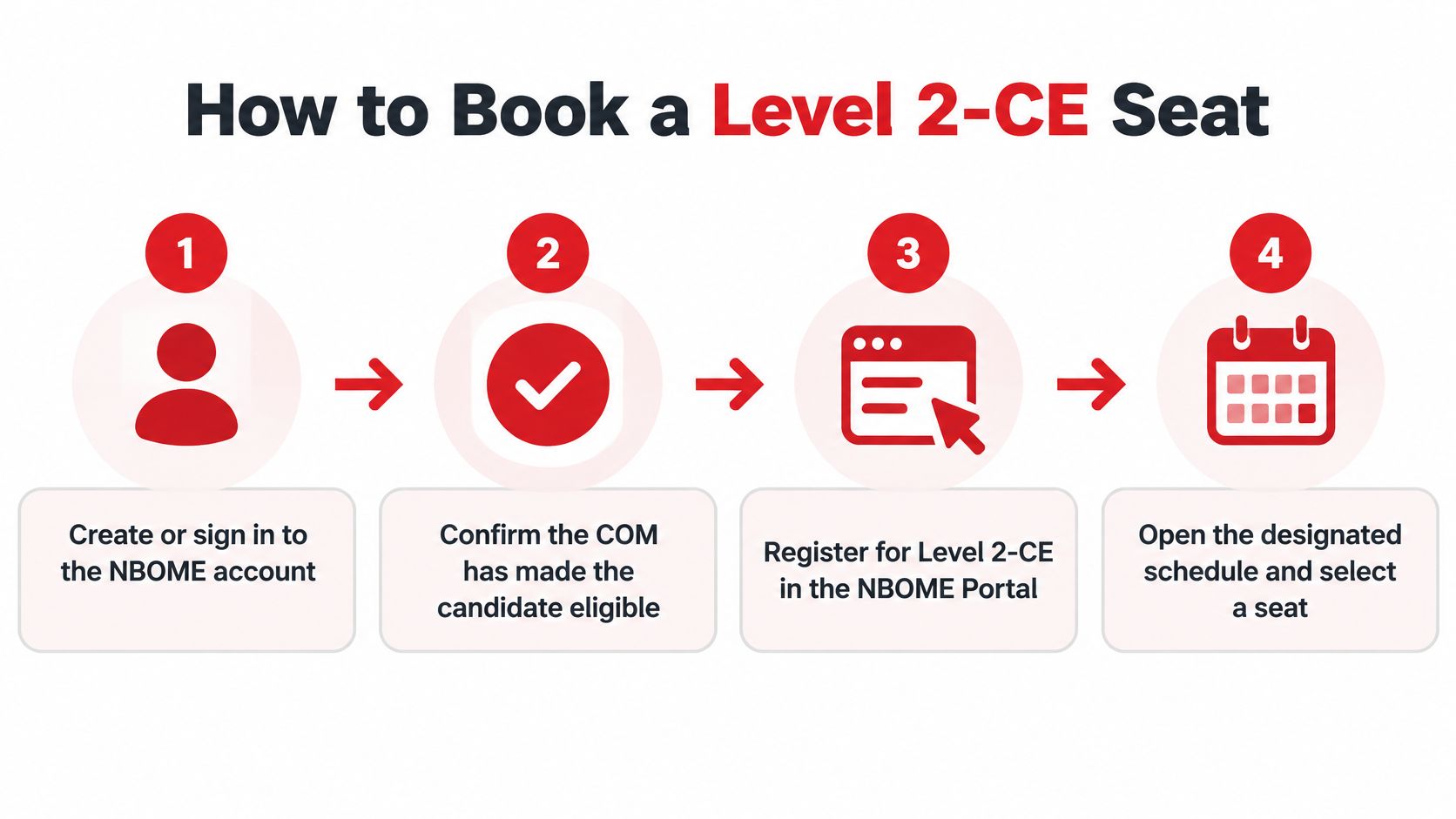
The NBOME Bulletin of Information registration and scheduling section explains that candidates need an NBOME account, eligibility from their COM, and registration before scheduling through the NBOME Portal and designated scheduling system. Registration typically opens about six months before a testing window begins, and dates are generally available up to six months in advance.
The Booking Steps in Order
- Create or sign in to your NBOME account: Check that your legal name matches your identification.
- Confirm COM eligibility: Verify that your COM has made you eligible for Level 2-CE.
- Register in the NBOME Portal: Select the correct exam level and testing cycle.
- Open the designated scheduling system: Search within your intended window, then compare locations and centers.
- Check the date against your clinical schedule: Account for travel, post-call days, night float, and the start of a new rotation.
- Book and save the confirmation: Keep the confirmation somewhere easy to find.
- Check the booked date against your score deadline: Make sure the appointment falls in the window you selected for that purpose.
The scheduling vendor appears on the live NBOME scheduling screen, so confirm it there at booking rather than relying on an older handout, since vendor names in saved PDFs age quickly.
A delay can reduce your choice of nearby centers. You may have to travel farther or choose a date in a different window. If you later need to change an appointment, follow the COMLEX rescheduling guidance and current NBOME policy. A confirmed appointment secures a seat; it does not establish that the score will arrive by your deadline or that you are ready to test.
Rotation-Aware Scheduling Checklist
A checklist earns its place during a busy block because it holds decisions a tired student shouldn't have to reconstruct between shifts. This one divides the work into what happens before seat shopping, during the search, and after booking.
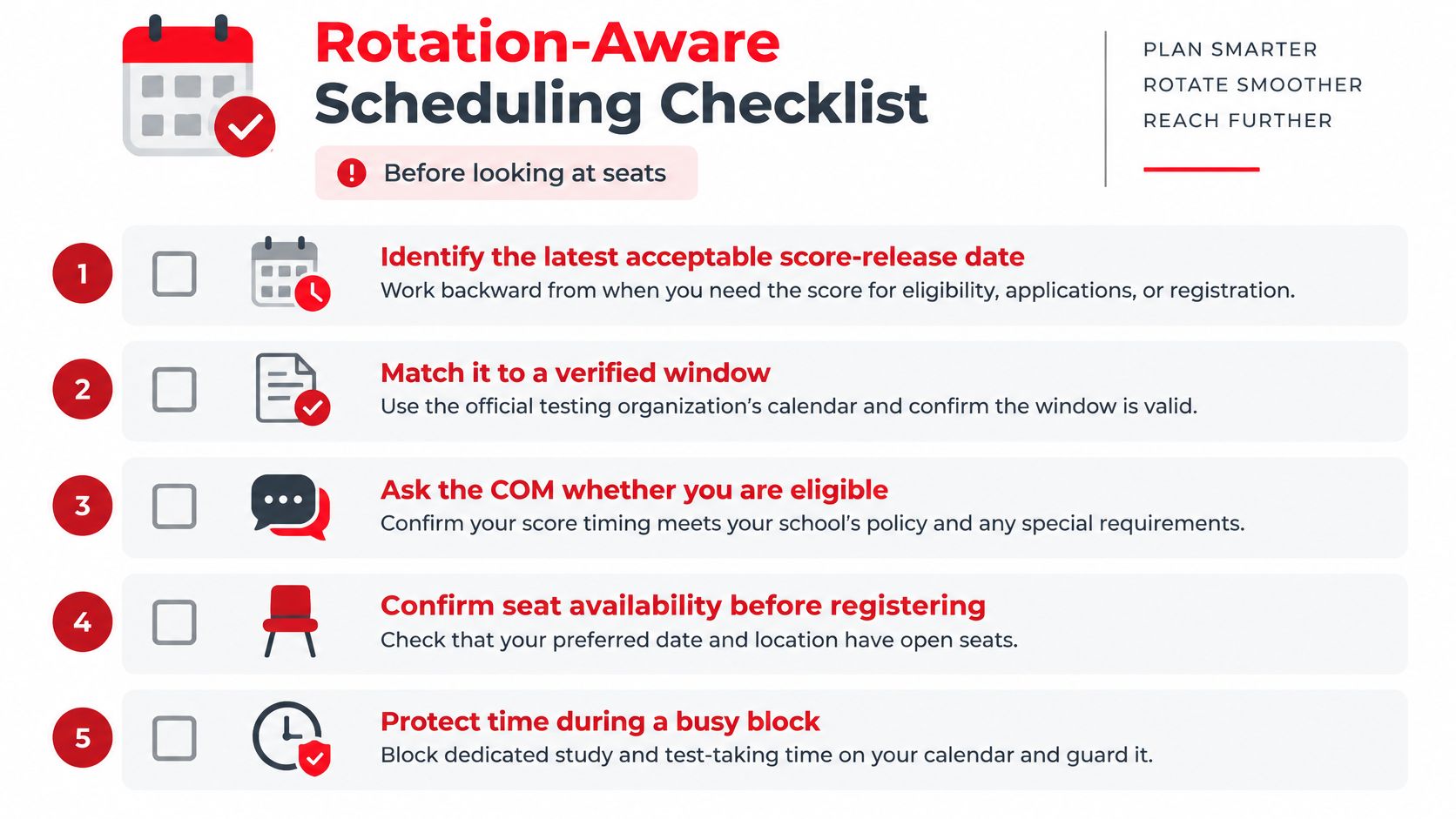
Before Looking at Seats
- Identify the latest acceptable score-release date: Write the school or application deadline first, then subtract buffer days.
- Match that date to a verified window: Use the official window table, not a classmate's recollection of a prior cycle.
- Ask the COM about eligibility timing: Confirm eligibility will be active when registration opens for the target window.
- Block the exam day and the surrounding evenings: Protect the night before for sleep and the evening after for recovery.
- Start accommodation requests early: Approved accommodations can narrow available sites, so those requests belong before seat shopping, not after.
While Searching for a Seat
Start near the 120-day mark and check more than one city, since the closest center isn't always the one with a seat inside the right window. Avoid the first day back from nights when fatigue is predictable, even if that date looks clean on paper. Don't assume a vacation week will still have seats a month later, because every other student with the same break is looking at the same centers.
A seat that's easy to reach on a rested morning is worth more than a closer seat taken after a night shift.
After Booking
Save the confirmation and tell the rotation coordinator only what the school requires. Plan the route to the center, including parking and arrival time, before the final study week. Set a personal reminder well before the date when changing the appointment becomes costly, and check current amounts in the official NBOME rescheduling policy rather than relying on any summary, including the COMLEX cost breakdown, for live fee decisions.
A Sample Pattern for Illustration
Consider a student finishing a June rotation who needs a score by late August. This illustration, not a recommendation, targets the June 28-July 16 window because its listed release is August 13, then looks for a seat in the first half of that window to protect study time after the rotation ends. Another student with a heavier June block might reasonably choose differently, and the checklist supports that judgment rather than replacing it.
The checklist also creates a calmer response when plans wobble. A weak practice result, a family obligation, or an unexpected clinical demand can be weighed against written dates instead of panic. There's no shame in moving a date for readiness, and one difficult block doesn't define a student's trajectory.
Official Pages and Related Reading
Official pages should be the only authority for live dates and policies, since secondary summaries age as soon as a calendar updates. Each NBOME page below answers a different question, and using the right one prevents the common mistake of reading a general statement as a specific guarantee.
- Windows and releases: NBOME's testing-windows and score-release page lists each completion window with its projected release.
- Who may test: The eligibility section of the Bulletin of Information covers Level 1 passage, second-year completion, and dean attestation.
- Accounts and scheduling: The registration and scheduling section covers the NBOME account, Portal registration, and the six-month scheduling horizon.
- General release timing and passing standard: The NBOME FAQ gives the general release statement and the official standard.
- Cancellation timing and fees: The current NBOME rescheduling or bulletin policy controls, and amounts shouldn't be taken from older summaries.
- Accommodations: NBOME's current accommodations instructions explain documentation, and fewer available seats can add planning time.
For preparation once the window is chosen, the COMLEX Level 2 preparation guide for clinical knowledge covers study planning for DO students, and the COMLEX tutoring services page describes one-on-one support options. Ace Med Boards is not affiliated with or endorsed by NBOME, and every date should be refreshed on NBOME on the day of registration.
Confirm the Window Before You Book Help
A target window is only useful if your eligibility will be active, a seat is available, and the score is released when you need it. Put the target window, projected score-release date, and eligibility timing on one calendar. Then protect the exam day around rotations and choose a practice assessment early enough to guide what you study.
Ace Med Boards offers a free COMLEX consultation to discuss your exam level and timeline. Session timing depends on your exam date, practice performance, clinical duties, and available study time, and can adjust as preparation develops. Tutoring can support your preparation, but it cannot promise a score, a pass, a match, or an exam seat. Recheck NBOME's current information on the day you book.
Students who have chosen a Level 2-CE window can explore one-on-one COMLEX tutoring focused on clinical reasoning, question approach, and pacing. Visit Ace Med Boards to schedule a free consultation and discuss your exam level, target window, and timeline.