
If pediatrics feels harder than adult medicine, that's because it is tested differently. The exam is rarely asking you to memorize a child-sized version of adult disease, it's asking whether you can reason from age, growth, and family context fast enough to choose the safest next step. For medical students and residents, that shift is the whole game.
Pediatrics is less than two centuries old as a specialty, and its growth tracks with the rise of children's hospitals, specialized journals, and formal training pathways in Europe and the United States (historical overview). That history matters because modern pediatrics still reflects its core problem, children are not just small adults, they change fast, and your questions have to keep up.
What Pediatrics Tests and Why It Feels Different
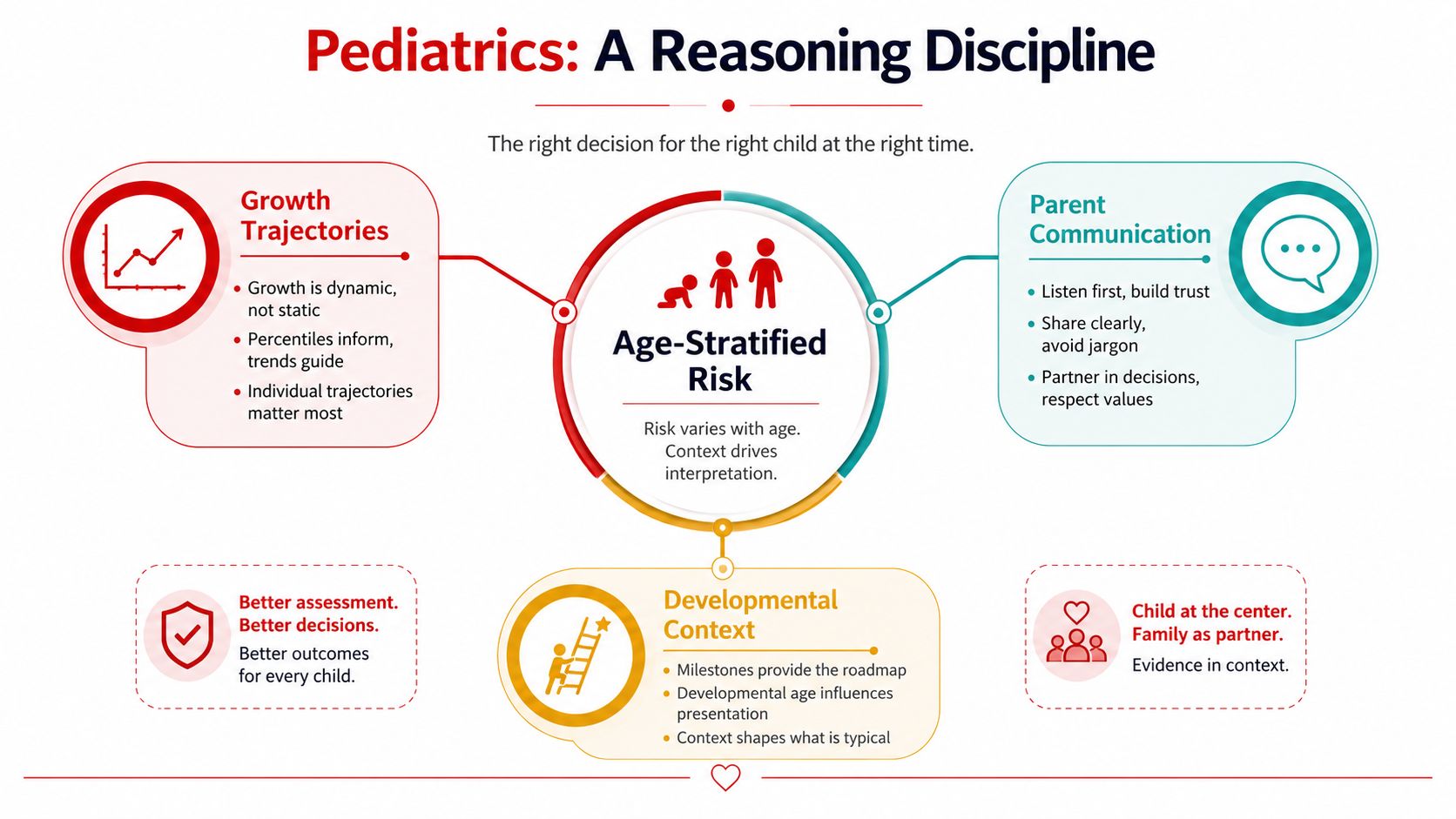
Pediatrics rewards a different habit of mind. Adult medicine often centers on chronic disease management, but pediatrics asks you to notice what changes with developmental age, what belongs in anticipatory guidance, and when the family unit is part of the diagnosis, not just the audience.
The three pillars behind most questions
Start with age. A symptom that is reassuring in a school-age child may be a red flag in a newborn, and the exam writers know that. They build stems around this shift, so the right answer usually depends less on a rare diagnosis and more on whether you recognize the right age band, the right trajectory, and the right level of urgency.
Practical rule: when the stem gives you an age in days, weeks, or months, treat that number like a vital sign.
The second pillar is growth. Pediatrics uses weight trend, length or height, head circumference, and feeding history as diagnostic tools, so students get into trouble when they read a percentile like a static label instead of a moving pattern. The third pillar is communication, because a lot of the test is really asking whether you can give parents clear next steps without missing danger.
If you want a human version of how pediatric work feels day to day, this overview of a day in the life of a pediatrician fits the same lens, because the work is constant sorting, reassurance, and escalation.
What students usually miss on the first pass
The common mistake is trying to force adult defaults onto child cases. Another miss is seeing a developmental variation and calling it pathology too quickly. A third is skipping the counseling sentence in the stem, then losing points on what looked like a straightforward medical question.
That's why pediatrics questions often feel deceptively simple. The right move is usually the one that matches age-stratified risk, not the one that feels most familiar from internal medicine or emergency medicine. Once that pattern clicks, the shelf-style question becomes much more manageable.
Growth, Development, and Preventive Care Foundations
The backbone of pediatric reasoning is the timeline. A child is not judged by a single snapshot, but by where they are now, where they were last visit, and whether the curve makes developmental sense.
Growth curves and the pattern of concern
Growth data only helps if you read it as a trend. A child who is consistently small may be normal for that family, while a child who crosses percentiles unexpectedly needs a broader look at feeding, absorption, chronic illness, and endocrine causes. In practice, this means you should pay more attention to growth velocity than to one isolated percentile.
For early infancy, the evidence base is thin despite the clinical stakes. A 2024 systematic review found very limited high-quality evidence for nutritional interventions in growth faltering under 6 months, so the safer reasoning pattern is to search for reversible causes rather than assume one feeding change will solve everything (systematic review). That framing shows up on exams as a “what do you evaluate next?” stem, not a “what supplement fixes this?” stem.
Milestones and vaccine logic
Developmental questions usually test whether you can match a skill to the correct age band. The table below is a memory scaffold, not a substitute for a full milestone review, but it captures the kind of pattern you're expected to recognize quickly.
| Age | Gross Motor | Fine Motor | Language | Social |
|---|---|---|---|---|
| 2 months | Lifts head briefly | Opens hands more | Coos | Social smile |
| 4 months | Pushes up on arms | Reaches for objects | Laughs, babbles | Enjoys interaction |
| 6 months | Rolls over | Transfers objects | Babbles with consonants | Recognizes caregivers |
| 9 months | Sits without support | Raking grasp | Understands simple words | Stranger anxiety |
| 12 months | Pulls to stand, cruises | Mature pincer emerging | Says simple words | Waves, separation anxiety |
| 18 months | Walks independently | Scribbles | Follows one-step commands | Pretend play |
| 24 months | Runs | Tower of blocks | Two-word phrases | Parallel play |
| 36 months | Pedals tricycle | Copies circle | Three-word sentences | Cooperative play begins |
| 48 months | Hops on one foot | Copies cross | Tells stories | Shares more readily |
| 60 months | Skips | Copies square | Speaks clearly | Plays with peers well |
Vaccines are tested as timing logic, not as rote lists. The most common board pattern is a child who is old enough for a routine vaccine, too young for a live vaccine, or behind schedule and needs catch-up reasoning. If you can track age, immune status, and live-vaccine spacing, you're already ahead of most distractors.
For a useful adjacent lens, the behavioral health integration page is a reminder that preventive care in pediatrics often overlaps with family systems, not just disease prevention.
Growth that stalls, jumps, or crosses unexpectedly is usually more important than growth that is simply low.
Preventive care questions are really counseling questions
A lot of pediatrics stems hide preventive care inside parent counseling. They ask whether you know what to say about feeding, sleep, injury prevention, or what to monitor next. The “best answer” is often the one that gives a clear, age-appropriate next step rather than a dramatic intervention.
That's why the exam keeps returning to milestones and prevention. They're not extra topics, they're the structure of the specialty.
High-Yield Clinical Domains by Age and System
Once the developmental frame is in place, the organ-system content becomes easier to sort. The exam is usually testing whether you can combine age, presentation, and urgency in one pass.
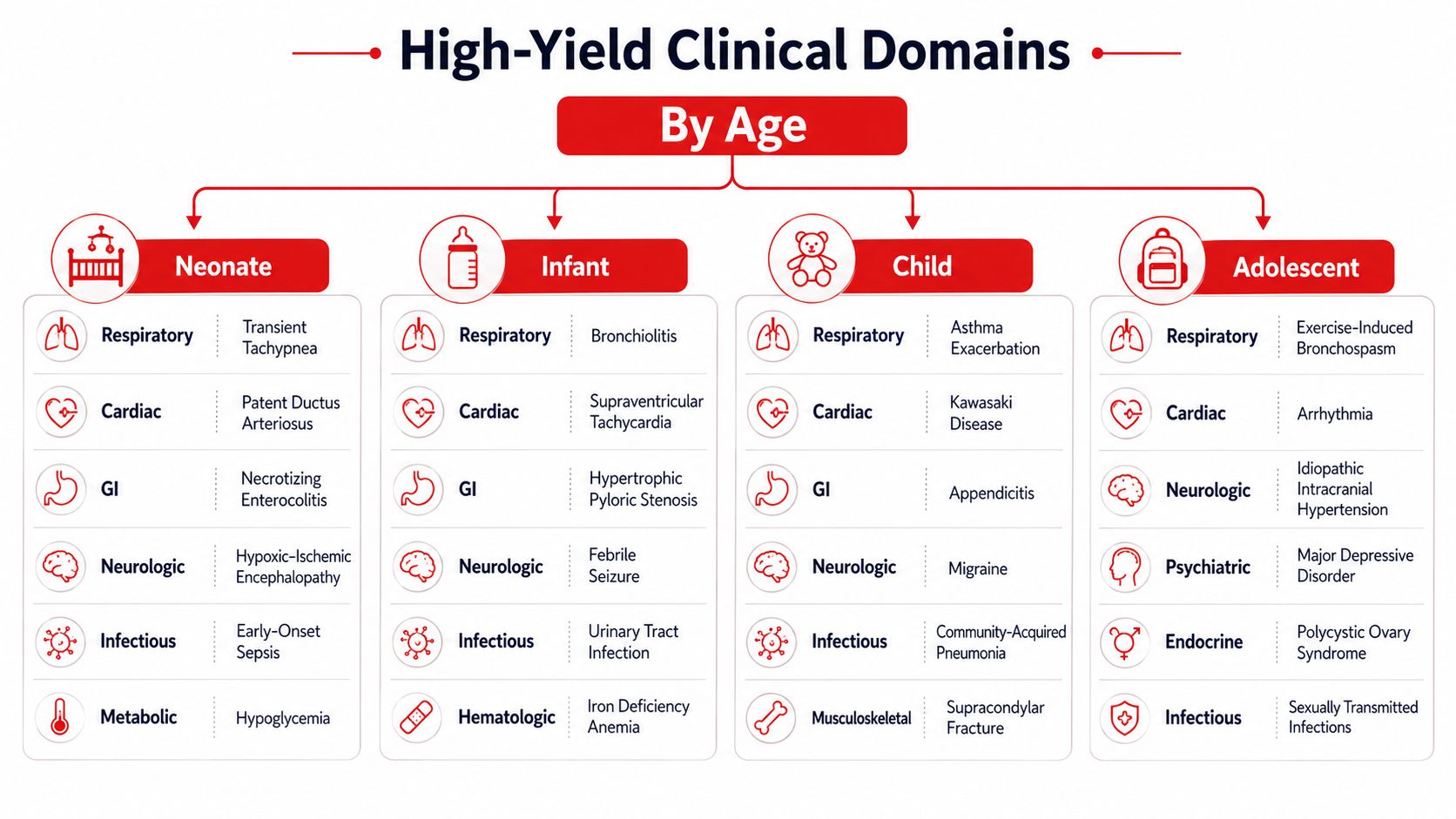
Neonates and young infants
Newborn questions often revolve around adaptation, screening, and early danger recognition. If a baby is struggling with breathing, temperature stability, jaundice, or feeding, the stem is usually trying to get you to think about what is physiologic versus what is time-sensitive pathology. Respiratory distress syndrome, hyperbilirubinemia, and abnormal newborn screening all fit that pattern.
The fever-without-source algorithm is where age matters most. In well-appearing febrile infants 8 to 60 days, the American Academy of Pediatrics uses age bands of 8 to 21 days, 22 to 28 days, and 29 to 60 days, with different testing sets for each group, including urinalysis, blood culture, inflammatory markers, and selective lumbar puncture (AAP infant fever guidance). The board logic is simple, the younger the infant, the lower your threshold for invasive evaluation because the pretest probability of invasive bacterial infection is higher.
Children with fever, rash, or toxic appearance
Older pediatric infectious disease questions often test pattern recognition rather than obscure organisms. Kawasaki disease, meningitis, and bronchiolitis all show up in ways that hinge on how sick the child looks and how long the symptoms have been present. In a febrile child with a rash or mucous membrane findings, the exam wants you to keep inflammatory syndromes on the table, not just common viral illness.
Heart, lungs, and the anatomy clues
Cardiac stems usually split into murmurs and cyanosis. Innocent murmurs are commonly positioned against pathologic ones, while congenital heart disease questions often rely on feeding difficulty, poor weight gain, tachypnea, or differential cyanosis. Respiratory questions do something similar with bronchiolitis, asthma severity, and foreign-body aspiration, where the trick is recognizing whether the child is wheezing from diffuse lower-airway disease or obstructing one airway in a more focal way.
GI and endocrine cases that reward age-based thinking
GI questions are often built around dramatic presentations with a narrow age window. Pyloric stenosis, intussusception, malrotation, and cow's milk protein allergy all present differently depending on whether the baby is vomiting, crying, or failing to thrive. Endocrine questions do the same thing with congenital hypothyroidism, congenital adrenal hyperplasia, and diabetic ketoacidosis, where age, appearance, and dehydration pattern matter as much as the lab value.
For a related procedural topic that often pairs with trauma or burns content, rule of the nines is a useful reminder that pediatric body proportions change how you estimate injury burden.
The easiest way to read these stems is to ask, “What is dangerous at this age?” If you do that first, the rest of the differential usually sorts itself.
Clinical Reasoning Patterns Pediatric Questions Reward
Pediatrics questions are often built from the same four moves, even when the surface story changes. The writer gives you age, growth context, parent report, and one or two exam clues, then waits to see whether you chase the headline or the underlying pattern.
The most common reasoning traps
The first trap is adult-medicine anchoring. A toddler with poor intake is not a small adult with vague abdominal complaints, and a newborn with fever is not a routine outpatient viral syndrome. The second trap is overcalling normal developmental variation as disease, especially when the stem gives you a milestone that is close to, but not exactly, the expected window.
Plain rule: if the stem centers on age in months, think development first, diagnosis second.
The third trap is ignoring communication. Families often provide the clue that changes the answer, especially when the child cannot give a clear history. In pediatrics, the parent report is part of the physical exam in a practical sense, because it tells you what changed, when it changed, and what the child can't yet describe.
A quick stem-to-answer workflow
- Identify age-specific risk. Is this a neonate, young infant, child, or adolescent?
- Check the trajectory. Are weight, feeding, breathing, or behavior getting better, worse, or stuck?
- Use the family story. What are parents worried about, and what did they notice first?
- Sort urgency. Is this likely self-limited, or does this age group require immediate workup?
That sequence matches how exam writers hide the answer. They'll bury the key risk signal in feeding history, sleep changes, or a comment about how long the parent has been “noticing something off.” If you read for trajectory, not just diagnosis labels, you'll avoid the most common misses.
For a broader framework on how to think through stems under time pressure, the clinical reasoning page pairs well with pediatric cases because the same logic applies, just with more age sensitivity. Ace Med Boards can also be one option for structured, one-on-one pediatrics shelf tutoring when you want help turning missed questions into a repeatable decision method.
USMLE, COMLEX, and Shelf Exam Approaches Compared
The same pediatric content appears across exams, but the emphasis changes. If you blur the lines, you end up studying too broadly and missing the platform-specific style that matters on test day.
What each exam tends to emphasize
The NBME Shelf usually tests clerkship-level workflow, triage, and the next best step. USMLE Step 2 CK adds more integrated reasoning, with broader internal medicine overlap, ethics, and decision-making under uncertainty. COMLEX Level 2 CE includes the same clinical core but adds osteopathic framing, musculoskeletal emphasis, and osteopathic manipulative medicine content where relevant.
ACGME-accredited pediatrics residency training in the United States is 36 months long, and the updated requirements that apply to residents entering July 1, 2025 include 16 weeks of inpatient general pediatrics or pediatric hospital medicine, 12 total weeks in intensive care with at least 4 weeks each in NICU and PICU, and 40 weeks of individualized curriculum (ACGME requirements summary, updated rotation structure). That matters for learners because it reflects how pediatrics is tied to inpatient and age-specific decision-making.
Platform comparison for pediatrics study
| Feature | NBME Shelf | USMLE Step 2 CK | COMLEX Level 2 CE |
|---|---|---|---|
| Core emphasis | Clerkship workflow, triage, next step | Integrated reasoning, broader clinical synthesis | Clinical reasoning plus osteopathic content |
| Question feel | Tightly written, practical | Broader stems, more cross-system linkage | Similar clinical core with OMM-related material |
| Pediatrics focus | High-yield inpatient and outpatient presentation patterns | Same content, more cross-disciplinary integration | Same content, plus extra attention to musculoskeletal and OMT-relevant concepts |
| Best study posture | Fast pattern recognition | Broad differential with efficient elimination | Clinical pattern recognition plus osteopathic review |
| Common pitfall | Overthinking simple next-step questions | Missing pediatric age nuance in mixed stems | Underpreparing developmental and vaccine material |
Where resources and tutoring fit
For question banks, UWorld is the core reference point for all three exams, while TrueLearn, COMBANK, and AMBOSS can be useful supplemental tools depending on your platform and weak areas. If you're missing questions because of a content gap that keeps repeating, a tutor can help you build a targeted plan. If you're still early in prep and reviewing misses well on your own, a structured self-study block may be enough.
The cleanest decision rule is this. If your issue is pattern recognition under time pressure, practice blocks and review may solve it. If your issue is that every missed question reveals a different blind spot, a short period of remediation with guided feedback can keep you from spinning your wheels.
Four-Week Study Plan and Question-Review Workflow
A four-week plan works best when it's simple enough to repeat on rotations. You do not need a perfect schedule, you need a schedule you'll follow.
A workable four-week structure
Week 1: Review milestones, growth curves, and immunization schedules, then do 20 timed practice questions daily with full review.
Week 2: Pair one system per day with 30 targeted questions, focusing on neonatology, infectious disease, respiratory, cardiac, GI, and endocrine patterns.
Week 3: Move to mixed timed blocks of 40 questions and track whether your misses cluster by age group or by topic.
Week 4: Take a full-length assessment, then spend the remaining time on weak areas and test strategy.
Review every miss by reason, not by label. “Didn't know the fact” and “knew the fact but missed the age clue” are different problems.
Daily review protocol
- Rewrite the stem in your own words. Strip out the distractors and keep only the age, trajectory, and key symptom.
- Name the failure mode. Was this a knowledge gap, a rushed read, or an age-based reasoning error?
- Write one teaching point. Keep it short enough that you could scan it the night before the exam.
- Tag the age band. Neonate, infant, child, or adolescent, because that's often what changes the answer.
If you're balancing clerkship hours, aim for a realistic block of study time rather than an ideal one. A focused hour with careful review beats a long session where you're too tired to notice why you missed the item.
For a more general study structure that fits clerkship pacing, how to study for shelf exams is a useful companion piece, especially if pediatrics is only one part of your rotation load.
Key Takeaways and Common Pediatric Exam Questions
Key takeaways
- Age is the first diagnostic filter in pediatrics.
- Growth trajectory matters more than one percentile.
- Parents are part of the data stream, especially for behavior, feeding, and symptom timing.
- Older infants often need less invasive workup than neonates, but only if the stem supports that lower-risk pathway.
- Questions reward pattern recognition, not random memorization.
Common questions after a practice block
- Which question bank should I use first? Start with the platform that matches your exam, then add a second bank only if you're missing the same concepts repeatedly.
- How long should remediation take after a bad block? Long enough to fix the pattern behind the miss, not just the single question.
- Is one question bank enough? Sometimes yes, if your review is disciplined and your misses are improving.
- How do I handle COMLEX osteopathic content? Keep the pediatric clinical core strong first, then layer in the osteopathic material instead of trying to learn both from scratch at the end.
If your pediatric misses keep clustering around age-based risk, growth interpretation, or parent communication, Ace Med Boards can help you turn those misses into a cleaner question-review process. Visit Ace Med Boards to explore pediatrics shelf tutoring and set up a focused plan that fits your timeline.