What should a small set of resources for emergency medicine shelf exam prep do? It should map to the official NBME blueprint, close the student's specific gaps, and stay short enough to fit a busy rotation week. For most learners, that means one strong question source, one concise reference or video source, and one official self-assessment used as a readiness check. The exam itself is an end-of-clerkship assessment, not an emergency medicine specialty board, and NBME's published content outline is the best anchor for study choices as of the publication date, especially because format, scoring, fees, and registration policies can change over time NBME Emergency Medicine subject exam content outline.
For students who want one-on-one help turning that outline into a plan, Ace Med Boards offers Emergency Medicine Shelf tutoring and a broader Shelf exam tutoring hub. That support complements official materials, it does not replace them.
The comparison below uses four practical filters, alignment with the official assessment outline, question quality, explanation depth, and cost transparency. Costs and feature details are time-sensitive, so each product page still needs a fresh check before purchase. The point is not to build a huge library. The point is to choose a small, defensible set and use it well.
Key Takeaways
- Start with the blueprint. NBME gives more weight to management, pharmacotherapy, interventions, and stabilization than to simple fact recall NBME Emergency Medicine subject exam content outline.
- Use questions first. Retrieval practice and spaced repetition have the best support for durable learning in the medical-student literature medical-student preparation review.
- Match the resource to the gap. A focused Qbank, a concise reference, and an official self-assessment cover different jobs.
- Keep the set small. Too many tools usually creates scattered review, not better shelf performance.
- Treat tutoring as a guide, not a substitute. A tutor can help organize reasoning, but official materials and practice questions still matter most.
1. Private Shelf Exam Tutoring for NBME and COMAT
Some students do not need more pages to read. They need help seeing why the same answer choice keeps looking right. Private Shelf Exam tutoring for NBME and COMAT preparation fits that problem well, because it slows the reasoning down and turns missed questions into a pattern a student can fix.
Ace Med Boards presents this option as individualized support for medical students preparing for shelf-style exams, including question review, targeted feedback, and study planning. That makes it useful when the issue is not volume, but direction. A tutor can help a student sort through unstable-patient management, disposition, or the next best step, then tie those decisions back to the official shelf exam tutoring resource. It works best when the student brings real misses to the session, because each case becomes a chance to tighten the clinical sequence.
Where it fits best
This option is a good match for a student who already has a question bank and still keeps repeating the same errors. It also helps when the learner knows isolated facts but struggles to connect history, exam findings, testing, and treatment in the right order. Emergency medicine puts a lot of weight on management and intervention, as noted above, so that kind of step-by-step coaching can be especially helpful.
Practical rule: Use tutoring to examine errors, not to replace self-study. A useful session ends with fewer repeat mistakes and a clearer weekly plan.
Strengths
- Personalized planning: The session can focus on one student's gaps instead of a general review.
- Question review: Missed items can be worked through one step at a time.
- Strategy coaching: The student can practice pacing, answer selection, and clinical reasoning.
- Flexible use: It can support both NBME-style and COMAT-style shelf work.
Limitations
- Time and cost commitment: Private instruction usually asks for more than a self-study-only approach.
- Fewer public details: The page does not list session length, tutor credentials, or score guarantees.
- Needs a solid base: Tutoring works best when the student also brings questions, notes, or a weak-area log.
For a learner who feels stuck, this can be the most direct support tool in the set. For a learner who only needs content exposure, a cheaper source may be enough.
2. AMBOSS for a Structured EM Shelf Plan
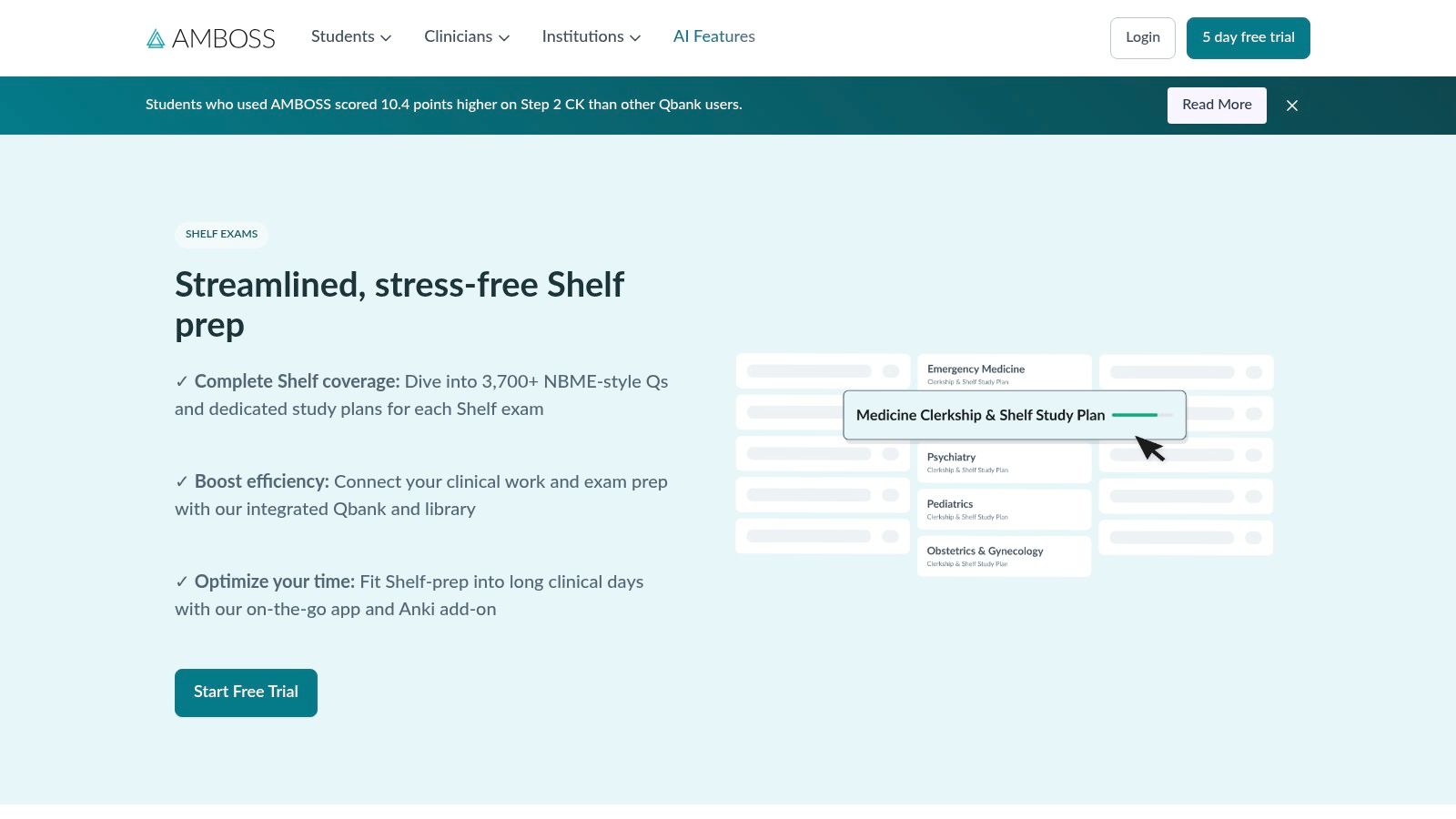
AMBOSS is useful when the main problem is structure. AMBOSS for Step 2 and shelf prep shows how it fits a rotation plan, and the Emergency Medicine shelf page ties that plan to focused review and question practice. For a student who wants a clear path through the rotation, that combination can reduce the guesswork.
Its value is easiest to see in a specific workflow. A student can read a short topic, answer questions on the same topic, then return to the explanation when a miss shows a gap. That works well for common emergency presentations such as chest pain, dyspnea, and toxicology, where the shelf exam often asks the learner to move from symptom to diagnosis to next step. The linked library articles keep that cycle tight, so review does not have to become a separate project.
AMBOSS also works well for students who study in short blocks. A few questions before rounds, then a quick review later in the day, is a realistic rhythm on a busy rotation. The limitation is access. Full Qbank access requires a paid tier, and the monthly Library plan is limited to 50 questions per month AMBOSS pricing, so verify before purchase. That limit makes the platform less attractive for someone who wants a large volume of practice in a short time.
Use it for: building a steady routine, reviewing concepts after questions, and checking details during the rotation.
Best fit for
- Students who want a plan: The study roadmap is already built in.
- Students who like quick explanations: The linked library keeps review compact.
- Students balancing clinical work and study: Web and mobile access make short sessions easier.
- Students who want broader Step 2 CK carryover: The same platform can stay useful later.
Main caution
- Do not use it as passive reading only. The value comes from answering questions, reviewing misses, and then returning to the same concepts later.
- Watch the plan limits. The monthly Library cap matters if the rotation is short or the student is trying to cover many items quickly.
- Verify pricing before buying. Subscription details can change.
For a student who wants one organized home base, AMBOSS can handle a lot of the planning work. It is less useful if the learner wants the largest possible EM-only question set.
3. NBME Clinical Science Mastery Series for a Readiness Check
How close is your current review to the shelf exam? The NBME self-assessment is the clearest official checkpoint for answering that question. It is not a replacement for a question bank. It shows where your knowledge is steady, where your reasoning breaks down, and where the last round of review still needs attention. NBME reports performance with equated percent-correct scores on a familiar 0 to 100 percent scale.
For emergency medicine shelf prep, this tool fits best near the end of the study period. It can show whether you are balancing management decisions, diagnosis, and the smaller foundational science portion in the right proportion. That makes it more informative than informal self-review alone, because the questions come from the same organization that writes the subject exam.
Use it after some question practice, not before it. The form is short compared with a full bank, so it works like a checkpoint on a route rather than the route itself. The NBME Clinical Science Mastery Series, Emergency Medicine is the closest thing to an official dress rehearsal, and the NBME Emergency Medicine subject exam content outline helps you see the topic mix it is trying to reflect.
How to use it well
Take the form under timed conditions. Then sort each miss into one of three buckets, content gap, reasoning error, or pacing problem. That simple split usually tells you whether to review more material, redo questions, or slow down and change your approach.
A second pass helps too. Review the questions you got right and ask whether the answer came from solid knowledge or from a lucky guess. If the latter shows up often, your score may look steadier than your actual understanding.
Strengths
- Official style: The questions feel closer to the exam than most informal practice.
- Late-stage feedback: It shows whether the current study plan is working.
- Pacing practice: It helps you feel the time pressure in a controlled setting.
- Content feedback: Misses can guide the final review list.
Limitations
- Limited length: It should not be the only practice source.
- Brief explanations: Commercial banks usually explain more.
- Best used later: It works better as a checkpoint than a starting tool.
This is the resource for the question, “Am I ready to tighten my review?” That is more useful than guessing readiness from confidence alone.
4. SAEM CDEM Curriculum and SAEMTests for Core Clerkship Content
SAEM's Clerkship Directors in Emergency Medicine curriculum is a strong anchor for a student who wants an organized review of core emergency medicine topics. It fits well alongside medical student clerkship support because both aim to help students see what clerkship-level learning should cover. The curriculum is built for medical students, and SAEM also separates its M3 and M4 exam structures, which helps clarify the expected depth.
The better use case is a learner who wants a formal framework, not a loose reading list. The modules, cases, and primers help build a map for triage, resuscitation, and common presentations. That matters most when rotation materials are thin or bedside exposure is uneven, because the student still needs a reliable outline to follow.
SAEMTests can add a question layer, although access is often arranged through the student's institution. That makes it less predictable than a commercial Qbank. It also means the student may need to ask the clerkship office or course director whether the school already has access. The SAEM student exams and curriculum resources described above help show the level of depth expected, while SAEMTests gives a way to check whether that material is sticking.
Good use case: Learn the core framework first, then use questions to test it.
Strengths
- Core clerkship alignment: The material is built for student-level emergency medicine training.
- Free curriculum access: The modules and primers can reduce cost pressure.
- Clear academic tone: It suits students who want a structured, reputable source.
- Institutional relevance: Some schools already use or reference it.
Limitations
- Not a full Qbank: It is not enough by itself for shelf practice.
- Access can vary: SAEMTests may depend on the school.
- Fewer timed practice items: Students still need additional question work.
A practical weekly workflow is simple. Start with a curriculum module to cover the topic, read the related primer to fill the gap you noticed, then use SAEMTests or another question source to check whether the concept holds under pressure. That sequence works like a checklist. First, learn the structure. Then, spot the weak point. Finally, test it again.
5. UWorld Step 2 CK for Broad Clinical Question Practice
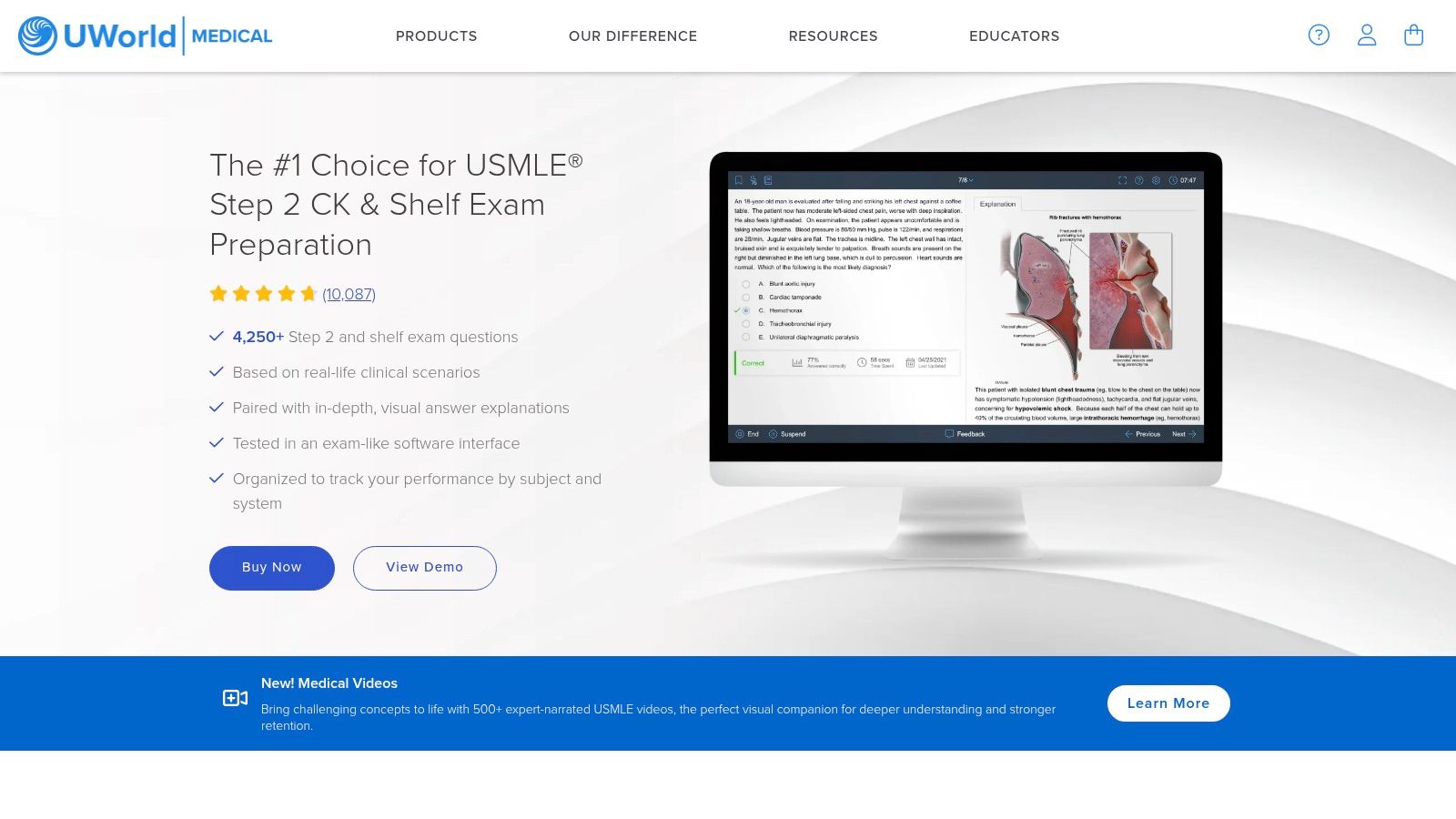
A broad Qbank can still serve an emergency medicine shelf exam well if you use it with a clear filter. UWorld is not specific to emergency medicine, but its breadth and explanations help students work through the kinds of decisions that show up on the shelf. It also gives you a resource that remains useful for Step 2 CK later UWorld Step 2 CK. For filtering tips, see how to use UWorld Step 2 CK for shelf prep.
The main strength is not topic labels alone. It is the way UWorld makes you explain why one diagnosis, treatment, or disposition fits better than another. That matters for the shelf, where the task is often to choose the next best step in acute care rather than to recall isolated facts.
Focus matters here. A student who opens every block at random can end up spending time on material that does little for emergency medicine. A student who filters for acute care, unstable presentations, and management questions gets a much better return. Used that way, UWorld works like a broad map with the useful roads highlighted.
The best fit is a learner who already knows how to review questions carefully and wants detailed explanations after each set. The less useful fit is a student who wants only EM-specific items and does not want to sort through the larger bank.
Useful way to use it
- Filter by relevant topics: Keep the blocks tied to acute care, management, and unstable presentations.
- Run timed blocks: Shelf exams reward pace, not unlimited reflection.
- Review explanations fully: Pay attention to differential diagnosis, first-line treatment, and disposition.
- Track misses by theme: Watch for repeated errors in workup or management decisions.
Strengths
- Large question pool: Good for repetition and volume.
- Detailed explanations: Helps with reasoning, not just recall.
- Flexible block design: Timed and tutor modes make it adaptable.
- Longer-term value: It still matters after the rotation ends.
Limitations
- Not EM-specific: Filtering takes discipline.
- Subscription cost varies: The exact price depends on the plan.
- Less targeted than a focused EM bank: You have to do more curation.
For many learners, UWorld works best as the main question engine, with an EM-focused source used to fill the specialty gaps.
6. Blueprint Prep Emergency Medicine Shelf Qbank for Focused EM Practice
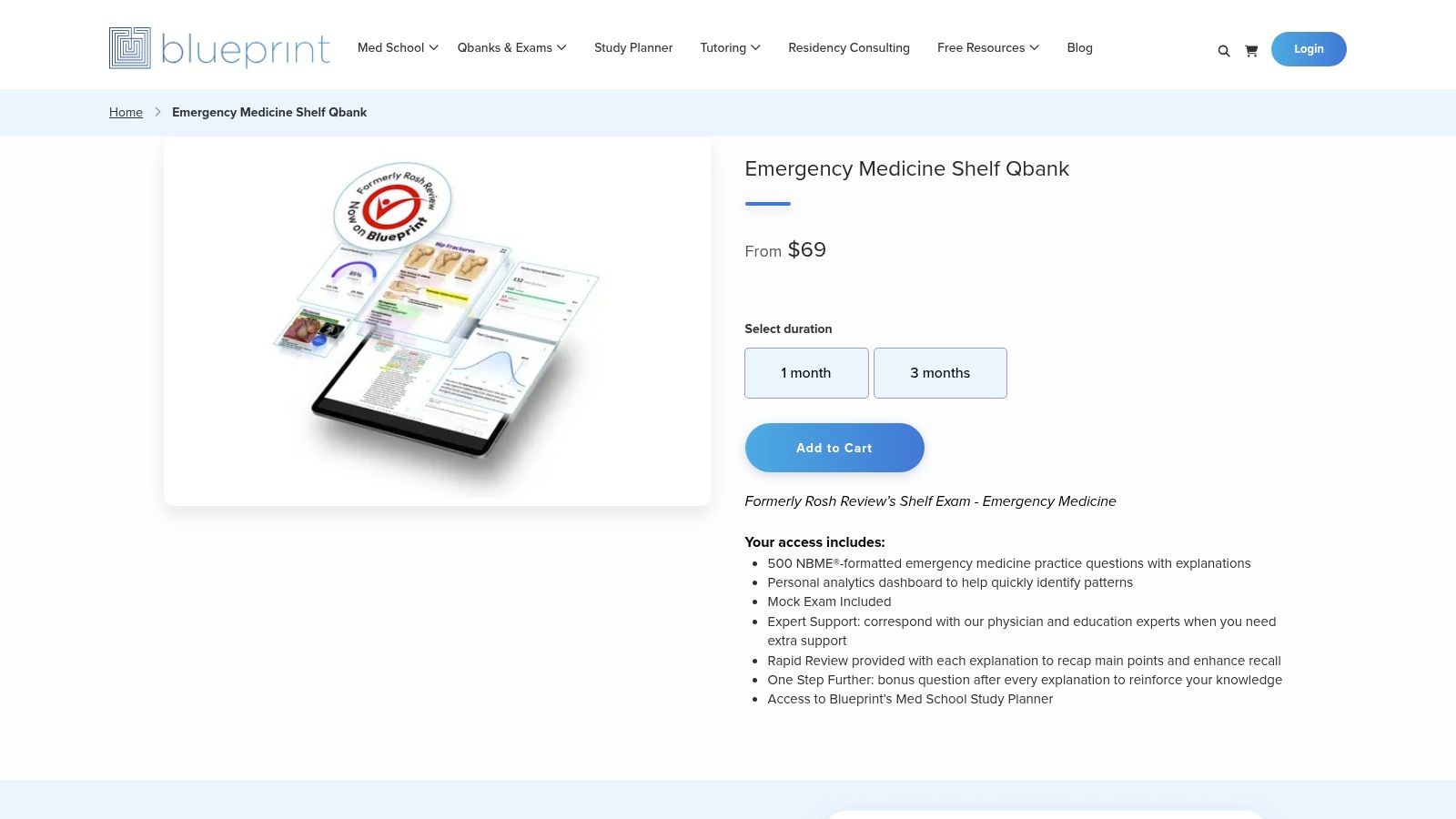
Blueprint Prep's EM Shelf Qbank is narrower than an all-purpose bank, which is often a strength for a short rotation. Its dedicated EM scope makes it easier to stay inside the shelf blueprint without extra filtering. The product page is the right place to verify current pricing and trial details, since these can change.
This option is best for a student who wants a focused set of NBME-formatted questions rather than a huge library. The mock shelf exam and performance analytics make it easier to see where the student keeps slipping. That is useful when the weak point is not knowledge alone, but the pattern of decisions made under time pressure.
Because the bank is smaller, it works better as a concentrated practice set than as the student's only source of exposure. It is especially handy when paired with an official self-assessment and a concise reference.
Best fit: short rotations, focused drilling, and students who already know they need more EM-specific practice.
Strengths
- Emergency medicine focus: Less distraction from unrelated topics.
- NBME-style format: Helps students get used to the shelf rhythm.
- Mock exam option: Good for a late-stage practice pass.
- Analytics: Makes missed patterns easier to see.
Limitations
- Smaller question pool: There is less total volume than broader banks.
- May need a companion resource: Many students will still want a video or concise text source.
- Pricing should be checked directly: Current options can change.
This kind of resource is most helpful when the student wants to sharpen a specific shelf skill set, not just accumulate more questions.
7. OnlineMedEd for a Video-First Study Structure
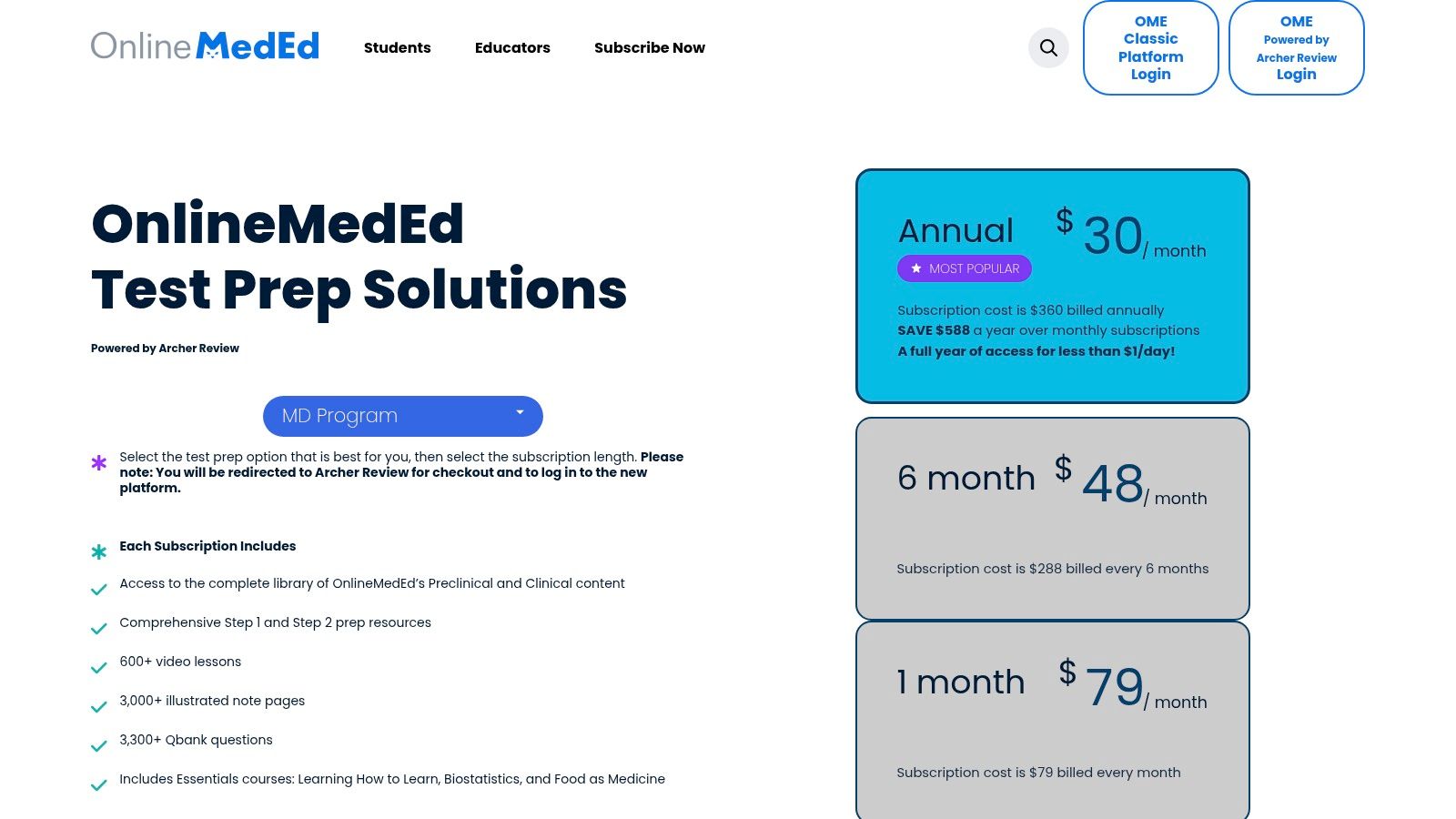
Some students do not need more questions first. They need a better way to organize the content before they return to questions. OnlineMedEd is useful for that, because the rotation roadmaps and concise videos give the student a clean structure for studying around clinical work OnlineMedEd free trial.
It is a strong companion source, not a standalone shelf plan. The videos help with common emergency presentations and clerkship-level thinking, but they do not replace a question bank. That limitation matters. Shelf exams test choices under uncertainty, not just recognition of a diagnosis.
For students who like short teaching blocks, this can be a low-friction way to build the first layer of understanding. It is especially useful early in the rotation or on days when the student is too tired for a long question set.
Strengths
- Clear structure: The roadmaps help turn scattered topics into a plan.
- Video format: Good for learners who absorb content better by watching first.
- Rotation-friendly: Easier to fit around clinical hours.
- Good companion tool: Works well alongside questions.
Limitations
- Less practice volume: It is not built for heavy question drilling.
- Variable pricing: Subscription details depend on the plan or institution.
- Needs pairing: Students still need NBME-style questions for shelf readiness.
A student who feels overwhelmed by the volume of emergency medicine material may benefit from this kind of guided start. The video layer can make the next question block much more useful.
8. EM Clerkship Podcast for Repetition During Low-Study Time
Audio fits the days when study time is broken into small pieces. The EM Clerkship Podcast gives a student a way to review common emergency medicine presentations, rotation guidance, and exam habits while commuting or doing routine tasks EM Clerkship Podcast.
Use the podcast to rehearse chief-complaint scripts for chest pain, dyspnea, and abdominal pain, then test those scripts in a timed Qbank block the same day. That pairing matters because the podcast supports recall, while the shelf exam still asks for fast choices under pressure.
The content works like a quick mental rehearsal. A student can listen between shifts, keep the framing of common complaints fresh, and return to questions with a clearer starting point. That makes it useful for the knowledge gap between full study blocks and active practice.
Plain rule: If the resource does not force answer selection, it should support shelf prep, not carry it.
Strengths
- Free access: Easy to start.
- Convenient format: Useful during commutes or low-energy time.
- Student-centered topics: Focuses on rotation-level concerns and common presentations.
- Good reinforcement tool: Helps repeat core ideas without rereading a long chapter.
Limitations
- Not a primary question source: Audio alone will not prepare a student for the shelf.
- Depth varies by episode: Some topics will be covered more fully than others.
- No built-in analytics: It does not show readiness.
For low-study windows, this resource keeps the material warm without asking for a full sit-down session. It works best as a repeatable audio layer, then the EM Clerkship Podcast site can sit in the background of a broader question-based plan.
9. Case Files Emergency Medicine for Short Case-Based Review
Case Files Emergency Medicine works well when the student wants a compact case format. Its 60 cases create a natural bridge between reading and shelf-style thinking, because each case pushes the learner to move from presentation to diagnosis and management in a short format Case Files: Emergency Medicine, 5th edition.
The strongest use is not volume. It is pattern recognition. A student can read a few cases between shifts, then use the clinical pearls and questions to reinforce how emergency medicine cases are framed. That makes it a practical supplement for learners who prefer short sessions.
It is not a substitute for a full Qbank. The case-based format helps the student think, but shelf exams still require a lot of timed decision-making. That means this source works best after the first layer of question practice is already in motion.
Strengths
- Case-based learning: Matches the style of many EM shelf vignettes.
- Short sessions: Good for quick review when time is tight.
- Clinical pearls: Helpful for retaining the key point of each case.
- Portable formats: Works in print or electronically.
Limitations
- Not enough on its own: A full question bank is still needed.
- Less exam-like analytics: It does not track performance the way online banks can.
- Better as reinforcement: Not the first choice for primary shelf prep.
For a student who likes reading through concrete cases instead of dense chapters, this is a sensible second layer.
10. PreTest Emergency Medicine for Offline Question Practice
PreTest Emergency Medicine is a classic question book for students who want portable practice. The print and eBook formats make it easy to use away from a laptop, and the question set gives EM-specific practice without requiring an online subscription PreTest Emergency Medicine, 5th edition.
Its value is straightforward. It gives the student another place to answer questions, see explanations, and review common EM topics in a compact format. That makes it useful for travel days, breaks, or any time the student wants low-friction review.
The tradeoff is also straightforward. The question style may feel less NBME-exact than a modern online bank, and there is no built-in analytics dashboard. So the student gets portability, but not the same level of progress tracking.
Strengths
- Large EM-specific set: Good for extra practice.
- Offline access: Helpful when internet access is limited.
- Simple format: Easy to pick up between shifts.
- Useful companion: It can sit beside a larger online bank.
Limitations
- Less analytics: Miss patterns must be tracked manually.
- Question style may feel older: It may not match the shelf as closely as NBME-style tools.
- Best as extra practice: Not the only resource to rely on.
This kind of book helps when the student wants more repetition without more screen time. It is a practical add-on, not the whole plan.
Top 10 Emergency Medicine Shelf Exam Resources: Side-by-Side Comparison
| Resource | Format and Focus | Standout Value | Best For | Price and Access |
|---|---|---|---|---|
| Ace Med Boards Private Shelf Exam Tutoring | One-on-one NBME/COMAT tutoring with a personalized study plan and question review | Tailored feedback on clinical reasoning and test-taking strategy | Students seeking individualized guidance | Pricing not provided; free consultation available |
| AMBOSS Shelf Plan and Qbank | EM study plan, question bank, and linked medical-library articles | Structured study with explanations, performance dashboards, and mobile access | Students wanting an organized plan plus reference tools | Paid Qbank tier; Library plan includes 50 questions monthly |
| NBME Clinical Science Mastery Series: Emergency Medicine | Official self-assessments; 50 questions per form with score feedback | NBME-style readiness benchmark and content feedback | Students checking exam readiness or identifying gaps | Forms sold individually; online access year-round |
| SAEM CDEM Curriculum and SAEMTests | Free EM clerkship modules, cases, and primers; institution-managed testing platform | Reputable content aligned with clerkship objectives | M3/M4 students seeking free core content | CDEM modules are free; SAEMTests access typically through school |
| UWorld Step 2 CK QBank | Large clinical question bank with explanations, filters, and custom blocks | Extensive practice that also supports Step 2 CK preparation | Students wanting broad question practice and detailed explanations | Subscription pricing varies by duration |
| Blueprint Prep Emergency Medicine Shelf Qbank | 500 EM questions, mock exam, and performance analytics | Focused Shelf practice with a mock exam | Students seeking an EM-specific Qbank | Listed from $69; free trial noted; check current options |
| OnlineMedEd (OME) | Rotation-focused videos, notes, checklists, and study roadmaps | Guided, video-first study structure | Students who prefer concise videos and organized schedules | Subscription or institutional access; free trial noted |
| EM Clerkship Podcast | Free audio episodes on EM presentations, rotations, and exam preparation | Convenient reinforcement for commutes and downtime | Students who learn well through audio | Free on major podcast platforms |
| Case Files: Emergency Medicine, 5th Edition | 60 case-based reviews with questions and clinical pearls | Concise case practice that supports pattern recognition | Students wanting focused vignette review | Print and electronic formats; price not provided |
| PreTest: Emergency Medicine, 5th Edition | 500 EM questions with explanations in print and eBook formats | Large, portable question set for offline practice | Students seeking additional EM-specific questions | Print and eBook; price not provided |
Turning Your Gap Audit Into a Short Shelf Review Plan
The right shelf plan starts with a gap audit, not with collecting more resources. If the main weakness is management and next-step decisions, a focused question bank plus official NBME practice should be the backbone, because the blueprint gives that domain the largest share of the test NBME Emergency Medicine subject exam content outline. If the weakness is content organization, a concise video or curriculum source can help make the questions make sense. If the weakness is reasoning under pressure, tutoring can help a student slow down the logic and clean up repeated errors.
A simple final-week workflow usually works better than a long list of tools. First, do a timed block from one primary question source. Second, review misses and turn recurring errors into a short note set or spaced-repetition prompts. Third, use one concise reference source for the weak areas only. Fourth, take one official NBME self-assessment under timed conditions and sort every miss into content, reasoning, or pacing. That is the cleanest way to see whether the student needs more knowledge, more repetition, or more control of time.
A student who is short on confidence should not assume that more reading will fix the problem. The official exam still rewards active reasoning. The best fit is usually one question bank, one concise reference or video source, and one official self-assessment, used in a disciplined loop.
That is also where tutoring can help. A good session can translate the gap audit into a weekly plan, especially when the student feels clinically underprepared or has limited emergency department exposure. It supports the process, but it does not replace official materials or independent work. No resource guarantees a particular shelf score.
For students who want help interpreting a gap audit or choosing between a question-heavy plan and a more guided plan, Ace Med Boards offers emergency medicine shelf tutoring through a free consultation model. It is a low-pressure way to talk through weak areas and decide whether one-on-one support would be useful.
Sources
- NBME Emergency Medicine subject exam content outline
- NBME Clinical Science Mastery Series
- SAEM CDEM student resources
- EM Clerkship Podcast
- Emergency medicine clerkship and rotation guidance from SAEM
- NBOME Emergency Medicine COMAT assessment overview
Prices, formats, and access rules are time-sensitive. Product pages and official organization pages should be checked again before purchase or use, and any final publication should receive qualified editorial review.
Ace Med Boards helps medical students build a tighter, more focused plan for the emergency medicine shelf exam. If the question set is already in place but the weak spots still feel scattered, visit Ace Med Boards to explore tutoring that can help organize the plan, review missed questions, and narrow the next study step.