

The MCAT score range is 118 to 132 for each section and 472 to 528 overall. A total score of 500 is the midpoint of the scale, not a passing score or a universal admissions cutoff.
That distinction matters when you receive a practice score. Your number tells you where you sit on a standardized scale, but it doesn't decide whether you're ready to test or whether a medical school will consider your application. To interpret it responsibly, you need to examine the total, each section score, the current percentile table, and the rest of your academic profile.
The Association of American Medical Colleges, or AAMC, updates percentile ranks using recent examinee data. The current interpretation therefore depends on the testing cycle, while admissions committees consider the MCAT alongside GPA, experiences, essays, mission fit, and other application elements.
What the MCAT Score Range Actually Means
The Medical College Admission Test, or MCAT, has four scored sections:
- Chemical and Physical Foundations of Biological Systems
- Critical Analysis and Reasoning Skills, or CARS
- Biological and Biochemical Foundations of Living Systems
- Psychological, Social, and Biological Foundations of Behavior
Each section receives a whole-number score from 118 through 132. The four section scores are added together, creating a total score from 472 through 528. The AAMC describes 125 as the midpoint for an individual section and 500 as the midpoint for the total exam. You can review the official structure in the AAMC explanation of the MCAT score scale.
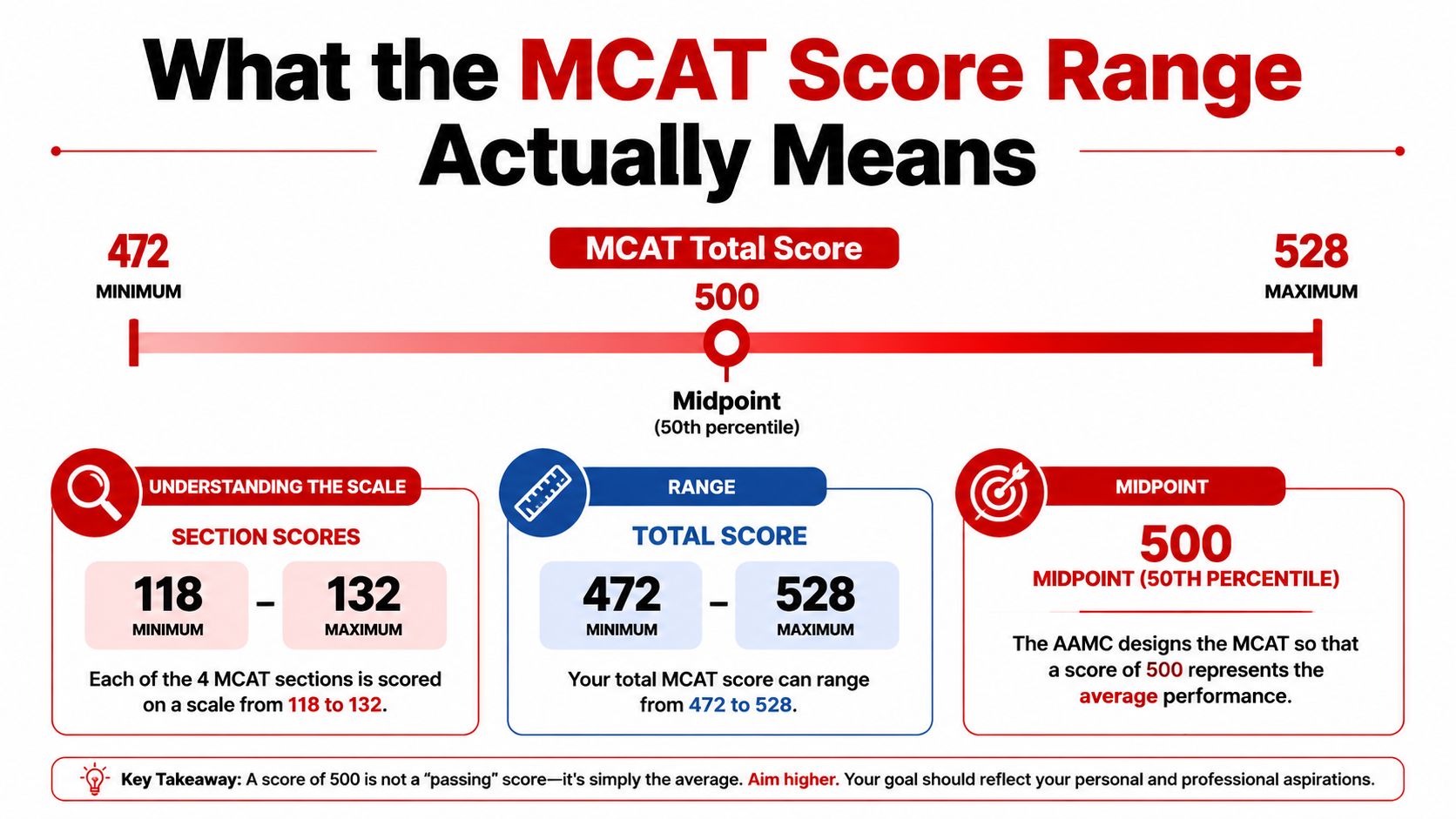
A 500 doesn't mean you passed, because the MCAT doesn't use a pass-or-fail standard. It means your performance is located around the midpoint of the standardized scale. Likewise, a section score of 125 isn't automatically strong or weak. Its meaning depends on the current percentile distribution and the way a school evaluates applicants.
Why the total score can be misleading
Every section contributes equally to the total. A profile of 127, 125, 124, and 124 produces the same total as 125, 125, 125, and 125, but admissions readers may notice the different patterns. The total summarizes performance, while the section profile shows where that performance came from.
The scale is deliberately narrow. There are 15 possible scores per section and 57 possible total scores, according to the AAMC's score-scale description. The exam isn't curved against the students testing on the same day. Instead, the AAMC scales and equates administrations so a given score retains the same intended meaning across test dates, as explained in its MCAT score guidance.
Practical rule: Treat 500 as a reference point, not a target that automatically makes an application ready. Your target should reflect your schools, academic record, timing, and practice-test stability.
How MCAT Percentiles Connect to the Score Range
A percentile rank tells you how your score compares with the recent reference group. The AAMC refreshes its percentile table using examinees from the latest three testing years. The table in effect from May 1, 2025, through April 30, 2026 uses examinee data from 2023, 2024, and 2025, as described in the AAMC percentile-rank guidance.
The curve is not linear. A one-point change near the midpoint may move you only slightly within the distribution, while a one-point change in a high-scoring band can represent a much larger percentile movement. AAMC score-report materials place 500 near the middle, with 501 at about the 49th percentile, while the official table places 510 around the 79th percentile, 515 around the 91st percentile, and 528 at the 100th percentile. Those reference points appear in the AAMC percentile table.
| MCAT Total Score | Approximate Percentile Rank |
|---|---|
| 500 | Near the middle of the current scale |
| 501 | About the 49th percentile |
| 510 | Around the 79th percentile |
| 515 | About the 91st percentile |
| 528 | 100th percentile |
This is why the difference between a 510 and 515 deserves more attention than the five-point gap might suggest. The percentile change is substantial because scores are more compressed toward the upper end. A strong student deciding whether to invest in another preparation cycle should evaluate the likely value of a targeted improvement, not just count points.
Percentiles change, but the score scale doesn't
The total range remains 472 to 528, but the reference group used to calculate percentiles is updated. A score should therefore be interpreted with the current AAMC table rather than an old chart copied from a preparation website.
For a practical explanation of how individual sections combine into the total, see this MCAT total score guide. Use the current AAMC table when reviewing an official score report, especially if you're comparing information from different application cycles.
Competitive Score Bands for MD, DO, and Top Schools
A score band is more useful than a rigid cutoff, but it still isn't an admissions promise. The AAMC's 2025 FACTS table reports a mean total MCAT of 506.3 for recent U.S. medical school applicants, which places the applicant pool's average above the formal midpoint. The AAMC applicant and matriculant data also show why applicants should consider MCAT performance together with GPA and the broader application.
The following bands are planning guides, not universal thresholds. A student's state residency, GPA trend, clinical exposure, service record, school mission, and application timing can change how a score is viewed.
| Applicant Goal | Approximate Competitive Score Range | Recent Average or Median |
|---|---|---|
| Many DO programs | 505 to 508 | Varies by school and cycle |
| Broad MD applicant strategy | 510 to 514 | Applicant-pool context matters |
| Highly selective research programs | 515 to 519 | Strong score band, not a guarantee |
| Exceptional score positioning | 520 or higher | Near the upper end of the distribution |
A 505 to 508 can support a thoughtful osteopathic, or DO, school list and may be workable for some MD programs, depending on the entire application. A 510 to 514 generally places an applicant in a stronger position across many MD conversations, but “competitive” doesn't mean every school is realistic. A 515 to 519 can strengthen an application to highly selective research institutions, while 520 or higher indicates very high positioning within the score distribution.
Use averages as context, not permission or prohibition
An average describes a group. It doesn't establish the lowest acceptable score or predict an individual result. A score below a school's reported average may still be considered, particularly when the applicant's academic record and experiences fit the institution's mission. A score above an average also won't compensate automatically for weaknesses elsewhere.
Before changing your school list, compare your score with each institution's current class profile and published information. The guide to what counts as a good MCAT score can help organize that comparison, but school-specific information should remain the deciding reference.
How Admissions Committees Read a Score Profile
A total MCAT score is only one part of the report. Admissions readers also see four section scores, so the same total can represent different academic profiles. For example, a 510 may come from four closely grouped sections or from strong science scores paired with a noticeably lower CARS score.
Schools may use the MCAT as an early academic-readiness screen, but their process varies. Some emphasize a total-score range. Others examine section performance, repeat attempts, GPA trends, or fit with the institution's mission. No universal rule says that a particular CARS difference automatically leads to rejection.
Read each section as evidence, not as a verdict
Each section provides different evidence. CARS measures reading and reasoning with unfamiliar passages. The science and behavioral-science sections combine foundational knowledge with interpretation and application. A lower section can reflect a content gap, difficulty reasoning through passages, pacing, or an unusual test-day disruption.
Section percentiles also help explain why a score's meaning changes across the scale. In the Biological and Biochemical Foundations of Living Systems section, 125 corresponds to the 50th percentile and 132 to the 100th percentile in the official AAMC section percentile table. Near the upper end, a small section-score increase can represent a meaningful change in relative standing because the distribution is compressed.
| Program Type | CARS Emphasis | Science Sections Emphasis | Typical Threshold Approach |
|---|---|---|---|
| Mission-focused MD program | May review CARS alongside the total | May value sections connected to institutional priorities | Customized and school-specific |
| Research-intensive MD program | Usually considered within the full profile | Strong science preparation may receive close review | Competitive pool comparison |
| DO program | Interpreted with the total and academic record | Balance and readiness remain relevant | School-specific, comprehensive review |
| International applicant strategy | Considered with transcript context and school policy | May require careful academic interpretation | Highly dependent on institution |
The table is a guide, not a set of admissions rules. A mission-focused program may interpret the same section pattern differently from a research-intensive school, while a DO program may weigh the score alongside academic history and readiness. International applicants also face institution-specific policies about transcript interpretation.
A high total does not erase a weak academic record, and an uneven section does not automatically end an application. Compare the complete score profile with each school's published class information, mission, and applicant expectations. The useful question is whether the pattern supports your selected schools and whether a retake is likely to strengthen the application without introducing another risk.
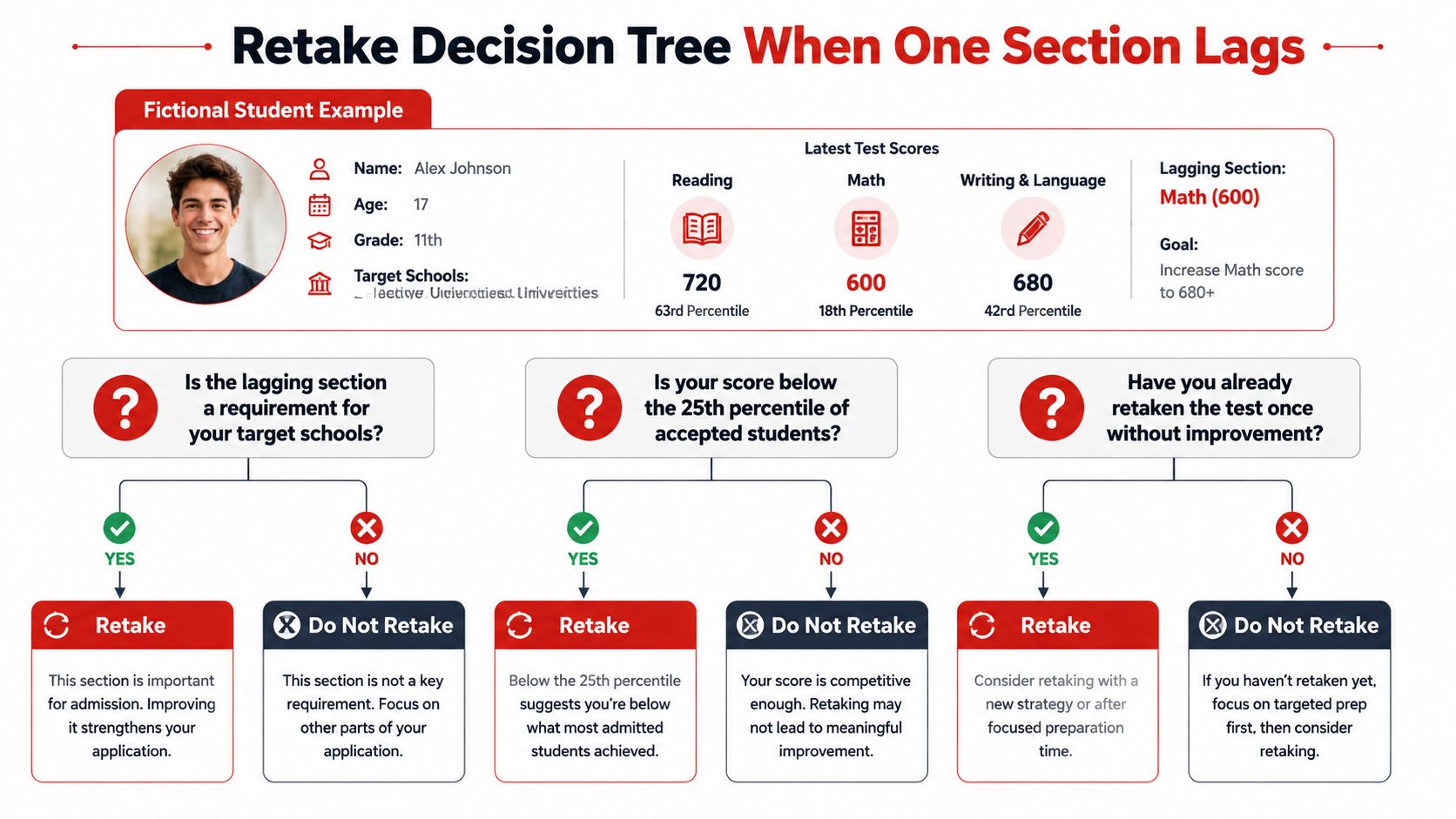
Retake Decision Tree When One Section Lags
Consider this clearly labeled composite hypothetical, not a real student: Maya earns a total in her target band, but one section sits below the midpoint while the other sections are stronger. She shouldn't decide based on anxiety alone. She should audit the score and the circumstances that produced it.
Start with three questions:
- Is the lagging section below 125? The AAMC identifies 125 as the midpoint of the section scale.
- Is the section an outlier by two or more points? A larger spread deserves closer review than a one-point difference.
- What caused the result? Separate content gaps from timing, passage interpretation, stamina, or test-day conditions.
Three possible branches
- Small imbalance and a competitive total: If the lower section is close to the others and the total fits the intended school list, applying without a retake may be reasonable. Use the rest of the application to provide context rather than retaking automatically.
- Clear section weakness with a strong total: If one section is below 125 and practice review identifies a fixable cause, a focused retake can make sense after dedicated preparation. The goal should be a demonstrated improvement plan, not just taking the exam again.
- Total below the applicant's working target: If the overall result is below 506, a thorough reassessment is generally more appropriate than studying only one section. The AAMC's reported applicant mean of 506.3 provides context for that planning decision, but it isn't a universal cutoff.
On test day, the AAMC provides a score-preview process that allows examinees to decide whether to have the score reported or void it. Verify the current terms directly with the AAMC before testing, because registration and score-reporting policies can change. For readers evaluating a lower result, this low MCAT score resource offers another framework for considering repair, retesting, or school-list strategy.
A short video can provide a visual overview of the decision process:
Moving From Your Current Band to the Next
The strategy that helps a student move from one band to another depends on the type of error, not just the total score. A student near 500 may need broad content repair and better endurance. Someone near 514 may already know most tested material and lose points through imprecise passage reasoning or avoidable mistakes.
| Current Band | Primary Focus | Secondary Focus | Practice Test Cadence |
|---|---|---|---|
| 500 to 505 | Repair weak content categories | Build timing and endurance | Regularly enough to evaluate stamina and trends |
| 506 to 510 | Analyze question-type errors | Refine CARS reasoning and behavioral-science discretes | Use full-lengths as checkpoints, not daily drills |
| 511 to 514 | Eliminate careless and timing errors | Strengthen precision in CARS and science passages | Space exams to preserve deep review |
| 515 or higher | Maintain consistency | Address small section imbalances | Prioritize stable performance over constant testing |
For the 500 to 505 band, begin with the AAMC content outline and identify recurring gaps across all four sections. Review every full-length exam for both missed questions and correct guesses, because a correct answer reached through weak reasoning may not remain reliable.
In the 506 to 510 band, categorize mistakes by question type. CARS review should ask why a passage supports one interpretation over another. Psychology and sociology review should distinguish vocabulary gaps from errors interpreting study design or behavioral evidence.
At 511 to 514, improvement often comes from precision. Track careless arithmetic, premature answer selection, overlooked qualifiers, and pacing decisions. Students above 515 usually benefit more from consistency and targeted imbalance repair than from collecting more disconnected content facts.
A useful progress system should measure reasoning quality, not just the number of questions completed. This resource on avoiding shallow tracking metrics can help you build a review process that captures why performance changes. For a structured score-improvement framework, see how to improve your MCAT score.
Next Steps and How Targeted Support Can Help
Start with your official AAMC score report, not a memory of the test-day experience. Record the total, each section score, and the corresponding current percentile information. Then compare the profile with the schools you may apply to, using each school's published class data and mission rather than a generic internet cutoff.
A useful audit can fit on one page:
- Mark the profile: Write the total and four section scores.
- Locate the limiting section: Identify the score that most weakens the overall profile or conflicts with a target school's stated expectations.
- Name the cause: Label each recurring problem as content, passage reasoning, timing, stamina, careless error, or test-day condition.
- Choose the response: Decide whether to apply, postpone, retake broadly, or retake with a narrow section-focused plan.
- Set a reassessment point: Use new practice evidence before committing to a test date.
Match the response to the score band
Students below 500 may need to rebuild foundational content using the AAMC topic outlines before emphasizing speed. Students in the 500 to 507 range often benefit from timed passage work paired with a detailed error log. Those in the 508 to 514 range can sharpen CARS reasoning and high-yield science-passage interpretation, while students at 515 or higher may need endurance work and small section adjustments rather than a complete restart.
Don't treat a practice score as a final identity. Treat it as diagnostic evidence. A single result can reveal a problem, but repeated results and careful review help determine whether the problem is stable, fixable, or caused by testing conditions.
One-on-one guidance can complement official AAMC materials, independent review, and a question bank. Ace Med Boards offers one-on-one tutoring benefits as part of a broader decision process, including score-range analysis, weakness mapping, and personalized study-plan support. Any tutoring plan should remain specific to your schedule, academic foundation, practice data, and application goals, and no provider can guarantee admission or a particular score.
Key takeaways
- The MCAT has 118 to 132 section scores and a 472 to 528 total range.
- 500 is the midpoint, not a pass mark or universal admissions cutoff.
- Current AAMC percentiles place 501 near the 49th percentile, 510 around the 79th, 515 about the 91st, and 528 at the 100th.
- A retake decision should consider the total, section imbalance, cause of the weakness, practice evidence, and school list.
- Medical schools interpret MCAT scores alongside GPA, experiences, essays, and mission fit.
Frequently asked questions
Is 500 a good MCAT score?
A 500 is around the midpoint of the total scale, but whether it's workable depends on your school list and complete application. It isn't a pass or fail result. Use the current AAMC percentile table and each school's published information instead of treating 500 as universally good or bad.
What is the highest possible MCAT score?
The highest total is 528, created by earning 132 in each of the four sections. The AAMC's current percentile materials identify 528 as the 100th percentile.
Should I retake the MCAT because one section is low?
Not automatically. Review whether the section is below 125, whether it's a meaningful outlier, whether the total fits your target schools, and whether you can identify a specific cause and correction. A retake makes more sense when you have evidence that preparation will produce a better result.
How should applicants compare MD and DO score expectations?
Use score bands as planning context, not guarantees. Compare your total and section profile with each school's current class information, then weigh GPA, experiences, mission fit, and any relevant applicant context. MD and DO programs don't use one universal score rule.
Do MCAT percentiles stay the same every year?
No. The AAMC refreshes percentile ranks using recent examinee data, so a score's percentile interpretation can change when the reference group is updated. The score scale itself remains 472 to 528.
If you want a structured review of your MCAT score range, section balance, and retake options, visit Ace Med Boards to ask about diagnostic tutoring and personalized study-plan support. Bring your official score report and recent practice data so the discussion can focus on concrete weaknesses and realistic next steps.