
A premed may recognize nearly every term in a biology passage and still struggle to explain what the experiment shows. To improve a Medical College Admission Test (MCAT) biology score, the most useful starting point is to classify missed questions, repair weak mechanism connections, and practice interpreting experiments under time pressure. More rereading is not always the answer, especially when the difficulty lies between knowing a fact and applying it.
By Ace Med Boards Editorial Team
Key Takeaways
- Diagnose before reviewing. A missing fact, misread graph, and unsupported conclusion need different repairs.
- Connect mechanisms. Content review should produce explanations and predictions, not just familiar vocabulary.
- Separate observations from conclusions. An experiment can support a limited finding without proving every proposed explanation.
- Measure reasoning quality. Stronger evidence, fewer repeated errors, and steadier timed performance matter more than familiarity with previously seen questions.
Start With a Biology Performance Audit
Better biology performance starts with identifying exactly where reasoning breaks down. A mixed, timed practice set provides a useful baseline because it requires the student to choose among concepts rather than follow a familiar chapter sequence. Before opening explanations, the student should record the original reasoning and confidence behind each uncertain response.
The Biological and Biochemical Foundations of Living Systems section contains 59 questions in 95 minutes, including passage-based and independent questions, according to the Association of American Medical Colleges section overview. That same overview gives an approximate disciplinary distribution of 65% introductory biology, 25% first-semester biochemistry, 5% general chemistry, and 5% organic chemistry. Those proportions support concentrating preparation on biology and biochemistry, but an individual error pattern should determine the next assignment.
Biology Error Audit
| Error category | What to check | Next action |
|---|---|---|
| Missing fact | Was essential knowledge unavailable without notes? | Retrieve the fact and apply it in a fresh context. |
| Broken mechanism connection | Was the starting concept known but its consequence unclear? | Write the causal chain and explain each connection. |
| Passage interpretation | Was a stated condition overlooked or reversed? | Identify the sentence that constrains the answer. |
| Experimental design | Were variables, controls, or comparisons confused? | Label what changed, what was measured, and what stayed comparable. |
| Graph reading | Were axes, units, legends, or trends misread? | Translate the figure into a plain-language statement. |
| Calculation | Was the setup, arithmetic, or unit handling wrong? | Rebuild the calculation with units visible. |
| Timing | Did rushing or prolonged indecision change the response? | Practice a deliberate stopping and return strategy. |
An incorrect response may involve several problems. The most useful primary category is the earliest faulty step, because repairing a later step won't fix an earlier misunderstanding. For example, a calculation error may begin with reading concentration as total amount.
A correct guess also belongs in the audit. If the student can't explain why the selected answer fits and why the strongest alternative fails, the reasoning remains unresolved.
Practical rule: Review the reasoning that produced the answer, not just whether the answer matched the key.
Reusable Post-Practice Checklist
- Preserve the original reasoning. Record it before an explanation changes the memory of the attempt.
- Identify the decisive evidence. Locate the relevant passage statement, figure feature, or content principle.
- Choose a specific repair. Replace “review biology” with an observable task.
- Plan a fresh check. Test the repaired skill using unfamiliar material rather than immediate repetition.
Prioritize Biology and Biochemistry Content
A broad weakness label such as “metabolism” doesn't identify a manageable study task. A narrower description does: the student can name pathway components but can't predict what happens when a passage changes an enzyme's activity. That distinction turns content review into targeted practice.
Organize content into connected families: cell structure and molecular processes, genetics, physiology, metabolism, enzymes, and proteins. Experimental interpretation belongs alongside those families, not in a separate category reserved for the end of preparation.
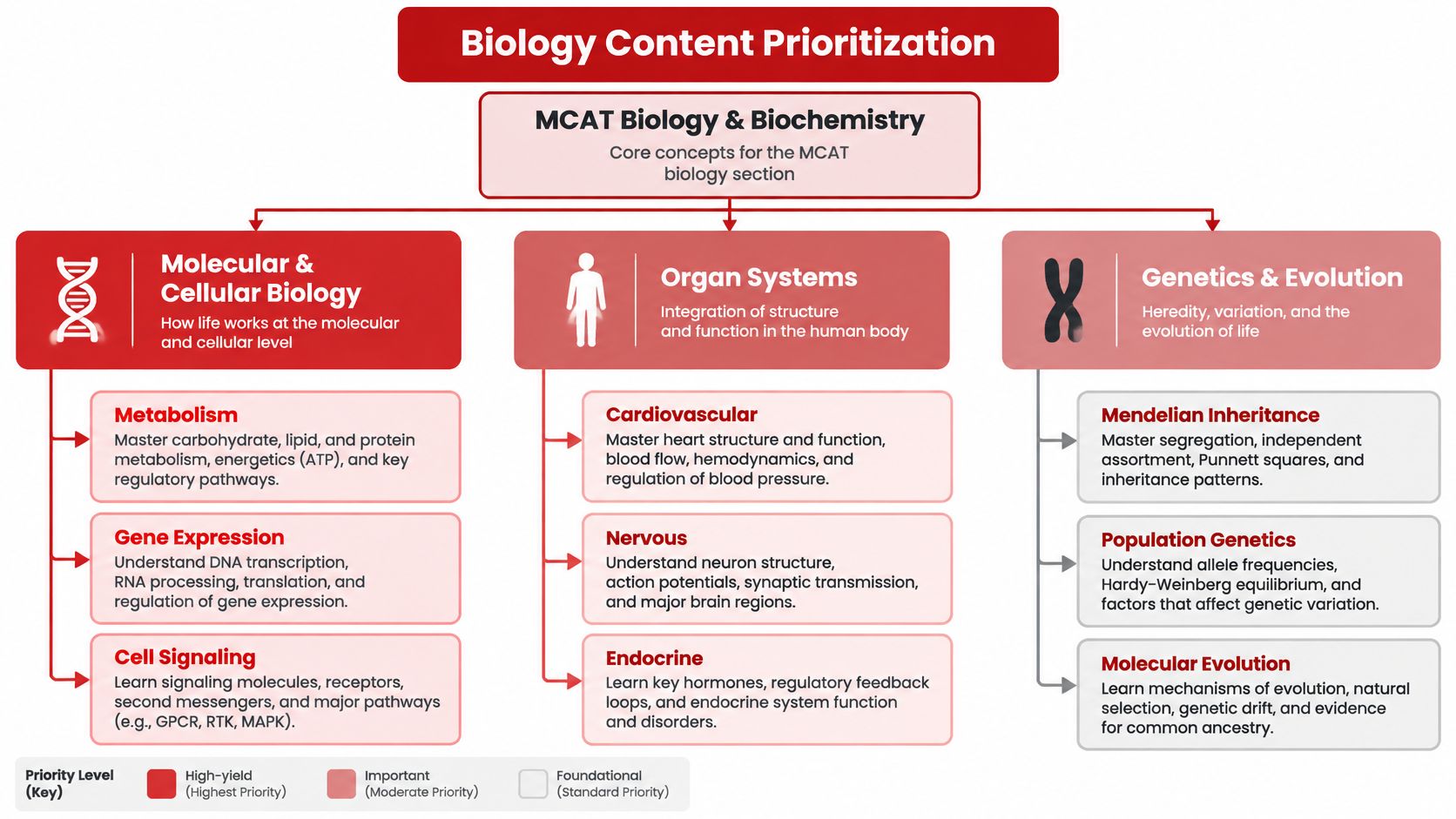
The diagram can serve as an organizational map, not a verified ranking of every subtopic. The MCAT high-yield topics guide can help organize a topic inventory, while the audit determines which topics need attention first.
Move From Recognition to Explanation
For each weak concept, the student should be able to describe its inputs, mechanism, consequence, likely distractor, and experimental representation. Recognition means a term looks familiar; explanation means the student can use it when the passage changes the context.
Consider an original educational model in which a passage defines an enzyme as converting a substrate into a product. Rather than memorizing that sentence alone, the student should explain what the experiment measures and which additional information would support a prediction about product formation. The passage's assumptions must guide the answer.
Concept Mastery Record
| Concept | Mechanism in one sentence | Graph or experiment link | Recall date |
|---|---|---|---|
| Passage-defined enzyme reaction | Explain how the stated reaction connects substrate and product. | Saved practice-item reference | Next planned retrieval |
| Gene-expression model | Connect the passage's proposed change to its measured outcome. | Relevant figure reference | Next planned retrieval |
| Physiological feedback model | Explain the stated stimulus, response, and feedback relationship. | Relevant experiment reference | Next planned retrieval |
The “link” field can contain a question identifier or saved reference rather than another website. Its purpose is to reconnect an abstract concept with evidence.
- Prioritize recurring weaknesses. A mechanism that repeatedly disrupts different passages deserves attention.
- Separate unfamiliar labels from missing understanding. A new protein name isn't automatically a content gap.
- Require transfer. A repaired concept should support a prediction in a different setup.
- Reassess after practice. The next topic should follow the latest error pattern, not the comfort of reviewing a favorite chapter.
Interpret Experiments, Figures, and Graphs
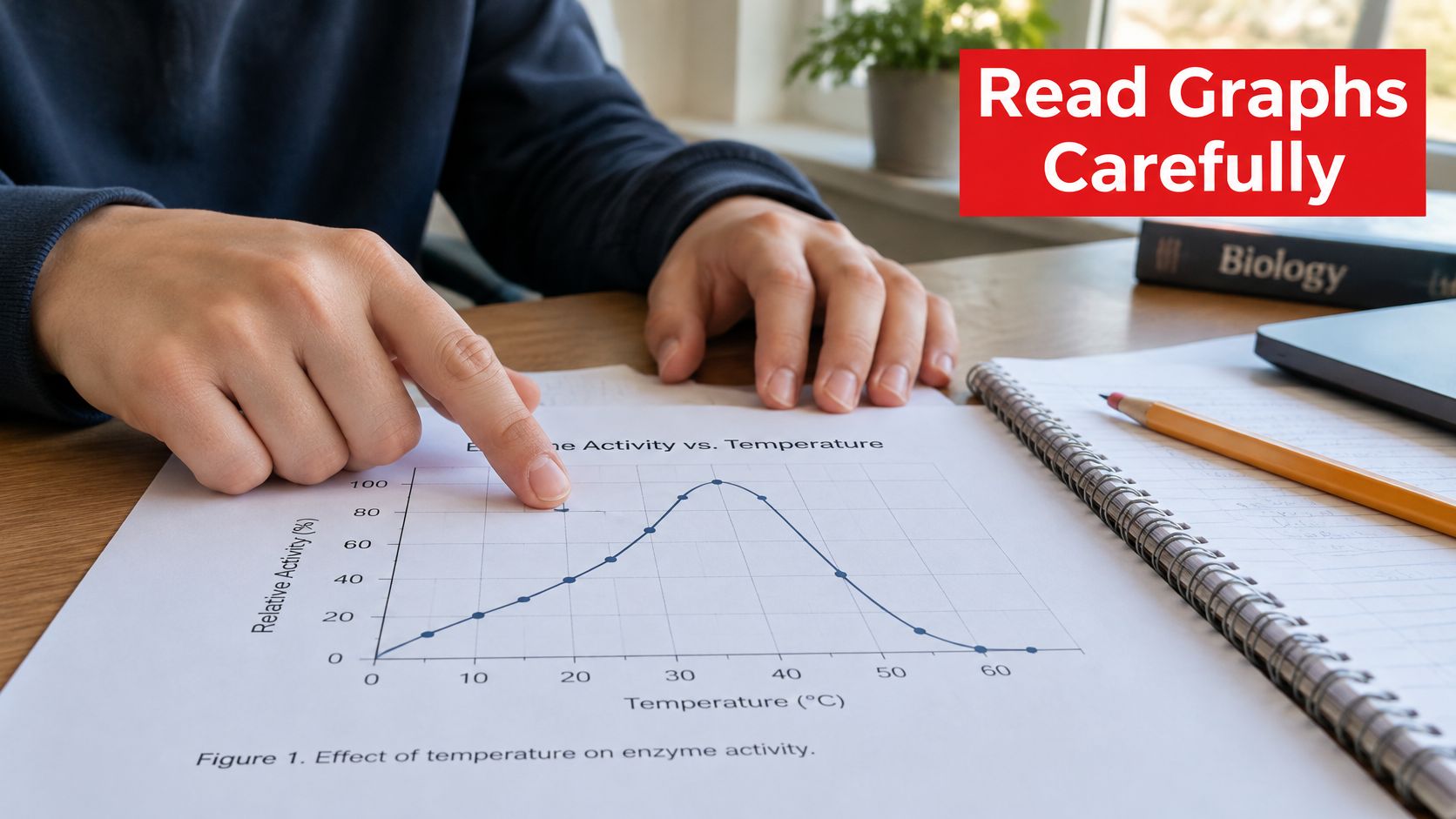
An unfamiliar experiment becomes more manageable when the student translates it before trying to explain it. The first task is identifying what the question asks: a reported observation, a mechanism, a control, or a prediction. Those tasks require different levels of inference.
An Original Enzyme Passage Example
The following is an original educational example, not an official or recalled examination item.
A hypothetical passage describes an enzyme tested across increasing substrate concentrations. Researchers compare an untreated condition with a condition containing compound R, keeping enzyme amount and other stated conditions matched. The graph shows initial product-formation rate on the vertical axis and substrate concentration on the horizontal axis.
The compound-R curve lies below the untreated curve at lower substrate concentrations, but the curves approach a similar plateau as substrate concentration rises. The question asks which conclusion the graph most directly supports.
A disciplined analysis separates the evidence:
- Manipulated conditions: Substrate concentration and the presence or absence of compound R.
- Measured outcome: Initial product-formation rate, not accumulated product concentration.
- Reference condition: The matched untreated preparation.
- Observed pattern: The difference between conditions becomes less apparent at higher substrate concentrations.
The defensible answer describes that pattern under the tested conditions. An answer claiming that compound R permanently destroys the enzyme goes beyond the evidence. An answer claiming that the graph directly measures compound binding also exceeds what the stated measurement establishes.
A familiar curve may suggest a mechanism, but suggesting a mechanism isn't the same as directly measuring it. The question's wording determines whether recognition of a model or restraint about the evidence is required.
A strong answer explains both what the result supports and what remains untested.
A Physiology-Style Graph Example
Consider another original passage defining a feedback model: increasing signal S is proposed to reduce secretion of hormone H. An experimental graph then shows H decreasing after S administration compared with a matched vehicle condition.
The observation is that measured H fell under the stated conditions. That result is consistent with the proposed feedback relationship, but it doesn't independently establish every intermediate step. A distractor claiming direct receptor binding would require evidence beyond the reported hormone measurement.
For either example, a compact figure annotation helps:
Axis meaning → comparison → trend → supported conclusion → unresolved question
This method doesn't replace content knowledge. It prevents familiar content from being used to justify an answer the experiment never tested.
Use Active Recall and Spaced Review
After reading an explanation, a student may feel that the answer was obvious. That feeling isn't a useful mastery test because the explanation has already supplied the missing connection. A better check requires reconstructing the reasoning with the explanation closed.
Suppose the enzyme example exposed confusion between rate and concentration. A weak review prompt would ask whether the explanation makes sense. A stronger prompt asks the student to describe what each axis measures and explain why the graph cannot, by itself, establish accumulated product at a later endpoint.
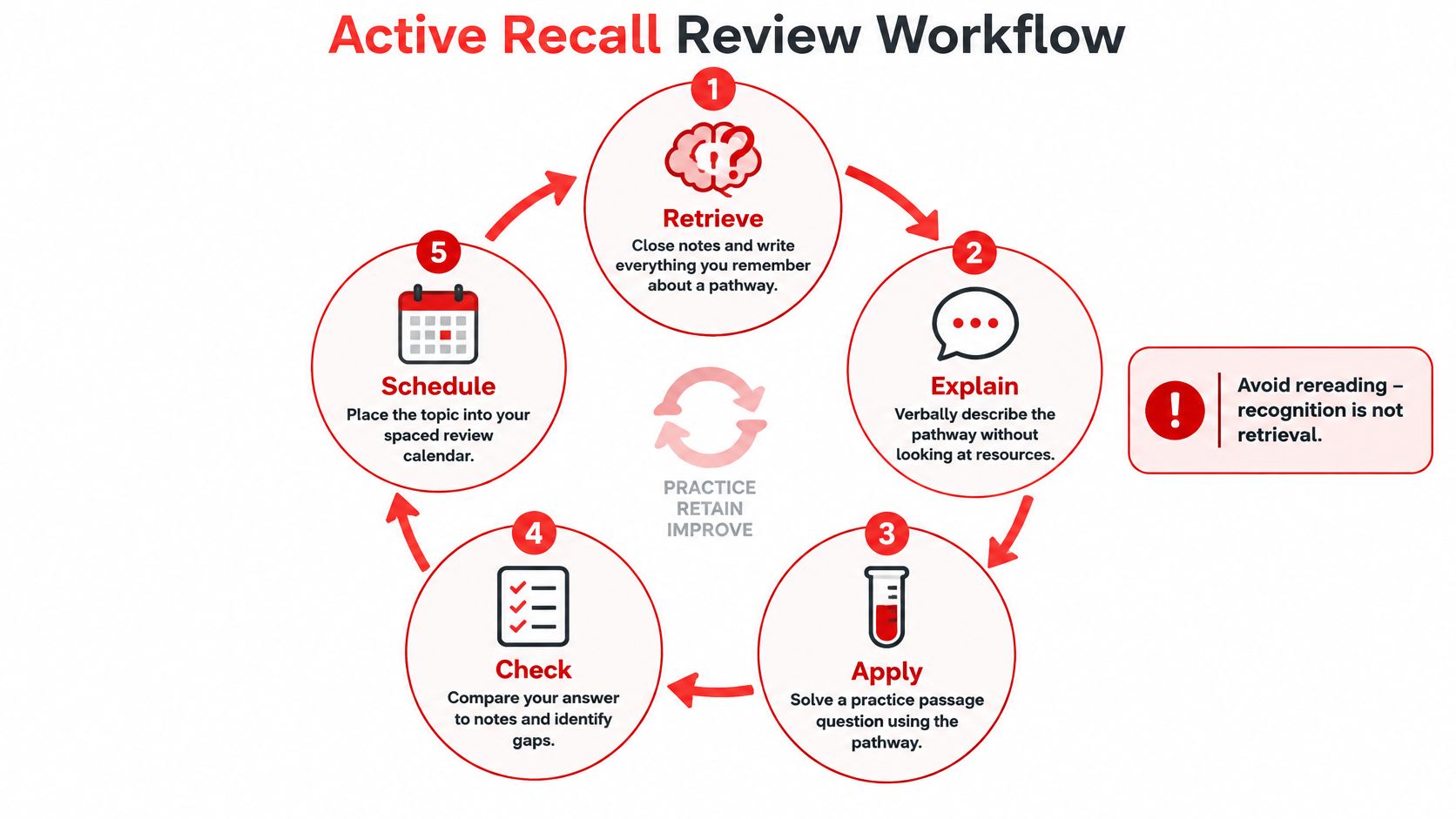
Turn an Explanation Into a Retrieval Task
A practical review record preserves the original question's reasoning demand without copying restricted material. The student can paraphrase the skill being tested, such as distinguishing a measured outcome from a proposed mechanism.
| Review stage | Student task | Completion criterion |
|---|---|---|
| Retrieve | Answer the paraphrased prompt without notes. | The explanation includes the relevant condition and outcome. |
| Explain | Describe why the conclusion follows. | Each causal or evidentiary connection is explicit. |
| Apply | Change a condition in an original practice scenario. | The prediction follows the stated assumptions. |
| Check | Compare reasoning with the reference explanation. | The earliest mismatch is identified. |
| Schedule | Plan another attempt after a delay. | The concept has a clear next review entry. |
The next retrieval should require more than reciting the corrected answer. For a graph-reading problem, the student might interpret a differently labeled figure. For a control problem, the student might explain which comparison isolates the variable of interest.
Space and Mix the Review
A workable spaced-review cycle revisits a concept after increasing intervals when recall remains sound and returns sooner when reasoning is incomplete. No universal interval needs to be imposed; the review record should reflect actual retrieval performance.
Related topics can also be mixed deliberately. An enzyme experiment, a gene-expression passage, and a feedback graph may all require distinguishing an observation from an explanation, even though their content differs.
- Retrieve before checking. Notes remain closed until an answer has been attempted.
- Explain the distinction. Similar concepts should be compared, not merely memorized separately.
- Change the context. Application provides a stronger check than repeating familiar wording.
- Record uncertainty. An incomplete explanation should remain an active review item.
Practice AAMC-Style Biology Under Time Pressure
Timed practice should reveal where performance changes under constraint, not merely produce another percentage. Official AAMC materials provide the appropriate reference for section-level preparation. Supplementary questions can offer additional exposure, but their wording, difficulty, and score interpretations shouldn't be treated as interchangeable with official materials.
The AAMC explanation of MCAT scoring states that scoring depends on questions answered correctly, with no penalty for guessing, and that equating accounts for small differences in difficulty between test forms. The practical implication is to complete every item rather than leave blanks while trying to predict a fixed raw-score cutoff.
Use a Flexible First Pass
A useful first-pass experiment is to read the question stem and identify the task before deciding how much passage detail is needed. An independent content question may not require extensive passage analysis; an experiment-specific question usually does. The student should test this approach against personal results rather than treat it as mandatory for every passage.
Answer elimination should remain evidence-based. A choice can be rejected because it reverses a relationship, introduces an untested mechanism, ignores a stated condition, or answers a different question. “Sounds unfamiliar” isn't a sufficient reason.
Pacing reminder: Continued reading should have a purpose, such as locating a condition or resolving a comparison. Repeating the same scan without a decision isn't progress.
Practice Review Decision Table
| Observed pattern | Likely priority | Next practice response |
|---|---|---|
| Weak performance both timed and untimed | Knowledge or reasoning foundation | Repair the mechanism before adding speed. |
| Sound untimed reasoning but rushed timed answers | Pacing or inefficient evidence retrieval | Use timed passages with deliberate marking and return. |
| Frequent changes from supported answers to unsupported alternatives | Answer evaluation | Require explicit evidence before changing a response. |
| Good passage understanding but repeated graph mistakes | Figure translation | Practice axes, units, legends, and comparison statements. |
| Accuracy appears strong but explanations are uncertain | Unresolved reasoning | Check performance on unfamiliar questions. |
The biology practice-question material can provide supplementary practice contexts. Its most useful role is supporting a specific assignment, such as identifying controls, rather than replacing official preparation.
When time expires, the student should record which items were unfinished and why. A missed question caused by a prolonged earlier decision calls for a different repair than a question missed because an essential concept was unknown. That distinction keeps pacing work from becoming indiscriminate pressure to read faster.
Build a Biology Error Log and Measure Progress
An error log becomes useful when it changes the next study decision. A spreadsheet filled with question titles but no corrected reasoning is mainly an archive. A productive entry explains what failed, what should replace it, and how the repair will be tested.
The following template supports comparison across sessions without reducing every difficulty to “carelessness.”
A Reasoning-Focused Log Template
| Field | What belongs in the entry |
|---|---|
| Topic and passage type | Content family plus experimental, graphical, or independent format |
| Error category | The primary failure identified during the audit |
| Confidence | Confidence before checking the explanation |
| Original reasoning | The actual path to the selected response |
| Corrected principle | A transferable rule grounded in the item |
| Repair task | A concrete retrieval or interpretation assignment |
| Next review date | The planned reassessment |
| Transfer evidence | Performance on a fresh application |
A strong corrected principle is specific enough to guide behavior. “Read more carefully” is vague; “compare the treatment condition with its matched control before comparing separate experiments” names an action.
Interpret Scores Without Overpromising
Each MCAT section uses a scaled range of 118 to 132, and historical AAMC retester analysis found median second-attempt gains generally ranged from 1 to 3 total score points, depending on the initial score, according to the AAMC score interpretation and retesting analysis. Those are total-score findings, not a promised biology improvement.
For score interpretation, the AAMC 2026 percentile table provides a dated reference; percentile comparisons should always identify the applicable table rather than assume older charts remain current. A percentile isn't an admissions guarantee or a complete description of an applicant.
During a monthly review, the student can select the most frequent content weakness and the most frequent reasoning weakness, then compare the next mixed assessment with the baseline. The MCAT practice-test guide offers a related planning reference.
- Isolated practice supplies new opportunities to attempt a skill.
- Error-log review identifies which skill needs deliberate repair.
- Targeted support may help when the student can't locate the faulty reasoning independently.
Progress means fewer recurring failure modes and stronger explanations on unfamiliar material, not just remembering previously missed answers.
Use a Schedule and Decide When to Get Help
A realistic schedule protects time for review rather than filling every available block with new questions. The student should be able to identify where content repair, retrieval, timed application, and recovery fit within the week. A lighter week can preserve that cycle without attempting the same workload.
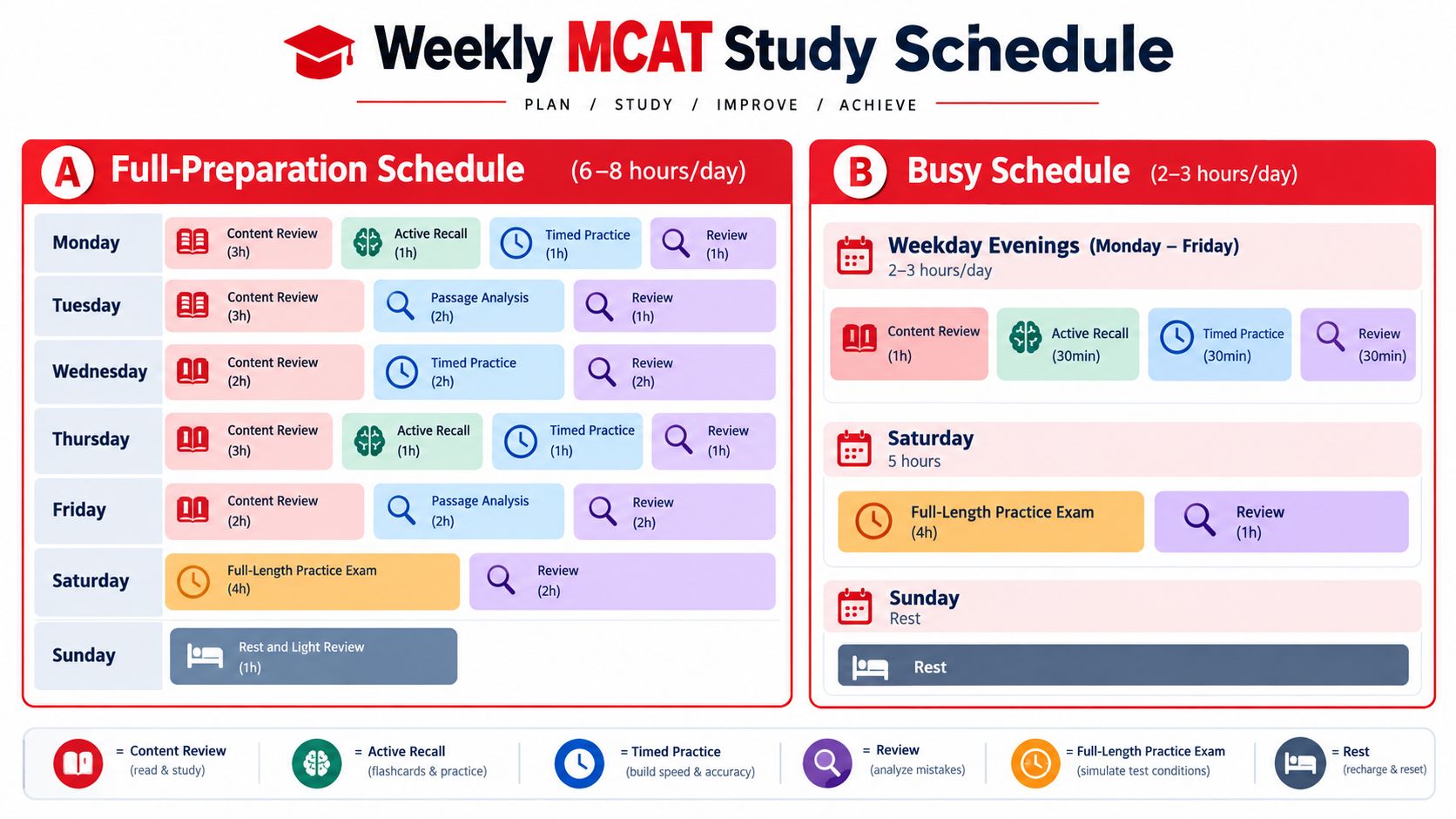
The graphic is an illustrative planning aid, not an official exam-duration reference or a required daily workload. Its full-length block shouldn't be used to determine testing duration; official materials should govern exam simulation. The MCAT study-schedule guide can help adapt preparation to existing commitments.
Match the Workload to the Week
During sustained preparation, the student can alternate content-repair blocks with passage-analysis blocks, then use a mixed assessment to check transfer. During a lighter week, maintaining retrieval and reviewing unresolved errors may be more manageable than adding extensive new content.
Supplementary biochemistry practice questions can support mechanism-focused work. Any paid support should be evaluated against a defined problem and transparent MCAT program and pricing information.
Study Support Decision Guide
| If the main problem is | First response | When additional support may help |
|---|---|---|
| An isolated knowledge gap | Focused review and fresh application | The same concept remains unclear across contexts. |
| Difficulty explaining mechanisms | Written causal chains and verbal explanation | Connections remain unsupported despite review. |
| Repeated experiment errors | Compare variables, controls, and conclusions | The student can't identify why an inference fails. |
| Stalled timed performance | Analyze where decisions consume time | A consistent pacing problem remains unresolved. |
Tutoring should complement official practice and independent review, not replace them. Useful goals include explaining controls accurately, connecting mechanisms without prompting, and making supported decisions under time pressure.
Sources
Primary references include the AAMC section overview, scoring explanation, score interpretation and retesting analysis, and dated percentile table linked above. These distinguish official exam information from the original educational examples and planning recommendations.
For persistent mechanism confusion or passage-analysis errors, personalized MCAT tutoring is an option alongside independent study and official practice. Visit Ace Med Boards to request a free consultation and discuss a focused plan using a recent error log and timed-practice results.