
Your first clinical rotation can make a simple note feel strangely hard. You have the story from the patient, the exam findings from the room, and a long list of possibilities in your head, but the chart needs one clear, defensible summary. A SOAP note gives you that structure, because it separates Subjective, Objective, Assessment, and Plan into a repeatable clinical logic that supports continuity of care, not just documentation for its own sake (NCBI Bookshelf).
A good SOAP note does more than keep your preceptor happy. It trains you to distinguish facts from interpretation, to prioritize problems, and to write a plan another clinician can follow without guessing. That same discipline also helps with board-style clinical vignettes, because it mirrors the way strong test-takers sort clues, build a differential, and choose the next best step.
Understanding the SOAP Note Structure and Purpose
On your first day in clinic, the temptation is to write everything exactly as it comes to mind. That often turns into a wall of text, where the patient's story, your exam findings, and your diagnosis blur together in one paragraph. The SOAP note prevents that by giving the chart a four-part logic. It separates what the patient says, what you observe, what you think it means, and what happens next, which is why it remains a standard way to organize clinical documentation (NCBI Bookshelf).
A simple way to see the value of the structure is to compare it with how you answer a board-style vignette. You first sort the clues, then decide which details are patient-reported, which are measurable, and which support the working diagnosis. That same discipline makes a chart easier for the next clinician to read, because the note is not just a record of events. It is a reasoning trail.
Why the structure matters
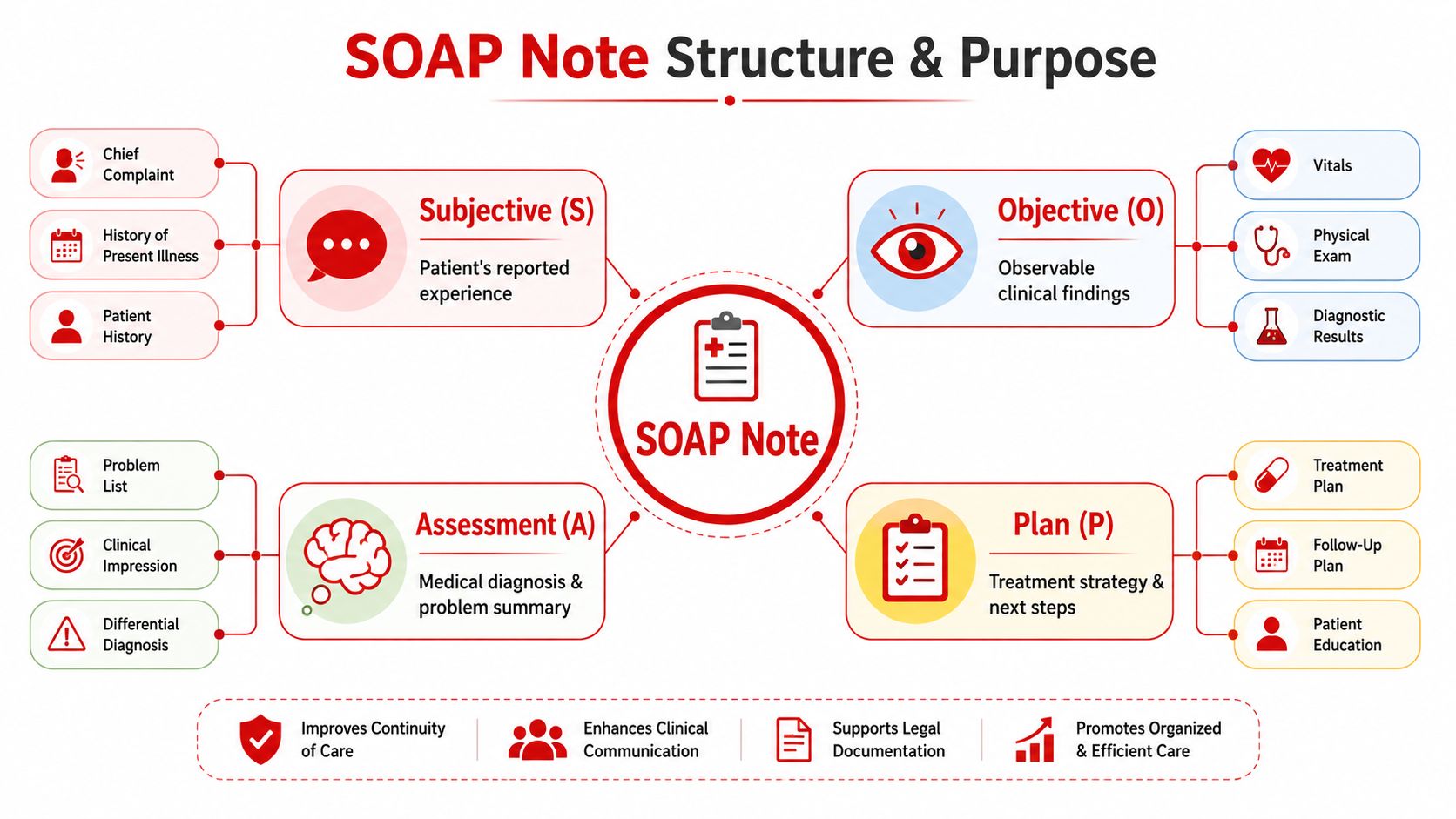
Subjective holds the patient's reported experience, including the chief complaint and history in the patient's own words when possible. Objective is where you record verifiable data, such as vital signs, lab results, physical exam findings, imaging, and other measurable observations (Purdue OWL). Assessment is your clinical reasoning, where the note becomes a working diagnosis or problem representation. Plan is the concrete next step, including medications, testing, referrals, counseling, and follow-up. The point is not just neatness. It is to keep observation separate from interpretation so another clinician can review the chart without guessing how you reached your conclusion.
That separation is why SOAP notes have endured across inpatient medicine, outpatient care, therapy, rehabilitation, and telehealth workflows (SonderMind). In practice, the format helps clinicians communicate across settings and keeps the chart anchored to measurable clinical inputs rather than narrative free text alone. If you want a clean model to compare against your own notes, this healthcare documentation guide from PDFWix shows how clear structure supports clear thinking.
Practical rule: if a sentence contains both an observation and a diagnosis, it probably belongs in the wrong section.
For students who want a broader framework for note quality, Ace Med Boards' documentation best practices guide is a useful companion resource because it reinforces the same habit of separating evidence from interpretation.
What Belongs in Each SOAP Note Section
A student with a confusing chief complaint can sort the note more cleanly by asking one question at a time, Whose voice is this, what can I verify, what does it mean, and what happens next? That habit keeps the chart readable when the case feels messy. It also mirrors how you approach a board-style vignette, where the facts arrive mixed together and you have to separate symptom report, exam findings, interpretation, and plan before you commit to an answer.
Section by section boundaries
The Subjective section should read like the patient's account. If the patient says, “I've had burning chest discomfort after meals,” that belongs here, along with symptom timing, associated symptoms, relevant history, and the reason the patient sought care today.
The Objective section stays with information another clinician could verify. It includes the physical findings, vital signs, and test results that can be observed or measured. If a finding depends on your interpretation rather than direct observation, it belongs elsewhere. That same discipline is useful in documentation questions that ask you to distinguish reported symptoms from observable behavior, including nursing-style cases such as the Premiere Education PTSD nursing discussion of assessment criteria.
The Assessment is the working clinical impression. It explains what the patient's story and the exam suggest, and it should show the reasoning behind the conclusion rather than just repeat the chart. In practice, this is the part that resembles differential diagnosis work, because you are comparing likely causes and deciding which one best fits the available evidence. A useful reference for that comparison is Ace Med Boards' differential diagnosis resource.
The Plan lists the next steps in concrete terms. That usually means medications, testing, referrals, counseling, safety instructions, and follow-up details. Generic phrases like “monitor” or “continue care” leave the reader guessing, while a specific plan tells the next clinician what to do and tells the patient what will happen next.
| SOAP Note Section Requirements | Include | Avoid | Common Errors |
|---|---|---|---|
| Subjective | Chief complaint, history of present illness, symptom course, relevant history, patient quotes when useful | Your diagnosis, exam findings, interpretation | Putting your own impression inside the patient story |
| Objective | Vital signs, exam findings, lab values, imaging, observable behavior, measurable data | Conclusions, speculation, unsupported labels | Using assessment language to describe what you saw |
| Assessment | Working diagnosis, prioritized differential, clinical impression, evidence for and against each major possibility | A list of copied symptoms, unranked problem dumping | Repeating the subjective data without reasoning |
| Plan | Diagnostics, treatment, medications, safety, follow-up, referrals, education, contingency steps | Vague reassurance or generic “follow up as needed” | Leaving the next step unclear, missing timing, or omitting safety instructions |
The logic is simple. Each section answers a different clinical question, so the chart stays organized the same way your thought process should stay organized during a vignette or a real encounter. If a sentence clearly belongs in more than one place, put it where its main purpose fits best.
Complete SOAP Note Clinical Example
A composite case helps the format feel real. A third-year student on medicine clinic might see a patient with chest discomfort and immediately worry about the worst-case diagnosis. The note should still stay organized, because the structure itself helps you avoid overcalling, undercalling, or burying an important differential.
A fictional clinic note
Subjective: A 46-year-old patient reports two days of intermittent burning chest discomfort that starts after meals and improves when sitting upright. The patient denies shortness of breath, syncope, or exertional worsening. The patient also reports mild sour taste in the mouth and says the pain feels “different from anything I've had before,” but not crushing or radiating.
Objective: Temperature is normal. Heart rate is regular, blood pressure is stable, respiratory rate is even, and oxygen saturation is normal. The patient is comfortable at rest, with a benign cardiopulmonary exam and soft, non-tender abdomen. No focal neurologic findings are noted.
Assessment: Most likely gastroesophageal reflux disease based on post-meal burning pain, sour taste, and relief with upright posture. Lower-probability alternatives include musculoskeletal pain and cardiac ischemia, though the absence of exertional worsening, dyspnea, radiation, or abnormal exam findings makes those less likely today. Because chest pain can represent a dangerous process, the differential still needs active attention rather than a one-line label.
Plan: Begin a reflux-oriented evaluation and treatment approach, provide dietary counseling, review warning signs that require urgent care, and arrange follow-up if symptoms persist or worsen. If the history changes or risk features appear, reassess for cardiopulmonary causes and escalate evaluation accordingly.
The point is not that this patient “has GERD” in the world. The point is that the Assessment ties the conclusion to the evidence from Subjective and Objective, and the Plan responds to the problems that the Assessment identified. That's the same logic you need when you explain a vignette answer on an exam.
The cleanest SOAP notes often read almost boringly logical. That's a good sign. A note that names the leading problem, acknowledges uncertainty, and lists the next action clearly is much more useful than a dramatic paragraph that sounds confident but hides the reasoning.

Common Assessment and Plan Mistakes to Avoid
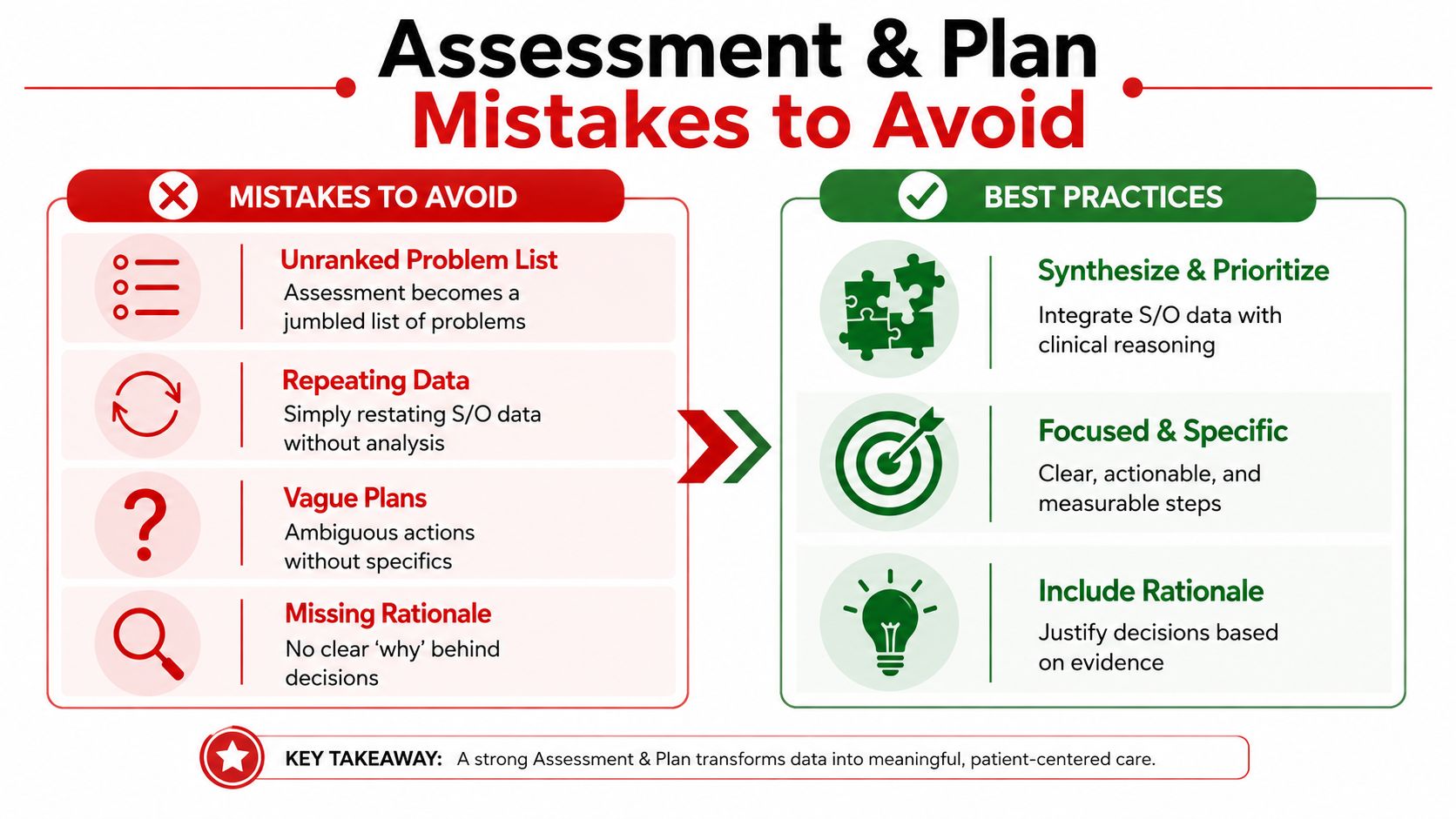
A common error appears when the chart lists diagnoses but never explains how the clinician reached them. A student may copy the Subjective and Objective findings into the Assessment, then stop at a problem list. That reads like a data dump, not clinical reasoning. On rounds, that kind of note leaves the next reader guessing what matters most, and on a board-style vignette it makes the answer feel foggy because the logic was never stated.
The safer habit is to start with a problem representation, a short sentence that captures the pattern you think is present. From there, rank the differential by likelihood and by danger. The point is to show the same thought process you would use when narrowing a vignette answer, first identify the dominant pattern, then test it against the findings that support it and the findings that do not.
A weak Assessment often sounds like a shopping list. “Chest pain, reflux, anxiety, and pneumonia.” That is not analysis, just a set of labels.
A stronger Assessment ties the labels to the evidence. “Most consistent with reflux-related chest discomfort given post-prandial burning pain and sour taste, but cardiac and pulmonary causes remain important to rule out if symptoms evolve.” That sentence does three jobs at once. It states the leading impression, shows why that impression fits, and leaves room for uncertainty when the presentation is still incomplete. That same structure helps when you are working through a clinical vignette, because the right answer usually depends on which clue carries the most weight, not on which diagnosis sounds familiar.
The Plan fails in a different way. Students write “continue monitoring,” “follow up,” or “patient educated,” but those phrases do not tell the next clinician what should happen next. A usable plan names the action, the purpose, and the trigger for escalation. It should read like instructions that another clinician could carry out without filling in missing pieces.
If you want a clean reminder of how poor documentation can contribute to preventable clinical confusion, the Ace Med Boards guide on preventing medical errors fits this section well because the underlying problem is often the same, missing structure.
Practical rule: if the plan could apply to almost any patient, it is too vague.
Two changes help right away. First, rank the differential so the most likely and most urgent problems appear first. Second, write the next action so the reader knows what happens, when it happens, and what would make you change course. That is the same discipline that makes vignette explanations tighter. You are not just naming a condition, you are showing why this patient needs this step now.
A note that says “follow up in one week, return sooner for worsening pain, fever, dyspnea, or new exertional symptoms” gives the reader something useful. A note that says “follow up as needed” does not. In real charting, that difference reduces confusion for the next clinician, and in exam practice it sharpens your eye for the safest next step.
Reusable Plan Checklist and EMR Efficiency Tips
A patient comes back with a new concern, and the chart needs to answer a simple question fast. What is the problem, what has already been decided, and what happens next? A strong Plan section does that work clearly, so the next clinician does not have to guess. In a busy clinic, the goal is a reusable mental checklist that keeps the note brief without losing safety or clarity.
A simple plan framework
Use this order when you are deciding what belongs in the plan:
- Diagnostics: labs, imaging, or referral testing that answer the main question.
- Treatment and medications: interventions already chosen or under consideration.
- Safety and monitoring: what to watch for, and what would trigger escalation.
- Patient education: key instructions, self-care, and warning signs.
- Follow-up: timing, location, or the next appointment.
- Contingency or escalation: what happens if symptoms change or the patient worsens.
That sequence keeps the plan actionable. It also prevents a common mistake, writing something that sounds finished but leaves the reader without a next step.
For fast-paced documentation, workflow matters too. Public SOAP-note guidance still emphasizes timely completion, concise language, and recording the date, time, location, and follow-up details, while the practical challenge is keeping notes efficient in electronic medical records (EMRs) without filling them with extra text (MedWriter.ai). If you are tightening your own charting habits, the WhisperAI guide to healthcare transcription practices is useful for thinking about clarity, accuracy, and how speech-to-text workflows can reduce friction without replacing clinical judgment.
A few efficiency habits help a lot.
- Use templates wisely: start from a standard structure, then edit the details so the note stays individualized.
- Watch for copy-paste drift: copied text can preserve outdated facts and weaken the chart.
- Keep only clinically relevant detail: include what changes decisions, not every observation you made.
- Check time-sensitive fields: date, modality, and follow-up details matter in modern records, especially in telehealth contexts (Ace Med Boards' electronic health record guide).
A concise note is not a thin note. It keeps the clinically important parts intact and strips out the rest. That same discipline helps with vignette questions, because the best answer usually comes from sorting what matters now from what is only background.
Using SOAP Note Reasoning for Clinical Vignette Analysis
A SOAP note and a board-style vignette ask you to do the same thing. Both present messy information, and both reward the person who can separate signal from noise. If you practice SOAP reasoning well, you're also practicing the exact habits that matter on USMLE, COMLEX, and shelf exams, problem representation, prioritization, evidence linkage, and next-step reasoning.
How the skills transfer
Start by sorting the vignette into Subjective and Objective clues. What did the patient report, and what was observed or measured? Then build an Assessment that ranks the likely diagnosis against the dangerous alternatives, not just the diagnosis that feels familiar. Finally, ask what the safest next action is, because that's often where exam questions hide the correct answer.
That process also helps you review mistakes. If you missed a question because you ignored a key symptom, that's a Subjective-to-Assessment error. If you jumped to a diagnosis without weighing a dangerous alternative, that's an Assessment problem. If you chose the right diagnosis but missed the best next step, the gap is in the Plan.
Track your errors by category, not just by topic. “Missed chest pain question” tells you very little. “Didn't prioritize unstable causes before benign ones” tells you what to fix.
The same approach works with supervisor feedback. If a preceptor keeps telling you that your notes are “too descriptive” or “not specific enough,” look at where the reasoning breaks down. Are you overloading Subjective with interpretation? Are you writing an unranked Assessment? Is your Plan too vague for another clinician to act on? Those are pattern problems, and pattern problems improve faster when you name them directly.
For a broader clinical framework that supports that kind of reasoning, Ace Med Boards' clinical reasoning guide is a helpful companion because the logic behind a good SOAP note is the same logic behind a good answer choice.
If you want personalized help applying that reasoning to charting, clinical vignettes, or your exam workflow, Ace Med Boards offers one-on-one support and a free consultation or Board Score Audit to help you identify the exact reasoning gaps worth working on.
If you want help turning SOAP-note practice into stronger clinical reasoning for exams and rotations, visit Ace Med Boards to learn more about one-on-one tutoring and targeted support. A focused session can help you sharpen your problem representation, tighten your differential, and write plans that are clearer on the wards and in vignette questions.