You can waste a month on MCAT prep and still not know whether you're improving. The better move is to treat the mcat prep exam as a forecasting tool, not a trophy, and build your plan from the first diagnostic onward. If you're two to three months out, staring at a pile of notes, and wondering whether you should buy another book or just start taking full-lengths, start with evidence instead of guesswork.
Key Takeaways
- Start with a baseline diagnostic before you build a calendar.
- Use full-lengths to forecast test-day performance, not just to collect scores.
- Match your timeline to your available hours, then adjust based on review data.
- Spend real time on error-driven review, not just more questions.
- Get outside help only when your gap map, retake plan, or schedule makes self-study inefficient.
Start with a Diagnostic Instead of a Study Plan
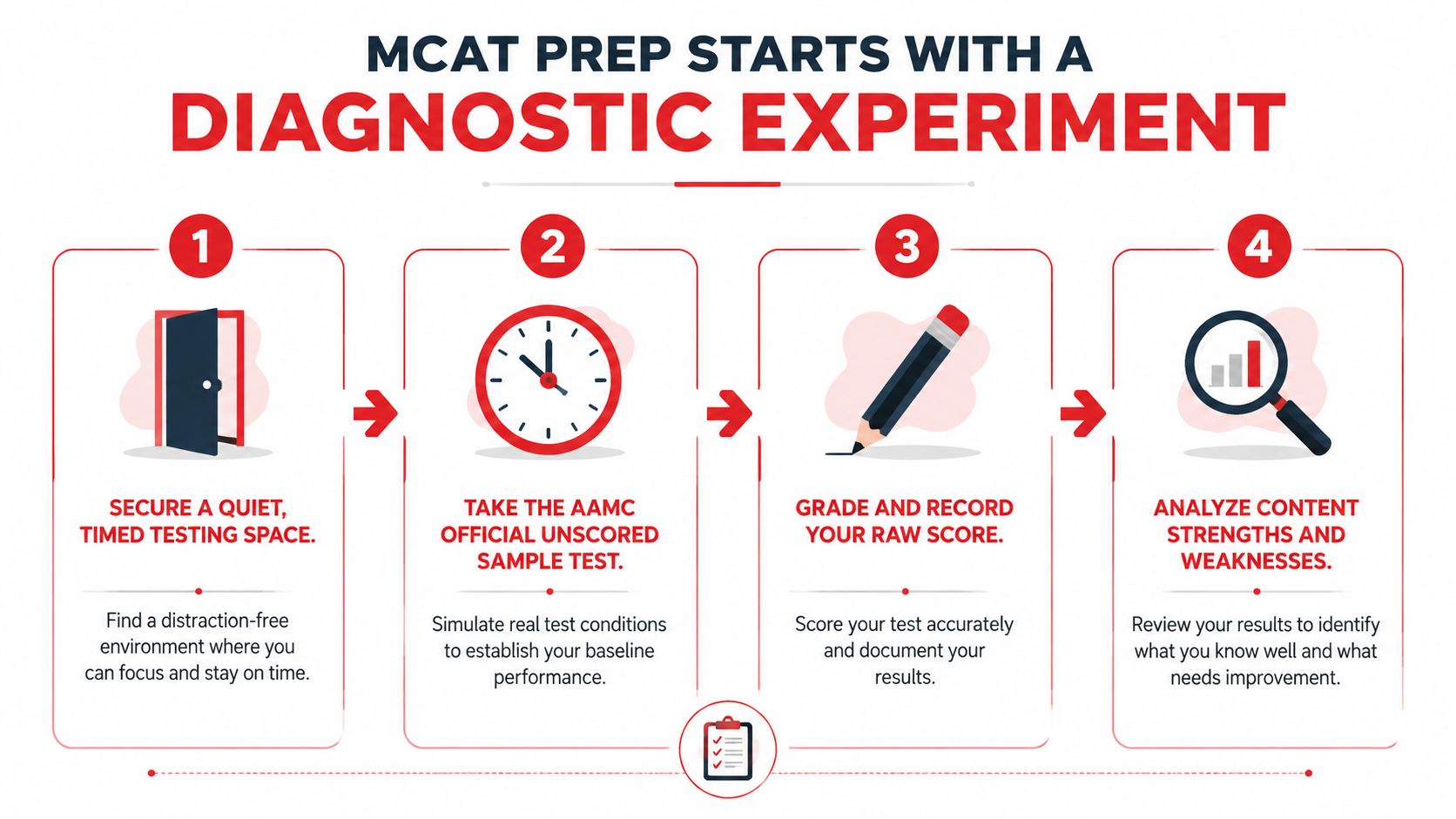
A lot of students begin MCAT prep by making a color-coded calendar, then discover a month later that the schedule doesn't match their actual weaknesses. That's backward. The first move is to establish a baseline with the AAMC MCAT Official Prep Unscored Sample Test, taken under timed, seated conditions, then use the Content & Skills Breakdown tab to tag each topic as low, medium, or high confidence.
Here's the clean version of the process. Take the sample test, review each section separately, and write down where you felt steady, uncertain, or lost. Then repeat that for all four sections so you end up with a real gap map, not a vague sense that “chemistry is bad” or “CARS feels weird.”
Practical rule: Don't buy a second resource until you know what the first diagnostic actually says.
The AAMC's study workflow is built around that baseline-first logic. It tells students to start with the unscored sample test, use the breakdown tab to identify gaps, and then match those gaps to the content outline, topic by topic, section by section. That matters because confidence levels change what you study first. A topic you rate as low confidence belongs near the top of your list. A topic you rate medium confidence needs reinforcement, not a full restart. High-confidence areas still need maintenance, but they shouldn't eat the same study time as your weakest points. See the AAMC's study-plan guidance in the official plan-builder workflow, then keep your own notes honest rather than optimistic.
A simple way to avoid drift is to create one page with four columns, section, topic, confidence, next action. That page becomes the anchor for everything else, including whether a tutor makes sense later. If you skip this step, you're planning in the dark. If you do it well, every later decision has a reason.
For readers who want a broader AAMC overview of the exam itself, the linked MCAT full-length overview is a useful companion to this baseline-first approach.
Choose a Realistic Prep Timeline
Pick your test date first, then work backward from the number of hours you can protect each week. AAMC-related survey data show that examinees often spent 5 to 6 months preparing, and another reported average places study time around 318.7 hours in 2023, so this is rarely a quick sprint AAMC prep data. The better timeline is the one you can sustain without losing track of what you studied last week.
Three common timeline patterns
A three-month intensive plan fits students with a lighter course load, strong baseline knowledge, and enough daily bandwidth to keep the material moving. It can work, but it compresses review and leaves less room to recover if the first full-length shows bigger gaps than expected.
A five-month standard plan is usually more forgiving. It spreads the workload across a realistic span, gives you room to cycle through content review and practice, and lowers the risk of burning out halfway through. For many students, this is the point where the schedule still feels serious without becoming so tight that every missed day throws off the plan.
A seven-month extended plan helps when you are balancing classes, research, work, or a retake strategy. The trade-off is straightforward. A longer window can improve pacing, but only if the work stays active. If the calendar stretches too far, studying can turn into fragments, and earlier material starts to slip.
A timeline is too aggressive when review keeps sliding, and too loose when you are “prepping” without finishing practice sets.
The 2023 AAMC-related data also show average section means around 125.6 to 125.7 in CARS and Psychological, Social, and Biological Foundations, with an average total score of 500.0. Those numbers do not define your target, but they do show that the exam rewards steady, disciplined gains rather than last-minute leaps. If you want a practical way to decide when to begin, compare your available weekly hours against your gap map, not against someone else's schedule. The article when should I start studying for the MCAT can help you turn that into a start date.
The cleanest test is whether your weekly plan survives a normal week. If you cannot maintain it for two straight weeks, it is not a real plan yet. It is a wish.
Map the Four Sections as Content Plus Skills
The MCAT is a 230-question exam with 4 sections, 6 hours and 15 minutes of content-testing time, and about 7 hours and 33 minutes in the full seated experience including breaks and administration MCAT statistics. That length matters because endurance is part of the score. But the deeper point is that the test isn't just four separate content lists. The AAMC organizes the natural and social sciences sections around 10 foundational concepts and scientific inquiry and reasoning skills, which means application matters as much as recall AAMC exam structure.
What each section asks from you
Chemical and Physical Foundations of Biological Systems rewards students who can connect equations, passage details, and basic science principles. It's not enough to memorize formulas if you can't use them in a passage.
Critical Analysis and Reasoning Skills (CARS) is a reading and reasoning section, so daily practice matters more than cramming. Students often get stuck because they keep looking for outside facts that aren't there.
Biological and Biochemical Foundations of Living Systems blends biology, biochemistry, and passage-based interpretation. Content review helps, but only if you keep tying it back to questions.
Psychological, Social, and Biological Foundations of Behavior is broad, and that breadth makes it easy to underestimate. It often looks familiar until the wording gets specific.
| MCAT Sections at a Glance | Focus | Study Priority |
|---|---|---|
| Chemical and Physical Foundations of Biological Systems | Passage-based science reasoning and applied concepts | Content review plus timed passage practice |
| Critical Analysis and Reasoning Skills | Reading comprehension and inference | Daily reading and passage analysis |
| Biological and Biochemical Foundations of Living Systems | Biology, biochemistry, and application | Mixed content review and question practice |
| Psychological, Social, and Biological Foundations of Behavior | Behavioral science concepts and interpretation | Concept review with regular passage work |
The easiest mistake is to over-study the sections that feel comfortable and undertrain the ones that feel abstract. If CARS is your weak point, it can't wait until the last month. If a science section is your weakest, it still needs timed passage work, not just flashcards. For a tighter breakdown of the material itself, the MCAT content review guide is a useful companion to the official section map.
Build a Score Tracking System That Actually Predicts
Practice tests shouldn't make you feel better or worse. They should tell you what's likely to happen on test day. One peer-reviewed study found full-length practice exam performance significantly predicted MCAT score, with a strong standardized effect, so the cleanest workflow is to take timed full-lengths under real conditions and then spend serious time reviewing mistakes and timing patterns rather than stacking more exams for the sake of volume practice exam prediction study.

What to put on the dashboard
Track the exam source, section scores, timing notes, and a confidence rating after each test. That lets you see whether a score change came from content knowledge, pacing, or just a bad day. If you want a non-medical analogy, this is the same logic used in a guide to customer health metrics, where one number means less than the pattern behind it.
Use the last two AAMC full-lengths as your main forecast, not every practice test you've ever taken.
Independent MCAT prep analysis reports that AAMC full-lengths are the most accurate predictors and that the final-2 average is typically within about ±2 to ±4 points of test-day performance score prediction analysis. That doesn't mean third-party exams are useless. They can still help with stamina and pacing. It does mean you should treat them as training data, not the final forecast.
A basic rule helps. If your last two AAMC full-lengths are flat, don't panic. Look at timing and missed-question patterns first. If one section is drifting downward across several tests, that's a study-plan issue, not a test-day mystery. The progress tracking dashboard can help organize that information in one place.
The goal is not to collect scores. It's to read the trend well enough to change your next week's work.
Run the Question Review Workflow That Drives Score Gains
Practice questions only help when you review them with discipline. After each block or full-length, sort every missed or uncertain question into one of four buckets, content gap, reasoning error, misread, or pacing failure. Then log the pattern and make the highest-frequency category next week's priority.
A review loop you can repeat
Start with the question itself, not your feelings about it. Ask whether you missed the underlying concept, chose the wrong answer because of logic, skipped a key word, or ran out of time. Then write a short note that ties the error to a concrete fix, such as a content page, a passage strategy, or a pacing cue.
For pacing, use drills that force a real rhythm. A practical benchmark is 20 science questions in 30 minutes or 40 in an hour, because timing problems often show up as missed easy points rather than dramatic failures. If you wait until the last minute to train pace, you usually don't have enough time left to fix it.
The question is not “How many questions did I do?” The better question is “How many mistakes did I understand well enough to stop repeating?” That shift matters because the MCAT rewards adjustment, not just effort.
A useful cadence is to review every practice set the same day, then revisit the recurring error types at the end of the week. That prevents old mistakes from becoming habits. It also helps you decide whether your next full-length should happen soon or whether you need more targeted work first.
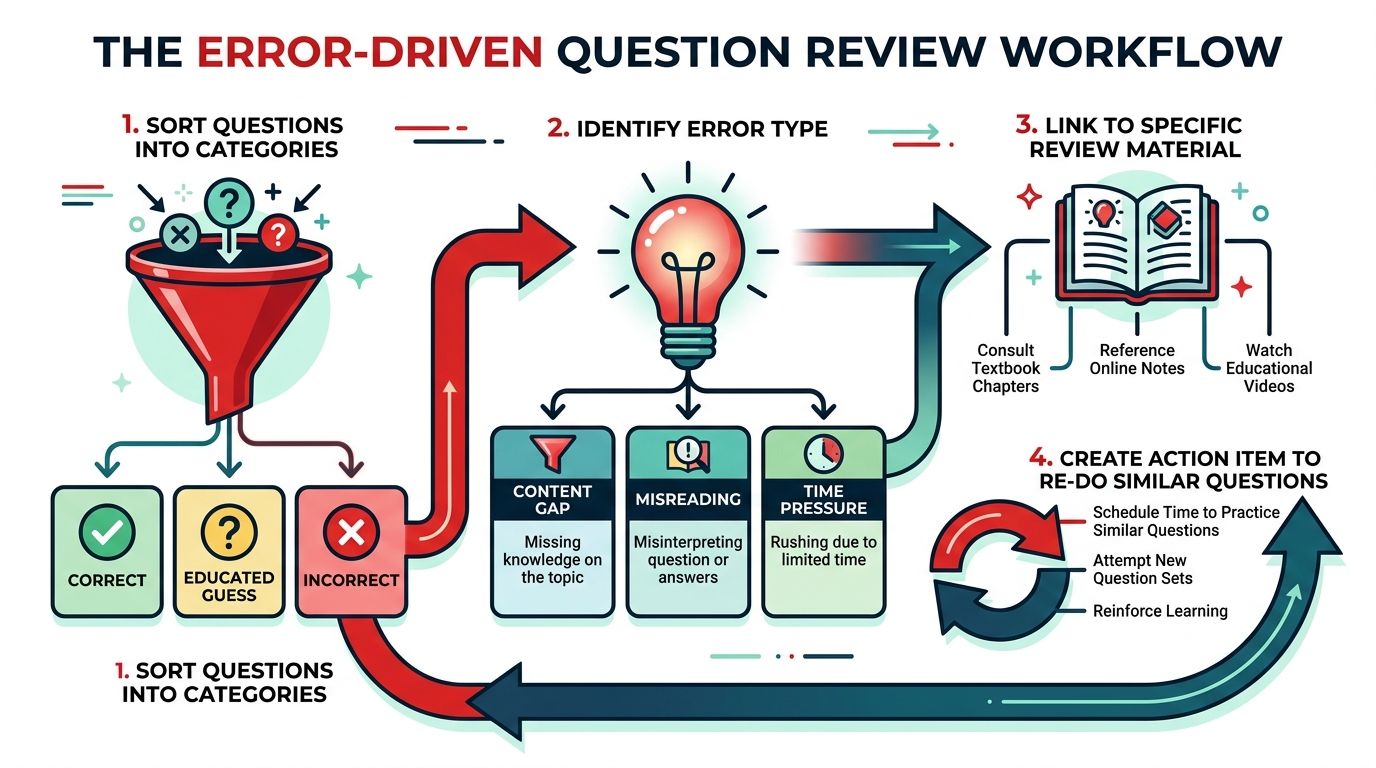
For a more detailed video walkthrough of this kind of review mindset, see the embedded discussion below.
If you're wondering how many practice exams are enough, the safe answer is several full-lengths, with deep review after each one. The exact number matters less than whether each exam changes your next study week.
Avoid the Pitfalls That Stall Real Progress
Most stalled MCAT plans don't fail because the student isn't serious. They fail because the workflow is messy. Resource hoarding is a common one. So is passive reading that feels productive but doesn't improve recall under pressure.
Five common traps and what to do instead
- Resource hoarding: Finish one core set of materials before adding another. Too many books and platforms create noise, not clarity.
- Passive content review: Pair review with active questions on the same topic so the material gets used, not just recognized.
- CARS procrastination: Put CARS on the calendar from week one, because reading skill doesn't improve well under a last-minute rush.
- Weak-section avoidance: Let diagnostic results drive the schedule instead of intuition.
- Skipping full-length simulation: Take practice exams under real conditions so pacing, endurance, and breaks feel familiar.
The most expensive mistake is treating content review as a substitute for practice. Content matters, but the MCAT is a reasoning exam, and that means you need to see how knowledge behaves inside passages. If you spend all your time turning pages, you may feel busy without becoming faster or more accurate.
A bad score can also derail a good plan if you read it as a verdict. That's the wrong frame. A dipped score is data, and data should change behavior. If your scores fall after a week with too much passive review, that doesn't mean you're incapable. It means your method needs more active retrieval and less reading.
Practical fix: Put one review block on the calendar for every practice block, and protect it.
For readers who want outside support without losing the discipline of self-study, structured tutoring can fit beside official AAMC materials rather than replace them. Recepta.ai for tutoring centers is one example of how education teams think about systems and support, while the MCAT still has to be built from your own practice, review, and timing work. If you want a more targeted explanation of how one-on-one help fits into an MCAT plan, the one-on-one tutoring benefits page is a useful place to compare options.
Decide When One-on-One Support Is Worth It
Self-study works for many students, and it should be the default. But there are moments when one-on-one support becomes the more efficient choice. If your diagnostic shows a wide gap map, if three full-lengths haven't moved much, if CARS stays stuck at the middle of the scale, or if you're trying to prep while carrying a heavy class load, outside help can keep you from wasting weeks on the wrong fixes.
A good tutoring session should do three things. It should identify the actual bottleneck, translate that bottleneck into a next-week plan, and show you how to use official practice materials more effectively. That's especially useful for students who have plenty of effort but no clear way to prioritize.
If you're evaluating a program, ask whether it starts with your diagnostic and whether it changes the plan based on your error patterns. If it doesn't, you may just be buying more information. The point is not more talk. The point is a cleaner route through the work.
Ace Med Boards offers MCAT tutoring through 1-on-1 online tutor sessions and tutoring bundles, which can fit students who need structured review alongside independent practice. It should still sit beside AAMC materials, not replace them, because the official sample tests, section work, and practice exams remain the core of the exam-prep process.
If you're unsure whether your current plan is on track, schedule a free consultation with Ace Med Boards and use your diagnostic, practice scores, and timeline to get a practical read on next steps. A focused conversation can help you decide whether to stay with self-study or add structured support before your test date.