

A good MCAT score is one whose percentile and academic context align with an applicant's target schools. In the current 2026–2027 AAMC table, a 508 is at the 74th percentile, while a 512 is at the 84th percentile, so neither number is universally “good” or “bad” without a school list and a complete application.
The right question isn't “Is this score high enough for medical school?” It's “Does this score make sense for the schools, GPA, experiences, residency status, and mission fit in this applicant's actual plan?” A 500 may require a different strategy from a 508, and a 518 may still fail to compensate for an unrealistic school list or a weak application narrative.
Why Good Depends on Where You Are Applying
A 500 is at the 48th percentile, a 508 is at the 74th percentile, and a 512 is at the 84th percentile in the current AAMC table. The MCAT uses a 472–528 total scale, with section scores from 118 to 132. The cited table applies from May 1, 2026 through April 30, 2027, using scores reported during the 2023–2025 testing years (AAMC's current MCAT percentile table).
Those percentiles describe performance among test takers. They do not predict admission by themselves. A medical school may interpret the same score according to its matriculant profile, state-residency preferences, mission, academic requirements, and approach to review of academics, experiences, and personal attributes. A state-supported program may favor in-state applicants and service to its local community. A school focused on rural health may place particular value on relevant clinical and service experiences, while a research-intensive institution may look more closely at sustained scientific work.

Three scores, three different interpretations
- The state-school hopeful with a 507: Treat 507 as a workable planning score for a carefully selected, state-focused list when the applicant also has a strong GPA, meaningful service in the state, and experiences that match the program's mission. The calculation changes if the list consists mostly of out-of-state public schools with limited nonresident access.
- The mid-tier MD applicant with a 511: A 511 can support a broad MD strategy, but it does not make every school a target. A lower science GPA, limited clinical exposure, or a list concentrated in highly selective programs may require a different plan.
- The research-intensive MD-PhD candidate with a 518: A 518 strengthens the academic portion of the file. It does not replace sustained research, strong letters, evidence of scientific purpose, or a credible physician-scientist narrative.
Build a personal target worksheet before labeling your score good. For every school, record the published MCAT range and median, then compare your total and section scores with those figures. Add GPA, state residency, mission fit, experiences, recommendations, essays, and application timing. Mark each school as a realistic target, a reach, or a poor fit based on the full file.
The recommendation is direct: judge your MCAT against the schools you can realistically pursue, not against a generic national cutoff. A good score supports a credible school list. It is not the highest score you can imagine.
How the MCAT Is Actually Scored
The MCAT, or Medical College Admission Test, uses scaled scoring rather than reporting the number of questions answered correctly. Each of the four sections receives a score from 118 to 132, and those four section scores are added to produce a total from 472 to 528. The midpoint of the total scale is 500, while the midpoint for each section is 125 (AAMC's explanation of MCAT scoring).
The four sections function like four legs of a relay race. Each leg contributes to the final result, so a strong total can conceal an uneven performance pattern. An applicant with consistent section scores may present a different academic profile from an applicant with one exceptional section and one notably weaker section, even when both totals match.
| Section | Content area | Score range |
|---|---|---|
| Chemical and Physical Foundations of Biological Systems | Chemistry, physics, biology, and related scientific reasoning | 118–132 |
| Critical Analysis and Reasoning Skills | Reading comprehension and reasoning across complex passages | 118–132 |
| Biological and Biochemical Foundations of Living Systems | Biology, biochemistry, and biological systems | 118–132 |
| Psychological, Social, and Biological Foundations of Behavior | Psychology, sociology, and behavioral science | 118–132 |
A 512, for example, could come from four 128s, or from a more uneven combination of section scores. Those profiles don't communicate exactly the same strengths. Schools may also publish their own score-use policies or review section performance differently, so applicants should examine each program's stated expectations rather than assume that one total-score formula applies everywhere.
Why percentiles matter more than raw correctness
The AAMC scales and equates MCAT forms so that a given scaled score has the same intended meaning across different test dates and forms. The result isn't graded on a simple curve, and an applicant shouldn't try to convert a practice-test percentage directly into an admissions conclusion.
The score report also includes section scores, a total score, percentile ranks, confidence bands, and a score profile. Confidence bands exist because standardized-test scores aren't perfectly precise. They discourage admissions readers and applicants from treating a small difference between similar scores as a definitive distinction in academic readiness (AAMC's score-report guidance).
Applicants should therefore review three things together: the total, the section pattern, and the current percentile. A score's usefulness comes from that combined profile, not from the total number alone. For a more detailed explanation of the scale, the MCAT scoring overview provides an additional reference.
Current Score Bands and What They Mean
A “good” MCAT score is useful only after you compare it with the schools on your list. National percentiles provide orientation, not an admissions decision. The AAMC's current table places 500 at the 48th percentile, 508 at the 74th, 510 at the 79th, 512 at the 84th, 515 at the 91st, and 520 at the 97th. Use those figures to understand your position among examinees, then compare your score with each school's published range and the rest of your application.
| Band | Total score | Percentile in the 2026–2027 table | Typical planning fit |
|---|---|---|---|
| Below average | 500 or lower | Around or below the 48th percentile | Requires careful school-list construction and a serious review of retake readiness |
| Average | 501–507 | From the low 50s to about the low 70s | May fit some state-focused, mission-driven, or newer programs when the broader file is strong |
| Competitive | 508–514 | 74th to 89th percentile | A realistic national range for many MD applicants, depending on GPA and school selection |
| Elite | 515 or higher | 91st percentile and above at the listed anchors | Strengthens applications aimed at highly selective research programs, MD-PhD tracks, and selective state flagships, but does not guarantee admission |
Below average does not mean the medical path is over
A 500 is the scale midpoint, yet it falls at the 48th percentile in the current table. That combination can feel confusing. It means the score is centered on the MCAT scale while sitting slightly below the current midpoint of reported examinee performance. It does not measure your capacity to become a physician.
It does require a deliberate application strategy. Review your GPA, clinical experience, service, school list, and practice-test history together. A lower MCAT result may remain workable for some applicants with strong mission fit or state ties, while a strong GPA alone does not automatically offset it. Retake only when your practice performance shows a credible path to meaningful improvement.
The average range needs context
Scores from 501 through 507 cover a wide planning range. A 507 stands materially higher in percentile terms than a 501, even though both appear in the same broad band. The upper end may support applications to some MD programs when the rest of the file fits their mission. The lower end calls for more conservative school selection and a closer review of published score ranges.
Use this MCAT score range guide to organize the score discussion, then replace generic labels with school-specific comparisons. Record each program's median or middle score range, your distance from it, and the strength of your academic and experiential profile. That worksheet gives “good” a practical meaning.
Competitive and elite are not guarantees
A score from 508 through 514 ranks above most reported scores in the current table, but national standing is only one part of review. Admissions committees also consider academic history, clinical exposure, service, research, letters, essays, and interviews.
A 515 or higher is a strong national result. It can support applications to highly selective schools and research-oriented programs, including MD-PhD tracks, but it cannot guarantee admission to top-20 schools. The table's 512 at the 84th percentile and 520 at the 97th percentile describe test performance among referenced exam results, not the probability of acceptance. Use the score to set a realistic school list, not to predict an outcome.
Applicants Versus Matriculants in 2025
The national gap is clear: the mean MCAT score was 506.3 for all 2025 applicants and 512.1 for matriculants, students who ultimately enrolled in U.S. MD programs. The matriculant mean rose from 511.8 in 2024, according to AAMC's 2025 medical-school enrollment report. For context on national averages, see the MCAT score average breakdown.
| Metric | All applicants | Matriculants |
|---|---|---|
| Mean MCAT score | 506.3 | 512.1 |
The 5.8-point difference helps calibrate your position, but it does not create a cutoff. A score above the applicant mean may still fall below the typical level among students who entered medical school. Those groups are different, and the comparison reflects selection through the admissions process.
Applicants bring varied GPAs, experiences, school lists, application timing, and preparation. Matriculants are the smaller group that moved through school-specific screening, secondary applications, interviews, and enrollment decisions. A national average therefore describes two populations. It does not predict an individual result from the MCAT alone.
The report also placed accepted applicants between 481 and 528, with a median of 512, and listed a median undergraduate GPA of 3.86. Those figures reinforce the point that schools read MCAT performance alongside academic history and the rest of the application.
A score above the applicant average still requires a deliberate school list. A score below the matriculant median can still support a viable strategy. Neither comparison replaces school-level analysis.
Use the national figures to start, then calculate your position program by program. Compare your score with each school's published matriculant range or median, record the gap, and weigh it against your GPA, experiences, and mission fit. A 510 may sit comfortably within one program's profile and below another's typical range. A 515 strengthens the academic side of an application, but it does not repair weak preparation elsewhere or an unrealistic list.
Building Your Personal Target Worksheet
A national percentile is a starting point. A personal target requires five inputs that force the applicant to examine the actual application rather than chase a round number.
The five inputs
1. Final school list. Divide programs into reach, target, and likely categories based on published data and genuine fit. Include public-school residency patterns, mission alignment, and the applicant's willingness to attend each program. A list made entirely of highly selective schools turns even a strong score into a weak strategy.
2. Score age. Record the test date and check every school's policy for the age of an accepted MCAT score. Schools don't all use identical validity windows, and an older score may be acceptable to one program but not another. The applicant should verify this directly in current school materials before finalizing a list.
3. Total and section profile. Write down the total score and all four section scores. A total that looks competitive nationally may require further review if one section is substantially weaker or conflicts with a school's published expectations. There is no universal minimum of 127 or 128 for every program.
4. Cumulative and science GPA. Record both GPAs, along with trends, post-baccalaureate work, and evidence of recent academic improvement. A strong upward trend can add context, but it doesn't erase the need to understand how a school reads the complete academic record.
5. Application timeline. Note the planned submission cycle, remaining coursework, gap-year status, letters, personal statement, secondaries, and available preparation time. A score target that requires a long delay may carry a different cost than a modestly lower score submitted with a complete, timely application.
How to read a school profile
For each school, record the published MCAT range, median, and the middle range of enrolled students when available. The AAMC's Facts: Applicants and Matriculants data can provide national context, while the school's own materials and the Medical School Admission Requirements database should guide school-level decisions.
The key comparison is simple:
- If the score falls below the lower end of the published range at every school, the list may be too ambitious, the score may need more work, or both.
- If the score sits near or above the median at likely programs, the MCAT is performing its intended role in the application.
- If the score is strong but the section pattern is uneven, the applicant should check each school's score-use policy before assuming the total tells the whole story.
- If the score is strong for the list but the GPA or experiences are underdeveloped, preparation time may produce a better return elsewhere.
The worksheet should be completed before scheduling a retake or changing a study plan. A personal target is a planning number, not a guaranteed admissions threshold.
When a Retake Actually Makes Sense
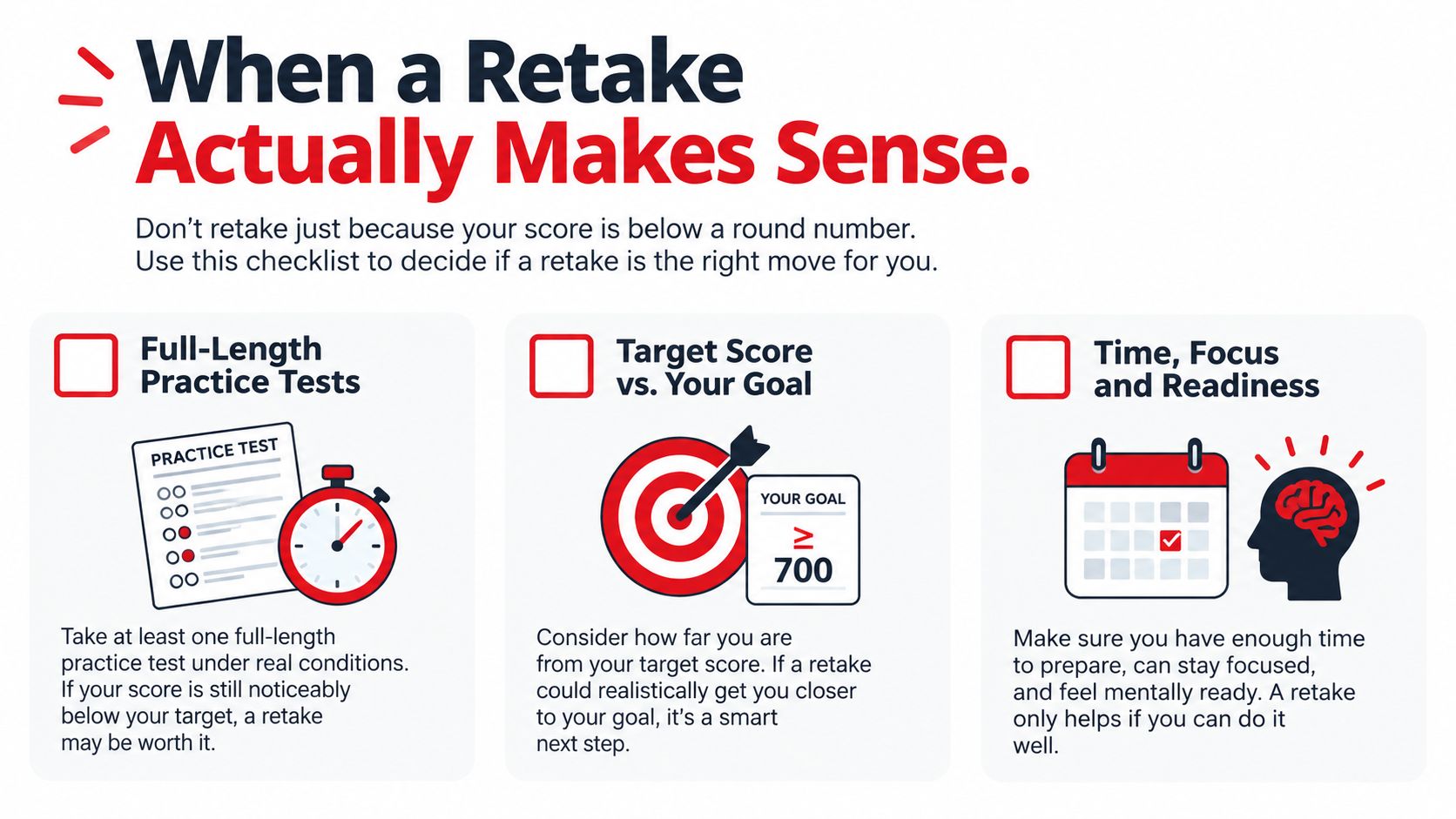
A retake shouldn't happen because the score misses a round number. It makes sense only when the applicant can explain what will change, how the change will be measured, and why the timing works.
Three conditions create a defensible retake case:
- Fresh full-length practice tests show consistent improvement. One unusually high practice result isn't enough. The pattern should be repeatable under conditions that resemble the official exam.
- The application timeline can absorb the retake. The new score must arrive in time to serve the intended application strategy, and the preparation period shouldn't undermine essays, letters, clinical work, or school research.
- The improvement would change the plan. A higher score should meaningfully strengthen the school list, resolve a section concern, or improve the academic balance of the application. A small increase that changes nothing may not justify another testing cycle.
Multiple attempts require an honest audit
Medical schools decide how to use multiple MCAT attempts, and policies vary. Applicants should read the current policy for every school rather than assume that all programs use only the highest score. The score report's confidence bands also caution against treating small differences as decisive, so a retake should be supported by more than anxiety about a one- or two-point gap.
A retake deserves more consideration when the first attempt followed inadequate preparation, a major disruption, or a clearly identifiable weakness that the new plan addresses. It deserves less consideration when practice scores remained near the official result and the proposed strategy is just to repeat the same preparation.
The applicant should also count opportunity cost. Another exam cycle can consume time that might otherwise improve secondary essays, interview preparation, clinical exposure, service, research, or academic repair. The low MCAT score guidance can serve as a starting point for evaluating whether the better move is a retake, a revised school list, or broader application strengthening.
Retake decision: If practice evidence, timing, and strategic payoff aren't all present, another exam seat is probably not the highest-value use of the applicant's time.
Planning a Realistic Study Timeline
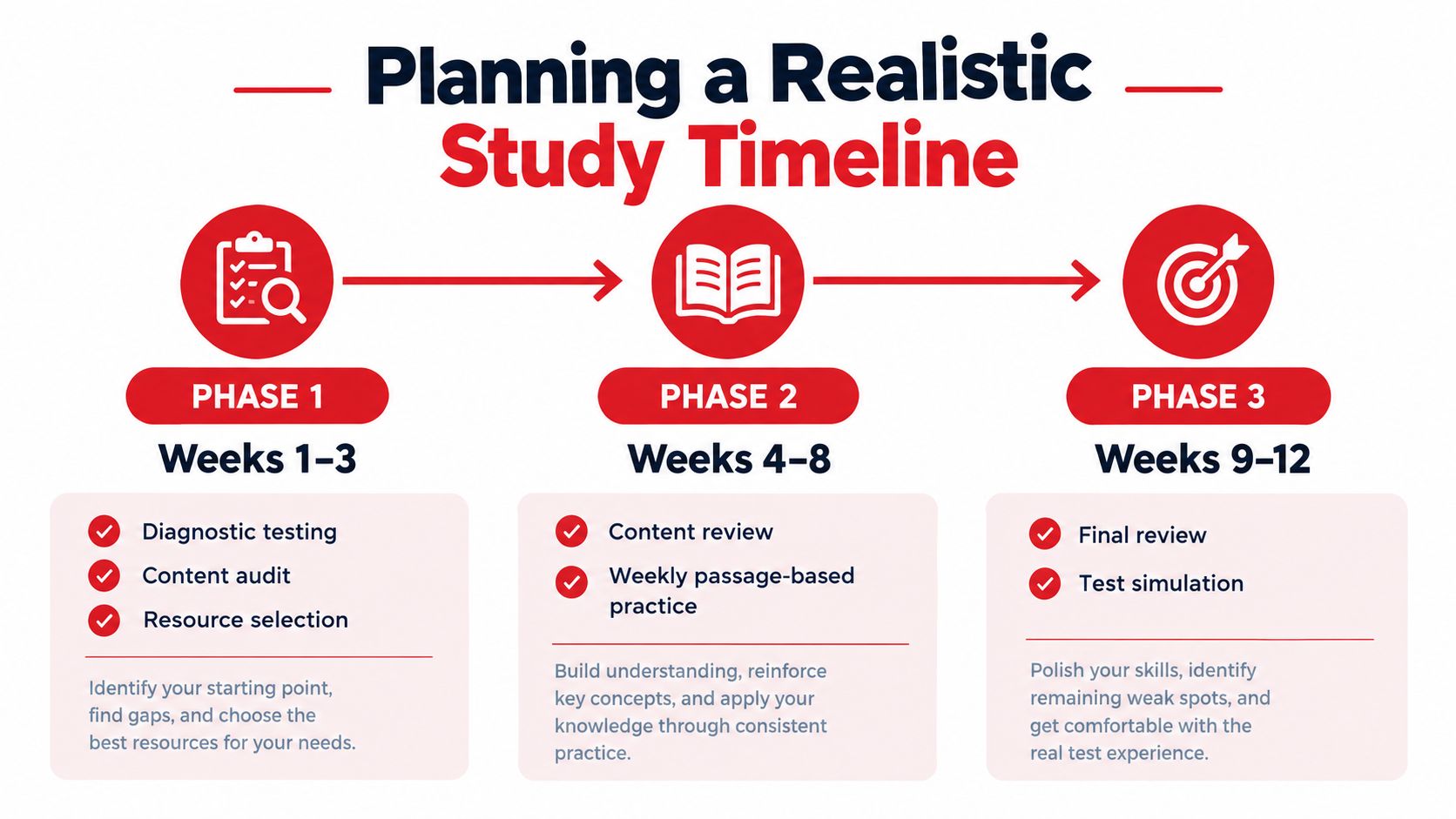
A 12-week plan works best when each phase answers a different question. The opening phase identifies the baseline. The middle phase repairs weaknesses while building passage skill. The final phase tests whether the improvement holds under realistic conditions.
Weeks one through three
The applicant begins with a diagnostic exam, a content audit, and a resource decision. The diagnostic should produce more than a total score. Section results, missed-question categories, timing problems, passage errors, and careless mistakes all belong in the audit.
A practical review asks:
- Did the applicant lack content knowledge?
- Did the passage contain evidence that was overlooked?
- Did timing force rushed guesses?
- Did the applicant choose an answer before identifying the question's task?
- Did the same error appear across multiple passages?
Resource selection should remain limited and deliberate. Official AAMC materials should anchor familiarity with the exam's style, while a question bank, review text, flashcard system, or tutoring support should address a specific need rather than create a crowded schedule.
Weeks four through eight
The middle phase combines targeted content review with weekly passage-based practice. Content review should follow the diagnostic rather than replace it. If biology recall is adequate but data interpretation is weak, rereading broad biology chapters may produce less value than reviewing experimental passages and analyzing every missed inference.
Each practice block needs a review block. The applicant should maintain an error log with the tested concept, the reason the chosen answer failed, the evidence supporting the correct answer, and the action that prevents repetition.
The MCAT study schedule framework can help organize those activities into a repeatable calendar.
Weeks nine through eleven
The final preparation phase uses full-length exams at regular intervals, followed by detailed review. The score matters, but the review matters more. An applicant who records only the total loses the information needed to make the next practice session useful.
A strong review cycle separates knowledge gaps, reasoning errors, timing failures, and avoidable mistakes. It also checks whether the same weak section continues to suppress the total. A plateau on one section, repeated errors on the same passage types, or limited time before the exam can justify one-on-one assistance from a qualified preparation provider.
Week twelve and the readiness check
The last week should taper rather than introduce an entirely new strategy. The applicant confirms registration details, sleep and transportation plans, test-day logistics, and familiarity with the testing interface.
A readiness checklist should include:
- Stable practice performance: Scores consistently sit near the personal target under realistic conditions.
- Weak-section progress: The weakest demonstrated section has improved by at least two points on fresh practice evidence.
- Full-exam stamina: The applicant can maintain concentration through the complete testing experience.
- Interface confidence: Navigation, highlighting, passage review, and timing decisions feel familiar.
- Error control: Recent misses reflect manageable judgment errors rather than unresolved foundational gaps.
A score target remains useful only when the preparation data support it. Confidence alone isn't readiness, but persistent panic also shouldn't be treated as proof of failure.
Putting It All Together
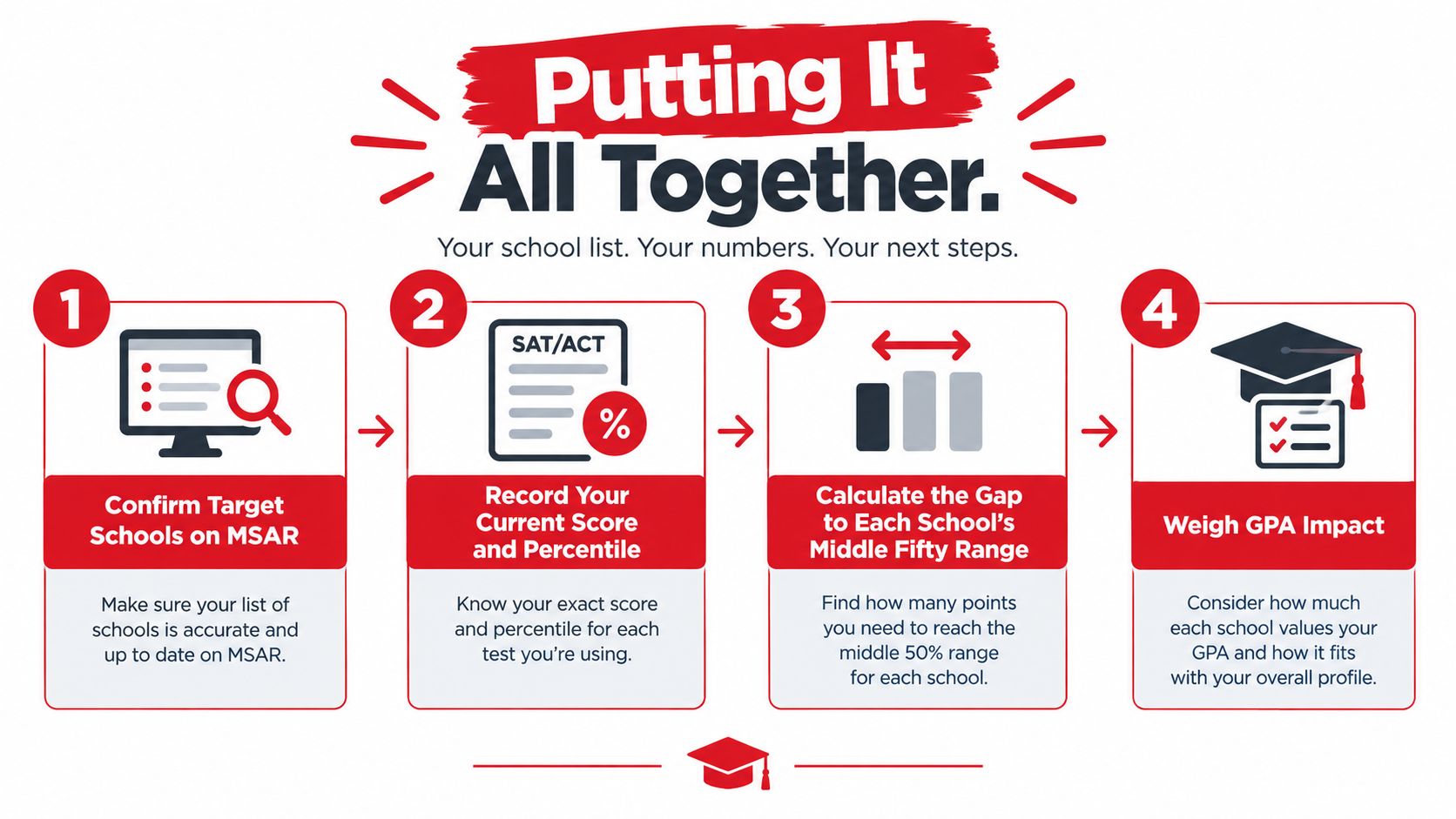
The answer to what is a good MCAT score becomes practical when the applicant stops looking for a universal cutoff and completes a school-specific audit.
- Confirm the current target list and review each program's published requirements.
- Record the total score, section profile, and current percentile.
- Compare the score with each school's median and published middle range.
- Weigh GPA, clinical exposure, service, research, letters, essays, residency, and mission fit.
- Decide on a retake only when practice evidence and application timing support it.
- Lock in a study schedule that addresses demonstrated weaknesses rather than general anxiety.
A score is one data point in a broad application. It can affect school-list strategy and academic positioning, but it doesn't define an applicant's potential as a physician, colleague, or future resident. A lower score calls for analysis and a realistic plan, not shame. A high score calls for disciplined school selection, not overconfidence.
Sources
- Association of American Medical Colleges, current MCAT percentile table effective May 1, 2026 through April 30, 2027.
- Association of American Medical Colleges, MCAT scoring guidance.
- Association of American Medical Colleges, 2025 medical-school enrollment and admissions data.
- Association of American Medical Colleges, Facts: Applicants and Matriculants.
- Association of American Medical Colleges, MCAT score-report guidance.
Applicants who need help translating an exam result into later board or residency planning can review the structured preparation and consulting options available through Ace Med Boards. The service offers individualized support for USMLE, COMLEX-USA, and residency-related planning, with the next step being a low-pressure consultation about the applicant's goals and timeline.