UWorld for USMLE Step 2 CK is most effective as a measured training tool, not passive reading: use timed mixed blocks, a two-axis error log, and spaced re-testing. The May 7, 2026 software change also makes pacing a separate skill because the exam now uses shorter, more numerous blocks without changing the total testing time.
You may be in the familiar position of having completed hundreds of questions, spent hours reading explanations, and still missing the same management decisions on fresh mixed blocks. That pattern doesn't mean you're incapable of improving. It usually means your question bank is functioning as a content library instead of a diagnostic instrument.
This guide treats UWorld as a way to measure accuracy, pacing, uncertainty, and recurring error patterns. It also shows how to combine question-bank work with NBME self-assessments, targeted remediation, and a clear decision about whether your readiness supports taking the exam or postponing it.
Why Most UWorld Prep Underperforms
A third-year student eight weeks from Step 2 CK finishes 1,200 questions, reads every explanation, and still converts about 55% on fresh mixed blocks. The student feels busy because each study day contains substantial reading, but the same errors keep returning: misidentifying the task, missing a decisive clue, choosing a familiar distractor, and changing a sound answer without evidence.
The problem isn't effort. The problem is that reading explanations doesn't automatically create a repeatable correction. If you don't record why you missed an item, you can't tell whether the next miss reflects missing knowledge, poor problem representation, weak pacing, or an avoidable answer change.
Passive review hides the actual failure
A highlighted sentence can feel memorable while leaving your decision process untouched. You may recognize the diagnosis in the explanation but still fail to identify it in a new vignette because you never practiced compressing the stem, naming the task, or comparing the leading alternatives.
Common forms of low-yield review include:
- Explanation collecting: Copying large portions of explanations creates notes but not necessarily retrieval strength.
- Answer-only review: Recording the correct option without identifying the decisive clue leaves the reasoning gap intact.
- Untimed comfort: Taking as long as needed makes difficult decisions feel manageable, but it conceals pacing problems.
- Unstructured repetition: Repeating missed questions without a category can produce recognition of familiar wording rather than transferable reasoning.
A better review asks three questions after every meaningful miss: What did I fail to know? What did I fail to notice? What will I do differently on an unseen item? The distractor analysis guide can support this kind of comparison without turning the explanation into a transcript to memorize.
Underperformance has a measurable definition
For this article, underperformance doesn't mean a particular percentage on one block. It means that your study activity isn't producing durable changes in at least one of four observable areas:
- Fresh-question accuracy, especially on mixed blocks.
- Time per question, including the number of questions reached before the block ends.
- Repeated error tags, such as premature closure or misreading.
- Transfer, your ability to explain why a different-looking distractor fails.
Practical rule: If review takes longer than the block and the same error category appears again, change the review process before adding another resource.
The solution is measured training. Complete questions under a defined time condition, log the reason for each miss or marked guess, repair only the relevant gap, and return to an unseen question after spacing. The rest of the plan is built around that loop.
What UWorld and Step 2 CK Actually Contain
UWorld describes its Step 2 CK question bank as containing over 4,300 sample questions written by practicing physicians. UWorld's official Step 2 CK guide places that resource inside an exam ecosystem where Step 2 CK is scored on a 1-to-300 three-digit scale, most test-takers score between 211 and 275, and the reported mean for first-time takers from U.S. and Canadian medical schools was 243 during 2018–2019.
The question bank and the exam aren't identical products. UWorld offers configurable practice through system-based, mixed, tutor, and timed settings. Step 2 CK asks you to switch among clinical problems and physician tasks under a fixed testing environment, so completing a large number of questions isn't enough unless your settings gradually train that switching.
The May 2026 format changes pacing
As of May 7, 2026, Step 2 CK uses 16 blocks of 30 minutes in the same 9-hour testing session. The exam still contains 316 questions, and the total exam time remains unchanged. Before that software update, the exam used eight 60-minute blocks. The USMLE's software update notice and the current Step 2 CK format summary should be checked again before scheduling because delivery details can change.
The practical implication is straightforward. A student who practices only long, comfortable sessions may understand the material but struggle with repeated starts, shorter decision windows, and accumulated fatigue. Your UWorld plan should include some shorter timed sets that resemble the cadence of the current software, while larger mixed blocks still build endurance.
| Parameter | UWorld Step 2 Qbank | Step 2 CK exam, May 2026 |
|---|---|---|
| Primary purpose | Learning, diagnosis, and practice | High-stakes clinical knowledge and reasoning assessment |
| Question source | Physician-authored preparation items | Official examination items |
| Organization | System-based or mixed, depending on settings | Mixed clinical presentation and task structure |
| Timing options | Tutor, timed, or untimed configurations | Fixed timed blocks |
| Current structure | Configurable by the learner | 16 blocks of 30 minutes |
| Total session | Determined by your study plan | 9-hour session |
| Question count | Over 4,300 sample questions in the bank | 316 questions |
UWorld doesn't replace the official USMLE content outline, and no question bank should be treated as a literal reconstruction of the exam. Use system blocks to repair a defined weakness, mixed blocks to test discrimination, and official self-assessments to observe how your preparation performs under a different item-writing environment.
Baseline Diagnosis Before You Change Anything
Start with one 40-question mixed timed block before changing your schedule. Complete it without pausing, use the same scratch-paper and break habits you expect to use on test day, and record more than the percentage correct.
Your spreadsheet can contain these fields:
- Accuracy: Correct answers divided by completed questions.
- Average seconds per question: Total active block time divided by questions answered.
- Marked items: Questions you flagged because your confidence was low.
- Educated guesses: Answers reached through elimination or partial knowledge.
- Blind guesses: Answers selected without a usable reasoning path.
- Error tags: The primary reason for each miss or marked item.
Don't use the first result as a verdict. A single block can be affected by topic mix, fatigue, or an unusually unfamiliar sequence. Repeat the same diagnostic conditions with a second fresh mixed block before you redesign your calendar.
Read the result as a starting point
The following bands are planning tools, not official USMLE categories:
| Baseline accuracy | Initial weekly approach |
|---|---|
| Below 45% | Use focused system blocks, shorter daily volume, and extensive error repair before emphasizing mixed endurance |
| 45% to 55% | Combine focused remediation with regular timed mixed practice and monitor recurring process errors |
| 55% to 65% | Increase mixed timed work, preserve targeted repair, and track pacing and marked-question accuracy |
| Above 65% | Emphasize mixed discrimination, NBME review, avoidable-error reduction, and exam-specific pacing |
These bands don't predict a score. They tell you where to look first. A learner at 58% with many knowledge-gap tags needs a different week from a learner at 58% whose misses are mostly misreads and answer changes.
Use an NBME Step 2 CK practice-exam resource for formal checkpoints, but don't substitute an NBME result for a process audit. Your next plan change should require two data points, such as a second block confirming the accuracy range or a stable error pattern across fresh questions.
Weekly Block Strategy and Mode Choices
A workable dedicated-study week can use four working days for question blocks and three days for remediation, review, or lighter consolidation. During dedicated study, some learners can work toward two or three timed mixed 40-question blocks daily. During clerkships, a smaller volume may be more realistic. The correct target is the largest amount you can review accurately without turning every explanation into an all-day reading assignment.
Match each mode to its purpose
Tutor mode is useful when you're acquiring a method or repairing a clearly defined content gap. It gives immediate feedback, which can help you connect a missed clue to the correct management principle before the reasoning disappears.
Timed mode is necessary once you need to train pacing, uncertainty management, commitment, and endurance. A practical switching trigger is three consecutive tutor blocks above 75% on a topic, provided the accuracy reflects genuine reasoning rather than recognition of repeated wording. That trigger is a study rule, not an official USMLE requirement.
| Criterion | Tutor mode | Timed mode |
|---|---|---|
| Main use | Immediate learning and focused repair | Exam-like decision-making |
| Best timing | Early work on a weak system or task | Later preparation and regular pacing practice |
| Feedback | Appears after each item | Appears after the block |
| Helpful for | Understanding mechanisms and management sequences | Reading speed, commitment, and fatigue control |
| Main risk | Overdependence on immediate explanations | Rushing without reviewing errors |
Build the week around deliberate variation
Early in a topic cycle, system-based blocks can help you connect related presentations and management decisions. After the first two weeks, introduce random ordering consistently so you must identify the relevant system and task without a label.
For a 40-question study block, reserve about 60 minutes when practicing the longer cadence, and add an optional 5-minute review window only if you can keep it separate from the timed work. Under the May 2026 exam format, also practice shorter sets that reflect the current 30-minute block rhythm. Don't pause mid-block in timed mode unless your planned practice specifically includes a break. Tutor mode can be paused for learning.
Finish every block with a 2-minute posture and timing audit before reading explanations. Write down when you started slowing, whether you left questions incomplete, and whether your marked answers were educated guesses or blind guesses. That small pause turns vague fatigue into a trackable variable.
Reviewing Incorrects With a Two-Axis Error Log
A useful error log records two different dimensions. The first axis describes where the knowledge failed. The second describes how the decision failed. Keeping those dimensions separate prevents you from labeling every wrong answer as a content gap.
The content axis can use three labels:
- Missing knowledge: You didn't know the diagnosis, mechanism, screening principle, or next step.
- Misapplied knowledge: You knew the relevant fact but applied it to the wrong clinical context.
- Careless execution: You knew the answer and missed through a preventable reading or attention error.
The process axis can include misread stem, missed decisive clue, faulty problem representation, distractor attraction, pacing cutoff, or answer change. Your log should also include the organ system, physician task, one-sentence correction, next review date, and an unseen transfer question.
Map the tag to an action
| Knowledge gap | Process error | Corrective action |
|---|---|---|
| Missing knowledge | Any process tag | Create a concise retrieval card or review a focused reference, then answer an unseen item |
| Misapplied knowledge | Faulty problem representation | Write a one-paragraph mechanism note and practice compressing a similar stem |
| Careless execution | Misread stem | Use a pre-block checklist that requires identifying age, timing, stability, and the asked task |
| Known content | Distractor attraction | State the decisive clue and the finding each leading alternative fails to explain |
| Any knowledge state | Pacing cutoff | Run a short timed sub-block and record the point at which reading or decision time deteriorates |
| Any knowledge state | Answer change | Record the original reasoning and the evidence that justified the change, if any |
You don't need to reread every explanation in full. For routine misses, first read the educational objective and the final paragraph, then inspect the specific explanation that resolves your error. Spend about 20 minutes reviewing a block before deciding whether an item deserves deeper study. The review time is a planning target, not a rule that overrides a complex gap.
Retest for transfer, not recognition
Create a 10-question spaced block from missed concepts approximately three days later. If you remember the original wording, ask yourself to explain the mechanism, identify the task, and eliminate the distractors without relying on visual memory.
A question shouldn't return more than twice in your planned repetition cycle. After that, replace it with an unseen transfer question. Repeatedly rereading a familiar item can inflate confidence while leaving performance on new wording unchanged.
A structured progress-tracking dashboard can help you review recurring tags weekly. Change your study plan only when a pattern appears across fresh questions, not because one difficult item felt alarming.
NBME Self-Assessments and the Postpone Decision
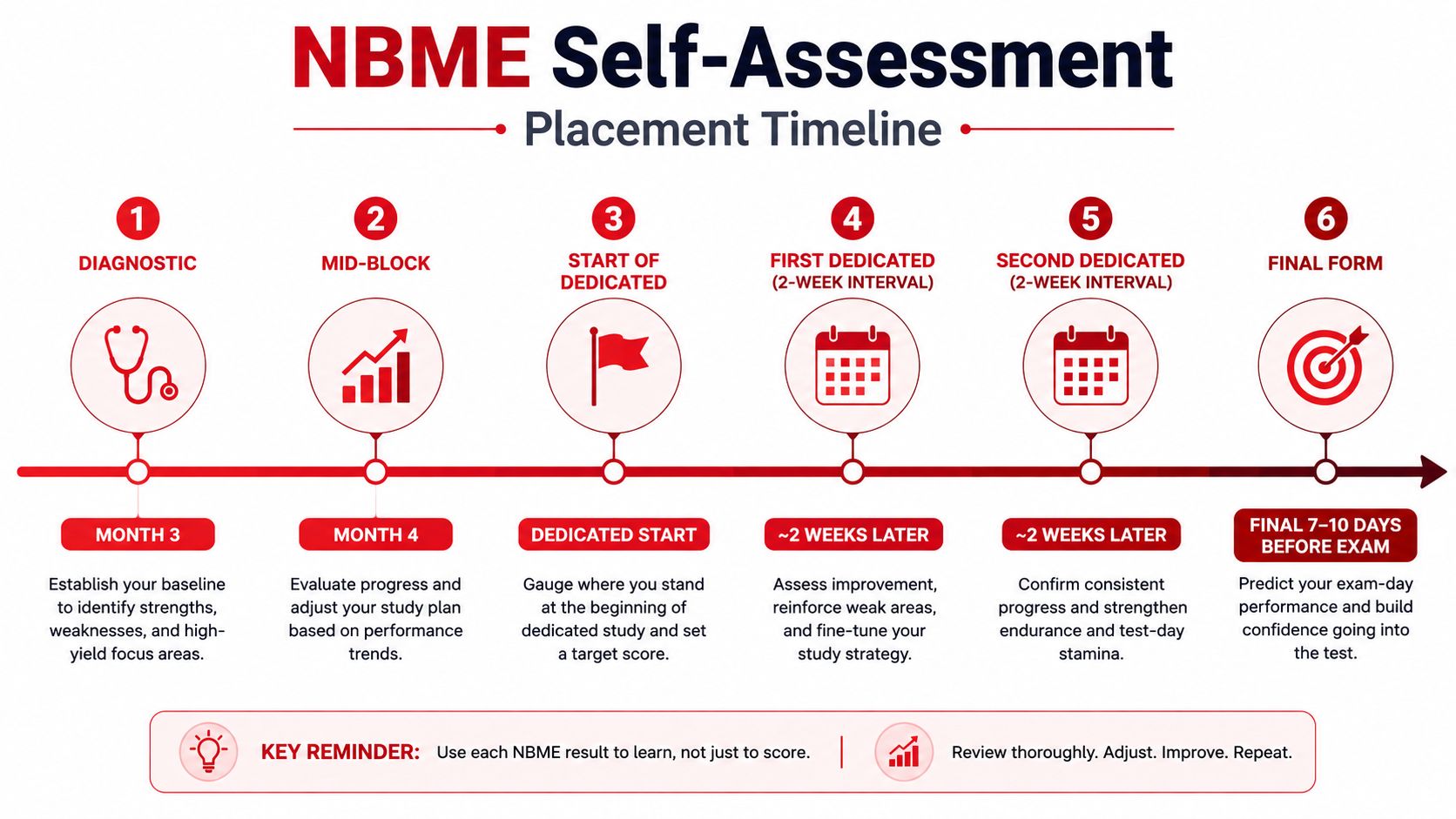
NBME self-assessments are checkpoints, not daily mood measures. Schedule one diagnostic assessment around month three, another around month four, one at the start of dedicated study, two during dedicated study at two-week intervals, and a final form 7 to 10 days before the exam. Confirm current form availability and score-reporting details through NBME's official self-assessment information.
Interpret trends, not isolated numbers
Use the score interpretation and published correlation information supplied with the relevant NBME form. Don't convert a raw percentage into a predicted Step 2 CK score by intuition, and don't compare results from different forms as though they were interchangeable measurements.
Pair every assessment with at least one process measure:
- Your recent fresh mixed-block average.
- The proportion of errors assigned to knowledge gaps.
- The frequency of repeated task-identification or pacing errors.
- Your ability to finish a 40-question practice block within 50 minutes when that is your chosen pacing drill.
A postpone discussion should use a decision tree rather than panic:
- Is the NBME trajectory improving across two forms? If not, identify the largest recurring error category.
- Are knowledge-gap tags below 20% of logged errors? If not, continue content repair and reassess.
- Can you complete a 40-question block within 50 minutes? If not, add structured pacing work before assuming the problem is knowledge.
- Do the second assessment and error log tell the same story? If they conflict, gather another data point rather than making an immediate scheduling decision.
The current passing standard is 218, effective for exams administered on or after July 1, 2025, after earlier increases from 209 to 214 and then to 218. Recent LCME-accredited medical-school means in USMLE materials were around 248 to 250 across academic years 2022–2023 through 2024–2025. Review the USMLE score and policy materials for current requirements.
A single NBME score never triggers a postponement. A two-form trend, consistent process data, and your actual testing constraints should drive that decision.
Monthly Plan, Final Review, and Common Mistakes
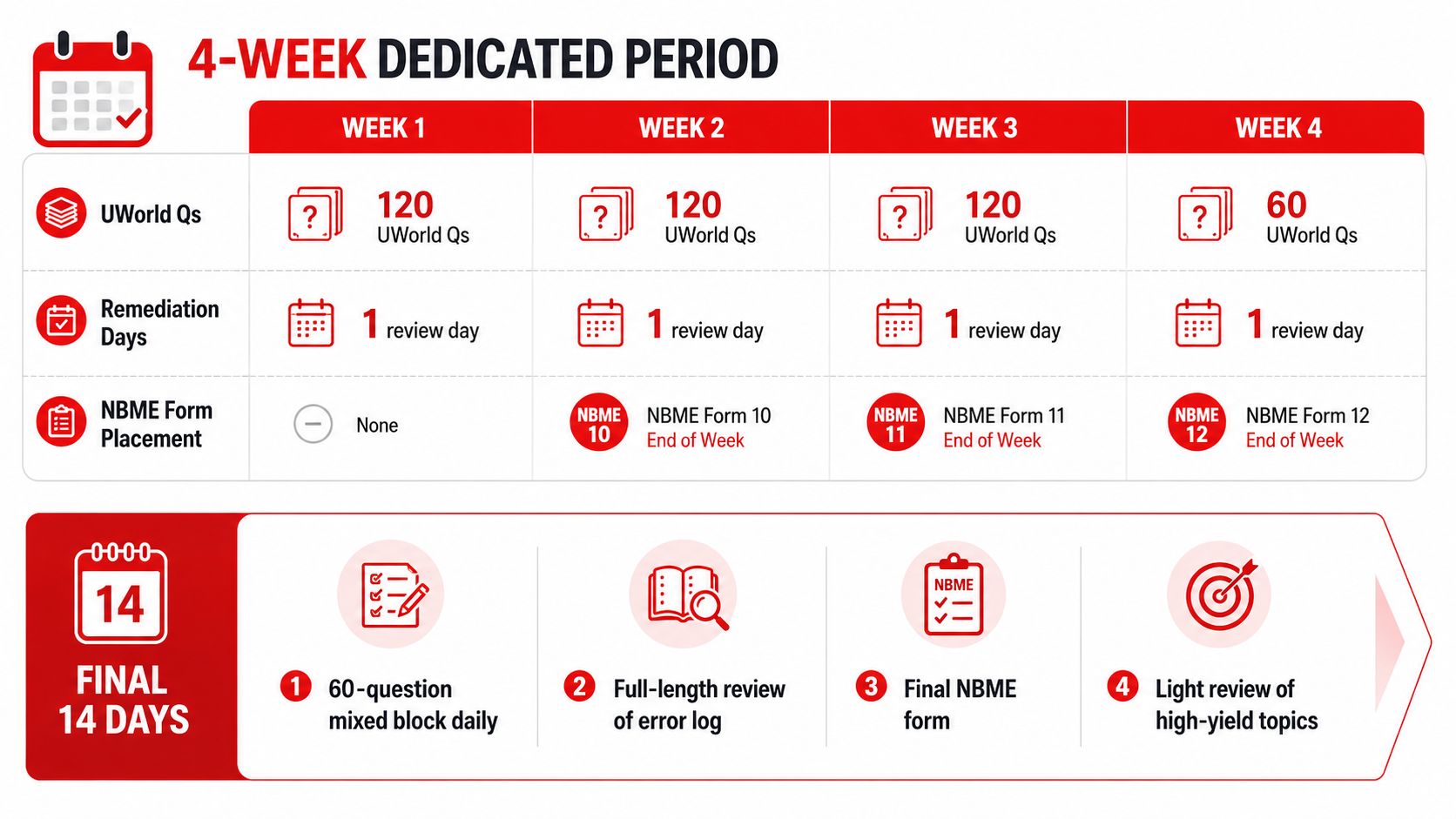
A four-week dedicated period works best when each week has a distinct purpose rather than identical question volume. The schedule below is a framework to adapt to your baseline, clerkship obligations, health, and available preparation time.
A four-week workflow
Week 1: Use focused tutor-mode blocks for the largest diagnostic weaknesses. End each day by tagging errors and selecting a small set of retrieval facts.
Week 2: Add mixed timed blocks while retaining system-specific remediation. Begin shorter pacing drills that reflect the current 30-minute exam rhythm.
Week 3: Make mixed timed work the center of the week. Review NBME errors alongside UWorld errors and look for shared task or process tags.
Week 4: Reduce novelty near the end. Prioritize repeated error categories, concise flashcards, sleep regularity, and the final readiness review rather than starting a large new resource.
During the final 14 days, a practical sequence is a 60-question mixed block in the morning when your schedule permits, afternoon review of incorrect and marked items through the two-axis log, and evening spaced retrieval for weak topics. A predictor-style block 48 hours before the exam can be useful if it doesn't disrupt sleep or confidence, but it isn't an official requirement.
Five mistakes that waste preparation time
- Over-reading explanations: Extract the objective, decisive clue, and correction instead of copying the entire page.
- Skipping timed mode: Schedule timed work before comfort becomes dependence.
- Ignoring shorter-block pacing: Practice repeated 30-minute efforts, not only long sessions.
- Treating NBMEs as the only benchmark: Pair each score with block data and error-tag trends.
- Redoing only marked questions: Include unseen transfer items so recognition doesn't masquerade as learning.
The Step 2 CK study plan can be useful when you need a broader calendar, but your own error data should determine how much time goes to content repair versus mixed practice.
Common questions about difficult decisions
Should you extend study time?
Extend only when the extra time has a defined purpose, such as repairing a recurring knowledge gap or stabilizing pacing. More calendar days without a changed habit usually produce more exposure, not necessarily more learning.
Should you retake a failed NBME?
A repeated form can measure familiarity as well as knowledge. Review the original errors, use unseen questions to test transfer, and interpret any repeated result cautiously rather than treating it as a clean new baseline.
Should you choose UWorld or AMBOSS?
Use one primary bank consistently enough to build a reliable error history. A second bank may help with a narrow weakness, but adding it before fixing review habits can split your attention and make progress harder to interpret. Ace Med Boards offers individualized question-analysis training, accountability, and tutoring for learners who need help turning block data into a repeatable study plan.
If your UWorld blocks show recurring task-identification, pacing, or distractor errors, Ace Med Boards can help you analyze those patterns, structure targeted practice, and maintain accountability without treating a question bank as a passive reading assignment. Schedule a free consultation to discuss your current block data and decide whether individualized USMLE Step 2 CK tutoring fits your preparation needs.