
UWorld supports the clinical-reasoning side of COMLEX Level 2-CE, but students still need separate osteopathic manipulative medicine (OMM) and osteopathic-content review to address a blueprint that assigns at least 10% to osteopathic principles, practice, and manipulative treatment.
Does strong performance on general clinical questions also demonstrate readiness to interpret osteopathic findings? Not necessarily. The useful approach is to treat UWorld as a clinical-reasoning engine, then measure osteopathic knowledge and COMLEX-specific application separately.
By Ace Med Boards Editorial Team
Does UWorld Cover COMLEX Level 2 on Its Own
UWorld can support a substantial portion of clinical preparation, but bank completion alone doesn't establish broad coverage. COMLEX-USA Level 2-CE, the Osteopathic Medical Licensing Examination Level 2 Clinical Evaluation, assesses how students apply medical knowledge within an osteopathic framework.
The National Board of Osteopathic Medical Examiners (NBOME) defines that framework. A student choosing UWorld for COMLEX Level 2 therefore needs to evaluate more than the number of available questions.
As of publication, UWorld's COMLEX Level 2 product materials list more than 4,250 Step 2 Clinical Knowledge (CK) and Shelf Exam questions, plus more than 140 osteopathic manipulative treatment (OMT) questions. These counts describe practice volume, not an item-by-item certification of blueprint coverage; product features should be checked before purchase.
NBOME Blueprint Minimums and What UWorld Contributes
The COMLEX Level 2 blueprint overview helps organize the following resource audit. The percentages describe different blueprint dimensions, so the musculoskeletal row isn't an additional competency-domain percentage to add to the other rows.
| Blueprint area | NBOME minimum | What UWorld contributes | Gap to plan for |
|---|---|---|---|
| Osteopathic patient care and procedural skills | At least 30% | Clinical vignettes across the Step 2 CK and Shelf question base | Separate osteopathic procedural reasoning review |
| Application of knowledge for osteopathic practice | At least 26% | Clinical application questions | An osteopathic reasoning tag for relevant misses |
| Foundational biomedical sciences | At least 25% | Mechanisms explained within clinical questions | Item-level mapping isn't established by bank size; audit weak mechanisms separately |
| Osteopathic principles, practice, and manipulative treatment (OPPMT) | At least 10% | Dedicated OMT questions | OMM texts and structured OMT review |
| Musculoskeletal presentations | 13% minimum | Clinical reasoning practice relevant to musculoskeletal presentations | A separate log for musculoskeletal and OMM-linked misses |
The contribution column describes practical uses, not a verified crosswalk of every UWorld item. A clinical question may strengthen diagnosis or management without assessing the osteopathic finding embedded in a COMLEX-style presentation.
Coverage test: A resource belongs in a study plan because it addresses a demonstrated need, not simply because its question count is large.
UWorld and NBOME are third-party names; this article isn't affiliated with or endorsed by either organization. Ace Med Boards doesn't include or resell question banks, and third-party accounts must remain in the student's name without shared login credentials.
The immediate task is a resource audit: mark each blueprint row as covered, partially covered, or needing another source.
How UWorld Compares With COMBANK and NBOME Practice
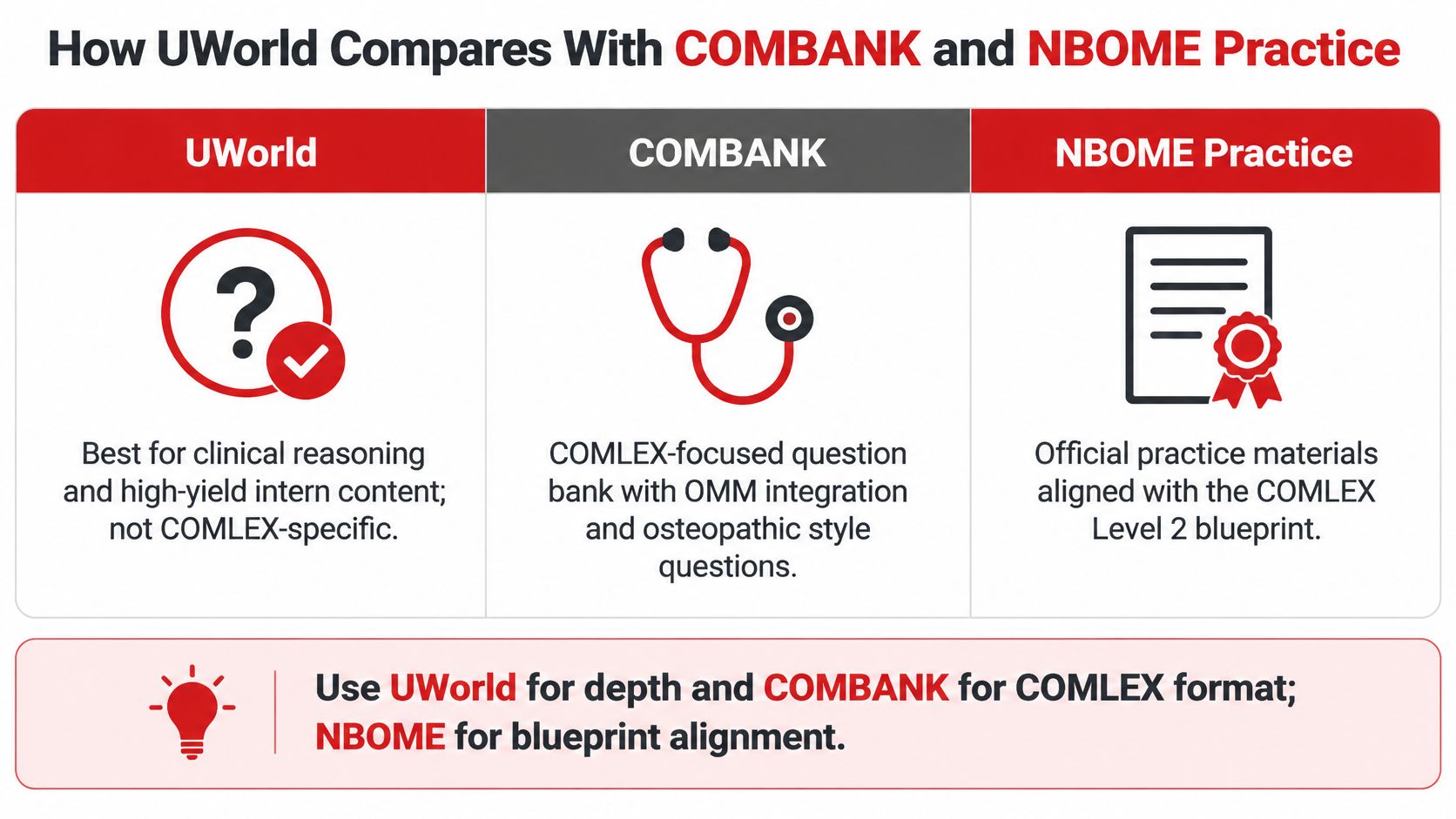
Three resources usually compete for the same study hours: a broad clinical bank, a COMLEX-focused bank such as COMBANK, and practice material published by NBOME. Each plays a different position. UWorld works like a sparring partner for clinical reasoning, a COMLEX-focused bank drills the specific dialect of osteopathic phrasing, and NBOME material shows what the actual match will feel like.
UWorld, COMLEX-Focused Banks and NBOME-Style Practice on the Same Criteria
| Criterion | UWorld | COMLEX-focused bank, such as COMBANK | NBOME-style practice |
|---|---|---|---|
| Question base | Clinical items with Step 2 CK and Shelf overlap | COMLEX-format items written for the osteopathic exam | Material published by NBOME itself, since an NBOME-style label alone doesn't confirm the source |
| Osteopathic content | Dedicated OMT subset | Osteopathic presentations built into the item pool; compare whether items are tagged to blueprint domains | OPP material written to the published blueprint; compare coverage domain by domain |
| Explanations | Detailed explanations in product materials | Written rationales; compare depth against UWorld's explanation on the same topic | Official answer keys; the closest available model of how NBOME frames the correct choice |
| Cost and access | Duration-based subscription; weigh cost against the planned study calendar | Subscription or package terms; weigh cost per week of dedicated study | A limited set of assessment forms, so each administration works better as a calibration event than as drill volume |
| Best use | High-volume clinical reasoning | COMLEX format drills and osteopathic terminology exposure | Blueprint calibration and familiarity with the official assessment construct |
The chart below summarizes the role each resource plays in a study plan.
Strengths and Limitations That Matter
- UWorld's strength: Its clinical question base and explanations support repeated work on diagnostic discrimination, mechanisms, and next-step reasoning. Its limitation is that a broad clinical bank isn't automatically a complete osteopathic curriculum.
- A COMLEX-focused bank's advantage: A second venue for osteopathic terminology and COMLEX-style phrasing. The comparison that matters is explanation quality on the topics you miss, not the size of the osteopathic label on the product page.
- Official practice materials' role: NBOME-published material exists to calibrate. Because the supply of official forms is limited, each one delivers more value as a scheduled checkpoint than as daily question volume.
For a closer product evaluation, the COMBANK and TrueLearn resource guide walks through how the osteopathic-focused options differ. Prices and access terms shift over time, so the durable comparison is functional: which resource closes which gap.
A student who follows clinical explanations but loses points to osteopathic wording needs a different supplement from a student who misses management decisions. Map each missed item to its blueprint domain first. The additional resource should address the largest diagnostic gap, not duplicate work you already perform well.
Question Volume and Timing for Each Study Plan
A content plan decides what you study. A pacing plan decides whether you can still reason clearly in hour seven. The NBOME examination description describes a one-day, eight-hour examination with 320 single-best-answer questions, divided into two separately timed four-hour sessions, with unused time from the first session not carried into the second.
That structure corresponds to approximately 40 questions per hour, or 1.5 minutes per question, before accounting for breaks and review. The practical progression runs from untimed learning to timed blocks to a full simulation that tests whether decision-making stays stable during the later session.
Editorial Starting Templates for UWorld Question Volume and Timing
The templates below are editorial planning examples. NBOME publishes no official question-volume requirements, and finishing the entire bank is not a prerequisite for exam day. Treat these numbers as a way to organize a hypothetical calendar, then adjust them against your own review speed.
| Plan | Timed-block pattern | Simulation schedule |
|---|---|---|
| Six-week plan | Four timed 40-question blocks per week | Two-session simulations in weeks 3 and 5, with a final simulation in week 6 if review and recovery time permit |
| Twelve-week plan | Three timed 40-question blocks per week | Two-session simulation every four weeks |
| Final two-week pacing check | One timed block per study day for pacing checks | One full simulation in the final week, early enough to review and recover |
A timed learning block can use a 40-question, roughly 60-minute practice target, matching the exam's own pacing. That block only counts if you can also review it thoroughly the same day. A student who completes four blocks but reads none of the explanations has trained pacing while leaving the underlying reasoning uncorrected.
Working Backward From the Calendar
Build the calendar in reverse. Reserve time for rotations, required school activities, rest, OMM practice, and explanation review first, because those commitments do not shrink when a block schedule gets ambitious. Assign question blocks only to the study time that remains, and leave open space after each simulation for remediation.
After the first two timed blocks in this framework, inspect where the time went. If reading the stem consumes the whole decision window, or the second half of the block turns rushed, shrink the block temporarily and practice naming the task in the question's final sentence before adding volume back.
Finishing more questions does not help when the student cannot explain why each rejected option was inferior.
A simulation should reproduce the two separately timed sessions instead of running as one uninterrupted marathon, because fatigue is part of what the exam measures. Record whether later-session errors came from fatigue, rereading, uncertainty, or content gaps, since each cause calls for a different fix.
National outcomes provide context for interpreting your own trajectory: Touro University's outcomes table reports a 91.33% national first-time pass rate for 2024–2025. A population figure describes the group; it cannot establish an individual student's readiness.
Review quality should determine sustainable volume. A smaller schedule that produces corrected reasoning patterns beats an ambitious calendar that leaves explanations unread.
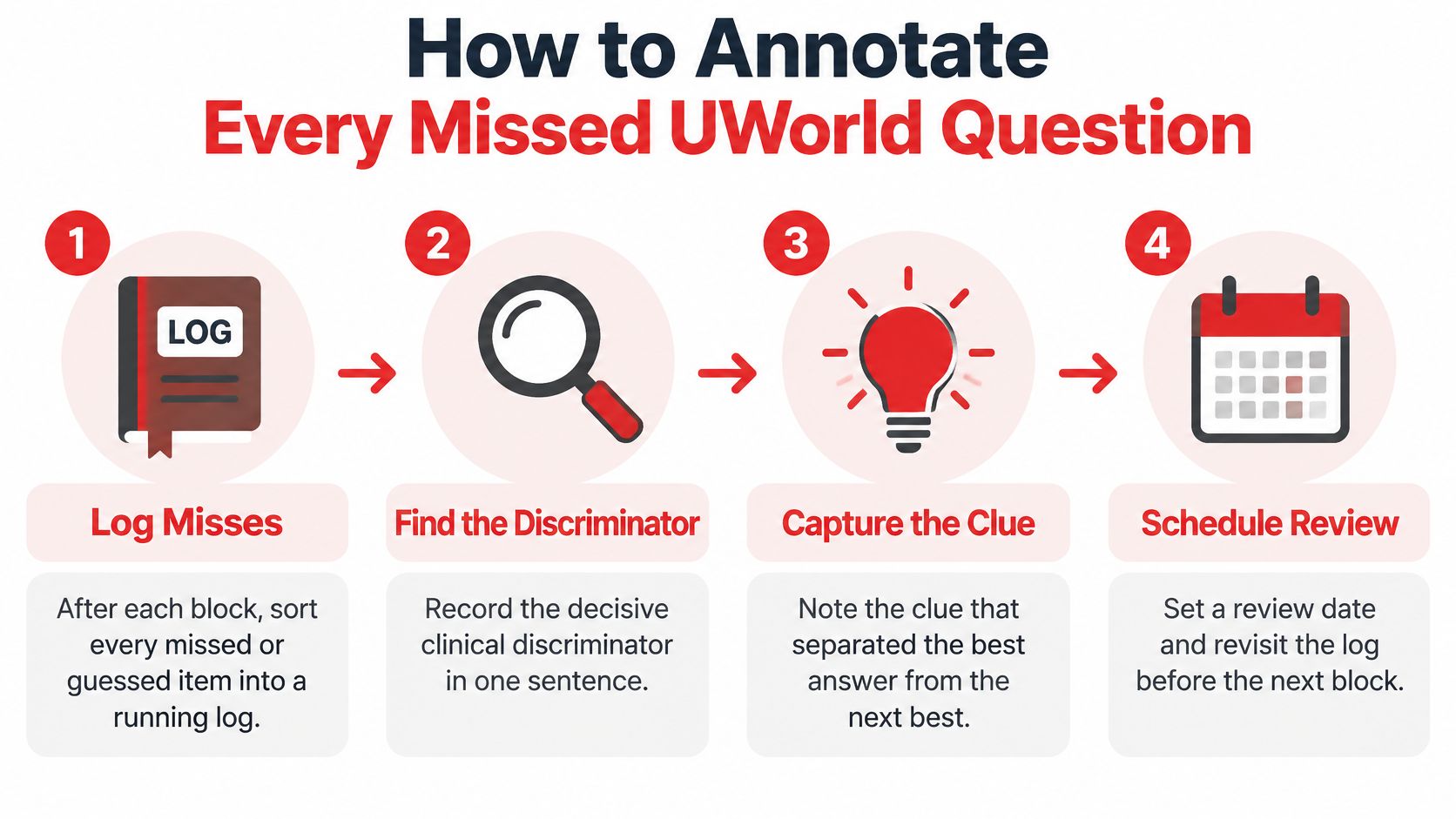
How to Annotate Every Missed UWorld Question
A useful annotation log captures the decision rule and the reason it was missed, not a condensed copy of an explanation. Every incorrect item and every correct guess belongs in that review process.
The official NBOME Level 2-CE blueprint supplies the domain framework for the coverage audit and error log. Its minimum weights distinguish osteopathic patient care and procedural skills at 30%, application of knowledge at 26%, foundational biomedical sciences at 25%, OPPMT at 10%, and musculoskeletal presentations at 13% within the presentation dimension.
A Repeatable Question-Review Workflow
Log misses and uncertain answers. Record the clinical presentation and competency being tested. Correct guessing shouldn't disappear into the block percentage.
Write the decisive discriminator. Use a sentence naming the finding that separated the best answer from its closest competitor. This reveals whether the problem was missing knowledge or failing to use an available clue.
Add the osteopathic layer. Note the relevant OMM diagnosis, OMT principle, contraindication, or terminology. Write none when no meaningful osteopathic connection exists rather than forcing one.
Classify the error. Use knowledge, interpretation, or execution. Execution includes rushing, overlooking the question task, or changing an answer without a defensible reason.
Convert repetition into practice. As an editorial rule, a tag recurring across three blocks can trigger a mixed set of 20 to 40 fresh questions addressing that reasoning problem. Keep the surrounding presentations mixed so recognition doesn't depend on a narrow topic label.
Prioritize by blueprint relevance. Compare recurring weaknesses with the exam framework rather than allowing the most memorable mistake to dominate the schedule.
Schedule a fresh-item check. About two weeks later is a reasonable editorial starting point. The purpose is to test transfer, not recognition of an answer previously reviewed.
An Original Educational Log Entry
| Presentation | Discriminator | Error type | Osteopathic layer | Next action |
|---|---|---|---|---|
| Generic musculoskeletal practice scenario | The documented motion restriction mattered more than the pain location | Interpretation | Review how the stated structural findings support the dysfunction label | Explain the finding before looking at answer choices |
This is an original reasoning example, not a recalled examination item or patient-care recommendation.
The guide to reviewing UWorld questions faster can help students keep annotations concise. Students who prefer speaking original study notes can compare the best dictation apps for students, without uploading question-bank text, screenshots, or protected material.
The log turns a percentage into specific, fixable patterns. This workflow supports examination reasoning, not clinical treatment decisions.
Reading Performance Metrics Without Overtrusting Percent Correct
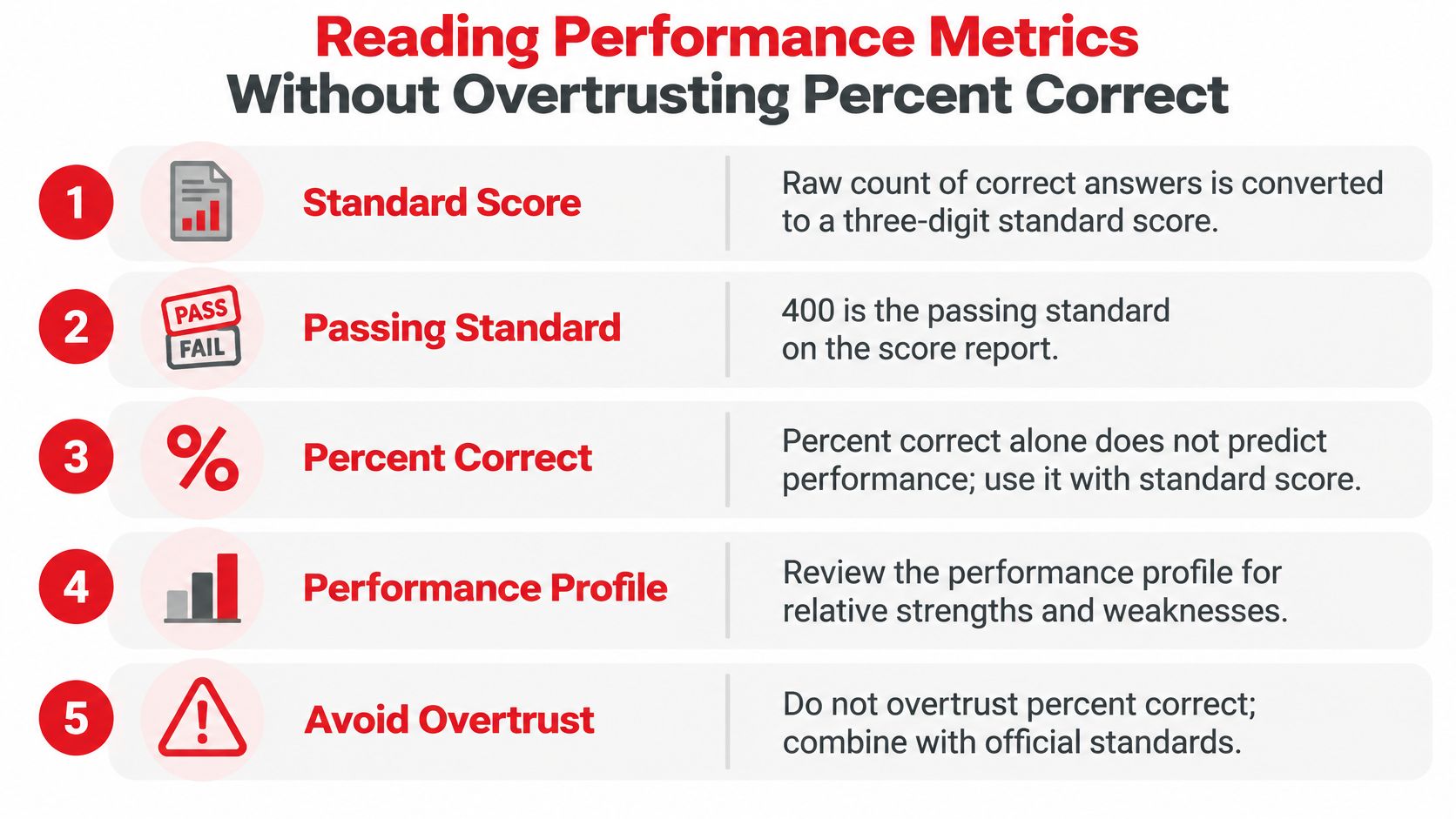
According to NBOME's scoring and reporting guidance, the number of correctly answered questions is converted into a three-digit standard score, and the Level 2-CE passing standard is 400. The official report also includes a pass/fail designation and a graphical Performance Profile comparing overall and content-area performance with first-time examinees who passed.
A UWorld percentage isn't that standard score. It reflects performance on the selected practice items under the conditions used for that block.
Score-Audit Checklist for UWorld Blocks and Simulations
The review intervals below are editorial tracking suggestions, not official score-prediction rules.
| Checklist item | What to record | When to review |
|---|---|---|
| Standard score | Record the result from each official score report and confirm the applicable passing standard | After each official score report |
| UWorld percent correct | Log results by block and blueprint domain | After every block |
| Repeated domain misses | Flag a domain recurring across three blocks | Weekly |
| Pacing | Record block time and later-session performance separately | After every block and simulation |
| OMM-specific misses | Maintain a dedicated column | After every relevant block |
| Baseline | Use the first full simulation as the starting reference | At the beginning of simulation tracking |
| Trend over time | Compare similar blocks and simulations | Every two weeks |
Compare Like With Like
An untimed, topic-specific block and a timed mixed block don't measure the same task. Repeated items can also reward answer recognition, so fresh-item performance deserves its own label.
Suppose a student's overall percentage improves while OMM errors remain unchanged. The appropriate conclusion is narrower than general readiness: clinical performance may be improving, but the osteopathic deficit still needs direct measurement.
Likewise, stable accuracy with faster completion may represent progress in execution. That improvement should be recorded without converting it into a predicted licensing score.
Interpretation rule: Practice performance should support a decision about the next study action, not become a verdict about the student's ability.
No universal UWorld percentage-to-COMLEX conversion is established by these official scoring materials. A qualified advisor or tutor can help interpret trends alongside appropriate assessments, but an online cutoff shouldn't substitute for that review.
When progress stalls, classify the recurring errors before adding more questions. Knowledge, interpretation, and execution require different corrections.
Closing the Osteopathic Gap With Targeted OMM Practice
OMM preparation needs a separate diagnostic process because broad clinical performance can conceal osteopathic weaknesses. The NBOME Level 2-CE specifications describe an examination spanning seven competency domains and ten clinical-presentation categories, making an OMM-only percentage an incomplete measure of integrated application as well.
The useful distinction is between knowing an osteopathic fact and using it inside a clinical vignette. A student may recognize terminology on a flashcard yet struggle when structural findings appear alongside competing diagnostic or management information.
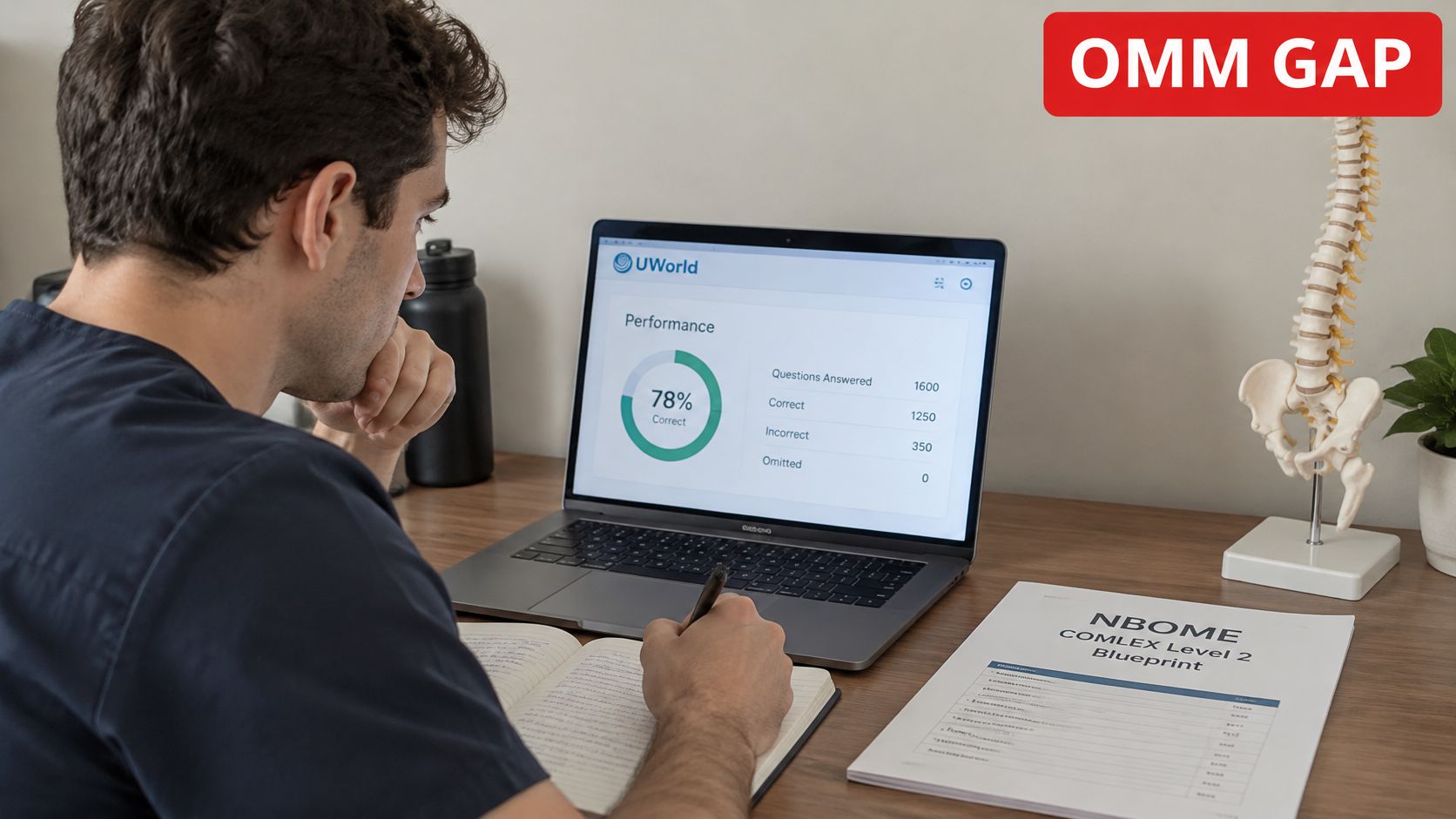
Run an Osteopathic Diagnostic Audit
Begin with the clinical error log and identify presentations that plausibly involve osteopathic reasoning. Then complete a separate short OMM-only block using material with explanations.
Keep those results distinct. The clinical log shows where integration may be missing; the focused block tests whether the underlying osteopathic concepts are available at all.
Organize targeted review around concrete examination topics:
- Osteopathic terminology: Interpret structural findings and distinguish descriptive language from the task being asked.
- Viscerosomatic relationships: Review associations in an OMM reference, then practice recognizing their role within a vignette.
- Chapman points: Pair location review with explanation-based questions rather than relying only on isolated recall.
- Counterstrain positioning: Use diagrams and structured recall, then check application in educational items.
- Technique principles and contraindications: Practice explaining why an option fits or doesn't fit the stated scenario.
These are study categories, not instructions for examining or treating a patient. Detailed clinical teaching should rely on authoritative references and qualified medical-educator review.
Make OMM a Scheduled Commitment
Choose an OMM text or COMLEX-specific OMT item set that explains the reasoning behind answers. The selection criterion should be whether the resource corrects the identified error, not whether it adds another large collection of material.
A fixed weekly slot prevents OMM from becoming the subject studied only after everything else is finished. Within that slot, alternate reference review, retrieval practice, and integrated questions.
The OMM board-review guide can help organize that work. A useful review ends with the student explaining which finding mattered, what principle it invoked, and why competing options were less appropriate.
Ace Med Boards' COMLEX Level 2-CE tutoring uses clinical vignettes to practice diagnosis, next steps in management, and reasoning through competing answer choices. That work complements official materials, independently owned question banks, and independent study rather than replacing them.
This content supports examination preparation only. It isn't medical advice or guidance for patient treatment.
Confirm Your Score Timeline and Choose Your Next Step
Key Takeaways
- Assign resources distinct jobs: Use clinical questions for reasoning practice and a deliberate osteopathic layer for unmet content needs.
- Prioritize corrected errors: A blueprint-mapped annotation log is more informative than a completion counter.
- Interpret metrics carefully: Practice percentages show trends; official scoring determines the licensing result.
- Protect OMM time: Give osteopathic review a recurring calendar slot and assess it directly.
Scheduling also requires attention to score reporting. NBOME's testing-window and score-release guidance states that Level 2-CE scores are generally available within two to six weeks from the end of the applicable testing window, not necessarily from an individual's appointment; release dates can change, and releases generally occur by 5:00 p.m. Central Time, barring unforeseen circumstances.
A student working toward a graduation or application deadline should therefore check the applicable window before selecting an examination date. Leaving a buffer helps prevent a reporting delay from becoming an avoidable administrative problem.
The COMLEX Level 2 score-release planning guide can help organize those calendar questions. The official NBOME schedule should remain the authority for the actual release date.
A Practical Decision Sequence
- Choose the resource mix from the diagnostic audit. Add clinical explanation, osteopathic practice, or format exposure according to the largest unresolved weakness.
- Select a sustainable plan length. Reserve review and recovery time before assigning additional blocks, especially when rotations or other obligations constrain the calendar.
- Confirm score timing before committing. Compare the applicable release window with the date by which the score is needed.
Students facing a plateau or returning after an unsuccessful attempt can use the same process without treating the previous result as a fixed limit. A revised plan should identify what will change in content review, interpretation, pacing, or assessment use.
Product descriptions and scheduling information are time-sensitive as of publication. No prices are quoted, current terms should be checked before purchase, and no pass, score, or other outcome is guaranteed.
Sources
Primary references linked throughout include UWorld's product description and NBOME's examination description, blueprint, Level 2-CE specifications, scoring guidance, and score-release calendar. Touro University's published outcomes table supplies the separately identified national performance context.
Ace Med Boards offers COMLEX tutoring that can complement a UWorld-based plan with focused clinical reasoning and pacing support. Students can visit Ace Med Boards to schedule a free COMLEX consultation about their exam level, timeline, and unresolved preparation gaps.