

Which reference range does COMLEX Level 3 expect you to have memorized? Fewer than most students assume. On this exam the reference interval usually sits beside the result, in parentheses when a question reports one or two values and in a small table when three or more appear, so the skill being measured is interpretation rather than recall. The National Board of Osteopathic Medical Examiners (NBOME) shows the format in its own illustration: a hemoglobin of 10.4 g/dL printed against 13.5–17.5 g/dL, paired with a mean corpuscular volume of 102.0 mcm³ against 79.0–93.3 mcm³.
That design choice reshapes how to study comlex level 3 lab values. You still need adult anchors so you can recognize a pattern in seconds, but memorizing 40 isolated cutoffs without the ability to grade severity or name a next step loses points that a dozen well-understood patterns win.
What follows is a working method: a scannable adult study-anchor chart, the approved panel list used inside clinical decision-making cases, a pattern-to-management table, three original teaching vignettes, the unit and specimen traps that break otherwise solid reasoning, and a timed checklist for lab-heavy items.
What Level 3 Prints Beside a Lab Result
When a Level 3 item reports laboratory results, the range travels with them. NBOME's frequently asked questions page states the convention plainly: one or two values carry their reference range in parentheses, while three or more values are set out in a table. The same page uses hemoglobin and red-cell size to demonstrate, which is why the anemia example above reads the way it does.
Three acronyms are worth fixing before anything else. COMLEX-USA is the Osteopathic Medical Licensing Examination of the United States, the licensing sequence for osteopathic physicians. NBOME is the National Board of Osteopathic Medical Examiners, the organization that publishes the blueprint and administers the exam. Clinical decision-making (CDM) cases are the interactive Level 3 format where you order tests and interventions in sequence rather than picking a single answer.
Because the comparator is printed, the exam rarely rewards a memorized institutional normal. It rewards three moves: deciding whether the abnormality is mild, moderate, or severe; connecting it to the patient's presentation; and choosing the next diagnostic or management step. A hemoglobin of 10.4 g/dL means one thing in a stable patient with menorrhagia and something quite different in a patient with melena and a heart rate of 120.
The real question behind the number: not "is 10.4 low?" but "low enough to change what you do next, and for which patient?"
Key takeaways
- Read the printed range before naming a disease. The supplied interval, not your memory, defines abnormal for that item.
- Grade the size of the change. Mild, moderate, and severe abnormalities lead to different next steps.
- Attach the pattern to the presentation. Age, symptoms, medications, and vital signs decide which pattern fits.
- Answer the decision the stem asks. Diagnosis, next test, treatment, and disposition are four different questions.
One caution protects you on both exam day and the wards. Reference intervals shift with laboratory, age, sex, pregnancy status, altitude, and testing method, so the anchors later in this article are study conventions for practice, not universal normals.
Scope note: this is examination education. Nothing here is medical advice, a diagnosis for any reader or patient, or a reason to start, stop, or change treatment. Format details reflect NBOME's published guidance as of 2026 and should be rechecked on the current NBOME pages before your test date.
High-Yield Ranges Worth Knowing Cold
The table below is a drill sheet, not a governing document. Every interval is a commonly taught adult study anchor, the kind you'd see in a U.S. question bank or a hospital handbook. None of it replaces the interval printed inside a question, and none of it should be used to judge a real patient whose own laboratory reported a different range.
| Test | Units | Study anchor (adult) | Exam focus |
|---|---|---|---|
| Hemoglobin, adult male | g/dL | 13.5–17.5 | Grade anemia and pair with MCV |
| Hemoglobin, adult female | g/dL | 12.0–15.5 | Same, and consider pregnancy context |
| MCV | fL | 80–100 | Microcytic versus macrocytic pattern |
| WBC | ×10³/µL | 4.5–11.0 | Infection, steroid effect, or marrow problem |
| Platelets | ×10³/µL | 150–400 | Bleeding risk or reactive thrombocytosis |
| Sodium | mEq/L | 135–145 | Volume status and osmolality clues |
| Potassium | mEq/L | 3.5–5.0 | ECG risk, renal losses, or GI losses |
| Bicarbonate | mEq/L | 22–28 | Metabolic acidosis or alkalosis |
| BUN | mg/dL | 7–20 | Prerenal pattern when read with creatinine |
| Creatinine | mg/dL | 0.6–1.2 | Acute versus chronic kidney context |
| Glucose, fasting | mg/dL | 70–100 | Hypoglycemia urgency versus hyperglycemia |
| Calcium | mg/dL | 8.5–10.5 | Correct for albumin before acting |
| Arterial pH | none | 7.35–7.45 | Identify the primary acid-base process |
| PaCO2 | mm Hg | 35–45 | Respiratory acidosis or alkalosis component |
| AST and ALT | U/L | roughly 10–40 each | Hepatocellular pattern with ALP and bilirubin |
| Albumin | g/dL | 3.5–5.0 | Chronic illness and calcium correction |
| INR | none | 0.8–1.2 | Bleeding risk and anticoagulant context |
| TSH | mIU/L | 0.4–4.0 | Interpret only with free T4 and the story |
Merck Manuals makes the underlying point that students often skip: reference ranges vary according to the demographics of the healthy reference population and the assay method or instrument in use (Merck Manuals normal laboratory values). A range is a property of a population and a method, not a law of physiology.
Three rules for reading any printed interval
Rule one, the printed range wins every disagreement. NBOME's own MCV illustration uses 79.0–93.3 mcm³, which is narrower at the top than the familiar 80–100 fL window. If a stem prints 95 fL as the upper limit and your chart says 100, the stem is right and the chart is a memory aid. Candidates lose items by arguing with the page in front of them.
Rule two, don't convert units mid-question unless the answer choices force it. If the stem reports glucose in mg/dL and the choices are clinical actions, the arithmetic buys you nothing. Convert only when a choice depends on the number, such as a threshold written in a different unit.
Rule three, "inside a wide study range" never means safe. A potassium of 5.4 mEq/L technically sits just above a 3.5–5.0 anchor, but a case that prints its own range of 3.5–5.1 and a peaked T wave is telling you the value is the problem. Context outranks the anchor every time.
Use the chart to build speed, then stop collecting cutoffs. For a worked application, see this walkthrough of how to interpret thyroid function tests, where the free T4 and the clinical story decide the answer and TSH alone rarely does.
The pattern layer is where the gains sit. A single abnormal number is a fact; a cluster of abnormal numbers is a diagnosis waiting to be named.
Laboratory Panels on Clinical Decision-Making Cases
A case asks for a panel when several related results help answer one clinical question. In Level 3 CDM cases, the COMLEX-USA Level 3 page lists these available panels: arterial blood gases, basic metabolic panel, complete blood count, electrolyte panel, hepatic panel, lipid panel, serum immunoglobulins, and urinalysis.
Select a panel from that list when it fits the question. If you need a test that is not included in an approved panel, order it individually.
| Panel | Choose it when | Do not use it as |
|---|---|---|
| Arterial blood gases | Respiratory failure or an acid-base problem is suspected | A substitute for the electrolyte or metabolic panel |
| Basic metabolic panel | Assessing volume loss, kidney injury, glucose, or electrolytes | The automatic answer to every chest-pain case |
| Complete blood count | Evaluating bleeding, anemia, infection, or unstable chest pain | A lipid or chronic-risk workup |
| Electrolyte panel | The question focuses on sodium, potassium, chloride, or bicarbonate | A full hepatic or urine evaluation |
| Hepatic panel | Hepatocellular injury or biliary disease is suspected | A label for every mild enzyme rise |
| Lipid panel | Assessing chronic cardiovascular risk | The first order for acute chest pain |
| Serum immunoglobulins | An immune or protein question fits the case | A first-line acute panel |
| Urinalysis | Assessing kidney injury or urinary findings, alongside BUN and creatinine | A replacement for the basic metabolic panel |
Acute versus chronic decides the order
For unstable chest pain with diaphoresis, a complete blood count and basic metabolic panel may help assess the patient, while cardiac markers are ordered individually. A lipid panel answers a longer-term risk question, not what should happen in the next few minutes. Match the order to the clinical question.
Suspected hepatic injury points toward a hepatic panel. Volume loss or rising creatinine points toward a basic metabolic panel and urinalysis before a more specialized urine study. For suspected respiratory failure or a mixed acid-base problem, read arterial blood gases alongside electrolytes. Review how to interpret arterial blood gases to practice connecting the results to the clinical picture.
The same symptom can call for different testing depending on the case. Dyspnea with an acute gas-exchange problem points toward an ABG; a question about long-term cardiovascular risk points toward a lipid panel. Identifying whether the case is acute or chronic helps keep the order focused.
The Level 3 blueprint weights osteopathic patient care and clinical application heavily. That makes the choice of test part of the clinical decision, not a separate lab exercise. Correctly reading a result does not help if the order or next action does not fit the patient's condition.
Before you select an order: state the clinical question, then name the panel or individual test that answers it. If the test does not answer that question, reconsider the order.
For a broader look at how panels are grouped beyond licensing exams, browse biomarker panel comparisons. Bundled panels address broader questions, while focused tests target a narrower one.
Abnormal Patterns and the Management Clue
Which finding changes the next step: the lab value by itself, or the pattern around it? Read each result against the reference interval printed beside it, then consider how far it falls outside that range, whether it is changing, and which other findings move with it. The management clue usually comes from that combination.
| Pattern | Cluster to notice | Usual exam clue | Trap |
|---|---|---|---|
| Iron deficiency | Low hemoglobin, low MCV, low ferritin | Look for a blood-loss source | Treating the number alone |
| B12 or folate deficiency | Low hemoglobin, high MCV | Neurologic signs point toward B12 | Folate-only plan when neurologic findings exist |
| Prerenal azotemia | Rising BUN and creatinine, concentrated urine | Assess volume and perfusion first | Calling every rise intrinsic kidney injury |
| Intrinsic kidney injury | Rising creatinine with casts, blood, or protein | Review nephrotoxins and look for the cause | Reflex fluids for every elevated creatinine |
| Metabolic acidosis | Low pH and low bicarbonate | Calculate the anion gap, then look for the cause | Ignoring compensation and the clinical story |
| Respiratory acidosis | Low pH and high PaCO2 | Assess ventilation and airway safety | Treating bicarbonate as the first move |
| Hepatocellular injury | AST and ALT dominate | Consider toxin, virus, or ischemia context | Labeling every enzyme rise cholestasis |
| Cholestasis | ALP and bilirubin dominate | Consider obstruction versus infiltrative disease | Skipping fractionation or the ductal story |
| Consumptive coagulation | Low platelets, prolonged clotting, low fibrinogen | Address the driving cause urgently | Treating one blood product as the whole plan |
| Marked hyperkalemia | Potassium clearly above the given range | Check the ECG and stabilize urgently if severe | Choosing dietary advice for a dangerous value |
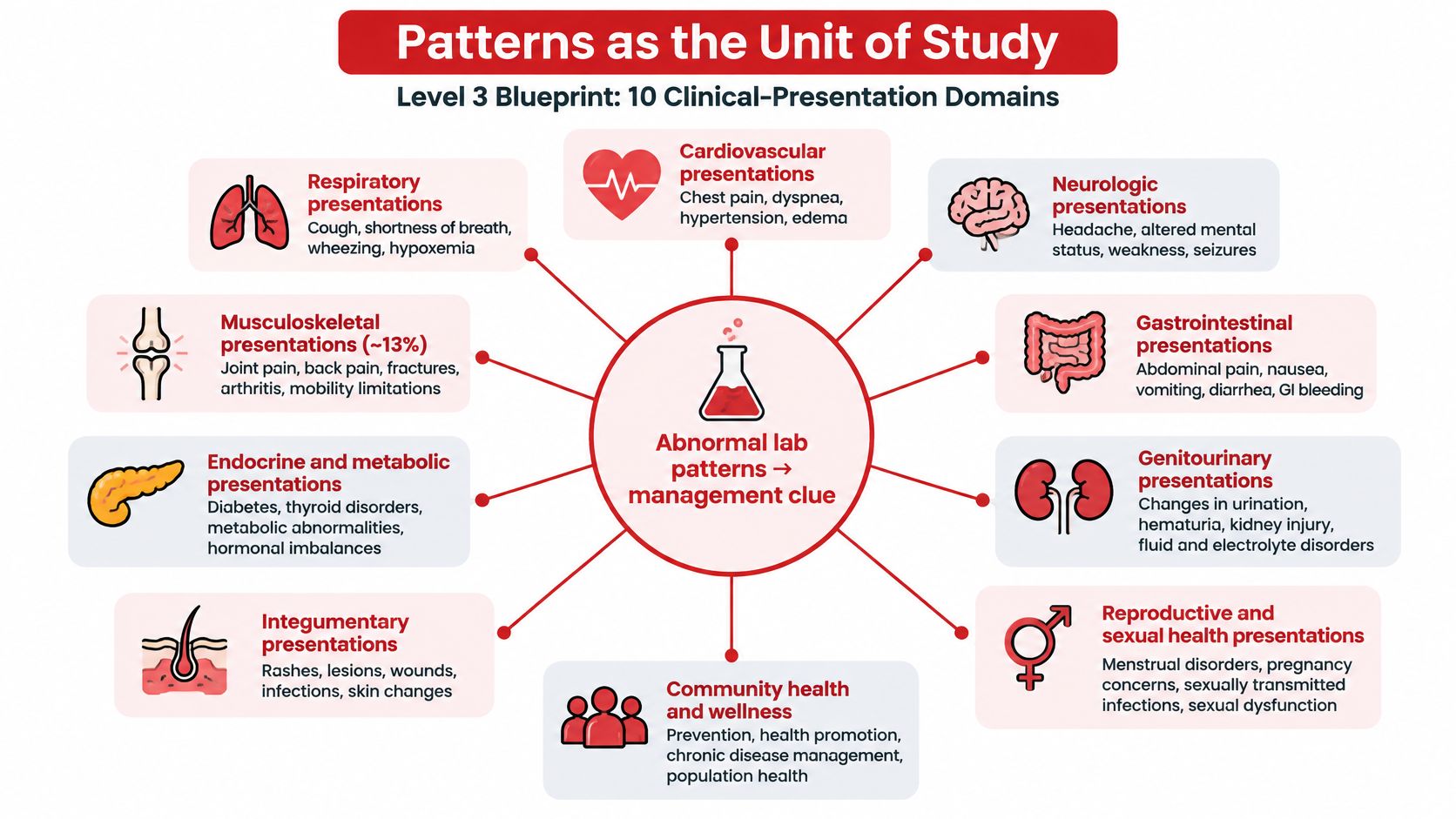
What each cluster is really asking
Treat the rows as decision prompts, not definitions. A microcytic anemia with low ferritin points toward finding a source of blood loss. A macrocytic anemia with numb feet raises concern for B12 deficiency, because folate alone may improve the blood count while neurologic problems remain unaddressed.
A creatinine rise with concentrated urine and vomiting suggests a different problem from a rise with casts after a possible kidney insult. The first pattern points toward assessing perfusion; the second calls for considering intrinsic injury and its cause. The same abnormal number can lead to different next steps.
For acid-base questions, first identify the disorder, then calculate the anion gap and interpret it in context. With respiratory acidosis, prioritize ventilation and airway safety rather than chasing the bicarbonate value. For liver tests, notice which enzymes dominate: AST and ALT suggest a hepatocellular pattern, while alkaline phosphatase and bilirubin suggest cholestasis.
Competency domains can hide the lab question
A lab abnormality may be presented through a decision about follow-up, a procedure, or handoff rather than a direct question about diagnosis. For example, markedly low platelets may prompt you to decide whether to call the patient back or hold a procedure. The result sets up the problem; the safest appropriate action answers the question.
These are study patterns, not universal thresholds or patient-care instructions. Reference intervals and management depend on the reporting laboratory and clinical setting.
Original Cases Where the Labs Change the Plan
Every vignette below is original teaching fiction. None is a recalled COMLEX item, none is NBOME material, and none is a patient-care plan.
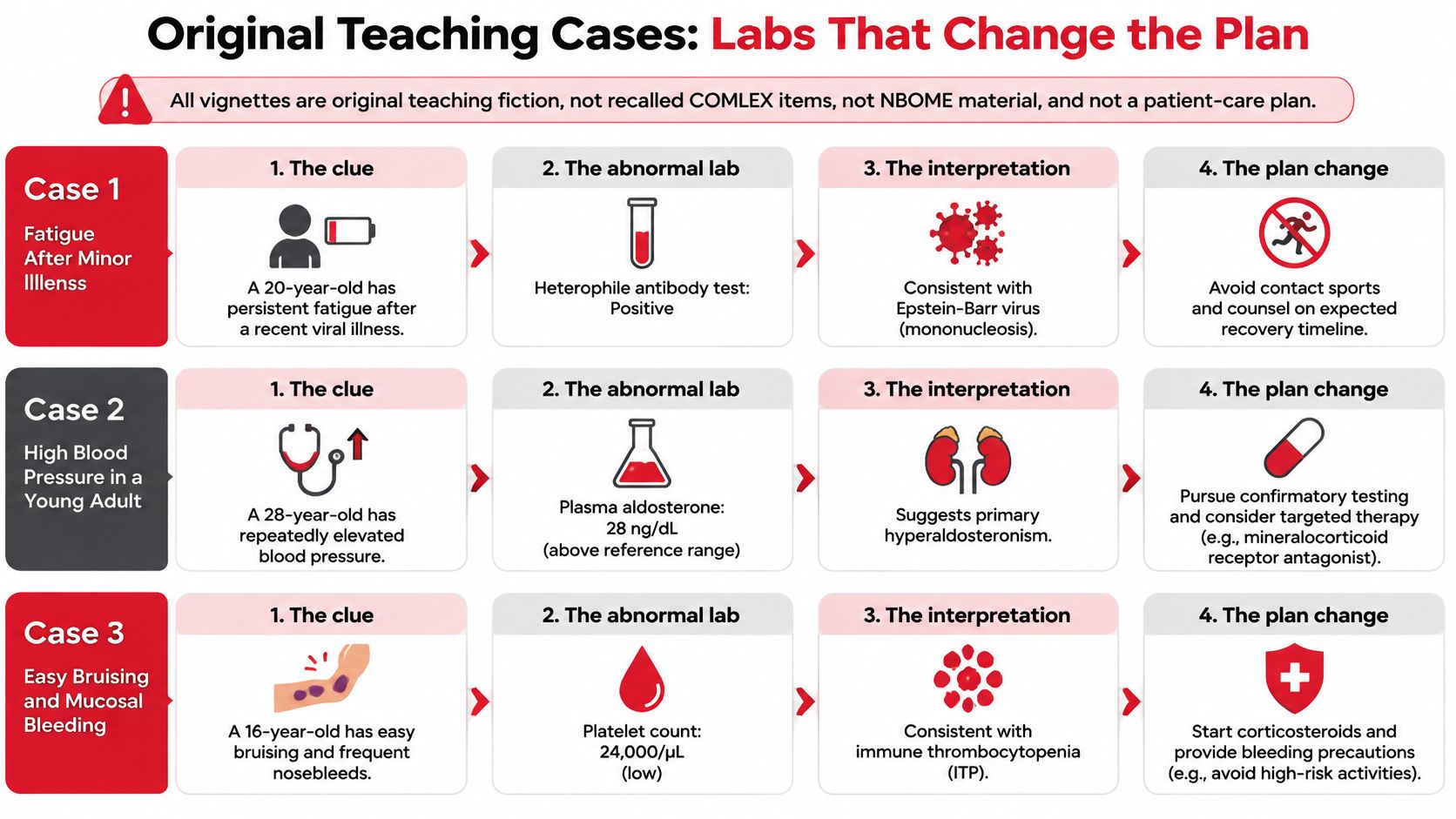
Case one, the tired patient with tingling feet
The clue: months of fatigue and new numbness in both feet. The labs against the printed range: hemoglobin 10.4 g/dL against 13.5–17.5 g/dL, and MCV 102 against a printed 79–93. The attractive wrong answer: start folate alone, or repeat the blood count in three months with no diagnosis attached. The better exam answer: evaluate B12 status and treat the neurologic findings as part of the problem, because a macrocytic anemia with sensory symptoms is not a nutritional footnote.
The reason students miss this one is speed. They see a low hemoglobin and reach for iron, or see a high MCV and reach for folate, without asking which deficiency explains both the blood and the nerves.
Case two, the vomiting patient with a gap
The clue: days of vomiting and almost no intake. The labs: bicarbonate 14 mEq/L, a widened anion gap, a very high glucose, and positive ketones. The attractive wrong answer: discharge with oral fluids, or file the case under a primary respiratory acidosis and stop there. The better exam answer: urgent care for diabetic ketoacidosis, where fluids, insulin, and potassium monitoring describe the category of action, and the specific dosing belongs to the treating clinician.
The competing-abnormality rule decides this one. Two problems exist, and the unstable one gets treated first.
Case three, the upper abdominal pain with a ductal fingerprint
The clue: right upper quadrant pain after fatty meals. The labs: alkaline phosphatase and bilirubin dominate while AST and ALT rise only mildly. The attractive wrong answer: announce viral hepatitis because an enzyme went up. The better exam answer: evaluate for biliary obstruction, because the dominance pattern names the compartment.
The six-step method to reuse
- Read the asked task. Diagnosis, next test, treatment, and disposition are different questions.
- Mark each value against the printed range. Circle, don't skim.
- Group the pattern. Name the cluster in a few words.
- Match it to acuity. Stable versus unstable decides priority.
- Eliminate the choice that treats a different pattern. Wrong-compartment answers are everywhere.
- Pick the safest next diagnostic or management step. Safety beats elegance.
One discipline keeps this honest. Don't invent labs the stem never gave you, and don't assume a result that isn't printed, however much it would simplify the case. When renal replacement questions appear, the same logic applies, and this explanation of indications for dialysis using AEIOU shows how the decision follows the pattern rather than the number alone.
Pitfalls Mnemonics and Unit Traps
Most missed lab items aren't knowledge gaps. They're reading errors, and they cluster in predictable places.
Specimen and unit mismatches
Serum and plasma are not interchangeable in a stem, and total bilirubin answers a different question than conjugated bilirubin does. Name the specimen before interpreting the number. If a result is reported in a unit you didn't expect, check whether the choices even depend on the conversion before spending time on arithmetic.
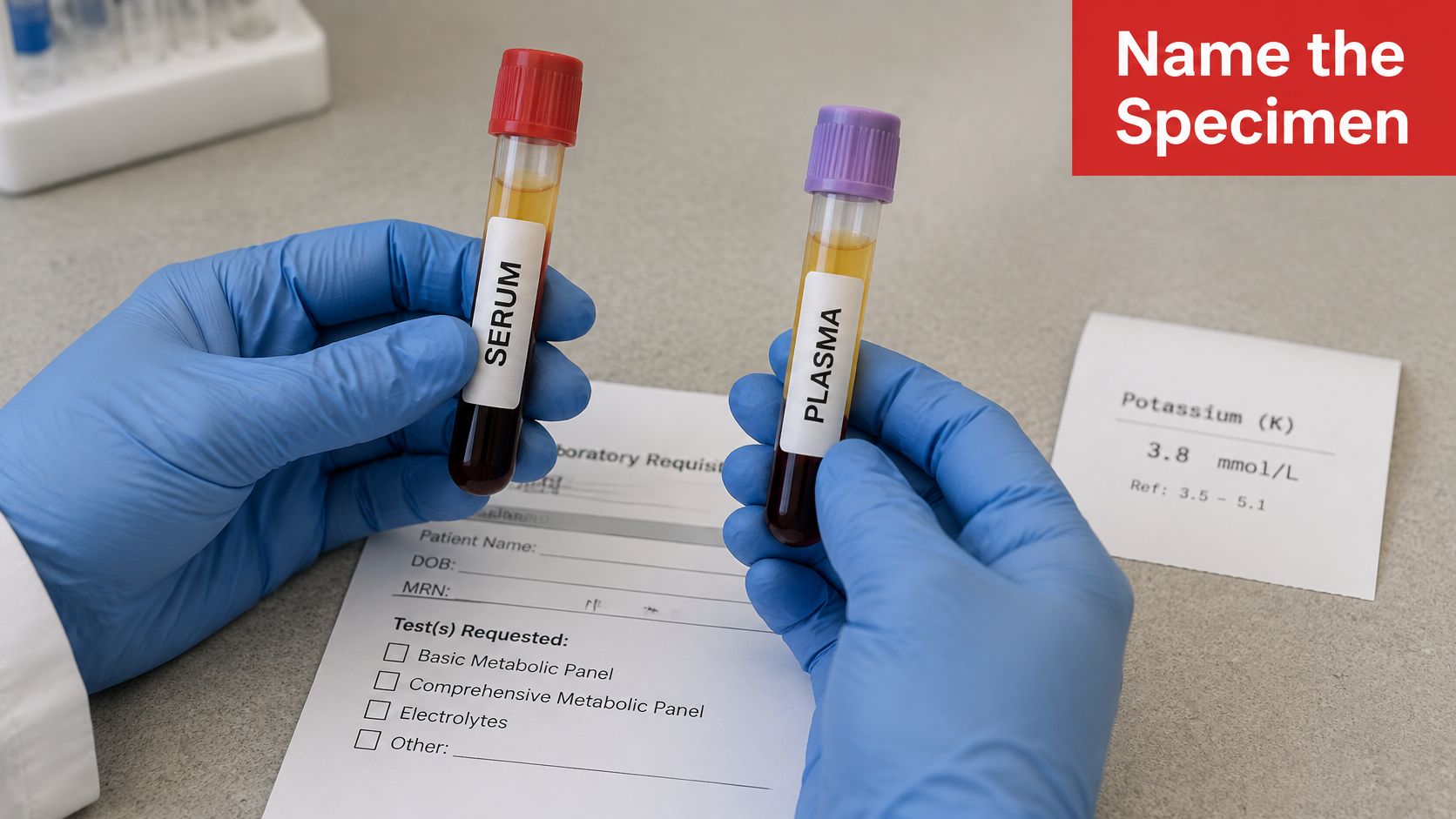
Trend blindness and context drift
A lone potassium, sodium, or hemoglobin can hide a dangerous trend. If the stem includes an earlier result, compare before you call the value stable. Pregnancy, age, altitude, and medications move expected values, so a nonpregnant adult anchor shouldn't be forced onto a pregnant patient's stem.
Two corrections catch a lot of candidates. Correct total calcium for a low albumin before calling hypocalcemia, and keep ionized calcium separate from total calcium. Then compute the anion gap as sodium minus chloride minus bicarbonate, because skipping it turns a cause question into a vague acidosis label.
Compensation, direction, and dirty samples
Treat compensation as a direction check. A high PaCO2 with a low pH is primarily respiratory; a low bicarbonate with a low pH is primarily metabolic. ROME exists only to test pH against PaCO2 direction, nothing more.
Read BUN with creatinine and the urine findings before you say prerenal. If the stem mentions hemolysis, lipemia, or a poor sample, treat an extreme chemistry number cautiously rather than building a diagnosis on it.
Mnemonic discipline: MAD COW covers methanol, uremia, diabetic ketoacidosis, the older paraldehyde and phenformin entries, iron or isoniazid, lactic acidosis, ethylene glycol, and salicylates. When a stem's toxidrome contradicts a list, the toxidrome wins.
One more distinction earns points. A left shift with bands is a different finding from a mildly high total white count, and the answer choices usually reward the difference.
A Timed Checklist for Lab-Heavy Items
Can you keep a lab question moving without rushing past the finding that changes the plan? Use the reference interval printed beside each result as your first check, then follow the same brief sequence: identify the abnormality, judge its magnitude and trend, name the pattern, and choose the next step.
For current exam-format details, check the NBOME examination format page. The page describes COMLEX-USA Level 3 as a two-day computer-based examination administered within a 14-day window, with four 3.5-hour testing sessions and 420 single-best-answer multiple-choice questions. Day one has two sessions of 70 questions each. Day two starts with 26 CDM cases split across two sections, then ends with another session of two 70-question sections. Optional breaks use a pooled 60 minutes.
Keep the lab routine compact. A repeatable approach is more useful than a long calculation you cannot sustain across the exam.
The checklist
- Mark the abnormal values. Compare each result with the reference interval printed beside it before rereading the full story.
- Judge magnitude and trend. Ask how far the result is from the interval and whether an earlier value shows improvement or deterioration.
- Name the pattern briefly. For example, “macrocytic anemia with neurologic signs” keeps the finding connected to the clinical picture.
- Identify the task. Is the item asking for a diagnosis, next test, treatment, or disposition?
- On CDM items, order selectively. Choose an approved panel or the single test that answers the clinical question.
- Convert units only when needed. Check whether the units affect your comparison with the answer choices.
- Prioritize instability. If two abnormalities compete for attention, address the one that threatens the patient first.
- Classify each miss. Label it range-reading, pattern, order, or timing, then use that label to guide review.
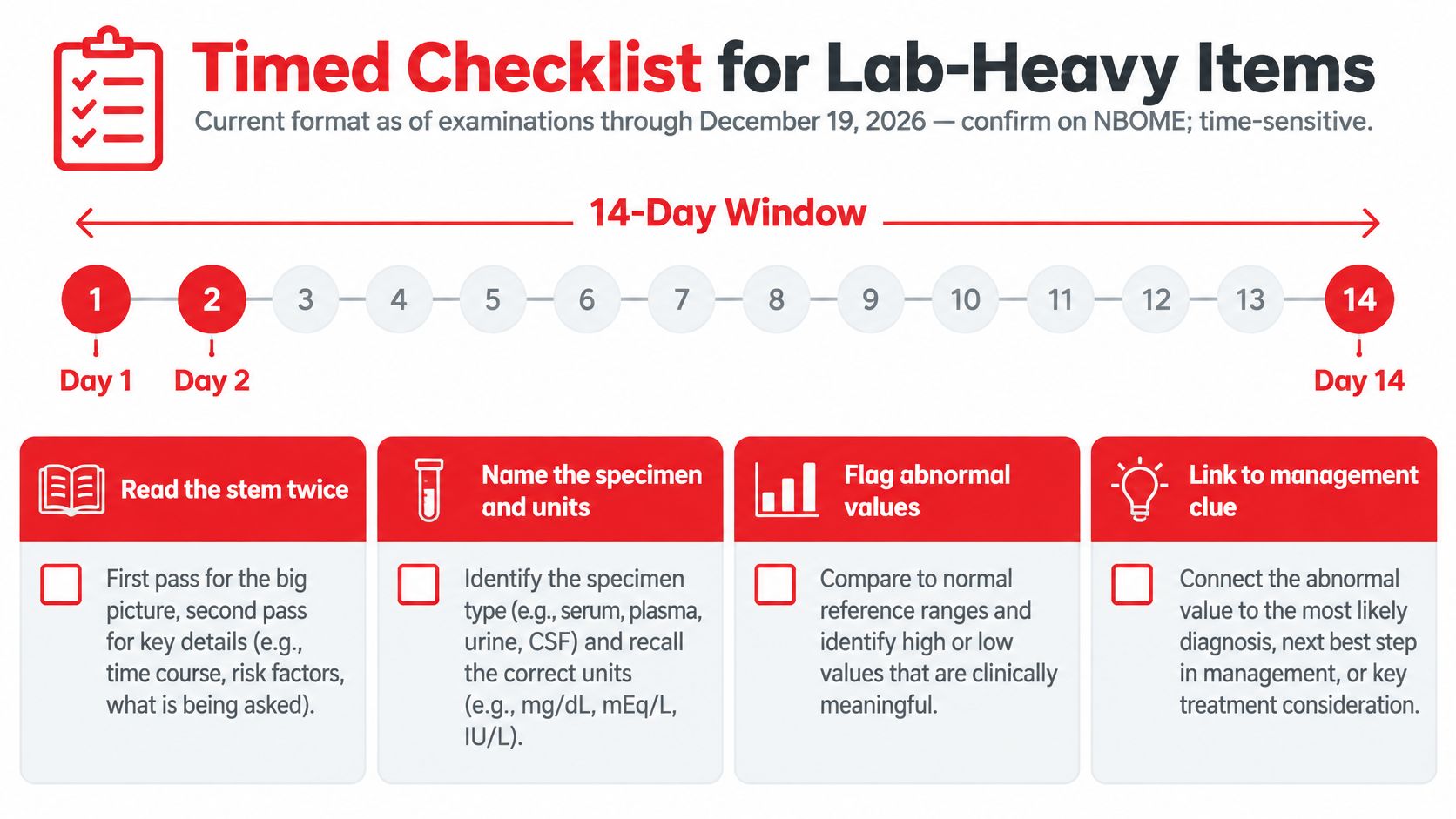
A weekly drill can combine 20 mixed lab items with two short original CDM order sequences, reviewed the same day. For each miss, return to the skill it tested: reference-interval comparison, choosing an order, or selecting the next step. Timed COMLEX Level 3 practice test material can help you check accuracy under exam-like pressure.
A low practice-set score points to a skill to work on, not a verdict on your ability. Identify the skill, then give it focused practice.
Get Help When Patterns Still Stall You
Most students can run this system alone. Self-study is the sensible plan when missed items are mostly careless range-reading and your error log improves across two weeks. If the same pattern keeps slipping, though, more solo volume usually just repeats the same mistake faster.
Tutoring becomes the reasonable choice when pattern misses persist past the point where review should have fixed them, when CDM orders stay unfocused, when pacing collapses on the longer cases, or when you're returning after an unsuccessful attempt and want structure rather than more hours.
Ace Med Boards provides one-to-one online COMLEX tutoring for Level 1, Level 2-CE, and Level 3, including students working through a plateau or coming back after an unsuccessful attempt. Sessions cover content review, clinical reasoning, question approach, and pacing, and a tutor can target weak topics and work through practice questions you bring. The COMLEX tutoring page lists available hours, package prices, and eligible guarantees.
That tutoring complements official NBOME materials and independently chosen question banks rather than replacing them. Ace Med Boards isn't affiliated with NBOME or with those publishers. A free COMLEX consultation can cover your exam level and timeline, and a Board Score Audit is an optional way to see which of the four miss types dominates your log.
NBOME completed its Level 3 passing-standard review in November 2023 and implemented it in January 2024, so the standard you're aiming at has been stable for a while (NBOME standard setting). What moves is your reading speed and pattern recognition, and both respond to deliberate practice.
Sources
NBOME frequently asked questions (laboratory reference range format), NBOME COMLEX-USA Level 3 page (approved panels and blueprint), NBOME examination format page (sessions, question counts, break pool), NBOME standard-setting page, and Merck Manuals laboratory reference ranges and normal laboratory values pages.
Ace Med Boards Editorial Team
If lab-heavy items still cost you time, or the same pattern keeps slipping after review, Ace Med Boards offers one-to-one online COMLEX tutoring for Level 1, Level 2-CE, and Level 3 that works directly on printed-range reading, pattern naming, panel selection, and pacing under the two-day structure. A tutor can target the weak topics you already know are weak and work through the practice questions and CDM order sequences you bring to the session. Visit Ace Med Boards to book a free consultation and map your timeline before the next attempt.