You're staring at a large syllabus, a question bank, and an exam date that suddenly feels much closer than expected. The practical answer is that USMLE Step 1 preparation should begin with a diagnostic baseline, not with an attempt to read every resource from the first page to the last. Your first task is to identify how you miss questions, then build a schedule that reduces those errors while developing the stamina required for the full testing session.
What USMLE Step 1 Is and How to Think About It
The United States Medical Licensing Examination (USMLE) Step 1 is the first USMLE examination and assesses foundational medical sciences through their clinical application. Students commonly take it after completing the preclinical curriculum, while graduates of international medical schools may take it as part of the pathway toward U.S. physician licensure. The exam matters for progression through medical training and for the broader licensing process, but its role in residency applications has changed substantially since score reporting became pass/fail.
The official Step 1 content outline organizes basic science across organ systems and processes, with questions mapped across 18 major content areas. That structure explains why isolated memorization is unreliable. A renal physiology fact may appear inside a clinical vignette involving pharmacology, pathology, acid-base reasoning, or patient communication. You need both retrieval and application.
A useful preparation model has four movements:
- Assess your starting point under realistic conditions.
- Categorize errors instead of treating every missed question as the same.
- Assign study time to the highest-impact weaknesses.
- Reassess repeatedly to determine whether your error patterns are shrinking.
The USMLE Step 1 overview can supplement this foundation, but your study plan should remain anchored to the official Step 1 content outline.
Practical rule: A missed question is useful only when you can explain why you missed it and what will prevent the same error next time.
Step 1 preparation is therefore a deliberate practice problem. You're not trying to prove that you can survive a marathon of resources. You're trying to build reliable performance across mixed disciplines, unfamiliar presentations, timed decisions, and a long exam day.
Eligibility, Scoring, and the 2026 Format Update
Your eligibility route determines which requirements you must verify before scheduling Step 1. The recognized groups include students or graduates of LCME-accredited U.S. MD programs, students or graduates of COCA-accredited U.S. DO programs, and students or graduates of international medical schools listed in the World Directory of Medical Schools who meet ECFMG eligibility requirements. Registration policies can change, so check the current 2027 USMLE Bulletin before choosing an eligibility period.
Step 1 score reporting changed on January 26, 2022. Examinations administered on or after that date report a pass/fail outcome only, rather than a three-digit numeric result. The minimum passing standard rose from 194 to 196 on that date. The three-digit score itself is no longer reported for current examinations. The official USMLE examination results and scoring information describes the current reporting framework. For a plain-language explanation of the passing standard, see this Step 1 passing-score explanation.
Pass/fail reporting changes the target, not the work required to reach it. You still need dependable performance across mixed disciplines and unfamiliar clinical presentations. Residency programs may also review clinical performance, Step 2 Clinical Knowledge (CK), letters, experiences, and the broader academic record. Set your planning question accordingly: “How will I establish dependable pass readiness?” A single practice score can help locate risk, but readiness is stronger evidence when the same error categories shrink across several checkpoints.
What changes in the testing session
The 2026 update creates a pacing problem that many study guides understate. Before May 14, 2026, the exam uses seven 60-minute blocks in an 8-hour session, with up to 280 items, at least 45 minutes of break time, and a 15-minute optional tutorial. On or after that date, it uses 14 30-minute blocks in one 8-hour session, with no more than 20 items per block, at least 55 minutes of break time, and a 5-minute optional tutorial, according to the 2027 USMLE Bulletin and the official interactive testing experience.
| Feature | Pre-2026 Format | 2026 Format |
|---|---|---|
| Block structure | 7 blocks of 60 minutes | 14 blocks of 30 minutes |
| Maximum items | Up to 280 items | No more than 20 items per block |
| Break time | At least 45 minutes | At least 55 minutes |
| Optional tutorial | 15 minutes | 5 minutes |
| Planning implication | Sustain focus through longer blocks | Reset pacing and attention more frequently |
Fourteen shorter blocks require fourteen starts, finishes, and resets. A candidate may manage one block well yet lose time through repeated transitions, especially as fatigue builds. Practice should therefore include micro-break planning, a fixed end-of-block routine, and checkpoint reviews that track pacing errors separately from knowledge gaps.
Use some timed work in the new rhythm, then complete full-condition practice to test endurance. The goal is not merely to finish questions. It is to reduce recurring timing and attention errors across multiple checkpoints before test day.
Building Your Diagnostic Baseline and Error Taxonomy
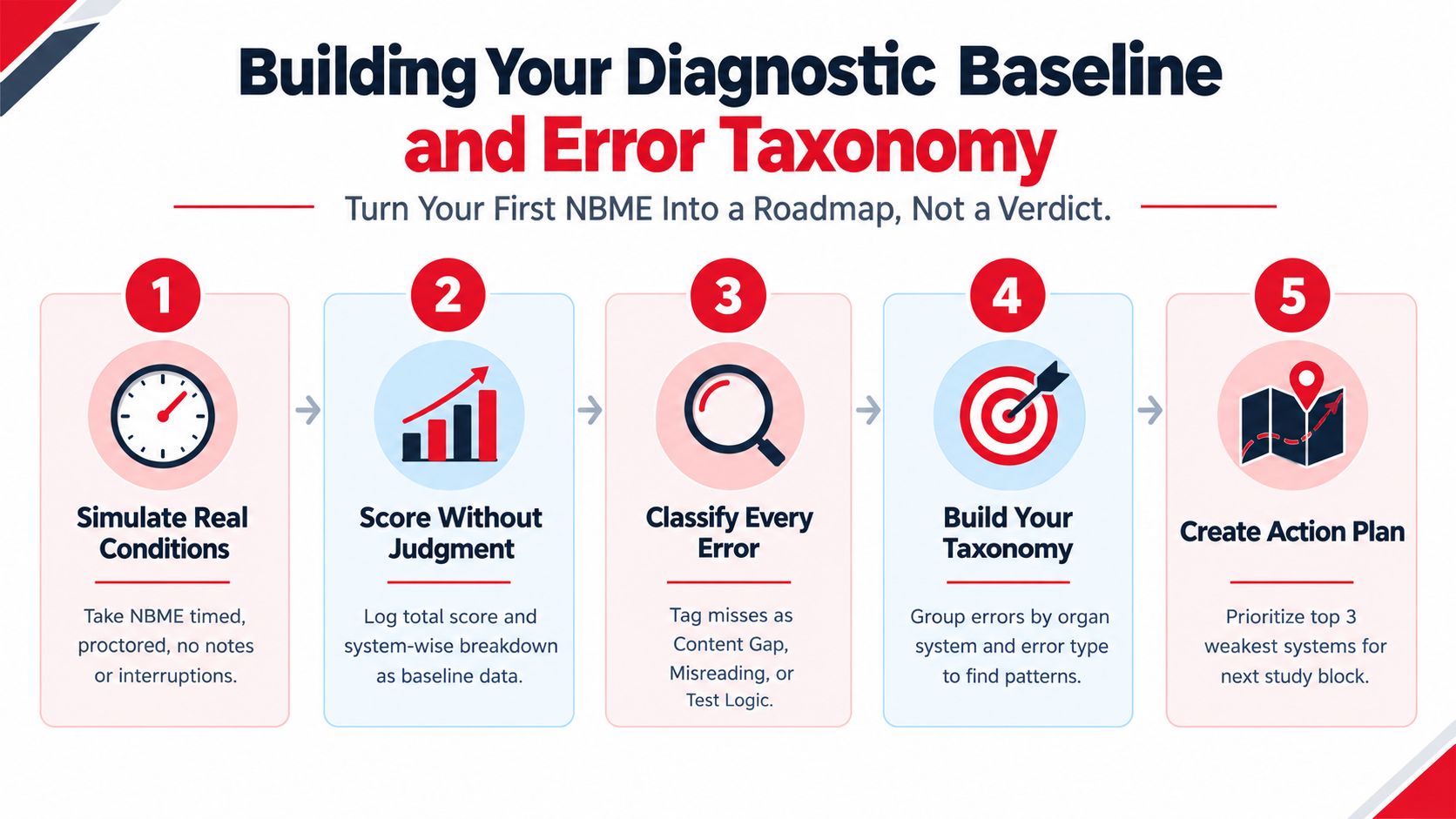
Your first NBME-style assessment should function as a map, not a verdict. Take it timed, use no notes, avoid interruptions, and reproduce the testing conditions as closely as your circumstances allow. Record your overall result and system-level performance, but don't stop there.
Review every incorrect and flagged item. Then place each miss into an error taxonomy that distinguishes the remedy:
- Content gap: You didn't know the fact, mechanism, or relationship required.
- Application error: You recognized the information but failed to connect it to the clinical task.
- Misread or test-taking error: You overlooked a qualifier, answered a different question, or changed a sound answer without justification.
- Pacing or fatigue error: You ran short on time, rushed late items, or lost accuracy as concentration declined.
Turn review into an action list
Tag each error by organ system, discipline, physician task, and cause. A cardiovascular question might be marked as physiology plus diagnosis, while a microbiology question might involve a knowledge gap rather than poor reasoning. This level of detail prevents a vague plan such as “review cardio” from consuming time without addressing the actual problem.
Use a simple review record:
| Field | Entry |
|---|---|
| System and discipline | For example, renal physiology |
| Physician task | Diagnosis, mechanism, management principle, or interpretation |
| Error cause | Knowledge, reasoning, misread, pacing, or fatigue |
| Decisive clue | The feature that should have directed your answer |
| Correct mechanism | A plain-language explanation |
| Next action | Flashcard, targeted review, teaching explanation, or timed drill |
Set a measurable process goal rather than inventing a guaranteed score target. For example, you might aim to reduce repeated errors in your two most frequent categories by the next checkpoint, then verify the change on unseen material. The NBME preparation resource can be used alongside official materials, but each assessment should remain a calibration event rather than an opportunity to memorize answer patterns.
Review fatigue separately. If your early blocks are accurate and your later work becomes rushed, the problem isn't solved by another textbook chapter. It calls for pacing drills, planned breaks, sleep protection, and practice under longer conditions.
Study Schedules for 6, 8, or 12 Weeks
A shorter schedule doesn't eliminate subjects. It compresses the feedback loop and forces earlier triage. A longer runway gives you more room to revisit weak systems, interleave question types, and verify whether improvements transfer beyond the resource where you first learned them.
The table below is a framework, not a promise of a particular outcome. Adjust question volume and review hours to your school responsibilities, health, baseline, and ability to analyze mistakes thoroughly.
| Week | 6-Week Plan | 8-Week Plan | 12-Week Plan |
|---|---|---|---|
| 1 | Baseline assessment, error taxonomy, organ-system triage. Complete a modest set of timed questions. Review only the most urgent gaps. | Baseline assessment, taxonomy, and first weak-system remediation. Begin mixed questions after focused review. | Baseline assessment, taxonomy, and foundational review. Use system blocks with interleaved questions. |
| 2 | First content pass across the highest-priority systems. Add concise retrieval cards from errors. Checkpoint: targeted reassessment. | Organ-system remediation with timed mixed blocks. Keep a weekly error dashboard. | System block one, mixed question sessions, and spaced retrieval. Create cards only for concepts you repeatedly miss. |
| 3 | Second pass begins. Increase mixed timed work. Checkpoint: assessment under realistic conditions. | Dedicated weak-topic remediation, followed by application questions. | System block two with mixed practice. Checkpoint: formal reassessment and schedule adjustment. |
| 4 | Mixed timed blocks, error repair, and pacing drills. Avoid starting large new resources. | Second remediation cycle and broader mixed blocks. Teach difficult mechanisms aloud. | System block three, mixed practice, and targeted review of recurring errors. |
| 5 | Full-condition practice and final high-frequency error review. Checkpoint: readiness assessment. | Mixed timed blocks and fatigue management. Revisit unresolved taxonomy categories. | System block four, mixed blocks, and a mid-course review of all repeated errors. |
| 6 | Taper, logistics, sleep routine, and concise retrieval. Sit only if the readiness pattern supports it. | Full-condition verification, taper, and test-day planning. | System block five, mixed practice, and targeted remediation. |
| 7 | Not applicable. | Taper and final readiness review. | System block six with increased mixed practice and pacing work. |
| 8 | Not applicable. | Test-day logistics and final taper. | Checkpoint: formal reassessment, then decide whether to remediate or enter verification. |
| 9 | Not applicable. | Not applicable. | Full mixed blocks, error reduction, and planned breaks. |
| 10 | Not applicable. | Not applicable. | Checkpoint: readiness assessment under full conditions. |
| 11 | Not applicable. | Not applicable. | Full-length simulations, targeted repair only, and no broad resource expansion. |
| 12 | Not applicable. | Not applicable. | Final verification, taper, logistics, and sleep stabilization. |
Match the runway to the learner
For weekly tracking, record question volume completed, review hours, new retrieval cards, repeated-error count, timing consistency, and checkpoint interpretation. Don't treat a high volume of unanswered or poorly reviewed questions as productive work.
Choose six weeks only when your baseline indicates that the major task is consolidation and your daily schedule is stable. An eight-week plan is more forgiving when one or two systems require focused remediation. Twelve weeks is better suited to significant knowledge gaps, a demanding school schedule, or a prior attempt that revealed broad problems.
The plan should change when the data change. If repeated errors remain unchanged after focused review, reduce new content and repair the underlying learning process before adding more resources.
Question Bank Workflow and Active Recall Habits
A question bank becomes useful when every block produces a specific learning decision. For a standard practice block, use 40 timed questions with tutor mode off, then review every incorrect and flagged item within the next day. The point isn't to admire the percentage. It's to determine whether the miss came from missing knowledge, weak representation, a misread stem, or poor time control.
For each reviewed question, write a compact explanation:
- Concept: What subject was tested?
- Trap: What tempting interpretation pulled you away?
- First principle: Why is the correct answer correct?
- Transfer cue: What would change the answer in a different presentation?
A strong reasoning chain is:
Clinical problem representation → tested task → decisive clue → mechanism → eliminate distractors.
Use tutor mode selectively during first-pass learning or when you need immediate explanation. Use timed, mixed blocks when you need to measure retrieval, application, and stamina. Mixed practice forces you to identify the relevant system and task before reaching for a familiar pattern, which makes it more representative of the integrated nature of the official content outline.
Build retrieval around your errors
Daily Anki reviews should draw heavily from missed concepts rather than becoming an uncontrolled card-production project. Add cards that ask for mechanisms, discriminating clues, or comparisons. Once a week, explain a difficult pathway or disease process aloud without looking at your notes. If your explanation depends on copying a diagram, the knowledge may not yet be retrievable.
The 2026 format makes block transitions part of preparation. Practice stopping cleanly, recording your break plan, and beginning the next short block without carrying frustration forward. The official Step 1 examination content page provides the current examination framework. NBME assessments should remain separate calibration events, not substitutes for daily question analysis. For neutral information about a commercial question-bank workflow, review USMLE Step 1 question-bank guidance, while remembering that commercial resources aren't official USMLE materials.
Readiness, Postponement Decisions, and When to Seek Tutoring
Readiness is a pattern of dependable performance, not a single attractive result. Look for stable or improving performance across consecutive checkpoints, fewer repeated errors, better late-session accuracy, and the ability to explain missed concepts without relying on answer recognition.
One planning framework uses a predicted pass probability above 95% on two administrations, but that figure should be treated only as a stated decision criterion, not as a guarantee or a universal official rule. Use it with your broader error record and the current policies governing your examination.
A practical postpone-versus-go matrix
| Evidence pattern | Days remaining | Remaining weakness | Practical decision |
|---|---|---|---|
| Improving across checkpoints | Adequate study time | Errors are specific and shrinking | Continue, then verify under full conditions |
| Stable but fragile | Limited time | Several systems remain inconsistent | Consider postponement and targeted remediation |
| Declining or highly variable | Any | Repeated reasoning, pacing, or fatigue errors | Pause and diagnose before sitting |
| One strong result only | Any | Error pattern is unclear | Gather another checkpoint rather than relying on one result |
| Prior failure with persistent repeats | Any | Same causes remain unresolved | Build a retake plan around the failure pattern |
Postponement carries emotional and logistical costs. So does taking an examination when your preparation data show unstable performance. A postponement decision should compare the cost of additional preparation with the risk of repeating an unresolved process, not with shame about changing a date.
A postponement is a planning decision, not a verdict on your ability to become a physician.
Tutoring can be useful when the obstacle is specific and persistent. Examples include repeated application errors despite knowing the underlying facts, a plateau after consistent self-study, inefficient review, weak foundational mechanisms, or difficulty maintaining pacing through the new fragmented format. Effective tutoring should work inside your existing question-bank and NBME process rather than replace it.
Seek structured support when you can show the tutor your error taxonomy, checkpoint history, and review records. Self-study may be sufficient when your errors are declining, you can independently explain missed concepts, and your schedule remains consistent. One-on-one guidance is more likely to add value when you keep studying without being able to identify why the same errors return.
A Special Focus on IMGs, Retakers, and Customized Plans
A learner can recognize the facts yet miss the question. This pattern is common among international medical graduates (IMGs) adjusting to curriculum emphasis, U.S.-style question presentation, biostatistics, epidemiology, and physician-task framing. Repeat takers may need a different diagnosis: application, interpretation, timing, fatigue, or a review process that never converted mistakes into changed behavior. Our complete guide for international medical graduates addresses those preparation differences in greater detail.
Official performance data show different first-attempt outcomes by graduate group, including approximately 93% for U.S. MD graduates, 89% for U.S. DO graduates, and 75% for non-U.S. graduates. Review the current USMLE performance data directly, and treat these figures as group-level context, not an individual prediction.
A customized plan should function like a diagnostic loop. At each checkpoint, ask whether recurring errors are becoming less frequent, not whether one score looks reassuring:
- Error taxonomy review: Sort repeated mistakes by system, knowledge gap, reasoning step, and physician task.
- NBME debriefs: Convert each assessment finding into a specific action for the following week.
- Remediation sprints: Repair one mechanism or discipline at a time, then verify the change with new questions.
- Pacing drills: Rehearse short blocks, transitions, and break control so the fragmented 2026 format does not turn late-session fatigue into avoidable errors.
- Retake planning: Change the process behind the prior result rather than repeating the same resource list.
Self-study fits learners who can interpret feedback and maintain a stable schedule. Structured support may help when sustained effort still produces no clear next action. Ace Med Boards offers individualized USMLE Step 1 tutoring that may include question analysis, accountability, and retake planning. Tutoring should complement official materials and independent practice, without promising a particular result.
Frequently Asked Questions and Next Steps
How long should I study for Step 1?
Use the shortest schedule that allows repeated remediation and verification without sacrificing health or school obligations. A six-week plan can suit a strong, well-diagnosed baseline, while eight or twelve weeks may better support broader gaps or a retake.
When should I take my first NBME?
Take it near the beginning of dedicated preparation, under realistic conditions. Its value comes from the error taxonomy you build afterward, not from treating the initial result as a final judgment.
Should I delay Step 2 CK because Step 1 is pass/fail?
Not automatically. Coordinate the timing with your school, clinical training, preparation quality, and broader application strategy. Step 1's reporting format doesn't erase the importance of building a strong foundation for later clinical reasoning.
How do I know whether to postpone?
Postpone when results are declining or unstable, repeated error categories remain unresolved, or your late-session performance collapses. Proceed when multiple checkpoints show a dependable pattern and your remaining weaknesses are specific and manageable.
Start by scheduling a realistic baseline assessment and completing the error log before buying another resource. If you want help translating that evidence into a focused plan, you can request a no-pressure consultation.
Ace Med Boards provides individualized USMLE Step 1 tutoring focused on question analysis, accountability, targeted remediation, and retake planning. Visit Ace Med Boards to explore whether a customized study plan fits your baseline, timeline, and preparation needs.