
As of August 27, 2026, the remaining published 2026 U.S. MCAT dates are September 3, September 4, September 11, and September 12. The AAMC says 2027 registration opens October 20, 21, and 22, 2026, by testing-center location, so your next decision depends on whether you're finishing the current cycle or planning ahead.
Choosing an MCAT date isn't just a matter of finding an open seat. You're coordinating preparation, registration deadlines, travel, accommodations, score release, and the application timeline around a fixed testing window. The AAMC offers the MCAT multiple times from January through September at hundreds of sites in the United States, Canada, and international locations, but it isn't an on-demand exam available whenever you're ready. (AAMC registration information)
The practical rule is simple: select the date that gives you enough preparation time and produces a score when your application needs it, not the date that happens to be available first.
2026 MCAT Test Dates and the Registration Window You Need to Know
You are finishing content review, your application cycle is approaching, and the only open seat appears to be a late September test date. Registering immediately may feel practical, but the right choice depends on when your score will be released, when schools need it, and whether you can prepare properly.
The final published 2026 U.S. MCAT administrations are September 3, September 4, September 11, and September 12. Applicants seeking a current-year score should confirm that a September result fits their application and school-review timelines before paying for an appointment. The date alone does not determine whether the plan works. Score release, application timing, readiness, and travel all matter.
For applicants planning beyond 2026, the next calendar anchor is the AAMC's 2027 registration opening scheduled for October 20 through October 22, 2026, released by testing-center location. Because registration opens in stages, prepare before your location becomes available. Create your account, check your identifying information, and list realistic testing centers in advance. (AAMC U.S. MCAT calendar and scheduling deadlines)
Use the calendar as a decision anchor
Work backward from your application deadline, then answer these questions:
- Which application cycle are you targeting? A date suitable for a future cycle may be too late when your current application depends on the score.
- When must your score be available? Score release belongs in the test-date decision, not in a later administrative check.
- When will you be ready? An open seat cannot replace unfinished content review or insufficient practice.
- Can you reach the center reliably? Site availability may determine your choice, especially when early appointments appear only in selected metropolitan areas.
- What is your contingency plan? Before paying, record the applicable 60-day, 30-day, and 10-day change or cancellation cutoffs.
A late-cycle date can work for a later application cycle, a targeted retake, or an applicant who needs more preparation time. It can fail for someone who needs a score for an imminent review. Use the last available date only when its score-release timing and preparation runway fit your plan.
How to Read the U.S. Canada and International AAMC Calendars
The AAMC publishes separate schedules for the United States, Canada, and U.S. territories and international locations. Treat those calendars as different operating systems, not interchangeable versions of the same list. A Canadian date may not exist on the U.S. calendar, and an international date may be available only in specific countries or sites. (AAMC MCAT registration guidance)
The 2026 U.S. territories and international calendar includes administrations on January 9, February 13, March 20, April 10, May 8, June 12, July 24, August 21, and September 3. The Canadian schedule identifies selected dates and cities, including Toronto, Vancouver, Ottawa, and Calgary. These regional differences affect more than convenience. They determine which preparation runway, score-release date, and travel plan you can realistically use. (AAMC Canadian MCAT calendar)
| Calendar | Who It Applies To | Key Note |
|---|---|---|
| United States | Applicants testing at U.S. centers | The 2026 U.S. calendar includes dates from January through September, with site availability varying by location. |
| Canada | Applicants testing at Canadian centers | Use the Canadian calendar and listed cities as the controlling schedule. |
| International and U.S. territories | Applicants testing outside the continental United States, including listed territory and overseas sites | Dates and locations are country-specific and may be more constrained than the U.S. schedule. |
Verify the correct region before studying around a date
Start with the place where you intend to test, then confirm the corresponding AAMC calendar. Don't build a study plan around a U.S. date if you're expecting to test in Canada or overseas. A U.S. test-taker can't substitute a Canada-only seat, and a Canadian or international applicant shouldn't assume that U.S. registration rules, site rosters, or available administrations will match their own region.
International and foreign medical graduate applicants should also account for travel documentation, time zones, and local test-center access early. The official regional calendar should control your planning, not a third-party date list.
Understanding the 60 30 and 10 Day Scheduling Deadlines
The AAMC uses 60-day, 30-day, and 10-day cutoff windows for MCAT scheduling changes. These deadlines are tied to the local test-center time, which matters if you're coordinating across time zones or arranging international travel. The last day to schedule an exam is 10 days before test day. (AAMC scheduling rules)
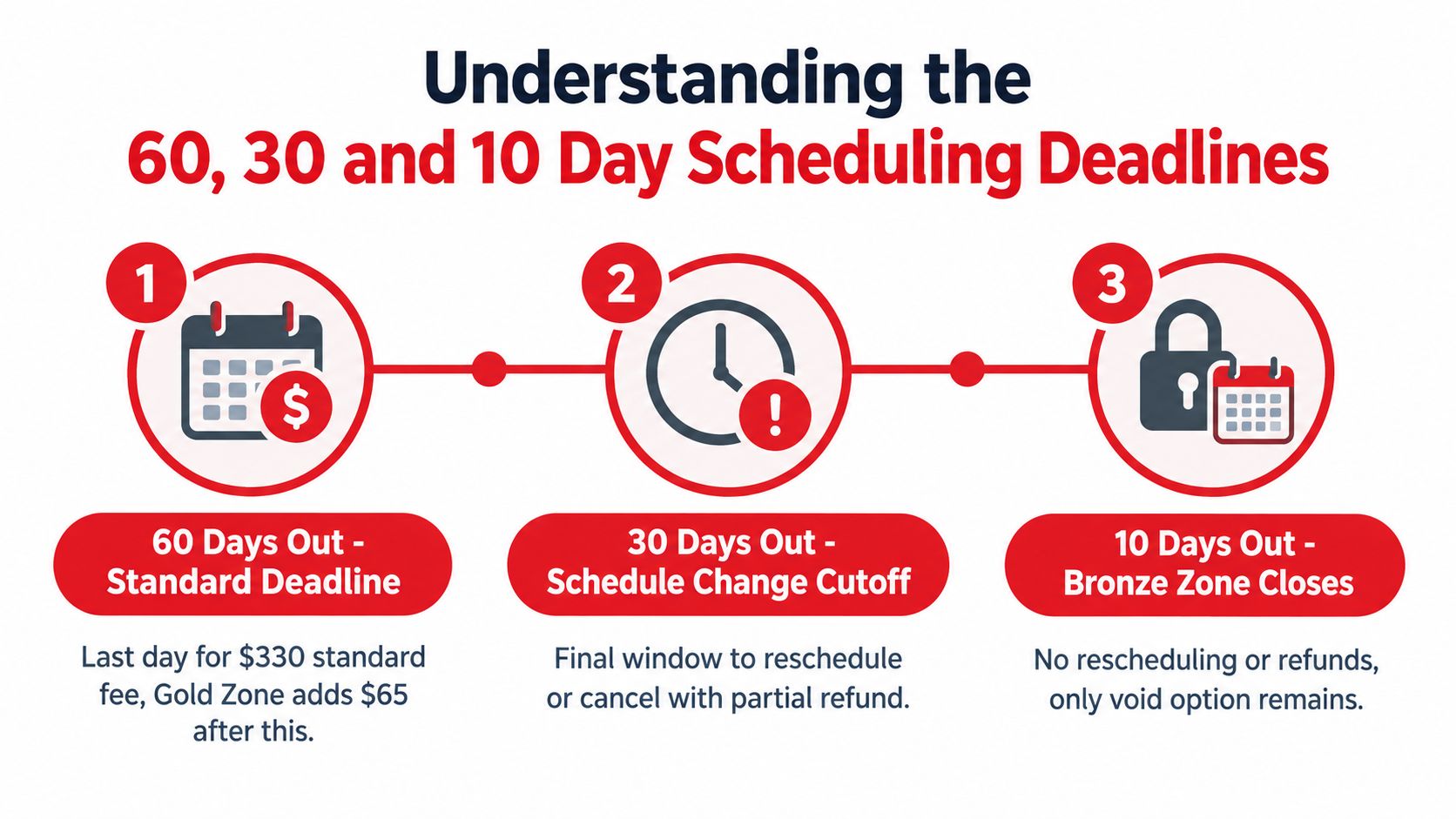
The useful way to remember the windows is to attach a decision to each one:
- At 60 days: Confirm that the date, location, and travel plan are workable. This is the point at which your flexibility starts narrowing.
- At 30 days: Treat the appointment as substantially committed. Any remaining conflict, location concern, or preparation issue needs immediate attention.
- At 10 days: Scheduling closes. You can't rely on a last-minute booking or assume you can preserve the date by waiting.
Don't treat these cutoffs as trivia. They're risk controls. If your course schedule, clinical obligations, or accommodations are uncertain, choosing a date without recording the deadlines creates avoidable pressure. The AAMC's registration, cancellation, and refund rules state that standard registrants receive a $175 refund when cancelling 60 or more days before the exam and also when cancelling 30 to 59 days before it. There's no refund for cancellations 10 to 29 days before the exam.
Practical rule: Put all three cutoff dates in your calendar immediately after registration, then add a separate reminder to verify the official appointment details.
For a concise overview of the administrative sequence, review the MCAT registration process and keep the AAMC page open when making any change. Policies and fees can change, so confirm the current terms for your specific testing year.
Working Backward From Application Deadlines A Composite Example
A composite applicant, Priya, illustrates how someone targeting a projected June 2027 medical school application cycle can plan from the application deadline backward. She first identifies when she wants her primary application ready, then checks verification time, score release, test day, preparation milestones, and registration cutoffs. The nearest available MCAT seat is not the starting point.
Her working timeline includes:
- Application target: She plans to submit her primary application in early June 2027.
- Verification buffer: She leaves time for the application to move through verification before schools receive it.
- Score-release buffer: She targets an official score release at least four weeks before verification, giving her time to decide whether the result fits her application plan.
- Test selection: She compares the AAMC calendar's official test dates and score-release dates instead of choosing by test-day availability alone.
- Preparation plan: She schedules content completion, passage practice, full-length exams, and review before test day.
- Registration control: After choosing a date, she records the 60-day, 30-day, and 10-day deadlines immediately.
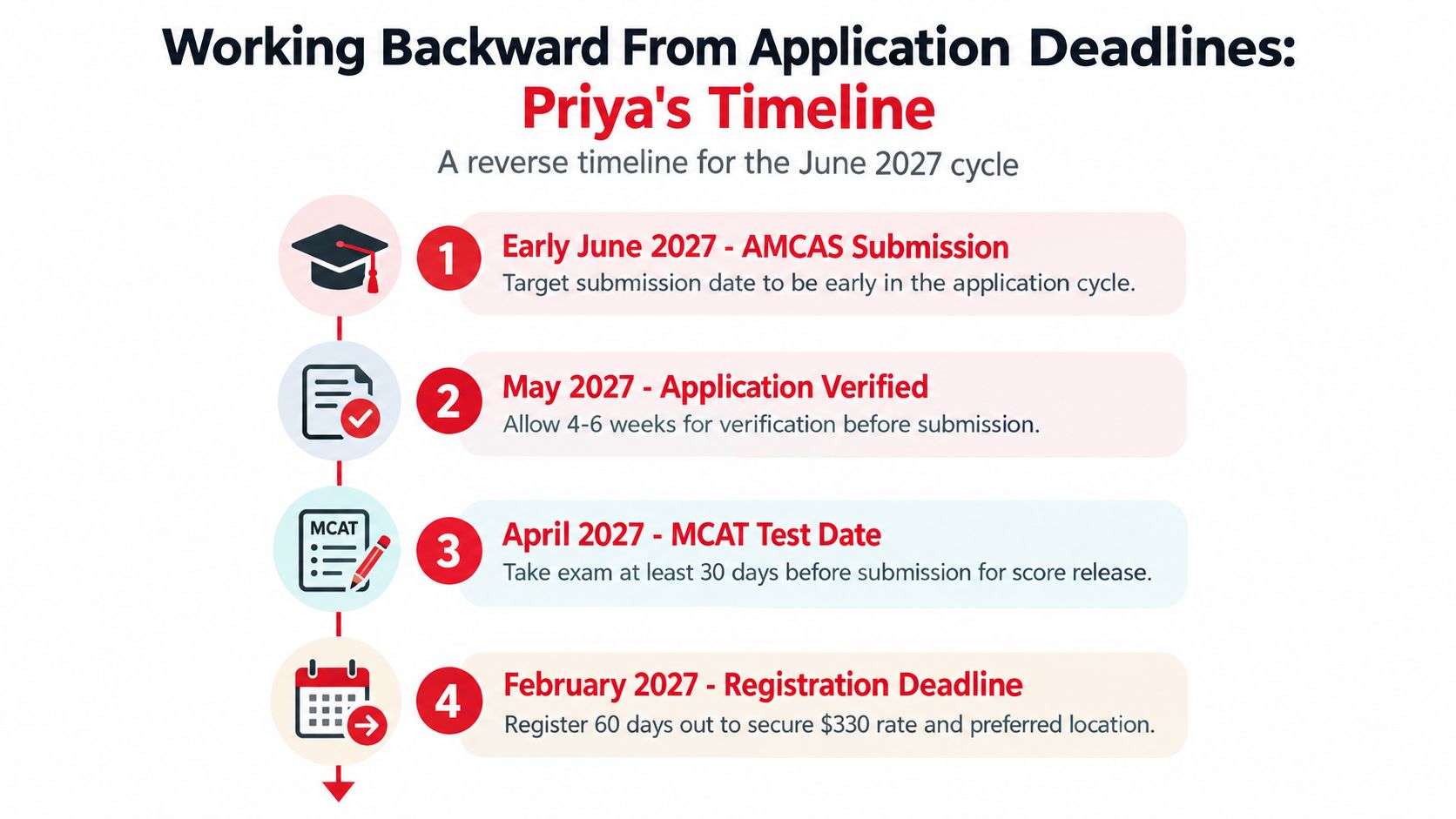
Priya then compares an earlier administration with a later one. The earlier date is acceptable only if she can finish preparation, complete full-length exams, and correct weaknesses without sacrificing coursework or application work. If it leaves no diagnostic or review time, she rejects it even though the score would arrive sooner. A later AAMC date works only when its official release still meets her four-week score-release buffer and application schedule.
A second composite applicant, Marcus, wants to test on September 12, 2026. He accepts the later score release because the additional preparation time lets him address a persistent CARS weakness and complete another round of targeted practice. More study time can improve readiness, but it does not guarantee a particular score.
Priya begins with application timing and works backward. Marcus begins with a readiness problem and checks whether the resulting score release still fits his cycle. Both use the official calendar and cutoff windows before registering, rather than booking first and hoping preparation catches up.
For a broader planning reference, review this medical school application dates guide, then confirm deadlines with the official application service and each school.
A test date works only when the preparation milestones before it and the score-release timing after it both fit your plan.
Choosing the Right MCAT Date for Your Schedule and Application
The strongest date depends on three variables: readiness runway, application timing, and access to a workable seat. Early-year dates can suit applicants who have already built a strong foundation and can study consistently through the preceding months. Late-spring dates often align more naturally with applicants preparing for the same application cycle, while September dates may serve later-cycle applicants or students who need more time.
| Date Window | Readiness Runway | Application Timing | Seat Scarcity Risk |
|---|---|---|---|
| Early year | Requires earlier preparation and disciplined review before the academic year becomes crowded. | Can provide an earlier score for applicants whose cycle depends on it. | Preferred locations may be limited, especially for selected early administrations. |
| Late spring | Gives many students more time to complete coursework and build practice stamina. | Can work when the score-release date still fits the application plan and primary materials are ready. | Demand can concentrate around dates that fit common application schedules. |
| September end | Offers the longest runway within the annual cycle for applicants who need additional preparation. | Often better suited to a later application cycle or a plan that doesn't depend on an immediate score. | There are few late-cycle opportunities, so location and date flexibility matter. |
Canadian and international applicants must replace this U.S.-centered comparison with the applicable AAMC regional calendar. Their available dates and cities may be narrower, so the nominal window doesn't necessarily equal practical access. (AAMC international and territory scheduling information)
Match the window to your actual situation
- You're ready early and need the score for the current cycle: Consider an early administration, but only after confirming preparation readiness and score-release timing.
- You're balancing demanding classes: A later spring or summer date may protect both coursework and MCAT preparation.
- You're repairing a weak section: Choose the date that leaves enough time for targeted review and full-length practice rather than chasing an earlier score.
- You're applying in a future cycle: A later date can be sensible if it creates a better preparation environment.
- You're testing outside the United States: Start with the regional calendar, then evaluate travel and local seat availability.
A single retake per testing year is allowed under the policy framework specified in the provided planning brief, so don't treat a rushed first attempt as harmless. Check the current AAMC rules before relying on any retake plan. For students coordinating study blocks, task planners and calendar systems can help, and this neutral overview of productivity apps for students may help you compare organizational tools.
For a focused preparation timeline, use the MCAT study-start planning guide alongside the official calendar. Your choice should answer one direct question: Which date gives you a realistic path to readiness while keeping the resulting score useful for your application?
A Practical Checklist Before You Click Register
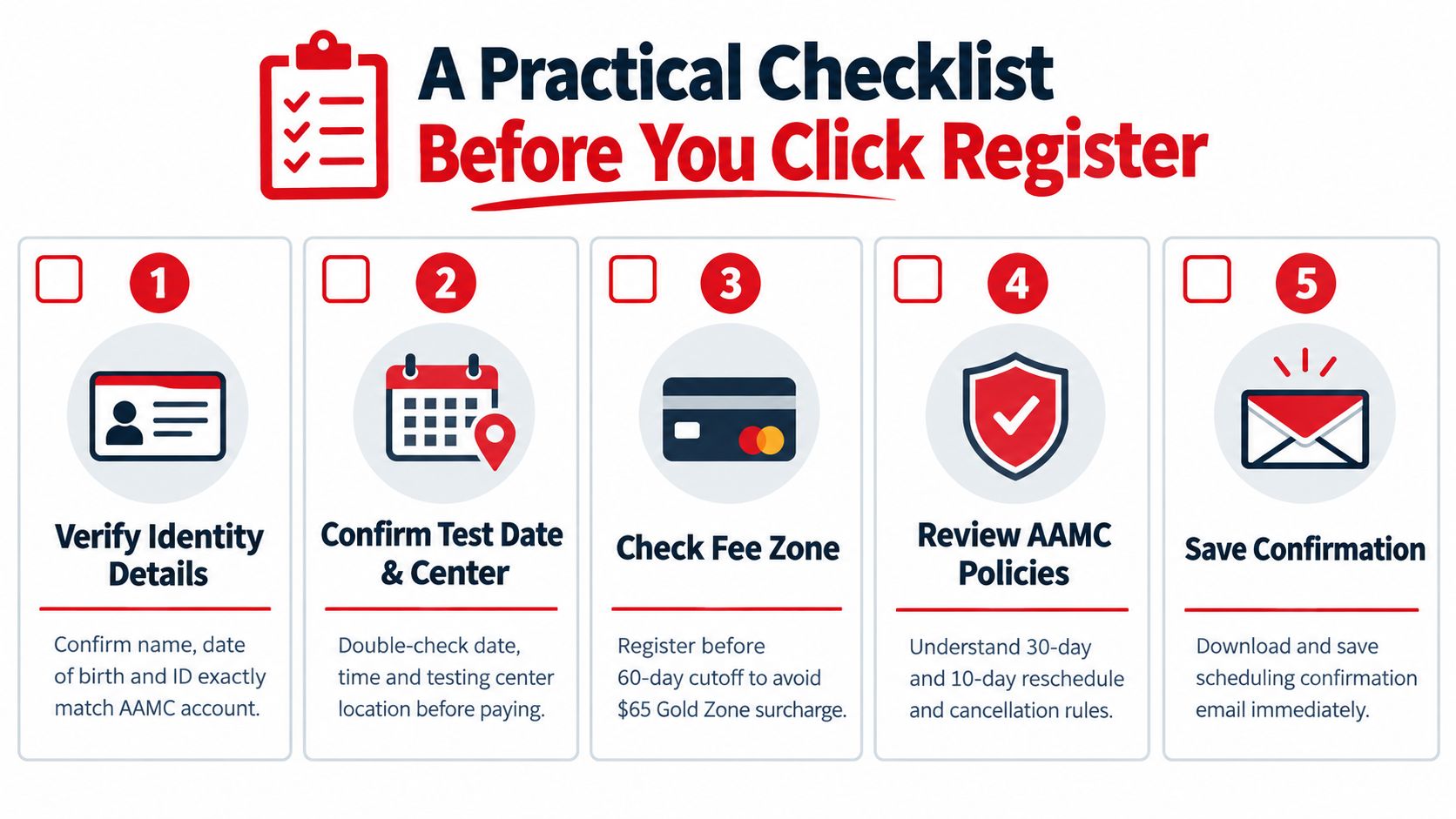
A seat can look convenient until a misspelled name, difficult commute, or late accommodation request creates a problem. Complete this checklist before paying for an appointment.
Identity and eligibility
- Verify your legal name: Match your AAMC account with the government-issued identification you will present on test day.
- Check your date of birth: Correct the record before registering. An error can create complications at the testing center.
- Review eligibility: Read the current AAMC requirements for your testing year, particularly if your academic or citizenship circumstances are unusual.
- Start accommodations early: Review the process and submit a request at least 130 days before your desired date, as specified in the planning requirements. Leave time for review or resubmission.
Appointment and travel
- Confirm the center: Check the exact date, start time, address, and seat availability before payment.
- Compare travel options: Review parking, public transportation, lodging, and the route at the time you expect to travel.
- Record the local time: Scheduling deadlines follow the test center's local time. This matters when you book across time zones.
- Build a contingency plan: Decide what you will do if the location becomes impractical or your preparation changes before a cutoff.
Documentation and follow-up
- Save the confirmation email: Store the AAMC registration confirmation and Pearson VUE appointment notice in one folder.
- Calendar the cutoff tiers: Enter the 60-day, 30-day, and 10-day dates immediately. Use these deadlines to control changes, not just to record them.
- Recheck policies: Review current identification, security, accommodations, and cancellation policies before traveling.
- Verify the appointment again: Reconfirm the address and start time during the week before the exam.
Do not click Register until every box is checked. Use the official AAMC registration page as the final authority if a third-party summary conflicts with a current instruction.
2026 U.S. MCAT Key Dates and Cutoffs at a Glance
A September appointment can look available while leaving little room for changes, travel planning, or score timing. Use the AAMC 2026 U.S. MCAT calendar as the source of record, then calculate your own 60-day, 30-day, and 10-day checkpoints before choosing a seat.
| Test Date | Registration Opens | 60-Day Deadline | 30-Day Deadline | 10-Day Deadline | Score Release Approx. |
|---|---|---|---|---|---|
| September 3, 2026, as of August 27, 2026 | Previously opened, exact opening details must be confirmed in the AAMC system | Confirm in the official AAMC calendar | Confirm in the official AAMC calendar | Confirm in the official AAMC calendar | Confirm in the official score-release calendar |
| September 4, 2026, as of August 27, 2026 | Previously opened, exact opening details must be confirmed in the AAMC system | Confirm in the official AAMC calendar | Confirm in the official AAMC calendar | Confirm in the official AAMC calendar | Confirm in the official score-release calendar |
| September 11, 2026, as of August 27, 2026 | Previously opened, exact opening details must be confirmed in the AAMC system | Confirm in the official AAMC calendar | Confirm in the official AAMC calendar | Confirm in the official AAMC calendar | Confirm in the official score-release calendar |
| September 12, 2026, as of August 27, 2026 | Previously opened, exact opening details must be confirmed in the AAMC system | Confirm in the official AAMC calendar | Confirm in the official AAMC calendar | Confirm in the official AAMC calendar | Confirm in the official score-release calendar |
The table lists U.S. administrations only and does not supply an unverified full calendar or estimated score-release dates. The official calendar determines appointment availability, registration deadlines, and score-release information for each administration.
Registration for the 2027 cycle opens October 20, 21, and 22, 2026, by testing-center location. Confirm the opening sequence in the AAMC system instead of assuming every center becomes available at the same time.
Canadian and international applicants must consult their regional calendars. Center availability, accommodations, travel, and local operating rules may require earlier personal deadlines than the standard cutoff windows. A composite applicant should plan backward from application and score-release needs, not just select the nearest open appointment.
Keep the calendar, your registration confirmation, and your backward-planned deadlines together. Recheck the official information before booking nonrefundable travel or making a change near a cutoff.
Frequently Asked Questions About MCAT Test Dates and Registration
How should 2027 applicants coordinate score release and application verification?
Start with the application cycle's required timing, then work backward to an official MCAT score-release date. A score arriving after submission may still be usable in some circumstances, but school policies and application-service timing differ. Don't assume that a submitted primary is complete for review just because the MCAT appointment has already occurred.
For the exact score-release framework, use the MCAT score-release dates resource and confirm every date with the AAMC calendar before registering. The score-release date should be treated as part of the appointment decision.
Can you reschedule after the 60-day cutoff?
The AAMC provides change windows at 60 days, 30 days, and 10 days before the exam. Your options, restrictions, and any applicable charges depend on the window in which you make the request. After the 10-day point, scheduling closes, so don't wait until the final days to resolve a known conflict.
What happens if the AAMC cancels an administration?
If the AAMC cancels or changes an administration, follow the instructions delivered through the official registration system and appointment communications. The remedy can depend on the specific event and available centers. Don't rely on informal summaries or assume that a cancellation automatically produces the same option in every location.
How should international examinees coordinate a U.S. score with Canadian or overseas calendars?
Use the calendar for the location where you'll test, then separately review the application requirements for the schools and countries where you intend to apply. A U.S. date doesn't guarantee that a Canadian or international seat exists on the same day. Travel, time-zone deadlines, identification, and score-reporting requirements should be checked before you build a preparation schedule around the appointment.
Can you retake after voiding an attempt?
A voided attempt is still an examination event, but the precise retake consequences depend on current AAMC policy and the testing-year rules. Check the official policy before assuming that a void preserves all future options. If you're considering a retake, document the relevant dates and review the current limits before selecting another administration.
The AAMC scheduling portal remains the authoritative source for last-minute changes, center availability, policies, and score-release updates. Use it directly before registration and again before making travel arrangements.
Ace Med Boards offers MCAT preparation support with individualized study planning, content review, and question-analysis guidance, which can help you connect your chosen test date to a practical preparation schedule. Visit Ace Med Boards to review the available MCAT support and request a free consultation without making any score or admissions assumptions.