You're in the testing room, the screen is lit, and a question you swear you knew a minute ago has turned into a gray blank. Your pulse jumps. The room feels louder. You look at the stem again, and the panic is worse because the answer feels close enough to hurt.
That moment is real, and it has a name. In cognitive neuroscience, mind blanking is described as a waking state with no reportable conscious content, not just a vague lapse or a lack of effort. One review notes that people described 18% of task-unrelated mental states as thinking of “nothing at all,” and that mind blanking may account for roughly 5% to 20% of waking hours in everyday life (review on mind blanking). Another line of research shows that the mind is removed from the present perceptual environment nearly half the time, which helps explain why these lapses feel so familiar even before exam pressure enters the picture (same review).
For a student who just froze on Step 1, that matters. The experience is not proof that you're unprepared, and it's not a character flaw. It's a state you can recognize, interrupt, and work around.
If your version of this starts with test anxiety rather than a true blank, a resource like college student anxiety care can help you separate stress management from test-day tactics. For a more exam-focused breakdown, the framework in how to overcome test anxiety maps well onto what happens when pressure takes over your working memory.
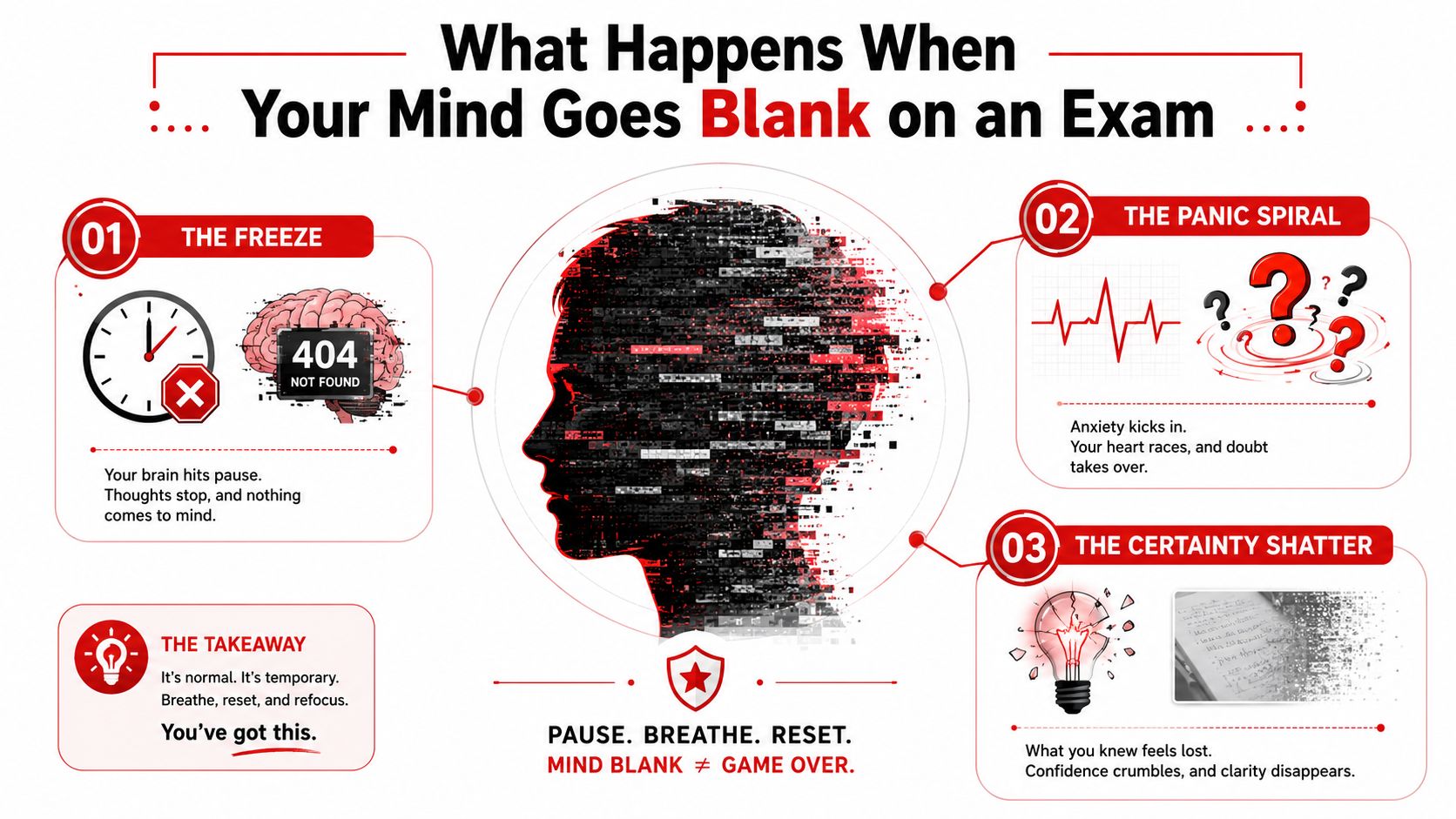
What Happens When Your Mind Goes Blank on an Exam
You hit a question you have seen a dozen times in practice, then the answer does not arrive. The stem looks familiar, your eyes keep moving over the words, and nothing connects. In the testing room, that moment can feel like the floor dropped out from under your working memory.
Why the feeling is so intense
In cognitive neuroscience, mind blanking is different from ordinary distraction. Mind wandering still has content, a stray memory, a plan for dinner, a worry about the next block. Mind blanking is narrower, because there is no reportable conscious content at that moment, so the student does not just feel off task, they feel as if access itself has gone missing (European Journal of Neuroscience review).
That difference matters under exam pressure. A student who reads the freeze as proof of failure adds shame on top of the stall, and shame tends to make retrieval even harder. A better reading is simpler, your retrieval system has stalled under pressure, and it needs a reset instead of a verdict.
Practical rule: treat the blank as a temporary state, not a diagnosis of your ability. The faster you label it, the less room panic has to build.
If the blank starts as anxiety rather than a true loss of content, how to overcome test anxiety is a useful frame for separating the fear response from the actual exam task. For broader support around that kind of stress, college student anxiety care can help you sort general anxiety from what is happening in the testing room.
What the brain research adds
The older and newer neuroscience papers point in the same direction. A 2022 PNAS study defined mind blanking as a waking state with no reported mental content and linked it to recurring patterns in brain activity. Earlier imaging work found deactivation in regions including Broca's area and the hippocampus, while later summaries described broader quieting across occipital, frontal, parietal, and thalamic regions during mind blanking episodes (controlled fMRI study).
That is useful for exam coaching because it tells you the state is not imaginary. A controlled study found that participants could intentionally induce mind blanking, and later work reported higher global signal amplitude and globally positive-phase coherence during blank reports, which supports the idea that this is a distinct physiological pattern rather than just weak attention (controlled fMRI study).
For a student who freezes on Step 1, the main takeaway is practical. The blank is a state you can recognize, interrupt, and work around, which is why the rest of this article focuses on exam-specific recovery scripts and the study structure that makes blanks less likely before test day ever arrives.
Immediate Recovery Techniques You Can Use in Seconds
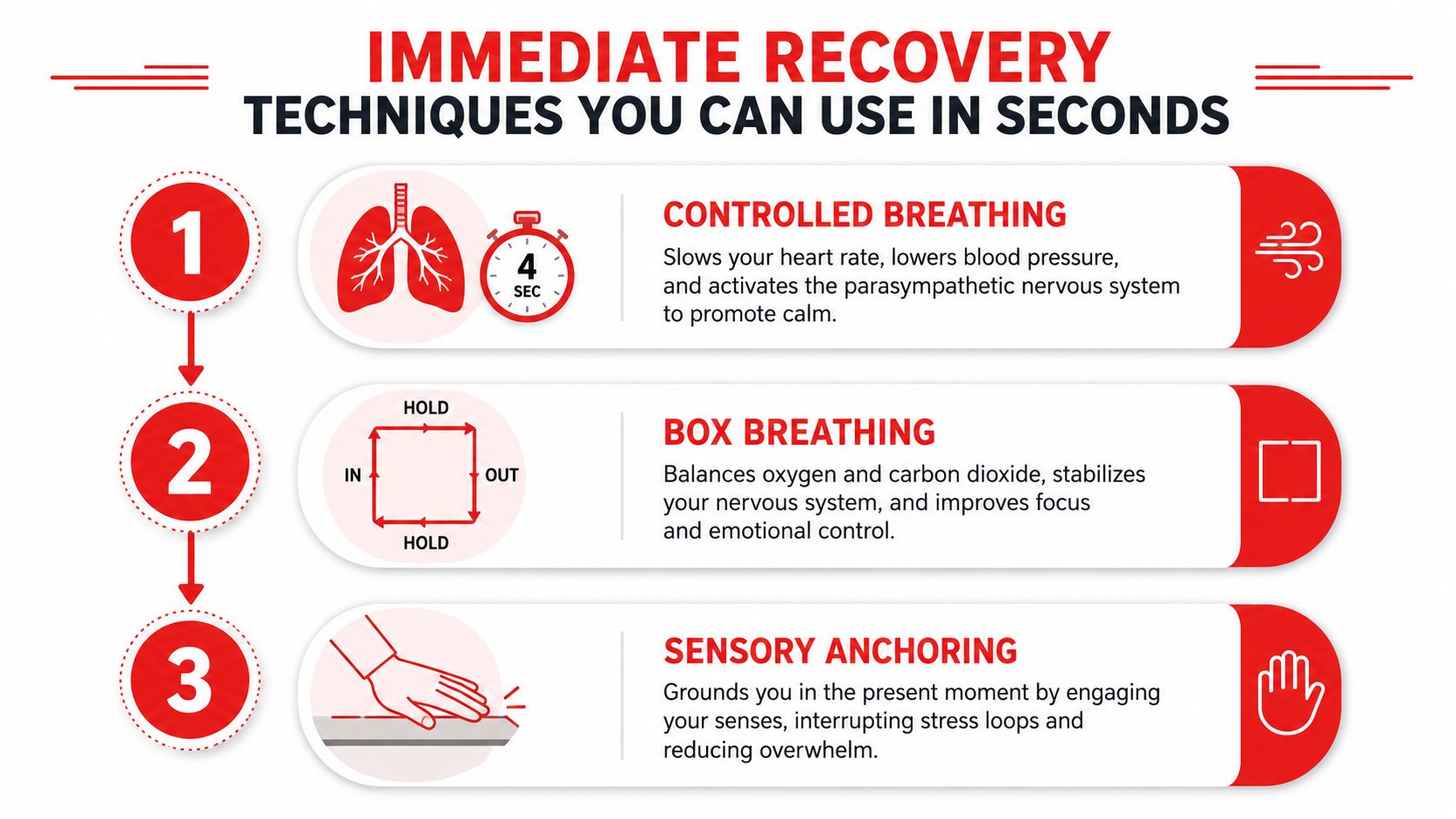
The first priority is to stop the spiral from eating the whole block. If you have 5 seconds, don't try to think your way out. If you have 15 to 30 seconds, you can buy enough calm to restart retrieval.
Start with breathing and grounding
Take one slow breath in, then a longer breath out. If you know box breathing, use it, four in, hold, four out, hold. That pattern gives your body a simple rhythm to follow when your cognitive system is overloaded, and it's a practical version of the grounding reset students often use when pressure spikes (test-anxiety coping guidance).
Then anchor yourself physically. Feel both feet on the floor. Press your fingers lightly into the desk. Name three sensory details, the texture of the chair, the light on the screen, the sound of the room. That kind of sensory anchoring pulls attention back into the present moment instead of letting it ricochet through fear.
If you want a prebuilt drill, the guidance in performance under pressure is worth reviewing before a high-stakes block.
Breathe first. Think second. If you reverse that order, the panic usually wins the race.
Restart retrieval with a tiny cue
Once your body is slightly calmer, don't search for the whole answer. Restart the network with one known fragment. Whisper the first related word that comes to mind, even if it feels too small to matter. Rephrase the question in your own words. If you're looking at a chest pain stem, say to yourself, “middle-aged patient, pain with exertion, what category is this?” That tiny reformulation often gives the brain a bridge back to the relevant shelf of memory.
You can also use a silent image cue. Picture the page where you studied the topic, the table, the figure, the slide, anything tied to the fact set. The goal isn't perfect visualization, it's to reconnect the question to a known retrieval route.
Use a short script
When the freeze hits hard, a script keeps you from doing nothing.
- “What is this question really asking?”
- “What's the first clue I do recognize?”
- “I know the broad category, now narrow it.”
The point is not eloquence, it's motion. Once you're moving, even slowly, the brain often gives you the next step.
How to Rebuild Your Answer When the Facts Disappear
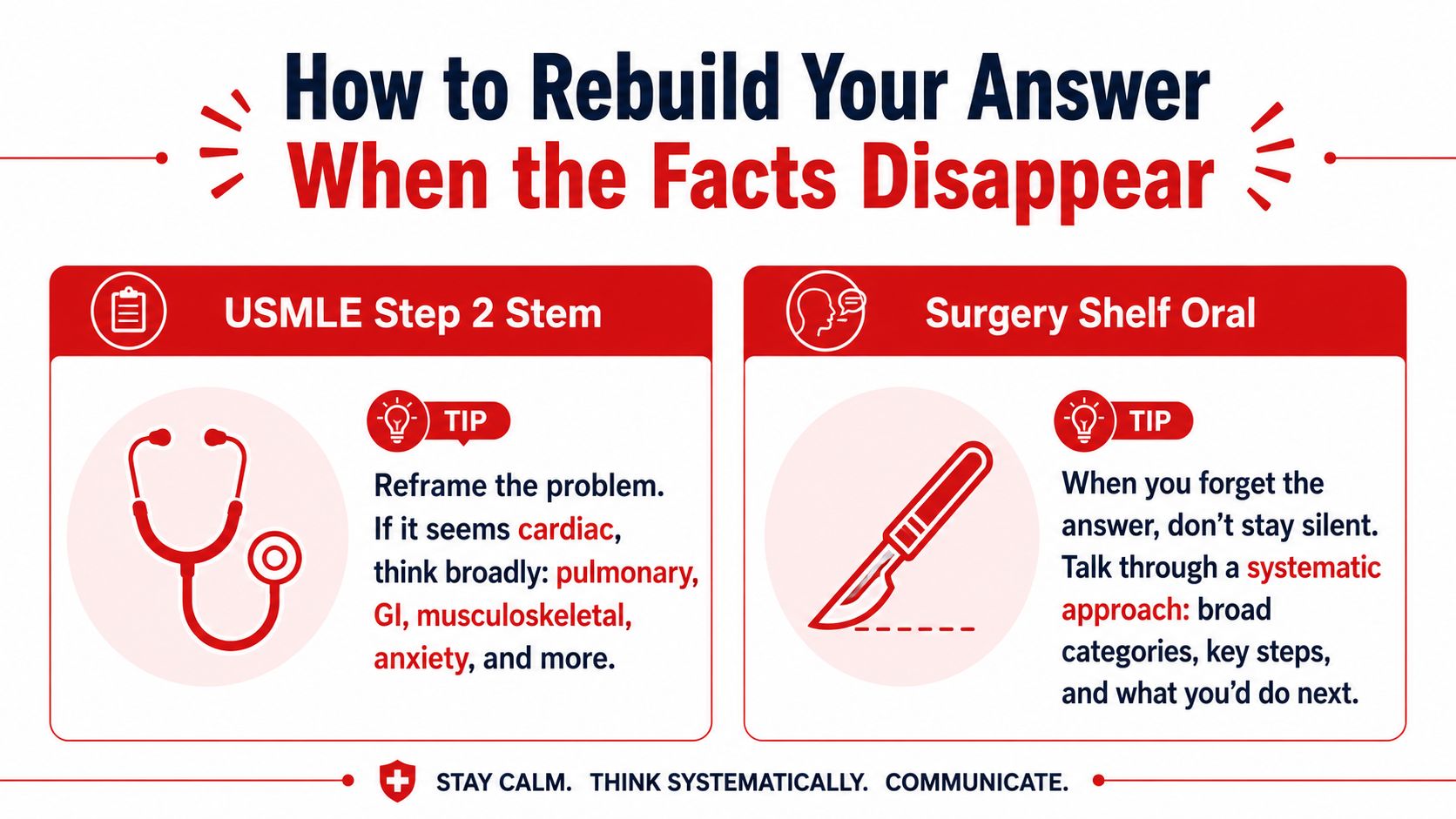
A blank answer rarely stays blank once you rebuild the skeleton. Think about a Step 2 internal medicine stem: a patient with chest pain, risk factors, and a couple of details that point you toward a category you've seen before. If the exact mechanism is gone, start with what you still know, not what you lost.
A useful resource for this style of retrieval practice is the MasteryMind blurting guide, because blurting is basically structured recall under imperfect conditions. The skill is to produce the scaffold first, then fill in detail.
The chest pain stem
Say the question asks for the most likely diagnosis. You don't need every detail immediately. Rephrase it in your own words, “This is a chest pain question, likely cardiac until proven otherwise, what clue separates the top choices?”
From there, anchor on the clues you do have. Exertional pain points one direction. Reproducible tenderness points another. A patient's age, the pattern of radiation, and the timing after meals or exertion all help you classify the problem before you remember the exact label.
That is how you rebuild. You move from the specific forgotten fact to the larger clinical bucket, then back down to the answer choice that fits the bucket best.
The Surgery Shelf oral
An attending asks for the differential for an acute abdomen, and your mind goes flat. Don't chase the one perfect answer. Start with a simple structure, “obstruction, perforation, ischemia, inflammation, gynecologic causes if relevant.” Saying a systematic framework out loud gives your brain a path to follow while you search for detail.
If you're still stuck, bridge instead of freezing. Try, “The most concerning cause is the one that fits hemodynamic instability, and I'd want to rule out that first.” That keeps the conversation moving and buys time for the next fact to return.
Useful habit: if the exact answer is missing, state the likely category, then reason backward from the patient's age, symptoms, and red flags.
When should you skip, and when should you commit? If one item is dragging you into a full panic cycle, move on and come back. If you already have the category and two supporting clues, commit to the best answer and stop negotiating with yourself.
In-Exam Tactics for Time Management and Smart Guessing
Blanking gets worse when you treat one lost question like a lost exam. That's a pacing problem, not just a memory problem. A steady test taker protects the rest of the block, because the next stem may supply the clue that the current one refused to give.
| Situation | First Action | Recovery Cue | Skip or Stay |
|---|---|---|---|
| One question suddenly goes blank | Take one breath and reread the last line | “What category is this?” | Stay if a clue returns quickly |
| Two or three answer choices look plausible | Eliminate the ones that violate anatomy, physiology, or first-line logic | “What cannot be right?” | Stay and narrow, then choose |
| An oral examiner is waiting | State one thing you know, then a second linked fact | “Here's the framework I'd use” | Stay, speak, and ask for a prompt if needed |
| You've lost too much time | Mark it and move on | “I can return after the next set” | Skip and revisit later |
For multiple-choice questions, educated guessing should never feel random. First eliminate choices that flatly contradict basic anatomy, physiology, or the usual first-line approach. Then choose from the remaining options instead of letting hesitation swallow the clock. The internal link at how to improve test-taking skills fits this kind of pacing work well.
If you're in an oral or clinical setting, use cue-card logic. Say one thing you know, tie it to a second fact, then ask for a prompt if you still can't rebuild the answer. That is better than silence, and it shows the examiner a working mind instead of a stalled one.
Breaks matter too. If your exam has scheduled breaks, use them intentionally. Drink water, stand up, and reset your attention instead of scrolling through the last missed item in your head. The break is a recovery tool, not dead time.
Long-Term Study Methods That Prevent Blanking Before It Starts
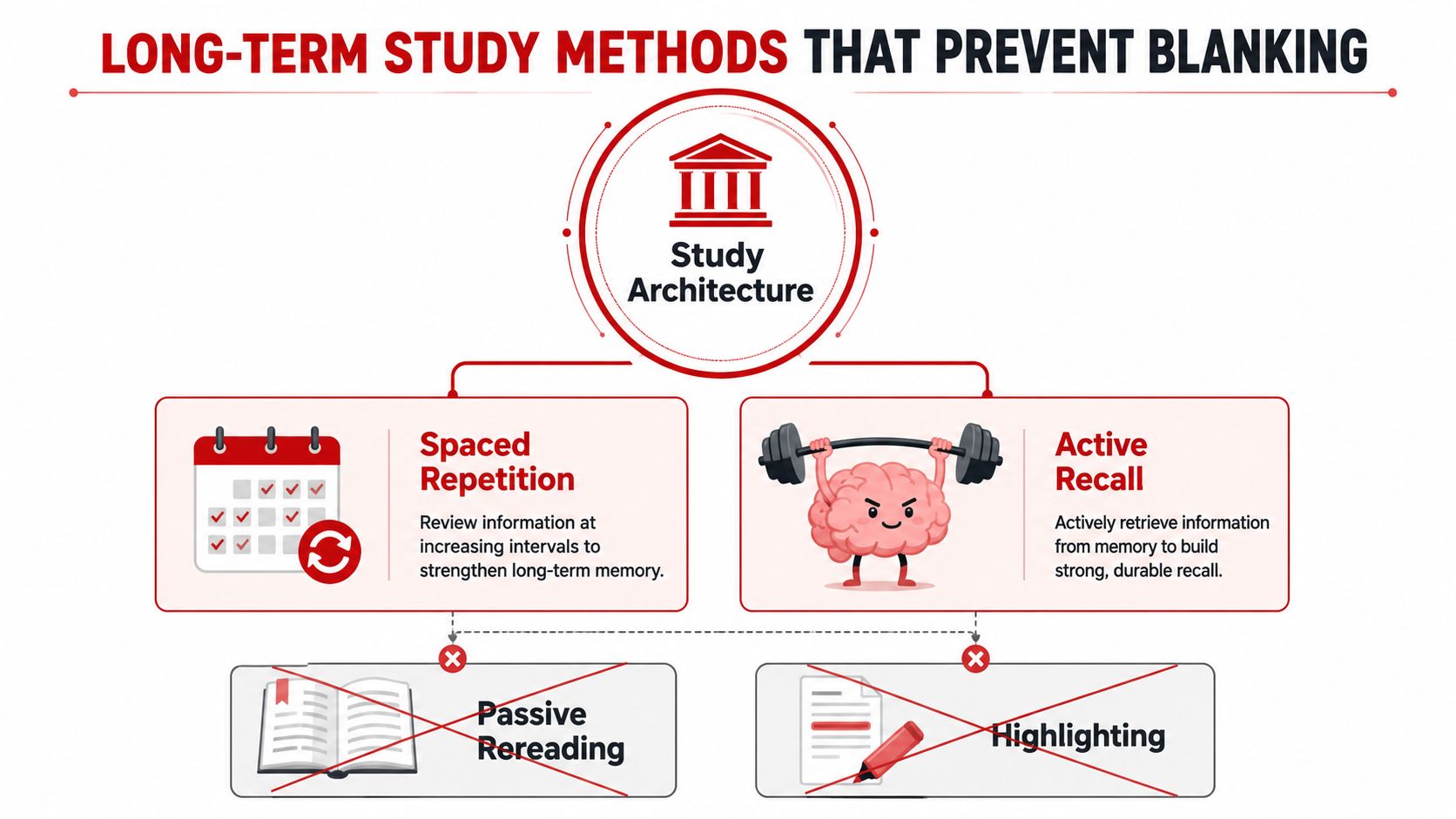
Prevention is mostly about study architecture, not personality. Students who blank less on test day usually aren't relying on motivation alone. They've built a system that forces recall under increasing pressure until the material feels less fragile.
Use retrieval, not recognition
Active recall matters because it asks you to produce an answer before you see it. That's different from rereading, where the page does the work and your brain gets the illusion of knowing. The internal guide on active recall for medical students fits this exactly, because it trains the memory path you need in the exam room.
Spaced repetition adds a second layer. You revisit the same fact after a delay, then again after a longer delay, so the memory has to survive repeated retrieval instead of a single comfortable review. That makes the material harder to fake and easier to access when pressure is high.
Review misses by pattern
Question banks help because they simulate the setting that causes blanking in the first place. Don't just reread the explanation after a miss. Sort the miss, was it a knowledge gap, a misread clue, a timing error, or a second-order trap? That simple categorization helps you fix the right problem instead of circling the same page again.
You can also rehearse under pressure on purpose. Do short timed blocks. Mix subjects across the week instead of keeping one topic in a sealed container. Interleaving makes retrieval less dependent on one context, so the brain learns to find the fact even when the cue looks different from the one you studied first.
Build mnemonics that survive stress
Mnemonics work best when they're attached to practice, not just memorized once. Say them out loud during timed questions. Write them from memory after a block. Use them in a mock oral presentation. The more often they survive under mild stress, the more likely they are to show up when the exam tightens your attention.
Study rule: if you can only recognize the fact on the page, you don't own it yet. Keep testing until you can retrieve it cold.
Lifestyle Foundations and When to Seek Professional Help
A blank mind is not just a test-day problem. Sleep, food, movement, and stress regulation shape how often retrieval fails in the first place. When your brain is running on too little sleep or too much stress, it has less room for working memory and less flexibility when a question feels unfamiliar. That is the testing-room version of the problem, the moment your notes vanish even though you recognized the material the night before.
Sleep comes first. Poor sleep disrupts the systems you use to pull information back up, including hippocampal function, so the answer can feel out of reach even when the fact was learned correctly. Before an exam block, eat in a way that keeps your energy steady, drink enough water to stay comfortable, and build in brief low-intensity movement during the day so your body is not starting from a stalled state.
Stress regulation matters in the same way. A useful overview of resilient mind habits can help you treat daily regulation as part of performance, not as a side issue you handle after the exam is over. If you want a place to start with counseling and related care, the internal guide on medical student mental health gives a structured starting point.
Know when blanking needs more than test coaching
An occasional blank on an exam is common. The pattern changes when blanking starts showing up in practice exams, oral presentations, or daily work, because then the issue is no longer limited to one stressful room. Recurring physical symptoms, panic attacks, avoiding practice tests because they feel unbearable, or noticing the same freeze response in other settings are signs that the problem deserves closer attention.
That does not mean the situation has to become dramatic before you get help. Counseling, cognitive-behavioral therapy, performance coaching, and sometimes medication evaluation can all reduce the interference that keeps your knowledge from coming through. The goal is simple, lower the noise so retrieval has a clear path.
If you are unsure whether the pattern is test anxiety or something broader, ask a clinician to sort it out with you. That is a performance decision, not a failure.
Your Layered Recovery and Prevention Plan
Use this as your quick reference before a test.
When the mind goes blank in the moment
- Reset the body first. One slow breath, feet on the floor, hands on the desk.
- Name the question category. Chest pain, abdomen, neuro, ethics, whatever the bucket is.
- Start with one anchor clue. A single word is enough to restart retrieval.
When you're mid-exam and still stuck
- Rephrase the stem. Say it in plain language.
- State the broad answer path. Pick the likely system or diagnosis family.
- Guess smart, not fast. Remove choices that break basic physiology or first-line logic.
- Mark and move if needed. Protect the rest of the block.
When you're studying for the next exam
- Use active recall every week.
- Space your repetition instead of rereading once and hoping it sticks.
- Run timed practice blocks and review misses by pattern.
- Practice your mnemonics out loud under pressure.
A blank answer is a problem you can train for, not a fixed limit on your ability. If you want help drilling these moves across USMLE, COMLEX, and Shelf formats, Ace Med Boards offers one-on-one tutoring built around question analysis, timed practice, and exam-day recovery habits.
If you're ready to make blanking less likely on test day, Ace Med Boards can help you rehearse the exact reset, guessing, and reconstruction skills that matter under pressure. Work with a tutor who can turn your weak points into a structured plan, then practice those skills until they hold when the room gets quiet.