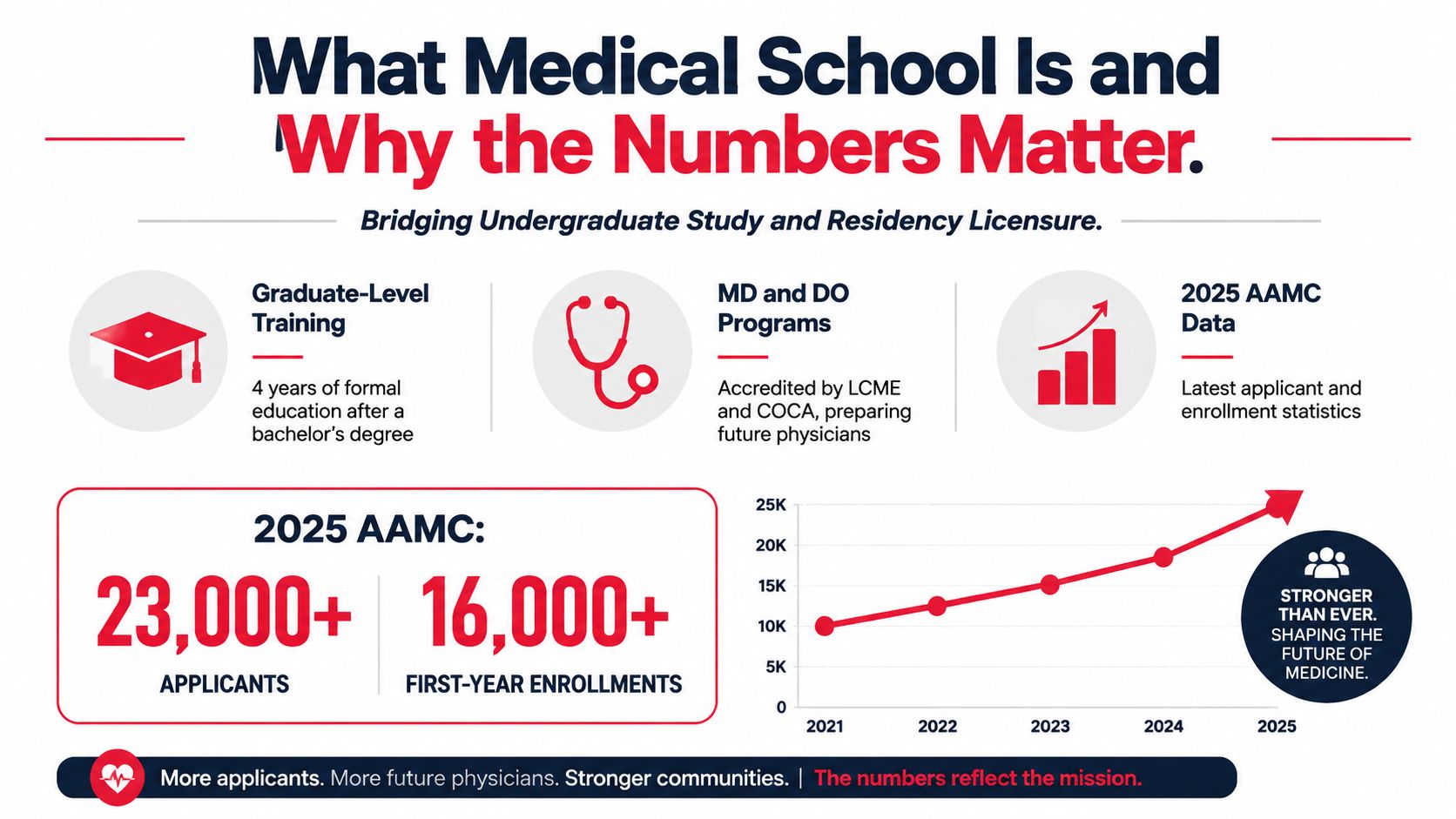
There are more than 100,000 students enrolled in MD-granting U.S. medical schools, and the latest AAMC cycle also drew 54,699 applicants from the AAMC's 2025 enrollment release. That combination tells you the story of medical school: demand is strong, the pathway is structured, and every stage, from prerequisites to residency, rewards preparation that's specific and deliberate.
Medical school is the graduate-level bridge between a bachelor's degree and physician licensure. It isn't just “more school.” It's a four-year sequence that turns classroom knowledge into clinical judgment, then sends graduates into residency, where training becomes specialty-specific and much more supervised than most applicants expect.
What Medical School Is and Why the Numbers Matter
Medical school sits at the center of physician training because it connects undergraduate study, licensing exams, clinical rotations, and residency placement. In the U.S., that usually means an MD or DO degree, both of which lead to full physician licensure through their own accredited pathways. Across the world, there are about 2,600 medical schools, with especially large concentrations in India, Brazil, the United States, China, and Pakistan according to the PubMed-indexed global inventory.
The scale matters because the system is large, but not uniform. Some schools graduate many students, others train smaller cohorts, and the average output reported in 2012 was 181 graduates per medical school in the same global review. That variation helps explain why applicants hear mixed advice about competitiveness, curriculum style, and school fit.
The basic training arc
The path usually runs in a clear order. First comes prerequisite coursework and the MCAT. Then comes the application through AMCAS or AACOMAS, followed by interviews, matriculation, preclinical science training, clinical clerkships, licensing exams, the residency match, and finally specialty training.
That sequence matters because each stage builds on the one before it. A student who treats admissions as separate from later training often gets blindsided by how early performance starts to matter again.
Practical rule: if you're choosing schools, don't think only about getting in. Think about whether the program's assessment style, clinical exposure, and residency pipeline fit the way you learn.
MD and DO training now sit in the same residency environment after the single accreditation transition, so applicants can no longer think of the two routes as separate end points. They're different educational traditions with the same destination, and that makes school choice more about fit, mission, and training style than about whether one path leads to physician status.
Admissions Prerequisites and the Application Roadmap
Before you apply, you need to know whether your coursework, timing, and evidence match what schools expect. That sounds obvious, but applicants often underestimate how much of the process is about organization, not just ambition. The core prerequisites usually include biology, general chemistry, organic chemistry, physics, biochemistry, English, and statistics, although each school can set its own details, so you always have to verify program-specific requirements.
Timing matters more than people think
MCAT timing is not uniform across schools. The AAMC's MSAR materials for the 2025 to 2026 AMCAS cycle track each school's latest and oldest MCAT administration dates considered for admission, which means you can't assume one national cutoff as noted in the MSAR guidance. That's one reason applicants should build their testing plan around the schools they want, not around a generic calendar.
The rest of the application has a similar logic. AMCAS and AACOMAS each ask for verified transcripts, personal statements, work and activities entries, and secondary essays. Schools then use letters of recommendation, sometimes situational judgment tools such as CASPer or PREview, and interviews to decide whether your record matches their training environment.
MD and DO applications in plain language
The MD and DO routes overlap more than many applicants realize. Both are U.S. medical school pathways to full licensure, and both feed into the same residency system. The day-to-day differences usually show up in philosophy, curriculum emphasis, and sometimes clinical exposure patterns, not in whether you can become a practicing physician.
One useful way to think about this is to ask three questions before you submit anything:
- Am I eligible? Check coursework, degree progress, and test timing.
- Do I fit the school's mission? Community service, primary care focus, research emphasis, rural health, or academic medicine all matter.
- Can I show evidence, not just interest? The application has to prove your claims.
For a practical walkthrough of course requirements, you can use Ace Med Boards' prerequisite guide for medical school as a planning aid alongside the official school pages.
Schools don't admit “potential” in the abstract. They admit evidence, then ask whether that evidence matches their mission and curriculum.
Applicant Evidence Matrix and School-Fit Scorecard
A lot of premed advice fails because it tells students to “be well rounded” without giving them a way to compare themselves to actual schools. A better approach is to build two tools, an Applicant Evidence Matrix and a School-Fit Scorecard. Together, they help you see whether you're ready, where you're competitive, and which programs deserve a closer look.
How to use the matrix
The matrix is simple. List your GPA, science GPA, MCAT, clinical exposure, research, service, and leadership. Then add each target school's published or median benchmarks where available. The point isn't to chase a perfect score. The point is to spot gaps early, before you submit costly applications to schools that don't match your profile.
The scorecard asks a different question. How well does the school fit your goals? Look at mission alignment, curriculum structure, early clinical exposure, location, patient population, residency placement context, and student support services. A strong fit doesn't guarantee admission, but it can sharpen your school list and make your secondary essays more specific.
| Metric or Criterion | Hypothetical Applicant | Target School A Median | Target School B Median | Fit Score (1-5) |
|---|---|---|---|---|
| GPA | 3.70 | 3.75 | 3.55 | 4 |
| MCAT | 512 | 513 | 507 | 4 |
| Science GPA | 3.62 | 3.70 | 3.50 | 4 |
| Clinical exposure | Solid but concentrated in one setting | Broad primary care and hospital exposure | Broad urban and rural exposure | 3 |
| Research | Poster-level experience | Expected for many applicants | Optional but valued | 3 |
| Service | Sustained volunteer work | Strong community mission | Strong service mission | 5 |
| Leadership | One major role | Multiple leadership examples | Team-based leadership | 3 |
A labeled hypothetical that tests transfer
Hypothetical applicant, Maya, has decent academics but limited community service. If she compares herself only to test averages, she may overestimate her readiness. If she uses the matrix, she sees that her service story is the weakness for mission-driven schools, so she can adjust school choice or strengthen the narrative before applying.
Now change one variable. If Maya's MCAT were higher but her clinical exposure narrower, the matrix would point her toward programs that value academic strength while she builds broader patient-facing experience. That's the transfer skill schools want too, not just recall of your résumé.
For a related planning lens, review what medical schools look for and then compare that checklist against your own evidence.
Inside the Medical School Curriculum and Rotations
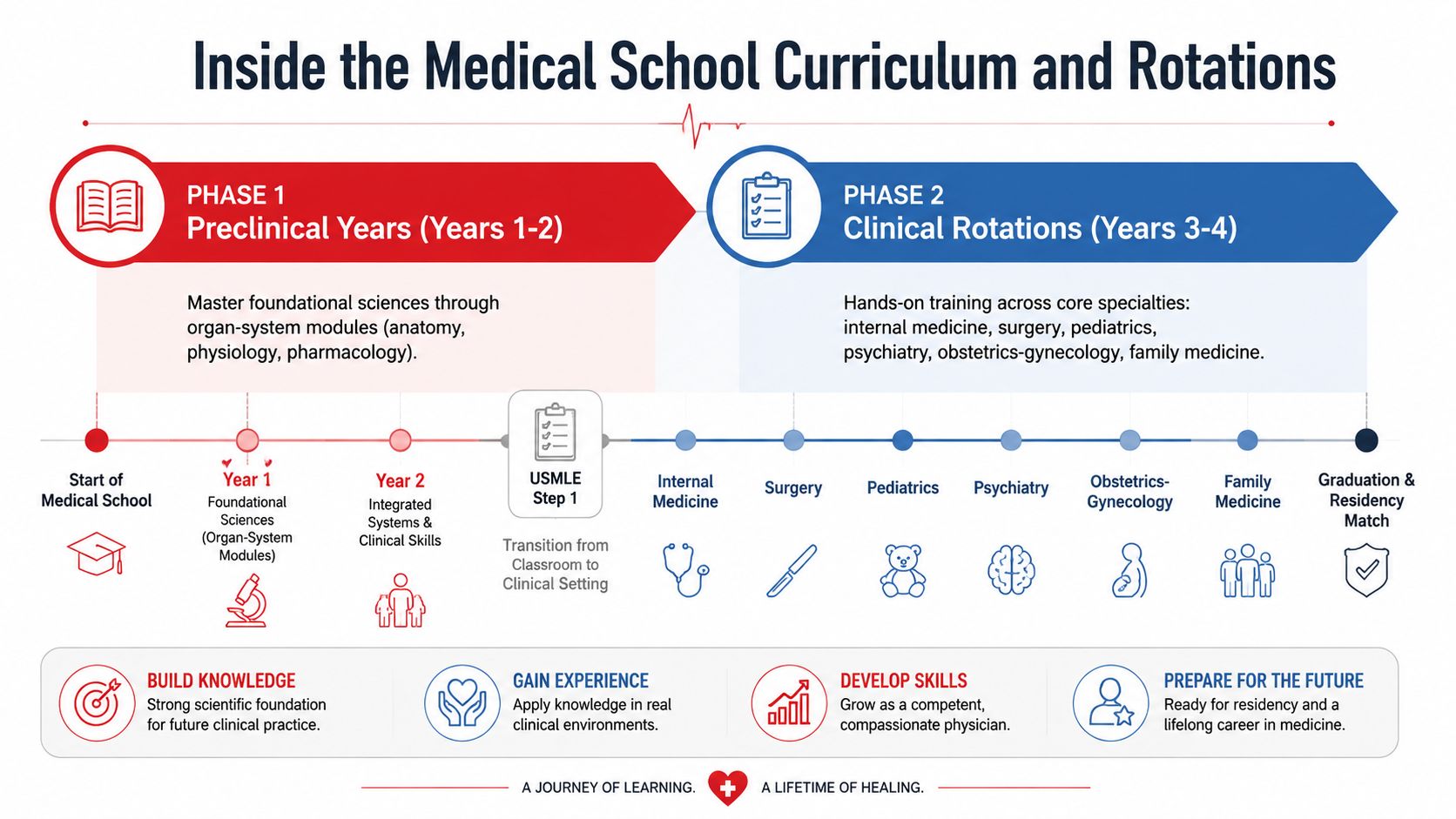
Medical school usually unfolds in two broad phases, and the biggest confusion for new students is thinking that the classroom years and the clinical years are separate worlds. They aren't. The earliest content is designed to prepare you for real patients, and the later rotations depend on how well you've already learned to reason under pressure.
Preclinical learning builds the framework
The first phase, often the first two years, focuses on foundational sciences through organ-system blocks, case-based discussions, and simulation work. Students learn anatomy, physiology, pharmacology, pathology, and clinical reasoning in a way that's intended to support patient care later, not just pass exams.
Many schools now use competency-based, outcome-aligned curricula instead of simple time-based progression as described in the core curriculum framework. That means the school is trying to measure whether you can do the work of a future physician, not just whether you sat in class long enough.
Clinical rotations turn knowledge into judgment
The second phase brings core clerkships in internal medicine, surgery, pediatrics, obstetrics-gynecology, psychiatry, and family medicine. Students also do electives and, in many cases, audition rotations or sub-internships to show readiness for residency. Many students first realize that professionalism, communication, and follow-through matter as much as content knowledge.
Assessment is broader than a written exam. Medical education literature emphasizes validity evidence from content, response processes, internal structure, relations to other variables, and consequences, because a score only means something if it supports the intended interpretation of competence as discussed in contemporary assessment literature. In practical terms, schools use mixed assessment batteries, including workplace-based evaluation and portfolios, so a student can't hide behind one strong test score.
Clerkship performance often matters earlier than students expect. If you treat rotations as observation time, residency programs will usually notice.
For a plain-language overview of what the classroom and ward years look like, this medical school learning guide can help you connect the sequence.
Major Exams From USMLE and COMLEX to Shelf
The exam environment looks confusing until you separate who takes what, when it matters, and what each score is used for. Medical students often mix up shelf exams, Step exams, and COMLEX levels because all of them affect progression, but they don't serve the same purpose.
The main exam lanes
Shelf exams and COMATs are subject-specific tests taken during clerkships. They help schools assess whether you're learning the material expected on each rotation, and they often show up in the MSPE, the Medical Student Performance Evaluation. That makes them more than just “practice exams.”
USMLE Step 1 is now reported as pass/fail, which changed how students prepare and how residency programs interpret it. Step 2 CK remains scored and still carries major weight in residency screening, especially where programs need a more recent academic signal. For osteopathic students, COMLEX-USA is the parallel exam series, with Level 1 reported pass/fail, Level 2-CE scored, and Level 3 taken during residency.
| Exam | Audience | Purpose | Scoring |
|---|---|---|---|
| USMLE Step 1 | MD students and many IMGs | Foundational medical knowledge | Pass/fail |
| USMLE Step 2 CK | MD students and many IMGs | Clinical knowledge for residency screening | Scored |
| COMLEX Level 1 | DO students | Osteopathic foundational knowledge | Pass/fail |
| COMLEX Level 2-CE | DO students | Clinical knowledge for residency screening | Scored |
| Shelf / COMAT | Medical students during clerkships | Subject mastery during rotations | School-based or exam-specific reporting |
Timing and strategy
The right study window depends on your clerkship load and the exam you're facing. Shelf exams are tied to rotations, so they should be prepared for across the year, while Step 2 CK and COMLEX Level 2-CE usually deserve a more focused block once core clinical knowledge has built up.
International medical graduates usually work through USMLE rather than COMLEX, while many DO students consider both pathways if they want to keep options open across residency programs. If you're comparing exam planning or score review, Ace Med Boards' medical board exam score resource is a useful place to start.
Practical rule: don't treat the pass/fail label as permission to ignore Step 1. Schools still expect a strong knowledge base, and that foundation shows up everywhere else.
Costs, Debt, and Financing Medical School
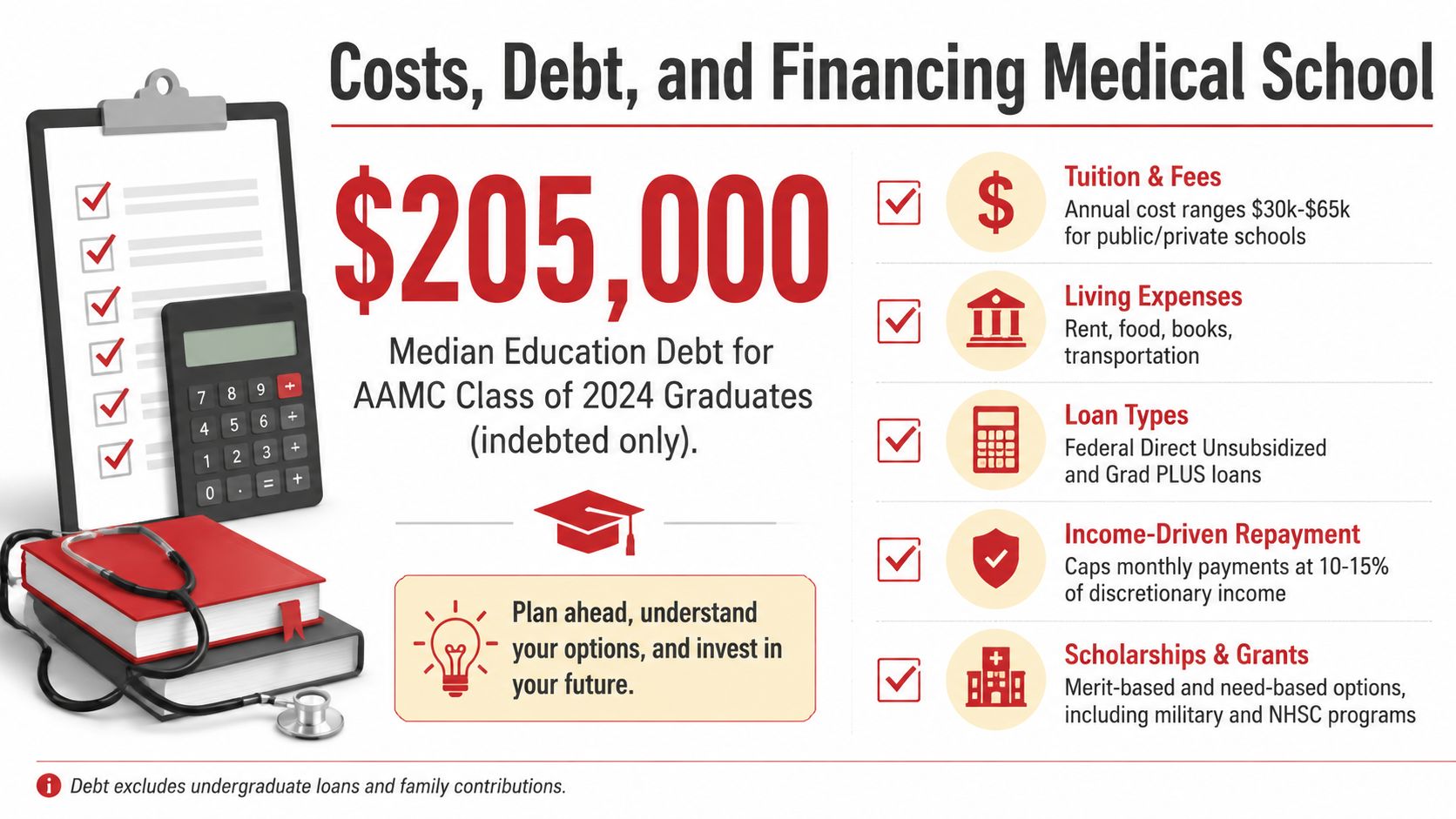
The financial side of medical school is more than tuition, and students often feel the pressure most when they compare the visible price tag with the hidden costs. The AAMC's Class of 2024 fact card reports a median medical education debt of $200,000 among graduates who borrowed for medical education, and a median total education debt of $203,606 when premedical and medical debt are combined from the AAMC fact card.
What the debt number leaves out
That debt figure doesn't include every expense a student will face. It also doesn't erase the costs that stack up over four years, such as tuition, fees, health insurance, equipment, board exam fees, living expenses, and sometimes residency interview travel. The dollar amount matters, but so does the structure of the bill.
Students also need to check tuition and student fee patterns by school type. Public in-state, public out-of-state, and private schools can differ dramatically, so current institutional data and AAMC tuition resources matter more than any single headline number. Loan terms, interest rates, and repayment rules change, so a plan that worked last year may not be accurate now.
Financing options people actually use
Federal Direct Unsubsidized Loans and Grad PLUS loans are the most common tools for many students. Some schools also offer institutional loans, and service-based options such as the Health Professions Scholarship Program and the National Health Service Corps can matter for students with military or service commitments.
Repayment strategies also deserve attention. Public Service Loan Forgiveness and state-based repayment assistance can shape specialty choice, location, and monthly budgeting, but the details change often enough that any decision should be checked against current federal guidance. That's especially true if you're planning around residency rather than just the degree itself.
For a school-specific scholarship planning resource, this medical school scholarship guide can help you think about financing as part of the application strategy.
A realistic budget doesn't just ask “Can I borrow enough?” It asks “What will four years of borrowing do to my options after graduation?”
Residency Match Mechanics and Career Pathways
Residency is where medical school becomes a real profession. The degree gets you to the match, but the NRMP algorithm determines how applicants and programs are paired, which is why rank list strategy matters far more than many students realize as stated by the NRMP.
How the match actually works
Applicants submit rank lists, programs submit their own preferences, and the algorithm uses those preferences to make pairings. If no direct match is possible, programs may fill through the Supplemental Offer and Acceptance Program, SOAP, which becomes the backup route for unmatched applicants. That structure rewards careful planning, honest self-assessment, and a realistic understanding of specialty competitiveness.
The 2025 Main Residency Match reported 6,605 IMG matches and 19,898 U.S. senior matches in the NRMP's 2025 report. Those numbers show how different applicant groups move through the same system, even when their paths to that point have looked very different.
| Applicant Type | Total Matches | Matched % | Top Specialties |
|---|---|---|---|
| U.S. seniors | 19,898 | Not provided in the verified data | Specialty mix varies by applicant |
| International medical graduates | 6,605 | Not provided in the verified data | Specialty mix varies by applicant |
Career paths after the match
A matched resident can head into primary care, hospital medicine, academic medicine, surgery, or a fellowship-oriented path. The training length varies by specialty, so it helps to think of medical school as only the beginning of the formal training timeline. USMLE or COMLEX scores, clerkship grades, letters of recommendation, and away rotations often influence interview invitations long before rank list season starts.
For IMGs, the pathway remains competitive. The NRMP reported that in 2025, U.S. citizen IMGs had a PGY-1 match rate of 67.8%, while non-U.S. citizen IMGs had a PGY-1 match rate of 58.0%; the same report said 31.0% of active U.S. IMGs and 41.3% of active non-U.S. IMGs went unmatched in the 2025 results report. Those numbers don't define a career, but they do show why strategy, specialty choice, and backup planning matter.
Common Pitfalls, Realistic Timelines, and Tutoring Support
Most students don't struggle because they lack effort. They struggle because they start too late, aim too broadly, or study without enough feedback. A better plan is usually simpler than people think, but it has to be honest about timing and honest about weaknesses.
The mistakes that cost applicants time
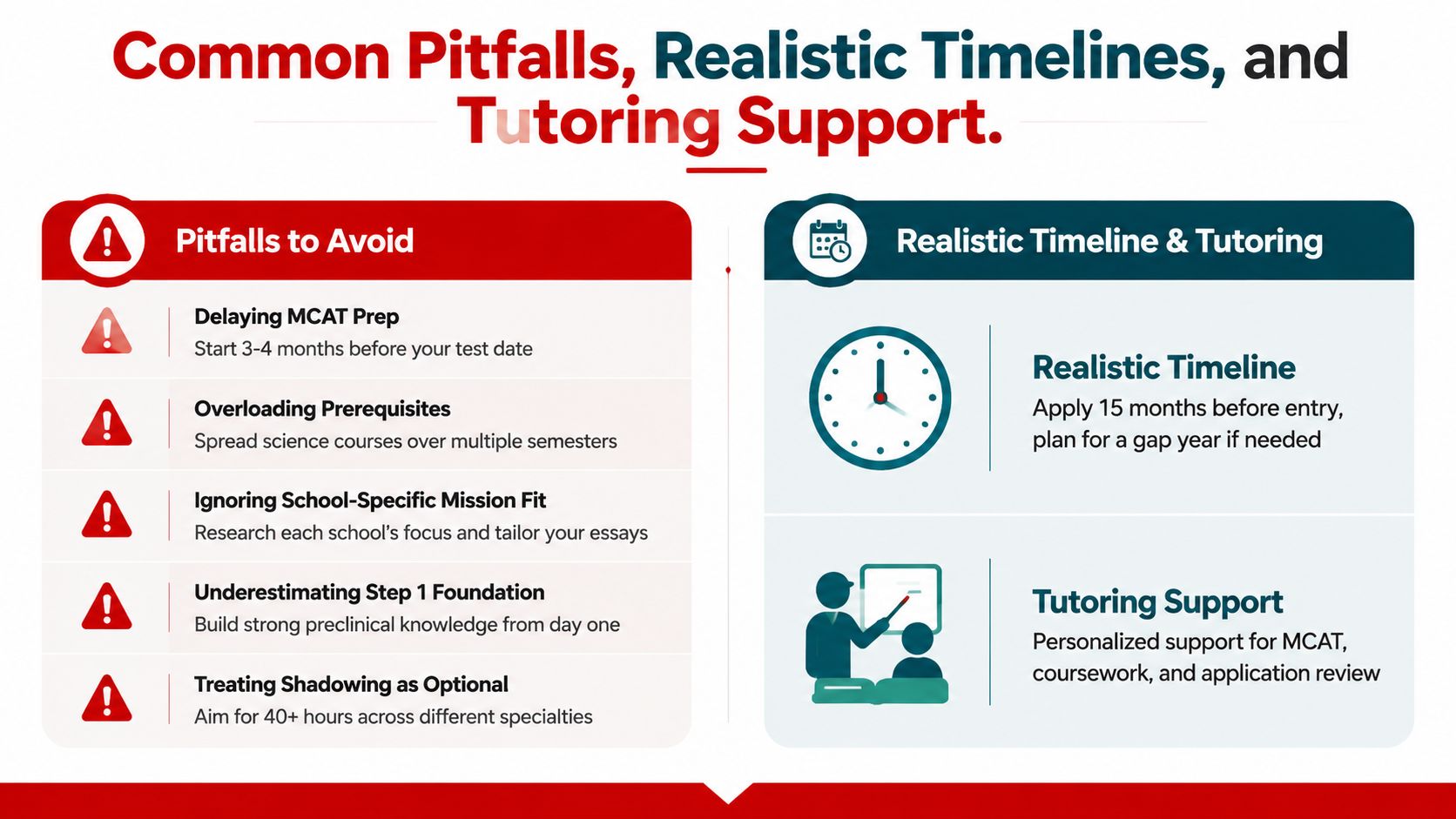
The biggest errors are usually predictable. Students delay MCAT prep, cram too many prerequisites into one term, ignore mission fit, and treat rotations like passive attendance. Some also underestimate the importance of building a strong foundation before high-stakes exams, which creates avoidable stress later.
A useful timeline looks like this:
- Freshman and sophomore years: spread prerequisites across semesters and start logging clinical exposure.
- Junior year: commit to MCAT prep, application materials, and school research.
- Application year: submit early, respond carefully to secondaries, and prepare for interviews.
- Medical school: shift from memorization to performance, because clerkships and shelf exams now matter together.
Where targeted tutoring helps
Targeted tutoring works best when the problem is specific. A student who is shaky on biochemistry reasoning doesn't need more random content review. A student who freezes during a simulated patient encounter needs communication practice, not another broad lecture on anatomy.
That same logic applies to board prep. A good audit of prior question bank performance often reveals whether the issue is content, reasoning, misreading, or pacing. For some students, one-on-one support can be useful for MCAT planning, admissions positioning, or exam review, and Ace Med Boards is one option in that space when you want structured support around admissions and testing.
If you're trying to decide what to fix first, use this sequence:
- Eligibility and prerequisites
- School fit
- Evidence inventory
- Application narrative
- Interview readiness
When students work in that order, they usually waste less energy and explain their choices more clearly.
If you want help turning your own timeline into a workable plan, Ace Med Boards offers diagnostic tutoring and personalized study-plan support for MCAT, admissions, and medical-student exam prep. Visit Ace Med Boards to schedule a free consultation and review where your application or study strategy needs the most attention.