A third-year medical student hears classmates whisper about “the Match,” opens an application calendar, and suddenly feels that an entire career depends on a process nobody has explained clearly. Medical residency is the structured, accredited graduate medical education that follows medical school and prepares physicians for independent practice in the United States. The process includes choosing a specialty, applying through the Electronic Residency Application Service (ERAS), ranking programs through the National Resident Matching Program (NRMP), and completing supervised clinical training.
The system can feel mysterious, especially for osteopathic students, international medical graduates (IMGs), re-applicants, and students still deciding between specialties. It becomes more manageable when you separate the stages: medical school, licensing requirements, residency, the Match, optional fellowship, board certification, and practice.
What Medical Residency Really Is
Medical residency is paid, supervised physician training after medical school. Residents care for patients, participate in clinical decisions, document encounters, communicate with families, and learn progressively complex skills under attending-physician supervision. They aren't medical students completing classroom-based education, although they continue learning every day through rounds, conferences, case discussions, procedures, and independent study.
The first postgraduate year is commonly called PGY-1, meaning postgraduate year one. A PGY-1 resident is also often called an intern. The terms can confuse applicants because “internship” may sound like a separate stage, but in the modern U.S. system, the intern year is generally the first year of residency. A preliminary intern year can be a standalone year before an advanced program, while a categorical PGY-1 begins a complete residency pathway.
Programs accredited by the Accreditation Council for Graduate Medical Education (ACGME) provide the main structure for U.S. graduate medical education. The former osteopathic accreditation system transitioned into the single ACGME accreditation system, so DO applicants and U.S. allopathic graduates now apply within the same national residency framework.
The stages to keep separate
- Medical school: You build foundational scientific and clinical knowledge and complete required clerkships.
- Residency: You train in a chosen specialty with increasing responsibility and supervision.
- Fellowship: You may pursue additional subspecialty training after residency, such as cardiology after internal medicine.
- Independent practice: You work with the level of licensure and certification required by your state and specialty.
A residency program doesn't award a degree. Completion generally makes a physician eligible to pursue specialty board certification, subject to the requirements of the relevant board. The American Medical Association's overview of PGY-1 and residency training can help clarify how the first postgraduate year fits into the larger pathway.
Practical rule: Treat residency as a sequence of verifiable milestones, not as one dramatic event called Match Day.
How the U.S. Residency System Developed
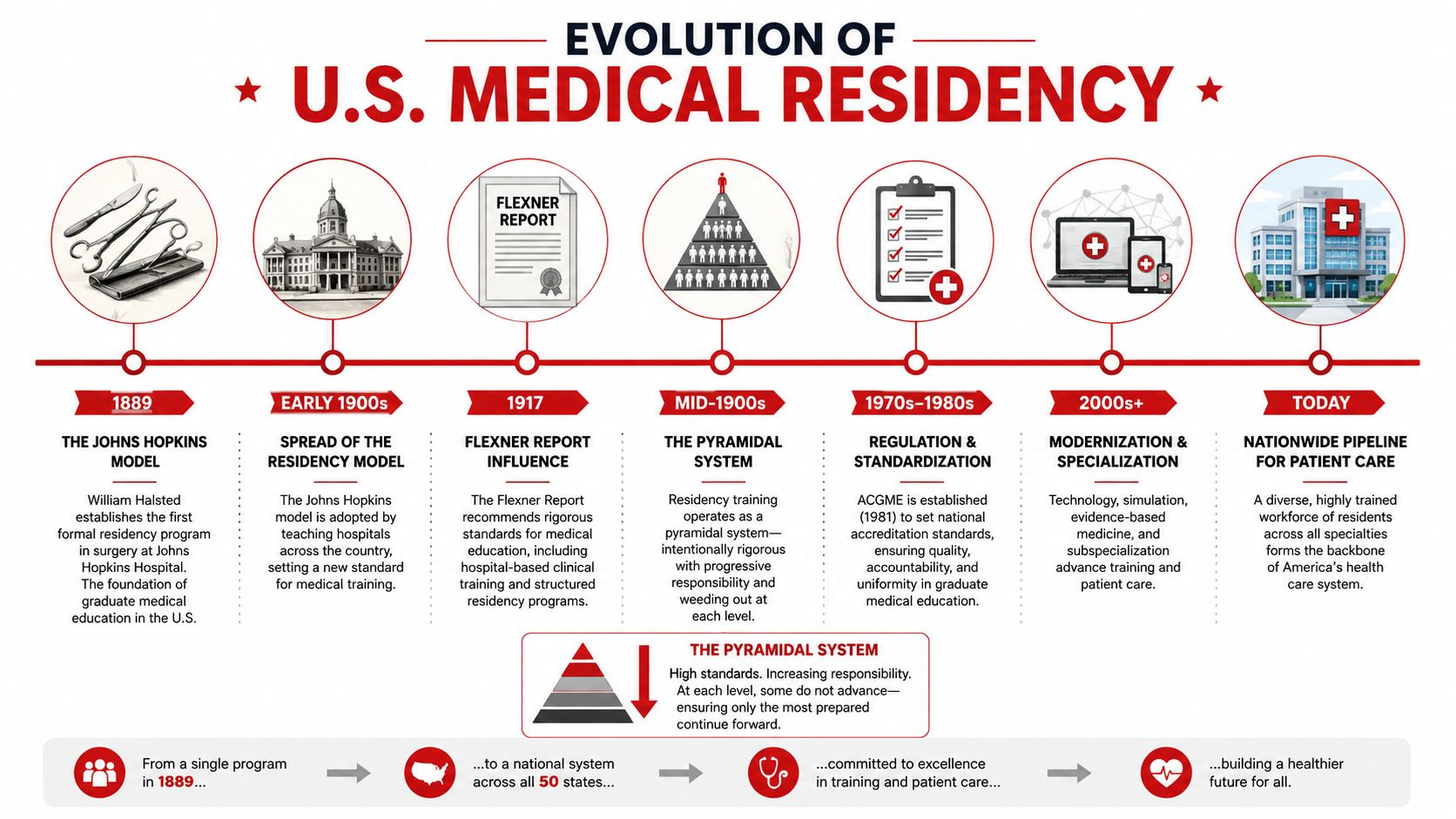
The U.S. residency model is usually traced to the late 19th century and is widely associated with surgeon William Halsted's system at Johns Hopkins in the 1880s and 1890s. The American Medical Association explains that the residency model as it exists today was introduced about 125 years ago, shifting physician training from informal apprenticeship toward structured graduate medical education. The AMA's history of residency places that development in the broader evolution of physician education.
Halsted's approach used a demanding pyramidal structure. Trainees entered the system, assumed progressively greater responsibility, and competed to remain. The model influenced surgical education for decades, but later reforms moved programs toward a rectangular structure, in which accepted residents were not expected to compete for survival within the program.
Why modern oversight matters
Residency became more standardized as concerns about fatigue, supervision, patient safety, and educational quality grew. The current system includes institutional oversight, specialty-specific requirements, evaluation processes, work-hour monitoring, and accreditation review.
Its scale is substantial. The ACGME reported 162,644 active residents and fellows across 13,393 accredited programs in academic year 2023–2024, rising to 167,083 residents and fellows across 13,762 programs in 2024–2025. That was an increase of 4,439 residents or fellows and 369 accredited programs in one year, according to the AMA's summary of ACGME data.
Medicare graduate medical education funding also helps underwrite residency training through payments to teaching institutions, although hospitals and programs have additional funding sources and local financial arrangements. The result is a national training pipeline that is larger and more regulated than the informal apprenticeship model that preceded it.
The Match is part of that modernization. It provides a national mechanism for applicants and participating programs to submit preferences and receive placements under defined policies. It isn't a guarantee of equal outcomes, but it is more structured than the personal patronage networks associated with earlier eras.
The Application Timeline From ERAS to Match Day
The Electronic Residency Application Service (ERAS) is the application platform used by many residency applicants and programs. The NRMP conducts the Main Residency Match, which uses applicant and program rank-order lists to determine placements. These systems work together, but submitting an ERAS application isn't the same as entering a rank list, and neither event is Match Day.
For the 2025–2026 cycle, use the official ERAS and NRMP calendars to verify program-specific dates. A practical planning sequence looks like this:
- June, preparation begins. ERAS opens for the cycle, and applicants begin organizing letters of recommendation, drafting personal statements, reviewing their Medical Student Performance Evaluation (MSPE), and identifying faculty who will provide required documentation.
- Late summer, application materials are refined. Applicants finalize experiences, geographic preferences, program signals where applicable, and specialty-specific materials. Your medical school controls some documents and deadlines, so its calendar matters too.
- Late August or early September, submit strategically. Applicants submit MyERAS applications after checking transcripts, exam records, work authorization details, personal statements, and letters. Waiting for perfection can create avoidable delays, but submitting incomplete materials can also weaken review.
- Mid-September, programs begin accessing applications. Programs may begin downloading applications according to the ERAS schedule. Interview invitations commonly arrive over the following months, with many interviews occurring from October through January.
- Late January, certify the rank-order list. Applicants and programs submit and certify their preferences through the NRMP. The NRMP All In policy requires participating programs to attempt to fill covered positions through the Match or another national matching plan. Applicants should rank only programs they would accept.
The 2026 Match Week timeline is especially useful for backward planning. NRMP states that Match Week begins at 10:00 a.m. Eastern Time on Monday, March 16, 2026, and SOAP operates from Monday through Thursday through offer rounds. Match Day follows on Friday, March 20, 2026, for applicants who receive a position through the main process or SOAP.
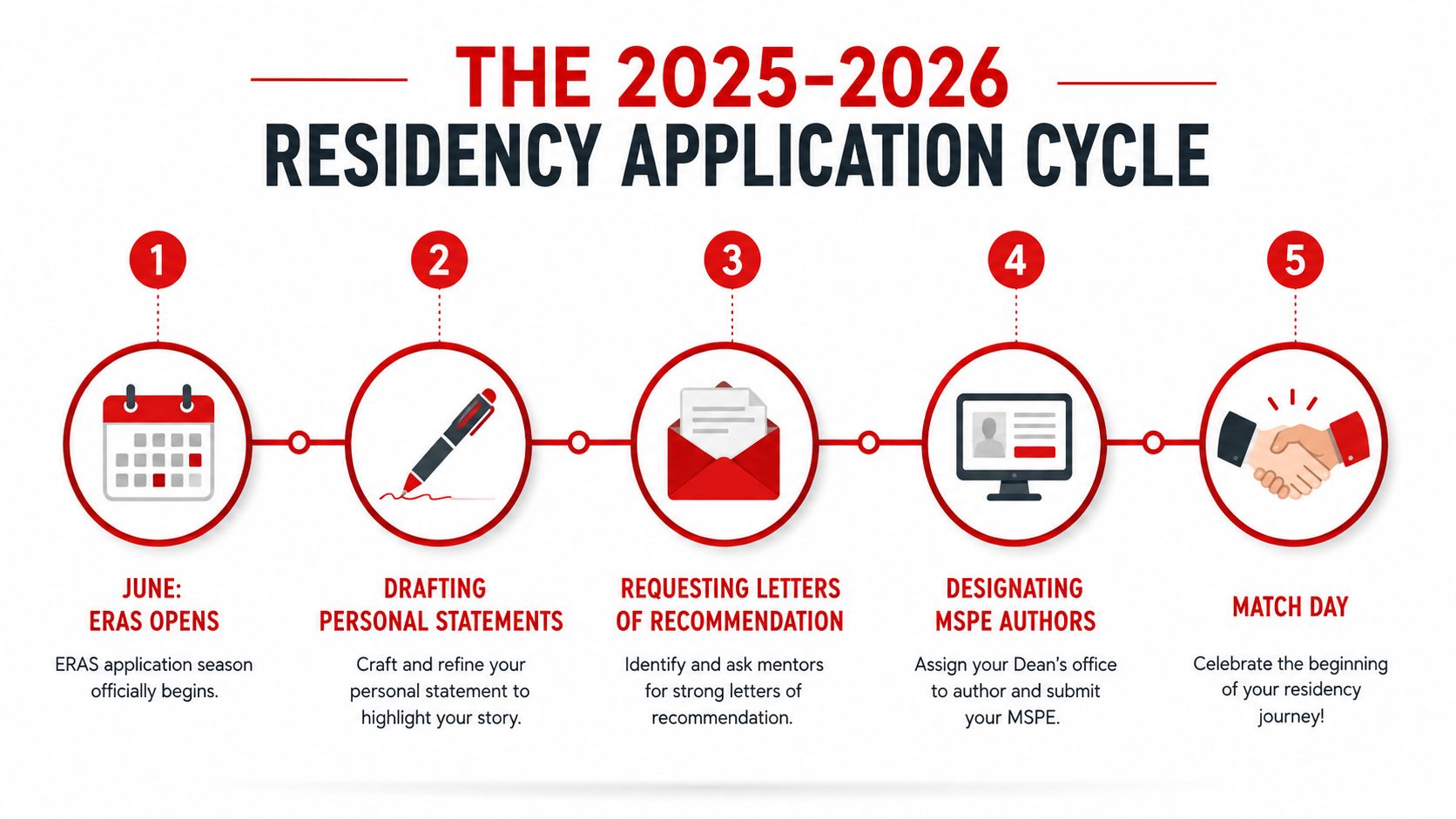
For a calendar you can adapt to your school's deadlines, use this ERAS application timeline alongside the official NRMP applicant information. Keep a separate checklist for documents, interviews, rank-list certification, and Match Week. They're related tasks, not interchangeable ones.
Specialty Training Lengths and Program Structures
Residency length varies significantly by specialty, ranging from three years in several primary care fields to about seven years in neurosurgery. The AMA's overview of medical specialty choice and residency length helps explain how specialty selection affects training time. Fellowship can extend the pathway before independent subspecialty practice. For a breakdown of residency training lengths across specialties, compare the target specialty, preliminary requirements, and fellowship expectations.
| Specialty | Total Residency Years | Preliminary Year | Notes |
|---|---|---|---|
| Family Medicine | Often 3 years | Usually no separate preliminary year | Broad outpatient and inpatient training |
| Internal Medicine | Often 3 years | Usually categorical | Common entry point for fellowships |
| Pediatrics | Often 3 years | Usually no separate preliminary year | General pediatric training |
| Emergency Medicine | Often 3 years | Structure varies by program | High-acuity acute care training |
| Psychiatry | Often 4 years | May include required preliminary training | Longitudinal mental-health and hospital experience |
| Anesthesiology | Often 4 years | Some pathways include a separate clinical base year | Procedural and perioperative training |
| General Surgery | Often 5 years | Categorical programs commonly include PGY-1 | Operative and perioperative responsibility |
| Neurosurgery | About 7 years | Usually integrated into the pathway | Long procedural training sequence |
Categorical, preliminary, and advanced positions
A categorical position includes the full residency pathway beginning at PGY-1. A preliminary position usually covers only the initial year, often in medicine or surgery, and does not guarantee a later advanced position. An advanced position begins after that prerequisite year, frequently at PGY-2.
Dermatology, radiology, ophthalmology, and some anesthesiology pathways may use advanced structures. Applicants may need to rank a preliminary year separately from the advanced specialty position. Matching into the advanced position without securing the prerequisite year can leave a gap in training, so applicants should review both rank lists carefully.
Combined programs join two disciplines in one coordinated curriculum. Internal Medicine-Pediatrics, for example, integrates both specialties over four years, rather than requiring two separate three-year residencies. Psychiatry-Neurology is another combined pathway, with the exact duration depending on program structure. Subspecialties such as cardiology, gastroenterology, oncology, and hand surgery usually require fellowship after core residency.
Program duration is only one part of the comparison. Review accreditation, required rotations, call structure, and whether the program is categorical, preliminary, advanced, or combined. WeekdayDoc on short residencies can supplement program-specific research. Confirm the current duration and structure through the ACGME-accredited program and the relevant specialty board.
Duty Hours, Workload, and Resident Well-Being
Duty-hour rules create a safety boundary, but they don't make every residency experience feel the same. In major U.S.-influenced graduate medical education frameworks, clinical and educational work can't exceed 80 hours per week averaged over four weeks, and first-year continuous duty is often capped at 16 hours, with on-call assignments generally limited to 24 hours. The National Center for Biotechnology Information overview of resident duty hours explains the fatigue-related rationale and connects shorter shifts with fewer harmful and fatal resident-reported medical errors after policy changes.
ACGME expectations also include limits on continuous duty, time away from work, call frequency, and handoffs. Off-site call time counts toward the weekly total. The operational question for applicants isn't only “How many hours do residents work?” Ask how the program records duty time, protects handoffs, schedules clinic after call, and responds when a rotation repeatedly approaches the limit.
Workload has several causes
A surgical rotation may feel very different from an outpatient-heavy psychiatry or primary care rotation, even when both programs follow the same broad duty-hour framework. The stress comes from more than scheduled clinical hours.
- Administrative burden: In a 2025 resident well-being report, 32.6% of respondents cited administrative tasks as a top stressor. The AMA's report on resident burnout and job stress provides that finding and reports 28.6% burnout and 34.2% job stress in the survey.
- Outside work: The same 2025 data reported that 29% of residents and fellows took outside work, while average workload was 64 hours per week. 71% worked more than 60 hours weekly, and almost 20% worked over 80 hours.
- Financial pressure: Student-loan stress rose from 49% to 75% year over year in the cited 2025 survey data. That pressure can affect decisions about location, specialty, moonlighting, and whether to pursue additional training.
Published studies have reported resident burnout prevalence ranging from 27% to 75%, and one nationwide study found 36.4% of residents reported burnout, as summarized by the AMA. Disengagement, persistent sleep disruption, hopelessness, and symptoms of depression deserve prompt attention through confidential institutional or professional support. Seeking help isn't evidence that you don't belong in medicine.
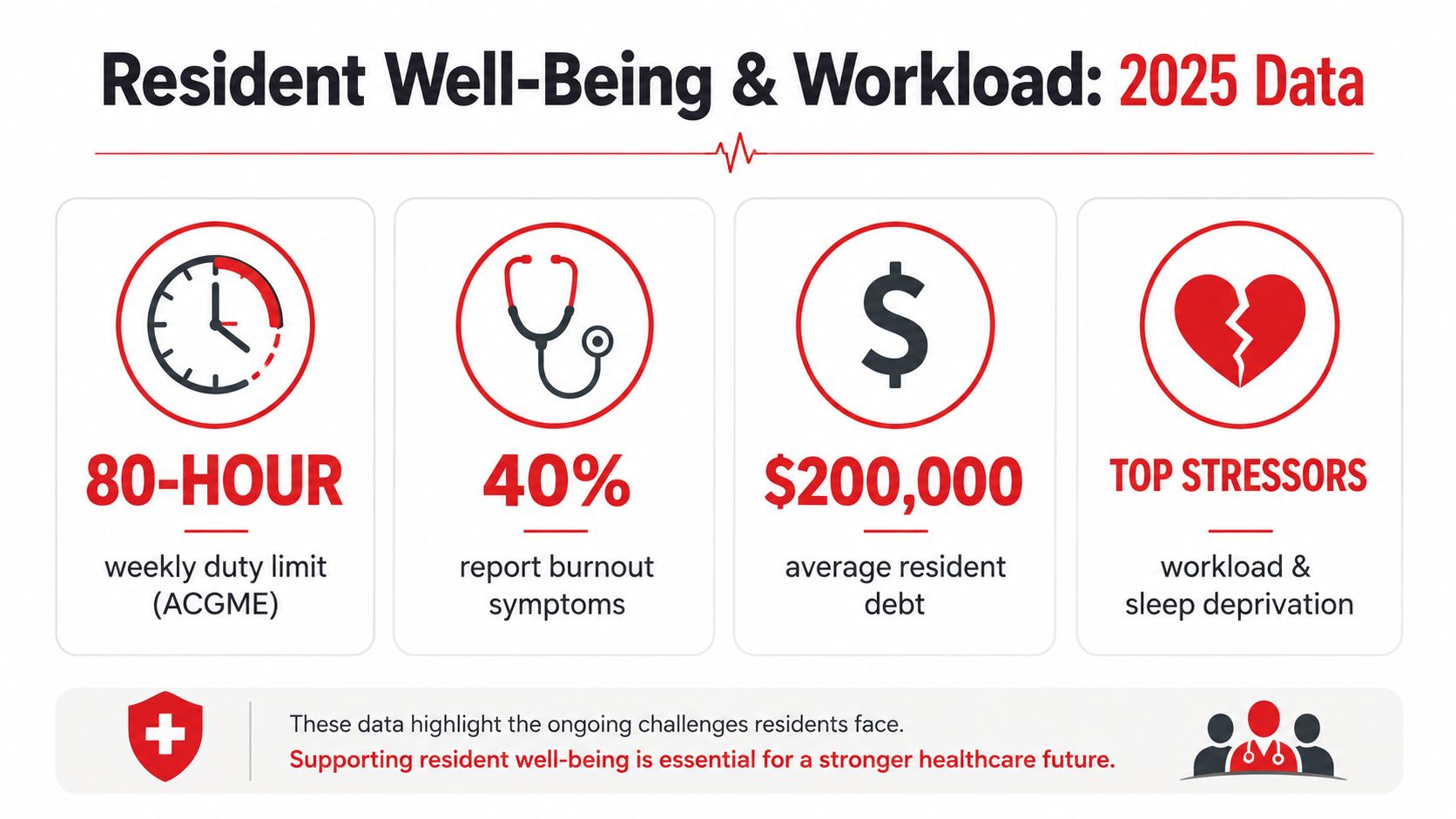
Before ranking a program, ask residents about schedule predictability, protected education, handoff quality, coverage during leave, and how leaders handle fatigue. A written wellness curriculum matters, but the daily behavior of the program matters too.
Paths for Osteopathic and International Applicants
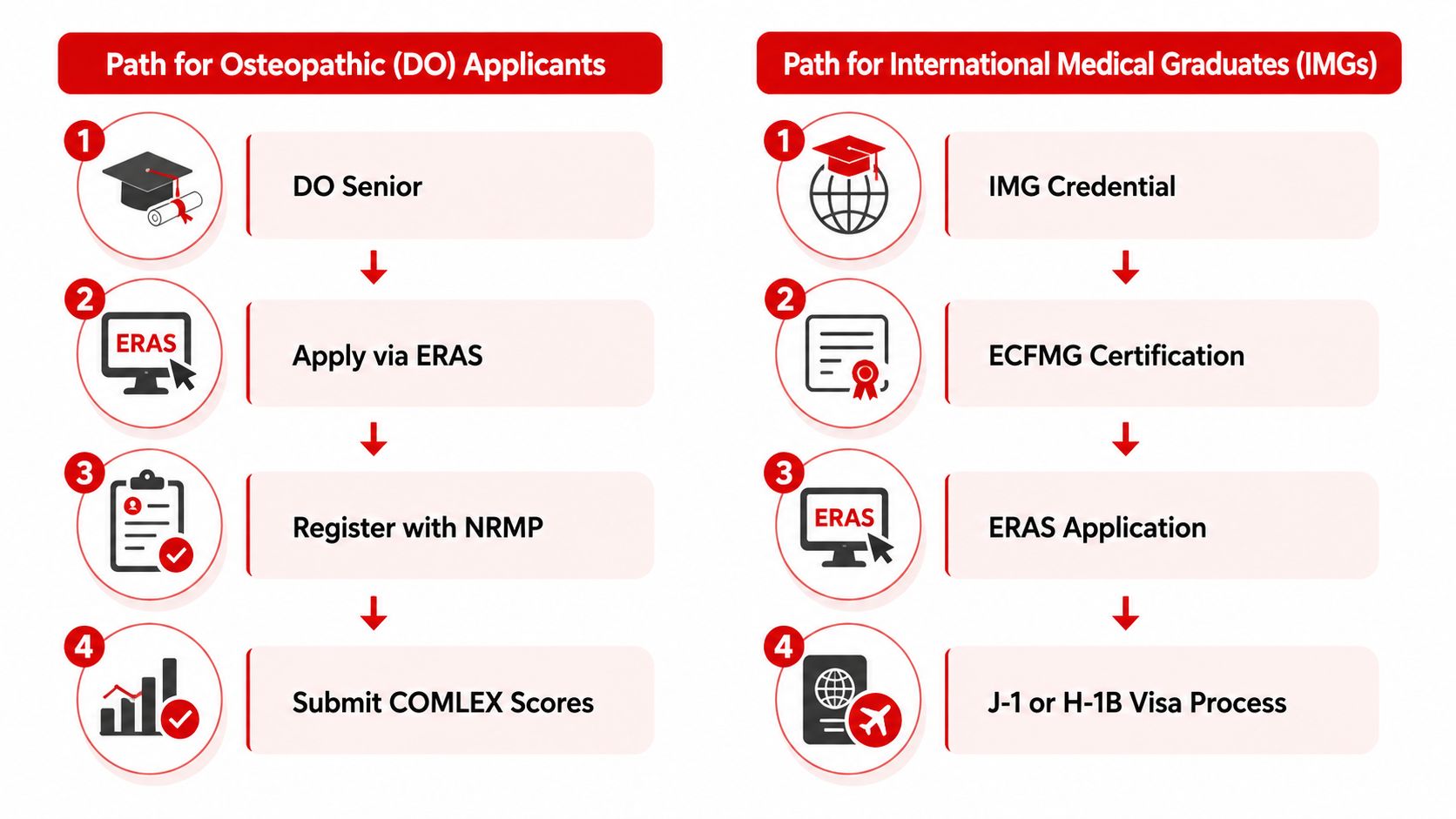
DO and IMG applicants participate in the same broad Match environment, but their preparation pathways aren't identical. Treat them as separate eligibility audits rather than assuming one checklist fits everyone.
Osteopathic applicants
Osteopathic students generally apply through ERAS and register with NRMP like other applicants. Their primary licensing-exam record commonly includes COMLEX-USA Level 1 and Level 2-CE, while many programs also accept USMLE Step 1 and Step 2 results. Whether an applicant should take both examination series depends on specialty goals, school guidance, program requirements, and the applicant's own preparation capacity.
Former American Osteopathic Association programs transitioned into the ACGME single-accreditation system. Some programs retain osteopathic recognition or identify particular osteopathic educational features, which can matter when applicants compare curriculum, mentorship, and ranking preferences. Verify every program's current requirements directly instead of relying on a general assumption about DO eligibility.
International medical graduates
IMG applicants need a separate credential and timing review. ECFMG guidance states that ERAS participation requires both a MyIntealth Identification Number and a USMLE Identification Number. For Match participation, NRMP requires applicants to meet the examination requirements for ECFMG Certification and have passing results or satisfactory completion available by the Rank Order List certification deadline. ECFMG's ERAS eligibility guidance explains why completing an exam isn't enough if the required result isn't available at the governing deadline.
ECFMG certification also involves medical education documentation and examination requirements. Visa sponsorship is a separate issue. Institutional guidance for international applicants describes the J-1 visa under ECFMG sponsorship as a common route into U.S. graduate medical education and distinguishes certification from visa processing. Review the UC Davis guidance for international residency applicants, then confirm current visa rules with ECFMG, the program, and qualified immigration counsel when needed.
IMGs are a significant part of the physician workforce. A peer-reviewed analysis found that IMGs account for about 23% of U.S. physicians, and 57,160 non-U.S. IMGs who weren't U.S. citizens matched into residency between 2004 and 2020. In 2024–2025, IMGs represented 22.5% of residents and fellows in specialty programs, compared with 57.8% U.S. allopathic graduates and 19.6% U.S. osteopathic graduates, according to ACGME data summarized by the AMA. These figures show participation at scale, not a promise for any individual applicant.
For IMG applicants, start by confirming certification, examination-result timing, visa sponsorship, clinical experience expectations, and program-specific eligibility. The residency guidance for IMGs can help organize those questions before you build a final list.
What Happens When You Do Not Match
Not matching in the first result doesn't end the cycle immediately. The Supplemental Offer and Acceptance Program (SOAP) gives eligible unmatched or partially matched applicants a formal opportunity to pursue unfilled positions during Match Week.
NRMP states that SOAP runs from Monday through Thursday of Match Week through a series of offer rounds. Applicants who are eligible are registered through the Match process rather than paying a separate SOAP registration fee. During SOAP, communication with programs is restricted and must follow NRMP rules, so applicants shouldn't contact programs independently in ways that violate the process.
A practical SOAP preparation plan
- Before Match Week: Prepare a concise application packet, updated personal statement, contact list, and specialty-specific explanation for gaps or changes.
- When results arrive: Confirm whether you're unmatched, partially matched, or matched. The appropriate response differs.
- During SOAP: Review available positions, submit materials through the permitted process, and respond to offers within the stated window.
- After SOAP: If no position is secured, move into a deliberate reapplication or alternate-pathway plan rather than making rushed commitments.
Available positions can be limited, and SOAP decisions may require rapid judgment. A plan might include reapplying through ERAS, considering a preliminary or transitional PGY-1 position, pursuing research, completing a public health degree, or obtaining targeted clinical experience. The value of each option depends on the reason for the prior outcome and the requirements of the specialty.
The SOAP and scramble guide for unmatched medical students can help you distinguish the structured SOAP process from post-SOAP outreach. A gap year isn't automatically a failure. It becomes useful when it addresses a documented weakness and produces evidence of readiness.
Strengthening Your Application Before Application Season
Residency applications become stronger when each component answers a different question. Your examination record shows academic readiness, the MSPE places performance in context, ERAS experiences show what you did and how you contributed, personal statements explain specialty fit, and letters describe your work to people who supervised you.
A useful first step is to define the stage you're in. A premedical student should focus on medical-school preparation and foundational planning. A medical student preparing for residency should map specialty requirements, licensing-exam timing, clinical performance, letters, research, and application deadlines. An IMG or re-applicant needs an additional eligibility and gap analysis.
Build a pathway map
| Stage | Main decision | Evidence to organize |
|---|---|---|
| Premedical preparation | Which medical-school path fits? | Academic record, experiences, advising |
| Medical school | Which specialty family fits your interests and strengths? | Clerkships, feedback, scholarly work |
| Licensing exams | When should Step 2 CK or COMLEX Level 2-CE be completed? | Study plan, practice-question review, score-release timing |
| Residency application | Which programs are eligible and realistic for your profile? | ERAS materials, MSPE, letters, experiences |
| Match | How will you rank programs? | Interview notes, program research, decision criteria |
| Residency | What skills and responsibilities will you develop? | Evaluations, milestones, clinical portfolio |
| Fellowship | Is subspecialty training necessary for your intended practice? | Specialty-board and fellowship requirements |
| Practice and certification | What licensing and board steps apply? | State, institution, and specialty-board policies |
A checklist you can use this week
- Name the target. Write down your specialty or specialty group, likely residency length, and whether fellowship is common for your intended role.
- Verify eligibility. Check each program's current requirements, accepted exams, visa policy, graduation-year rules, and required documents.
- Work backward from submission. Put ERAS opening, your school's MSPE deadline, application submission, interview season, and NRMP rank-list certification on one calendar.
- Schedule the major exam early enough. If Step 2 CK or COMLEX Level 2-CE is part of your application strategy, allow time for preparation, testing, score release, and a contingency plan.
- Audit your experiences. For every ERAS entry, record your role, actions, population served, and concrete output. Don't claim impact you can't explain.
- Ask for feedback. Identify two or three mentors who can review specialty fit, the MSPE context, personal statement, and program list.
- Prepare for interviews. Build concise examples that show judgment, teamwork, accountability, curiosity, and response to difficulty.
A selective board-preparation plan can fit into this process when exam timing or content gaps affect application readiness. Ace Med Boards offers one-on-one tutoring for USMLE and COMLEX preparation, so applicants can use structured study planning, targeted content review, and question-analysis practice as one part of a broader residency strategy. Tutoring doesn't replace official examination information, your school's advising, or independent use of legitimate practice resources.
For document presentation, a neutral resource such as this doctor CV format guide may help you review organization and readability. Your residency CV still needs to follow the application system's expectations and accurately reflect your own work.
Frequently asked questions
How is residency different from medical school?
Medical school emphasizes broad foundational learning and supervised clerkships. Residency places you inside a specialty service, where you care for patients with increasing responsibility while meeting program and accreditation requirements.
How does the Match work in plain language?
Applicants and programs each submit a preferred order of choices. The NRMP algorithm uses those lists to make placements according to its rules. Match Day reveals the result, while SOAP handles eligible unfilled-position opportunities during Match Week.
What should IMG applicants prioritize first?
Start with eligibility, ECFMG certification requirements, examination-result timing, credential verification, visa sponsorship, and program-specific rules. Don't build a large program list before confirming that you can meet each program's actual requirements.
What should I do this week?
Create the pathway map, verify target-program rules, schedule your major exam work, inventory your experiences, and book mentor feedback. Small completed tasks are more useful than an ambitious plan that remains on your calendar.
The 2026 Main Residency Match offered 44,344 positions, the largest Match Day cycle on record, with 93.3% of PGY-1 positions filled and 79.8% of certified applicants matching to PGY-1 positions, according to NRMP's residency applicant information. Expansion creates more opportunity, but it doesn't remove specialty imbalance, applicant competition, or the need for careful preparation.
If you want structured help connecting licensing-exam preparation with residency readiness, visit Ace Med Boards to learn about its personalized USMLE and COMLEX tutoring options. You can use the free consultation to discuss your timeline, identify preparation priorities, and decide whether one-on-one support fits your plan.