You're in third year, staring at a shelf exam review book, and it feels obvious that the grade will come from path, pharm, and question stamina. Then you notice something awkward during rounds. The residents and attendings who get trusted fastest are not always the ones who studied the most, they're the ones who keep the team moving, speak clearly under pressure, and make other people's work easier.
That gap is where medical leadership development lives. It's not a future executive hobby, and it's not just for people who already have titles. It shows up in how you run a preround update, how you ask for help, how you close a loop on a task, and how you leave a record that makes an attending think, “this student can be counted on.” If you want a practical frame for building that kind of judgment and polish, even a simple planning tool like a Webflow site builder can be useful as a model for organizing work into clear blocks, feedback points, and visible outputs.
The curriculum often treats leadership like a soft add-on. In reality, it sits right next to communication, teamwork, and systems thinking, which are the habits that separate a competent learner from a dependable teammate.
Why Medical Leadership Development Matters Earlier Than You Think
A lot of students assume leadership only matters after residency, when someone gets a chief, director, or medical director title. That mindset misses the part trainees feel every day. On a busy rotation, the person who notices the missing lab, updates the list cleanly, and keeps the intern informed is already leading, even if nobody put that word on their badge.
Historically, medical education was slow to make that explicit. By the mid-2010s, only 54.5% of surveyed U.S. allopathic schools reported a formal leadership curriculum, and just 19% offered leadership education longitudinally across all four years of medical school, according to a survey of medical schools (PMC5419299). That means many trainees are still being asked to perform leadership behaviors without being taught them in a deliberate way.
Practical rule: if leadership is absent from the syllabus, it still shows up in evaluation.
That's why students get mixed signals. Board prep rewards solitary mastery, but clinical evaluation rewards how well you help a team function. A strong shelf score can open the door, but it won't fully answer questions about how you collaborate, prioritize, or communicate under stress.
Students who understand this early have an advantage because they can build evidence while they're already on rotation. A concise way to organize that evidence is to treat it like a project portfolio, the same way teams track work in a system such as progress tracking dashboard. The content matters less than the habit of documenting what you led, what changed, and who noticed.
The lesson is simple. Leadership is already being assessed, even if the school calls it professionalism, teamwork, or initiative. Students who build it on purpose have more to point to when the interview question turns from knowledge to judgment.
What Medical Leadership Development Is
Medical leadership development is the process of building the competencies needed to lead clinical teams, improve systems, and advocate for patients. It is a skill set, not a personality type. A quiet student can develop it, and a naturally outgoing student can still be weak at it.
A useful analogy is history-taking. No one says good history-taking is just a gift. You learn a structure, practice it, get corrected, and repeat it until it becomes reliable. Leadership works the same way. It gets stronger when it is taught, observed, and refined in real settings instead of being left to chance.
That shift away from “accidental leadership” matters because the older model assumed people would absorb leadership by watching senior clinicians. The survey of medical school curricula showed that this approach was still uneven and not standardized in the mid-2010s, which is one reason formal training has become more visible now (PMC5419299).
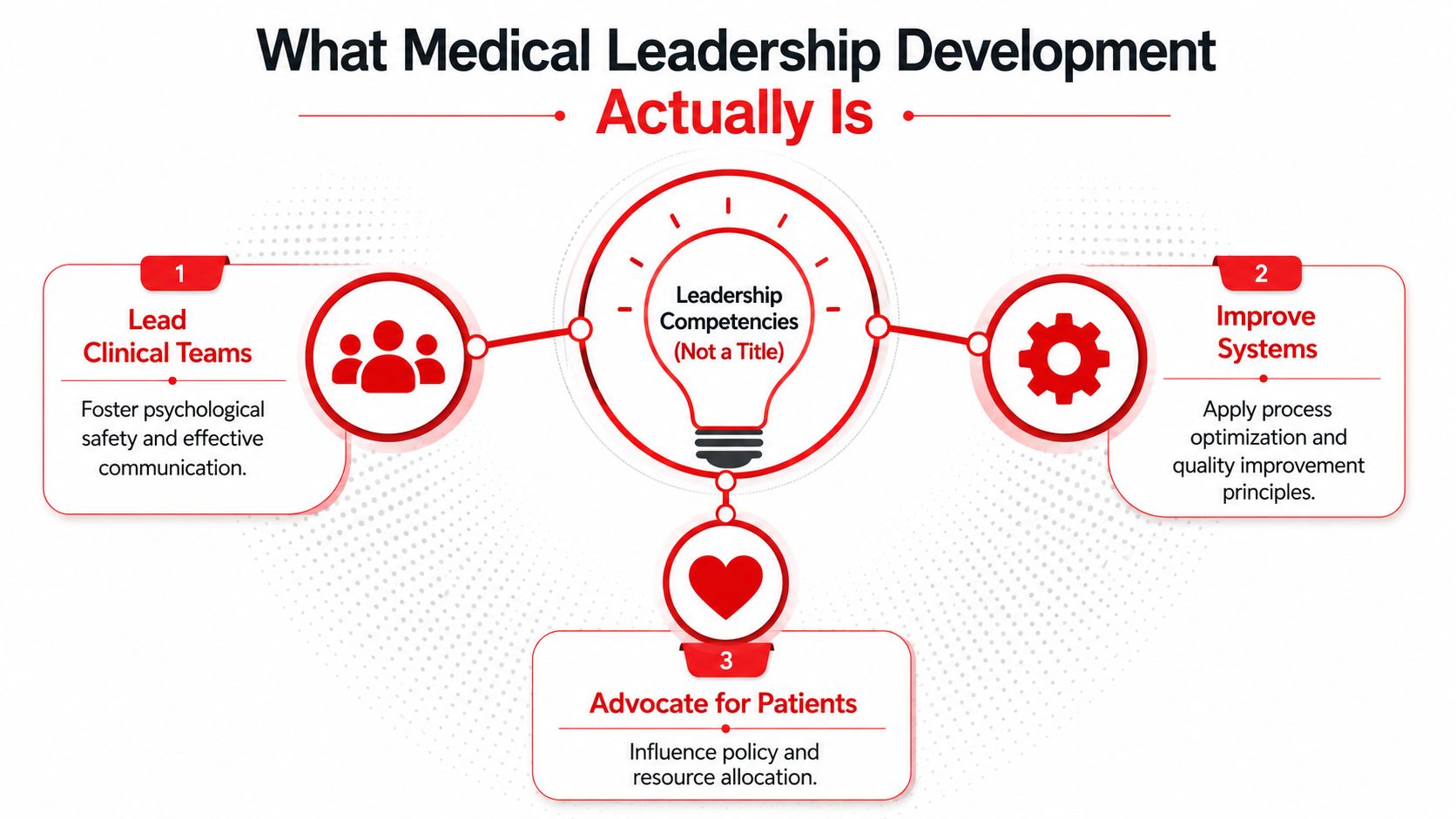
Consider the field as having three practical jobs. First, lead clinical teams by keeping communication clear and psychologically safe. Second, improve systems by noticing waste, errors, and process gaps. Third, advocate for patients by pushing for better access, fairer decisions, or smarter resource use.
Leadership is not the opposite of medicine. It is part of how medicine gets done well.
That definition is useful in a personal statement because it keeps you out of vague language. You can say you are developing the ability to coordinate care, improve workflow, and support patients, instead of claiming you are “passionate about leadership.” The first sounds real because it is tied to action.
The same idea shows up in residency language too. Programs read for behaviors, not slogans, and the ACGME core competencies give one common vocabulary for describing teamwork, communication, professionalism, and systems-based practice. If you need a practical way to frame your experiences, the resource on key leadership skills to list can help you translate what you did into the terms selection committees recognize.
Core Competencies and Frameworks You Will Encounter
Different training systems use different labels, but the underlying behaviors overlap more than students think. CanMEDS, the NHS Medical Leadership Framework, and the ACGME core competencies all point toward the same cluster of skills: communication, collaboration, systems awareness, and self-management. The names change. The work you are expected to do at the bedside, in team rounds, and in quality improvement does not.
| Competency Domain | CanMEDS Role | NHS Framework | ACGME Core |
|---|---|---|---|
| Communication | Communicator | Clear, timely communication | Interpersonal and communication skills |
| Teamwork | Collaborator | Working with others effectively | Professionalism, systems-based teamwork |
| Systems thinking | Leader | Improving services and decision-making | Systems-based practice |
| Patient advocacy | Health Advocate | Speaking up for patients and populations | Patient care, professionalism |
| Self-management | Supports multiple roles | Personal effectiveness and reflection | Professionalism, practice-based learning |
These frameworks are not just for faculty development sessions. They shape the language that appears in MSPE comments and residency interviews, because programs want evidence that you can function inside a team, not just recall facts. If you want a clear way to describe those behaviors, the key leadership skills to list resource can help you turn experience into plain, usable wording.
For residents and attendings, the ACGME competencies are already familiar, and a concise overview like ACGME core competencies helps you map your behavior to the language programs already use. That mapping matters because it turns a vague story into a specific signal.
Here is what students often miss. These frameworks do not ask whether you want a title. They ask whether you can do the work. If you arrived prepared, communicated a change in plan clearly, helped a team fix a process problem, or reflected on a mistake, you have already touched multiple competencies.
Training Models and Programs That Work
A lecture can give you the vocabulary of leadership, but it will not teach you how to steady a tense team when the plan changes on rounds. A project can show you how systems improvement works, but only if someone helps you read what happened and why. The delivery method matters because leadership is learned in action, not by seeing the words once.
The evidence base points in the same direction. Reviews of physician leadership development describe the strongest patterns as interactive workshops, simulations with feedback, multisource feedback, coaching, action learning, and mentoring (Geerts 2019). That means passive exposure is weak medicine for this skill. Repetition, reflection, and guided practice do more of the work.
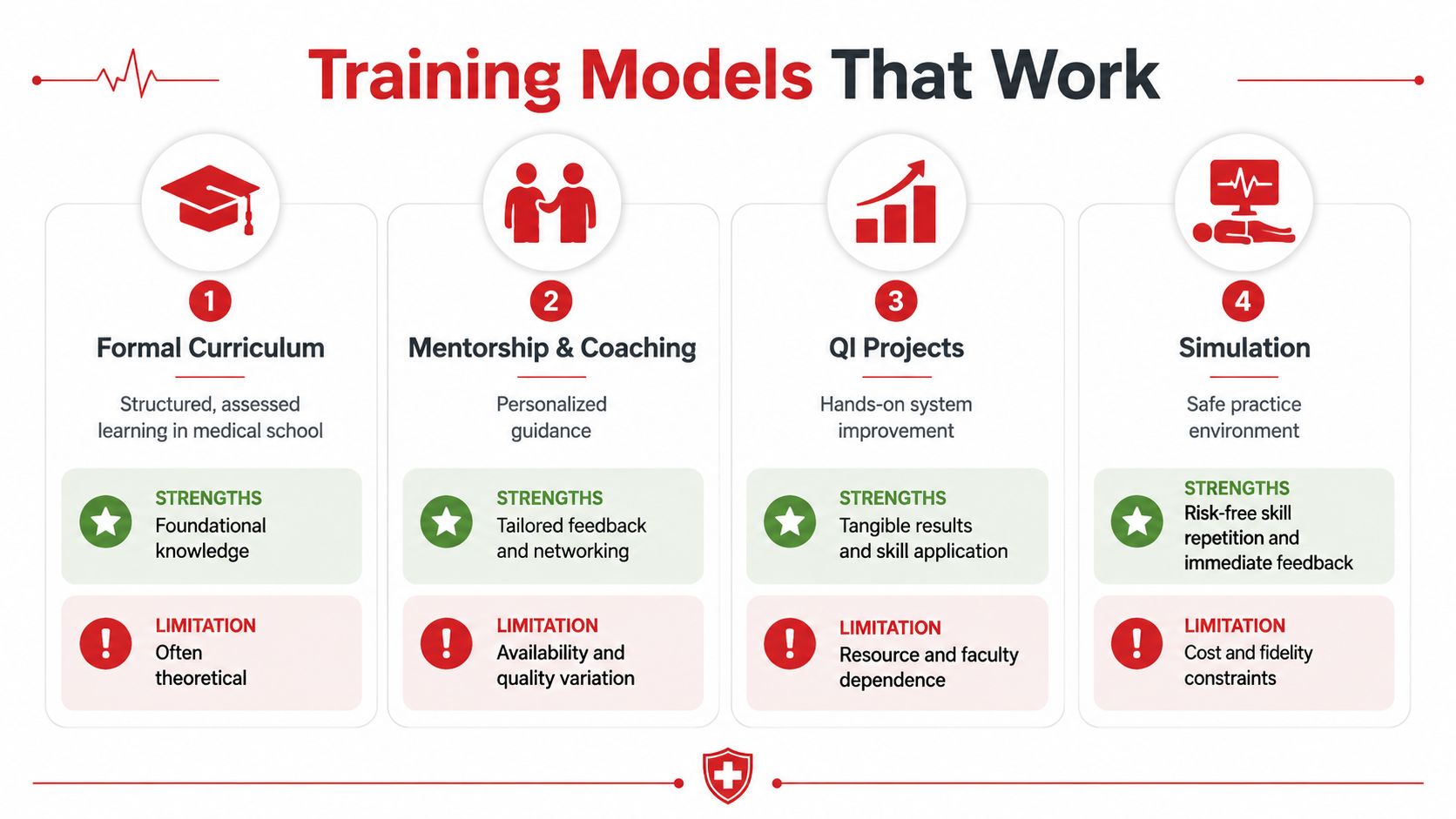
A practical way to sort the common models is this:
- Formal curricula: helpful for giving structure and shared language, but they often stay abstract unless tied to real clinical work.
- Mentorship and coaching: useful when the mentor gives direct, specific feedback, though quality depends a lot on the person and the setting.
- QI projects: strong for showing that you can improve a process, especially when the aim is narrow and easy to measure.
- Simulation with feedback: useful for practicing difficult conversations, delegation, and team leadership in a low-risk setting.
One source of confusion is that these models do not all build the same kind of leadership. A curriculum may help you explain what good leadership looks like. A simulation may help you practice the behavior. A QI project may show a residency program that you can work inside a system and change something concrete. Students who want to understand how these methods show up in real learning can use a case-based learning medicine approach to turn an experience into a story they can explain in an application or interview.
The same review also recommends objective outcome data at baseline, at the end of the program, and again 6 to 9 months later to see whether behavior really changed (Geerts 2019). That matters for students too. If you cannot point to a before-and-after change, the experience may have looked good on paper without changing how you lead.
For a student balancing boards and rotations, the best mix is usually small and real. One mentor, one visible project, and one setting where you can practice feedback will teach more than a pile of certificates. The infographic below captures the main models well, curriculum, mentorship, projects, and simulation all have a place, but they work for different reasons.
Measuring Outcomes and Assessing Leadership Growth
A student can collect leadership activities and still have no clear sign of growth. The cleaner question is whether other people experienced a change in how that student communicates, follows through, and handles responsibility. Measurement makes that visible.
The strongest approach uses multisource feedback, simulation review, and objective tracking of outcomes. Evidence syntheses on physician leadership development favor interactive learning with assessment at the start, at the end, and again later to see whether new habits hold (Geerts 2019). For a student, the practical lesson is simple. Do not rely on confidence or a polished reflection to judge progress, because leadership can feel stronger to you while teammates still see the same patterns.
Simple test: if your intern, resident, or attending cannot name one specific behavior that improved, the growth is not documented yet.
During clerkships, the best feedback is narrow enough that a busy preceptor can answer it without guessing. “How did I do?” invites vague praise. “Did I present the assessment and plan clearly to the team?” or “Did I close loops on tasks without reminders?” gives the attending something concrete to observe and correct. Those details matter because leadership at the student level often looks like small, repeated behaviors rather than a dramatic moment.
A structured record helps turn those behaviors into something you can review later. Keep a one-page log of the project you touched, the feedback you received, and the examples of initiative that were visible to others. A tool such as measurable performance goals can help because it uses the same logic many training programs try to teach, define the target, watch the behavior, and check whether the result changed. If you want a cleaner way to see patterns over time, a progress tracking dashboard gives you a place to collect feedback, project milestones, and brief notes from rotation to rotation.
Three kinds of evidence are worth tracking while you train:
- Behavioral feedback: what people said you did well or poorly.
- Process evidence: a task you coordinated, a meeting you ran, or a problem you helped solve.
- Outcome evidence: whether the work moved forward, even in a small way.
That record gives you better material for MSPE language and ERAS stories later. It also keeps the standard honest. You can see whether you are becoming more reliable under pressure, or just busier.
The Hidden Barriers Nobody Talks About
A lot of advice frames leadership as a simple skill gap. Take the course, get the certificate, and you're set. That story ignores how people rise in medicine. Sponsorship, access to opportunities, and institutional culture still shape who gets seen as “leadership material.”
The equity literature is blunt about this. A BMJ Leader study found that even when physician leadership programs mention equity, diversity, and inclusion, they often rely on frameworks that reduce underrepresentation mainly to race and gender instead of addressing sponsorship, access, and organizational culture (BMJ Leader 6(2):146). That means the problem is not only whether a trainee has skills. It's also whether the system notices, supports, and promotes them.

Underrepresented trainees should pay close attention to whether a program offers sponsorship, not just mentorship. A mentor gives advice. A sponsor opens doors, names you for opportunities, and uses their credibility to help you get into rooms you wouldn't reach alone. If a program only offers generic advice and no pathway into visible work, that's a warning sign.
The stress load matters too. Leadership development is harder when mental health is already strained, which is why a thoughtful check on workload and resilience belongs here. A resource on medical student mental health can be useful when you're deciding how much extra responsibility you can realistically carry.
Generic leadership training won't fix representation by itself. If the same kinds of students keep getting the same opportunities, the pipeline hasn't changed, even if the slide deck looks more inclusive.
Two Students, Two Different Paths
Student A treated every rotation like a chance to build evidence. On surgery, she volunteered to help organize a tiny QI project around discharge communication, then asked a resident to review her approach. In family medicine, she took a committee role, documented what she did, and asked for specific feedback on communication and initiative. She also spent time at a student-run free clinic, where she practiced coordination, resource navigation, and patient advocacy in a setting that made her responsible to a real team.
By interview season, Student A had stories that sounded concrete because they were concrete. She could describe a problem, what she did, who she worked with, and what changed. Her MSPE had multiple examples of follow-through, not just “pleasant” or “hardworking,” and her answers sounded like someone who already knew how to lead without waiting for a title.
Student B was bright, disciplined, and excellent at exams. He kept telling himself he would become a leader “later,” once residency gave him a formal role. During interviews, when someone asked about leading a team or handling conflict, his answers got vague fast. He knew the theory, but he hadn't practiced the behaviors in settings that produced memorable examples.
The difference wasn't intelligence. It was timing and evidence.
If you're a student, that contrast is a clear warning. Programs don't just want to know that you can think. They want to know whether you can help a group function when the pace gets ugly. The students who build that proof early have a much easier time sounding credible later.
Your 90-Day Leadership Building Plan
A good 90-day plan is built around one repeatable loop. You choose a small leadership behavior, practice it where the work is real, and then make the result visible.
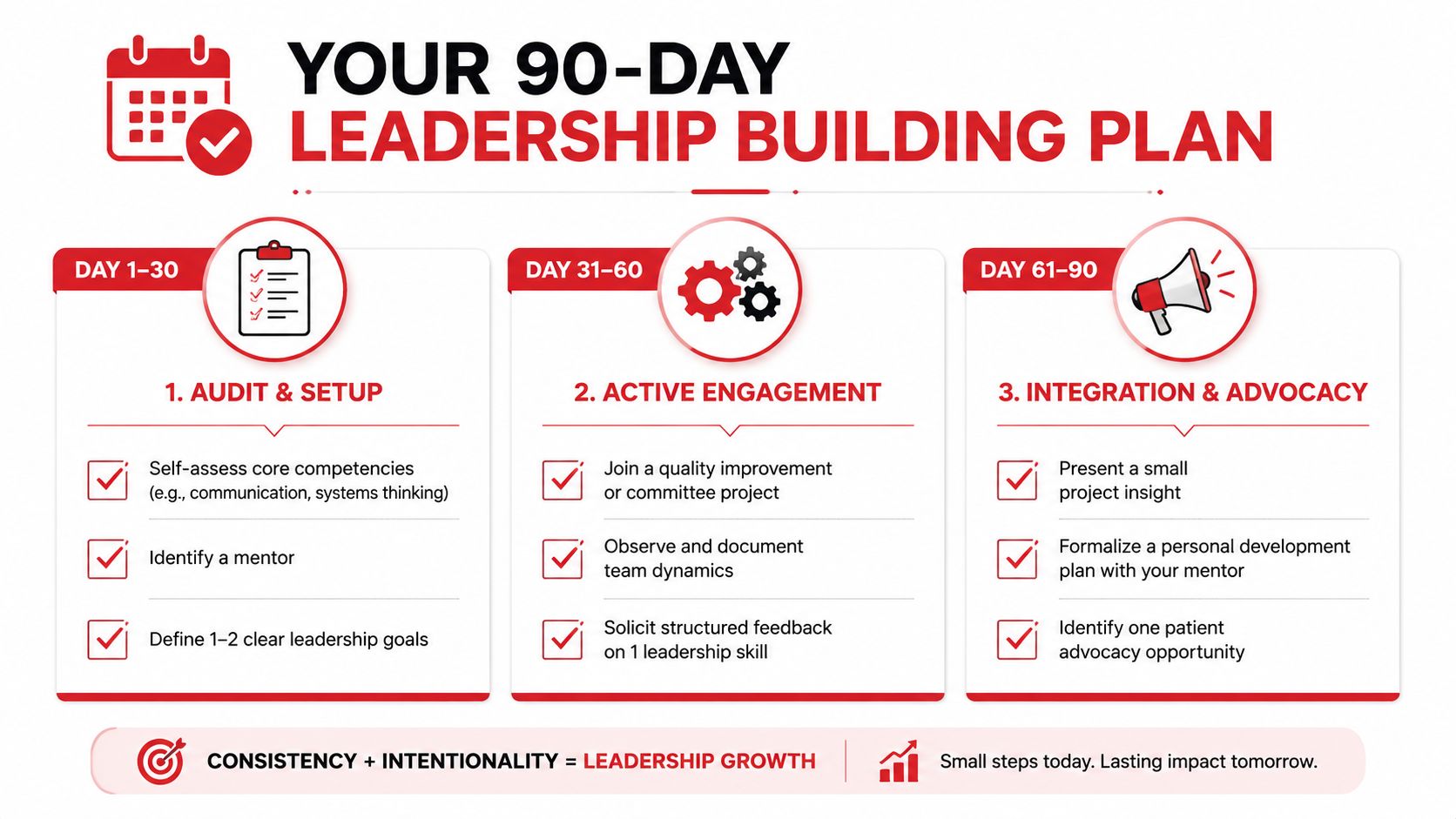
Days 1 to 30, audit and set up. Pick one framework, CanMEDS or ACGME, and rate yourself on communication, teamwork, systems thinking, and self-management. Ask two attendings on each rotation for feedback on one specific behavior, because “How am I doing?” is too vague to change anything. A clerkship is like a practice lab, you are testing habits in a setting where someone can still show you what to fix.
Days 31 to 60, build one visible project. Join a QI effort, a committee, or a student-run clinic task that has a clear aim and a real owner. Write down the metric you want to move, then schedule a follow-up so the work does not vanish after the meeting ends. A simple planning page like measurable performance goals helps keep the project concrete, because leadership without a target is just busywork.
Days 61 to 90, capture and translate. Draft a one-page leadership portfolio, write three STAR stories, and turn them into language that fits MSPE and ERAS expectations. If you need a quick way to frame the applications side, use the residency match planning approach, show evidence of initiative, reliability, and teamwork, not just interest. That is the part residency programs can read and remember.
Screenshot checklist: self-assess, ask for feedback, lead one small project, document results, save three stories.
If you start tomorrow, you do not need a title to begin. You need one rotation, one question, and one small responsibility you can handle well enough for someone else to notice.
If you want help turning your clinical experience into stronger shelf scores, clearer feedback, and residency-ready leadership stories, visit Ace Med Boards. Their tutoring and exam strategy support can help you connect board prep with the kind of clinical performance that programs notice.