

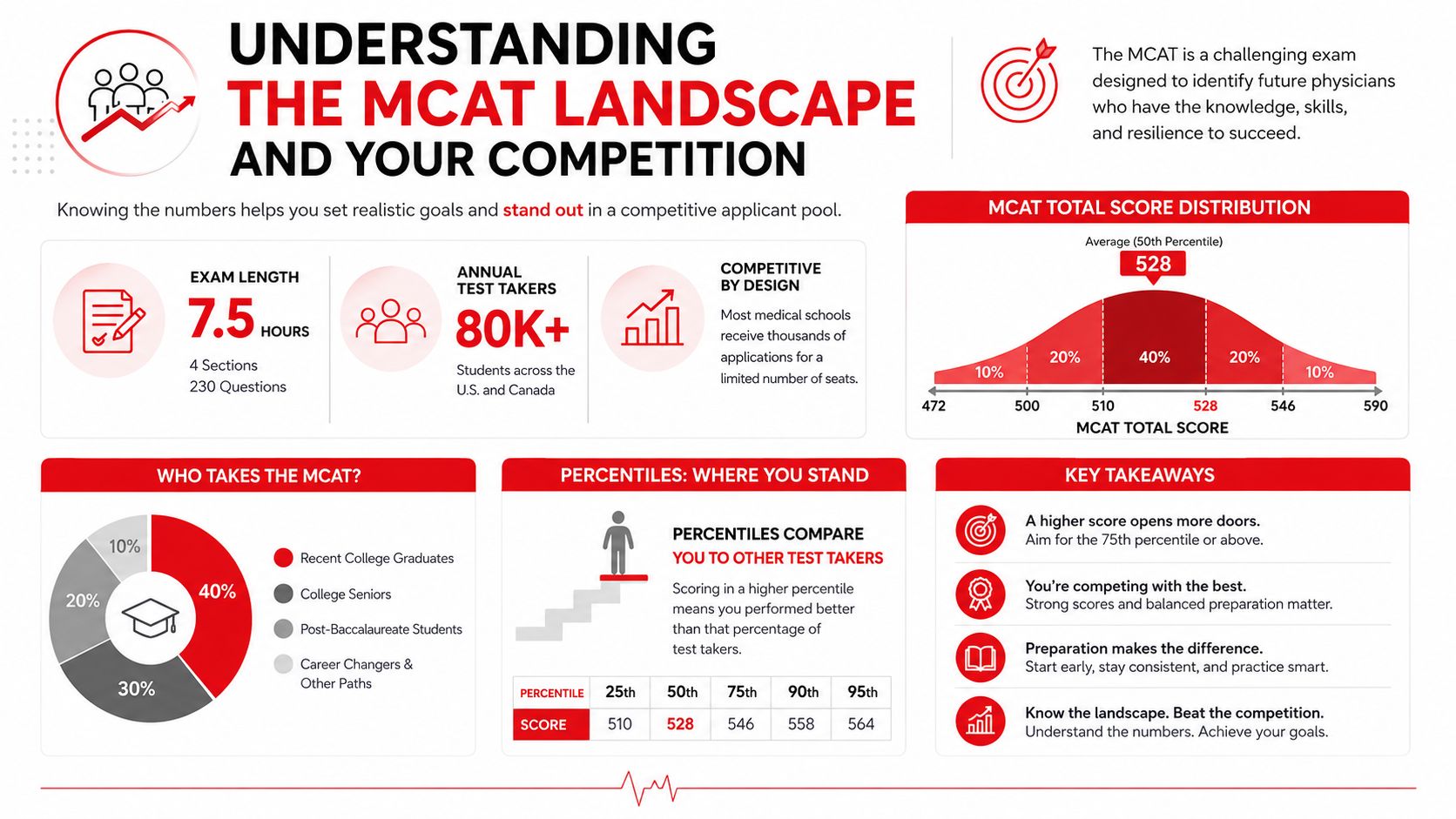
The MCAT is not a niche hurdle. It's a durable gatekeeper that has shaped medical admissions for more than 90 years, and today it remains a standardized, computer-based exam used by all U.S. medical schools and many Canadian schools (AAMC history). If you want a realistic MCAT plan, start with the facts, the average applicant score is 506.3, the average matriculant score is 512.1, and that gap tells you why smart execution matters more than collecting more resources (AAMC applicant and matriculant tables).
Understanding the MCAT Context and Your Competition
The MCAT sits inside a long admissions tradition, and that is part of why it carries so much weight. The AAMC traces the exam's history back more than 90 years, including the 1948 rename to the Medical College Admission Test after earlier revisions in 1946 reduced it from eight sections to four (AAMC history). That history matters because medical schools need one standardized way to compare applicants from different colleges, majors, and grading systems.
Prep gets easier once you understand the size of the field. The AAMC reports that more than 85,000 students take the MCAT each year, and in 2025, 96,061 examinees took the exam while 305,494 exams were administered across 2023, 2024, and 2025, with a mean total score of 500.6 across those exams (AAMC applicant and matriculant tables). That pool gives you context, but it is not the same as the applicant pool. The applicants who are being compared for admission usually sit in a stronger scoring band.
Why the score gap changes your strategy
For applicants, the AAMC reports a mean total MCAT of 506.3. For matriculants, the mean is 512.1 (AAMC applicant and matriculant tables). The gap is the point. It shows that the exam is not just a long test of endurance. It separates students who are ready from those whose score still needs to support the rest of the application.
A useful way to think about this is simple. Resources help only if they change your score, and score change comes from fixing missed concepts, cleaning up timing, and reviewing errors in a disciplined way. A stack of books or question banks does little by itself if you do not record why you missed a question, identify the pattern, and revisit it later.
Practical rule: Do not build your plan around a vague “good score.” Build it around the score range your application needs, then use diagnostics to measure the gap.
That is why score interpretation matters as much as content review. A practice exam is not just a number to celebrate or panic over. It is a map of where your process is strong, where it breaks down, and whether you are spending time on the right fixes. For a broader look at how schools weigh different pieces of an application, see what medical schools look for.
MCAT Format and Section Breakdown
The MCAT is a computer-based, multiple-choice exam with four sections. Three sections are science-heavy, and one centers on reading and reasoning. The sections are Biological and Biochemical Foundations of Living Systems, Chemical and Physical Foundations of Biological Systems, Psychological, Social, and Biological Foundations of Behavior, and Critical Analysis and Reasoning Skills, or CARS (AAMC exam overview). The format matters because each section rewards a different kind of thinking, and pacing errors surface quickly in passage-based questions.
What each section is really asking
The three science sections give you 95 minutes for 59 questions each. The AAMC outlines 10 passage-based sets and 15 independent questions in those sections (AAMC exam chapters). CARS gives you 90 minutes for 53 questions, all passage-based, arranged in 9 passage-based sets. That means the exam is not a simple recall test. You are reading, filtering, reasoning, and choosing under time pressure. For a clear pacing reference, see the MCAT time breakdown.
| MCAT Section Specifications | |||
|---|---|---|---|
| Section | Time | Questions | Question Types |
| Biological and Biochemical Foundations of Living Systems | 95 minutes | 59 | 10 passage-based sets, 15 independent questions |
| Chemical and Physical Foundations of Biological Systems | 95 minutes | 59 | 10 passage-based sets, 15 independent questions |
| Psychological, Social, and Biological Foundations of Behavior | 95 minutes | 59 | 10 passage-based sets, 15 independent questions |
| Critical Analysis and Reasoning Skills | 90 minutes | 53 | 9 passage-based sets, passage-based only |
The score scale is fixed, which helps with planning. Each section is scored from 118 to 132, the total score ranges from 472 to 528, and the total is the sum of the four section scores, with 500 as the midpoint (AAMC score scale). A weak section can drag down an otherwise solid total, so balance matters more than many students expect.
That is why execution matters as much as content review. A large question bank only helps if it changes how you work through missed questions, timing slips, and passage traps. The useful habit is simple. Record why you missed each question, sort the miss by pattern, and return to it later with active recall. A practice exam is then a diagnostic, not just a score report. It shows which skills hold up, where your process breaks, and whether your study time is aimed at the right fixes.
Why MCAT Scores Predict Medical School Success
A strong MCAT score matters because it reflects more than recall. It captures the kind of reasoning, pacing, and correction habits that also matter once students enter medical training. AAMC validity research shows the exam has a meaningful relationship with later performance, with median correlations in the moderate range (AAMC validity research). That still leaves room for judgment, growth, and experiences outside the test. It means the score is measuring something real.
How the MCAT and GPA work together
The clearest signal appears when admissions teams look at the MCAT alongside undergraduate GPA. In a 2022 multisite study, MCAT plus undergraduate GPA explained a substantial share of performance variance across preclerkship work, Step 1, clerkship exams, and Step 2 CK (AAMC validity research). For applicants who fixate on one number, that point matters. Schools read a pattern, not a single data point, and your study plan should reflect that same logic.
The exam also appears in broader evidence reviews. A PubMed meta-analysis reported predictive validity for both preclinical performance and USMLE Step 1, with the biological sciences subtest showing the strongest subtest relationships in that analysis. The practical lesson is straightforward. The MCAT rewards skills that medical school keeps demanding, careful reading, scientific reasoning, and disciplined review of mistakes.
Bottom line: A stronger MCAT score does more than support an application. It reflects habits that continue to matter in training.
That is why resource collection alone rarely moves scores. A student can own every question bank and still stall if missed questions are not categorized, timing errors are not reviewed, and weak reasoning patterns are not corrected. Active recall and error analysis turn practice into progress. For a practical way to interpret score bands and decide what they mean for your plan, see MCAT score range guidance.
Building Your 12-Week MCAT Study Plan
A useful MCAT schedule has three jobs, build knowledge, convert knowledge into test performance, and leave time to correct recurring mistakes. The students who stall usually do one of two things, they either front-load content review until test day feels far away, or they jump into full-lengths before they have anything to learn from the results. A better plan keeps those pieces in sequence.
A simple 12-week structure
Weeks 1 to 4, foundation building. Use this block to identify weak topics, review core content, and set your daily routine. If your diagnostic shows uneven section performance, give the weakest section slightly more time, but don't drop the others. Keep practice questions in the mix so content review doesn't become passive reading.
Weeks 5 to 9, intensive practice. Shift the balance toward passage work, timed sets, and review of missed questions. Full-lengths should become more frequent here, but only if you have enough time to analyze them well. One full-length without review is just fatigue in disguise.
Weeks 10 to 12, final review. Tighten timing, revisit recurring errors, and reduce the temptation to chase brand-new content. Your goal is cleaner execution, not a new textbook stack.
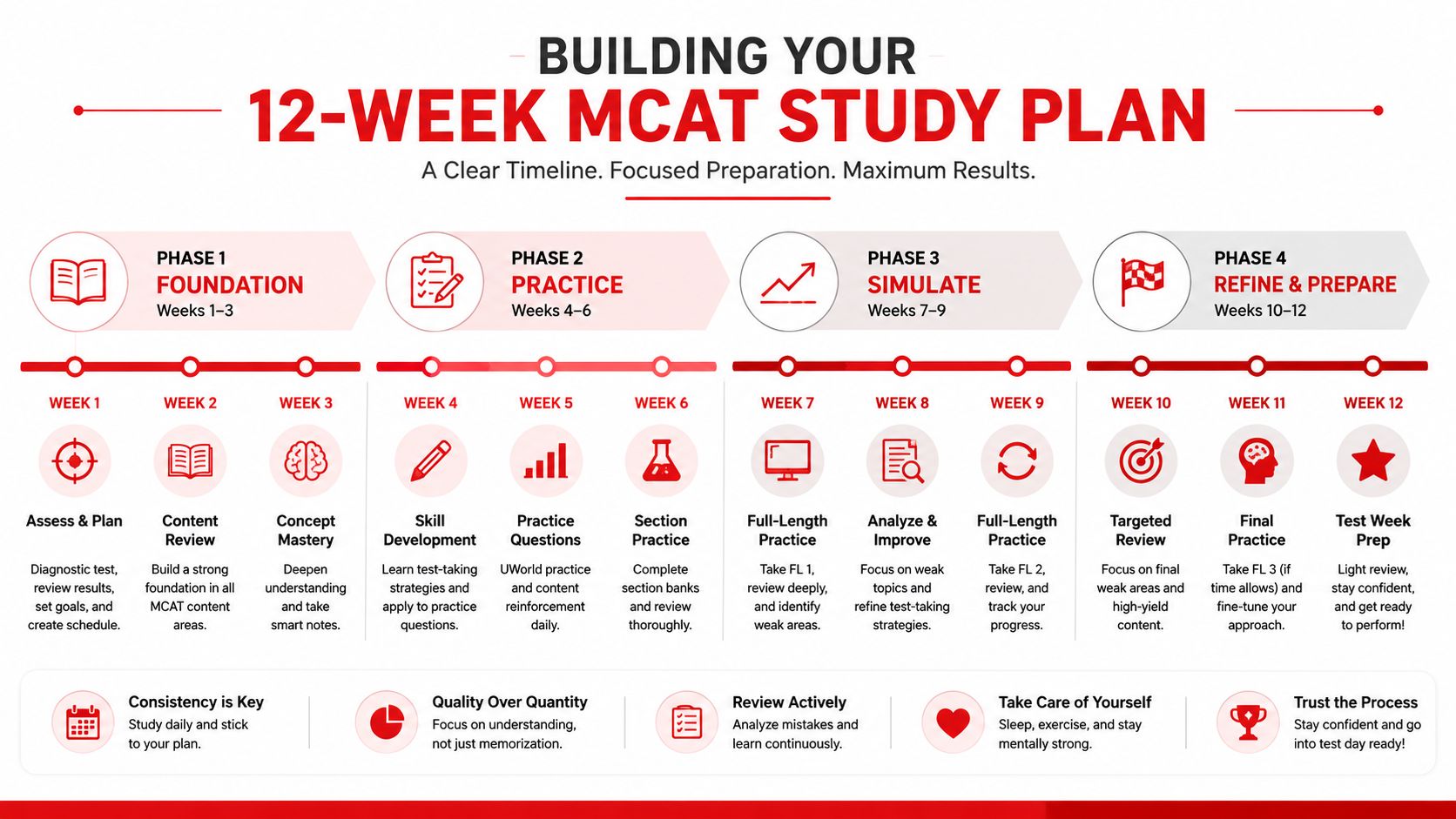
A workable weekly rhythm often looks like this: two content-focused days, two mixed practice days, one review day, and one lighter day for CARS passages or targeted flashcards. Keep one block reserved for errors you keep repeating, because those are the highest-value minutes in the week. If a topic keeps reappearing in your wrong answers, it deserves its own review slot.
The video below is useful if you want another visual pass over planning.
For a ready-made framework you can adapt, see this MCAT study schedule.
High-Yield Study Strategies That Actually Work
Most students don't fail to prepare because they lack materials. They struggle because they use those materials passively. Reading explanations once, highlighting a page, or doing a long string of questions without reviewing why the answer was right or wrong creates the feeling of work without the payoff. The fix is not more volume. It's better feedback.
Build an error log that changes your studying
A useful error log should sort every miss into a category. Common buckets include content gap, misread question, timing pressure, and reasoning error. That label matters because each type needs a different correction. A content gap gets content review. A misread question gets slower passage discipline. A reasoning error gets a rethink of how you eliminate choices.
Review every question, even the ones you got right. The point isn't to celebrate the answer, it's to verify the thinking that got you there.
The most common mistake is to review questions emotionally instead of analytically. Students often ask, “Why did I miss that?” and stop there. A better question is, “What exactly in the passage, stem, or answer choices led me off track?” That extra layer of analysis turns one missed question into a pattern you can fix.
Use active recall instead of passive familiarity
Active recall means forcing yourself to retrieve information without looking first, then checking what you missed. The linked AAMC survey coverage notes that many students rely on self-study, flashcards, and free online resources, while review habits such as answer explanation review and self-explanation are less common (survey coverage). That gap matters because the test rewards retrieval and reasoning, not recognition alone. For a clear definition and practical use of that technique, see active recall.
CARS deserves special attention here. If your science scores rise but your CARS score stays flat, the issue is usually not effort, it's method. Read for the author's main claim, the function of each paragraph, and the tone shift when the passage changes direction. Then explain, in your own words, why each wrong answer is wrong before you move on.
A simple error-log workflow
- Mark the problem type: Content, misread, timing, or reasoning.
- Write the trigger: What in the stem, passage, or answer choices caused the miss.
- State the fix: A review action, a timing adjustment, or a passage-reading rule.
- Re-test the skill: Do a short, targeted set on the same topic within a few days.
- Track repeats: If the same category keeps showing up, move it to the top of next week's review.
Choosing the Right Prep Resources and Support
There isn't one correct MCAT resource stack. The right mix depends on your diagnostic score, your timeline, and how you learn. Official AAMC materials should anchor the plan because they match the exam's style and timing. Commercial question banks can add breadth, especially when you need more passages and explanation practice. Prep courses can help with structure. One-on-one tutoring makes the most sense when a student has a plateau, a specific section problem, or a hard time turning feedback into a study plan.
A good resource stack is less about brand names and more about function. If your issue is content coverage, start with the basics and use targeted drills. If your issue is execution, spend more time on timed practice and review. If your issue is consistency, add outside accountability.
Ace Med Boards offers 1-on-1 online MCAT tutoring and free consultation support for students who want a personalized study plan, but it still belongs in a broader system that includes official practice materials and your own error log. That's the right way to think about any tutoring option, not as a replacement for the exam itself, but as a way to make your study time more precise.
How to evaluate support without getting lost in marketing
Look for services that are clear about what they do and what they don't do. Ask whether the support focuses on passage analysis, content review, accountability, or plan design. Ask how they adjust when a student's diagnostic changes. If the answer sounds generic, the fit probably is too.
A few grounded criteria help separate useful support from noise:
- Alignment with your weak area: Some students need content rebuilding, others need CARS strategy, and others need pacing help.
- Responsiveness to data: Good support should change when your practice results change.
- Compatibility with official materials: If a program ignores AAMC practice, that's a warning sign.
- Clear scope: A tutor can guide the process, but you still need your own independent review.
If you're weighing options, the question isn't “Who promises the most?” It's “Who helps me turn missed questions into a better next week?”
Interpreting Your Score and Planning Next Steps
A single score number only becomes useful when you compare it with context. The AAMC's current percentile tables and applicant-by-major and state data show that score interpretation depends on more than one cutoff, which is why a flat “good score” rule is too simplistic (AAMC percentile and applicant context tables). Applicants should read their score alongside GPA, school list, major background, and the rest of the file.
How to think about a retake
A retake makes sense when the new attempt has a realistic path to a better outcome, not when it's driven by frustration alone. If your practice scores are consistently below your target, the better move may be to pause, rebuild weak sections, and re-evaluate timing. If your practice scores are stable and the issue is modest, you can decide whether the rest of the application offsets that score enough to move forward.
Decision rule: Use the MCAT as one part of the application story. Don't let one result define the whole file.
For applicants who didn't hit their target, the next step isn't panic. It's triage. Strengthen the rest of the application, identify whether the score issue was content, pacing, or strategy, and decide whether a retake would produce a meaningful change. For some students, the right answer is a later application. For others, it's a better school list and stronger execution elsewhere.
If you want help turning diagnostics into a real plan, Ace Med Boards can support MCAT tutoring, diagnostic interpretation, and study-plan building through Ace Med Boards. A short consultation can clarify whether your next step should be content review, timing work, or a tighter question-review system.