
MCAT scores are released 30 to 35 days after the exam date and are available no later than 5:00 p.m. ET on the scheduled AAMC release day. The result usually appears on a fixed release date rather than immediately after the exam, so the date belongs on the same planning calendar as your application milestones.
You may be checking the portal between classes, work, or application tasks, wondering whether a pending score will change your plans. That uncertainty is understandable, but the release process is predictable. The more useful question isn't only “When will my score arrive?” It's “How will I interpret it and decide what to do next?”
How MCAT Score Release Works and When to Expect Results
The Association of American Medical Colleges (AAMC) follows a standardized schedule for MCAT score release. Official scores become available 30 to 35 days after the exam date, and the AAMC guarantees availability by 5:00 p.m. Eastern Time on the scheduled release day. You can confirm the applicable date on the official AAMC MCAT calendar.
That schedule explains why results often appear on a Tuesday afternoon instead of directly after the exam. The exam date and the score date are separate milestones. Treating the release date as a fixed planning event helps you coordinate the American Medical College Application Service, or AMCAS, submission, secondary applications, and preparation for school review.
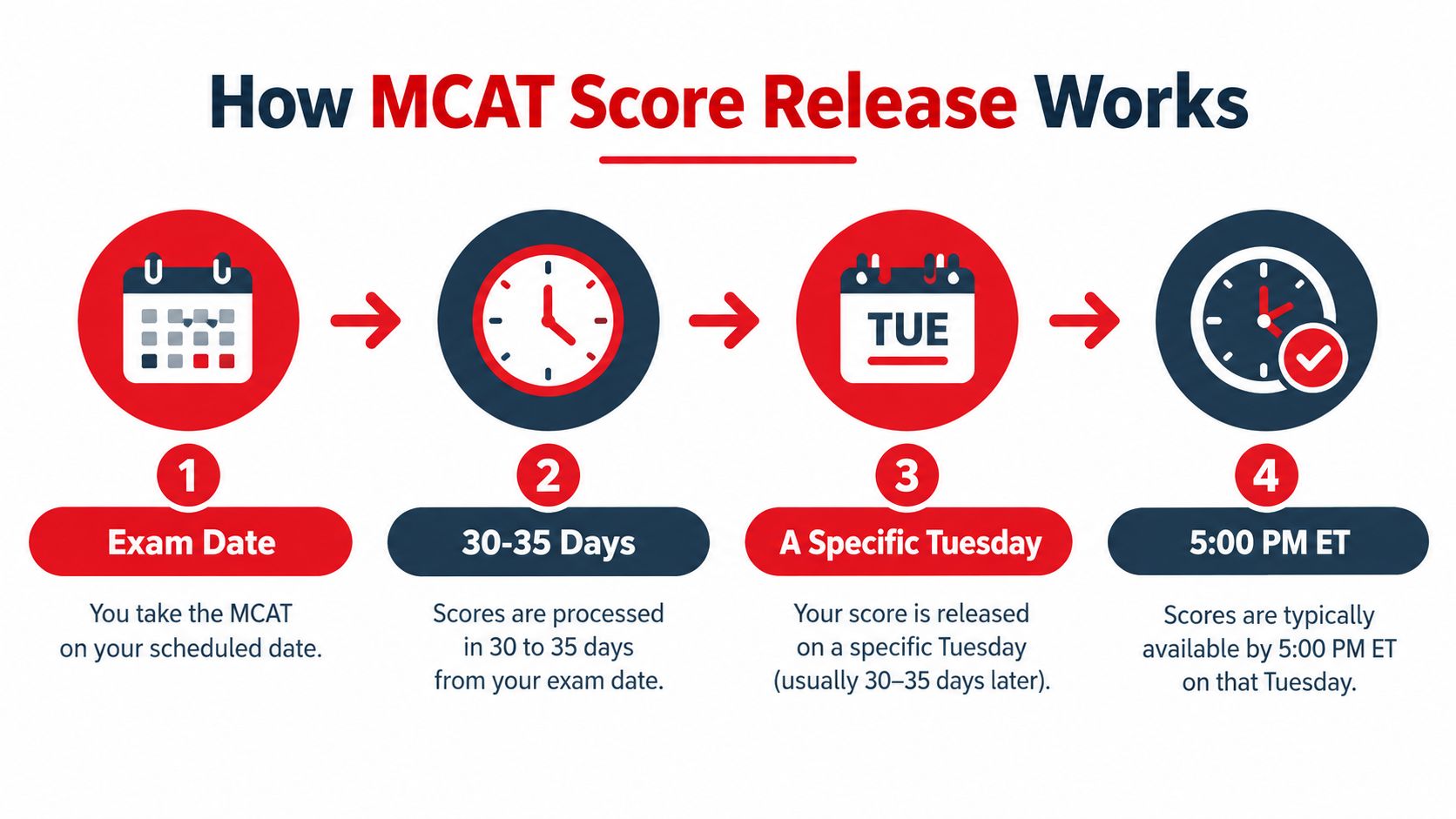
What happens between test day and release
After the exam, your score isn't available as an unofficial estimate. You wait for the scheduled report, then review the official information in the AAMC Score Reporting System.
Use this sequence:
- Record the release date: Add the date from the AAMC calendar to your application calendar.
- Plan around the time: Expect availability by 5:00 p.m. ET, not necessarily at the start of the day.
- Protect decision time: Avoid scheduling the first review during a class, work shift, or other obligation.
- Separate facts from reactions: Your post-exam feeling doesn't determine your score or your retake decision.
Your score date may affect when schools can evaluate an application, but a release date isn't automatically the same as a school's review date. AMCAS-linked schools and individual institutions may have their own processing practices, so applicants should check the current instructions for each application service and school.
If you need to review the scoring framework before results arrive, use this explanation of what the MCAT is scored out of. Knowing the score structure in advance can make the report easier to read calmly.
Understanding the 2026 MCAT Testing and Score Release Calendar
The 2026 AAMC calendar uses fixed release dates to operationalize the 30 to 35 day window. The published schedule includes release dates such as February 10, February 17, February 24, March 17, May 12, June 23, July 27, September 2, September 15, September 22, October 6, and October 13. These dates are not predictions based on online rumors. They're scheduled dates published by the AAMC.
A practical way to read the calendar is to start with your exam date, locate its corresponding release date, and then work backward from application milestones. If the score will be pending when you submit an AMCAS application, review the current AMCAS instructions and the policies of schools on your list. Don't assume every school handles pending scores in exactly the same way.
2026 MCAT Score Release Date Mapping
| Test Window | Scheduled Release Date | Planning Implication |
|---|---|---|
| January and early February exams | February 10, February 17, or February 24 | Use the assigned date to organize early application preparation and score review. |
| February exam window | March 17 | Keep the release date visible when planning the transition from preparation to application work. |
| Spring exam windows | May 12 or June 23 | Compare the release date with AMCAS submission plans and the time needed to reassess a retake. |
| Summer exam windows | July 27 or September 2 | A later release can require more deliberate coordination with secondary applications. |
| Late summer exam windows | September 15 or September 22 | Review the school list and application status before assuming the score will be considered on a particular timeline. |
| September exam windows | October 6 or October 13 | Use the official date to plan next steps rather than relying on a general “about a month” estimate. |
The table is a planning aid, not a substitute for checking your exact registration record. For a broader view of the year's testing schedule, see the 2026 MCAT test dates and planning guide.
Planning rule: Put the score release date beside your application deadlines, not only beside your exam date.
How to View Your MCAT Scores on the AAMC Portal
On release day, the AAMC Score Reporting System is the authoritative place to check your result. The AAMC states that examinees receive an email notification when scores are posted and can view the report through the system. Before official release, the relevant score report and exam date history won't appear as though the result has already been finalized.
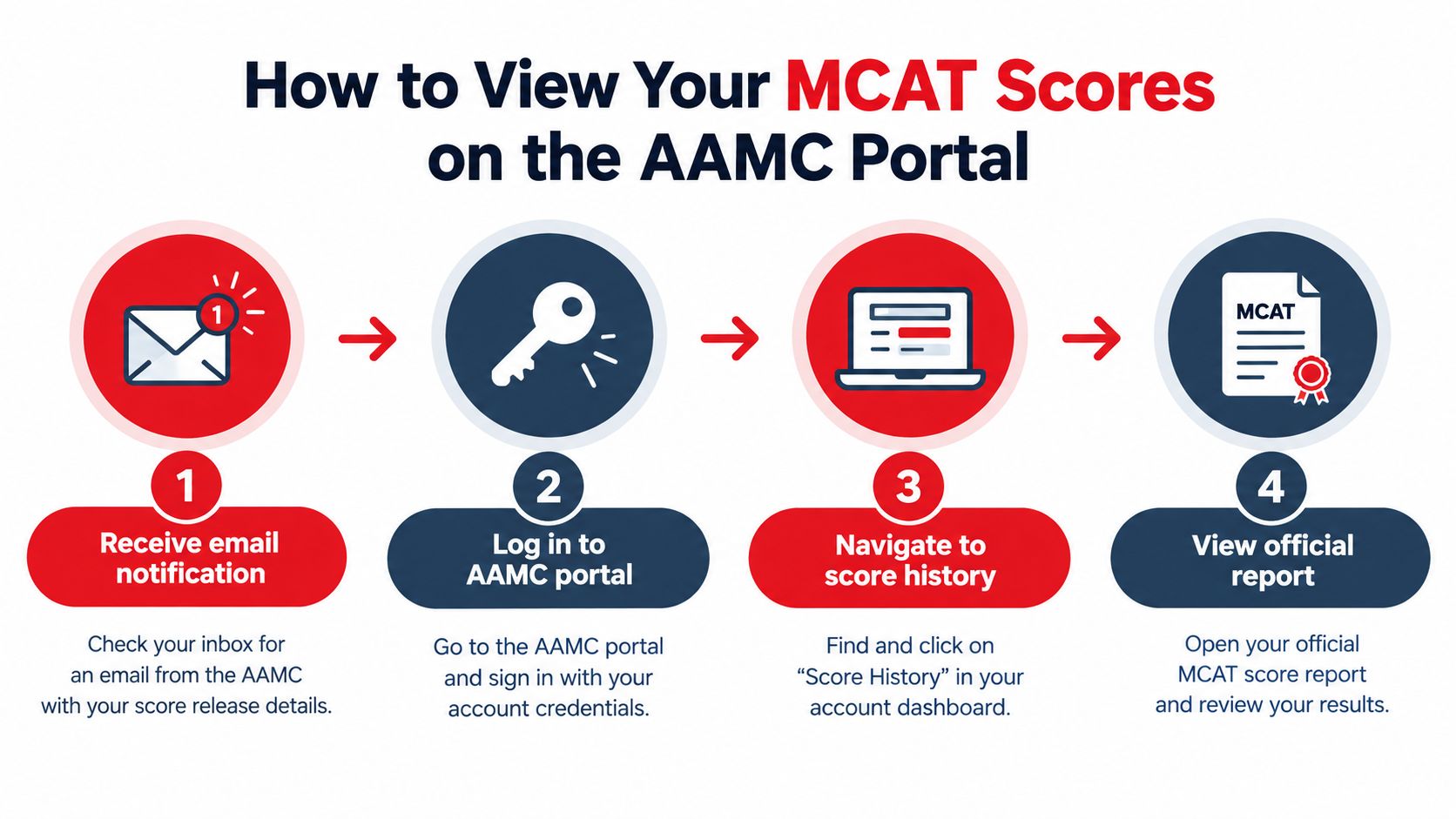
A release-day viewing sequence
First, wait for the notification or the scheduled release time. An email is a useful signal, but don't treat an email preview, a screenshot, or another person's result as your official report.
Next, sign in through the AAMC account connected to your MCAT registration. Use the account you normally use for AAMC services. If you can't access it, resolve the account issue through the AAMC rather than creating an informal substitute record.
Then, open the Score Reporting System and locate your score history. The report becomes available once the scores are officially released. The exam date history isn't displayed there until scores have been released, so an empty or incomplete view before the scheduled date doesn't mean that your exam has been lost.
Finally, save the official information for your records. Review the total score, section scores, percentile ranks, confidence bands, and score profile. You can print or download the report if the system provides that option, but use the official report rather than a screenshot when communicating with an application service or school.
A quiet environment helps. Before logging in, decide whom you want to contact that day and what decisions can wait until you've reviewed the report. You don't have to interpret every part of the score immediately.
For related account and registration guidance, review the AAMC MCAT registration information. The registration page and the score-reporting system serve different purposes, so be sure you're using the score system when results are released.
How to Read Your MCAT Score Report and Percentiles
When your score appears, begin with the report itself rather than a screenshot, a preview, or someone else's result. It gives you a profile, not just one number: four section scores from 118 to 132 and a total score from 472 to 528, as described in AAMC's MCAT score scale and score report guidance.
The four sections are:
- Chemical and Physical Foundations of Biological Systems
- Critical Analysis and Reasoning Skills
- Biological and Biochemical Foundations of Living Systems
- Psychological, Social, and Biological Foundations of Behavior
Your report also includes confidence bands, percentile ranks, and a score profile. Read them as different lenses on the same result. The total summarizes performance across sections, section scores reveal balance, the percentile compares your result with the relevant AAMC reference group, and the confidence band shows that the reported score is an estimate rather than an infinitely precise measurement.
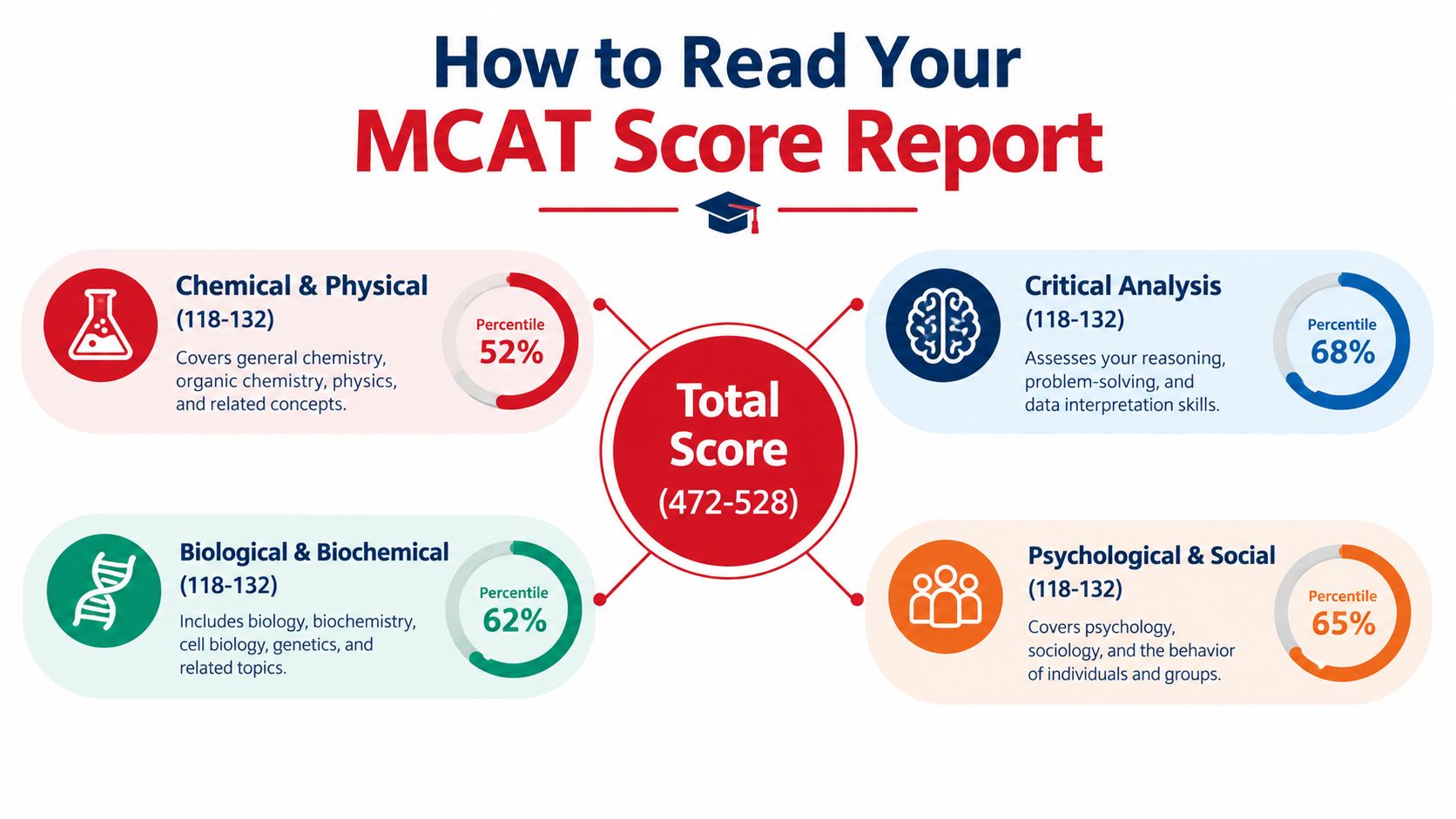
Why total score and section balance both matter
A “good” MCAT score has no universal cutoff. Interpret yours alongside the current AAMC percentile table, your academic record, the schools you are considering, and the rest of your application. A strong total can conceal a materially weaker section, while a balanced profile may provide context that the total alone misses.
Use MSAR, the Medical School Admission Requirements database, to review current school-specific score ranges when you have access to its entries. A school's reported range describes admitted applicants as a group, not your individual chance. Pair that comparison with each school's official admissions guidance instead of treating a range as a decision rule.
A simple reading order
- Record the total without judging it. Write it exactly as reported.
- Review all four sections. Check the pattern, including the highest and lowest scores.
- Check the percentile rank. Use the current AAMC table, not an older chart copied online.
- Read the confidence bands. They add context to the score's precision.
- Compare the profile with target schools. Use MSAR and official guidance, then consider GPA, experiences, mission fit, and timing.
This sequence turns score release into a decision workflow. Record the total, section balance, percentile, and relevant MSAR ranges in one worksheet. Then ask whether the result supports your current school list, calls for a narrower list, or justifies a retake review based on a specific weakness. A low score is information about the next decision, not a complete judgment of your preparation or potential.
For a concise explanation of how the scoring scale is organized, review this MCAT score range guide.
How MCAT Scores Are Sent to Medical Schools and What Can Delay Them
Viewing your score and delivering it to schools are related but distinct steps. The AAMC says scores are automatically transmitted to medical schools connected to your AMCAS application. For institutions that don't use AMCAS, you may need to share the score actively through the MCAT Score Reporting System.
| Destination | What generally happens | Applicant action |
|---|---|---|
| AMCAS-linked medical schools | Scores are automatically transmitted to AMCAS-linked schools. | Confirm that your application information is accurate and monitor the relevant application system. |
| Non-AMCAS institutions | Scores can be shared through the Score Reporting System. | Use the Share Scores feature and complete any required release step. |
| Other authorized recipients | An official report can be released using an authorization code. | Create and provide the authorization code through the approved process. |
The AAMC describes the system as more than a passive score viewer. It includes a Share Scores feature for participating programs and application services outside AMCAS, along with authorization codes for releasing an official report to other institutions or trusted individuals. That controlled process is preferable to relying on screenshots or informal email attachments. The AAMC guidance on receiving and sending MCAT scores explains the relevant steps.
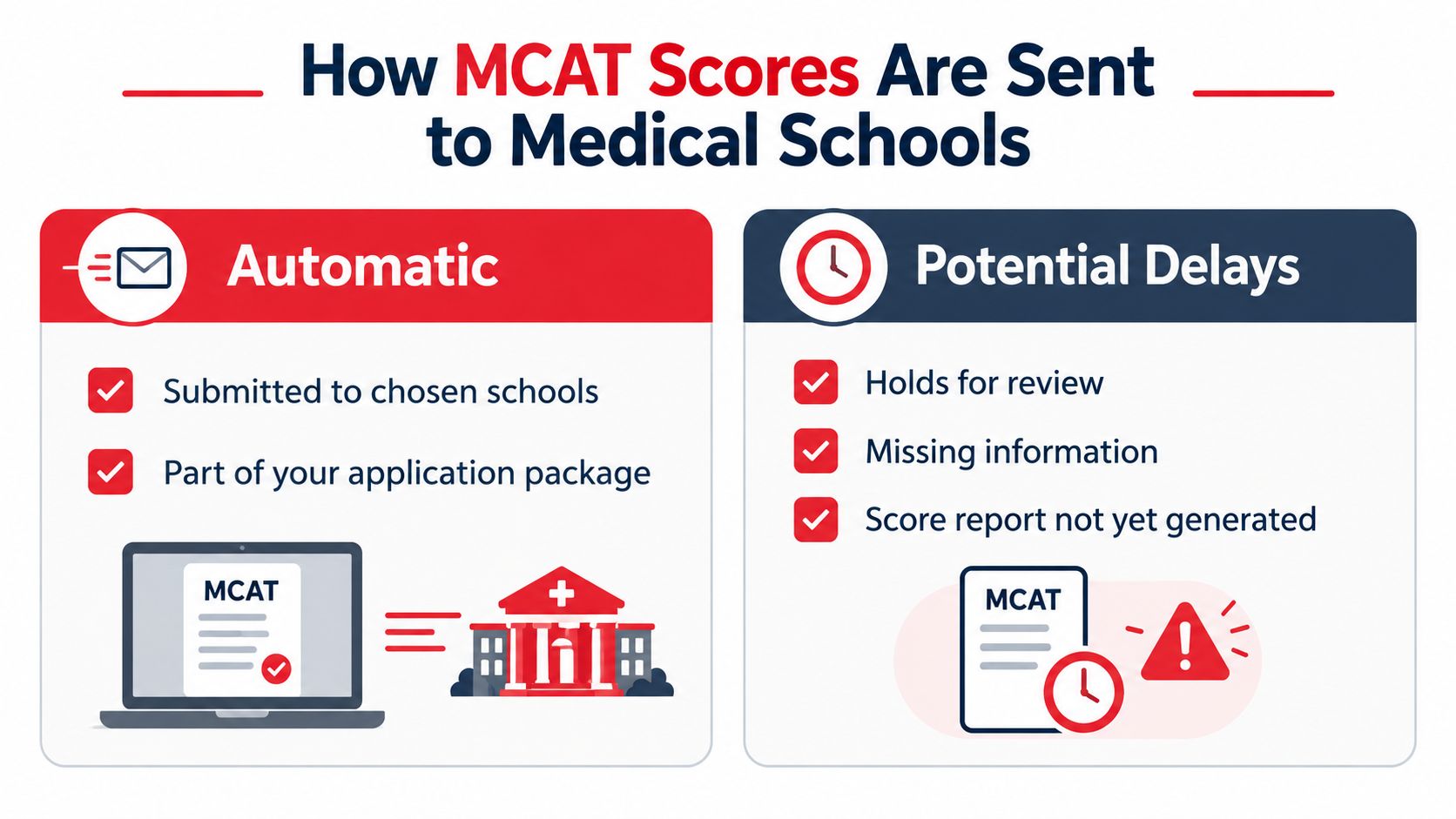
Where administrative delays happen
A school can't use a report that hasn't been officially generated, and a non-AMCAS institution won't receive a score that you haven't shared through the required system. Missing information, an incomplete sharing step, or confusion about whether a school participates in AMCAS can create avoidable downstream problems.
After release, make a short verification list:
- Confirm the report exists: Open the official report in the AAMC system.
- Identify the destination: Separate AMCAS-linked schools from non-AMCAS programs.
- Complete active sharing: Use Share Scores or an authorization code where required.
- Retain confirmation: Keep a record of the action you completed.
This administrative check doesn't determine whether your score is competitive. It helps ensure the correct official report reaches the intended recipient.
What to Do After Your MCAT Score Release With a Score Context Worksheet
A score-release decision should use evidence from the report and your application plan, not one emotional reaction. Start with the official total, all four sections, and the current AAMC percentile. Then compare that profile with target-school information in MSAR, your GPA and academic context, practice-test trends, available preparation time, and the application timeline.
A labeled composite example
Composite example, not a real student: An applicant receives a competitive total score but has one materially weaker section. The applicant doesn't label the result "good" or "bad." Instead, they compare the section profile with the current AAMC percentile table and target-school ranges in MSAR, then review whether practice scores showed the same imbalance, whether the weaker section reflects a correctable pattern, and whether enough time remains for a focused retake.
The decision could be to keep the score and proceed, to consider a retake after a targeted section plan, or to strengthen other application components without retesting. None of those choices guarantees admission or a future score. The right choice depends on the applicant's complete context.
MCAT Score Context Worksheet for Retake Decisions
| Worksheet Field | Your Data | How to Interpret |
|---|---|---|
| Total score | Record the official total from the AAMC report. | |
| Chemical and Physical section | Compare with the other sections and your target-school information. | |
| Critical Analysis and Reasoning section | Consider whether the result matches your practice trend and passage-review patterns. | |
| Biological and Biochemical section | Look for a stable strength, a content gap, or an unusual departure from practice performance. | |
| Psychological, Social, and Biological section | Interpret it as part of the whole profile, not in isolation. | |
| Current percentile | Use the current AAMC percentile table, not an outdated conversion. | |
| Target-school ranges | Enter current MSAR information for each school. A group range isn't an individual probability. | |
| GPA and academic context | Consider coursework, trends, postbaccalaureate work, and the rest of the academic record. | |
| Practice-test trends | Ask whether the official result was consistent, higher, or lower than your full-length pattern. | |
| Time available | Assess whether preparation can be focused without creating an unmanageable application timeline. | |
| Retest factors | Identify the specific strategy change, section plan, and scheduling consequences before registering. |
A retake deserves serious consideration when you can name the problem and the change. “I need to study harder” is less useful than “I lost time in a particular section because my passage approach and review process were inconsistent.” For targeted planning, this resource on how to improve your MCAT score can help you organize the analysis without treating improvement as guaranteed.
A retake should be a reasoned plan, not an automatic response to disappointment.
Your Next Steps After MCAT Score Release Day
Release day has two jobs. First, confirm the official report and record the information accurately. Second, give yourself enough distance to make a decision based on context rather than panic.
Release-day checklist
- Choose a workable time: Open the report when you have privacy and aren't rushing to another obligation.
- Verify the source: Use the AAMC Score Reporting System, not a screenshot or unofficial message.
- Record the profile: Save the total, four sections, percentile, confidence bands, and score profile.
- Check transmission: Confirm whether your intended schools are AMCAS-linked or require active sharing.
- Delay the verdict: Don't decide on a retake before reviewing the worksheet and your practice history.
If the score supports your current application plan, continue with the tasks you can control. If it falls below your expectations, a low score is information about one exam performance. It doesn't define your capacity to become a physician, and it doesn't require an immediate decision.
The following weeks
Use the worksheet to compare your score with current school information and your broader application. If you're considering a retake, identify the weak section, the underlying cause, the study method that will change, and the time available. If you aren't retesting, turn your attention to school selection, essays, letters, and other application elements that remain within your control.
Key takeaways
- MCAT scores follow a predictable 30 to 35 day release schedule.
- The official report contains more than a total, including section scores, percentiles, confidence bands, and a score profile.
- AMCAS-linked schools receive scores automatically, while non-AMCAS institutions may require active sharing.
- A retake decision should reflect section balance, current AAMC percentiles, MSAR ranges, GPA, practice trends, and timing.
- A thoughtful next step matters more than an immediate emotional reaction.
If you want help reviewing your report, Ace Med Boards offers personalized MCAT preparation support that can be used to examine section-level performance and build a focused next-step plan. Visit Ace Med Boards to learn about the available support and request a free consultation or Board Score Audit.