The MCAT punishes students who answer with their gut. After sitting full-lengths alongside hundreds of students, we found the single biggest score mover to be the Process of Elimination (POE) — deliberately hunting for reasons each wrong answer fails before you ever try to pick the right one. Content mastery gets you to the door; disciplined test execution gets you the 515.
This guide breaks down seven MCAT test taking strategies, from POE and passage mapping to pacing benchmarks built around section clocks. Before the strategies, check the foundation: if you have a documented condition, exploring testing accommodations like extended time on standardized tests is worth doing months before test day, not the week of.
Decision Aid: Which Strategy Fits Your Profile?
If you only have time to work on one thing, work on the right thing. This block maps your weakest symptom to the strategy that fixes it:
- You're stuck choosing between two answer choices on nearly every question → Start with Strategy 1 (Process of Elimination). The scenario below shows exactly how to force a 50/50.
- You're running out of time in B/B → Strategy 4, specifically the 1.5-minute benchmark and the flag-and-leave rule.
- Your CARS score won't budge despite content review → Strategy 2 (Passage Mapping) applied to arguments, plus Strategy 6 (Active Reading).
- You know the content but miss questions anyway → Strategy 3 (Question Stem Analysis). The "EXCEPT" trap section is written for you.
- You blank on material you swore you studied → Retrieval practice is the fix. A 2019 review of cognitive-psychology applications found students who quizzed themselves after lectures scored statistically higher on exams than students who only reread a review of the testing effect — and that finding carries directly into prediction-based answering (Strategy 7).
1. Mastering the Art of Elimination: The POE Technique
The Process of Elimination reframes every question. Your job is not to find the right answer out of four — it's to find three demonstrably wrong ones. The MCAT is built around distractors engineered to look plausible, and when you hunt for their specific flaws instead of trying to "feel" your way to the correct choice, a blind 25% guess becomes a calculated 50% chance, or certainty.
The POE Workflow: Flagging Distractors
- Science sections (C/P, B/B, P/S): Check for factual errors first. A glycolysis question whose answer invokes a Krebs-cycle enzyme is dead on arrival; a physics answer with wrong units (Joules where Watts belong) is dead in one second.
- CARS: Compare each choice directly against the passage. Kill anything too extreme, out of scope, or contradicting the author's stated argument.
Worked example. A biochem passage describes an experiment on an enzyme that phosphorylates glucose. The stem asks: "Which change would most increase the reaction rate?" The choices:
- A) Decreasing ATP availability contradicts the passage, which identifies ATP as a phosphate donor, so eliminate it.
- B) A mutation that doubles the enzyme's Km lowers affinity and slows the reaction at fixed substrate, assuming standard Michaelis-Menten kinetics. Eliminate it.
- C) Increasing substrate concentration is plausible; at high [S], a high-Km enzyme can be driven faster.
- D) Adding a competitive inhibitor is implausible given the passage setup, but subtler.
You've eliminated A (passage contradiction) and B (mechanistic logic) in well under 30 seconds, converting a four-way question into a reasoned choice between C and D. That is POE doing its job: even when you don't know the answer, you've raised your expected value on the question.
POE in CARS: Scope vs. Extreme Language
Two kill criteria do most of the work. Extreme language — "always," "never," "only," "must" — almost never matches an author who wrote carefully hedged claims. Scope drift is quieter and deadlier: the answer sounds plausible but draws on information the passage never stated. Test yourself on every surviving choice: "Can I point to a line justifying this, or does it just sound reasonable?" If you can't point, it's a scope violation.
Key Insight: POE is not guessing. It is logical deduction about what must be true once what is false is removed.
One caution, born of watching students over-apply it: elimination should take 15–25 seconds, not two minutes. If you cannot articulate a concrete reason to kill a choice, leave it alive. Guessing wrong because you eliminated the correct option on vibes is the single most avoidable error we see in review sessions.
2. Passage Mapping
MCAT passages bury their real content under experimental detail and layered argument. Passage mapping means building a skeletal outline on your scratch paper as you read — a directory of the passage's structure, not a transcription of it — so you never reread to locate a specific fact.

The Anatomy of a Map: Hypothesis vs. Result
In experimental passages, your map has four mandatory slots: Hypothesis/Goal, Methods/Variables (what was changed, what was measured), Results ("Drug X ↑ Protein Y" — arrows, not prose), and Conclusion. The discipline that separates a useful map from scribbling is separating what the researchers hypothesized from what they observed. Distractor answers routinely swap these, offering the hypothesis where the stem demands the result, or vice versa. If your map marks the distinction explicitly, the switcheroo fails on contact.
Note this is different from pure data interpretation: an experimental passage asks you to track design and causal logic, while a data-heavy passage (a figure-driven C/P setup, for instance) mostly needs you to note where each variable and trend appears so you can find them again in seconds.
Mapping CARS Arguments
CARS maps track function, not data. For each paragraph, one to five words: "Background," "Counter-argument," "Author's rebuttal," "Concession." Add the author's tone (critical, neutral, qualified) and their main claim at the top of the map. When a question asks what the author "would most agree with," your one-line claim at the top is where you answer from.
Key Insight: A map is a functional directory, not a summary. It transforms you from a passive reader into an active analyst from the first read.
In timed practice, we found students lose the benefit by over-mapping — capturing minor details that the questions never touch. If a detail isn't load-bearing for the conclusion, leave it off the page.
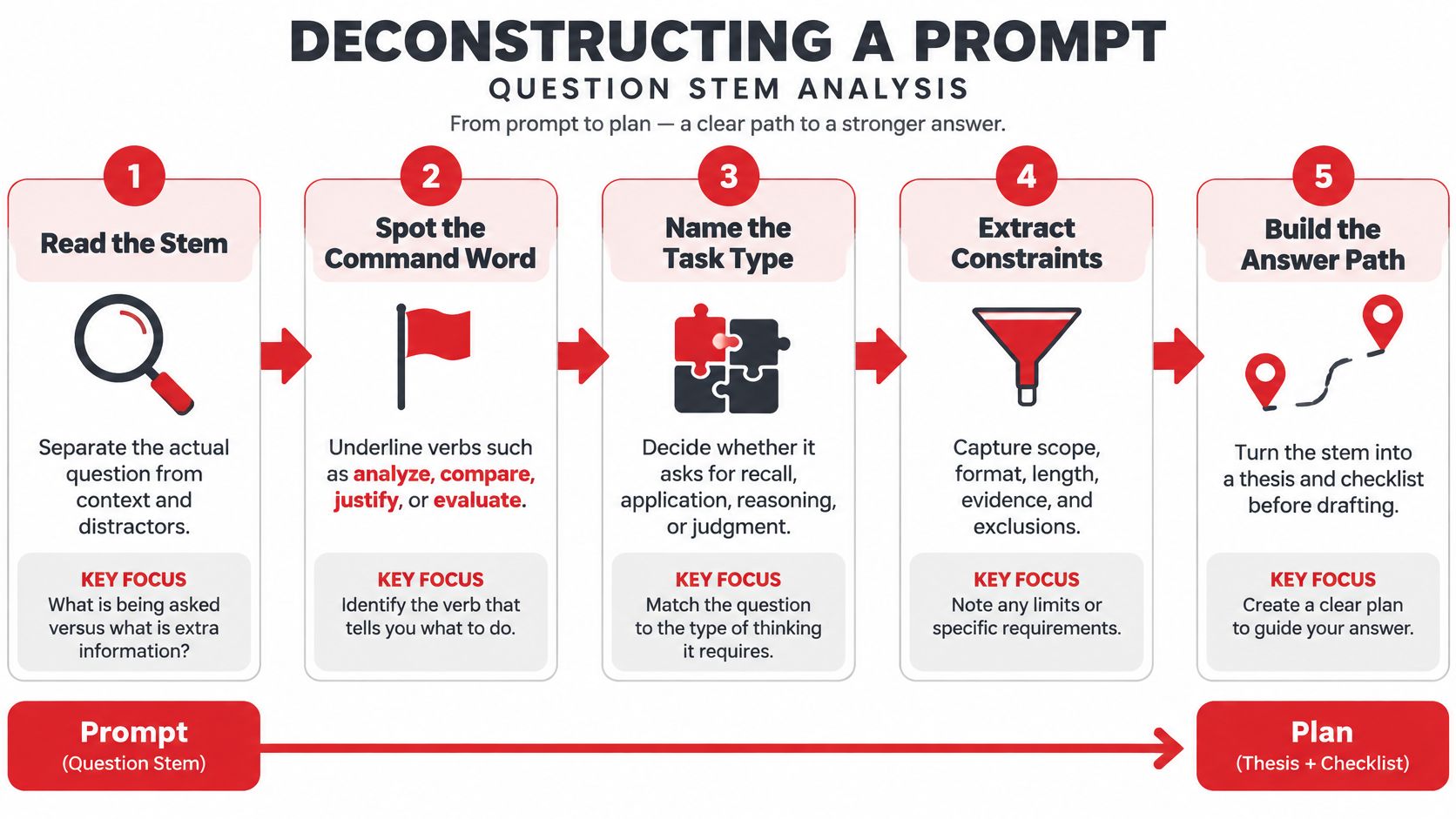
3. Deconstructing the Prompt: The Power of Question Stem Analysis
Read the question stem before the answer choices, and read it the way a lawyer reads a contract. Superficial reading is exactly what the distractors are priced against.
Identifying Directive Verbs
The verb tells you the cognitive task, and each task demands a different route: infer (draw a conclusion the passage supports but never states outright), identify (locate a stated fact — answer sits in your map), explain (supply the mechanism), apply (move passage logic into a new scenario it never discussed). Misreading "infer" as "locate" sends you hunting for a sentence that doesn't exist, and you leave with the answer that merely paraphrased the passage — which the test writers count on.
Also classify whether the question is passage-based or a pseudo-discrete dressed in passage clothing; a "based on the passage" stem forbids outside knowledge, while an "apply" stem requires it. Recognizing that in two seconds saves the ten seconds of confusion after it.
The 'EXCEPT' Trap
Modifiers like EXCEPT, LEAST, and NOT invert the task. A "least supported" question asks you to find three true statements and one false one — students who skim the stem then pick the most supported option, wrong with total confidence. The mechanical habit: when you spot a modifier, physically write the inverted task on your scratch paper ("circle the FALSE one"). It costs three seconds and has saved more points in our review sessions than any other single habit.
Key Insight: You are answering the question the test-makers actually wrote, not the one you assumed they wrote.
Inference vs. application — a distinction worth 30 seconds of your attention: Inference questions stay inside the passage; you're extrapolating to the nearest logical step the author already set up, and the correct answer will feel almost boring. Application questions deliberately leave the passage; the correct answer will involve unfamiliar context and the wrong answers will feel familiar because they're recycled passage details. If an answer choice feels suspiciously like a direct quote of the passage on an application question, distrust it.
4. Strategic Time Management
The MCAT's clock is tight enough that pacing is a scored skill, not an administrative detail. Effective pacing means allocating time deliberately — answering everything, rushing nothing, and refusing to donate five minutes to one impossible question. The AAMC's MCAT exam overview lists the sections and their timing, so use the official format to anchor your practice benchmarks.

The 1.5-Minute Benchmark
For C/P, B/B, and P/S, budget roughly 1.5 minutes per question: a 6-question passage takes about 9 minutes, discretes closer to 90 seconds each. That buffer matters — here's a rounded pacing illustration for the 95-minute C/P section, not a claim about a fixed number of passage sets:
- Roughly 10 discrete questions: about 15 minutes
- Passage-based questions: use the remaining time at a pace near 1.5 minutes per question
- Keep a small review buffer for flagged questions and guesses marked as low-confidence
If that math looks impossible at your current speed, that's information — it means your per-passage read is running long, and the fix is faster mapping (Strategy 2), not faster clicking. For a practical framework, see Strategic Time Management on acemedboards.com.
CARS: The 9-Minute Passage Cap
CARS gives you 90 minutes for 9 passages. Treat that as a hard 9-minute cap per passage including reading and all questions. The discipline is asymmetric: a brutally hard passage can be exited at 8 minutes with your best guesses logged, and the 90 seconds you saved buys you a near-certain point elsewhere. As a rough trigger, at the 4.5-minute mark you should be finished reading and into the questions.
Key Insight: Pacing is proactive: you set the benchmark, practice under it, and control the clock instead of being controlled by it.
5. Content Integration and Cross-Referencing
The MCAT is not just a test of isolated facts; it's an examination of your ability to think like a future physician by connecting information across disciplines. Content Integration and Cross-Referencing is a powerful MCAT test taking strategy that involves actively linking concepts from physics, chemistry, biology, and psychology. By recognizing these overlaps, you can solve complex, multi-step problems that are becoming increasingly common on the exam.
This approach mirrors the AAMC's own design philosophy, which emphasizes the foundational, interdisciplinary nature of modern medicine. Instead of studying organic chemistry in a vacuum, for example, you learn to see its reactions as the fundamental steps within the metabolic pathways you study in biochemistry. This transforms your understanding from a list of memorized facts into a cohesive web of knowledge.
How to Implement Content Integration Effectively
True integration requires you to move beyond subject-specific silos during your preparation. The goal is to see the underlying principles that unite different fields.
- Biochemistry and Physics: When studying cellular metabolism, don't just memorize ATP yield. Apply physics principles of thermodynamics and electrostatics to understand why ATP hydrolysis is so exergonic or how the electron transport chain harnesses potential energy.
- Biology and Psychology: Connect the biological basis of neurotransmitters and hormones (B/B section) to their impact on behavior, stress, and mental disorders (P/S section). For example, link the function of the sympathetic nervous system to the fight-or-flight response discussed in psychology.
- Organic Chemistry and Biology: View metabolic pathways like glycolysis or the Krebs cycle as a series of organic chemistry reactions. Recognizing reaction types like nucleophilic acyl substitution or redox reactions in a biological context deepens your understanding and makes the information stick.
Key Insight: The MCAT rewards a holistic understanding. This MCAT test taking strategy is less about learning more content and more about building connections between the content you already know. This creates a more robust and flexible knowledge base that is less prone to forgetting under pressure.
Actionable Tips for Test Day
To develop an integrated mindset, you must practice it consistently. Here's how to make it a core part of your study routine:
- Create Concept Maps: Don't just make lists. Draw diagrams that visually link a central concept (e.g., "Amino Acids") to its properties in chemistry (chirality, pKa), its role in biology (protein structure), and its function in lab techniques (isoelectric focusing).
- Hunt for Overlap: When you learn a new topic, ask yourself: "Where have I seen this principle before?" Connect fluid dynamics from physics to blood flow in the circulatory system.
- Analyze Missed Questions: When you get a question wrong, don't just review the direct concept. Identify if it was an "integration question" that required you to pull knowledge from two different subjects. This reveals gaps in your cross-disciplinary thinking.
- Focus on Foundational Principles: Master core ideas like Gibbs free energy, acid-base chemistry, and electrochemical gradients. These concepts appear repeatedly across C/P, B/B, and even P/S, acting as the glue that holds your knowledge together.
6. Active Reading and Critical Analysis
Passive reading is the enemy of a high MCAT score. Active Reading and Critical Analysis is one of the most vital MCAT test taking strategies, transforming you from a simple consumer of information into an engaged, critical thinker. Instead of just letting words wash over you, this approach demands that you question, challenge, and dissect the information presented in passages. This is non-negotiable for the CARS section but is equally powerful for deconstructing dense experimental passages in the science sections. A peer-reviewed study of active reading strategies discusses retrieval and engagement approaches that support learning; apply the same deliberate attention when working through passages.
This strategy involves constantly asking "why?" and "how?" as you read. You're not just reading a study's conclusion; you are actively evaluating its methodology and looking for potential flaws or biases. By engaging with the text on this deeper level, you anticipate the types of questions the MCAT will ask and are better prepared to identify the subtle distinctions between correct and incorrect answer choices.
How to Implement Active Reading Effectively
The goal is to interact with the text, not just absorb it. You must analyze the structure and purpose behind the words on the page.
- For Science Sections (C/P, B/B, P/S): When reading an experimental passage, don't just accept the results. Ask yourself: What is the hypothesis? What are the independent and dependent variables? Are the controls appropriate? Actively look for the difference between correlation and causation in the study's claims. This critical lens helps you evaluate answer choices that test your understanding of experimental design.
- For the CARS Section: This is the core skill for success. As you read, identify the main point of each paragraph and how it connects to the author's overall argument. Pay close attention to transition words like "however," "consequently," or "in contrast," as they signal shifts in logic. Question the author's tone, potential biases, and the evidence they use to support their claims. If you want to dive deeper into this skill, you can find more information about improving your CARS score on acemedboards.com.
Key Insight: Active reading turns passages from daunting walls of text into structured arguments you can navigate. This MCAT test taking strategy isn't about reading faster; it's about reading smarter and with greater comprehension, which ultimately saves you time and prevents rereading.
Actionable Tips for Test Day
Incorporate these active reading habits into your practice so they become automatic on exam day:
- Map the Passage: Briefly jot down the main idea of each paragraph on your scratch paper (e.g., P1: Intro problem, P2: Author's main claim, P3: Counterargument). This creates a quick-reference map.
- Highlight with Purpose: Use the highlight tool strategically. Highlight the author's main thesis, strong opinion words, and key definitions, not entire sentences.
- Identify the Author's Voice: Constantly ask, "What is the author trying to achieve with this sentence/paragraph?" Are they arguing, explaining, or refuting?
- Summarize Before Answering: Before looking at the questions for a passage, take three seconds to mentally summarize the author's main point in your own words. This grounds your understanding and helps you avoid distractor answers.
7. Answer Choice Prediction
A powerful yet underutilized MCAT test taking strategy is to formulate your own answer before looking at the provided options. This technique, known as Answer Choice Prediction, shifts your approach from reactive selection to proactive problem-solving. It forces you to engage with the question and passage, building your own conclusion based on the evidence rather than being swayed by cleverly crafted distractors.
This mental exercise is a potent defense against the MCAT's most tempting wrong answers. By arriving at your own logical endpoint first, you enter the selection process with a clear benchmark. The task then becomes a simple matching game: find the option that aligns with your pre-formulated answer. This builds confidence and significantly reduces the time wasted agonizing over similar-sounding choices.
How to Implement Answer Choice Prediction Effectively
The key is to use the question stem and passage information to construct a mental blueprint of the correct answer. This looks different across the various MCAT sections.
- For Science Sections (C/P, B/B, P/S): In calculation-based physics questions, estimate a rough answer or determine the expected units before you even touch your calculator. For a biology passage describing an experiment, predict the likely outcome of a control group or what would happen if a specific enzyme were inhibited.
- For the CARS Section: After reading a question, try to summarize the author's answer in your own words based on your understanding of the passage. For instance, if asked about the author's primary purpose, formulate a sentence like, "The author is arguing against a popular theory by highlighting its key flaws." Then, find the choice that best matches this sentiment.
Key Insight: Answer Choice Prediction is a direct application of active recall, one of the most effective learning techniques. Instead of passively recognizing information, you are actively retrieving and constructing it, which is a much higher-order cognitive skill that leads to greater accuracy.
In a study of Dutch medical students, retrieval-practice questions produced statistically different rates of correct answers and non-answers than regular questions, with every comparison reaching P < 0.05, as reported in research on retrieval practice in medical sciences — evidence that constructing answers from memory, rather than recognizing them, is measurable in performance.
Actionable Tips for Test Day
Integrate this prediction habit into your practice to make it an automatic part of your test-taking process.
- Cover the Options: Use your hand or scratch paper to physically cover the answer choices (A, B, C, D) after reading the question. Force yourself to think through the answer first.
- Start with Discretes: This strategy is easiest to practice on standalone discrete questions before applying it to more complex passage-based problems.
- Be Flexible: Your prediction might not be worded exactly like the correct answer. Look for the option that best matches the core concept of your predicted answer.
- Don't Force It: If you read a question and are completely unsure, don't waste time trying to form a perfect prediction. In these cases, pivot immediately to other MCAT test taking strategies, like the Process of Elimination.
MCAT Test Strategy Comparison Matrix
| Strategy | Implementation Complexity 🔄 | Resource Requirements ⚡ | Expected Outcomes 📊 | Ideal Use Cases 💡 | Key Advantages ⭐ |
|---|---|---|---|---|---|
| Process of Elimination (POE) | Medium – requires practice to identify elimination patterns | Low – relies on careful reading and logic | Increased accuracy even with partial knowledge | All MCAT sections, especially questions with distractors | Improves guessing, reduces impact of distractors, builds confidence |
| Passage Mapping | Medium – initial time investment to develop mapping skills | Moderate – needs annotation tools or note-taking | Better comprehension and retention, time-saving on re-reads | Long and complex reading passages, science and CARS sections | Enhances focus, saves time, organizes complex info |
| Question Stem Analysis | Medium – requires familiarity with question patterns | Low – requires attentiveness and annotation | Prevents misinterpretation, improves accuracy | All question types, especially complex or tricky questions | Clarifies question intent, reduces distraction |
| Strategic Time Management | High – involves learning pacing and decision strategies | Moderate – requires timed practice & self-monitoring | Improved section completion and point maximization | Full MCAT sections with strict time limits | Ensures pacing, reduces anxiety, maximizes score potential |
| Content Integration & Cross-Referencing | High – demands broad content knowledge and synthesis skills | High – extensive study across disciplines | Stronger problem-solving and interdisciplinary understanding | Complex multi-concept questions, advanced practice sets | Enhances understanding, confidence, and problem solving |
| Active Reading & Critical Analysis | Medium – needs sustained focus and questioning habit | Low to moderate – practice and engagement | Improved comprehension, critical thinking, inference skills | CARS section and all passage-based questions | Develops deep understanding, critical evaluation |
| Answer Choice Prediction | Medium – requires solid content knowledge and prediction skill | Low – mental exercise during question work | Increased accuracy, confidence, reduced distraction | Calculation and inference questions, confidence building | Minimizes distractor influence, builds confidence |
Integrating Strategies for Peak Performance
Mastering the MCAT is not about discovering a single "magic bullet" strategy. Instead, it is about methodically building a versatile and interconnected toolkit of mcat test taking strategies and developing the intuition to know exactly when to deploy each one. The seven powerful techniques detailed in this guide, from the meticulous Process of Elimination to the proactive method of Answer Choice Prediction, are not isolated tricks. They are foundational components of an integrated, dynamic approach to conquering one of the world's most challenging standardized exams.
Weaving Your Strategic Tapestry
Think of these strategies as interlocking gears. Your journey from a novice test-taker to a seasoned expert involves learning how to make these gears turn in perfect harmony. You cannot effectively use Process of Elimination without first performing a rigorous Question Stem Analysis. Likewise, your ability to predict an answer is directly tied to the quality of your Active Reading and the accuracy of your Passage Map. Each strategy supports and enhances the others.
Your next steps should focus on integration. During your practice sessions, consciously layer these techniques:
- Start with Passage Mapping to build a structural and thematic framework for the text.
- Engage in Active Reading as you examine the science, critically evaluating claims and data.
- Dissect each Question Stem to understand precisely what is being asked before ever looking at the options.
- Use your analysis to either Predict the Answer or pivot to the Process of Elimination.
- All of this must be executed under the constant, guiding pressure of Strategic Time Management.
For a broader survey of how these habits fit into effective study systems, Rooy Development's page is a useful outside perspective on structuring practice around retrieval rather than rereading.
The goal is to move beyond simply knowing these strategies to internalizing them. They should become an automatic, reflexive part of your problem-solving process, freeing up valuable cognitive resources to focus on the content itself.
From Practice to Peak Performance
Consistent, deliberate application during your full-length practice tests is the only way to make these skills second nature for exam day. Applying them under test conditions turns theoretical knowledge into tangible points. Your physical state matters as much as your mental preparation. Cognitive endurance, focus, and recall are heavily influenced by your well-being. Supporting your study efforts by optimizing your nutrition for brain health to boost memory and focus can provide a significant edge, ensuring your mind is as prepared as your strategic toolkit.
One refinement worth making to your practice loop: score your accuracy on first-pass answers before reviewing explanations. Research on the testing effect shows the benefit is strongest when learners initially answer more than 75% of items correctly, intermediate between 51% and 75%, and unreliable below 50% without corrective feedback — so if your first-pass accuracy is below that threshold, the priority is targeted content remediation, not more passages. The distinction is laid out in an Annual Review of Psychology examination of the testing effect.
By shifting your focus from just what you know to how you apply that knowledge under pressure, you are taking the final, critical step toward your target score. Mastering these mcat test taking strategies is the bridge between understanding the science and demonstrating that understanding when it counts the most. This strategic mastery is what separates good scores from great ones and ultimately helps secure your well-deserved place in medical school.
Frequently Asked Questions
How does the Process of Elimination improve a score? It converts partial knowledge into expected value. Killing two demonstrably wrong answers turns a 25% guess into a 50/50; across dozens of uncertain questions on exam day, that difference can improve your odds of answering correctly.
Should I answer questions in order, or skip around? Within a passage set, answer in order so stem-analyzing each question builds on the previous. Across the section, use the flag function: if a discrete or a passage question exceeds your benchmark (~1.5 minutes in science, hard stop at the 9-minute passage cap in CARS), log your best guess, flag it, and move on. The review window at the end of each section exists for exactly these.
Is POE useful in CARS, where answers are subjective? It's most useful there. CARS wrong answers cluster into recognizable categories — too extreme, too narrow, out of scope, or contradicting the author. Eliminating the three that fail those tests is more reliable than trying to divine the "best" answer directly, because the correct choice is the one that survives your rational elimination.
How early should these strategies be part of practice? From your first timed section. Strategy skills train as slowly as content — a student who starts POE and pacing three months out arrives fluent; one who starts the final week arrives with theory.
Do I need to change strategy order for different sections? The chain stays the same: map, read actively, analyze the stem, then predict or eliminate. What changes is pacing — 1.5 minutes per question in science sections versus a hard 9-minute passage cap in CARS.
Ready to improve your approach and turn strategic weaknesses into strengths? The expert tutors at Ace Med Boards specialize in personalized MCAT preparation, helping you integrate these advanced strategies and build a customized plan for a top score. Visit Ace Med Boards to learn how targeted guidance can maximize your exam performance.