You're staring at a screen full of Anki cards, UWorld questions, and a classmate's study schedule that looks impossibly polished. They swear by a specific app, a specific hour block, a specific colored notebook, and you're tempted to copy the whole thing because their score is hard to ignore. That instinct is understandable, but it's usually the wrong move.
Learning from the best is not imitation. It's deconstruction, then adaptation. The goal is to identify the thinking patterns, study structures, and question habits that drive results, then rebuild them around your own time, energy, and access constraints. That's the only version that holds up when you're on rotations, juggling family obligations, or studying with limited bandwidth.
Why Copying Top Scorers Rarely Works
A student in my tutoring sessions once showed me a classmate's Step study schedule and asked if they should “just do that.” The schedule was tidy, disciplined, and completely useless for them. Their day had clinic, a commute, and evening obligations, while the model schedule assumed uninterrupted blocks and perfect focus.
That's the problem with copying a top scorer's routine as if it were a recipe. You see the visible outputs, but you don't see the hidden inputs, like prior knowledge, stamina, question habits, tolerance for repetition, or even how that person studies when they're tired. The routine may look efficient because it fits their life, not because it contains some magical structure.
Metacognition matters here because you need to know what kind of learner you are before borrowing anyone else's system. A useful starting point is metacognitive awareness, which forces you to notice where your understanding breaks down instead of assuming every productive-looking habit will work for you.
Surface habits are not the same as the engine underneath
A top scorer might use one question bank, another person might use a different one, and both may still succeed for the same reason. They're not winning because of the brand name on the platform. They're winning because they're constantly testing themselves, correcting errors, and choosing tasks that force recall instead of recognition.
Practical rule: copy the behavioral mechanism, not the cosmetic setup.
That means you ask a different question when you admire someone's routine. Don't ask, “Which app do they use?” Ask, “How do they expose themselves to uncertainty, retrieve information, and review mistakes?” That shift saves time, money, and a lot of self-sabotage.
The birthday paradox is a useful mental model for this kind of mistake. In a group of just 23 people, there's about a 50% chance that two share a birthday, even though there are 365 days in a year, which is a blunt reminder that intuition is bad at probability and context. The lesson carries over cleanly to studying, since the most obvious explanation is often not the true one. Good learners look for the denominator, the base rate, and the underlying distribution, not the flashy surface pattern. This classic statistics example is memorable because it shows how easily people confuse appearance with reality.
Identifying High-Impact Study Behaviors
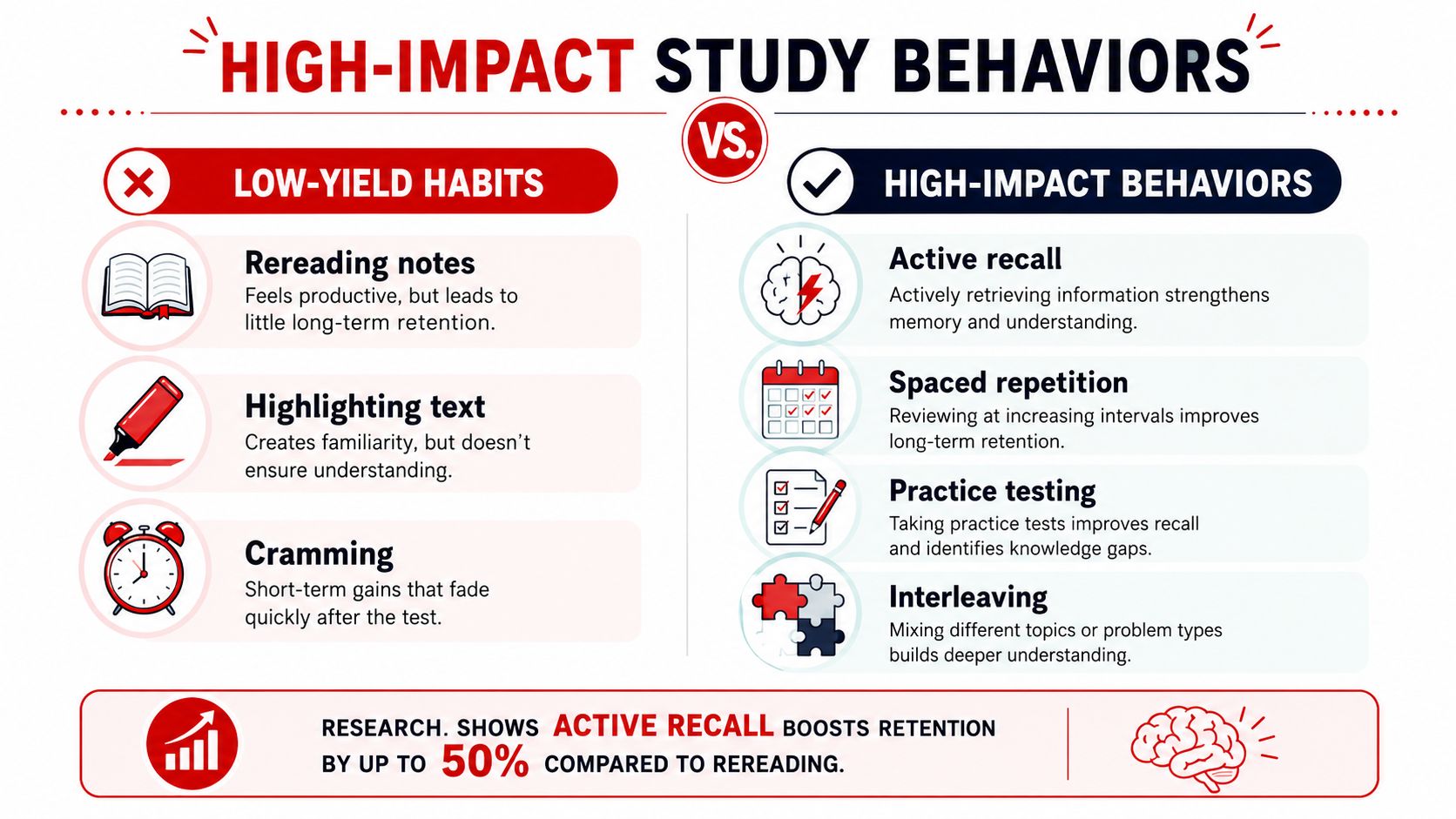
The quickest way to waste a month is to keep doing low-yield work and call it discipline. Medical students do this constantly. They reread notes, highlight paragraphs, and convince themselves that familiarity equals mastery, then panic when practice questions expose the gap.
A large meta-analysis of 242 studies with 169,179 participants found an overall mean effect size of 0.56 across learning techniques, and it ranked distributed practice and practice testing as the most effective strategies, while underlining and summarization came out least effective. That matters because the most common study habits are often the weakest ones. The review in Frontiers in Education makes the hierarchy hard to ignore.
What actually moves the needle
The practical ranking is simple. Distributed practice beats cramming because memory strengthens when material is revisited across time, not stuffed into one exhausted session. Practice testing beats rereading because retrieval is the point of the exam, and the brain gets better at what it must pull out under pressure. UC San Diego's study guide also emphasizes combining spaced practice with retrieval practice, then repeating until recall is solid.
Use this as an audit:
- Rereading notes, if that's most of your day, means you're creating recognition, not recall.
- Highlighting text, if it replaces answering questions, is decoration.
- Cramming, if it's your default before every quiz, gives short-term familiarity and weak retention.
- Active recall, if you force yourself to answer before looking, changes the game.
- Spaced repetition, if you revisit content over days instead of one sitting, protects retention.
- Practice testing, if you review why each option is right or wrong, teaches exam thinking.
- Interleaving, if you mix related topics instead of blocking one subject for hours, better reflects real exam demands.
The simplest rule is this. If the task feels comfortable, it's probably too passive. If it feels effortful and exposes what you don't know, you're probably doing something worthwhile. That's why most effective study techniques should be chosen by learning value, not by popularity.
Deconstructing Expert Question Techniques
A lot of students lose points because they treat questions like reading comprehension. Expert test-takers do the opposite. They interrogate the stem, identify the tested concept fast, and treat the answer choices like a trap map.
The skill is not raw speed. It's disciplined reading under pressure. That's why a strong question-answering process can rescue a student who knows the content but freezes when the vignette gets long.
Read for the problem, not the decoration
Start with the stem and strip it down to the clinical task. Ask what the question is really testing, then identify the one or two clues that matter most. Everything else is usually there to distract you, mimic a different diagnosis, or waste your time.
Use this sequence every time:
- Read the stem for the clinical scenario and the key details.
- Identify the question before looking at the options.
- Eliminate distractors that are clearly incompatible.
- Select the best answer based on the most correct fit.
- Review your reasoning so you don't talk yourself out of the right choice.
That framework sounds obvious, but most misses happen because students skip step 2 and jump straight into option-matching. Once you know the concept being tested, the wrong answers usually collapse on their own. This distractor analysis resource is useful because it pushes you to explain why an option is wrong, not just why the right one feels familiar.
Build a personal playbook from worked examples
Don't just review answer explanations. Reconstruct them. If you miss a renal, cardio, or ethics question, write down the clue that should have triggered the right pathway, then note the trap that pulled you away.
The best tutoring clips I've seen make this process visible. If you want to watch how strong educators break down reasoning in real time, expert interview clips at Flexwork are a helpful supplement because they show how skilled thinkers move through uncertainty instead of leaping to the first answer that sounds right.
Building a Personalized Practice Plan
A plan that ignores your actual life is fantasy. If you're on clerkship, commuting, working part-time, caring for family, or studying with spotty internet, your schedule has to be built around reality, not around someone else's idealized day. The point is to preserve the core methods and adapt the delivery.
A modern statistical workflow uses PPDAC, or Problem, Plan, Data, Analysis, Conclusion, which is a clean model for study planning too. Define the problem, choose the plan, gather the data from your performance, analyze what it means, and adjust the conclusion based on evidence. That same discipline sits behind every serious study overhaul. The statistics framework is useful because it forces sequence instead of impulse.
Build around your constraints, not against them
Start with your baseline. A diagnostic exam, question set, or shelf score tells you where your gaps live. Then set weekly goals that are concrete and limited, because vague goals like “do more questions” collapse the moment your day gets messy.
A workable plan usually looks like this:
- Assess your baseline with a diagnostic and a short error review.
- Set specific targets for content, question volume, and review.
- Schedule practice blocks at times you can protect consistently.
- Incorporate active recall inside each block, not just passive reading.
- Review and adjust based on where your misses cluster.
If you need a planning tool, this exam preparation planner can help you turn those pieces into a calendar instead of a vague intention.
Keep the method, change the packaging
If you have twenty-five minutes between obligations, use that block for retrieval practice and a short review of missed questions. If you have a longer stretch, layer in interleaving so you're forced to distinguish close concepts. The rule is not to chase the perfect study block, but to preserve the highest-value moves inside the time you have.
Some learners also benefit from thinking about their study brand like a coach thinks about positioning. The coach personal branding framework is useful as a metaphor here, because it reinforces a simple idea, your system should reflect your strengths, your audience, and your constraints instead of pretending you're someone else.
Leveraging Mentorship and One-on-One Tutoring
A student can memorize a large amount alone and still miss the underlying problem. The bottleneck is often reasoning, not content. A tutor or mentor helps expose those blind spots fast, then shows you how to correct them in a way that holds up under exam pressure.
The useful sessions are diagnostic. Bring missed questions, a weak subject, or a repeating error pattern, then force the conversation toward why the mistake happened and what changes in your next attempt. Ace Med Boards offers one-on-one online tutoring for USMLE, COMLEX, and shelf exam prep, with targeted review, case-based work, and question-analysis coaching.
What a high-yield session looks like
Preparation decides whether the session helps. If you arrive with scattered questions and no record of what went wrong, the time gets spent on material you could have handled alone. If you bring a short log of weak areas, the tutor can focus on decision-making, not just definitions.
Practical rule: bring errors, not excuses.
Ask for explanations that change what you do next time. Press for the clue that should have stood out sooner, the elimination step that should have removed the wrong option, or the memory cue that will survive the next block. Good tutoring matters because it turns one conversation into a repeatable habit, not a one-time fix.
Choose mentorship that fits your exam and schedule
Fit matters more than prestige. A tutor should understand your exam format, your available time, and your main bottleneck, whether that is content gaps, pacing, or question interpretation. If you need broad support, choose someone who can move between high-yield content and live question review without wasting time on filler.
The best mentors also respect constraints. Students with unstable schedules, childcare demands, budget limits, or accessibility needs need tutoring that is flexible and structured, not rigid and performative. For students who need a wider range of support styles, exploring tools like those you browse AI character options can help you identify the right support model. That difference matters because advice that sounds polished is useless if you cannot use it.
Tracking Progress and Avoiding Common Pitfalls
Most students don't fail because they lack effort. They fail because they misread their own progress. A good week of rereading feels productive, then a timed block exposes that nothing stuck. That's not bad luck. That's a bad feedback loop.
Use a simple tracker, not an elaborate spreadsheet you'll abandon in ten days. Log your practice score, your missed topics, and whether the miss came from content, timing, or reasoning. If you want a straightforward way to keep that visible, this progress tracking dashboard is aligned with the kind of weekly review that changes behavior.
The traps that keep repeating
The first trap is passive review masquerading as studying. If your notes look cleaner but your retrieval hasn't improved, you're polishing the surface. The second is ignoring weak areas because they're unpleasant, which guarantees the same errors keep showing up.
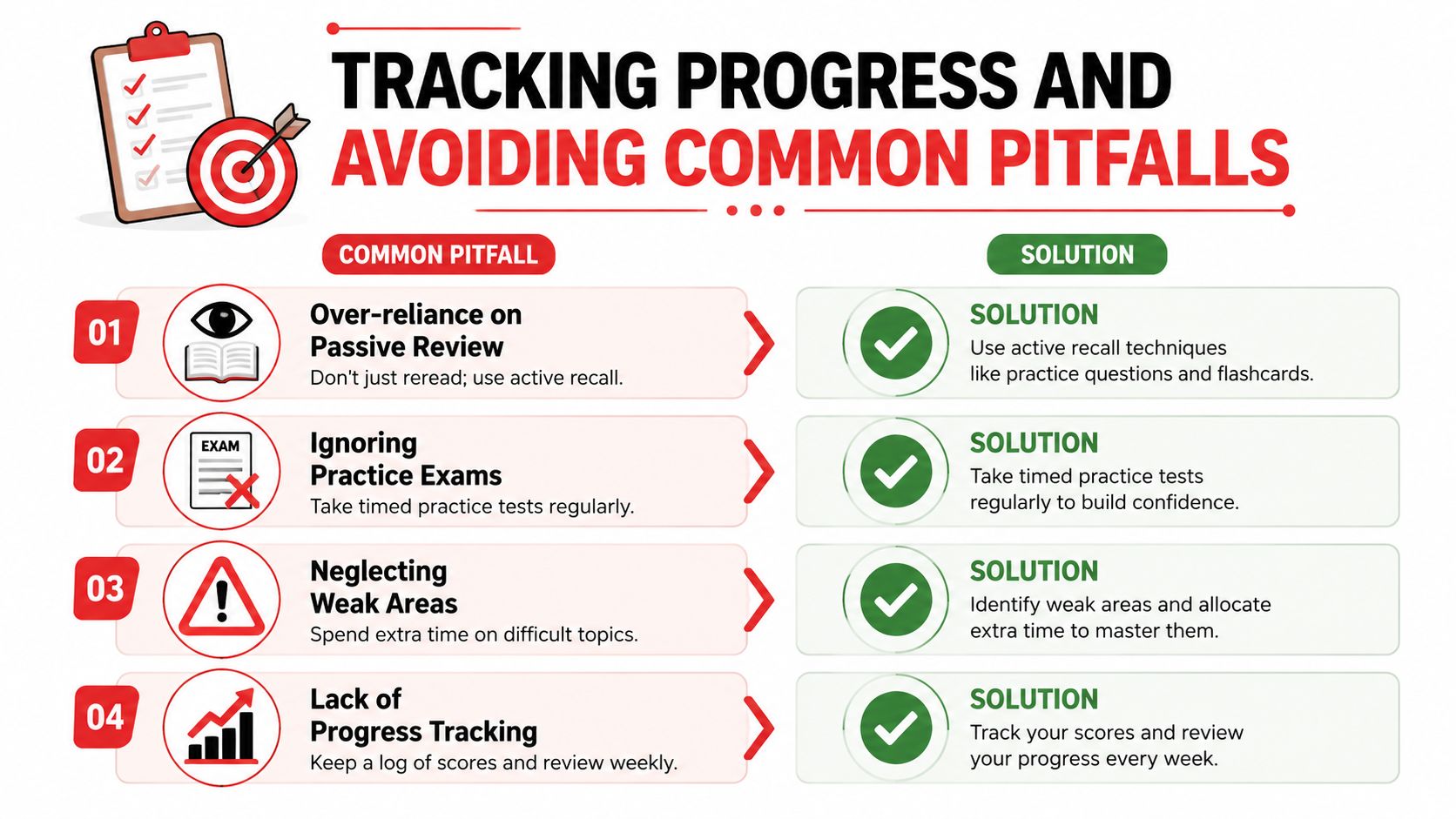
The third trap is resource overload. Too many decks, too many question banks, too many videos, and no coherent system. The fourth is pretending score trends are simple. One practice test is noise. A pattern over time is data.
Adjust based on evidence, not panic
If your tracking shows weak recall, increase retrieval practice. If your misses cluster around time pressure, do more timed sets. If your content knowledge is uneven in one subject, stop pretending every weakness deserves the same attention.
Learning from the best is a refinement process, not a personality transplant. You borrow the method, test it against your own results, and keep what survives contact with real exam performance. That's how strong students get better without wasting months acting like someone else.
Ace Med Boards builds tutoring around the exact problem medical students face, turning missed questions, weak content, and poor timing into a clearer study plan. If you want structured one-on-one help for USMLE, COMLEX, or shelf exams, visit Ace Med Boards and set up support that fits your schedule and your exam goals.