It's 6:05 a.m., the room is cold, and the team is already looking at you before you've finished opening the chart. You've got the labs, the vent settings, the overnight note, and three new “small” changes that are anything but small. If you start by reading every normal number, you lose the room. If you start with the wrong detail, you miss the thing that changed the patient's day.
A strong ICU presentation template fixes that problem before rounds ever begin. It gives you a repeatable order, helps you separate signal from noise, and makes it obvious what still needs ICU-level support, whether that's a pressor, a ventilator, or both. The point isn't to sound polished. The point is to make the bedside team trust that you see the patient the way they do, with the right priorities in the right order. For a communication-focused refresher, the principles line up well with the broader approach to doctor communication skills.
Why a Fixed ICU Presentation Template Changes Everything
The worst ICU presentation is usually not a disaster because the resident forgot information. It falls apart because the resident had too much information and no structure for sorting it. One morning, the presenter launches into potassium, hemoglobin, glucose, calcium, and a dozen other values, then gets to the vent only after the attending asks whether the patient is still on pressure support. The room has already moved on.
A fixed template stops that drift. It gives you a one-line reason for ICU care, then a short overnight story, then the data that changed, not every data point that exists. That matters because ICU decisions are usually driven by trends, outliers, and support needs, not by a recital of normal values. The teaching materials that emphasize ICU presentation all point toward the same habit, focus on what changed, what matters, and what still keeps the patient in the unit. A structured handoff also fits the competency-based expectations that programs teach through ACGME core competencies.
Why attendings notice the difference
Attendings don't need you to prove you can read a chart. They need to know whether the patient is getting better, worse, or stuck. A fixed sequence helps you answer that without rambling, and it shows clinical judgment before you even reach the assessment.
Practical rule: If the number is normal and unchanged, don't spend bedside oxygen on it.
That sentence sounds simple, but it changes how you think. Instead of building a speech from the chart outward, you build it from the patient inward. You tell the story of why the patient is here, what happened overnight, and what decisions are pending right now. Once that becomes automatic, your presentation sounds calmer, shorter, and more credible.
The Core Blocks of an Effective ICU Presentation
A solid ICU presentation template has a predictable skeleton. The wording can change from patient to patient, but the structure should stay steady. Start with the one-line reason for ICU care, move to overnight events, then cover vital-sign trends, lines and tubes, labs, imaging, and a system-by-system assessment and plan. That order keeps the patient's current instability in the foreground instead of burying it inside a chart dump.
Build the presentation from the top down
The one-line opening should answer three questions quickly, who the patient is, why they are in the ICU, and what support they still need. After that, give the overnight story in chronological order. If the patient was hypotensive, received fluid, needed a pressor change, or was extubated and then reintubated, say it plainly and in sequence.
Then move into vital-sign trends, not isolated numbers. The teaching sources on ICU presentations consistently stress trends and outliers rather than every normal value, and they also emphasize finishing by naming the ICU support still required. That ending matters because it ties the whole presentation to the actual reason the patient remains in the unit, not just the diagnosis on the problem list. Common daily review frameworks such as FASTHUGSBID reflect the same safety logic, feeding, analgesia, sedation, thromboembolic prophylaxis, head-of-bed elevation, stress ulcer prophylaxis, glycemic control, spontaneous breathing trial, bowel regimen, catheter removal, and de-escalation of antibiotics all belong on the ICU's mental checklist, even when you do not say the mnemonic out loud. That same disciplined habit aligns with the expectations summarized in ACGME core competencies.
Here is the order I want juniors to internalize:
- Reason for ICU care. One sentence, no detours.
- Overnight events. What happened between sign-out and now.
- Vital-sign trends. Show direction, not clutter.
- Lines, tubes, and drains. Mention what matters for current management.
- Labs and imaging. Call out abnormalities and changes.
- Assessment and plan by system. End with the active ICU supports.
The closer your presentation stays to that order, the fewer times you will get interrupted for housekeeping questions. It also makes it easier for the whole team to follow along, including nurses, co-residents, and consultants who are listening for different pieces of the story.
How the sequence maps to the bedside
A systems-based review works because it mirrors how ICU problems interact. If the lungs are failing, the hemodynamics, sedation, renal function, and fluid status all matter. If the kidneys are improving after shock, you still need to know whether the patient is making urine and whether lines or tubes need to come out. The right template helps you connect those dots instead of treating each lab row like a separate event.
Keep the assessment and plan attached to each system, not tacked on at the end as an afterthought. That habit forces you to synthesize. It also makes it easier to notice when a patient's “stable” overnight course still hides a problem, like persistent ventilator dependence or a pressor requirement that has not been weaned. For a related example of organizing a clear message, this guide on research findings uses the same basic discipline.
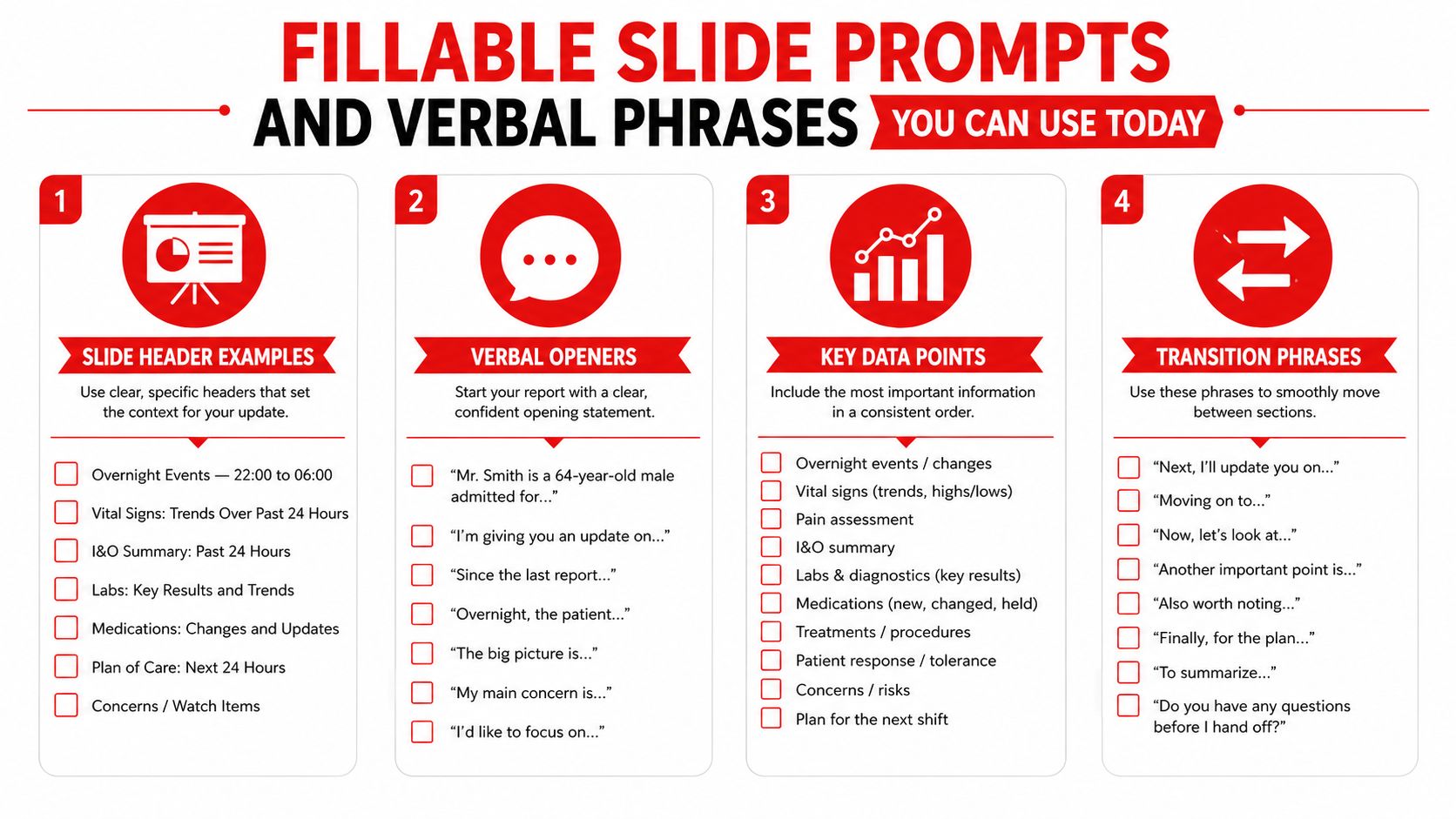
Fillable Slide Prompts and Verbal Phrases You Can Use Today
You can know the case cold and still stall at the first sentence. That is usually a problem of structure, not knowledge. A phrase bank gives you a starting point so your presentation does not wobble while you decide how to begin.
For an ICU presentation, the opening line should do one job first, then the rest can build from there. On rounds, that first job changes a little depending on who is listening. An attending wants your assessment early. A co-resident needs the facts that protect continuity. A bedside nurse needs the pieces that affect care right now. A board examiner wants clear reasoning, not a meandering story.
Copy-ready slide headers and openers
Use slide headers that label the bucket before you start talking. Short, specific headers keep the room oriented. They work like lane markers on a dark road, because the listener can tell where the story is headed before you get there.
A few examples fit real ICU rounds:
- Overnight Events, 22:00 to 06:00
- Vital Signs, Trends Over the Past 24 Hours
- Lines, Tubes, and Drains
- Assessment and Plan, Cardiovascular
- Assessment and Plan, Respiratory
Then pair them with openers that put the case in motion:
- Mr. Smith is a 64-year-old man admitted for septic shock, now intubated and on norepinephrine.
- She was stable after admission, but overnight developed increasing oxygen needs and required a vent change.
- He remains in the ICU for pressor support and close respiratory monitoring.
That first sentence should answer the question people are already asking in their heads. If the case is surgical, say so. If the patient is post-op, name the operation and where they are in the course. An attending can then focus on your judgment sooner, and the rest of the team can follow the frame you set.
Phrases that keep you moving
Transition phrases matter because they stop you from freezing between systems. Use short bridges that point the listener to the next part of the story.
- Moving to cardiovascular, his MAP has trended up overnight.
- From a respiratory standpoint, he remains ventilator dependent.
- Renally, urine output has improved, but creatinine is still high.
- Neurologically, he is more awake and following simple commands.
- For infection, the current antibiotic plan is still active pending cultures.
Those lines work because they sound like clinical thinking, not a memorized script. They also reduce the mental load of talking, answering interruptions, and checking the chart at the same time. A separate guide on presenting research findings uses the same discipline of leading with the point, then supporting it.
Useful habit: Say the transition out loud while you are writing the note. If it sounds awkward on paper, it will sound awkward at the bedside.
The phrase bank should steady you, not make you robotic. Once the opener, the transitions, and the closing line are ready, you can focus more on the patient and less on inventing a script from scratch every morning.
Adapting Your Presentation for Different Audiences
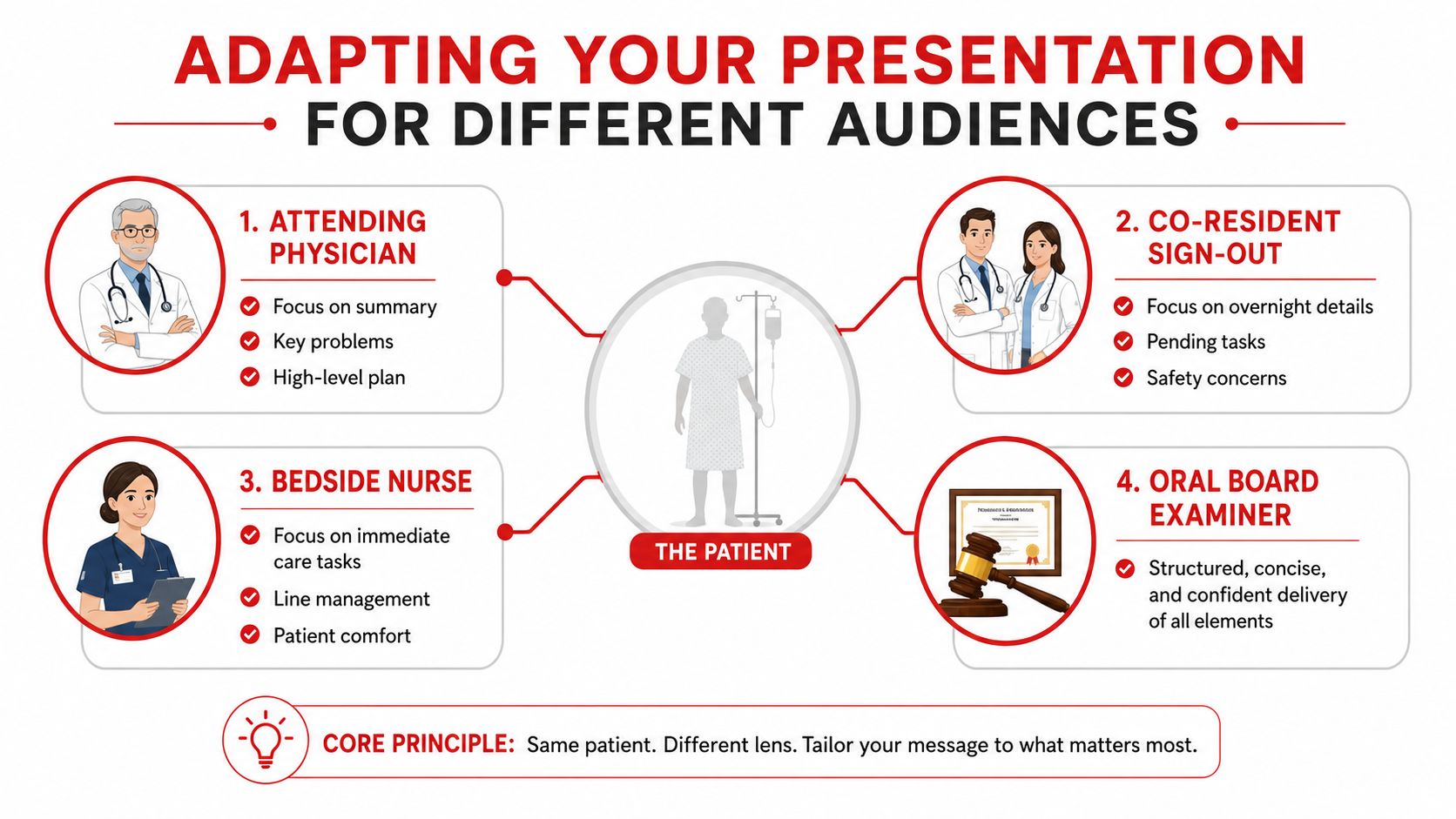
The same ICU patient should not sound identical to every listener. The facts stay fixed, but the order and emphasis should change depending on whether you are speaking to an attending, a co-resident, a bedside nurse, or an oral board examiner. That flexibility is what makes a presentation sound thoughtful instead of generic.
What each audience wants first
An attending physician wants your assessment and plan early. They are listening for your judgment, the active problem list, and whether your plan fits the physiology. If the main issue is still pressor dependence, you do not need to spend time reciting every normal lab value.
A co-resident covering the patient needs the facts that keep care moving safely. Overnight events, pending labs, follow-up imaging, and any safety concerns belong near the top. The goal is practical continuity, because the next person may be the one answering the overnight call.
A bedside nurse needs information they can act on during the shift. Line status, medication changes, vent settings, pain control, sedation targets, and anything that affects turning, suctioning, mobility, or comfort matter more here than a full narrative. Clarity helps the whole room work from the same plan.
An oral board examiner wants structure and reasoning. The case needs to sound complete and disciplined, with no wandering and no hidden assumptions. When the differential matters, state it clearly and keep the reasoning tied to the facts.
Same case, different emphasis
Take one post-op ICU patient on norepinephrine and mechanical ventilation. To the attending, lead with the active hemodynamic problem and your best explanation for it. To the nurse, start with the current support, which lines are in place, and what may change during the shift. To the co-resident, keep the overnight sequence tight so they can continue care without digging through the chart.
The board examiner is different again. They do not want a chatty update. They want a clean, orderly presentation that shows you can prioritize, summarize, and reason under pressure. The template stays the same, but the lens changes with the audience. That is the point. You are not rebuilding the patient from scratch, you are selecting the right level of detail for the person in front of you.
The best presenters do not switch formats. They switch emphasis.
That flexibility keeps the bedside team aligned. When people hear the same facts framed for their job, they can act with less confusion and fewer follow-up questions. For another example of staying composed under pressure, see performing under pressure.
Common Presentation Mistakes and How to Fix Them
An ICU presentation often goes off track for the same few reasons. That is good news, because each mistake has a clear correction. Once you catch the habit while you are speaking, you can correct it before the attending has to stop you.
The most common traps
One common trap is reading every normal lab value. It sounds careful, but it hides the actual problem. Give the abnormal findings and the changes that matter, then move on.
Another trap is burying the lead. If the patient had worsening hypotension overnight or needed more respiratory support, say that first. The room should know the main issue before you walk through the rest of the chart.
A third trap is skipping the overnight narrative. Without a timeline, the presentation becomes a list, and the team loses the reason the patient changed. In ICU care, the sequence often explains the physiology better than a stack of isolated numbers.
The fourth trap is failing to state the current ICU support. If the patient is still on pressors, still ventilator dependent, or still needing frequent monitoring, say it plainly. That final line tells the team why the ICU bed is still justified.
A small self-check helps here, especially if you want to sound steady when the room is tense. The same calm, organized mindset matters in performance under pressure.
Flawed version versus corrected version
Here's the difference in practice:
Flawed: “Potassium 4.1, sodium 138, creatinine 1.2, hemoglobin 9.8, platelets 180, glucose 112.”
Better: “Labs are largely stable, with the main changes being persistent anemia and improving renal function.”
Flawed: “He had some events overnight.”
Better: “Overnight he became more hypotensive, so the team increased norepinephrine and gave additional fluid.”
Flawed: “His lungs look okay.”
Better: “He remains on the ventilator, and we have not yet reached a point where spontaneous breathing looks safe.”
Flawed: “Everything else is fine.”
Better: “He still requires ICU-level pressor support, and that is the main reason he remains in the unit.”
The corrected version still gives the facts, but it turns them into a clinical argument. That is what earns respect at the bedside. It shows you are not just reporting data, you are interpreting it.
Your Pre-Rounds Checklist and Exam-Day Strategy
A strong ICU presentation starts before you enter the room. Skim the chart, write the one-line reason for ICU care, note overnight changes, review vital-sign trends, confirm lines and tubes, and decide what your assessment and plan will be. If you cannot state the patient's ICU-level support in one sentence, you are not ready to present yet.
That preparation also helps you adjust the same template for different listeners. Attendings want a clean clinical argument, co-residents want the case to move efficiently, nurses need the current support and pending tasks, and board examiners want a clear, organized differential with next steps. The template stays the same, but the emphasis shifts. For example, if you are reviewing gas exchange or ventilator status, a quick arterial blood gas interpretation guide can help you frame the numbers before you speak.
On exam day, use the same structure. Start with the one-line opener, give the overnight story, then move system by system with a clear conclusion. If you are practicing for oral exams or shelf-style case write-ups, rehearse out loud until the transitions feel natural. A slow, organized five-minute presentation usually earns more confidence than a fast one that sounds scattered. The point is to sound like you understand the case, not like you are discovering it as you talk.
Pre-rounds check: What changed, why it changed, what support is still needed, and what needs follow-up today?
Keep that question on your clipboard. If you can answer it before rounds, your presentation sounds like you already understand the case. That habit turns an ICU template into muscle memory, and it keeps you steady whether you are speaking to the attending, the bedside nurse, or an examiner who is listening for your reasoning.