
Does a stronger second-pass percentage show better reasoning, or just better memory for the questions? Doing UWorld twice is worthwhile when the repeat pass repairs identifiable gaps through spaced retrieval. A full repeat suits broad weaknesses and enough remaining study time; incorrects and guessed items suit a shorter runway; fresh questions suit learners who retain explanations but need to test transfer.
The decision shouldn't depend on a completion percentage. It should depend on what the learner still gets wrong, how much familiar answers influence performance, and whether improvement appears on questions not previously seen.
Which Second-Pass Option Fits Your Situation
Choose the smallest review plan that addresses the demonstrated weakness. Repeating the entire bank isn't automatically more thorough than a selective pass, especially when familiar, well-understood items consume time needed for unresolved concepts.
The relevant audience is learners preparing for the United States Medical Licensing Examination (USMLE), including Step 1 and Step 2 Clinical Knowledge (CK). The choice concerns question-bank learning, not eligibility or a prediction of an examination result.
Second-pass options compared
| Option | Best when | Main gain | Main risk |
|---|---|---|---|
| Full second pass through the bank | Several weeks remain and first-pass errors are spread across many systems | Spaced retrieval across the whole bank and reinforcement of first-pass explanations | Recall contamination inflates the repeat percentage |
| Incorrect and guessed items only | Time is short and errors cluster in identifiable topics | Corrections prioritize demonstrated weaknesses | Correct-but-unstable items go unchecked and false fluency can hide |
| Fresh or unused questions | First-pass explanations are well retained and the goal is transfer to new vignettes | A cleaner estimate of unseen performance | Less efficient when basic content gaps remain and the unseen pool is limited |
| Mixed plan with incorrects and a fresh block | Time is moderate and the error profile is mixed | Corrections plus an independent check in the same cycle | Separate pools require additional record-keeping |
A full repeat should have a defensible purpose beyond finishing again. Broad gaps, weak delayed retention, and enough time for explanation review support that choice. When weaknesses cluster, selective correction leaves more room to investigate the underlying content.
Fresh questions serve a different purpose. They test whether the learner can apply a principle without remembering the original stem, answer position, or explanation. A mixed plan is the practical middle option when both remediation and independent checking remain necessary.
Keep learning plans separate from exam rules
Step-specific score expectations and administrative requirements belong in official guidance, not in a question-bank percentage. Current reporting status, eligibility, scheduling, and score-reporting policies should be confirmed through the eligibility and score-reporting pages on the official USMLE website before examination decisions.
The USMLE study-planning tips can support the broader schedule, but the governing rule remains narrower:
Decision rule: Whichever review option fits the audit, unfamiliar questions must corroborate the result before repeat performance is trusted.
Why Repeat Scores Overstate Readiness
A repeat block can look strong even when the learner can't explain why the selected answer is correct. Recognizing a distinctive stem or remembering the answer location may produce a correct response without reconstructing the reasoning.
That is recall contamination: prior exposure influences a result intended to measure independent problem-solving. A qualitative study of medical students' question-bank use describes how repeated exposure can encourage familiarity with the item rather than understanding of the underlying reasoning.
The distinction matters because remembering an answer is useful during learning but insufficient evidence of transfer. A learner can retain the explanation's conclusion while losing the chain of reasoning that supports it.
Signals that recognition is doing the work
| Signal during a repeat block | Check that challenges it |
|---|---|
| The answer appears familiar before the stem is fully read | State the diagnosis or tested principle before examining the choices |
| The correct option is recognizable, but the decisive clue isn't | Identify the finding that changes the decision |
| Distractors seem wrong only because the correct answer is remembered | Explain when each plausible distractor would fit |
| The explanation feels obvious immediately after opening it | Write the rationale before viewing it |
| Familiar items improve while unfamiliar items remain difficult | Compare performance within the same systems and task types |
Repeated-exposure research illustrates why caution is warranted. In an analysis of 1,629 questions across four uses, mean item difficulty, expressed as the proportion answering correctly, rose from 79.8% to 85.2%, while discrimination declined from 0.17 to 0.14, as described in the medical-education discussion of question-bank use and repeated item exposure. Those findings don't establish a UWorld-specific effect, but they show why easier-feeling familiar questions aren't sufficient evidence of broader mastery.
A cold re-answer check
For a sample of previously correct items, the learner should conceal the choices where practical and write the diagnosis or principle, decisive clue, and supporting rationale. Each item can then receive an audit label: recalled, reasoned, or uncertain.
These labels create an observable record, not a validated scoring instrument. A substantial gap between cold reasoning and ordinary repeat accuracy should lead the learner to treat the repeat result as inflated, without inventing a numerical correction factor.
The guide to metacognitive awareness offers related context for distinguishing confidence from demonstrated understanding. A high repeat score alone doesn't justify skipping fresh questions.
Audit Your Gaps Before Picking an Option
The audit is a collection of existing study evidence, not another examination the learner must pass. Its purpose is to identify which activity deserves the next available study session.
A useful record includes both incorrect answers and correct answers reached through guessing. Accuracy alone can conceal unstable knowledge, while an error log without system-level context can make isolated misses appear more representative than they are.

Gap audit measures to pull before choosing
| Measure | Where to find it | What it decides |
|---|---|---|
| First-pass accuracy by system | Performance report in the question bank | Whether gaps cluster in a few systems or spread widely |
| Error category counts | Personal error log | Whether to fix content, reasoning, or test-taking behavior |
| Guessed and low-confidence correct items | Self-flags made during the first pass | Which weaknesses accuracy alone doesn't show |
| Timed versus untimed accuracy | Timed block records | Whether speed or knowledge needs closer investigation |
| Days remaining before the test | Registered test date, confirmed on the official scheduling record | Whether a full repeat fits the actual window |
| Explanation retention after a delay | A cold re-answer of earlier items after several days | Whether repeat exposure still produces learning |
| Performance on unseen questions | A fresh block or an unused NBME self-assessment | An independent comparison with repeat results |
NBME refers to the National Board of Medical Examiners. An unused self-assessment can serve as a separate checkpoint in this framework, whereas a previously reviewed form is no longer an unseen comparison.
Read the pattern rather than chasing a cutoff
There's no universal threshold in this framework for first-pass accuracy, guessed items, or the size of a concerning repeat-to-fresh gap. The learner should compare systems against one another and review whether the same weaknesses persist across different question sets.
A clustered pattern means the weakest systems account for much of the unresolved work. A broad pattern means knowledge or reasoning difficulties appear across much of the bank. These patterns support different allocations of time, even when overall accuracy looks similar.
Timed and untimed results also need context. Differences between unmatched blocks can reflect content differences, so they shouldn't automatically be labeled a pacing problem. Repeated observations under comparable conditions are more informative.
- Calendar reality: Available time should include explanation review, content repair, and independent assessments, not just question completion.
- Missing records: When confidence flags weren't recorded initially, current cold checks can begin filling that gap.
- Tracking simplicity: The progress-tracking dashboard guide can help organize findings without turning the audit into a second study project.
Decision Tree for Choosing Your Next Step
The audit should lead to a concrete next action rather than a permanent commitment to a resource. Each branch below uses observable study evidence and can be revisited when new results arrive.
This is an editorial decision framework, not a validated score-prediction tool. Its branches guide study allocation; none guarantees an examination outcome.
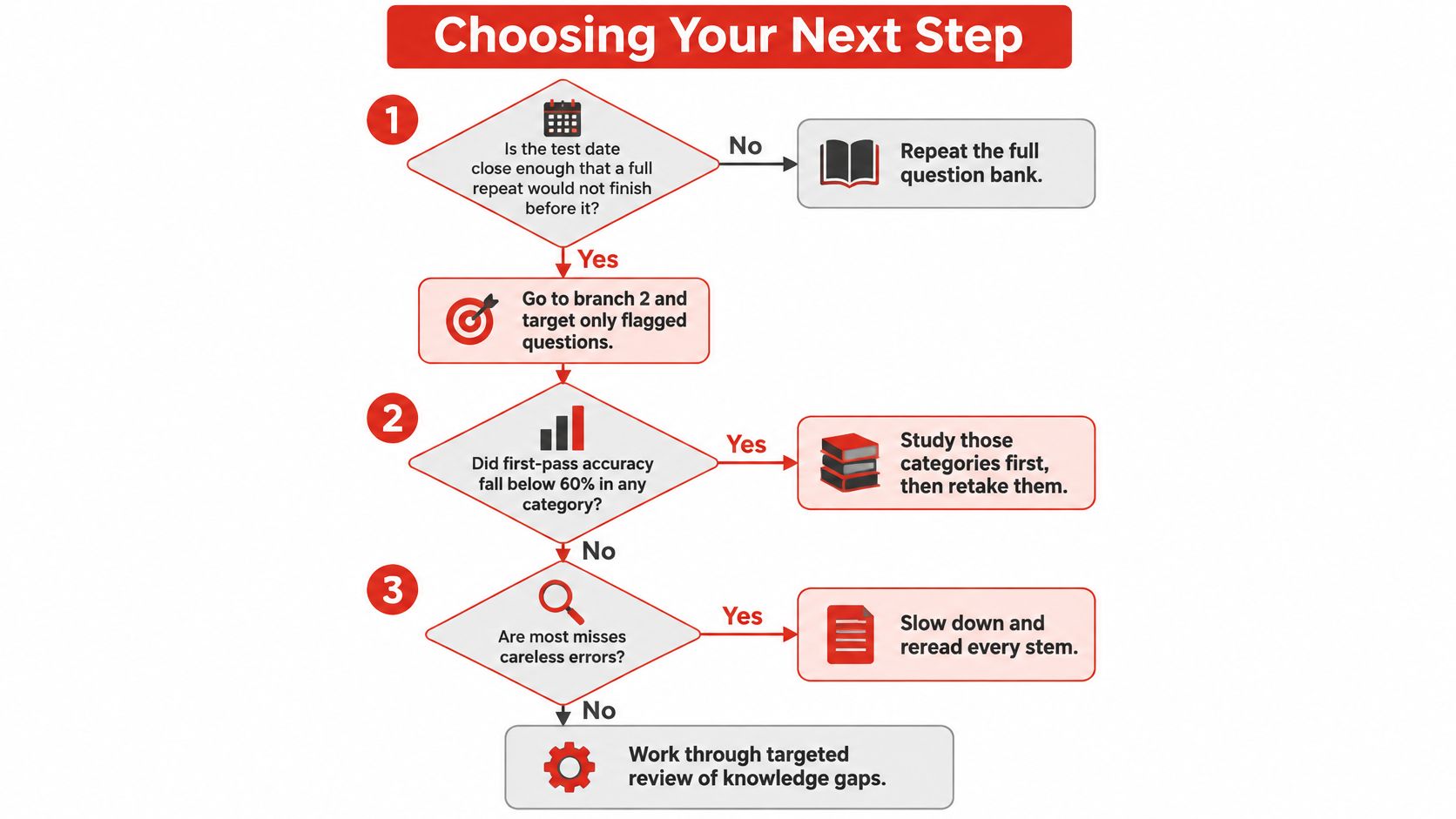
Follow the written branches
Would a full repeat exceed the remaining study window?
If yes, proceed to the clustered-gap question below. If no, consider whether weaknesses are broad and explanation retention is weak. Finishing questions without enough time to review them doesn't constitute a useful full pass.Do incorrect and guessed items cluster in identifiable systems?
If yes, prioritize those items, add fresh questions from the same systems, and use a separate content resource for unresolved principles. If no, choose a mixed plan that combines selected corrections with unfamiliar questions across systems.Are first-pass weaknesses widespread, with poor explanation retention?
If yes, a full second pass with written rationales and spaced exposure is reasonable. If no, inspect the cold re-answer comparison rather than assuming that available time must be filled with repetition.Does cold re-answer performance fall substantially below the ordinary repeat result?
If yes, stop treating familiar-item accuracy as the main progress measure and shift toward fresh questions. If no, compare repeat and fresh results within matching systems.Do fresh-question results support the same pattern of understanding?
If yes, proceed to independent readiness checks. If no, return to the audit and repair the particular weakness exposed by the unfamiliar material.
Use the visual as an overview, not a threshold
The graphic below is a simplified study-planning illustration. Any fixed category cutoff or automatic full-repeat recommendation shown in it should not override the individualized written branches above; this framework establishes neither.
Hypothetical application
Illustration only, not a real student or an outcome prediction: A learner's calendar leaves room for targeted corrections and independent checking, but not a full repeat with careful review. The audit shows concentrated weaknesses, while other systems remain comparatively stable.
The learner schedules targeted incorrects during earlier study sessions, content repair afterward, and a fresh same-system block at a later checkpoint. Cold re-answers occupy subsequent review sessions rather than immediately following the explanations.
That learner follows the short-window, clustered-gap branch. If unfamiliar questions expose broader weaknesses, the next cycle changes to a mixed plan instead of continuing the original schedule merely for consistency.
Execute the Second Pass and Avoid Its Pitfalls
A second pass only counts if it separates memory from reasoning. Treat every familiar answer as possibly contaminated by recall, then make the item prove it still deserves credit.
The observational study of self-directed retrieval practice and licensing-exam performance supports a narrower point: students who used retrieval-heavy practice tended to perform better. It cannot show that repeating an identical bank caused the gain, so use it as support for active recall rather than as a reason to trust repeat percentages.
A repeat workflow that requires reasoning
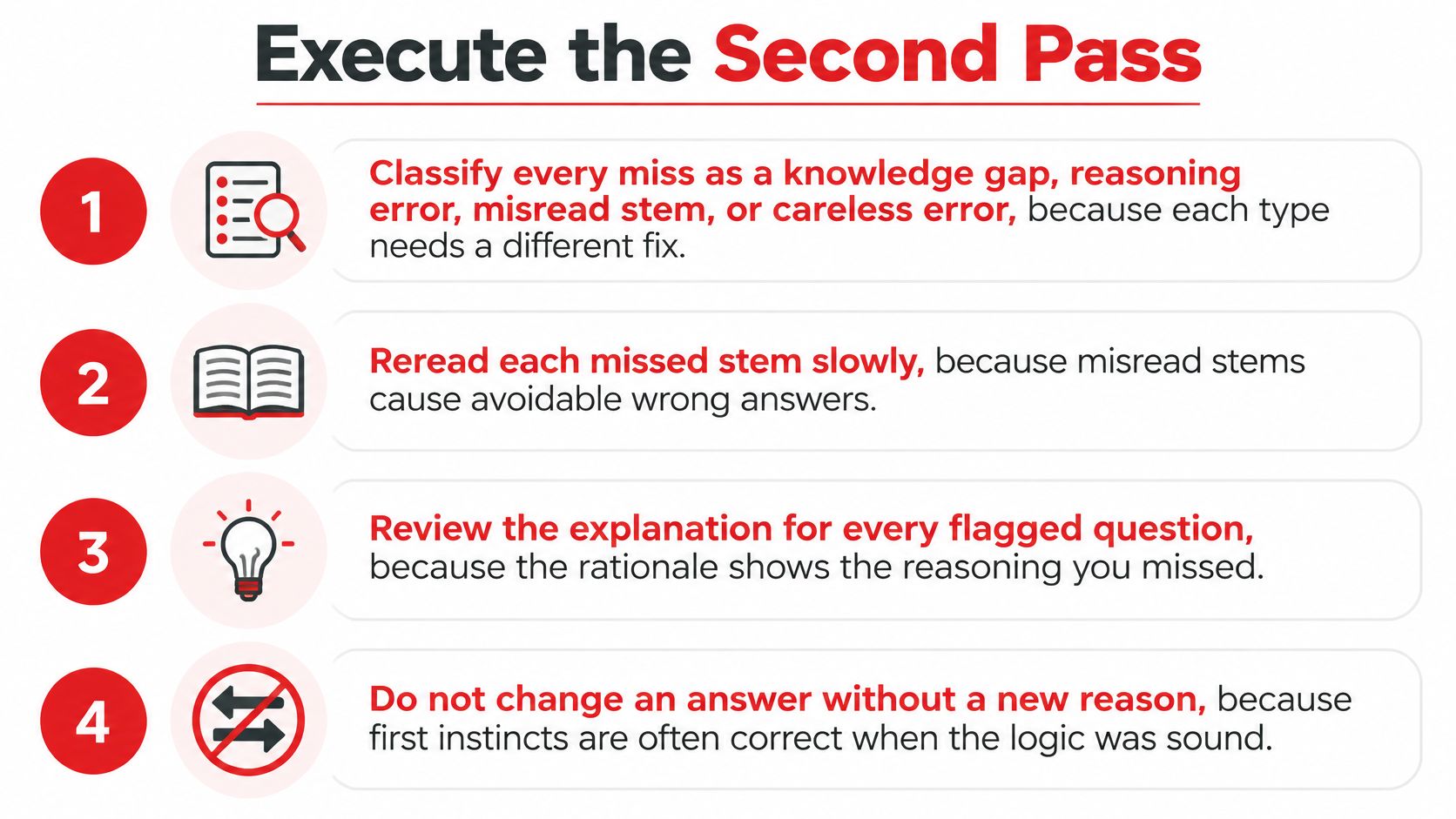
Classify each miss during the first pass as a knowledge gap, reasoning error, misread stem, or careless execution, because each category requires a different correction. The recorded corrective concept should be brief enough to use later.
Maintain a question-level log containing the item identifier, error category, tested concept, first-exposure date, and repeat label: recalled, reasoned, or uncertain. That label turns recall contamination into something measurable instead of letting a high repeat score hide it.
Schedule another attempt after several days to two weeks, then consider a longer interval after successful independent reasoning. An item that remains unstable needs content repair and a manageable recheck, not an automatically longer delay.
Before opening the explanation, answer cold and write why the selected answer fits and plausible distractors fail. This makes the reasoning available for inspection instead of allowing the explanation to supply it retrospectively.
Use two independently reasoned correct attempts separated by time as a proposed working mastery rule, not a validated readiness threshold. Consecutive recognition of an answer doesn't satisfy that rule.
Include guessed-correct items in repeat blocks, because an incorrect-only pool can overlook false fluency. The purpose is to test whether earlier confidence was justified while leaving comfortable items out.
Spacing evidence extends beyond one question bank. The review of retrieval practice and spaced repetition supports the general claim that distributing retrieval is associated with better retention across varied formats; read that as support for spacing, not as a promised UWorld score gain.
The following visual offers a compact review reminder. Written reasoning should remain the basis for keeping or changing an answer, rather than a blanket preference for the first instinct.
Second-pass pitfalls, warning signs and fixes
| Pitfall | Early warning sign | Fix |
|---|---|---|
| Counting question volume as progress | Question count rises while unseen accuracy stays flat | Review unseen accuracy and error categories regularly |
| Rereading explanations on repeat exposure | Correct answers come without a stated rationale | Write the rationale before viewing the explanation |
| Repeating everything in one sitting | Items feel familiar within the same session | Space repeats across days to weeks |
| Ignoring correct-but-guessed items | Repeat scores look stable while unfamiliar results lag | Include guessed-correct items in repeat blocks |
| Skipping fresh questions | Scores rise only on previously seen items | Complete an unseen block before choosing another pass |
| Using repeat percentage as the only readiness measure | Repeat performance substantially exceeds fresh performance | Compare results within matching systems |
The guide to reviewing UWorld questions faster provides related workflow guidance. Efficiency should mean less redundant note-taking, not less independent reasoning.
When timed unseen performance, error patterns, and delayed retention don't improve, more explanation rereading isn't the next intervention. The unresolved content or decision-making problem needs direct attention.
Confirm Your Choice With Unseen Questions and Next Steps
A study plan earns continuation through evidence, not through the effort already invested in it. After a review cycle, the learner should compare current findings with the previous checkpoint and decide whether to continue, narrow, or change the approach.
Repeated and unseen results should remain separately labeled. Combining them into a single running percentage removes the distinction the audit was designed to preserve.
Check whether the intervention addressed the problem
| Checkpoint | Record | Decision supported |
|---|---|---|
| After a repeat block | Recalled, reasoned, and uncertain classifications | Whether familiar items still offer useful retrieval practice |
| After a fresh block | Accuracy, system, task, and error categories | Whether the correction transfers |
| During delayed review | Cold rationale and explanation retention | Whether understanding persists |
| Before changing the plan | Current findings beside the prior checkpoint | Whether to continue, narrow, or switch activities |
A targeted content intervention should reduce the same knowledge error on unfamiliar material. A pacing intervention should improve execution under timed conditions without replacing careful reading with rushed selection. If the relevant error persists, the learner needs a different correction rather than another identical cycle.
The USMLE practice-test planning guide can support independent checkpoints. Results from different tools shouldn't be treated as interchangeable percentages, and self-assessment interpretation should follow the relevant official materials.
Key Takeaways
- A repeat percentage is a process signal, not an independent readiness score.
- The review choice follows the audit, including time, gap distribution, retention, and recall contamination.
- Unseen questions must corroborate improvement before familiar-item results inform readiness decisions.
For Step 1 learners establishing the underlying workflow, the UWorld for USMLE Step 1 guide provides related question-bank guidance. Learners considering additional support can also review the individualized USMLE tutoring service; independent study and official assessment materials remain central with or without tutoring.
A concrete next action
During the next study week, the learner can assemble the audit, choose the matching branch, and reserve unused questions for the next comparison. That is a more informative commitment than deciding in advance to finish the bank again.
Editorial safeguard: Step-specific reporting status, eligibility, fees, and scheduling require current official confirmation and qualified review before publication or reliance. No examination-rule verification date is asserted in this article.
Sources and Editorial Review
Byline: Ace Med Boards Editorial Team
USMLE policy information in this article was checked against the official USMLE website at publication; eligibility, scheduling, fees, and score-reporting rules can change, so confirm them on the current USMLE pages before relying on them. This material covers examination preparation only and does not address patient care, diagnosis, or treatment.
The evidence cited in the body can be matched to claims as follows:
- USMLE official website: current policy language and navigation for eligibility, scheduling, and score reporting.
- Observational study on preparation practices and licensing-exam performance: supports the claim that study behaviors correlate with outcomes, not that one behavior causes a score.
- Qualitative study on repeated question-bank use: supports the points about familiarity, recognition, and learning strategy.
- Repeated-item discussion: supports the concern that repeated exposure changes item difficulty and discrimination.
- Retrieval-practice and spacing review: supports the claims about practice testing and distributed review across educational formats.
These sources differ in design. Observational associations and qualitative findings do not establish causation, and none proves a UWorld-specific score outcome from completing the bank twice.
Ace Med Boards offers personalized USMLE tutoring that can complement question-bank study and independent assessments. Learners seeking help interpreting an error audit or choosing between targeted repeats and fresh questions can visit Ace Med Boards to request a free consultation and discuss the study evidence with a tutor.