You're comparing medical school applications, but the letters after a physician's name can make the choice feel more consequential than it is. The short answer is that MD and DO graduates are fully licensed physicians, and both can enter the same Accreditation Council for Graduate Medical Education (ACGME) residency system and pursue every medical specialty. The meaningful differences are accreditation, curriculum, osteopathic manipulative medicine, examination pathways, school resources, and individual fit.
A rational choice starts with school-level evidence rather than stereotypes. The DO pathway has become a substantial part of U.S. medical education, with more than 39,200 osteopathic medical students enrolled in the 2024–25 academic year, according to AACOM's osteopathic medicine quick facts. The right question isn't whether one degree is universally superior. It's whether a particular school, curriculum, location, and residency environment match the physician you're preparing to become.
Introduction to Medical Degree Pathways
A premedical applicant choosing between MD and DO programs is also choosing how to train, test, and compete for residency. The relevant questions are practical: Does the curriculum fit the student's learning style? Will osteopathic training be useful in daily practice? Which licensing exams will be required? Does the school offer clinical sites, research access, advising, and residency support aligned with the student's goals?
Both pathways cover biomedical science, clinical medicine, diagnosis, treatment, and patient care. MD programs are accredited by the Liaison Committee on Medical Education, or LCME. DO programs are accredited by the Commission on Osteopathic College Accreditation, or COCA. DO programs also teach osteopathic principles and osteopathic manipulative medicine, commonly abbreviated OMM.
The historical distinction remains relevant, although it does not define two separate physician professions. Andrew Taylor Still developed osteopathic medicine in 1874, and the first osteopathic medical school opened in Kirksville, Missouri, in 1892, according to AACOM's historical and statistical overview. Contemporary training outcomes have converged substantially, while DO programs retain a distinct osteopathic component.
Practical rule: Compare the school you would attend, not only the degree label you would earn.
The AACOM pathway overview places undergraduate preparation, medical school, licensing examinations, residency, and licensure in sequence. That sequence clarifies why the degree affects preparation and application strategy without creating separate physician professions.
A sound comparison uses institutional and personal evidence. Review accreditation, curriculum design, clinical rotations, advising, research opportunities, and location. Then assess comfort with OMM, preferred learning environment, specialty interests, finances, and willingness to follow the associated examination route. Residency selection adds another practical variable: applicants should evaluate school-specific advising, clinical networks, and match preparation rather than assume the degree alone determines specialty access.
MD and DO Decision Matrix
The most useful comparison is concrete. The table below separates verified structural differences from areas that depend on the individual school.
MD vs DO Decision Matrix
| Feature | MD, allopathic | DO, osteopathic |
|---|---|---|
| Degree | Doctor of Medicine | Doctor of Osteopathic Medicine |
| Accreditation | Programs are accredited by the LCME, the responsible accreditor for U.S. allopathic medical education. | Programs are accredited by COCA, the responsible accreditor for U.S. osteopathic medical education. |
| Foundational curriculum | Biomedical sciences, clinical sciences, diagnosis, treatment, and supervised patient care. | The same broad medical foundation, with additional osteopathic principles and related instruction. |
| Osteopathic manipulative medicine | OMM isn't a defining curricular requirement of the MD pathway. | OMM is a distinct curricular component. Cleveland Clinic describes DO programs as including about 200 hours of OMM instruction in its MD versus DO comparison. |
| Licensing examinations | The standard pathway uses the United States Medical Licensing Examination, or USMLE. | The standard pathway uses COMLEX-USA, administered by the National Board of Osteopathic Medical Examiners, or NBOME. DO students may also take USMLE examinations. |
| Clinical training | Clinical education occurs through the school's affiliated hospitals, clinics, and rotation network. | Clinical education also depends heavily on the school's affiliated sites, regional network, and student placement system. |
| Residency system | Graduates apply through the single ACGME-accredited residency system. | Graduates apply through the same ACGME-accredited residency system. |
| Residency support | Advising, research mentorship, letters, away-rotation guidance, and specialty preparation vary by school. | The same support categories matter, with additional attention to COMLEX planning and, for some applicants, USMLE strategy. |
| Cost | Tuition and living costs vary by institution, residency status, financial aid, and location. Compare official school disclosures rather than assuming one degree costs less. | The same variables apply. A nearby school with stronger clinical access may be financially preferable to a lower-tuition option with greater relocation costs. |
| Geography | School location influences clinical networks, regional mentorship, and residency relationships. | School location has the same influence, and some DO programs maintain particularly regional clinical structures. |
| Personal fit | May suit students who prefer an allopathic curriculum without a required OMM component. | May suit students who value osteopathic principles and are willing to learn hands-on OMM alongside conventional medical training. |
The table shows why “MD versus DO” isn't a simple ranking exercise. Accreditation and exam routes differ, but residency access is unified. Clinical experience and residency support are school-specific variables, not automatic consequences of the degree title.
DO students should examine how much OMM is taught, how it's assessed, where clinical rotations occur, and how the school supports students pursuing specialties with historically stronger degree-based barriers. MD applicants should ask comparable questions about clerkship quality, specialty advising, research access, and geographic reach. The osteopathic medicine guide provides additional context for the DO curriculum without treating it as a shortcut or a lesser version of medical education.
Navigating Licensing Exams
The examination distinction is one of the clearest operational differences between the pathways. MD students generally prepare for USMLE examinations, while DO students prepare for COMLEX-USA. The National Board of Osteopathic Medical Examiners describes COMLEX-USA as the osteopathic licensing examination series, and the USMLE program provides the official framework for the United States Medical Licensing Examination.
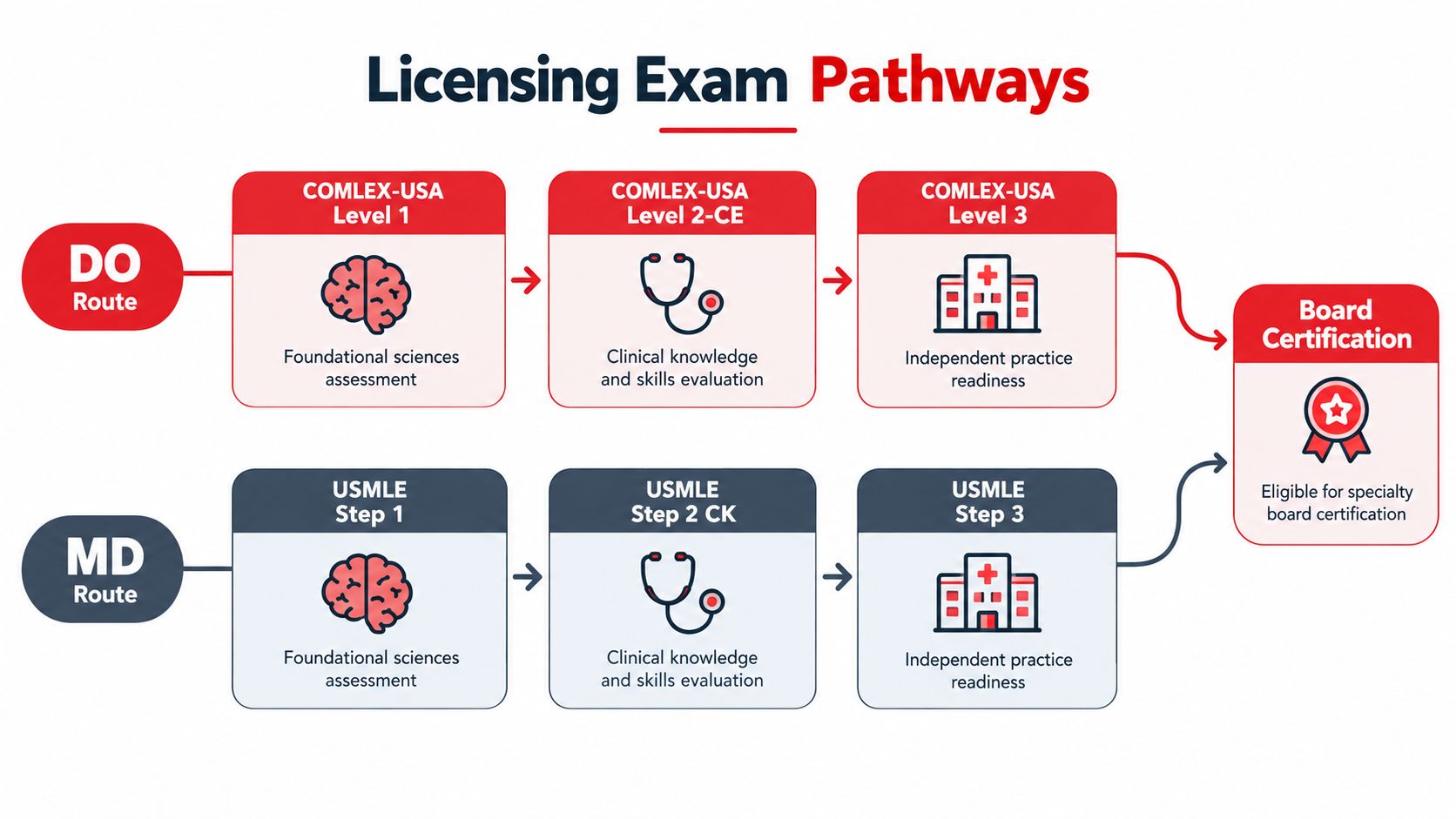
The DO route includes COMLEX-USA. Some DO students also take USMLE examinations, especially when their intended residency programs historically rely heavily on USMLE results or when program directors commonly use that examination in application screening. That decision should be based on a specific residency strategy, available preparation time, school policy, and performance readiness, not on the assumption that every DO applicant must take both series.
A student choosing between exam routes should ask four questions:
- Requirement: Which examinations does the medical school require, and which does it recommend?
- Residency relevance: Do the programs and specialties on your target list state preferences about USMLE, COMLEX-USA, or accepted score reporting?
- Preparation capacity: Can you prepare for an additional examination without weakening performance on the required sequence?
- Evidence: Have you reviewed current program guidance rather than relying on forum anecdotes or outdated advice?
The two examination systems aren't interchangeable in preparation. COMLEX-USA includes osteopathic content, while USMLE preparation follows its own blueprint and reporting structure. A DO student who plans to take both should create a coordinated schedule, use official examination information, and avoid duplicating every study task without a clear purpose.
A second exam is a strategic choice, not a badge of commitment. It makes sense only when its expected application value justifies the preparation burden for that applicant.
The COMLEX-USA preparation resource can sit alongside official NBOME materials and a student's school advising. Neither a tutoring service nor a commercial resource replaces the examination sponsor's current rules, eligibility information, or preparation guidance. Exam policies can change, so students should verify current requirements before registering.
Residency Match Rates and Competitiveness
The national residency picture is less polarized than many applicants expect. In the 2026 National Resident Matching Program, or NRMP, Main Residency Match, U.S. MD seniors had a 93.5% PGY-1 match rate across 20,934 active applicants, while U.S. DO seniors had a 93.2% rate across 8,503 active applicants, according to the NRMP results and data report. PGY-1 means the first postgraduate year of residency.
The difference in match rate was small nationally, but the applicant pools were not the same size, and national averages conceal specialty-level variation. The same report describes placement rates of 98.5% for DO seniors and 97.8% for MD seniors, which reflects a broader measure than the initial PGY-1 match rate.
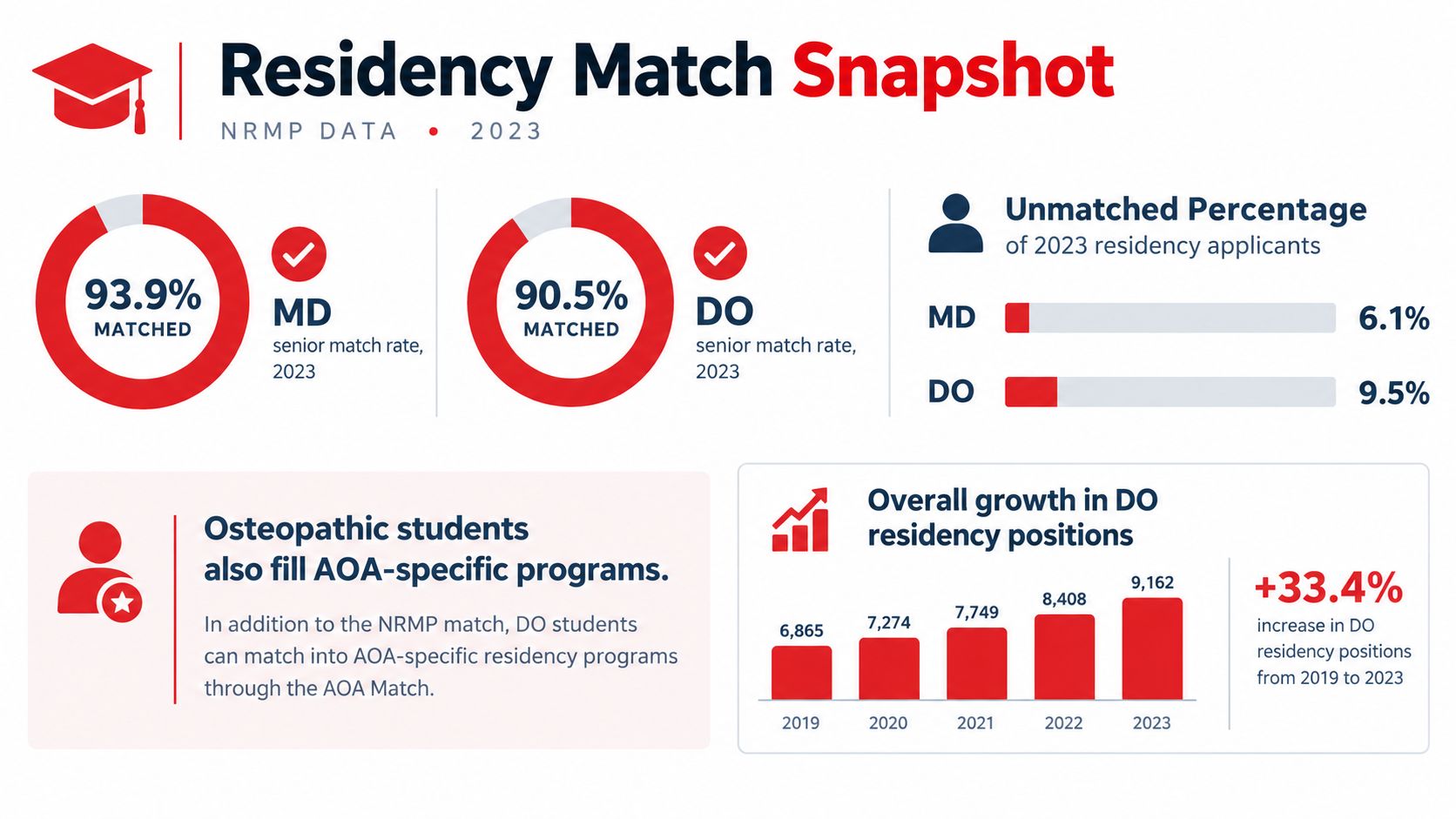
The more difficult question is whether parity holds inside every specialty. A multi-specialty analysis covering 2016 through 2024 found overall match rates of 93.85% for MD applicants and 87.75% for DO applicants across ten specialties. In selected surgical subspecialties in 2023, the summed match rate was 52.89% for DO applicants versus 73.61% for MD applicants, as reported in the peer-reviewed analysis.
Those figures shouldn't be read as proof that degree alone determines an outcome. Competitive specialties also evaluate examination performance, clinical grades, letters, research, publications, audition rotations, professional relationships, and fit. But they do show why a national average can mislead an applicant whose target field has a narrower pathway.
A residency-focused self-audit
Before applying, assess:
- Specialty pattern: Is your target field broadly accessible, or does it have persistent degree-based representation differences?
- Program type: Are you prioritizing academic centers, community programs, or a balanced list?
- Portfolio evidence: Do your clinical evaluations, letters, research, and examination record support the programs you're naming?
- Geographic strategy: Are you applying only where you already have connections, or have you built a defensible geographic range?
- Advising quality: Can your school identify realistic programs and help you address weaknesses without catastrophizing them?
The specialty match analysis is most useful when treated as a starting point for program-level research. Near-parity nationally means the old claim that DO graduates cannot match is inaccurate. Specialty-specific differences mean the opposite claim, that the degree never matters, is also too simple.
Career Outcomes and Common Myths
A student choosing between an MD and a DO may later find both credentials represented in the same hospital, specialty, or clinical team. DOs and MDs are fully licensed physicians who can diagnose and treat patients, prescribe medications, perform procedures, and enter specialties through the unified residency system. Their accrediting structures and curricular emphases differ, but the difference does not make one credential inferior.
The claim that DO education is less rigorous also needs qualification. Both pathways require substantial medical education, while DO programs add osteopathic principles and OMM. The student's experience depends on faculty, clinical sites, assessment quality, advising, and institutional resources.
What the evidence supports
- Workforce size: A 2024 physician census summary places MD physicians at 89% and DO physicians at 11% of licensed U.S. physicians, as summarized in this MD versus DO data overview. MD physicians therefore remain the larger group, while the DO pathway has expanded.
- Professional growth: AOA statistics report an increase of 158,000 DOs since tracking began in 1935, representing a 1,721% rise, in AOA's osteopathic medicine facts.
- Primary care patterns: Historical summaries associate MD and DO graduates with different specialty patterns. These are group tendencies, not fixed limits on an individual physician's career.
- Daily practice: Degree choice does not determine whether a physician listens carefully, reasons well, communicates clearly, or develops reliable clinical habits. Residency selection and later practice depend on the broader record, including examinations, clinical evaluations, letters, research, professional conduct, and specialty fit.
OMM is a hands-on component of osteopathic education, not a substitute for biomedical diagnosis or evidence-based care. Students can review what osteopathic manipulative treatment involves and compare how individual schools teach it. That comparison is more useful than assuming every DO curriculum or future practice will look identical.
Applicants should assess the professional profile they are building. Communication, documentation, teamwork, ethical judgment, quality improvement, and digital competence matter alongside grades and examinations. This list of top healthcare resume skills can help applicants identify capabilities to document without filling a résumé with unsupported adjectives.
The degree opens the door. School environment, preparation, clinical performance, relationships, and specialty strategy influence what happens next.
How to Choose the Right Path
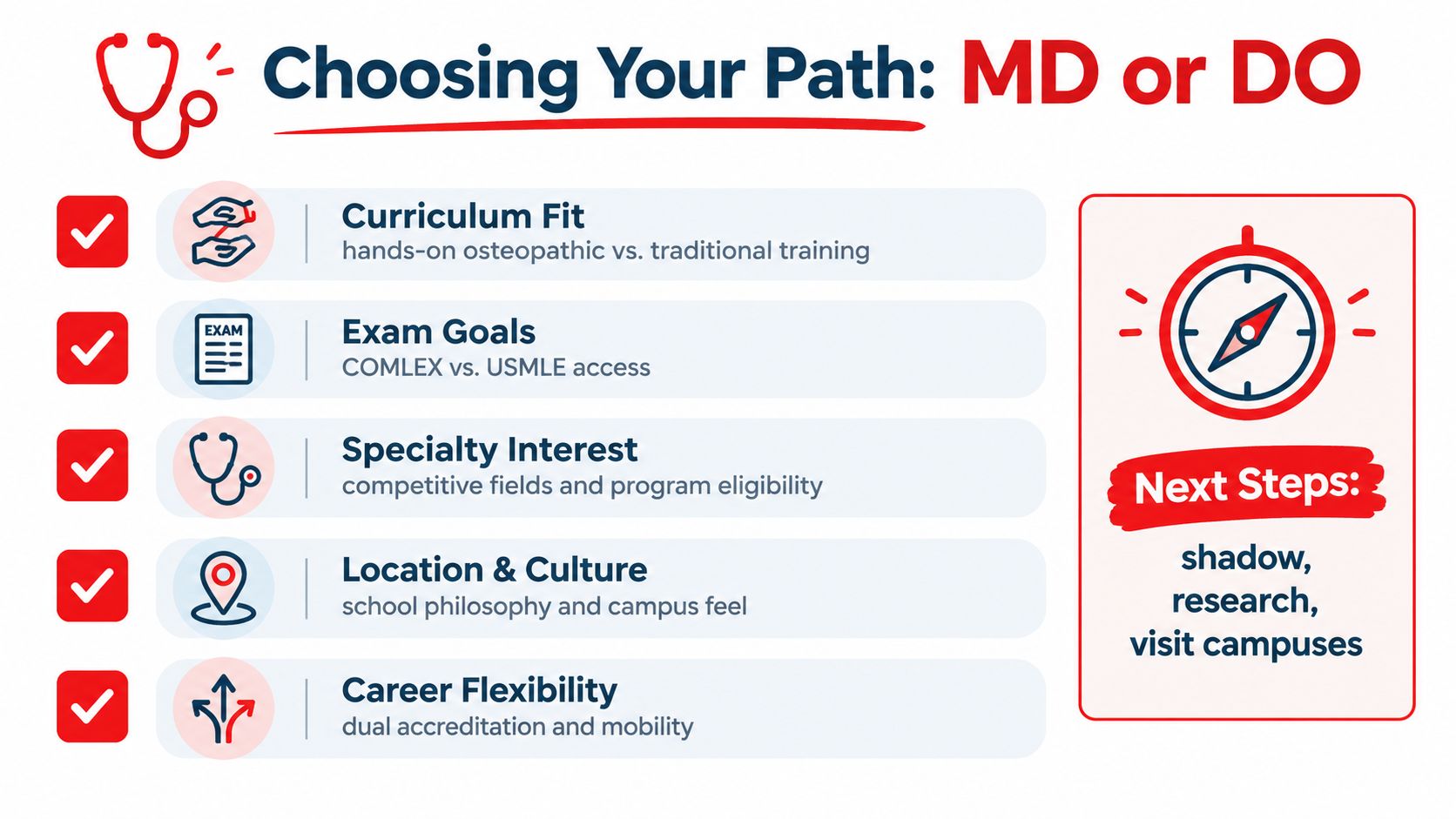
Choose the pathway by comparing actual schools against your priorities. Start with mission and fit, then test that first impression against curriculum details, clinical placement, finances, and residency goals.
A practical decision sequence
- Compare mission and learning environment. Read the curriculum map, attend an information session, and ask current students how the school delivers anatomy, clinical reasoning, feedback, and remediation.
- Examine OMM objectively. If you're considering a DO program, determine whether you're willing to learn hands-on OMM. You don't need to build your career around it, but treating it as irrelevant can create avoidable friction.
- Review school-specific outcomes and support. Ask about clinical rotation sites, specialty advising, research mentorship, residency application coaching, and the process for obtaining letters.
- Model cost and geography. Compare tuition, living expenses, relocation, transportation, and the practical value of staying near family or an established support network. Don't infer cost from the degree label.
- Map licensing examinations to residency goals. Identify the required exam sequence and investigate the expectations of programs in your intended specialty.
- Test personal fit. Consider whether you learn best in a highly structured environment, a research-intensive setting, a community-oriented program, or a curriculum with additional hands-on instruction.
A labeled composite example
A hypothetical composite applicant values whole-person care but remains undecided about OMM. Instead of assuming that one degree is easier, the applicant compares specific schools, including their costs, clinical rotation structures, research access, match advising, geographic location, and willingness to teach hands-on OMM.
The applicant then creates a simple scoring sheet, marks any unanswered question, and contacts each admissions office for current information. That method produces a more defensible decision than relying on a generalized claim about MD or DO competitiveness.
Preparing for Exams and Residency Applications
The degree decision and the preparation decision are related, but they aren't identical. An MD student may need a USMLE-focused plan. A DO student needs a COMLEX-USA plan and may need to evaluate whether USMLE preparation fits a particular residency strategy. Both students need a realistic schedule, active question review, content-gap tracking, and timely advising.
A useful preparation workflow is:
- Define the target: Write the examination, intended test window, residency specialty, and programs that require investigation.
- Audit readiness: Review practice performance, missed-question categories, study consistency, and test-taking endurance.
- Build the plan: Assign content review, question blocks, error analysis, spaced repetition, and rest to specific days.
- Review applications early: Residency applicants should identify letters, clinical experiences, research, personal narrative, and geographic strategy before deadlines compress the work.
- Escalate support selectively: Use official materials for rules and blueprints, question banks for practice, school faculty for curriculum-specific guidance, and tutoring or consulting when an individualized diagnosis is needed.
Students facing low scores, failed attempts, academic gaps, or test anxiety need an evidence-based recovery plan, not shame. A setback can change the timeline and may require honest reassessment, but it doesn't automatically end a medical career.
Ace Med Boards offers one-on-one preparation for USMLE and COMLEX-USA, along with residency application support, according to the publisher's stated services. Students should compare any tutoring option by its scope, approach, current availability, and fit with official resources rather than expecting a guaranteed score, pass, admission, or match.
If you're weighing the DO and MD pathways, visit Ace Med Boards to discuss a focused exam-preparation or residency-planning question. Bring your target specialty, current timeline, and the decision points you still need to verify so the consultation can stay practical and specific.