You miss the question, feel the sting for a second, then do what almost every student does. You check why the correct answer was correct, nod once, and move on to the next card or block. The problem is that the essential lesson was sitting in the wrong answers the whole time.
A multiple-choice question is not just a right answer plus three decoys. It is a small diagnostic tool. If you learn to read the wrong options the same way you read the stem, every missed item starts telling you something useful about your reasoning, your knowledge gaps, and the traps the next exam is likely to use.
The Mistake Almost Every Med Student Makes With Wrong Answers
The usual review habit is fast and comforting. You miss a question on nephrotic syndrome, see the correct choice, recognize the explanation, and tell yourself you “knew that.” Then you close the tab and never ask why the other choices looked tempting in the first place.
That habit leaves most of the learning on the table. A multiple-choice item is built to show you where your thinking bent, and the wrong answers are the clearest place to look. Basic item analysis has long treated distractors as part of the signal, not just filler, which is why review works better when you inspect the wrong options instead of stopping at the keyed answer. The same idea shows up in formal item analysis, where analysts often look at how options behave across groups such as the upper 27% and lower 27% to see which choices actually separate stronger from weaker test takers (BYU Assessment Basics).
You do not need psychometrics software to use the method on a Qbank. After every miss, ask what each wrong option was testing. Was it a choice that only weaker students would grab because it sounded familiar, or a trap that pulled in stronger students because the wording pointed them toward the wrong concept? That difference tells you whether the problem was missing content, reading the stem too quickly, or mistaking a tempting distractor for the best answer.
If you want a cleaner way to practice that kind of review, use a focused guide like this test-taking skills walkthrough and pair it with your missed questions. The goal is not just to confirm the right answer. The goal is to see why the wrong ones felt close enough to choose.
Practical rule: If you only review the correct answer, you learn what the test wanted. If you review the distractors, you learn what the test wanted you to confuse.
That shift turns a question block into a pattern log. Over time, you stop asking, “Why was this one right?” and start asking, “Why did I think the others were plausible?” That second question is where score improvement usually starts.
What Distractor Analysis Actually Means
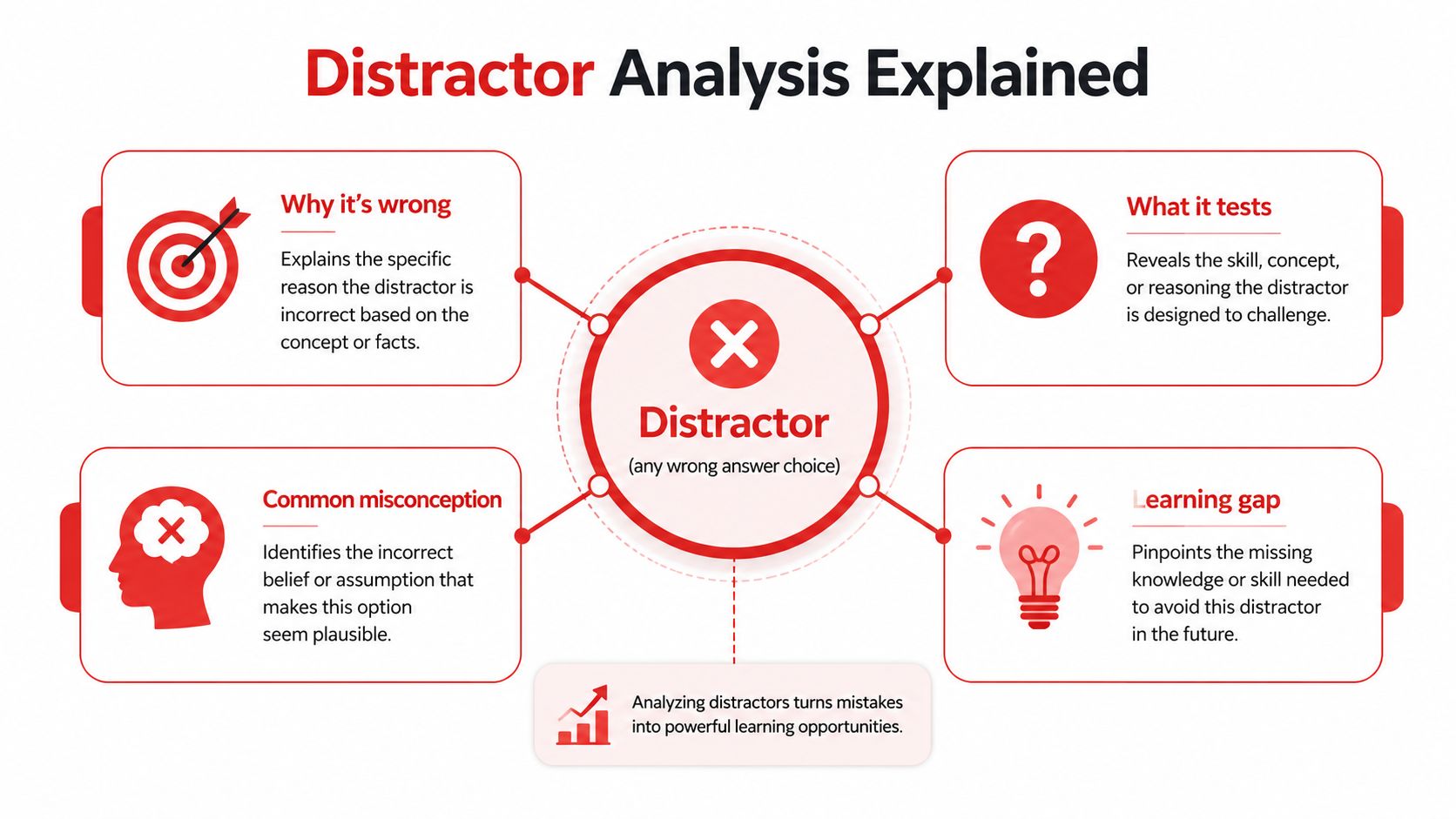
A distractor is a wrong answer choice, and distractor analysis means studying those wrong choices to see who selected them, how often they were selected, and what kind of reasoning made them tempting. In item analysis, that review sits beside difficulty and discrimination, because a question only earns its place in a Qbank if the wrong options do real work instead of sitting there as filler.
The easiest way to understand it is through what each wrong option does to the student at the screen. A functional distractor draws in the students who have a specific gap. A nonfunctional distractor gets ignored because it is too obvious or too weak. A cueing distractor gives away part of the logic and points the reader toward the key. A reverse-discrimination distractor pulls in stronger students less often than weaker students, which usually means it matches a common misconception or a familiar phrase rather than the stem itself.
The four patterns to notice
- Functional distractor. It looks believable enough that lower-performing students choose it, but it does not steal strong students away from the keyed answer.
- Nonfunctional distractor. It attracts almost nobody. In practice, a distractor selected by fewer than 5% of examinees is often treated as nonfunctional and worth revising for plausibility.
- Cueing distractor. It gives away part of the logic. You spot it when one wrong option is absurdly broad, oddly specific, or obviously mismatched to the stem.
- Reverse-discrimination distractor. It tempts the wrong group more than the right group, which usually means the option maps onto a common misconception or a memorized phrase that feels familiar but does not fit the case.
For a medical board student, the value is practical. After you miss a question, you are not just asking why the key was correct. You are asking what each wrong answer was teaching, whether it was a content gap, a reading mistake, or a trap built around a half-remembered concept. That habit matches the same kind of review used in a focused UWorld question workflow, where the point is to study the option set, not just the explanation.
A useful historical point helps here. In one 2014 study of revised items, 71% of distractors across 39 mathematics items became more discriminating, and 78% of distractors across reading items did the same after modification. The board-prep lesson is simple, wrong answers are not fixed objects. When an item is improved, the distractors often become more informative too.
The Pre-Question and Post-Question Workflow
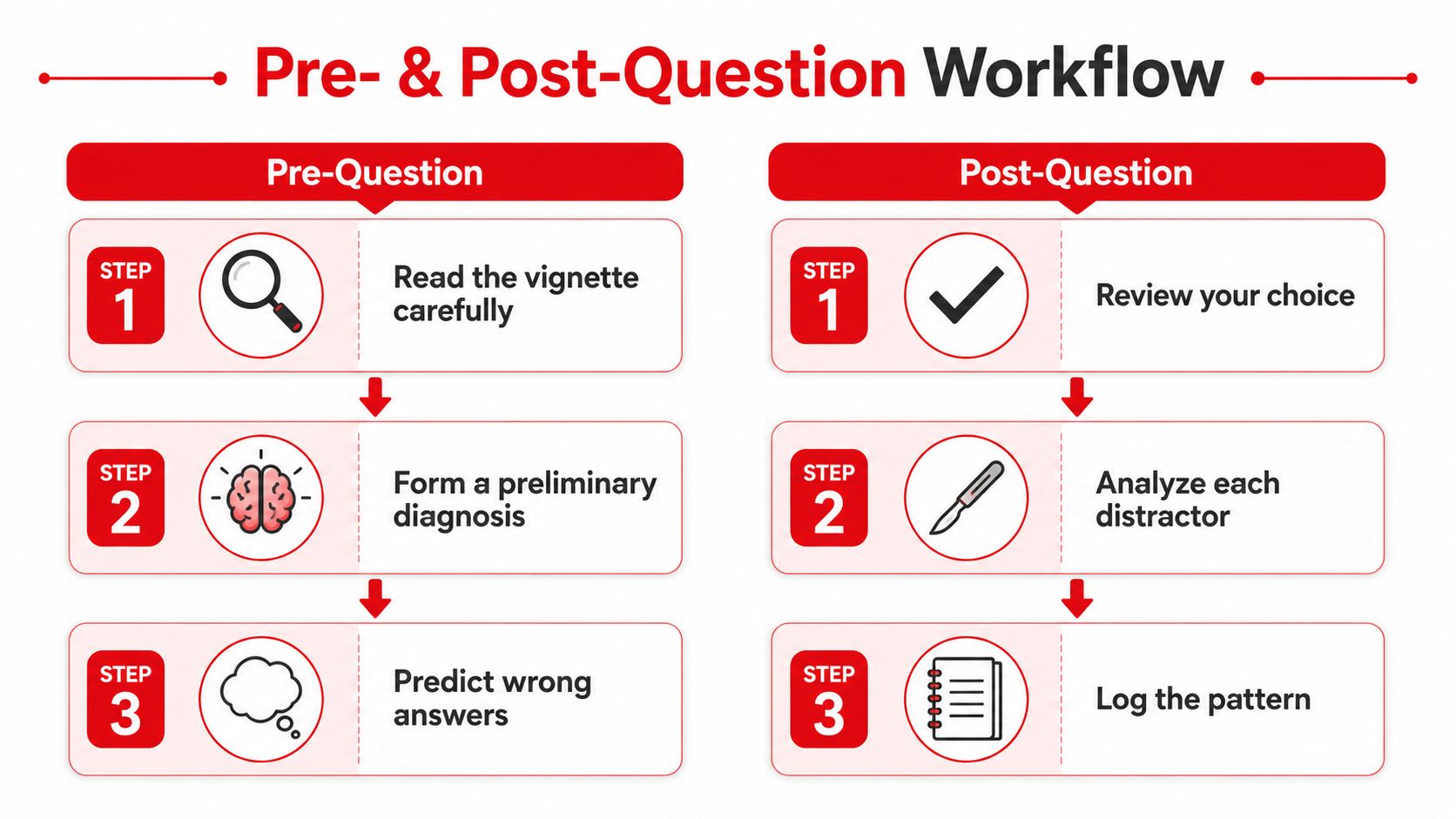
You do not need a new app for this. You need a repeatable sequence that starts before you click an answer and continues after the explanation page opens. That sequence works best when you force yourself to predict first, then inspect the answer set with intention, then tag the wrong choices after the key reveals the right one. The habit looks small, but it changes how your brain stores the item.
Before you answer, read the stem and state the likely diagnosis or concept in your own words. Then scan the options and notice which one fits your prediction cleanly, which one feels like a cousin of the right idea, and which one only sounds right because it uses a familiar keyword. If you want a practical Qbank habit, the workflow on Ace Med Boards' UWorld question guide fits this same pattern, because it pushes you to think about why an option pulled you in rather than just whether you got it correct.
After the answer key, reread all four choices, even when you were right. Tag each wrong option with a short label in the margin or notebook, something like too extreme, right family wrong member, classic trap, or outside the stem. That one-word tag matters because it forces you to classify the miss instead of admiring the explanation.
A question you got right can still expose a weak spot if the wrong answer felt attractive for a second.
A quick rhythm to use in every block
- Read the stem for the task, not the trivia. Ask what decision the question is making.
- Predict the answer before the options. Even a rough prediction protects you from seductive phrasing.
- Scan for the loud option. The loud one is often the distractor built to catch fast readers.
- Justify the choice in one sentence. If you cannot say why the other choices are wrong, you probably guessed more than you realized.
- Log the reason, not just the result. “Missed” is too vague. “Confused enzyme with transport defect” is actionable.
The post-question part is where the learning sticks. A wrong answer that feels familiar is telling you something different from a wrong answer that feels random. The first usually points to a misconception. The second often points to a content gap or a stem-reading problem. That distinction is exactly what you want before the next study session.
Two Annotated MCQs You Can Practice With Tonight
Start with a basic science item, because it trains your eyes to separate mechanism from surface wording.
A physiology question asks which transporter is responsible for sodium reabsorption in the thick ascending limb. The options include NKCC2, SGLT2, ENaC, Na⁺/K⁺-ATPase, and aquaporin-2. The correct answer is NKCC2, because that cotransporter sits in the thick ascending limb and is the classic target in that setting.
Now read the wrong answers like a tutor. SGLT2 is a right family wrong member distractor, because it belongs to kidney reabsorption but not this nephron segment. Students who memorized “renal glucose transport” without anchoring the segment often pick it. ENaC is a stage or location shifter, because it belongs lower in the nephron and sounds close enough to feel plausible. Na⁺/K⁺-ATPase is a mechanism mis-attribute, since it is essential everywhere but not the specific luminal transporter the question asks about. Aquaporin-2 is a classic trap for anyone who hears “water handling” and moves too quickly.
The pattern teaches a simple fix. If you missed this item, your content gap is probably not “kidneys” in general. It is the map of where each transporter sits. You need a nephron sketch, not another full lecture.
Now switch to a clinical vignette in the style of a Shelf or Step 2 question.
A patient with chest pain after an upper respiratory infection has a pericardial friction rub, diffuse ST elevation, and relief when sitting forward. The options include acute coronary syndrome, aortic dissection, pulmonary embolism, pericarditis, and pleurisy. The correct answer is pericarditis.
The distractors here work differently. Acute coronary syndrome is the severity extender, because it sounds more dangerous and more “board-like,” which pulls in students who see chest pain and stop too early. Aortic dissection is another severity extender, especially when exam anxiety makes anything with thoracic pain feel life-threatening. Pulmonary embolism is an organ overlap distractor, because it belongs in the cardiopulmonary space and can sound right if you focus on dyspnea instead of the positional relief and friction rub. Pleurisy is a right family wrong member choice, since it shares pleuritic pain but misses the cardiac exam clue.
If you're reviewing this missed item, your content gap is not just “chest pain differential.” It is the ability to weigh one clue against the rest of the stem instead of locking onto the first familiar diagnosis. That is why distractor analysis helps. It shows which clue you overvalued, which clue you ignored, and which diagnosis you reached for because it was emotionally loud.
This sample question walkthrough is useful here because it trains the same habit, slow down, read each option against the stem, and name the trap before moving on.
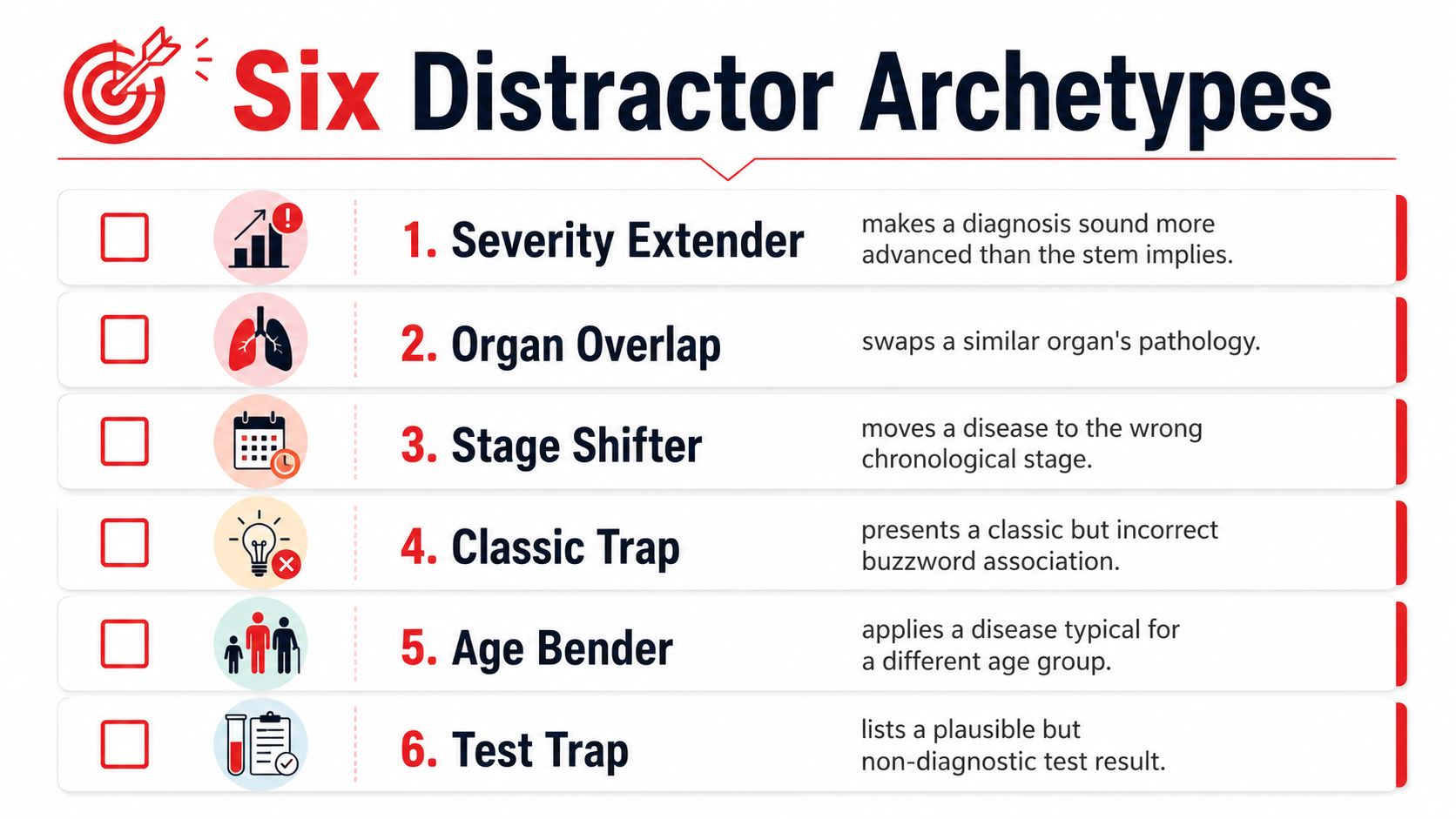
Six Distractor Archetypes and How to Beat Them
Medical boards recycle a few wrong-answer shapes over and over. Once you know the shapes, the options stop looking random. You start seeing the writer's hand, and that makes timed blocks less slippery.
| Archetype | What it looks like | How to beat it |
|---|---|---|
| Severity extender | The option is more dramatic than the stem warrants. | Subtract the emotional weight and ask whether the clinical details actually support the more serious diagnosis. |
| Right family wrong member | The answer belongs to the right topic but the wrong subtype, organ, or segment. | Match the clue to the exact subcategory, not the general subject. |
| Prior-step distractor | It names a result from an earlier stage of reasoning, not the final answer. | Ask whether the stem is asking for diagnosis, mechanism, next test, or management. |
| Eponym impostor | It borrows a famous name that feels familiar but doesn't fit the case. | Cover the name and test the underlying definition instead. |
| Mechanism mis-attribute | It gives the correct pathway or process but assigns it to the wrong disease. | Pair each mechanism with the disorder that actually uses it. |
| Management scope-expander | It recommends treatment that is broader, faster, or more aggressive than the vignette supports. | Check whether the stem calls for watchful waiting, confirmation, or immediate intervention. |
The fastest counter-move is to mentally strip qualifiers. Words like always, never, only, and must often make a distractor sound stronger than it is. If the stem does not clearly support that level of certainty, the choice is probably trying to bully you.
Practical rule: When two options feel close, ask which one is answering the exact question asked, not which one sounds like a better medicine answer in general.
The useful part is that each archetype points to a different fix. A severity extender usually means you overreacted to danger language. A right family wrong member usually means your classification tree is fuzzy. A prior-step distractor means you jumped ahead in the reasoning chain. If you keep that distinction clean, every block gives you better feedback than a simple correct or incorrect mark.
Templates and a Tracking System You Can Set Up Today
You do not need a huge spreadsheet. You need a short review log that you'll use after a block, then a weekly roll-up that tells you what kind of errors keep repeating. A light system beats an ambitious one that dies after three days. The Ace Med Boards progress dashboard is a good reminder that tracking only works when it stays simple enough to maintain.
Distractor Review Template at a Glance
| Field | What to write | Why it matters |
|---|---|---|
| Question ID | UWorld, NBME, or lecture question label | Lets you revisit the item later without guessing |
| Picked distractor | The wrong option you almost chose or actually chose | Shows your exact pressure point |
| Archetype | Severity extender, right family wrong member, and so on | Reveals the pattern behind the miss |
| Next step | One fix, such as review nephron segments or rewrite your chest pain branch | Turns the miss into a specific action |
Keep the whole log to at most four fields per question. If you add too many columns, you will stop filling it out. For a spreadsheet, use one row per missed question and add simple tags for system, topic, archetype, and whether the error came from a content gap or a reasoning trap. In the row for a reverse-discrimination pattern, color the archetype cell bright red so those items jump out during your weekly review.
A paper notebook works too, as long as each line ends with a next action. If you missed a question because you mixed up atrial fibrillation management with flutter management, the fix should say exactly that. If you missed a stem because you chased the loudest diagnosis, the fix should remind you to predict before scanning the options.
Here's a clean way to keep the setup usable:
- Write the miss immediately. Do it while the reasoning is still fresh.
- Use one label only. Don't stack three diagnoses onto the same mistake.
- Review the log once a week. Ten focused minutes is enough if the tags are consistent.
- Fix the pattern, not just the question. One well-chosen flashcard can solve ten similar misses.
If you want a broader planning framework for turning review into measurable habits, the study strategy ideas from Magna Education are a useful comparison point, even though the testing context is different. The underlying principle is the same, good study systems make your errors visible.
Wiring It Into Your Study Plan and Measuring Real Improvement
The easiest way to use distractor analysis is to fold it into the study routine you already have. Put your review log beside your Anki session, your Qbank block, or your weekly subject review, and keep the same three questions in front of you: what was the distractor, what pattern was it, and what content gap or reasoning error did it reveal? Once those questions become routine, the method stops feeling like a separate project and starts acting like part of the work.
A student who misses a heart failure question, for example, should not just write down “read more cardiology.” The better note is specific, because specificity shows you what to repair. If the wrong answer was a severity extender, the problem may be that you recognized the diagnosis but missed the clue that changed the stage of disease. If it was a reverse-discrimination trap, the fix may be to slow down and ask what finding would rule the diagnosis out before you look at the options. That is the kind of correction that changes the next question you face.
Watch three things. First, your per-distractor miss rate by archetype, which tells you whether severity extenders or right-family-wrong-member choices keep fooling you. Second, your second-pass accuracy on the same Qbank about 21 days later, which tells you whether the fix stuck. Third, the share of misses that come from content gaps versus reasoning traps, which tells you where to spend your next hour. If you want a cleaner way to set those targets, use the measurable performance goals guide to turn vague intentions into concrete checkpoints.
A useful constraint comes from item analysis practice. Questions are usually more informative when distractors behave like distractors, and a nonfunctional option, especially one chosen by fewer than 5% of examinees, often points to a weak item rather than a true knowledge failure. That matters for your studying too. If you keep eliminating a distractor instantly, the issue may be that your knowledge has moved past the item, not that you are missing the concept.
First week checklist
- Tag every missed question.
- Classify the wrong answer by archetype.
- Write one fix in plain language.
- Revisit the same pattern two or three days later in Anki or notes.
- Check whether the same trap still works on you at the end of the week.
If you want a broader planning framework for turning review into measurable habits, the AP exam study strategies are a useful comparison point, even though the testing context is different. The underlying principle is the same, good study systems make your errors visible.
If you do this consistently, you will know within a couple of weeks whether your review has become more precise. The goal is not to avoid every wrong answer. The goal is to make every wrong answer tell you exactly what to study next.