

Which COMLEX Level 3 question bank should you buy? Most candidates answer with a number, picking whichever bank advertises the most items. That's the wrong first question. The right one is which bank's question mix, case format, explanations and analytics match the exam you will sit, and the weeks and budget you have.
A Level 3 bank isn't a generic drill library. The exam scores you against a published blueprint, mixes clinical decision-making (CDM) cases with single-best-answer items, and reports a three-digit standard score alongside a blueprint-based performance profile. A bank that mirrors those structures trains the skill the exam measures. A bank stuffed with isolated recall questions trains something else.
The sections below cover the selection matrix, the blueprint shares a bank has to cover, a weekly schedule built around real constraints, a review routine that stops the same errors from repeating, and how to read practice analytics without pretending they predict your score.
Key Takeaways
- Match format before volume. A Level 3 bank needs case-based CDM practice and short written responses, not only single-best-answer drills.
- Check the blueprint shares. Osteopathic patient care and procedural skills carries the largest minimum share of the exam, so a bank light in management cases is a poor fit no matter how many items it holds.
- Analytics decide usefulness. Domain filters, timed versus untimed views and confidence ratings turn a percentage into an action plan.
- Question counts are vendor claims. They tell you about volume, not fit.
- Commit to one bank per cycle. Switching platforms mid-cycle scatters your repeated-error list and resets every trend line.
Comparing Level 3 Question Banks on Five Criteria
How can you tell whether a Level 3 question bank will prepare you for the exam format, rather than give you more questions to answer? Compare banks using five criteria: CDM practice, explanations, analytics, question mix, and budget. Then check that access fits your study and testing dates.
| Criterion | Strong fit looks like | Weak fit looks like | How to verify |
|---|---|---|---|
| CDM practice | Cases that ask you to prioritize management and provide concise written responses | Only single-best-answer drills | Use trial access to check for multi-select and short-answer formats |
| Explanations | Explains why distractors are incorrect and the reasoning behind the answer | One-line answer reveal | Compare explanations for questions you can solve and check whether they explain the competing choices |
| Analytics | Filters by blueprint domain, timed versus untimed mode, and confidence rating | Overall percentage only | Ask the vendor to show a sample performance report |
| Question mix | Items across blueprint domains, not only diagnosis or pharmacology | Heavy on isolated facts | Use a trial or sample set to check what kinds of questions appear |
| Budget | Clear access period and terms for rollover or extension | Low sticker price with short access | Compare the price with the months you expect to use the bank and read its current terms |
| Available time | Access dates cover your study period and testing window | Access ends before your window | Compare the access dates with your planned test date |
CDM practice is a useful first filter. These cases may require selecting multiple answers or typing a short response, so a bank built only around single-best-answer questions cannot give you the same practice. Check the case format in trial access before comparing other features.
Explanations should help you learn from both the right answer and the tempting wrong one. Review several questions in trial access, including questions you answer correctly. If the rationale only names the correct option, it may not help you recognize why a plausible alternative fails. Analytics are useful when they turn your results into a specific review task, such as revisiting a weak domain or slowing down on timed cases.
For question mix, examine the sample material and note which topics and case types recur. Then compare that pattern with the blueprint. For budget, compare the cost with the access period you expect to use, and check whether the terms mention an extension or rollover.
Question counts are vendor-reported figures, not a measure of how well a bank's cases or explanations fit your needs. TrueLearn reported more than 2,200 COMLEX Level 3 practice questions in 2026 on its COMLEX Level 3 question bank page. COMQUEST listed more than 1,665 Level 3 questions and reported contributions from over 20 physicians in 2026 on its COMLEX Level 3 exam page. Use those figures to compare stated volume, then judge the explanations, analytics, and case formats through each bank's available trial or sample access.
Check the vendors' current pages for question counts, case formats, analytics features, and access terms before you buy.
Blueprint Coverage Every Level 3 Bank Should Match
Does your question bank prepare you for the decisions Level 3 asks you to make, or mainly for recalling facts? The NBOME Level 3 blueprint outlines seven competency domains and minimum exam proportions. Use those proportions to check whether a bank offers practice across the work of clinical care, not just isolated diagnoses.
| Blueprint domain | Minimum share | What your bank should include |
|---|---|---|
| Osteopathic patient care and procedural skills | 40% | Management cases, patient-care decisions and procedure-related items |
| Application of osteopathic medical knowledge | 15% | Applied basic science inside clinical scenarios |
| Osteopathic principles and manipulative treatment | 10% | Indications and reasoning for osteopathic manipulative treatment |
| Practice-based learning and improvement | 8% | Evidence appraisal and self-improvement scenarios |
| Professionalism | 6% | Ethics, duty and conduct scenarios |
| Systems-based practice | 6% | Care coordination and health-system items |
| Interpersonal and communication skills | 5% | Patient communication and shared decision-making items |
| Community health and wellness presentations | 12% of clinical presentations | Population-health and prevention cases |
Patient care and procedural skills has the largest minimum share, at 40%. Community health and wellness presentations have a separate minimum of 12% of clinical presentations. These are floors, not exact predictions of your exam. A bank can meet them overall while still offering too little practice in a domain that gives you trouble.
Where Banks Drift Off Blueprint
Question banks can overemphasize isolated pharmacology and one-step diagnosis questions because these are straightforward to write and categorize. For your review, look for cases that also ask you to choose management, apply osteopathic reasoning, communicate with patients, or address ethics and health systems.
Check the bank's domain breakdown, then compare it with the table. A domain with few available questions may limit your ability to practice and review that area, especially if your mistakes cluster there. Track missed questions by domain for two weeks. Then compare your error pattern with the bank's available coverage, and choose review questions that address both.
Exam structure can affect how you use a bank, so confirm the current format and dates on the NBOME Level 3 page and review this COMLEX Level 3 format overview. A shorter sitting may change the conditions of practice; it does not, by itself, tell you how well a bank covers the blueprint. Judge question mix, case format, and analytics separately, and connect each gap to a specific review action.
Weekly Schedule Built Around Your Available Time
Format comes first, because the calendar follows it. The COMLEX-USA Bulletin of Information describes a two-day, computer-based exam with four 3.5-hour test sessions, two per day, inside a 14-day testing window, containing 420 multiple-choice questions and approximately 26 clinical decision-making cases. CDM items may call for extended multiple-choice responses, including selecting more than one correct answer, or constructed short answers.
Because CDM is a different task from multiple-choice recognition, it belongs in every week rather than in a final cram block.
| Weeks available | Suggested weekly hours | Timed mixed blocks per week | CDM case sets per week | Final phase |
|---|---|---|---|---|
| Under 6 weeks | 20-25 | 1 | 1 | Two full practice days in the final week |
| 6-10 weeks | 15-20 | 2 | 1 | One full practice day every two weeks, then timed-only blocks |
| 10-16 weeks | 12-15 | 2 | 1-2 | Two full practice days, with the final two weeks timed only |
Treat the hours as a starting framework, not a prescription, and adjust to the weeks you're working.
A Six-Step Weekly Routine
- Count the weeks to your confirmed test date and find your row in the table. The study schedule planning framework shows how to break a multi-week block into timed and review sessions when your clinical weeks are uneven.
- Block your study hours in the calendar, protecting at least two protected sessions each week from shift changes and clinic overruns.
- Schedule two mixed timed blocks, then a review session for each one. The review is not optional time you take when you're ahead.
- Add one CDM case set each week and write out a response, even when the platform allows a selection-only answer.
- Shift to timed-only practice in the final phase, including at least one full practice day.
- Leave the last two days for light review of your error list, not new content.
Protect the two review sessions the way you'd protect a clinic obligation. A blocked, timed question you never review is practice without feedback.
One scheduling constraint belongs on the calendar early. Eligibility for Level 3 requires passing COMLEX-USA Levels 1 and 2-CE, graduation from an accredited college of osteopathic medicine, and a good academic and professional standing attestation from your residency program director, according to the NBOME eligibility requirements. NBOME recommends, but does not require, six months of graduate medical education before testing. Residency duties and program authorization shape your study weeks more than any template does.
Enter the calendar into your bank's access dates before the first practice block, so your subscription doesn't expire during your final two weeks.
How to Review Each Question Until Errors Stop Repeating
What happens when the same blueprint item fails on Tuesday and again on Friday, after a block that felt strong? A raw percentage can look like readiness while one gap keeps returning underneath it. Review works like a follow-up visit. You check whether the same problem came back, not whether the first encounter felt successful.
A Level 3 bank earns its place when its question mix, case format, and analytics match the blueprint and the two-day exam. Question count and commercial success-rate claims do not show whether an error will stop. Each feature should trigger one review action after the block.
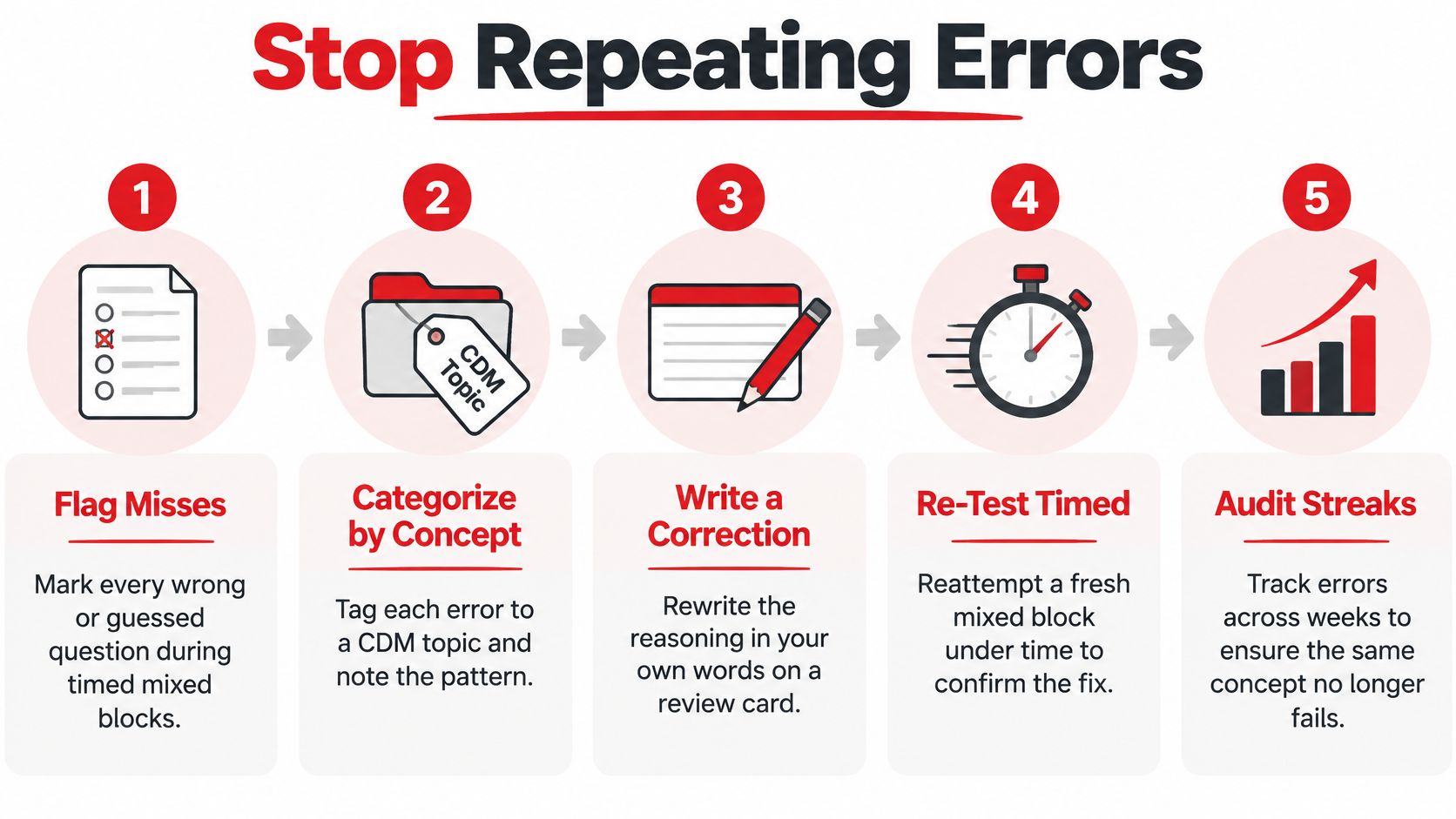
- Complete a mixed timed block without pausing to look anything up. A mixed set samples several blueprint domains in one sitting, closer to how the two days jump between systems than a single-topic drill does.
- Review every incorrect answer, plus every correct answer you guessed or marked low confidence.
- Tag the error type as a knowledge gap, a misread, a pacing problem, or a clinical-judgment error. Use the clinical-judgment tag when the case asks for the next management step and you chose a plausible but earlier or later action.
- Write a one-sentence rule explaining the error in your own words. The distractor analysis method fits this step, because it records why a wrong option looked attractive in words you can reread later.
- Add the concept to a repeated-error list, which is a separate file from your notes.
- Re-test the concept after two to three days, then again after a week.
Three Metrics That Tell You More Than a Percentage
Track timed-block accuracy, the share of answers you gave with high confidence, and your repeated-error rate across at least three successive mixed blocks. A falling repeated-error rate says more than one strong untimed session in a system you just finished reading.
If the analytics flag the same domain under time, the next action is a short timed set in that domain. If misses cluster on case-format items, rewrite the one-sentence rule around the decision point, then retest that decision. A weak block names the gap. It does not erase the concepts you already corrected.
Keep the repeated-error list in one file so the list, not your memory, decides what you review next.
Reading Analytics and Score Reports Without Guesswork
Start with the official anchor. The passing standard for Level 3 is a standard score of 350 or higher, per NBOME scoring and reporting. The score report gives a pass/fail result, the three-digit score, and a performance profile comparing your overall and content-area performance with first-time test-takers who passed. NBOME converts the number of correctly answered scored items into that standard score, unscored pretest questions don't contribute, and each scored question carries equal weight in the raw total.
What the Official Report Does and Does Not Reveal
It won't hand you a per-question conversion. NBOME does not publish the score value assigned to individual questions, so don't try to reverse-engineer your bank percentage into a projected three-digit score. Use practice data to build consistency across blueprint areas instead. Reports typically arrive about eight to ten weeks after the exam because of quality-assurance checks, so plan your timeline around that gap rather than around a same-week result.
Your bank's dashboard is where the diagnostic work happens.
| Pattern in your data | Likely cause | Next action |
|---|---|---|
| Strong untimed accuracy, weak timed accuracy | Pacing | Shorten the reading routine and practice timed blocks with a stopwatch |
| Repeated misses in one blueprint domain | Knowledge gap in that domain | Review that domain's concepts, then retest after two to three days |
| Correct answers given with low confidence | Unstable understanding | Write a one-sentence rule for each and retest them |
| Many misses on multi-part case stems | Reading or prioritization habit | Practice case sets and write the priority before selecting answers |
| Wrong answers given with high confidence | Misconception | Trace the reasoning step and correct the underlying concept before any new questions |
Pick the single pattern that shows up most often and act only on that one for the next two weeks. Chasing four patterns at once produces four half-finished fixes and a data set you can't interpret. When the same pattern survives a full fortnight of deliberate work, that's when it earns a second look at how you're studying rather than what you're studying.
Running Full Practice Exams and Where Tutoring Fits
The either-or belief is that a question bank alone will carry you, or that a tutor alone will. Neither holds up. Full practice days check what block practice can't: stamina across four sessions, pacing across two days, and the mental transition between day one and day two.

A Practice Day That Mirrors the Real One
Sit one block at the time of day you'll test. Keep breaks to the length you'll get on exam day, use no notes, and log the time you spend on each session. Afterward, review with the same routine you use on ordinary blocks, then add a pacing check for each session: where did the clock run out, and which question types ate the minutes? A COMLEX Level 3 practice test run under those conditions gives you usable data; a leisurely half-block at 10 p.m. doesn't.
The division of labor is straightforward. The question bank supplies volume and blueprint coverage. Official NBOME materials remain the reference for format, scoring and eligibility. A tutor earns their place by interpreting reasoning on the CDM cases you missed, spotting the pattern you keep stepping over, and setting pacing targets you'll hold.
Recent national figures put that in perspective. A COMLEX Level 3 score report document from NBOME lists first-time pass rates of 97.09% in 2025 and 96.81% in 2024, so most candidates clear the bar on the first attempt. The smaller group at risk of falling short needs precision remediation, not generic pass-focused advice, which is where targeted help changes outcomes.
Bring three questions to any tutor: which domain keeps producing the same errors, how to structure a written CDM response, and whether pacing or knowledge drives the timed misses. Those three answers do more than a general review session.
Choose Your Bank and Book a Free Consultation
Choose a question bank by how well its cases and review tools address your weak domains, not by question count alone. Then set up a routine you can sustain.
- Check current features, access terms, and question formats on the vendor's live page. These can change, so confirm what is currently included.
- Compare each bank against the five criteria in the matrix. Eliminate any option that misses the blueprint domains where you need the most practice.
- Choose one bank for this study cycle. Keeping the same bank makes your error patterns and analytics easier to compare from week to week.
- Schedule your first two timed blocks and their review sessions before starting. This gives you a clear point to begin and protects time for learning from missed questions.
If you need help interpreting recurring errors or setting a study focus, Ace Med Boards offers COMLEX tutoring in content review, clinical reasoning, question approach, and pacing. Tutoring is available for students preparing for Level 1, Level 2-CE, and Level 3, including those facing a plateau or returning after an unsuccessful attempt. A free consultation lets you discuss your exam level and timeline. See the COMLEX tutoring options or learn about specialized COMLEX preparation for osteopathic students.
Keep the question bank at the center of independent study. Tutoring can help you address a reasoning or pacing pattern; the practice and review still happen block by block.