The date you book also determines which exam format you will take. A seat before the format change belongs to the two-day exam period through December 19, 2026. A seat on or after the change belongs to the one-day exam beginning January 13, 2027. The gap between those dates matters because the transition is a boundary, not a softer preference. A date in that interval should be checked against the available schedule before you build a study plan around the wrong format.
That sequence works like a set of doors opening in order. Eligibility comes first, then the handoff among you, your program, NBOME, and Prometric. Fees and calendar windows come next, followed by the format cutoff. When one door is closed, the later steps stay out of reach even if your rotation schedule looks perfect.
Eligibility You Must Clear First
Do you already know the date you want, but the registration portal still will not let you pay? Eligibility works like a gate before the calendar. NBOME has to show you as eligible in your candidate account before registration can move forward, even if the month fits perfectly between rotations. The selected date also matters because the exam changes across the 2027 format cutoff. Testing through December 19, 2026 sits in the two-day exam period. Testing on or after January 13, 2027 falls under the one-day exam. The gap between those dates is small on a calendar, but large in planning terms: eligibility, registration, and format have to be treated as one decision.
The NBOME eligibility rules require successful completion of COMLEX-USA Level 1 and Level 2-CE, graduation from an accredited college of osteopathic medicine, an attestation from the residency program director confirming good academic and professional standing, and the clinical-skills requirement through the applicable NBOME pathway, such as the required clinical-skills attestation or an accepted alternative. The same rules recommend, but do not require, completing six months of graduate medical education before taking Level 3.
What must already be true
Eligibility works like a checklist with separate lines. A pass on one exam does not substitute for a missing document on another line.
| Requirement | Who confirms it | Blocks registration if missing |
|---|---|---|
| Passing COMLEX-USA Level 1 | NBOME candidate record | Yes |
| Passing COMLEX-USA Level 2-CE | NBOME candidate record | Yes |
| DO degree from an accredited college of osteopathic medicine | Medical school and NBOME | Yes |
| Clinical-skills verification for the candidate's class | School or applicable NBOME pathway | Yes |
| Program director attestation of good academic and professional standing | Residency program director | Yes |
| Six months of graduate medical education | Candidate and residency program | No; recommended only |
Passing Level 1 has to appear on the NBOME record. A school transcript that says you sat the exam is not the same thing as a posted pass.
Passing Level 2-CE is the cognitive clinical exam, not a general “I finished second year” checkbox. If that score is still pending, Level 3 registration stays closed.
The DO degree comes from an accredited college of osteopathic medicine. Graduation timing matters. A candidate who has finished coursework but whose degree has not been reported cannot treat the portal as ready.
Clinical-skills verification follows the pathway that applies to your graduating class. An incomplete attestation can stop an otherwise complete file, including when both earlier COMLEX-USA exams are already passed.
The program director attestation confirms good academic and professional standing. The director, not the candidate, completes that step. A verbal “you're fine to test” in a workroom does not post the attestation.
The one item that does not block you
Six months of graduate medical education is the outlier. NBOME recommends it. It does not, by itself, keep an otherwise eligible candidate from registering. Many residents still wait until they have several months of patient care behind them, because Level 3 assumes you can manage cases the way a house officer does. That is a preparation judgment, separate from a hard eligibility stop.
Clinical-skills verification deserves a closer look because the pathway can vary by graduating class. The safe approach is to confirm the requirement that applies to your class through NBOME and your school before asking anyone to sign. Students who want a broader map of how Level 1, Level 2-CE, and Level 3 fit together can use the COMLEX-USA overview, but the status line in your own NBOME account is the deciding record.
Practical rule: Recheck the posted requirements as of 2026 before you request anyone's signature. A file that matched last year's instructions can still be incomplete under the pathway for your class.
Four points worth keeping
- Eligibility precedes payment. The portal has to show you as eligible before the fee is worth submitting.
- An incomplete attestation can stop a file that already has Level 1, Level 2-CE, and a diploma.
- Rules should be rechecked as of 2026, especially clinical-skills verification by graduating class.
- The exam format depends on the booked date, so eligibility and the calendar are one decision, not two unrelated chores.
If Level 1 or Level 2-CE is not yet a pass, Level 3 is not open. That is a sequence, not a judgment about whether you will finish training.
How to Register and Schedule Level 3
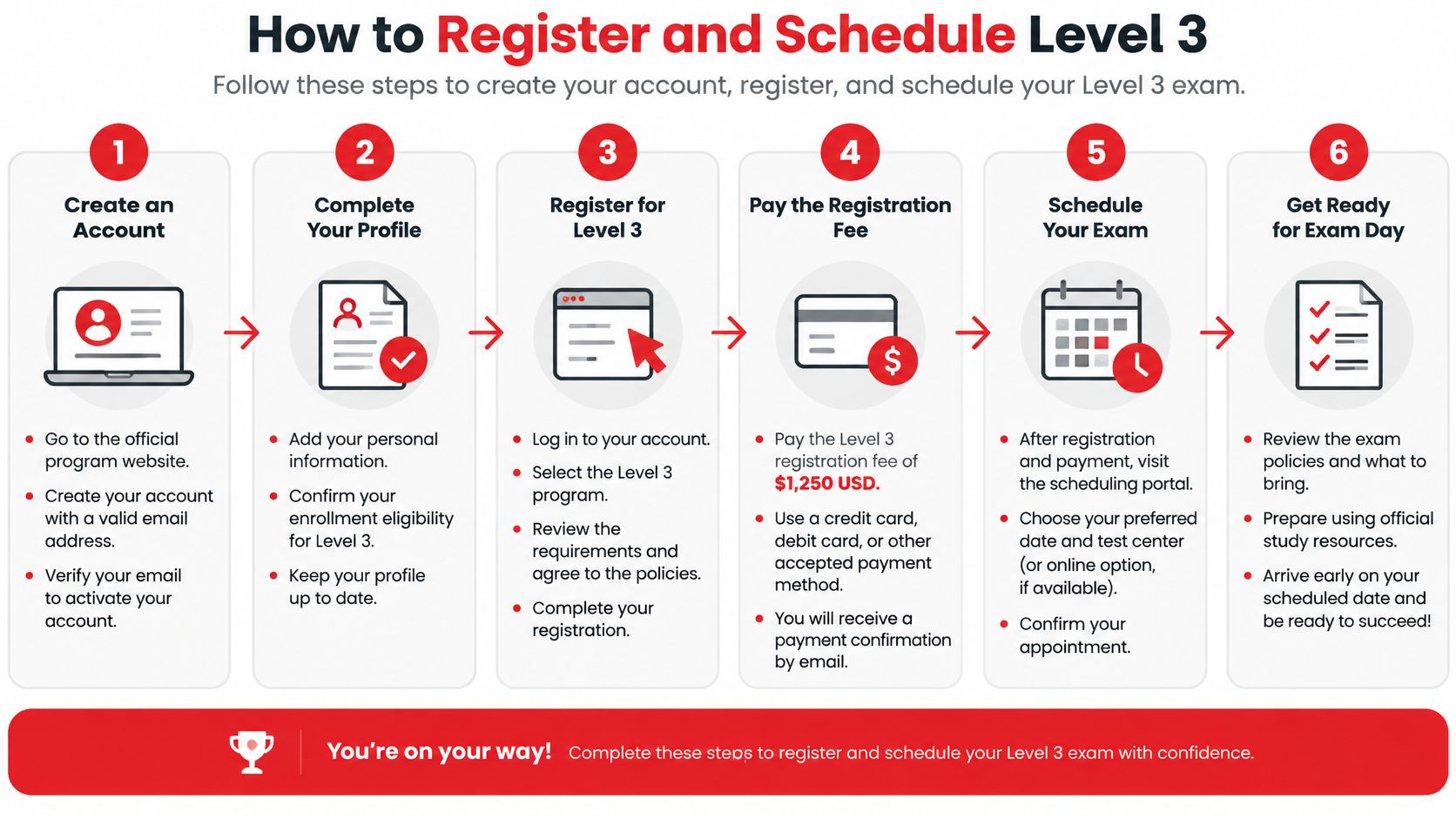
Registration is a handoff. You cannot skip to Prometric because a classmate found an open seat. The COMLEX-USA Bulletin of Information states that candidates must establish or maintain an online NBOME account and satisfy eligibility, including both earlier passes, the DO degree, verification of osteopathic clinical-skills competency, and the program director's good-standing attestation. Registration and scheduling are completed online through the candidate registration portal. An incomplete institutional attestation can prevent eligibility even when Levels 1 and 2-CE have been passed.
The handoff, in order
You update the NBOME account. Legal name, degree, and email should match school and residency records. A nickname on the account and a full legal name on the diploma is a common reason a later document will not attach. When the profile matches, the next person can find you.
You confirm both earlier passes are posted. Open the record and look for Level 1 and Level 2-CE marked as passed. If either is missing, stop and fix the record before you email the program. The handoff here is back to NBOME or your school, not forward to payment.
You request the program director attestation, and you confirm class-specific clinical-skills verification. Ask the director or the coordinator which form they use and how they submit it. For classes still on the attestation model, that institutional step is what lets the portal move. For the Class of 2029, confirm the school's C3DO or institution-based verification path before you assume an older form is enough. Nothing useful happens at Prometric until this line is done.
You file accommodations before you touch a seat, if you need them. Submit the NBOME request and the supporting documentation first. Use the timing described in the current bulletin. Do not assume a fixed number of review days, and do not select a seat while that request is still open. A seat chosen too early can force a later change that your call schedule cannot absorb.
You register online and pay only after the portal shows eligibility. This is the candidate's step, and it is the first moment money should move. Paying earlier does not speed a missing attestation. It only creates a fee you may have to unwind.
You schedule with Prometric inside a released testing window. Prometric scheduling comes after NBOME eligibility, not before it. Seats and dates are limited, so treat the window as something you enter as soon as you are eligible and your program has agreed to the dates. The handoff is from the NBOME portal to the Prometric appointment, using the exact name on your identification.
You save the confirmation, the registration deadline, and the score-release date, then send those exact dates to the program coordinator. Call, vacation, credentialing, and any licensing task should be reconciled against that trio. A confirmation email that stays in your inbox does not change the night-float roster.
Readers comparing a different licensure exam can look at the separate USMLE Step 3 application steps. That path does not clear COMLEX-USA Level 3, and a Step 3 seat does not satisfy NBOME eligibility.
Say the quiet part to your coordinator in writing: "These are the dates I intend to submit, and I will not pay until the portal shows eligible." That sentence prevents most of the expensive mix-ups.
Fee bands, sample 2026 deadlines, and score-release dates belong in the calendar check that follows. Do not pick the window from a group text.
Fees Windows and Score Release Dates
The NBOME FAQ lists the COMLEX-USA Level 3 examination fee as $950 as of 2026. Treat that amount as the direct exam fee, then add two timing questions before paying: has eligibility posted, and can your residency schedule hold the dates without forcing a late change?
The NBOME testing windows and score-release page shows why the fee is also a timing decision. Portions of the fee may be forfeited if you cancel or reschedule, including $170, $350, or $500 for Level 3, depending on how close you are to the examination date. Registration typically opens about six months before the start of the first testing window. A window beginning January 14, 2026, had a registration deadline of December 5, 2025. A window beginning October 26, 2026, had a deadline of September 16, 2026. Designated score-release dates for those listed windows run from April 2, 2026, through early January 2027.
| Item | Published figure | How to use it |
|---|---|---|
| Examination fee | $950 | Pay only after eligibility and the residency schedule are confirmed |
| Possible forfeited amount | $170, $350, or $500 | Confirm the current distance-from-test rule before canceling or rescheduling |
| Registration opening | About six months before the window | Monitor the NBOME dates page rather than waiting for a reminder |
| January 14, 2026 window | Registration deadline December 5, 2025 | Example of why a January test requires action in the prior year |
| October 26, 2026 window | Registration deadline September 16, 2026 | Example of a later 2026 administrative deadline |
| Listed score releases | April 2, 2026 through early January 2027 | Match the release date to licensing or credentialing needs |
How to read a window
The two 2026 rows are examples, not a complete future calendar. A January test can require action in the prior calendar year. A fall test still has an administrative deadline weeks before the first day of the window. Confirm which forfeiture band applies in the current bulletin before you change a date. The dollar amounts above are the published exposure, not a promise that every change costs the smallest figure.
Score release is a different date from the registration deadline and a different date from the test day. Think of the three dates as separate checkpoints on a route: eligibility gets you to the starting line, registration holds your place, and score release determines when the result can be used. Candidates who need the result for a file should start from the release date, then walk backward to a window they can sit. How a posted result is described on later paperwork is a separate question from getting the date right. The COMLEX Level 3 score release discussion is the place for that reporting detail.
A credentialing file, not a free weekend
Say a PGY-1 needs a Level 3 result in a state license or hospital credentialing file that will not wait until spring. That resident should pick the window whose published release date lands before the file is due, then lay the test days next to call and vacation before paying the $950. If the only open days sit on a stretch of nights, the cheaper decision is a later window with a release date that still meets the file, not a seat that has to be abandoned after the forfeiture clock has started.
The calendar also sits next to a format transition. Testing through December 19, 2026, uses the two-day exam. Testing from January 13, 2027, uses the one-day exam. The space between those dates matters because the score-release date and the testing format both move with the window you choose. A resident choosing late 2026 should compare the release date against the two-day schedule. A resident choosing early 2027 should compare the same release-date logic against the one-day format and the gap after December 19, 2026.
Treat the NBOME dates page as the live calendar. The rows here show the planning structure. They are not every future deadline.
Testing Before or After the 2027 Format Change
The test date you select determines the format you prepare for. The 2026–2027 COMLEX-USA Bulletin of Information states that Level 3 scheduling is generally available up to six months ahead and advises candidates to attempt scheduling at least 120 days in advance because dates and seats are limited. Testing through December 19, 2026, uses the two-day format. Testing that begins January 13, 2027, uses the one-day format, with changes to the number of multiple-choice questions and clinical decision-making cases.
Treat the gap between those dates as part of the calendar. Do not assume seat availability from December 20, 2026, through January 12, 2027. A test date works like a train connection: the schedule has to line up, and a gap in the timetable cannot be reasoned away at the counter.
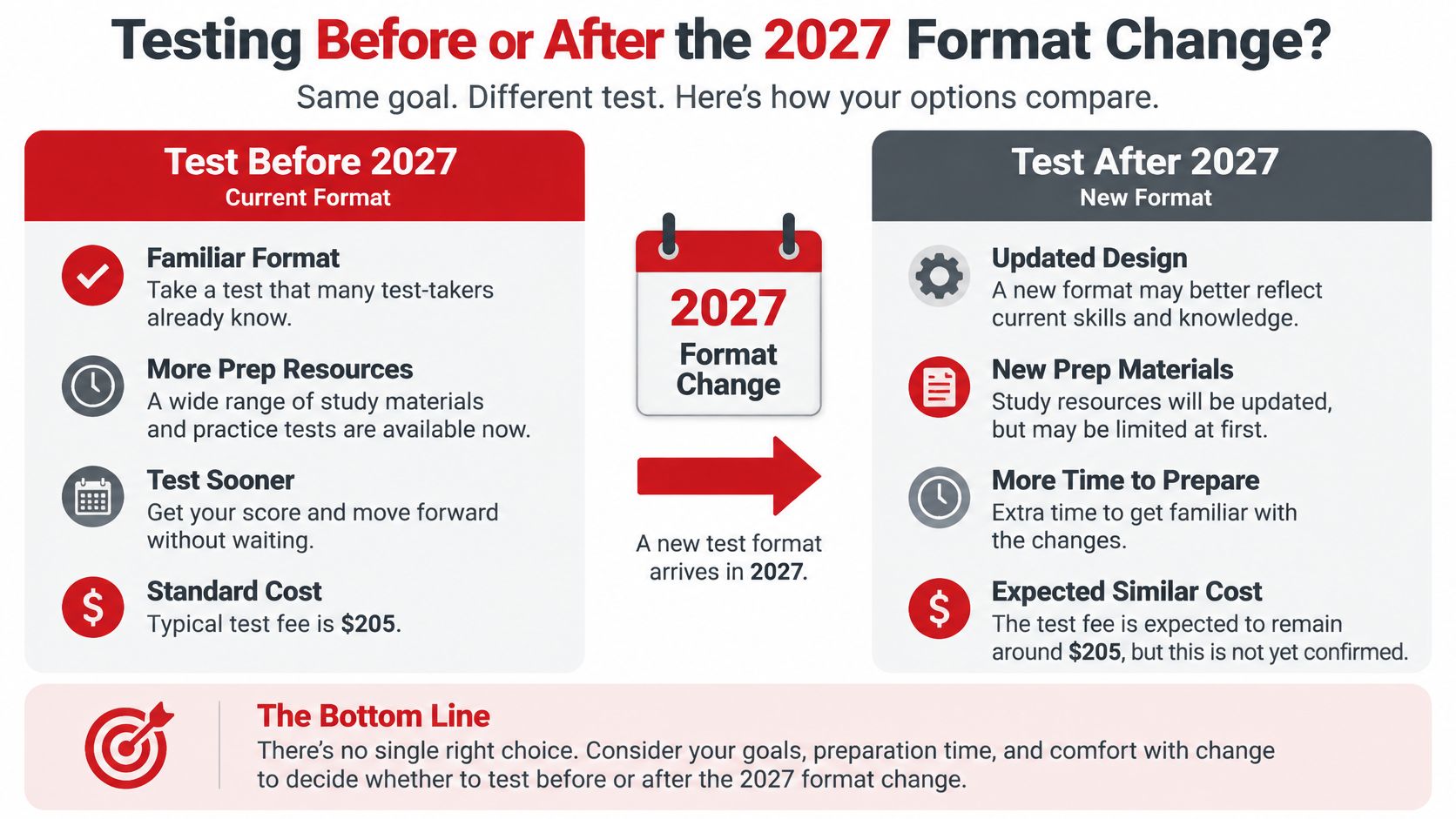
| Testing period | Exam format | Planning consequence |
|---|---|---|
| Through December 19, 2026 | Two-day Level 3 | Use the announced two-day pacing and CDM assumptions |
| December 20, 2026 through January 12, 2027 | No continuous availability should be assumed | Do not plan on finding a seat in the transition gap |
| January 13, 2027 onward | One-day format with changes to multiple-choice questions and CDM cases | Rebuild timing, case practice, and stamina planning before registering |
Choosing by situation, not by rumor
A shorter testing day requires a different plan, not an easier one. The format change affects pacing, the number of CDM cases you should practice under timed conditions, and the stamina plan you use on practice exams. Read the bulletin you are relying on before you pay, and align your preparation with the format attached to your selected date.
Choose a 2026 date when a program, license, visa, or credentialing deadline needs that score, and when preparation can realistically be ready for the two-day format. In that case the two-day structure is the known administration, and the release calendar attached to 2026 windows is what your file can use.
Consider January 13, 2027, or later when the program can support the date, travel is realistic, and you accept a changed blueprint with new practice-test assumptions. Rebuild the day before you register. A one-day administration is still a full professional exam. Treat it as a changed schedule, not as a reason to shrink the study plan to a long weekend.
The program director still controls part of eligibility, and rotations can make travel on either side of the cutoff unrealistic. Verify the cutoff in the 2026–2027 bulletin before you pay. A useful companion on what the day contains is the COMLEX Level 3 format overview. Use it to plan pacing and CDM practice, alongside the bulletin's date rules.
If your only acceptable dates fall after December 19, 2026, and before January 13, 2027, you do not have a hidden window. Move the plan to a real testing period and tell the coordinator early.
Registration Problems and How to Fix Them
The costliest registration mistake is paying before the program director attestation is posted. The portal is the status that matters, not a hallway assurance. If payment has already happened and the attestation is missing, pause scheduling, ask the coordinator what NBOME still needs, and treat the portal as the checkpoint. A Prometric search cannot repair a missing eligibility item.
Registration works like a set of locked doors. The exam clock may be running, but the door opens only when the academic and program requirements are posted. The following problems are administrative issues to fix in order, not judgments about your ability to practice medicine.
Treating six months of residency as a legal bar. Six months of residency is a recommendation, not a universal prohibition. If the portal is otherwise clear and preparation is ready, there is no need to invent a six-month rule. Early residency can still be a poor time to test if the clinical material feels new and call leaves little room for sustained study. Check the portal and program guidance instead of relying on a classmate's summary.
Filing an accommodations request after selecting a seat. Submit the request earlier, with the required documentation and within the bulletin's timing. A seat chosen before accommodations are approved often leads to a date change. The COMLEX rescheduling guide explains the steps once a date exists, but it works better as a repair path than as the original plan.
Mixing a registration deadline with a score-release date. Keep both dates in the same note to your coordinator. The registration deadline closes the window for that testing period. The score-release date is when a result is scheduled to post. A file that needs a result in March is not helped by a test date in March.
Booking inside a heavy call block. Get written confirmation from the coordinator or director before paying, then compare the target window with call, vacation, credentialing, and the score deadline. A seat during the only week of nights in the month is visible before payment, so it is a planning problem worth solving early.
Expecting a seat between the two-day and one-day transition. The two-day exam runs through December 19, 2026, and the one-day exam begins January 13, 2027. The space between those dates should be treated as a gap, not as a hidden testing window. Choose a published period on one side of that gap, then rebuild preparation around the format attached to that date.
A Class of 2029 candidate following older attestation instructions. The NBOME C3DO description states the class split. Graduating classes of 2026 through 2028 remain on the existing attestation model. Beginning with the Class of 2029, NBOME plans to use new assessment options, including C3DO or Complete Competency Verification (CCV). C3DO is intended to assess and verify fundamental osteopathic clinical-skills competencies and, when successfully completed, can serve as a licensing credential within the COMLEX-USA examination program. Confirm which path the school uses, because an old form can appear complete while eligibility remains unposted.
Prior passes also control the sequence. If Level 1 or Level 2-CE is not yet passed, Level 3 eligibility is not open. Finish the sequence first. A delayed Level 3 registration is a scheduling consequence, not a verdict on a medical career and not a prediction of later training performance.
Book the Window That Fits Your Program
The useful habit is to let the program's real calendar and the posted exam version choose the window, then pay. A seat that your coordinator has not seen, or a date whose format you have not checked, is not a plan.
Eight actions before you pay
- Confirm both prior COMLEX passes. Level 1 and Level 2-CE should show as passed on the NBOME record.
- Confirm the degree and the class-specific clinical-skills pathway. Match the DO report and the skills route to your graduating class.
- Obtain written program-director attestation. Keep the email or portal note that shows it was submitted.
- Compare call and vacation with the target window. If the days collide with nights, pick another released window.
- Verify the format attached to that date. Two-day through December 19, 2026, or one-day from January 13, 2027, with no assumed seats in the gap.
- Pay only after portal eligibility is posted. Status first, fee second.
- Schedule with Prometric at least 120 days ahead when possible. Seats are limited, and earlier is kinder to the roster.
- Save both the registration deadline and the score-release date. Send both to the coordinator with the test days.
If NBOME changes a calendar entry, use the dates page rather than a saved screenshot. Bulletins and windows move. Your confirmation should be the current one.
Once the date is secure, content review is a different job from registration. COMLEX tutoring at Ace Med Boards supports students preparing for Level 1, Level 2-CE, and Level 3, including a plateau or a return after an unsuccessful attempt. Sessions can cover content review, clinical reasoning, question approach, and pacing. A free consultation is available to discuss exam level and timeline. Current package terms, and any progress guarantee, have to be read on the pricing or terms page reached from the COMLEX tutoring page. Tutoring does not replace the bulletin, the portal, or official practice material, and it is not affiliated with NBOME.
Sources
NBOME eligibility requirements for COMLEX-USA. NBOME testing windows and score-release dates. NBOME frequently asked questions, for the examination fee. NBOME C3DO clinical-skills page. COMLEX-USA Bulletin of Information, 2025–2026 and 2026–2027 editions.
Ace Med Boards Editorial Team
Ace Med Boards offers one-on-one COMLEX tutoring for residents and students who already have a Level 3 date, or who are still sorting eligibility and a realistic window. A tutor can work through clinical reasoning, question approach, and pacing for the format attached to that date, including after a plateau or an unsuccessful attempt. Visit Ace Med Boards to schedule a free consultation and talk through your exam level and timeline.