So, you’ve made it through Steps 1 and 2. The finish line for your USMLE journey—Step 3—is in sight. But first, you have to navigate the application process, which can feel like its own special kind of board exam, especially when you're already buried in residency.
Don't worry, I've got you. Let's break down exactly what you need to do, who you need to talk to, and how to get it all done without losing your mind.
Your Roadmap to the USMLE Step 3 Application

Think of applying for Step 3 as your final administrative hurdle. The whole thing is managed by the Federation of State Medical Boards (FSMB). They're your go-to for pretty much everything—registration, fee payment, and getting the green light to actually schedule your test.
Once the FSMB gives you the thumbs-up, you'll head over to Prometric to pick your two exam dates. It’s a multi-step dance, but once you know the choreography, it's completely manageable. This guide will walk you through every move.
Understanding the Key Players
Getting this application right means knowing who handles what. It saves a ton of confusion and potential headaches down the line. Here’s a quick rundown of the organizations you'll be dealing with:
- Federation of State Medical Boards (FSMB): This is your mission control. You’ll create your account, fill out the application, pay the fees, and send your documents all through the FSMB's online portal.
- National Board of Medical Examiners (NBME): These are the folks who actually create the exam. While you won't interact with them directly during the application, they're the masterminds behind the questions you'll be tackling.
- Educational Commission for Foreign Medical Graduates (ECFMG): This is a critical one for International Medical Graduates. If you're an IMG, you absolutely must have your ECFMG certification before you can even start the Step 3 application. No exceptions.
To get a clearer picture of the overall requirements, the official USMLE site is always a good resource to have bookmarked.
The real challenge isn’t the application itself—it’s juggling it with your residency schedule. Planning ahead is everything. Knowing https://acemedboards.com/when-to-take-step-3/ is just as important as knowing how to fill out the forms.
USMLE Step 3 Application at a Glance
To make it even clearer, here’s a quick-glance table summarizing who does what.
| Component | Key Information | Responsible Body |
|---|---|---|
| Initial Application | Online form, personal information, and medical education verification. | Federation of State Medical Boards (FSMB) |
| Eligibility & Approval | Verifies your credentials and approves you to sit for the exam. | FSMB |
| IMG Certification | A mandatory prerequisite for IMGs before starting the Step 3 application. | ECFMG |
| Exam Content | Develops and administers the exam questions and clinical case simulations. | National Board of Medical Examiners (NBME) |
| Exam Scheduling | The platform where you select your two test dates and location. | Prometric |
This table should help you keep things straight as you move through the process.
Once you’re approved by the FSMB and have your scheduling permit in hand, you're in the home stretch. The final step is booking your dates with Prometric. After you pass, you might even start looking at next steps in your career, which for some could include learning how to apply for jobs abroad.
Verifying Your Step 3 Eligibility
Before you even think about filling out a single form, the absolute first thing you need to do is confirm you meet every single prerequisite. I can't stress this enough. Failing to check your eligibility upfront is one of the most common—and totally avoidable—reasons for application rejections and long delays.
While the details can vary slightly, the core requirements are non-negotiable for everyone.
This infographic breaks down the essential checkpoints you need to hit.
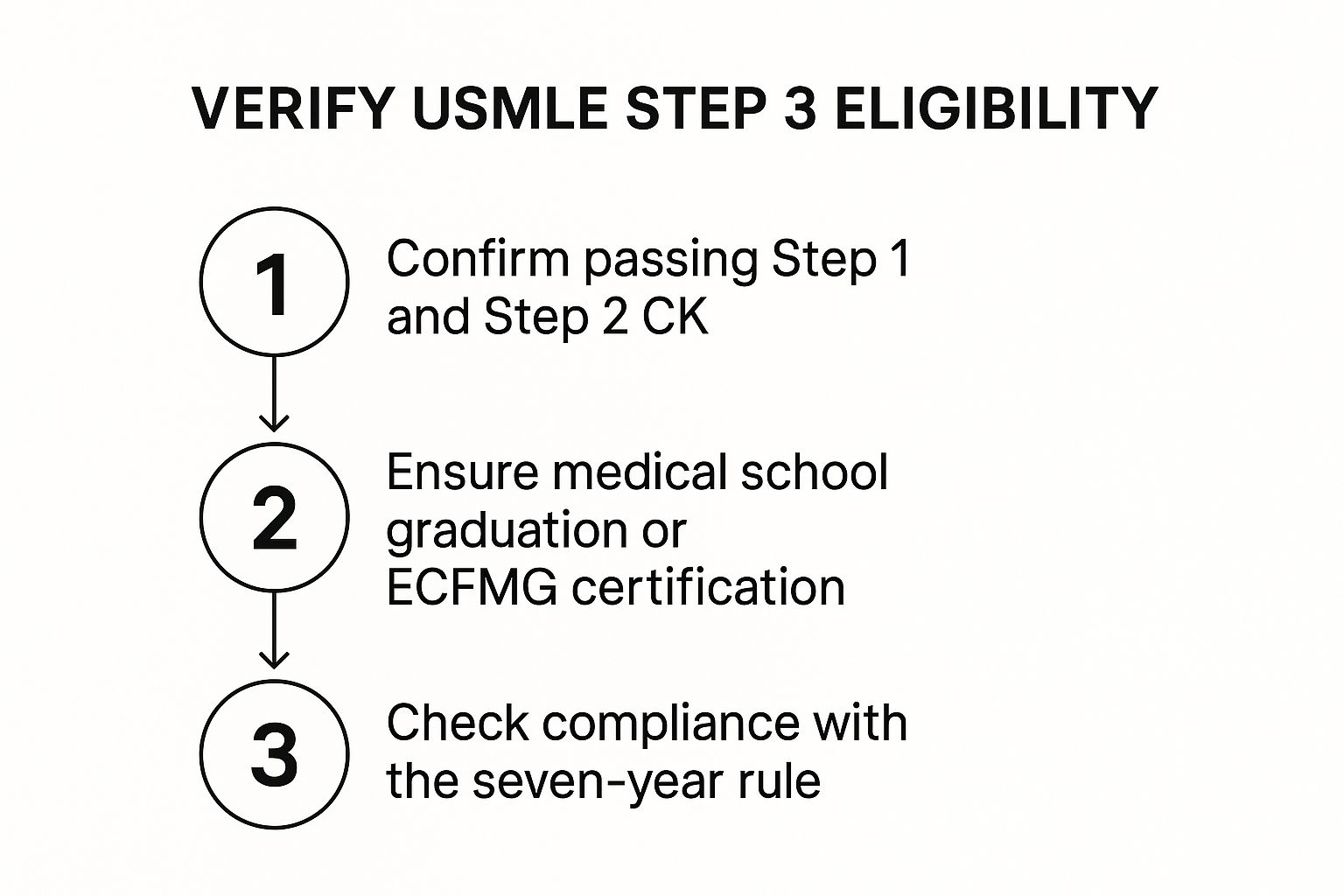
Follow this sequence exactly. It’ll save you from wasting time and money on an application that’s just going to get stuck in review. Each step builds on the last, giving you a clear path to getting your application approved without a hitch.
Core Academic Milestones
Let's start with the basics. You absolutely must have passed both Step 1 and Step 2 Clinical Knowledge (CK) before your application will even be looked at. There's no way around this, so make sure your USMLE transcript shows passing scores for both exams.
You also have to hold an MD, DO, or equivalent degree from a medical school accredited by the Liaison Committee on Medical Education (LCME) or the Commission on Osteopathic College Accreditation (COCA) in the U.S. or Canada. Your graduation status is a major verification point.
Special Considerations for IMGs
For International Medical Graduates, there's another crucial hurdle: a valid ECFMG Certification at the time you apply. This is your proof that you’ve met the minimum standards to enter residency or fellowship programs in the United States. Without it, your Step 3 application is a non-starter.
If you’re an IMG, our complete guide for international medical graduates dives much deeper into this whole process.
Don’t just assume your ECFMG status is active. Log in and physically confirm it before you even open the FSMB application. Taking a few minutes to do this can save you weeks of headaches and back-and-forth emails.
The Seven-Year Rule Explained
One thing that trips a lot of people up is the "seven-year rule." While it isn't a universal USMLE policy, many state medical boards require you to complete the entire USMLE sequence—Steps 1, 2, and 3—within a seven-year timeframe. This clock usually starts ticking on the date you first pass Step 1.
When you register with the FSMB, you'll have to provide proof of your Step 1 and Step 2 CK passing scores along with your medical degree. It is critical to check the specific rules of the state medical board where you plan to get licensed, as their enforcement of this rule can directly affect your Step 3 eligibility. You can dig into the specifics on the FSMB's official resources.
A Practical Guide to the FSMB Portal
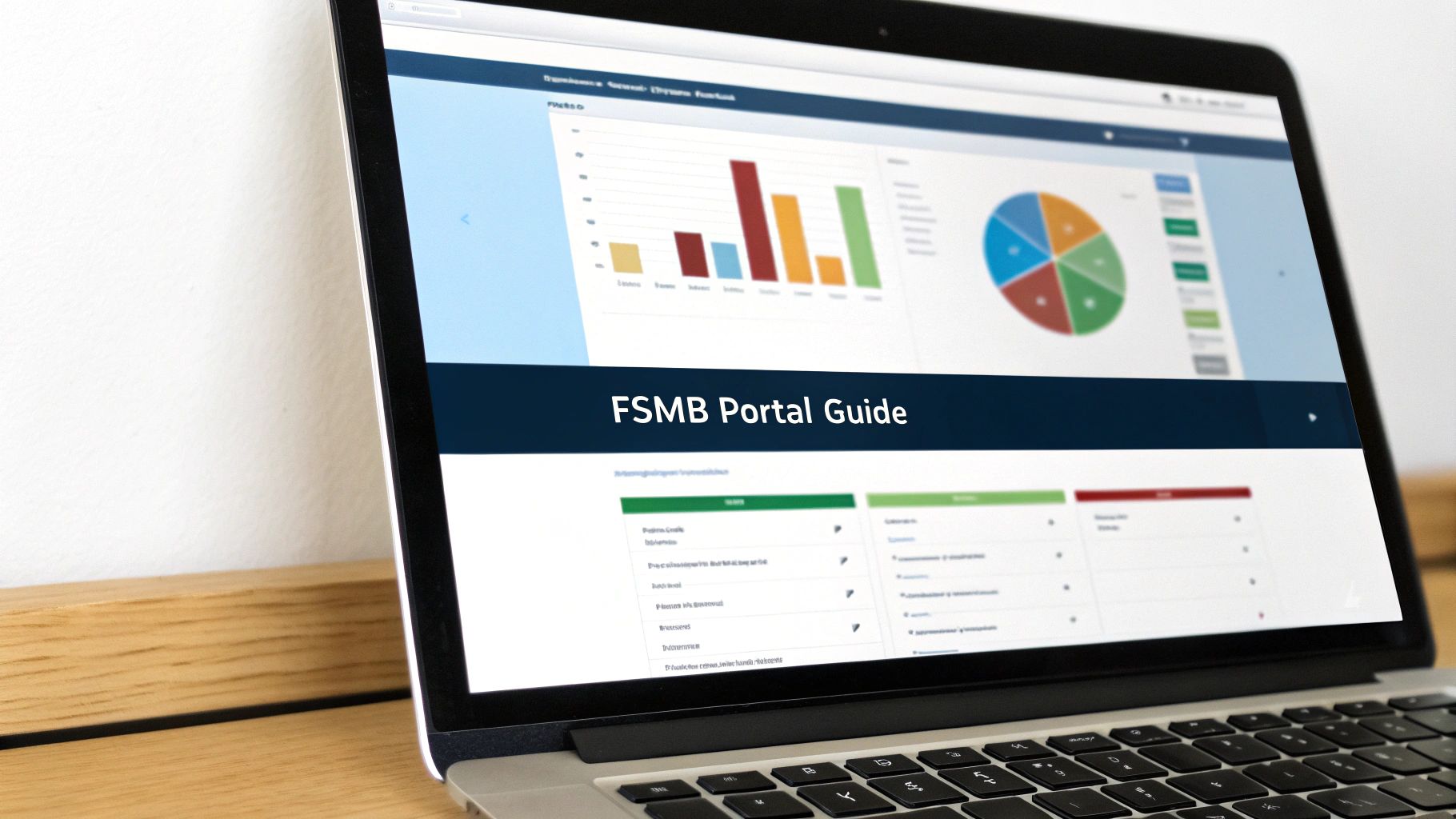
This is mission control for the next few weeks. Getting comfortable with the layout and functions of the FSMB portal is the first real step toward a smooth application process.
The entire application is managed by the Federation of State Medical Boards (FSMB), which works directly with the National Board of Medical Examiners (NBME). The good news is the FSMB provides detailed guides right on their site, which are genuinely designed to help you avoid common mistakes. It's worth taking a few minutes to explore the official FSMB resources to get a feel for their requirements before you dive in.
Creating Your Account and Kicking Off the Application
Your journey starts with creating an account on the FSMB website. This part is straightforward, but it demands your full attention.
The number one rule? Ensure the name you register with exactly matches the name on your government-issued photo ID and your medical diploma. Even a tiny discrepancy, like a missing middle initial or a slightly different spelling, can trigger a verification delay that throws your whole timeline off.
Once your account is live, you can officially start the Step 3 application. The portal walks you through multiple sections, covering everything from your personal info to your full exam history. Do yourself a favor and gather all your documents before you start. It's much less frustrating than saving and exiting multiple times.
A classic rookie mistake is rushing through the personal details. Triple-check your birthdate, social security number (if you have one), and all contact information. An incorrect email address is a huge liability—it means you could miss critical updates on your application status or, even worse, your scheduling permit.
Navigating Key Application Sections
The FSMB application is pretty thorough, so let’s break down the most important parts you absolutely need to get right.
- Medical Education: You'll provide detailed information about your medical school and graduation dates. For IMGs, this is where your ECFMG certification details are absolutely essential.
- Postgraduate Training: Be precise when listing any residency or fellowship training you have completed or are currently in. You’ll need the exact program names, locations, and dates.
- Exam History: This section requires you to report your entire history with all USMLE steps. Be honest and thorough here—this information will be cross-referenced with your official USMLE transcript, so everything needs to line up perfectly.
The Identity Verification Gauntlet
After you submit the main application, you'll tackle identity verification. This is a critical step that involves completing and notarizing a Certification of Identity (CID) form. You’ll have to print this form, attach a recent, passport-quality photograph of yourself, and get it notarized by a notary public.
This step is non-negotiable and serves as your official attestation. It’s also where a surprising number of applicants get held up because of simple mistakes. For example, make sure the notary's seal is perfectly clear and doesn't cover up any text or your photo.
Once it's notarized, you will upload a high-quality scan of the completed form to the FSMB portal. Please, do not just snap a picture with your phone. Use a proper scanner to ensure every single detail is crisp and legible. This one small step can literally make or break your application timeline.
Handling Fees and Prometric Scheduling

This interface is your next stop once the FSMB approves your application and sends over your scheduling permit. The Prometric portal is where you'll lock in the final logistical details.
Think of your scheduling permit as your golden ticket. It has the scheduling number you need to actually book your exam, so treat it like gold. Don't sit on this—popular dates and locations, especially in big cities, can fill up months ahead of time. Scheduling proactively is the best way to dodge any last-minute stress.
Managing the Examination Fee
Before you can book those dates, you’ll need to settle the exam fee through the FSMB portal. It's a significant investment, so it’s smart to budget for it ahead of time.
Right now, the Step 3 exam fee is around $895 for graduates of U.S. and Canadian medical schools. For International Medical Graduates (IMGs), there might be other costs tied to ECFMG credential verification. You can always find the most current numbers on the official USMLE site to learn more about current exam fees.
Booking Your Exam Dates with Prometric
With your scheduling permit ready, it’s time to head over to the Prometric website. You'll plug in your scheduling number to see which testing centers and dates are available near you.
One of the unique things about Step 3 is its two-day format, and you've got some flexibility in how you tackle it:
- Consecutive Days: A lot of residents just want to get it over with. They'll book Day 1 (Foundations of Independent Practice) and Day 2 (Advanced Clinical Medicine) back-to-back.
- Scheduled Break: You can also schedule the two test days with a little breathing room—a few days or even a week—in between. This is a great strategy if you want a final, focused review session for the CCS cases on Day 2.
How you space your exam days is a personal call that really depends on your study habits and hectic residency schedule. If you feel solid on your CCS cases, booking back-to-back is super efficient. But if you want that extra time to get comfortable with the case software, that break can be a game-changer.
Think about your personal stamina and what you need to feel confident. There’s no single "right" way to do it; it’s all about what works for you. For a deeper dive into scheduling strategies, you can check out our guide on USMLE Step timing.
Understanding Rescheduling Policies
Life as a resident is anything but predictable. Sometimes, things come up, and you have to reschedule your exam. Prometric gets it, but just know that it often comes with a fee that gets steeper the closer you are to your test date.
Pay close attention to the deadlines. Rescheduling more than 31 days out is usually free, but the fees can jump pretty quickly after that. The best move is to get familiar with Prometric's rescheduling policy the moment you book. That way, you know your options and can avoid any surprise charges if a clinical emergency or personal matter pops up.
Common Mistakes to Avoid During Application
Knowing the steps to apply for USMLE Step 3 is one thing. Actually sidestepping the common pitfalls that trip up countless applicants is another. It's often the small, completely avoidable errors that cascade into major delays, turning a straightforward process into a months-long headache.
One of the most frequent—and frustrating—mistakes is a simple name mismatch. The name on your FSMB application must be an exact, character-for-character match with the name on your passport and medical diploma. I'm not kidding—a missing middle initial, an extra space, or a hyphenated name entered slightly differently can flag your application for a manual review, tacking on weeks to your timeline.
Overlooking Document Specifics
Another classic hang-up is not preparing your documents correctly. The FSMB is notoriously specific about their upload requirements, especially for the notarized Certification of Identity (CID) form. Submitting a blurry, low-resolution photo or a scan where the notary's seal is illegible is a guaranteed way to get your application kicked back.
Before you even start filling out the forms, do yourself a huge favor and get high-quality digital copies of everything you need. This little bit of prep work saves an incredible amount of back-and-forth later. Think of it as pre-rounding on your application; it makes the real thing go a whole lot smoother.
"Treat every automated email from FSMB as a critical update. Many applicants ignore these, assuming they are just generic receipts. Often, these messages contain vital information about a potential issue with your application that needs immediate attention."
Timing Your Application Poorly
While there aren't many hard deadlines for the Step 3 application itself, timing is absolutely everything. A major misstep is applying way too close to your desired test date. The whole process, from the moment you hit "submit" to actually getting your scheduling permit in hand, can easily take several weeks.
You should plan to apply at least 4-6 weeks before you even hope to test. Remember, Step 3 is a two-day exam, with Day 1 covering Foundations of Independent Practice (FIP) and Day 2 focusing on Advanced Clinical Medicine (ACM), which makes scheduling a bit more complex. Giving yourself a generous buffer accounts for any processing hiccups and ensures you have enough time to snag your preferred dates at Prometric. You can find more details about the two-day structure on the official USMLE site.
Here are a couple of common timing errors I see all the time:
- Applying During Peak Seasons: Submitting your application right around major residency milestones (like match season or onboarding) can mean slower processing times because of the sheer volume of applications. If you can, aim for an off-peak period.
- Forgetting Prometric Availability: Popular testing centers get booked solid for months in advance. The second you receive that scheduling permit, book your dates. Don't wait. If you do, you might find yourself having to travel or accept a less-than-ideal testing window.
At the end of the day, a successful application just comes down to attention to detail. Double-check every single entry, get your documents in order meticulously, and give yourself plenty of time. These simple actions will help you dodge the most common delays and get you to your test days with minimal stress.
Answering Your Top USMLE Step 3 Application Questions
Even with a step-by-step guide, the Step 3 application process is notorious for its tricky details. It’s completely normal to have a few lingering questions. Let's tackle some of the most common ones I hear from residents so you can get through the final stretch without any surprises.
Can I Apply Before My Medical Diploma Is Issued?
This is a big one, especially for those of you trying to get the application in right after graduation. The short answer is, you really shouldn't. The FSMB is strict about this: they require your MD or DO degree to be officially conferred before you're considered eligible for Step 3.
If you jump the gun and submit before your school has verified your graduation with the FSMB, your application will just sit in an "incomplete" pile. To save yourself the headache and potential delays, it's always best to wait until your diploma is officially in hand before you hit that submit button.
How Long Is My Scheduling Permit Valid?
Once the FSMB gives you the green light, they'll issue your scheduling permit. This permit isn't a free pass to test whenever you want—it has a firm expiration date. Typically, you're given a 90-day eligibility period. That means you have to schedule and take both days of your exam within that three-month window.
Let that sink in: if you don't test within that period, you forfeit your entire exam fee and have to start the application process all over again. The moment that permit hits your inbox, check the expiration date and get on the Prometric website to book your dates.
Treat your eligibility period like a hard deadline. Prometric centers, especially in big cities, fill up shockingly fast. Booking your dates early is one of the smartest and simplest things you can do to reduce your stress.
What If I Need to Extend My Eligibility Period?
Life as a resident is unpredictable. A brutal rotation, a family emergency—things happen that can make testing within your 90-day window feel impossible. The good news is that there's a safety net: you can request a one-time extension of your eligibility period.
But before you rely on this, know the rules:
- It’s not free. You’ll have to pay a fee for the extension, so it's a decision with financial strings attached.
- It’s a one-shot deal. The USMLE program only allows a single extension per application. Use it wisely.
- You have to be proactive. You absolutely must request the extension before your original permit expires. You can't ask for one after the fact.
Think of this as a last resort, not a primary planning tool. It's there if you truly need it.
Deciphering Exam Day Structure and Breaks
Going into test day blind is a recipe for disaster. Knowing the structure helps you manage your stamina for what is truly a two-day marathon.
Day 1: Foundations of Independent Practice (FIP)
This day is all about the fundamentals. You're looking at about seven hours total, broken into six blocks of 38-39 multiple-choice questions each. You get 45 minutes of break time for the whole day, plus a 5-minute optional tutorial you can skip to add more time to your break.
Day 2: Advanced Clinical Medicine (ACM)
This is the beast. Expect to be at the testing center for around nine hours. The day starts with six blocks of 30 multiple-choice questions, and then you dive into 13 Computer-based Case Simulations (CCS). Each CCS case gets between 10 and 20 minutes. You get another 45 minutes (minimum) of break time here.
Here's the pro tip: you can add to your break time by finishing blocks early. Any time you have left over when you finish a block gets pooled into your total break time. Managing your pace isn't just about finishing the questions—it's about banking precious minutes for a mental reset.
Getting through the USMLE Step 3 application is the final administrative hurdle. Once that’s done, you can pour all your energy into preparing. If you need a hand mastering the high-yield content and building a bulletproof strategy for test day, Ace Med Boards is here to help. Our expert tutors provide the one-on-one guidance you need to walk in with confidence.
Schedule your free consultation today!