

The current first-time COMLEX Level 2-CE pass rate changes with each testing cycle, so the accurate figure is the one in the latest National Board of Osteopathic Medical Examiners (NBOME) performance report. Check that report for the rate by testing cycle and candidate cohort, since first-time and repeat candidates are typically reported separately.
COMLEX-USA is the Osteopathic Medical Licensing Examination of the United States. Level 2-CE, or Cognitive Evaluation, assesses clinical knowledge through questions built around patient presentations, diagnosis, and management decisions. It is distinct from Level 2-PE, the separate performance evaluation, and PE results should never be read as part of Level 2-CE pass-rate data.
One caution before that number goes to work. A pass rate describes a population of examinees, not the readiness of any individual, so it works best as a starting point for a preparation audit rather than a personal forecast.
Official COMLEX Level 2-CE Pass Rates by Cohort
A pass rate is the share of a defined group of candidates who met the minimum passing standard during a specified testing cycle. NBOME publishes these rates in its performance reports, and every figure in those reports carries two labels that decide what it means: the testing cycle and the candidate cohort. Each published rate works like a row in a ledger rather than a single national number.
To find the figure that applies to you, open the most recent NBOME performance report and locate the Level 2-CE results for the current testing cycle. Check whether the figures are marked final or preliminary, since a preliminary cycle is subject to update. Then find the cohort group that matches your situation before reading across to the rate.
The label matters as much as the number.
Read the labels before comparing rates
First-time candidates and repeat candidates are reported separately because they are different groups with different testing histories. When you quote the Level 2-CE pass rate, attach the cohort label to it. A first-time rate describes candidates sitting the exam for the first time in that cycle, while a repeat rate describes candidates returning after a prior attempt. Quoting one group's rate while belonging to the other hands you the wrong comparison.
Check the number tested beside each rate as well. A cohort with a small candidate count can produce a percentage that swings more between cycles than a large cohort's rate, so read the count and the rate together before treating any year-to-year change as a trend.
School-level tables need the same care. A college's published results describe that school's reported group for the stated cycle, not the national candidate pool, and a school's first-time rate only compares cleanly against national first-time data from the same cycle.
Once the right cycle and cohort are pinned down, the rate becomes a labeled population statistic. Treat it as one input in your preparation audit, and let the audit, not the headline percentage, drive your study decisions.
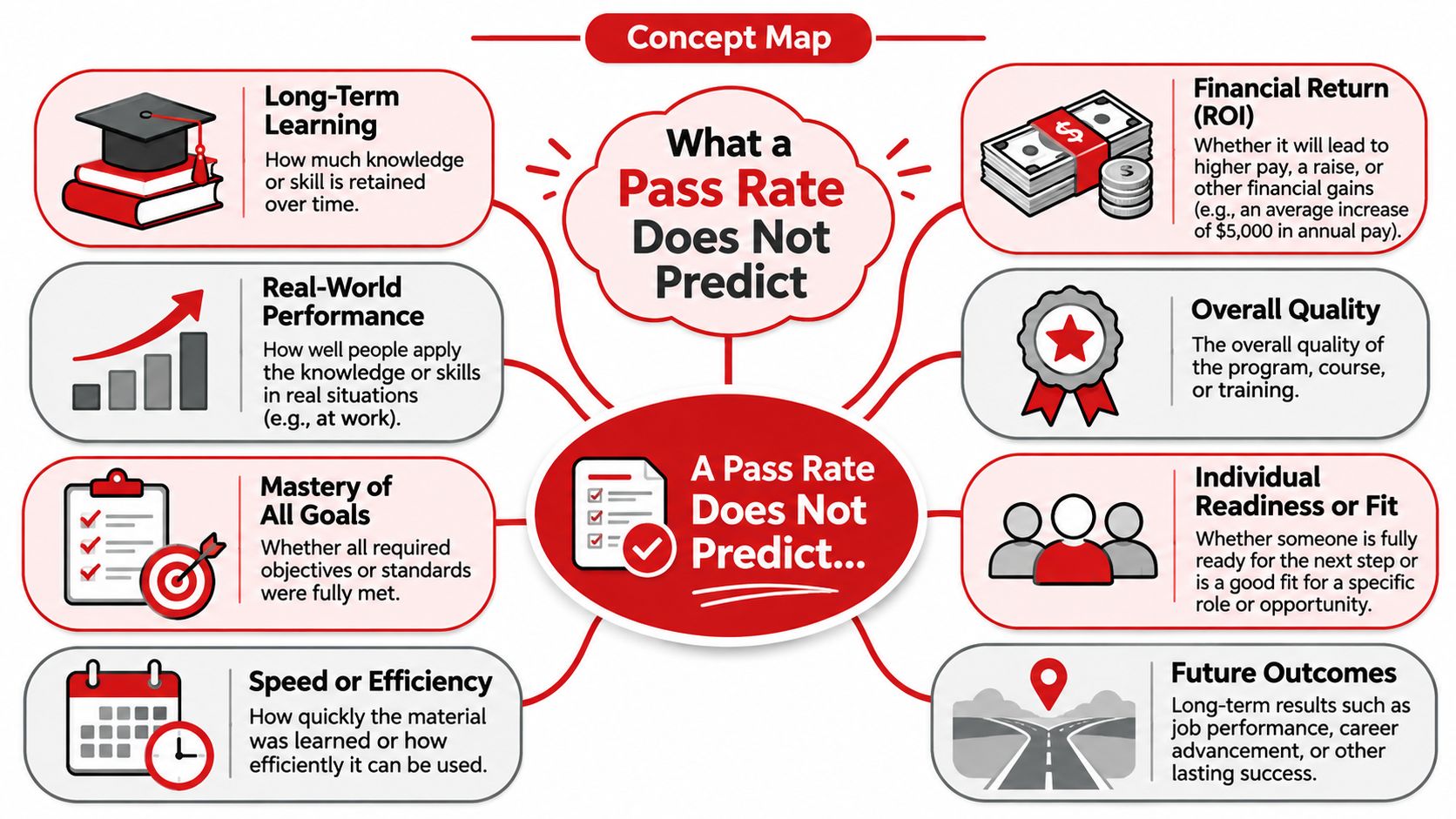
What a Pass Rate Does Not Predict
A national pass rate describes what happened to a candidate group after an exam. It works like a class average: it can summarize the group, but it can't tell an individual student what result to expect.
A high first-time pass rate doesn't mean every candidate found the exam easy, that every school has the same outcome, or that preparation guarantees a pass. A lower rate doesn't establish that a particular student is unprepared.
The standard and the group result are different
A criterion-referenced passing standard measures candidates against a set level of performance. It isn't a curve that requires a fixed share of candidates to pass. The share who meet the standard can change from cycle to cycle even if the standard itself remains unchanged.
COMSAE is an NBOME self-assessment used for practice. Its result is not an official Level 2-CE result, and it can't be converted into a personal pass probability using a national pass rate. It can contribute to a preparation review alongside other practice evidence, but it doesn't settle an individual readiness decision.
Key takeaways: Use the matching testing cycle and candidate group. Keep first-time and repeat rates separate. Check the passing standard for the relevant cycle. Treat school-level results as school-level data. Use a national rate as context, not a forecast.
A prior unsuccessful attempt changes which comparison group is relevant: repeat candidates, not first-time candidates. That group statistic still can't predict a person's next result, and an unsuccessful attempt isn't a verdict on a medical career.
Why Level 2-CE Pass Rates Move
A published rate can change when the candidate group changes, when the testing cycle differs, or when examination policies and standards change. Those are possible reasons to examine a year-to-year difference, not proof that any one factor caused it.
What the number leaves out
The first-time group can differ across cycles. A national rate also pools students with different school calendars and clinical schedules. Many students take Level 2-CE during their clinical years, but their rotation sequences, dedicated study time, and exposure to Osteopathic Medical Achievement Tests (COMATs) may differ.
COMAT is an NBOME test series, not Level 2-CE. COMAT preparation or performance shouldn't be treated as an explanation for a national Level 2-CE result unless the report itself supports that conclusion.
Preparation also varies. Students may differ in question volume, how carefully they review missed items, whether they integrate osteopathic manipulative medicine (OMM) into clinical study, and how consistently they practice pacing. Public pass rates don't identify which methods candidates used or establish that a particular resource, tutor, or schedule caused the group outcome.
Exam-blueprint updates, changes to the passing standard, and disrupted testing or policy changes may matter when the NBOME documents them. Without that documentation, attributing a rate change to a specific exam change or event would be speculation.
For a separate discussion of population-rate interpretation on another COMLEX examination, see this overview of the COMLEX Level 1 pass rate. For Level 2-CE, the useful comparison is between rates with the same cohort definition and passing standard. After that, the next step is to review personal practice evidence rather than read a national trend line as a forecast.
Level 2-CE and Step 2 CK Side by Side
COMLEX-USA Level 2-CE and USMLE Step 2 Clinical Knowledge (CK) both test clinical knowledge, but their published pass rates describe different candidate groups under different scoring systems. A Level 2-CE rate comes from an osteopathic cohort sitting an exam that includes osteopathic manipulative medicine (OMM). A Step 2 CK rate comes from a different population whose exam contains no OMM content. Because the populations and instruments differ, one rate can't be converted into the other, and neither one forecasts an individual student's result.
| Feature | COMLEX Level 2-CE | USMLE Step 2 CK |
|---|---|---|
| Primary purpose | Osteopathic clinical knowledge for licensure | Clinical knowledge for the USMLE licensure pathway |
| Score setter | NBOME | USMLE program, with NBME examination services |
| OMM content | Included | Not included |
| Where pass rates are published | NBOME Level 2-CE performance data | USMLE performance data by examinee group |
| Residency use | Required or accepted by many programs for DO applicants; individual program rules apply | Often requested; program rules vary |
Reading the table this way keeps the comparison honest: the exams overlap in subject matter, yet each rate belongs to a labeled population taking a specific blueprint. A strong Step 2 CK result doesn't establish readiness for Level 2-CE's OMM items, and a strong Level 2-CE result says little about Step 2 CK's emphases.
Students preparing for the USMLE pathway can review the Step 2 CK passing score separately rather than treating the two exams as interchangeable. For anyone weighing both, the practical question is which examination their program requirements call for, then matching practice evidence to that exam.
International medical graduates should confirm which examination their pathway requires before assuming COMLEX applies to them. The same logic holds for every candidate: answer readiness questions with evidence from the exam you'll take, whether that's COMLEX practice data for Level 2-CE or USMLE practice data for Step 2 CK.
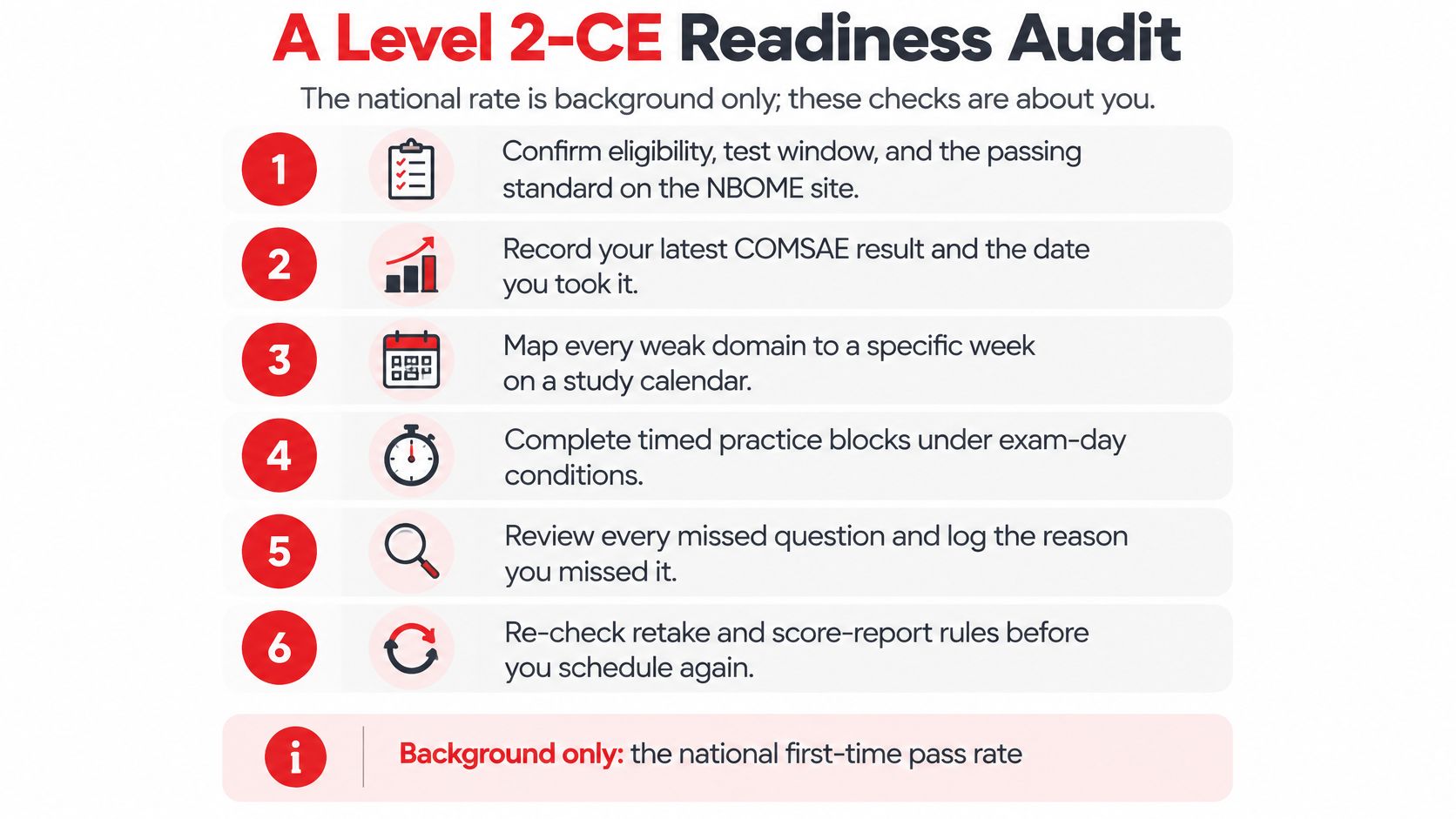
A Level 2-CE Readiness Audit
A preparation audit replaces a national prediction with questions a student can act on: what the practice record shows, where errors cluster, and whether there's time to address them.
- Confirm the logistics. Check eligibility, the test window, and the current passing standard with NBOME before setting or changing an exam date.
- Record practice evidence. Write down the latest COMSAE or school practice result and its date. Don't convert it into a predicted official score.
- Sort the misses. Mark whether each error came from diagnosis, the next management step, OMM, or pacing and test-taking decisions.
- Match gaps to study opportunities. Compare weak systems with remaining clerkship or COMAT coverage. Put each identified gap on a dated calendar.
- Set a decision point. Choose whether to sit, delay, or seek academic or tutoring support only after the identified gaps have a workable plan.
For example, a student's practice log might show consistent success with diagnosis but repeated misses on next management steps and OMM. The useful response is to preserve diagnostic practice while giving scheduled study blocks to management reasoning and OMM integration, then review new timed work for changes in those error categories. The example illustrates how to use a pattern; it doesn't predict an examination result.
A five-day study block can give that plan structure:
| Day | Main task |
|---|---|
| One | Timed question set |
| Two | Thorough review of missed and uncertain items |
| Three | Targeted content work on the weakest domain |
| Four | Second timed question set |
| Five | Mixed OMM and management practice |
A protected half day off can help keep the schedule sustainable. Question banks and COMSAE remain core practice materials; one-to-one tutoring can help a student interpret an audit and work on reasoning or pacing, but it doesn't replace independent practice.
Students reviewing how a self-assessment fits into preparation can consult this COMSAE Level 2 guide. For students who find anxiety is disrupting study or practice, Integrative Psychiatry of America's screening guide may offer a structured starting point for considering whether additional support would be useful. It isn't a diagnosis or a substitute for help from a qualified professional.
After a Low Result or an Unsuccessful Attempt
A low practice result or an unsuccessful attempt calls for a procedural reset, not a judgment about a student's ability to become a physician. The next step is to confirm the rules and identify what needs to change before scheduling again.
Separate knowledge gaps from process gaps
Wait for the official score report and review the current NBOME bulletin for retake rules, waiting periods, and attempt limits. Confirm school requirements and residency timing before booking another test date.
Then review the preparation record. Missing questions in the same content area across timed sets suggests a different problem from running out of time or changing correct answers. A short written review of topics and timing can help distinguish those patterns; it shouldn't attempt to reconstruct exam questions.
Repeat-candidate pass rates, when reported, describe a group. They don't forecast the next result for an individual. A practical reset is to verify the applicable rule, choose a new date that leaves time for remediation, rebuild the audit from fresh practice, and protect space for clinical duties and rest.
Test anxiety is a study-conditions problem, not a character flaw. If distress is significant, school support services can help a student consider appropriate support alongside exam preparation. Students returning after an unsuccessful Level 2-CE attempt can review this COMLEX retake planning resource.

Decide Whether You Need Another Set of Eyes
Some audit results point clearly to continued solo work: stable timed sets, shrinking missed-item categories, and a test date that leaves room to address weak areas. When a required COMSAE threshold, clerkship schedule, or possible leave enters the decision, a school's academic-support team is usually the right first contact.
Other results argue for outside help. Practice scores that have stopped moving, a return after an unsuccessful attempt, or a test date still undecided because readiness is unclear are the situations where a second reader adds the most value. A tutor's role there resembles a consultation on a difficult case, a trained eye that spots the pattern the person closest to the work keeps missing. The COMLEX tutoring program information outlines how Ace Med Boards approaches Levels 1, 2-CE, and 3, with sessions built around content review, clinical reasoning, question approach, and pacing, often using clinical vignettes to practice diagnosis, next steps in management, and choosing between competing answer choices.
For help reading a score report, the COMLEX percentile guide explains what the numbers mean. Students weighing support can start with the free consultation to discuss exam level and timeline, and check current pricing and package terms for package details. The ACE Progress Increase Guarantee attached to eligible 20-hour and 40-hour packages is an additional-hours remedy, not a money-back guarantee or a promised exam result, and it requires a COMSAE self-assessment before the first session and another by the end of tutoring, before the official exam.
Ace Med Boards offers one-to-one COMLEX tutoring that turns a preparation audit into targeted work on content gaps, clinical reasoning, question approach, or pacing. Readers considering support can visit Ace Med Boards to discuss whether a free consultation fits their exam level and timeline.