Could a candidate explain the testing center's identification and break rules as confidently as a familiar clinical concept? The most useful COMLEX test day tips start with verifying the appointment, matching identification to registration, packing only permitted items, and rehearsing the applicable break plan.
Preparation for the Osteopathic Medical Licensing Examination of the United States (COMLEX-USA) deserves a separate logistics checklist. A strong content-review plan doesn't resolve a name discrepancy, an unfamiliar building entrance, or uncertainty about medication access.
The National Board of Osteopathic Medical Examiners (NBOME) and the testing provider's appointment instructions should control those decisions. Older advice can help identify questions to ask, but it shouldn't determine what a candidate brings or when a candidate arrives.
Key takeaways
- Verify the actual appointment. Level, location, registration profile, and approved accommodations should agree.
- Resolve identification questions early. Supporting paperwork shouldn't be assumed to fix a discrepancy.
- Rehearse practical needs. Food, hydration, restroom use, and reentry belong in the break plan.
- Separate feelings from results. Post-exam reflection should assess logistics, not reconstruct questions or predict a score.
1. Confirm Current COMLEX Test-Day Requirements Before Anything Else
Start with the appointment confirmation, not a remembered procedure. Save the current candidate instructions alongside the confirmation, then record when each document was reviewed. Requirements should be checked again close to the appointment rather than treated as permanently settled.
The NBOME guidance on scheduling COMLEX-USA with Pearson VUE highlights why registration and accommodation status matter: an approved accommodation may require a profile update and rescheduling before it applies to an appointment. Approval alone shouldn't be treated as confirmation that the scheduled examination includes it.
Build a requirement record
- Exam identity. Copy the exact level and examination name from the confirmation, including Level 2 Cognitive Evaluation (Level 2-CE) where applicable.
- Appointment details. Record the reporting time, center address, and instructions for contacting the responsible organization.
- Unresolved questions. List name discrepancies, accommodation concerns, or conflicting instructions and obtain clarification before traveling.
For example, a candidate who notices a different surname on the confirmation should resolve the registration question rather than pack additional documents and hope they suffice.
The COMLEX Level 1 test-date planning guide can support broader scheduling preparation. Official appointment materials remain the authority for the actual examination date and test-center requirements.
2. Plan Arrival Timing and Check-In Logistics
A route that looks straightforward on a map can still involve an unfamiliar parking garage, locked entrance, or confusing office complex. Arrival planning should end at the correct check-in location, not merely the street address.
Candidates should take the required reporting time and check-in instructions directly from their appointment confirmation. A personal travel buffer is useful, but it isn't a substitute for the provider's stated arrival requirement.
Rehearse the journey, not the security procedure
A candidate testing away from home could check the building entrance beforehand, identify parking, and save an alternative route. That rehearsal shouldn't assume access to the testing room or permission to observe check-in.
- Primary route. Account for traffic, parking, walking, and building access.
- Backup option. Identify an alternative ride or transit route before departure.
- Waiting routine. Choose a quiet reset, such as relaxed breathing, rather than last-minute online discussions.
- Morning meal. Choose familiar food and avoid experimenting with a new routine.
Practical rule: A candidate should arrive prepared to follow the center's current instructions, not prepared to argue that another center handled something differently.
Students taking both licensing examinations should also keep their plans separate. The Step 2 CK break-time guide addresses a different examination and shouldn't supply COMLEX break rules.
3. Prepare Identification That Matches Your Registration
Consider a candidate whose passport and appointment confirmation use different name formats. The useful action isn't guessing whether the difference seems minor. It's obtaining an answer from the organization responsible for the registration and identification requirements.
Identification deserves its own verification task. Candidates should check the current instructions for accepted document types, required number of documents, expiration requirements, signatures, and name matching rather than assuming a familiar government-issued document will satisfy every condition.
Compare the documents directly
- Name fields. Compare the registration record, appointment confirmation, and intended identification side by side.
- Document condition. Check expiration, legibility, and any signature requirements stated in the current instructions.
- Recent changes. Ask how a legal name change or replacement document must be handled.
- Final placement. Put the verified identification in an accessible location before bedtime.
A candidate with a name change shouldn't assume that a marriage certificate, court document, photograph, or digital copy will be accepted. Any supporting document should be brought only according to the applicable instructions, not treated as an automatic workaround.
For students traveling internationally, resolving document questions before departure avoids relying on a last-minute replacement. Keep the written clarification with the planning materials, while recognizing that an informal assumption doesn't override official admission requirements.
4. Know What You Can and Cannot Bring
Pack from a permitted-items list, not from habit. A phone, smartwatch, study notebook, snack, and medication may each involve different storage or access rules. Candidates should distinguish what may enter the building, what must be stored, and what may enter the testing room.
The NBOME exam-day guidance states that food and drinks aren't permitted in the testing room and that access to food, water, medication, and personal items occurs during scheduled breaks. Candidates with medical-use needs should verify the applicable approval process rather than assume ordinary break access will meet those needs.
Sort the packing list by access
- Required for admission. Include identification and any appointment materials specified by current instructions.
- Stored for permitted access. Check the rules for food, water, medication, bags, and personal belongings.
- Approved for the testing room. Confirm any accommodation-related item against the approval and provider instructions.
- Better left behind. Remove unnecessary electronics, valuables, and study materials that add no practical benefit.
For example, a candidate who routinely wears a smartwatch could leave it at home rather than create another storage decision at check-in. A candidate who needs medication access should clarify the procedure before arrival and coordinate medical questions with the treating clinician.
An item being medically necessary doesn't, by itself, establish the testing-center procedure for bringing or accessing it.
Scratch materials, locker access, clothing, and permitted comfort items should likewise be checked against current instructions. Personal equipment shouldn't be assumed acceptable merely because a practice session used it.
5. Rehearse the Exam Structure, Breaks, and Testing-Center Experience
A useful rehearsal tests whether the candidate can complete the day's routine, not just tolerate a long question session. It should include transitions, food access, restroom use, and the point at which attention begins to fade.
The NBOME examination descriptions provide level-specific structure and timing. Candidates should use the version applicable to their administration rather than combine section counts and timing advice from different formats.
The NBOME examination-administration guidance describes a 60-minute pooled break allowance, with additional break time reducing remaining examination time once that pool is exhausted. The appointment's applicable scheduled-break structure should be verified separately before assigning breaks.
Test a break routine that fits actual needs
- Food. Choose something familiar, easy to eat, and practical to store.
- Hydration. Rehearse a comfortable routine rather than making a dramatic test-day change.
- Movement. Include a brief physical reset where permitted.
- Reentry. Leave room for the center's required return procedure rather than planning only time away from the workstation.
For example, a candidate could rehearse a food-focused break and shorter restroom or movement breaks at the permitted opportunities. If that routine feels rushed, the plan needs adjustment before examination day.
The COMLEX Level 3 format guide supports separate level-specific preparation. Interface practice should also use official tutorials where available, including navigation, flagging, and returning to items, without relying on recalled exam content.
6. Use a Day-Before and Morning-Of Readiness Checklist
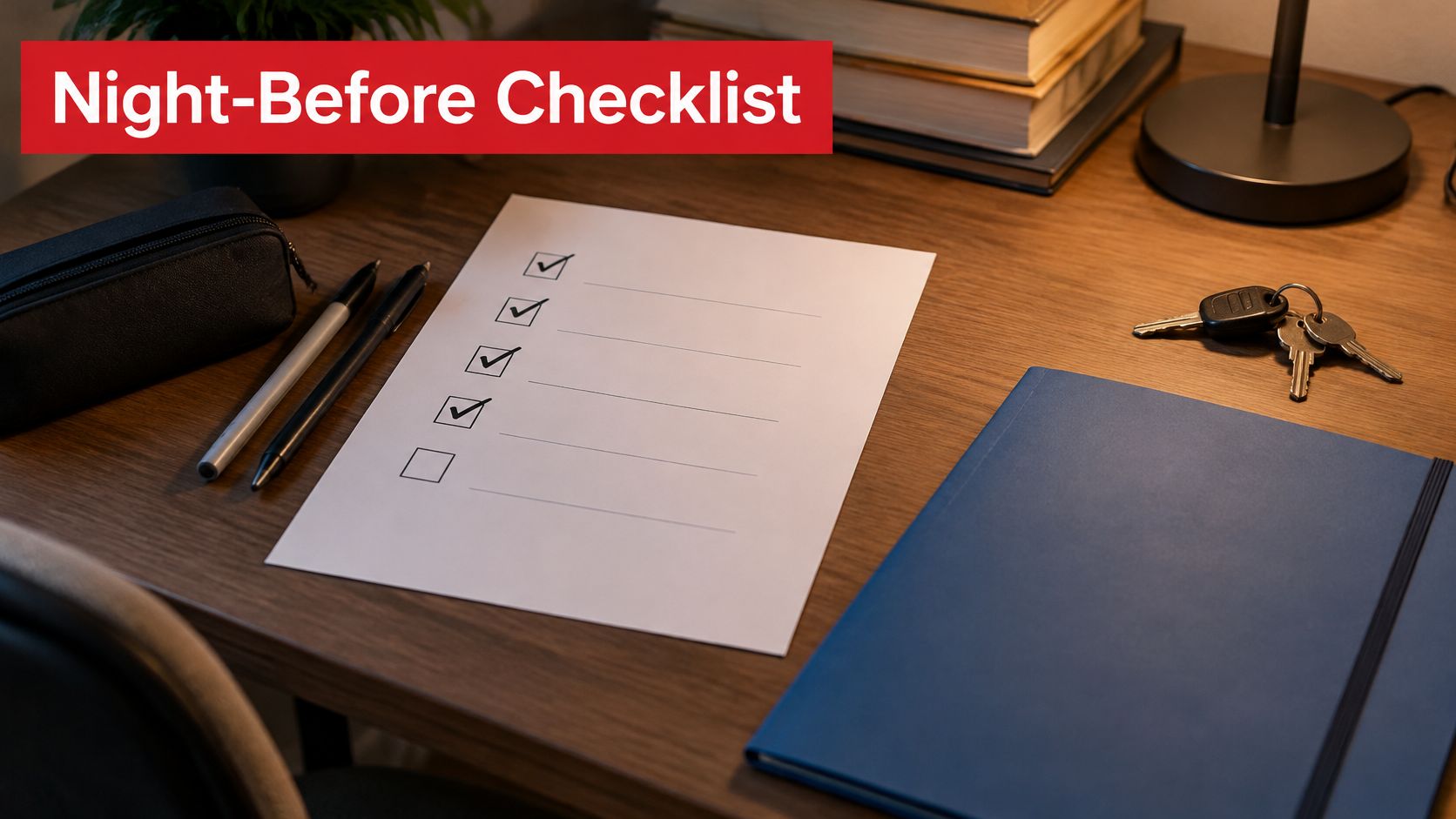
A written checklist reduces the need to remember practical details while managing understandable test anxiety. The strongest checklist names an action and a verification source, rather than saying “be prepared.”
The exam-day preparation guide can help organize the broader routine. COMLEX-specific admission and permitted-item decisions should still come from the candidate's current official instructions.
Day-before checklist
- Documents checked. Compare identification and appointment information, then place them together.
- Travel confirmed. Review the entrance, route, parking, and backup transportation.
- Bag simplified. Remove anything not needed or not permitted.
- Personal needs planned. Prepare allowed food, clothing, and approved medical-use items.
- Evening protected. Finish logistics early enough to preserve a familiar bedtime routine.
The SleepHabits sleep duration guide offers general background on sleep planning. It isn't an authority for examination rules or individualized medical advice.
Morning-of checklist
- Identification in hand. Physically check the document rather than relying on memory.
- Appointment rechecked. Confirm the location and reporting time.
- Familiar breakfast completed. Keep food and hydration consistent with rehearsal.
- Departure protected. Avoid adding errands or an unplanned study session.
For example, a candidate could keep this checklist beside the packed bag and mark each task only after completing it. That's more dependable than mentally reviewing the same concerns repeatedly.
7. Build a Post-Exam Reflection Plan Without Overinterpreting Your Experience
Feeling unsettled after a demanding examination isn't a score report. A difficult stretch, an awkward break, or remembered uncertainty provides limited evidence about the final result.
Reflection should improve a future routine, not reconstruct the examination. Candidates should avoid recording specific items, discussing recalled content, or turning a memory of uncertain answers into a pass-or-fail prediction.
Record process observations
- Arrival. Note whether the route, parking, and reporting plan worked.
- Check-in. Record any document or storage issue worth preventing next time.
- Breaks. Assess whether food, restroom access, and reentry felt manageable.
- Pacing. Describe broad patterns without reproducing examination content.
- Emotional response. Identify when anxiety increased and which practiced reset helped.
For example, a candidate might note that the packed snack was awkward to eat or that searching through a bag consumed too much of a break. The next action is concrete: simplify the food or reorganize permitted belongings.
Reflection boundary: Record what happened around the examination, not the examination's protected content.
The guide to feeling as though Step 1 went poorly addresses a different examination, but its broader emotional topic may be relevant to candidates struggling with post-exam uncertainty. It shouldn't be used to interpret COMLEX results.
Candidates should obtain score-release and access information through current NBOME materials. If an unexpected result follows, a school advisor or appropriate support professional can help identify next steps without treating a setback as a judgment on the candidate's future.
How the seven test-day logistics steps differ in source, benefit, and limitation
| Item | Primary Source to Check | Main Benefit | Main Limitation |
|---|---|---|---|
| Confirm Current COMLEX Test-Day Requirements Before Anything Else | Current NBOME candidate guidance and testing-provider appointment confirmation | Helps prevent errors caused by outdated requirements | Official guidance can be dense and level-specific |
| Plan Arrival Timing and Check-In Logistics | Appointment confirmation and current testing-provider instructions | Builds in time for travel delays and check-in | Unfamiliar routes and excessive waiting can add stress |
| Prepare Identification That Matches Your Registration | Current NBOME and testing-provider identification rules | Prevents avoidable check-in delays or rescheduling | Name changes or replacement IDs may require extra time |
| Know What You Can and Cannot Bring | Current NBOME and testing-provider permitted-items rules | Reduces packing uncertainty and check-in issues | Restrictions may limit access to personal items |
| Rehearse the Exam Structure, Breaks, and Testing-Center Experience | Official, level-specific NBOME guidance and testing-provider instructions | Builds familiarity with timing, breaks, and the testing interface | Practice systems may differ from the live exam |
| Use a Day-Before and Morning-Of Readiness Checklist | Current official requirements and appointment confirmation | Reduces the mental load of remembering test-day details | A generic checklist cannot replace official guidance |
| Build a Post-Exam Reflection Plan Without Overinterpreting Your Experience | NBOME score-reporting and interpretation guidance | Turns the experience into useful process-focused insights | Feelings about exam difficulty may make self-assessment unreliable |
Turn Your Checklist Into a Repeatable Routine
The most useful COMLEX test day tips turn uncertainty into a completed verification task. A candidate shouldn't finish planning with unresolved questions about identification, the building entrance, personal-item access, or whether an accommodation appears on the appointment.
Keep a single logistics record containing the confirmation, current instructions, resolved questions, and packing checklist. Update it whenever the appointment changes, and review it again close to departure. Conflicting guidance should prompt clarification from the responsible organization, not a guess based on whichever version seems more convenient.
Define readiness by completed actions
- Verified. The applicable official instruction has been located and reviewed.
- Resolved. Any discrepancy has been addressed through the responsible organization.
- Rehearsed. Travel, food, breaks, and practical needs have been tested where possible.
- Packed. Required documents and permitted belongings are ready.
- Released. Unnecessary final-day tasks have been removed from the schedule.
This approach keeps logistics separate from academic readiness. A polished packing list can't replace content preparation, and another review session can't resolve an identification problem. Both deserve attention, but they require different actions.
The post-exam routine should be equally restrained. Record practical lessons, allow time to recover, and wait for official results before making performance-based decisions.
Sources
Official references include the NBOME Pearson VUE scheduling guidance, exam-day expectations, examination descriptions, and examination-administration guidance linked above. Each should be checked for applicability to the candidate's level, appointment, and approved accommodations.
Ace Med Boards offers COMLEX tutoring in content review, clinical reasoning, question approach, and pacing for Level 1, Level 2-CE, and Level 3. Candidates seeking help coordinating academic preparation with a realistic examination-day routine can visit Ace Med Boards to schedule a free COMLEX consultation about their exam level and timeline.